




Abstract
This paper presents findings from a feminist pathways study undertaken with imprisoned Tomboys, a gender sexual minority group in Thailand. Utilizing life-history interviews, we mapped Tomboys’ journeys into prison. Results showed two pathways. The first, insubordinate lifestyles, was characterized by substance abuse and life-long lawbreaking. The second pathway - support, sacrifice, suffering - was marked by romantic love and familial caregiving. Many of the experiences and central mechanisms that constituted both trajectories aligned with those found in previous feminist pathways and queer criminological scholarship. Nevertheless, qualities distinct to Tomboys’ incarceration journeys were also identified.
After the publication of Kathleen Daly’s (1994) formative research exploring cisgender pathways into the criminal justice system, feminist researchers have continued to map the life experiences and circumstances leading to cis women’s (and sometimes cis men’s) criminalization. This now expansive scholarship has elucidated a particular and shared gender narrative in the lives of justice-involved cis women that is different from cis men. Here, ‘women’ are most often criminalized for exacting behaviors of survival within contexts of gender subjugation (Jeffries & Jefferson, 2022). However, feminist criminology, including pathways research, is predominantly cisheteronormative. Seeking to reduce this shortfall in knowledge, we present findings from a feminist pathways study undertaken in Thailand with incarcerated Toms, a gender sexual minority group.
Thai data on criminalized gender sexual minority groups is poor and difficult to source (even for Thai researchers). We do know between 4000 and 6000 prisoners are registered with the Department of Corrections as LGBT which equates to around two per cent of Thailand’s total prison population (Chitsawang, 2023; Kang, 2017; Pravattiyagul, 2022, p.110; United Nations Development Programme, 2019a). Research in this space is also limited. There are a few studies on gender sexual minority group experiences inside Thailand’s prisons (e.g., see Pravattiyagul, 2022) and one exploration of phu-ying-kham-phet (persons conventionally understood to be male who do femininity) pathways to confinement (Jeffries et al., 2023). However, little is known about how Thailand’s Toms (persons conventionally understood to be female who do masculinity) come into conflict with the law.
In this study, we utilize life-history interviews with imprisoned Toms to center and value their voices, establish their backstories, and map their pathways to lawbreaking and imprisonment. We begin by positioning our research participants in the broader socio-cultural context of Toms and Thai culture. Following this, we overview feminist pathways scholarship, paying specific attention to existing Thai studies and those focused on criminalisation beyond cishet populations. Next, we discuss our research methodology and findings, situating the latter within the previously discussed socio-cultural setting, relevant queer criminological and feminist pathways research. Finally, we conclude with remarks on the theoretical and practical implications of our research, as well as noting study limitations.
Setting the Scene: Tomboys in Thailand
The term Tom derives from the English word Tomboy, a word used to describe an intrinsically disruptive non-binarisable gender 1 sexual minority group in Thailand. Tomboys are conventionally understood to be female persons who look and act hegemonically masculine (Ojanen, 2009, p. 9). They will, for example, don short hair and cis men’s clothes, bind their breasts, use male particles for polite speech, 2 walk, interact, and generally behave in ways that align with what is understood to be ‘properly masculine’ (Miedema et al., 2022, p. 3; Ravine, 2014, p. 388). Tomness is grounded in markers of normative masculinity that release Toms from some of the patriarchal confines (e.g., restricted independence, mobility, and sexual agency) placed on bodies interpreted as female. Accordingly, Toms can move through society in ways usually reserved for cis men and typically disapproved of for cis women (Sinnott, 2004, p. 138). They can, for example, readily traverse public space rejecting feminine codes of deportment (Miedema et al., 2022, p. 3).
Toms often romantically pair with Dees (from the English word lady). Dees are socially realized female persons who identify with normative Thai femininity and are therefore understood to be ‘ordinary women’ (Ojanen, 2009, p. 9). Tom-Dee intimacy is implicitly heterosexual because, in Thailand, masculine-feminine coupling is a social convention, and sexual behavior is culturally understood as innately augmented from gender identity, not the sexed body 3 (Jackson, 2011; Jackson & Sullivan, 1999). Toms and Dees are bound in intimacy by their gender difference, and the Western term lesbian is openly rejected (Miedema et al., 2022; Ravine, 2014; Sinnott, 2004, pp. 28-29).
While Tom gender identity is anchored in masculinity, it is also pitted against it, being partially situated within frames of normative Thai femininity (Miedema et al., 2022). It is in this masculine-feminine blending that Tomness prevails as a culturally specific gender identity. Miedema et al. (2022, p. 4) note Toms describe “themselves as neither man nor women, but rather, somewhere along a continuum between the two.” Likewise, Sinnott (2004, p. 83) explains Toms are an extension and manipulation of both masculine and feminine genders, position[ed] between ideal masculinity and femininity, strategically accessing claims to both, while simultaneously distancing themselves from men and women.
For example, caretaking is central to Tomness (Sinnott, 2004, p. 90). Toms are expected to fulfil the masculine roles of familial leader, financial provider, and protector. Yet, they should also adhere to feminine social expectations concerning gendered social and interpersonal labor, such as being a dutiful daughter to their parents and elders and being sensitive and attentive to romantic partners’ emotional and sexual needs 4 (Blackwood & Wieringa, 2007; Sinnott, 2004, p. 90). While Toms ideally “take care of their partners as a man would,” they are contemporaneously tasked with manifest feminine attributes such as “understanding their partners better than men could,” and placing the needs of others, especially their Dees, above their own (Ojanen, 2009, p. 9; Sinnott, 2004, p. 90). Additionally, Toms are expected to fulfil normative feminine domestic and family duties because their bodies are socially interpreted as female. There are cultural gender anticipations placed on adult daughters, Toms and Dees alike, to support and financially provide for ageing parents and other family members (Doungphummes & Sangsingkeo, 2020).
Population surveys show most Thais have tolerant attitudes towards LGBT+ people (United Nations Development Programme, 2019b, pp. 20-21). This is explained in part by cultural traditions centered in the dominant religion, Theravada Buddhism, 5 which allows space, patience, and sympathy toward non-binarisable gender identities. Social tolerance and non-violence are cornerstones of Buddhist philosophy as is karma, the law of cause and effect directing that every volitional action has consequences (Doungphummes & Sangsingkeo, 2020, p. 547). Being Tom is understood as the karmic result of past misdeeds, a predestined condition of suffering that cannot be altered in the present life, and, as such, is deserving of sympathy (Doungphummes & Sangsingkeo, 2020; Jackson, 2011).
One primary source of Toms’ suffering is the loss of Dees to cisheteronormative family life (Sinnott, 2004, p. 94). Tom-Dee relationships are, for the most part, tolerated because they are ideated as a playful dalliance 6 before the ‘natural,’ obligatory, and serious business of cis marriage and motherhood (Sinnott, 2004, p. 99). Oftentimes, Dees will face intense family pressure to marry cis men for financial and social reasons (Sinnott, 2004, p. 125). Dutiful daughters should fulfil “social expectations of marrying and bearing children, both to continue the family line, and to ensure [the] social and economic security of ageing parents” (Miedema et al., 2022, p. 4). Toms anticipate this loss, and there is a gendered expectation to act selflessly by relinquishing their Dees (Sinnott, 2004, pp. 100-101). This expiatory forsaking is assisted by Buddhist ethics, morals, and philosophy. Love, desire, and worldly attachments ultimately result in discontent, and Toms giving up their Dees to cis men and mothering can be positioned as an act of Buddhist merit-making 7 (Sinnott, 2004, pp. 94–105).
Buddhist beliefs mitigate possibilities for overt aggression and persecution of people who disrupt the gender binary. However, as indicated above, while tolerance may invoke sympathy it does not necessarily equate to acceptance (Jackson & Sullivan, 1999; Miedema et al., 2022, p. 3; Ojanen, 2009; Sinnott, 2004, pp. 124-125; United Nations Development Programme, 2019b) More broadly, Tom-Dee relationships are only tolerated within the Thai Buddhist majority to the point that they do not pose a threat to cishet familial well-being. As noted previously, Tom-Dee couplings are often viewed as not ‘real’ partnerships, and Dees are often encouraged or pushed into marriages with cis men (United Nations Development Programme, 2019b, p. 32).
Likewise, Tomboys may face pressure to conform to ‘normal’ family life. 8 Miedema and co-authors (2022, p. 4) describe this as a form of “coercive feminization.” Coercive feminization is a type of cissexism that may include family members compelling young Toms into feminine clothing and denouncing non-feminine conduct (e.g., playing rough). In later adulthood, there can be a “coercive orientation” toward cisheteronormativity with Toms expected to fulfil social expectations of marrying cis men and having children-(Miedema et al., 2022, p. 4). However, Toms can sometimes navigate this by working hard, being economically successful, and providing for their families. Wealth is a potential buffer against heterosexist “family pressure to marry and have children” (Miedema et al., 2022, p. 4). Ergo, a prosperous Tom can still be a dutiful daughter. Relatedly, affluent Toms can help girlfriends fulfil their daughterly obligations. By financially supporting Dees’ families, Toms can mitigate the pressure placed on their partners to forsake them for the economic security that partnering with a cis man through marriage supposedly provides.
Toms also sometimes encounter “boundary policing” (Miedema et al. (2022), pp. 4–7). This involves hostility from cis men when Tom masculinity encroaches on or threatens their manhood (e.g., sexual access to cis women). Additionally, Toms are vulnerable to cis men’s proclivity to act violently towards people with vaginas. Thus, Toms are in danger of gendered harm on multiple fronts including sexual assault by cis men because they are understood as female, physical or other forms of violence for threatening or encroaching on cis men’s domains, and other injury. After all, by disrupting the gender binary, Toms are perceptually deserving of punishment. Boundary policing and coercive feminization can transpire at multiple locales, including families, public spaces, educational institutions, and workplaces (Mahidol University, 2014; Miedema et al., 2022).
Ojanen and colleagues (2019, p. 531) note “Thai LGBTI individuals experience no outright legal persecution but also have minimal legal protection or recognition.” Disruptive gender identities are not criminalized in Thailand, 9 and neither is ‘same-sex’ intimacy. Yet illustrative of tolerant unacceptability, Toms and Dees are not permitted to marry or adopt children, obtain bank loans together, and have no legal recourse regarding shared assets (Ojanen et al., 2019, p. 537). The landmark 2015 Gender Equality Act does make it illegal to discriminate based on gender identity and recently, in March 2024, the Equal Marriage Bill was passed by Thailand’s House of Representatives (Pravattiyagul, 2022; Tatarski, 2024). While still needing Senate approval and Royal Endorsement to become law, this is expected to happen by the end of 2024 (Kuhakan, 2023; Tatarski, 2024).
In the next section, beginning with the seminal work of Kathleen Daly (1994), we overview cisgender feminist pathways scholarship including previous studies that have been undertaken in Thailand. Then, at greater length, we discuss research exploring the criminalization of people who disrupt and challenge cisheteronormativity.
Cisgender Feminist Pathways Research
Daly’s (1994) foundational feminist study in the United States comparatively analyzed cisgender variance in pathways to a criminal court. Daly (1994) identified five pathways for cis women: 1. Street ‘women’ were either pushed out or ran away from abusive homes or were drawn to the excitement of street life. They had a history of arrest, some had spent time in prison, and everyone got involved in petty hustles, became drug-addicted, and engaged in criminalized activities that supported their drug habit and general survival (e.g., sex work). 2. Harmed and harming ‘women’ had life histories marred by childhood harm and developed substance misuse problems during adolescence. The trauma experienced eventuated in the ‘women’ being convicted of causing physical harm to others. 3. Drug-connected ‘women’ engaged in drug ‘offending’ attributable to the ‘men’ in their lives, usually intimate partners and/or family members. Drug use was recreational. 4. Battered ‘women’ lived with abuse in their adult intimate relationships and were criminalized as a direct result of these romantic couplings. 5. Other (or economic). These ‘women’ were criminalized due to immediate economic circumstances (Daly, 1994, pp. 46–55).
The above pathways differed in many respects from those of cis men. While Daly (1994) found overlap with the harmed/harming, drug-connected, and street pathways, there was substantial gender variance. Specifically, two types of street ‘men’-standard and hardened-were identified (Daly, 1994, p. 66). While substance misuse was common to both categorizations, the latter was further characterized by (deviant) professionalization or the extent of their commitment to the street. Standard street ‘men’ primarily broke the law to support substance misuse and had a growing record of established ‘criminality’. Some withdrew from street life for periods, such as when they found legitimate employment. Hardened street ‘men’ were more resolute in their commitment, toughened by the street and from serving time behind bars. Unlike ‘women’, childhood abuse and neglect were not prevalent in the street cis men’s stories.
Further, the criminalization of drug-connected ‘men’ was not associated with romantic partners or family members. There were no battered cis men, and the economic pathway was absent (Daly, 1994). Daly (1994, p. 68) did identify an additional male-only pathway labelled the “costs and excesses of masculinity.” Here, ‘men’ came into conflict with the law because of explosive violence (with no history of victimization), being in the wrong place at the wrong time, having defended themselves from harassing ‘men’, being used by other ‘men’ (bad-luck ‘men’) or masculine gaming. The latter was a “junior version of street men,” in which street ‘crime’ was a recreational activity enjoyed with friends (Daly, 1994, p. 68).
Summary of the Thai Cisgender Feminist Pathways Research and Alignment With Daly’s (1994) Seminal Work.
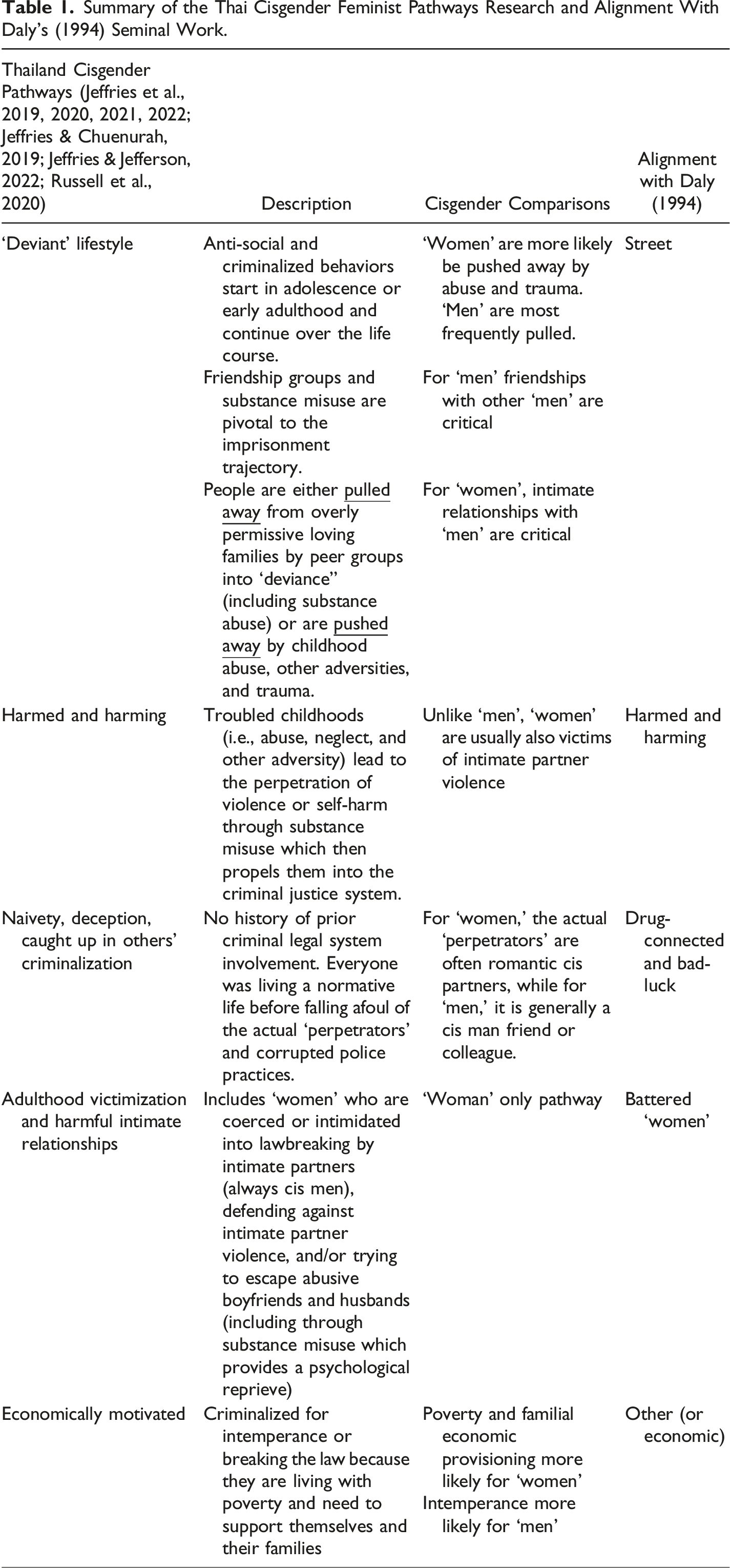
To summarize, numerous studies in Thailand have now mapped cisgender pathways to prison unmasking a particular and shared gendered story in the lives of justice-involved ‘women’ that is different from ‘men.’ Women’s criminalisation is underpinned by a grouping of interrelated life-history factors comprising victimisation and trauma, substance misuse, cis man influence and control, poverty, familial caretaking responsibilities, limited access to justice, and other adverse life experiences in childhood and adulthood. Although cis men’s pathways are characterized by many of these same factors, cis women’s experiences are gendered and distinct. In line with pathways research undertaken elsewhere, this body of work shows that Thai cis women are frequently imprisoned for exacting behaviors of survival within contexts of gendered oppression.
Queer criminologists have asked the discipline to engage in a queering project. Namely, to start disrupting, challenging, and posing questions that produce new knowledge about the lives of queer people in conflict with the law (Dwyer et al., 2016). However, to date and as noted previously, research on the criminalisation of people who disturb and contest cisheteronormativity is limited. Below, we overview what little is known in this space.
Criminalizing People Who Disrupt and Challenge Cisheteronormativity
As noted previously, feminist pathways research has been relatively silent about the criminalization of people who disrupt and challenge cisheteronormativity. More recent research has sought to address this problem. Queer criminologists have hypothesized that “queer pathways” will likely feature familial abuse, exile and associated homelessness, barriers to employment, and discriminatory practices within the criminal (in)justice system such as police targeting, harassment, and violence (Asquith et al., 2017, p. 167). This hypothesis has recently been upheld by findings from four studies investigating queer criminalization (Alvarez & Muñoz, 2022; Hereth et al., 2021; Jeffries et al., 2023; Rogers & Rogers, 2021).
Alvarez and Muñoz (2022) and Hereth et al. (2021) painted a broad descriptive picture of trans women in conflict with the law in the United States and Costa Rica. Jeffries et al. (2023) explored the narratives of criminalized phu-ying-kham-phet (persons conventionally understood to be male who do femininity) in Thailand. Taken together, these studies show commonalities in people’s backstories, including (1) leaving home young to escape harmful familial circumstances, including transgender abuse, (2) under-education, (3) early entry into the workforce to support themselves, (4) discrimination and violence at school, work, and elsewhere, (5) high levels of interpersonal violence victimization including intimate partner violence, state violence and structural harm (i.e. police harassment, mistreatment, and abuse), (6) engagement in sex work, and (7) living with homelessness, mental ill health, and substance misuse due to the plethora of wounding experienced.
Rogers and Rogers’ (2021) research provided insight into the characteristics of trans men’s pre-prison life in the United States. Here, once again, victimization (including transphobic harm) in the life stories of participants was routine, alongside homelessness and substance abuse to cope with maltreatment. Rogers and Rogers (2021, p. 130) conclude the interweaving of these factors “are the pathways to offending and incarceration.” Yet, the specifics of how these life experiences coalesced into criminalization are not explained. Hereth and colleagues (2021, p. 72) argue researchers must examine the “temporal ordering” of factors underpinning queer criminalization “to identify associations between life experiences and carceral involvement.”
To date, this has only been done by Jeffries and colleagues (2023). Here, three routes to prison were mapped for phu-ying-kham-phet: (1) criminalized lives, (2) normative lives, and (3) other. Many of the experiences and central mechanisms constituting these trajectories aligned with Daly’s (1994) and prior Thai cisgender pathways research. Normative lives reflected Daly’s (1994) drug-connected cis women and bad-luck cis men, as well as the Thai cisgender trajectory of naivety, deception, and being caught up in others’ criminalization. The other pathway aligned with previously identified economically motivated trajectories, harmed/harming, battered, adulthood victimization and harmful intimate relationships pathways (see Table 1, above). However, most were constituted under the criminalized lives pathway where a specific phu-ying-kham-phet sub-trajectory was identified.
The criminalized lives pathway paralleled Daly’s (1994) street pathway and the ‘deviant’ lifestyle route in previous cisgender Thai research (see Table 1, above). Here, phu-ying-kham-phet were either pushed (by child abuse and other adversity) or pulled away from families (described as loving and supportive) into peer group associations, which then led to situations that exposed them to the risk of criminalization, including drug use and sex work. Prior research has shown being pushed by damaging familial contexts onto the ‘street’ is more likely for cis women than cis men (Daly, 1994; Jeffries & Chuenurah, 2019; Jeffries et al., 2019, 2020, 2021, 2022; Russell et al., 2020). Likewise, the majority of phu-ying-kham-phet were impelled into criminalized lives by childhood familial maltreatment which in this case, repeatedly encompassed cissexist harm. However, even those who were pulled away from benevolent families by the social connectedness offered by friends narrated being looked down on because they were phu-ying-kham-phet. Here, peer groups and drug use offered a reprieve from the emotional harm of living in a cissexist world. Most phu-ying-kham-phet on the criminalized lives pathway were incarcerated due to what they coined the ladyboy lifestyle within Thailand’s kathoey 10 tourism sector. 11 For example, the illegality of sex work, central to kathoey tourism, exposes phu-ying-kham-phet to the risk of criminal legal system entanglement (see Jeffries et al., 2023 for more details).
Thus, to date, our knowledge of queer lawbreaking is limited to a handful of studies. Of these, only one has examined the temporal ordering of factors to identify associations between life experiences and carceral involvement (Hereth et al., 2021, p. 72) and in this case, the study was concerned with Thailand’s phu-ying-kham-phet, persons conventionally understood to be male who do femininity. Below, we utilize life-history interviews to map Tomboys’ criminalisation trajectories. In doing so, via the provision of new knowledge about events and experiences in time that trigger the carceral involvement of persons conventionally understood to be female who do masculinity, this research contributes to both feminist pathways research and the queering of criminology.
Methodology
We thematically analyzed 18 life-history interviews of Tomboys in Thailand to map their pathways to criminalization. We employed a qualitative research framework for several reasons. Primarily, as noted above, there is little available administrative data on Toms in the criminal justice system in Thailand. Qualitative approaches are routinely used in social science research to explore social phenomena where not much is known, where people or groups are socially marginalized, or where people are not likely to be forthcoming about involvement in criminalized activities. Moreover, feminist pathways research has historically examined the experiences and life stories of cis women as an important and central part of understanding and explaining their pathways to criminalization. As Daly (1994, p. 43) noted in her seminal work, statistical studies give, at best, a thin account of criminalized people’s lives. Qualitative feminist pathways research can thus provide an in-depth investigation and understanding of specific life circumstances and experiences, gender-specific or otherwise, that result in criminalization.
In this study, we extend Daly’s (and other feminist pathways scholars) emphasis on qualitative understanding of cis women’s stories to Tomboys. While feminist pathways research has traditionally focused on cis women (and in some cases cis men), its methodology of examining gender-specific circumstances shares several aims and goals with qualitative approaches in queer criminology. In particular, qualitative pathways investigations may provide voice and agency to participants as subjects in the telling of their stories and elucidation of social and cultural factors central to their criminalization. Within queer criminology, qualitative approaches have similarly been vital in bringing “queer experiences to light with richness and depth, thereby providing a space in which queer people can speak for themselves,” and in doing so, contribute to a “discursive reversal” or “shifting” of the privileging of cisgender subjects within criminological discourse (Ball, 2014, p. 544; Buist et al., 2018, p. 103).
Stated otherwise, feminist pathways research has been instrumental in privileging the life stories and circumstances of cis women to disrupt male-stream criminological notions of lawbreaking. As such, we recognize the hegemonic aspects of cisheteronormativity implicit in the historical exclusion of LGBT+ people in most pathways research to date. We also suggest, however, that methodological focus on the experiences and life stories in qualitative pathways approaches is not essentially cisheteronormative. On the contrary, qualitative pathways research is arguably well-suited to explicate the life histories and circumstances of Toms and other LGBT+ peoples that may lead to lawbreaking and criminalization in ways distinct from cishet people.
Fieldwork was conducted in four prisons in four regions of Thailand (Central, North-Eastern, Northern, and Southern). To identify possible participants, researchers worked with prison officials to invite Toms to meet with researchers if they were interested. Here it is important to note that Toms are not considered socially or sexually deviant in ways common to Western prisons for ‘same-sex’ relationships. Rather, as noted above, Toms generally dress and act in ways that establish their Tomness and, as such, there was minimal risk in working with prison officials to extend invitations to participate.
Interested participants then met with researchers who explained the goals and aims of the study. Following this, researchers explained the concept of voluntary consent (including the right to refuse or withdraw with no adverse consequences), potential risks, and the confidentiality of the study. For this study, no personally identifying information (including names) was collected from participants by researchers at any point in time, and all were immediately assigned a pseudonym. Prison officials were not present for interviews, and no information regarding the interviews was provided to prison staff at any point in time. To further protect confidentiality, minor life details were changed or masked in the write-up of interview narratives. Following this, when Toms agreed to participate, written consent was obtained, and the interview proceeded. Participants were not remunerated for their time or participation. While this is standard practice in much qualitative research, it is not allowed within the Thai prison system.
Our interview schedule was semi-structured, open-ended, and loosely derived from the previously discussed feminist pathways scholarship. This approach allowed participants to define and describe significant events in their lives and explore links between their varied life experiences and criminalization. The topics canvassed in the interviews included relationships (familial, friendships, and romantic), victimization experiences, education, employment, economic circumstances, health, substance (mis)use, what behaviors they were criminalized for, and interaction with, and experiences of, the criminal legal system.
The interviews, of one to -two hours duration, were audio-recorded. They were either (1) conducted in Thai (by the second or third author), simultaneously translated into English (for the first author) and transcribed verbatim in the translated English, or (2) conducted in Thai by the second author and then transcribed into English. From the transcripts, we constructed a life map for each Tom. These maps were then thematically grouped into imprisonment pathways according to common and/or divergent life experiences. An example of a life map can be seen below in Figure 1. Note that to protect confidentiality and anonymity, this map is a composite narrative and not the actual life story of an individual research participant. This mapping technique has been used previously (e.g., see Jeffries & Chuenurah, 2019; Jeffries et al., 2019; Jeffries et al., 2020; Jeffries et al., 2021; Jeffries et al., 2022). We actively sought to mitigate underlying biases and establish intercoder reliability by working separately and then together to thematically organize the maps. Life map composite example.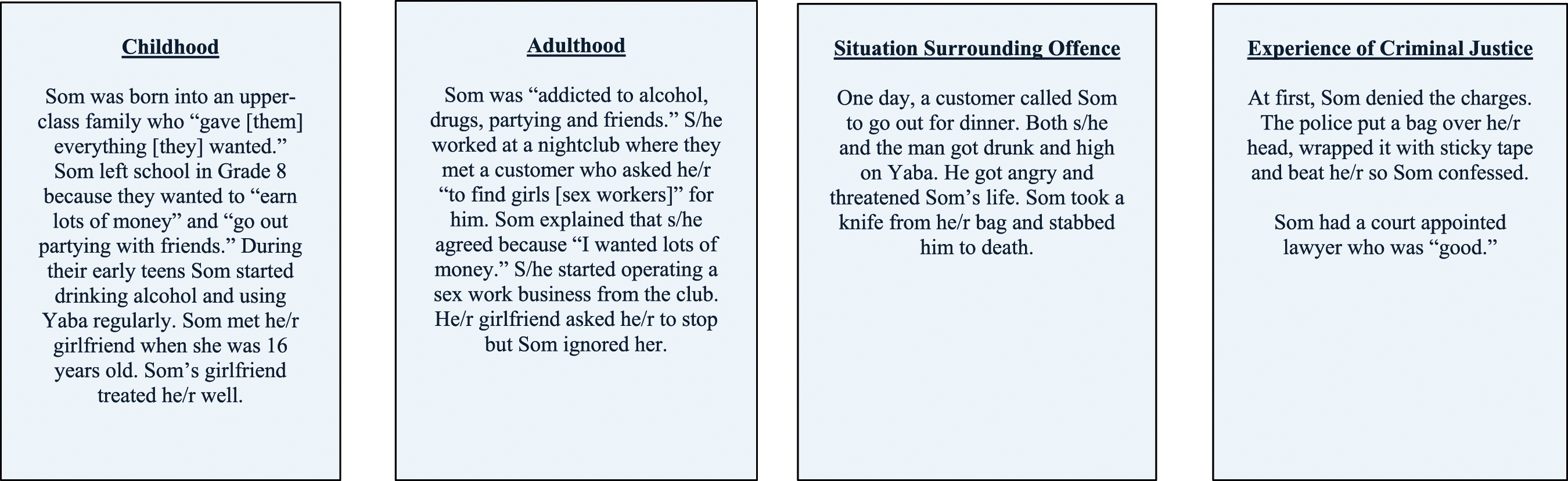
Research Findings
The Tomboys we interviewed ranged in age from 19 to 63 years. Most were under-educated (i.e., only six had completed secondary school) and imprisoned for possessing Yaba 12 and/or Ice 13 for supply/selling. A small number were confined for breaching property law and/or behaving violently. Sentenced prison terms ranged from one year to life. Most were Buddhist with a minority identifying as Muslim. Pre-incarceration, almost all Toms earned a proportion of their income through the underground economy (i.e., sex work, drug selling). Those in legitimate employment were in low-paying occupations (e.g., factory work) which is unsurprising given that most were undereducated. Following our coding and analysis of the transcribed data, two primary pathways into prison emerged: (1) insubordinate lifestyles, and (2) support, sacrifice, and suffering. Each is elucidated below.
Insubordinate Lifestyles: Hardened Professionals and Recreational Revelers
Eleven of the eighteen Tomboys narrated what we term an insubordinate lifestyle pathway. Nine were imprisoned for supplying or selling methamphetamine, one for theft, and another for murder. In our interviews, Toms described ways they had become involved in frequent ‘deviant’ and lawbreaking activities, beginning in adolescence or early adulthood. ‘Deviant’ activities comprised “skipping school”, staying “out at night,” “roaming around,” “drinking and partying,” and being “players” (i.e., having multiple girlfriends and constantly being unfaithful to them). Lawbreaking activities included getting into “fights”, acting violently toward Dees and family members, illicit gambling, drug use, trafficking, and sales.
All Toms who took this pathway to prison explained some type of problem in their lives related to alcohol or drug use that was central to their imprisonment. For example, Talay told us “I drink a lot. I drank until I passed out.” Tata said, “the drugs were close to me, and I was really addicted to it.” Everyone also shared stories of troublesome teen/early adult friendships with people who used and sometimes sold drugs and were involved in other antisocial behavior. These friendships were a critical turning point to criminalization and prison while intimate partnerships were far less consequential. For example, initiation into or escalation of drug use never occurred within the context of a romantic relationship, it was always peer group facilitated. Toms explained that if their Dees became aware they were involved with drugs, they would try to stop it. Invariably when this did not work, girlfriends would leave. Vela told us: My first girlfriend could not take me using drugs [and] we argued when I hung out with my friends because when I did this, I had no time for her [and] she got upset. I would go to the club, drink alcohol, dance with my friends and forget her. She broke up with me. I had other girlfriends, but it always ended the same. We broke up because of everything about drugs. They could not accept the way I was.
Most Toms on this pathway were pulled away from families, narrated as loving and overly indulgent, by peer groups into dissidence. For example, Tintin was raised in what s/he described as a loving middle-class family who supported he/r Tomness. Tintin explained, “my parents loved me, they didn’t force me to be a girl or anything [and] we were okay with the living” because Tintin’s parents owned a lucrative business. Tintin left school in grade 8 because “I skipped classes so much, I was so attached to friends, if they asked me to skip class with them, I would.” Tintin’s friends were the “party type,” and with them, at 14 years of age, Tintin “got involved with drugs [Ice and Yaba],” becoming “addicted.” Tintin further explained, “I wanted to challenge my parents when they told me not to go with my friends as I would get addicted to drugs.” After leaving school, “I worked in the family business. I did not need extra money [but] I wanted to make money to buy whatever I want.” Tintin described having numerous girlfriends who were warmly welcomed into Tintin’s family, but Tintin was a perpetrator of intimate partner violence. One incident involved a situation where Tintin goaded he/r Dee into violence: “I hit her with my hand challenging her if she would dare to stab me, and she did.”
Likewise, Nok described growing up in a supportive middle-class family. Nok left school in “grade 8, I was lazy and wanted to hang out with friends.” By 15 years of age, Nok was regularly drinking alcohol and had a Yaba dependence, “using 20-30 pills per day for fun.” Nok spent time “roaming around” with “fun friends,” all of whom were cis men. Together, they sold and used drugs, drank alcohol, partied, raced motorcycles, gambled, and moved around the community brawling with local cis men. Nok recounted: After I left school, I lived with nothing to worry about. I did not have to work because my parents gave me money. I just stayed home and hung out with friends, racing motorcycles, drinking, and getting into fights. One time, we had a fight and a person from the opposite side died. I was 17 or 18 [years old]. That day, I felt tired, and the other group was making noise. We told them to keep it down, but they did not. So, we beat them up. They remembered us, so I had to flee for six months. My family paid [off the police] to clear my name so that I could go home. After coming home, I roamed around and met with my friends who were involved with drugs [using and selling]. They asked me to take care of drugs for them, and they let me take leftovers. I could also sell to get money to drink.
While most Toms on this pathway described being pulled by their friends and peers into lawbreaking, a minority described being pushed toward anti-social associations by turbulent home environments. Pine was impelled into insubordination by gendered familial mistreatment through a campaign of coercive feminization. Pine expressed feeling that “no one supported me. Everyone tried to change me into a real girl.” So, Pine chose “friends over my family because friends accepted me the way I am.” At 16 years old, Pine left school and “ran away from home” to first live with friends, and then later, with girlfriends. Pine self-medicated with illicit drugs, which resulted in “addiction [and] drug selling” to support he/r habit and eventually, imprisonment. Pine explained how s/he came to abuse Yabba as follows: I was not close to my family. I thought that if being a good person is not okay for my family, then I would be the worst. I was close to my friends. I went to my friends, and all I did was use drugs. My friends taught me how and I started to feel good, so I took more. Like seven days a week. I kept increasing the amount depending on the frequency of my free time.
Ped was also pushed into an insubordinate lifestyle by childhood familial harm. Both Ped and he/r older sister were sexually assaulted by an aunt’s boyfriend who lived in the family compound. He “ripped off” Ped’s clothes, “touched my boobs,” and attempted penetration with his penis. Ped was only 13 years old and explained s/he had tried to tell he/r father and other family members. However, Ped explained, “nobody in the house believed me” because “I didn’t act like a girl.” In the eyes of Ped’s family, masculine identification somehow precluded Ped from cis men’s sexual violence. Ped also endured coercive feminization from family. In grade 9, Ped decided to escape further harm by leaving school, he/r home, and the province. Ped then moved in with he/r sister, a sex worker who had also “runaway” to escape the abusive step-uncle. From here, Ped worked in the sex industry; survived another attempted rape, and afterwards, at the suggestion of work friends, self-medicated with illicit drugs. Eventually, Ped became a mamasan
14
and earned a significant income. Ped reflected: If my family had taken care of me and supported and protected me, I would not have ended up working where I did and hanging out with whom I hung out. I was always close to illegal things because I worked at night with my sister. I saw a lot of drug dealing. Usually, I use [drugs] every day. I was addicted. I always had the supply, and I didn’t even have to pay for it. I was given for free by my friends and the men who came to buy the prostitutes.
While substance abuse and ‘deviant’ peer groups characterized all Toms on this pathway, some were more entrenched in lifestyles of insubordination than others. Ped’s story, for example, was characterized by what Daly (1994, p. 66) referred to as deviant professionalization. Ped was hardened by the lifestyle and resolute in he/r commitment to it. Others primarily broke the law to support their substance misuse and “partying.” Whether pushed out of problematic childhood homes or pulled away from loving overly indulgent families by friends, an insubordinate lifestyle ultimately resulted in imprisonment but also brought several positives, especially for ‘deviant’ professionals, including money, status, access to sexual partners, and some satisfaction with what Toms had been able to obtain or make for themselves. Most of the Toms on this pathway had prior criminal justice system entanglement and relayed experiences of police corruption and abuse.
For instance, View had been to prison more than once and was deeply entrenched in the lifestyle. S/he worked in the sex trafficking industry, moving cis women within/across national borders, and using violence [including murder] as directed by he/r employer. View told us s/he did this work because “it was my greed, like what I earn, 100,000 Baht [3000 USD] per month. It was never going to be enough.” View’s boss also taught he/r “new skills like shooting and stuff. I enjoyed it. I like doing practical things that require practice. I kill[ed] people for him.” View was eventually arrested for murdering a male client who refused to pay the money owed for cis women supplied. View explained that during police questioning “they asked me a series of questions, but I did not admit, I deny. They put a black bag on my head, wrapped sticky tape around it and beat me up until I passed out. Then they throw water at my face to make me wake up. I thought they would kill me. I was asked to sign blank pieces of paper. I just signed at the bottom of each page.”
In another example of insubordinate lifestyle enmeshment, Tien was a ‘player’ when it came to sexual intimacy, a perpetrator of intimate partner violence, a successful drug trafficker, a dealer, had been imprisoned previously and was physically assaulted by police because s/he were mistaken for a cis man. Tien explained: I had lots of girls [but] these relationships were not that good [because] I am a bad-tempered person. I hurt them. I did everything. Kick. Punch. Hit. When I got angry it was hard to control myself. I was so violent. I can be jealous very easily. Once, I tied a girlfriend up and put a knife to her neck. I am in prison because I started to bring drugs to Bangkok. I received 10,000-40,000 Baht [300-1200 USD] per time. I went out a lot. I sold these drugs to many people, and my customers kept upgrading. Like I found new customers with more buying power. I wanted money, and I spent it on going out, buying clothes, watches and [because I was rich] I had lots of girls. When I got arrested the police were violent, they pulled me so hard and kicked me. I shouted at them that I was female. They thought I was a guy which is why they kicked me.
Conversely, as noted above, some Toms were incarcerated because, for them, what the state defined as ‘crime’ was a form of recreation. Unlike Ped, View, Tien and others, there was no enmeshment in the ‘criminal’ underworld. Rather, they had legitimate jobs from which they earned their primary income, and no one relayed law-breaking to achieve anything other than a good time with friends. Here, imprisonment resulted from intoxicated rivalry or involvement in low-level supply to support their drug use or that of friends. Again, this behavior began in adolescence and persisted in adulthood. For example, Tara started using drugs in secondary school, worked at a 7–11, and spent free time partying. Shortly before being imprisoned, s/he was using “Yaba every day,” and having “fun” with friends. Tara decided to “help my friends deal drugs [because] I could get free drugs.” Eventually, Tara was incarcerated for stealing from a department store while intoxicated with three friends. Tara jovially explained to us that, “we went out to [store name] for fun [and] put on clothes, filled up the trolley and stuffed clothes into bags. I stole a soccer outfit and some boxer shorts. We also open the snacks and start eating them. It was fun; we were drunk and high.”
Support, Sacrifice, and Suffering: Tom-Dee Love and Familial Caregiving
Seven Toms constituted this pathway into prison. Five were incarcerated for contravening drug laws, one for violence, and another for receiving stolen property. Unlike the previous pathway, there was no evidence of persistent recalcitrance in adolescence or adulthood, entrenched or otherwise. Here, intimate relationships, rather than friendships or other peer relationships were the determinative turning point to prison. Instead of characterizing themselves as sexual players, these Tomboys relayed being committed family Toms. Criminalization occurred in the wake of caregiving, self-sacrifice, and/or suffering in connection with girlfriends and other family members. Some Toms on this pathway had a history of prior criminalization, but as was the case with their most recent conviction, this ensued from caregiving. Here, in all but one case, illicit drug use was in the past and recreational.
Fay was the only one who communicated being drug dependent pre-imprisonment, but again, this resulted from caretaking duties. Fay was incarcerated for selling Yaba to support he/r terminally ill mother and drug-dependent girlfriend. Fay reported using methamphetamine to stay awake for significant caregiving responsibilities: I used drugs to keep myself awake. My mother needed 24-hour care. There was one time that she fell asleep and stopped breathing for ten seconds. This impacted her a lot, so I needed to stay awake to provide intensive care. I started to sell drugs because I needed money for my mother’s medical expenses but also for my girlfriend, she needed money to fulfil her drug habit. At that time, my girlfriend was in debt [because of drugs], and a debt collector came looking for her.
Recall that caretaking is central to Tomness, and gender expectations are placed on Tomboys to be the leaders in their relationships with Dees, to provide, protect, and be attentive to partners’ needs. Cultural gender norms also require Toms, as daughters, to care and financially provide for their parents and other family members. Further, Toms may aid their girlfriends’ daughterly obligations by providing money to Dees’ families (as cis men should do for wives). Thus, Toms are duty-bound by normative femininity, by masculinity, and by convention that understands them as female. Here, criminalization was set into motion by the convergence of gendered suppositions and responsibilities unique to being Tom.
As was the case with Fay’s intimate partner, and in contrast to the previous pathway, all but one of the Tomboys’ girlfriends had a problem with addiction, either gambling and/or methamphetamine. Further, rather than dissuading criminal legal system involvement, Dees played a pivotal role in it. For example, Ming and Porshe were dutiful daughters and respectable Toms who financially supported their mothers, girlfriends, and their Dees’ families. Ming was in prison because of he/r Dee’s gambling addiction, and Porshe was caught up in he/r girlfriend’s drug abuse. Their narratives, presented below, illustrate the centrality of caretaking and Tom-Dee love for criminalization. I had my own business as a food vendor and got a decent amount of money. We [Ming and he/r girlfriend] separated money into two parts. One part is for both of us; the other is for supporting both of our families. I got to support my mom when she got older. My mother saved and bought a piece of land and built a new house. But then, my girlfriend loved to gamble. I do not like to gamble. I tried to stop her, but she never listened. She got addicted to gambling. We had to borrow money from loan sharks. The debt was too much. I could not take it anymore. We ran away, went back home [to their small rural village] and worked in the rice fields. The money was not enough. I saw people making money in my neighborhood from selling drugs, and I decided to try (Ming). I give my mother and my girlfriend’s mother money every month. My partner did not work, and she got more since there was both her and the baby. She was addicted to drugs. I felt sorry for her. I wanted to help. I told her to stop [but] I cannot stop her. She even used drugs when she was in labor. I gave it to her at the hospital because I love and feel bad for her. On the day I was arrested, my partner left eight Yaba pills with me. She liked to go to gambling houses. I went to pick her up. There was a police checkpoint. They asked me to empty my pockets [and found] the drugs (Porshe).
Nin’s girlfriend was a dutiful daughter. Nin told us that he/r Dee was the “only one who earned income for her family, her father, mother, and younger sibling. Her father and mother did not properly work because of their health issues. So, my girlfriend was the only one who earned money, through drug selling.” At first, Nin “did not know” that he/r partner “was involved with the drug business.” Later, after finding out, Nin “started to help” in a protective act of Tomness because “I did not want her to do the risky job alone.” Eventually, both Nin and he/r girlfriend were caught by police. Nin is in prison because s/he ‘took the fall’ for he/r Dee. The exemplary Tom is meant to be caring, protective, self-sacrificing, and willing to suffer for their Dee. Nin’s actions encapsulate these gender ideals. However, shortly after being imprisoned, Nin’s girlfriend left he/r and married a cis man. Nin explained: That day [of the arrest] police surrounded us. They had guns pointing at us. I was shocked. I loved her [girlfriend] so much, so I admitted everything instead of her. I tried so hard to make her not guilty. No one can help me. Those words were from my mouth. The police knew [I was lying]. I insisted that I did it. My mother was sad. She did not understand why I took the blame and why I loved [my girlfriend] more than myself. My girlfriend stopped coming to see me [in prison] because her family wanted her to have a boyfriend, not a Tomboy like me. Then, she got pregnant. I felt so sad. It was so unfair.
This was the first time Nin went to prison. After release, Nin worked in he/r mother’s business but was re-incarcerated for selling stolen car parts because “things always turn out bad when I try to find love.” Nin explained that a new girlfriend “spent a lot of money [but] I was in love, and I wanted money to pay for her. I earned [sufficient] money [to support myself] but with that girlfriend, it was not enough. I started selling stolen car parts to make extra money. My girlfriend spent it going out at night, drinking alcohol and partying.”
Pop also lost a girlfriend to a cis man, and Pop described this as he/r decisive turning point to prison. Once more, the centrality of intimate relationships, caregiving, selflessness, and dutiful daughterhood, albeit configured slightly differently, are evident in Pop’s story. Like Nin, Pop was incarcerated for supporting a loved one’s clandestine business dealings: I used to live with my girlfriend and went to work every day. After we broke up, it was like I was dead. I moved to Bangkok to live with my cousin. I did not want to see my ex-girlfriend and her husband [who lived in the same village]. At first, I did not know that my cousin was selling drugs. I only knew later. I was the only one who could drive, so my cousin would ask me to drive her places. I knew her purpose for going, but I wanted to help her because she helped me get a new life when I moved to Bangkok. She had financial problems because she had to support her whole family. Everything depended on her. I just drove her to wherever she wanted and dropped her off.
Great was in prison for perpetrating violence against he/r former girlfriend’s new husband. Great did not want to discuss the details of what s/he had done, but the suffering felt at losing he/r Dee to a cis man was emotionally laid bare throughout the interview. Great explained, “she was my first love. I was really into that relationship,” and when she “cheated [with a cis man] it affected me a lot, a lot, a lot, it impacted me a lot.” Great worked in a factory, supported he/r girlfriend, and had what s/he described as “a normal routine life. I lived with my girlfriend and my sister. I was with this girl for three years.” Then, one day, Great was blindsided when their Dee “left,” and “three days later, registered her marriage.” Great said, “I was not thinking straight [when I] pointed a gun [which] went off accidentally. I did not hurt him.” Toms are expected to act selflessly, relinquish their Dees, and forsake their own needs and desires. Great’s shame at not being about to do so was lamentable. For Great, Tomboys’ predestined condition of suffering was emotionally overwhelming, resulting in an aggressive response and subsequent criminalization.
Discussion
This study utilized in-depth life-history interviews with imprisoned Tomboys to establish the backstories and map the ordering of life factors, experiences, and circumstances culminating in their imprisonment. Feminist scholars have been charting cis women’s and to a lesser extent cis men’s, pathways into the criminal legal system since the 1990s. More recently, queer criminologists started to call for similar analyses, hypothesizing that queer pathways would feature cis and heterosexist familial abuse, exile and homelessness, employment discrimination, and prejudicial criminal justice system practice, especially police targeting, harassment, and abuse (Asquith et al., 2017). Subsequent research exploring criminalization beyond the cisgender binary has, for the most part, supported this supposition (Alvarez & Muñoz, 2022; Hereth et al., 2021; Jeffries et al., 2023; Rogers & Rogers, 2021).
For the Toms we interviewed, under-education and associated low-paying work were normal. Nevertheless, no one suggested this was due to discrimination either in the schooling or employment sector. Being pushed out of childhood homes by trauma, and self-medicating with illicit drugs did occur and, on rare occasions, Toms experienced familial cissexism through acts of coercive feminization. However, families never exiled their children because they were Tom, and no one relayed being homeless. Further, nobody had been directly targeted or harassed by the police for being a Tomboy. Granted, some Toms were assaulted by police during questioning, but this materialized through two-sided hyper-displays of toxic masculinity with Toms being misidentified as cis men, rather than cis or heterosexist malignment.
Overall, there was limited overt persecution in the Toms’ narratives. This likely reflects Thailand’s culture of social tolerance, sympathy, and concord. However, as noted earlier, this does not necessarily equate to acceptance (Sinnott, 2004, pp. 124-125). In addition to coercive feminization, cissexism and heterosexism were subtly yet insidiously evident via the cultural pressure to forsake Tom-Dee love for ‘normal’ family life. Our pathways analysis showed that attempts at buffering against cisheteronormativity through caregiving and sacrifice played a key role in the criminalization of Toms.
We mapped two pathways into prison, the insubordinate lifestyle, and the pathway of support, sacrifice, and suffering. Many of the experiences and central mechanisms that constituted these aligned with Daly’s (1994) work and subsequent Thai research (see Table 1, previous). We summarize and reflect on each pathway below.
Mirroring the ‘deviant’ lifestyle pathway found in past Thai research (see Table 1, previous), during adolescence/early adulthood, Toms in the insubordinate lifestyle pathway were either pulled away from favorable home situations or pushed out of noxious domestic settings into anti-social friendship groups and environments, characterized by substance misuse and other precarious activities. Here, everyone developed problems with drugs and/or alcohol, sometimes in response to harm, and there was continuity in contumacy throughout their lives before prison. The narratives of those pushed exemplified Daly’s (1994) street ‘women.’ However, paralleling Daly’s (1994) street ‘men,’ most were pulled into these lifestyles. Some were hardened street Toms. Here, the appetite for wealth, status and accompanying sexual access to cis women was an important driving force behind criminalisation. Indicative of Daly’s (1994, p. 66) standard street ‘men’ who broke the law to support their substance misuse, masculine gamers or junior street ‘men’, other Toms on the insubordinate lifestyle pathway were criminalized for recreational revelry with friends.
As noted earlier in this paper, masculinity markers are core to Tom gender identity, and these allow Tomboys to circumvent many of the patriarchal constraints normatively designated to cis women. Toms on the insubordinate lifestyle pathway narrated moving through public space like cis men and openly repudiating normative codes of feminine conduct. Like Daly’s (1994, p. 68) cis men who were criminalized for the “costs and excesses of masculinity,” several of the Toms on the insubordinate lifestyle pathway behaved in ways typically associated with the worst profligacy of proscriptive toxic masculinity. This encompassed rapaciousness, selfishness, a sense of sexual entitlement, and displays of physical prowess through aggression, violence, and perpetrating harm against cis women through intimate partner violence and sexual exploitation. While not all Toms on this pathway reported such profligacy, everyone eventually found themselves behind prison bars due to ongoing lawbreaking that started during adolescence or early adulthood.
The second pathway was marked by involvement in lawbreaking because of romantic love and familial care. Here, in contrast to the more overt or even noxious masculinity above, imprisonment resulted from the effectuation of Tomness through the melding of more amiable masculine and feminine aspects, considerate daughtering, and Tom gender sufferablity. Comparable in some respects to Daly’s (1994) drug-connected ‘women’ and previously identified Thai cis women pathways, (see Table 1, above) some Toms were embroiled in the illegal misconduct of intimate partners and family members. This included Toms who placed the needs of Dees above their own and sacrificed themselves to protect their girlfriends from the pains of nefariousness and prison.
Often dutiful daughterhood and being a ‘good’ breadwinning family Tom collided and culminated in criminalization. Here, we see alignment with familial economic provisioning and caretaking found in previous cis pathways studies of Thai ‘women’ (see Table 1, previous). While economically providing for girlfriends and families can act as a buffer against cisheteronormative pressures, despite their best efforts, some Toms lost their Dees to cis men. In some cases, the possible threat of inevitably losing their Dees to cishet family life led Toms to become involved in lawbreaking as an attempt to mitigate these pressures and better provide for their girlfriends. In other cases – and with some overlap – being left by their Dees resulted in substantial emotional pain that contributed directly or indirectly to criminal legal system entanglement.
Concluding Remarks and Limitations
In this study, we have sought first and foremost to provide some avenue for the voice and experiences of Tomboys as subjects in the narration and explanation of their life stories, circumstances, and choices that resulted in lawbreaking and incarceration. We recognize all social science research may, however unwittingly, do injustice or even violence to the experiences of criminalized people. Feminist pathways research has historically sought to mitigate this through the privileging of cis women’s life stories into lawbreaking, both to afford participants more voice and to understand the gender-specific circumstances of criminalization. Our study follows this tradition but moves feminist pathways analysis beyond the cishet in the study of Tomboys who are incarcerated. This is in line with calls from queer criminologists to start disrupting, challenging, and posing questions that produce new knowledge about the lives of queer people in conflict with the law through qualitative methods that can bring “queer experiences to light with richness and depth” and hopefully, in a small way, contribute to a “discursive reversal” or “shifting” of the privileging of cisheteronormative subjects within criminological discourse (Ball, 2014, p. 544; Buist et al., 2018, p. 103; Dwyer et al., 2016). As discussed above, it is also in keeping with calls from some queer criminologists to extend the use of pathways analysis beyond cishet populations and contexts (Asquith et al., 2017).
For readers not familiar with Thai culture, there might be a tendency to summarize our findings as ‘gender matters.’ This has certainly been the case in feminist pathways research, which has consistently found cisgender differences in criminalization pathways. Such research has, in turn, been vital in raising awareness and directing policy and practice towards interrupting and addressing cis women’s carceralization. Examples of this include the development of The United Nations Rules for the Treatment of Women Prisoners and Non-custodial Measures for Women Offenders (the Bangkok Rules), associated directives for gender-wise penology, and increased use of non-custodial measures, alongside hopes for a prison-free future (United Nations General Assembly, 2010; Wattanaporn & Holtfreter, 2014).
At the same time, there may be a tendency of readers not familiar with Thai culture to reduce or essentialize the lives and experiences of Tomboys in this study to those of Western trans men or the ‘butch’ lesbians. Toms are not lesbians; they are not cis women or trans men seeking to ‘pass’ or ‘transition’ to being ‘men.’ Rather, Toms are a discrete and long-established cultural category of personage who utilize a melding of hegemonic masculine and normative feminine aspects to do their gender. The performative aspects of being Tom are generally accepted and tolerated in Thailand. On the other hand, as we have discussed throughout the article, Tomboys are still beholden to traditional expectations of being dutiful daughters and also live beyond the margins of tolerance when it comes to full access to patriarchal economic, social, and interpersonal benefits of being a ‘man’ in Thailand.
All Toms in our study explained their lives in some ways as existing between these spaces of gendered performativity and proscriptions. For those in the insubordinate lifestyle pathway, this was generally undertaken in the embrace of greater freedoms, more status, and enhanced social opportunities to obtain pleasures and entitlements nominally afforded to cis men. For those in the support, sacrifice, and suffering pathway, this was generally undertaken in ways more reflective of the familial, partnership duties and responsibilities nominally expected of both cis women and men in Thai society.
Thus, perhaps the most important finding of this study is not simply that gender matters, but rather that the study of how gender matters must push beyond the cis. Toms (and presumably other non-binarisable people) demonstrate diverse and divergent pathways to lawbreaking and criminalization. This is in line with previous hypotheses and studies on queer pathways but it is also vital to developing a better understanding of how people with non-binarisable and intrinsically disruptive gender identities come to be imprisoned. This includes applied and practical implications as much as theoretical ones. For example, while the Bangkok Rules have been important and effective in many Thai prisons for ‘women’ (and in other signatory countries) when it comes to gender-responsive policy and practice, the Rules are built on a cisgender approach and inflexible normative definitions of women and femininity (Barberet & Jackson, 2017; Chuenurah et al., 2022; United Nations General Assembly, 2010).
This leads us to our final point, which is the limitations of this study. Feminist pathways research is not intended to be inferential. It does not ask who is likely to ‘offend’ but rather seeks to better understand specific gendered pathways to lawbreaking. Our sample of 18 Toms is small and should be taken as exploratory rather than definitive. There are probably other pathways not readily captured in this research. For example, boundary policing did not feature in the narratives of the Toms we spoke to, yet we can imagine this contributing to criminalisation. These and other questions demonstrate the very limited research knowledge in this area. As stated by the United Nations Office on Drugs and Crime (2020, p. 9) “information about the lived realities of lesbian, gay, bisexual, trans and gender-diverse persons around the world is, at best, incomplete and fragmented; in some areas it is non-existent…. It means that in most contexts [criminal justice and other related] policymakers are making decisions in the dark.” This needs to change. We hope in some small way this article contributes to such change.
Footnotes
Acknowledgements
The authors would like to extend sincere appreciation to the research participants for their invaluable time and willingness to share their life stories and Rodney Hughes for his feedback on earlier drafts of this paper.
Declaration of Conflicting Interests
The author(s) declared no potential conflicts of interest with respect to the research, authorship, and/or publication of this article.
Funding
The author(s) disclosed receipt of the following financial support for the research, authorship, and/or publication of this article: This work was supported by internal funding from the Thailand Institute of Justice and Griffith University.
