




Abstract
This article reviews the literature on mothers of victims and mothers of offenders through a feminist criminological lens. Results of our analysis of 52 articles from a twenty-year period indicated that, though situated on opposite sides of the criminal justice system, aspects of the experiences of mothers of victims and offenders were similar. Specifically, the mothers shared perceived accountability for their offspring’s involvement in crime, the burden of care for their offspring, and the negotiation strategies they employed. Our analysis makes visible these mothers as a unique sub-category in the study of crime and proposes a matricentric feminist criminology model.
Positioned on opposite sides of the criminal justice barricades, mothers of victims and mothers of offenders 1 are studied in parallel but separate bodies of academic literature. In contrast, this article critically reviews current knowledge on the mothering of victims and offenders. First, we approach this review with theoretical perspectives relating to feminist perspectives in criminology and family stress theory. We outline the current theoretical literature, which rarely compares the two groups, pointing to their current marginalization by scholars. Then we introduce the social context and the discursive fields in which the mothers act and specifically the problem of mother-blame. Finally, we critically analyze the existing empirical research on mothers of adult and young crime victims and offenders before returning to the need for a matricentric feminist criminology which facilitates the inclusion of mothers as they intersect with crime and the criminal justice system (CJS).
Mothering Victims and Offenders: A Feminist Perspective
Within feminist criminology, research on motherhood has focused on justice-involved mothers who are incarcerated, or mothers with partners imprisoned. We argue here that mothers of offenders and mothers of victims are also justice-involved and need to be central to a feminist criminological analysis of motherhood. As Hughes Miller has identified, “state-control of mothers … is the clear epicenter of the Venn diagram between feminist criminology and motherhood studies” (2020, p. 311) with twenty years of existing scholarship on ‘carceral motherhood’ (Brown & Bloom, 2009). We suggest that the experiences of mothers of offenders and mothers of victims – and the continuities between the two – have been rather obscured in this feminist criminological project and should be located clearly in the epicenter of the Venn diagram that Hughes Miller describes. This could be characterized as a matricentric feminist (O’Reilly, 2016) criminology that is inclusive and illuminates the experiences of all mothers whose lives are touched by crime and justice. We suggest that their experiences as mothers of victims and mothers of offenders are not incidental or collateral to the study of crime and justice but rather central to understanding its workings. As O’Reilly has argued, “matricentric feminism seeks to make motherhood the business of feminism by positioning mothers’ needs and concerns as the starting point for a theory and politics on and for women’s empowerment” (O’Reilly, 2019, p. 13).
Research on mothers of crime victims has focused, particularly in cases of child sexual abuse (CSA), 2 on their role as a caregiver of the child or on their alleged collusion with the perpetrator, ignoring their life circumstances that may have diminished a capacity to protect (Joyce, 1997) and the hidden nature of these offenses within families. An acknowledgment of the plight of victims’ mothers has been highlighted by victims’ rights movements that have widened the concept of victimization to include not only the directly victimized individual but also the victim’s family and friends (co-victims or secondary victims) who are indirectly victimized by the harm inflicted upon their friend or relative (Rock, 1998). Research has documented the severe impact of victimization on co-victims as well as the harmful, counterproductive encounter with various systems such as the CJS and the media in the aftermath of a crime, termed secondary victimization (Armour, 2003; Condry, 2010; Connolly & Gordon, 2015). However, despite this shift, calls for intervention to reduce caregivers’ distress have been based on the premise that psychological difficulties may interfere with their ability to adequately support their children (e.g., Van Toledo & Seymour, 2013). Fong et al. (2017) indicate that despite the many nationally accredited child advocacy centers serving sexually abused children throughout the United States, little is known about the acceptability of mental health services to caregivers. A recent narrative review by Serin (2018) examined non-abusing mothers’ need for support in their responses to the disclosure of CSA. The findings show that in the current CSA literature, support needs of non-abusing mothers are usually explained based on their interaction with their abused children, and only investigated to find out the effect on the quality of the support they provide for their children. Mothers’ own need for support, independently of their mothering role, are ignored.
On the opposite side of crime and the CJS, research that has focused on mothers of offenders has focused on inadequate parenting or has constructed mothers as a resource in their child’s desistance during and after incarceration (Codd, 2007; Gueta, 2018). In addition, scholars have acknowledged that the families of prisoners often face limited rights, reduced resources, social exclusion, and other adverse outcomes because of their loved ones’ incarceration (Comfort, 2007). In some cases, prolonged interaction with correctional institutions can even cause relatives and partners of prisoners to experience “secondary prisonization” (Comfort, 2007, p. 7). However, an expanding body of research has documented the collateral consequences or symbiotic harms (Condry & Minson, 2021) experienced by families of prisoners, most of which focus on spouses and children of male prisoners; very few studies have examined mothers’ own needs separately (Christian et al., 2006; Codd, 2007; Wildeman & Wang, 2017). This is despite previous studies identifying that the most common family member to serve as the primary supporter is the mother of the offender (Jones & Beck, 2007) and the gendered nature of such responsibilities (Condry, 2007; Holt, 2009).
However, despite these parallel lines of research, very little research draws comparisons between mothers of offenders and mothers of victims. One exception is a study by King (2004) exploring the impact of capital offenses by interviewing family members of murder victims and comparing it to Smykla’s (1987) findings on the experience of death row family members. King (2004) concludes that although comparison may be problematic due to the different nature of the experiences of victims’ and offenders’ family members, in many respects their experience reflects a mirror image on either side of the homicide.
Furthermore, comparing the experience of families affected by death row relates to the most serious crimes and severe punishment. In her meta-synthesis of qualitative studies examining the parents of incarcerated prisoners, Gueta (2018) suggests the importance of ‘positioning parents in the theoretical as well as practical arena as ‘subjects’ and social actors’ (p. 13). This call is in line with the shift that has taken place over the past two decades in family studies showing that parents of adults in Western countries may remain heavily invested in the parenting role into late life (Fingerman, 2017). Specifically, parents provide more frequent emotional and practical support when an adult child has disabilities, health concerns, or a mental health problem (Birditt et al., 2010). Researchers have documented the deleterious impact on midlife parents’ well-being associated with offspring problems, even when only one grown child experiences a single problem, regardless of how successful other children might be (Fingerman et al., 2012).
Furthermore, research on parent–child relations has shown how this differs considerably by gender (Birditt et al., 2010). Mothers may experience a more detrimental impact and experience more emotional distress than fathers because they invest more in the tie, assume a more significant role in caregiving (Silverstein & Bengtson, 1997), and are more often perceived as responsible for their children’s problems (Shirani et al., 2012). Thus, mothers’ intensive involvement with children, a concomitant prolongation of midlife parenthood, and the variety of potential problems, underscore an emergent need to understand better factors contributing to mothers’ well-being throughout the life course (Gueta, 2018).
Feminist literature differentiates between motherhood and mothering. The concept of motherhood reflects a powerful and influential social institution, comprising the conventional obligations and responsibilities attributed to women who bear and nurture children (O’Reilly, 2016). This concept frequently entails a set of conventions and expectations regarding how mothers should prioritize childcare regardless of the mothers’ specific life circumstances. This idealized image of a mother can impact how mothers perceive themselves, as well as the treatment they receive from others, particularly in situations involving child victimization or offending.
In contrast, mothering refers to the lived experience of motherhood including caring and caregiving behaviors that mothers engage in to assist and raise their children and is shaped by women’s specific life circumstances (Hays, 1996). This concept reflects a mother-centered approach, emphasizing the significance of women’s personal experiences in motherhood and has the potential to redefine motherhood, challenging gender-essentialist beliefs about caregiving norms (O’Reilly, 2016). The mothering experience can provide more agency to mothers that face additional challenges, such as mothers of victims and offenders.
Specifically, the literature on motherhood in Western societies shaped and disseminated in popular culture, expert discourses, and social policy indicates the dominance of an ideology of the “good mother” and, accordingly, that women’s ultimate self-fulfillment relates to mothering, an instinctive devotion to her children, and a desire to care for and to sacrifice her own needs (Hays, 1996). This idea is also linked to a cultural ideal that Chodorow and Contratto (1982) call “the myth of maternal omnipotence,” in which mothers are thought to be all-powerful and all-knowing in the family arena. These mothering ideologies persist, despite four decades of critical feminist theories that point to the inherent position of mothers as voiceless objects rather than as subjects in their own right, serving to preserve unequal gender power dynamics (Hays, 1996). According to previous research, even marginalized mothers, such as those who are incarcerated, tend to subscribe to the ideologies of hegemonic mothering as they frame their maternal regrets and the related external and internalized attributions of the “bad” mother label. However, these mothers simultaneously resist certain aspects of their identity while also working to establish a positive mother identity, using ‘protection scripts’ to redefine what constitutes good motherhood in the face of challenging personal and societal conditions (Broidy & Siegrist, 2023). Furthermore, research indicates that even women who do not conform to these ideologies are at risk of experiencing increased stress and anxiety, decreased self-efficacy in the face of the pressure to be perfect, and guilt for not living up to high mothering expectations (Henderson et al., 2016).
One of the most dominant constructions of motherhood ideologies relates to mother blaming. Jackson and Mannix (2004) provide a qualitative feminist analysis examining 125 studies that reveal a persistent discourse of mother blame. Jackson and Mannix (2004) identify a wide range of phenomena attributed to mother blaming, including tantrums, incest, schizophrenia, ‘transsexualism,’ delinquency, and the complications of blaming mothers for their own experiences. This attributed accountability focuses on mothers’ actions and choices (such as their maternal and marriage roles), as well as their perceived inaction (e.g., failure to provide children with a nurturing environment.) Further, mothers are blamed regardless of whether they are directly present, have the power to prevent harm to a child, or even when the mother is the primary victim of the child, such as in cases of matricide (Condry & Miles, 2023).
Thus, there is a need to draw comparisons between the two groups of mothers to contribute to feminist theories of crime and justice and promote a more dynamic and inclusive understanding of the impact of crime. Furthermore, this line of research may inform the development of therapeutic strategies that address implicit and explicit constructions of motherhood and facilitate knowledge and a better understanding of factors that might contribute to mothers’ well-being.
This paper aims to review the separate bodies of knowledge on the mothering of victims and on the mothering of offenders, providing a critical comparison of the current state of knowledge, and formulating a new conceptualization of mothers’ experiences. We ask how mothers of victims and offenders experience the criminal-legal system, and how their experiences are similar and different.
Methodology
To achieve the above aims, we used a critical review method to analyze the existing literature, as this method enables us to appraise the conceptual contributions in order to enhance our understanding or develop new concepts (Booth et al., 2022). This review technique has been subject to criticism for lacking transparent inclusion criteria (Booth et al., 2022). Thus, we also followed the guidelines of the Preferred Reporting Items for Systematic Reviews and Meta-Analysis guidelines (PRISMA) (Moher et al., 2009). Specifically, we took a critical realism perspective that recognizes the materiality of somatic, psychological, and social experience but conceptualizes this materiality as mediated by culture, language, and politics (Braun & Clarke, 2021). This allowed us to incorporate the findings of research conducted from a range of theoretical perspectives (psychological, sociocultural, or discursive) into one framework without having to reconcile competing epistemological assumptions (Braun & Clarke, 2021). A critical-realist analysis allows us to acknowledge many aspects of the mothers’ experience to conceptualize it as a complex phenomenon that is discursively constructed and embedded within a specific historical and cultural context (Ussher, 2000). Within a critical-realist approach, both qualitative and quantitative research can be used to provide insight into women’s experiences, professional knowledge, and lay people’s perspectives across different social, cultural, or relational contexts. We conducted a critical review of the literature guided by the principles of matricentric feminism (O’Reilly, 2016), which considers the challenges and contexts of mother-centered feminist theory.
Search Strategy
This study constitutes a critical analysis of the literature on mothers of offenders and victims. An extensive review of scholarly databases was conducted searching academic databases that reflect the multidisciplinary nature of the phenomenon under study; the databases that were searched included Psychinfo (EBSCO), Sociological and Social Services Abstracts (SOCA), Social Work Research and Abstracts (EBSCO), the Educational Research Information Clearinghouse (ERIC), Sage Journals Online (Sage), and Social Sciences Full Text (WILSON). These databases were searched by keywords such as collateral consequences; mother blaming; mothers of victims’ caregivers, and non-abusive mothers.
Inclusion and Exclusion Criteria
The criteria included (a) studies conducted with mothers alone or with other family members of young or adult crime victims, prisoners, or offenders (only mothers’ statements, and only studies in which mothers represented at least 30% of the sample were considered) or studies that focused specifically on the issue of motherhood in the CJS - we also limited our review to literature on non-offending mothers given their different characterization compared to offending mothers and in line with this focus of previous literature reviews (e.g., Serin, 2018); (b) a research design of qualitative, quantitative or mixed methodology; (c) peer-reviewed studies published in English from 1999 to 2019 (a twenty-year pre-pandemic period); and (d) articles were excluded if victimization occurred as a result of a suicide, motor vehicle accident, or fatal incident other than murder.
Screening
The initial search revealed 2851 articles and 791 duplicate records were removed. Next, titles and abstracts of the remaining 2060 were reviewed to ascertain relative fit using the criteria mentioned above, which left 271 articles that were subjected to a full-text review based on our exclusion/inclusion criteria. Bibliographies of eligible articles were reviewed for additional citations, and relevant articles were retrieved and judged for inclusion. Ultimately, 52 primary studies were found to meet the inclusion criteria.
Analysis
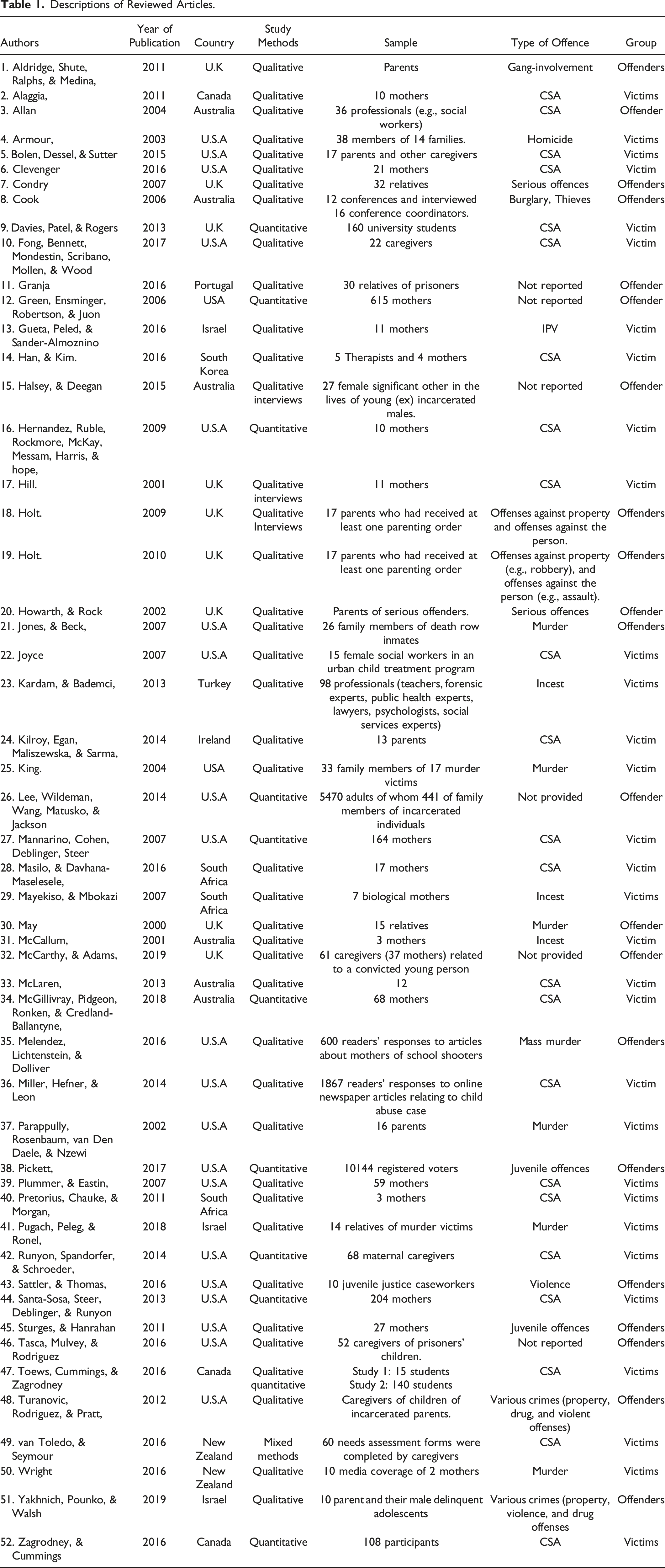
Descriptions of Reviewed Articles.
Characteristics of Papers
The majority (34) of the papers were published in the second decade of the 21st century, between 2009 and 2019, indicating a recent increase in the volume of research on mothers of victims and offenders. Most articles (n = 39) were qualitative, 11 were quantitative, one article reported two studies (one qualitative and one quantitative) and one used mixed methods. Concerning the groups, 21 articles were related to offenders and 31 were related to victims. Specifically, regarding the offense type among the victim group articles 23 articles were focused on CSA, four on murder, three on incest, one on IPV, and one on homicide. Among the offenders group articles (some articles reported various offenses), one gang involvement, one CSA, two serious offenses, 5 offenses against property (Burglary, Theft), six offenses against the person, two drug offenses, one murder, one mass murder, two juvenile offences and lastly six articles did not report a specific offense. Twenty articles were produced in the United States, 10 in the United Kingdom (including Ireland), six in Australia, three in Canada and in South Africa and Israel, two in New Zealand, and one article each in Portugal, South Korea, and Turkey. Most of the studies sampled parents (mostly mothers) while others sampled professionals (social workers) working with parents or children, and the remaining literature focused on lay people’s perspectives (See Table 1).
Result: Critical Analysis of the Literature
The literature indicated the inherent challenges faced by mothers of victims and mothers of offenders associated with their shared position as failed object and their role in supporting their children’s process of recovery and desistance. In contrast, differences between the two groups of mothers were related to the content of this object position, such as the reason for self-blame. The findings are presented and then discussed within the context of feminist literature on the societal role of mothers.
Mothers’ Accountability - Failure to Protect and Failure to Raise Appropriately
The first shared aspect of the two groups of mothers related to shifting responsibility for crime from the actual perpetrator, social power relationship, or social institutions, to the failure of mothers. Thus, mothers’ accountability was grounded in their idealization as omnipotent, all-powerful protectors of their children and as all-knowing (Chodorow & Contratto, 1982; Hays, 1996) and fuelled by ignoring the social contexts of mothers’ lives and the father’s role in these circumstances. This shifting blame and individualization of crime problems positioned mothers as failed objects and manifested in mothers’ self-blame and mothers’ blame by the CJS, practitioners, by others in their lives, and wider society.
Mothers’ Self-Blame
Mothers’ self-blame in both groups was grounded in internalization and self-perception of the ideal of the mother omnipotent in her ability to control and mold her child’s behavior as well as all-powerful protectors of the children (Jackson & Mannix, 2004).
The reviewed studies point to self-accusation and guilt over presumed responsibility among mothers of victims, related to not being aware of or ignoring the warning signs of the abuse (Fong et al., 2017; Han & Kim, 2016; Kilroy et al., 2014; Masilo & Davhana-Maselesele, 2016; McCallum, 2001; Pretorius et al., 2011). For example, Clevenger (2016) interviewed 21 mothers across Illinois who had a child who had been sexually assaulted. Many of the women said they felt like they had failed and blamed themselves, and this guilt manifested into self-loathing and even self-punishment. Kings’ (2004) research on family members of murder victims revealed their feelings of self-accusation for not preventing the murder. Mayekiso and Mbokazi (2007) found that mothers questioned their decision-making abilities and their reasons for choosing an abusive partner and living with him even after a CSA disclosure. An adult daughter being a victim of domestic abuse was found to undermine a mother’s self-perception and arouse feelings of failure and incompetence (Gueta et al., 2016).
Similarly, mothers of offenders felt responsible for their children’s criminality and saw their defective parenting as the root cause of their children’s offenses (May, 2000; Melendez et al., 2016). In England, Condry (2007) interviewed 32 families of people who had committed serious crimes (17 mothers) that attended the self-help group meetings of an organization called Aftermath. Applying Goffman’s (1963) concepts of courtesy stigma, Condry (2007) showed how parents of adult prisoners, especially mothers, may bear the burden of “guilt by association” and “kin culpability”. McCarthy and Adams’s (2019) interview data which mainly consisted of mothers of inmates (37/61), found differences in the ways caregivers articulated responsibility. Accounts differed primarily by gender concerning the levels of investment and nurturing those mothers displayed. This self-accusation associated with deficient motherhood may even overshadow other potential contexts for delinquent behavior, such as immigration (Yakhnich et al., 2019). In her research on restorative justice, Cook states that mothers attended all the conferences she observed either with the offender, with the victim, or as the victim and they are deemed accountable for their children’s behavior,’ with their cultural scripts intact. Mothers were constructed as both accountable and vulnerable, but mothers of offenders had a ‘finer line to walk’ and were subject to greater scrutiny (Cook, 2006, p. 117).
Blamed by the CJS, Healthcare Settings, and Society
In addition to the above accounts of mothers’ self-blaming, the reviewed articles also reported mother blaming by the CJS, professionals, friends, society, and public perceptions. The articles that reported mother-blaming included studies that sampled mothers, professionals, case vignettes with community samples or online and newspaper comments and indicated various factors for which mothers were held accountable.
First, the articles that sampled mothers in the reviewed literature indicated a perceived social stigma with mothers reporting being blamed and deemed responsible for their children’s behavior and situation in ways that were implicit, sometimes explicit, and grounded in a range of reasons (Cook, 2006; Granja, 2016; Mayekiso & Mbokazi, 2007; McCallum, 2001; Plummer & Eastin, 2007). Other research on mother blaming focused on mothers’ feelings of blame as experienced through formal health or social care settings (e.g., social workers) (Mayekiso & Mbokazi, 2007; McCallum, 2001; McLaren, 2013), a feeling of being blamed or not sufficiently supported, and anger expressed towards professionals which might limit mothers’ ability to receive support (Kilroy et al., 2014; Mayekiso & Mbokazi, 2007). Furthermore, the cultural background may further subject mothers to marginalization and alienation by caseworkers. For example, adherence to religious beliefs that place a high value on family preservation and traditional religious schemas can shape mothers’ choice to remain in contact with their abusive partners. Mothers’ feeling that caseworkers were unable to understand this choice harmed their ability to be helped by therapy (Alaggia, 2001).
Second, research on social workers, therapists, or caseworkers’ perceptions indicated perceptions of mothers of sexually abused children as “colluders” in CSA or failing to protect their children. Even though it was not always directly articulated, negative perceptions of mothers and covert mother-blaming grounded in an idealized motherhood ideology were evident (Allan, 2004; Han & Kim, 2016; Joyce, 2007; Kardam & Bademci, 2013). However, a study by Sattler and Thomas (2016) with juvenile justice caseworkers found that they perceived challenges faced by single parents (mostly mothers) with children in the custody of the juvenile justice system and identified how parenting practices were affected by their intergenerational poverty and community violence, leaving mothers with a profound sense of powerlessness and detachment from their children and themselves.
Third, research indicated that both mothers of offenders and victims felt blamed by close friends, relatives, and in broader public perceptions. Research on mothers of victims indicated that extended family members and friends were perceived as blaming, judging, and dismissing the mothers for not preventing the abuse (Clevenger, 2016; Gueta et al., 2016; Kilroy et al., 2014; McCallum, 2001; Pretorius et al., 2011; van Toledo & Seymour, 2016) or for not taking the necessary steps immediately after their child’s abuse (Mayekiso & Mbokazi, 2007). Victims’ mothers were blamed explicitly if they were also the perpetrator’s mother (Masilo & Davhana-Maselesele, 2016). Similarly, mothers of offenders reported a social reaction towards them of judgment for their offspring’s criminality (Condry, 2007; Hwarth & Rock, 2002). Specifically, cultural background and single parenthood may accelerate mothers’ experience of stigma and exclusion in their own families as a result of assumptions about their capacities to prevent their children’s involvement in crime and for not providing an adequate male role model for their male children (McCarthy & Adams, 2019).
Lastly, public perceptions of mothers of victims and offenders were also covered in the reviewed articles. Regarding mothers of victims, research methodologies such as case vignettes with community samples suggest the persistence of a proclivity to assign some degree of responsibility for the occurrence of CSA to mothers (Davies et al., 2013). Furthermore, Toews et al., (2019) indicate that research has attempted to move beyond the question of whether or not mothers are held at fault for CSA to identify the reasons mothers are held at fault (i.e., justifications for attributions). However, research focusing on the justification for mother blame points to the persistence of mother blaming grounded in socially constructed views of “ideal mothers”. For example, particular characteristics were found to be related to the level of fault assigned to her following CSA, such as the amount of time spent with the child (Toews et al., 2019; Zagrodney & Cummings, 2016). Other justifications reported included the mother’s relationship with the perpetrator, an expectation that she ought to have covert, intuitive knowledge of the CSA, and the mothers’ poor judgment due to misplaced trust in her partner (Zagrodney & Cummings, 2016).
Another line of investigation that reflects public perceptions of mothers of victims can be found in an analysis of online and newspaper comments. A study by Miller et al. (2014) analyzed online and newspaper comments on CSA that involved over 100 victims by a well-known Delaware paediatrician. Their analysis found that the public discourse overwhelmingly explained the abuse as the fault of the victims’ parents for trusting the paediatrician and not recognizing ‘red flags,’ which displayed an implicitly gendered mother-bashing. The authors conclude that even with apparent professional and CJS failures, given previous unaddressed allegations against the paediatrician, the victim’s mothers were still being blamed. In contrast, Wright (2016) points to the positive media coverage of some bereaved mothers (mostly mothers of the “ideal victim”) that can be constructed as victim heroes in crime news. However, this positive media coverage is grounded in displays of grief and motherhood ideologies that charge mothers with an emotional authority to encourage and support legislative change in the CJS.
This line of public response to mothers of victims was also directly relevant to mothers of offenders. This was documented by Melendez et al. (2016), using the results of a content analysis of media coverage that followed the school shootings at Columbine and Newtown. Focusing on the gendered nature of public responses to the tragedies in two online articles with comments, the content analysis indicated that the mothers were always blamed for their sons’ actions. At the same time, the fathers completely avoided blame and remained unmentioned throughout the video and the article. The disproportionate blame apportioned to mothers of mass murderers indicates gender norms have changed little concerning parental responsibility in U.S. society—mothers still shoulder a heavier burden than fathers. Specifically, in these alarming high-profile mass school shootings in U.S. society, mothers were blamed for not providing a countervailing force to mitigate modern society’s glorification of violence for their sons. However, a study by Pickett (2017) that uses data from registered voters (N = 10,144) to examine public views about whether maternal employment in two-parent households promotes juvenile delinquency indicates that only a small minority of Americans blamed maternal employment for juvenile crime. The study, however, also shows that biased racial attitudes are positively associated with endorsing the belief that maternal employment causes juvenile delinquency.
The Burden of Care and the Tool of Exposure to Offspring Involvement in Crime
The second shared aspect of mothers of victims and offenders relates to the ways in which mothers shoulder the burden of care in the aftermath of crime and the deleterious consequences for mothers following their child’s victimization or incarceration. This shared experience relates to the position of mothers as an object at the service of their offspring’s recovery or desistance, portrayed as child-focused and embedded in women’s mothering roles.
Providing Financial Support
Mothers in Plummer and Eastin’s study (2007) remarked that the financial costs after abuse disclosures were frequently central to the mother’s experiences and were not addressed by professionals, leading them to borrow money from family members to try to protect a child or because they lost the family breadwinner because of divorce or a prison term. Similarly, in many cases, the financial burdens of prison visits, phone calls, and travel, caring for an inmate’s children during incarceration in the immediate post-release period, are shouldered by mothers (McCarthy & Adams, 2019).
Mothers as Correctional Officers and Therapeutic Staff
The reviewed literature also indicated the emotional work of mothers and the intensive work of amending the injury of crime or preventing it. Clevenger’s (2016) study of mothers in CSA cases indicated that being a caregiver in the aftermath of victimization included not only taking care of the child who was victimized by coordinating counselling or visiting a child in a mental health facility but also taking care of their spouse, other children, working full-time, and running the home. This massive mothering labor was spurred by their guilt for their child being victimized and its impact on the family. Cook (2006) identified that mothers in restorative justice conferences were sometimes requested to serve as ‘correctional officers at home’ (p. 117), for example, assuring their offspring participation in an anger management program. Subsequently, parents, and especially mothers, have been made legally accountable through parenting orders and other measures such as fines and forced to participate in parenting programs intended to stop their adolescent children from offending (Aldridge et al., 2011; Holt, 2010; Sturges & Hanrahan, 2011). During the incarceration of primary carers, mothers also frequently take on the responsibilities of their grandchildren (Tasca et al., 2016; Turanovic et al., 2012).
Another shared aspect relates to the documented deleterious consequences for mothers following a child’s victimization or incarceration. Mothers have described their child’s victimization or incarceration as a major life crisis that subjected them to a unique and distinct experience of “de-normalization”. First, a vocabulary of bereavement and grief with consequences for their own mental and physical health has been used by both groups of mothers to describe their experiences (Condry, 2007; Kilroy et al., 2014; Turanovic et al., 2012). The studies reviewed have found high levels of distress, posttraumatic stress disorder, and depression among mothers of sexually abused children (Mannarino et al., 2007; Pretorius et al., 2011; Runyon et al., 2014; Santa-Sosa et al., 2013). Other studies confirm that mothers can feel powerlessness, emotional pain, depression, and suicidal ideation and that these feelings are likely to affect their coping strategies negatively (Masilo & Davhana-Maselesele, 2016; Mayekiso & Mbokazi, 2007; McCallum, 2001; Pretorius et al., 2011). Disruption of support networks and inadequate long-term support from family and friends have also been identified as challenges (Hill, 2001). In King’s (2004) study, relatives of murder victims mentioned medical problems that had begun after the murders, such as weight loss or weight gain, skin rashes, headaches, alcohol and prescription drug abuse, and chronic fatigue.
Similarly, research has shown that mothers of inmates suffer multiple hardships, including emotional, social, and health problems, during the imprisonment of their offspring (Condry, 2007; May, 2000; Lee et al., 2014). One large-scale quantitative study on this issue (Green et al., 2006) examined the effect of sons’ incarceration on psychological distress, measured by symptoms of anxiety and depression, in a community cohort of African American mothers (N = 615) over thirty years. The results showed that financial difficulties were associated with having a son incarcerated, compared with mothers who did not have incarcerated sons, and mediated the relationship between the offspring’s incarceration and the mother’s psychological distress.
Second, both groups of mothers in the reviewed literature described an inability to cope effectively with the aforementioned mental and physical health problems shaped by dominant ideologies of motherhood. The reviewed research points to the possibility that mothers from both groups feel shame, mediated by their feelings of accountability for their child’s involvement in crime, which could enhance the likelihood of self-isolation or social withdrawal as a coping mechanism to mitigate stigmatization (Condry, 2007; Kilroy et al., 2014; King, 2004; Masilo & Davhana-Maselesele, 2016; van Toledo & Seymour, 2016). This coping may, in turn, hinder mothers’ help-seeking behavior (Joyce, 2007; McCallum, 2001; Plummer & Eastin, 2007). This tendency for isolation in the aftermath of crime is further complicated by both groups of mothers feeling “unique” (Clevenger, 2016; Gueta et al., 2016; McCallum, 2001; Pretorius et al., 2011; van Toledo & Seymour, 2016).
Furthermore, mothers of both groups avoided self-care, prioritizing their child’s needs over their own, in line with motherhood ideologies. For example, mothers in Clevenger’s (2016) study did not seek out a therapist or support group for themselves. They reported hidden coping mechanisms of abuse of alcohol and food in a bid to preserve the strong mother persona. The women who did see a therapist to cope often felt guilt for spending time on their own needs rather than on their children or the household. These findings align with Toledo and Seymour’s (2016) study in New Zealand, which focused on the impact of CSA disclosure on families, and their needs afterward, employing a mixed method design with various scales and open-ended questions. The results showed that caregivers tend to focus on the care of their children rather than their own needs. Similarly, in Granja’s study, many prisoners’ mothers indicated that they lacked a support group of peers who could understand their grief and described prioritizing their son’s needs over their own medical needs (Granja, 2016).
Third, the reviewed research indicates the shared experiences of mothers as objects on a pendulum, oscillating between exclusion and hypervisibility. For example, Pugach et al. (2018) conducted a phenomenological study in Israel among 14 close relatives of murder victims. The participants experienced particular aspects of secondary victimization, termed by the authors ‘lingual injury’ of repudiation and muting of their own language in favor of professional jargon. Interviewees felt that the legal system and the media excluded and silenced them, failing to respond to their need to convey their messages. Accordingly, one mother learned about the trial of her daughter’s murderer from a local newspaper, another mother described her place in the court as passive, muted, and invisible— and a judge blocked another mother’s act of resistance in court. This experience of silencing and ignoring has also been documented among mothers of offenders during the court process (Condry, 2007) and during incarceration, where mothers are not told information about the welfare of their children (Jones & Beck, 2007; McCarthy & Adams, 2019). On the other side, mothers from both groups felt intrusiveness from the media interest in their story, which could become very aggressive, typically during the trial and in high-profile cases (Jones & Beck, 2007; Pugach et al., 2018).
Mothers’ Coping and Resistance: Crafting Their Own Space of Relief and Support
The reviewed literature indicates that mothers employ different coping strategies in their effort to mitigate the stress associated with children’s problems. It seems that the position of these mothers, at the margins of social contexts, paradoxically encourages them to exercise agency, albeit to a limited degree, by accepting support from healthcare professionals and creating spaces of relief and protection from social stigma and challenging motherhood ideologies.
Accepting Support From Professionals
The importance of interventions for non-offending caregivers following child abuse is recognized (Han & Kim, 2016; Kilroy et al., 2014). Specifically, the therapeutic value of intervention for mothers was the support, with its ability to focus on the mother’s needs (e.g., own history of CSA) and focusing on self-care that went beyond child symptomatology and behavior (Kilroy et al., 2014; Parappully et al., 2002; Parappully et al., 2002, 2002). Coping through religious beliefs and practice
Social Support and Activism
Given the experience of “de-normalization”, both groups of mothers indicated the value of support groups with peers that shared their experience as a way to normalize reactions and experiences, learn effective coping skills with children, and develop mutually supportive relationships (Han & Kim, 2016; Hernandez et al., 2009; Hill, 2001; Howarth & Rock, 2002; Kilroy et al., 2014; Masilo & Davhana-Maselesele, 2016). Second, peer support groups for both groups of mothers were beneficial, given their ability to create a space of non-judgmental and relief from stigmatization (Condry, 2007; Hill, 2001; Howarth & Rock, 2002; Jones & Beck, 2007). Support for mothers, along with support with children provided by neighbours, was also documented by both groups (Granja, 2016; Masilo & Davhana-Maselesele, 2016; Parappully et al., 2002). Social support was also found to be a significant negative predictor of psychological distress, with greater levels of social support predicting lowered distress (McGillivray et al., 2018).
In addition, mothers forming advocacy organizations and dedicating their lives to criminal justice change, or preventing crime by working with young delinquents and prisoners, have also been documented as ways to cope (Armour, 2003; Parappully et al., 2002). One study by Cook (2021) explored a community organization named Mothers Against Violence that emerged in response to an intense period of gun violence. Established by bereaved families, this organization provides members a space to engage in social, moral, and emotional learning processes and a practical means for resolving needs. Other mothers turned to social media, for example, creating a Facebook page honoring their child (Pugach et al., 2018).
Management of Emotions and Discursive Resistance
Plummer and Eastin (2007) found that mothers in their study felt blamed by professionals. As a result of these negative experiences, some mothers reported needing to “learn the art of manipulation, to play the game” (2007, p, 783). Similarly, in Pugach et al.’s study, there was an acknowledgment of the symbolic significance and practical efficacy of representations of crime and victims on real and legal consequences, and mothers developed a utilitarian approach to convey their message when media ignored their verbal messages and concentrated only on their physical signs of grief (Pugach et al., 2018).
The literature also indicated that some mothers enact vulnerable resistance to the penal policies that impact them and their position as failed objects. First, mothers resisted their culpability in their child’s situation by noting the limits of a parent’s capabilities, thus resisting the omnipotent maternal image (Aldridge et al., 2011; Gueta et al., 2016; Kilroy et al., 2014), while others resisted by highlighting the shared responsibility for a child’s upbringing with the father (Halsey & Deegan, 2015). Second, mothers employed an expanded conceptualization of motherhood. For example, mothers transferred responsibility for their child’s desistance to prison by pointing to the prison’s failure to provide education and support, likening prison to a “bad parent” (McCarthy & Adams, 2019).
Discussion
This critical review highlights the shared experiences of mothers of victims and mothers of offenders, despite their oppositional position in the CJS, and further highlights the problematic position mothers of victims and offenders occupy that may be counterproductive for mothers themselves and concomitantly for their offspring’s desistance or recovery. As such, mothers of victims and offenders may well constitute a unique sub-category in studying the impact of crime and the workings of the CJS. Currently, very little theorizing, research, and practice development directly confronts the issue of mothers, mostly studying mothers as an object at the service of their offspring’s desistance or recovery, and only limited attention is directed toward the physical, emotional, and financial toll it takes on her. Advocacy for victims’ movements, feminist scholarship, and, more specifically, feminist criminology are yet to develop a systematic understanding of mothers of victims and offenders, and the lack of a unifying theory of exposure to a child’s involvement with crime and criminal justice through mothering is evident. Given the potential of feminist criminology to lead the development of theory and practice in this domain of criminology, it should facilitate recognition of the problem of mothering offenders and victims. We conclude this article by offering a tentative direction for such a conceptualization of mothering, drawing on pioneering work in this domain.
First, the issue of mothering crime-involved offspring needs to attend to the multiple identities of mothers and address the mother as an object and subject. Mother-blame may be a form of shifting individualization of crime problems and positioning mothers as a failed object may justify cuts in public investment in crime prevention by shifting responsibility for crime from the CJS onto mothers. Further, the motherhood ideologies which were criticized and deconstructed by feminist scholars for the last four decades (Hays, 1996), seem to be entrenched in the prevailing images of mothers of victims and offenders, who are expected to shoulder the responsibility of their offspring’ recovery or desistance, regardless of situational, economic and health needs of their own. Mothers’ labor and the toll it takes on them is ignored, minimized, or invisibilized, while motherhood ideologies continue to play a powerful role in shaping accountability (Condry, 2007). This is like other ‘invisible work’ (Daniels, 1987) of women’s unpaid labor – such as caring for adult children with mental health problems – that is culturally and economically devalued and obscured, fostering inequality and injustice (Gueta & Tam, 2019). Notwithstanding the significant developments in this domain in the past decade, such as the promising theoretical alternative of “diminished capacity to protect” instead of the conceptualization of collusion (Joyce, 1997, p. 90), it seems that a vague form of mother-blame is still evident as well as an individualizing of responsibility. Similarly, mothers’ taking responsibility for the care of a child is in line with “the myth of perfect motherhood”. Accordingly, women are expected to sacrifice themselves and underestimate their own needs on behalf of their children in line with mothering expectations as “all-giving and ever available” (Hays, 1996). Alternatively, more critical attention in criminology to the role of motherhood ideologies in criminal justice discourses and practices is needed.
Secondly, to understand and respond to the shared experiences of mothers and the deleterious impacts of mothering within the CJS, efforts must be grounded in a multiplicity of theoretical and practical knowledge and may be advanced by a combination of critical theories of criminology and theories of the family in crisis. The findings of deleterious impacts associated with offspring incarceration and victimization are consistent with life course perspectives, which argue that considering the enduring connection between a child and parent, adult children’s problems are associated with parents’ psychological distress (Greenfield & Marks, 2006). Studies over the past two decades have demonstrated a strong association between numerous problems of adults and a wide array of measures of their parents’ psychological distress, including depressive symptoms (Pillemer et al., 2017) and emotional well-being (Fingerman et al., 2012). Parents with poor social support, or parents who blame themselves for the problem, tend to be more stressed and more prone to clinical depression and anxiety (Boyd, 2002).
Third, accounting for both commonalities and differences in mothers’ experiences may best be served by attending to the intersectional axes of marginalization that shape mothers’ experiences of accountability, the burden of care, and coping. For example, (Fine & Carney, 2001) argues that, especially for poor, working-class, or minority mothers, assuming personal responsibility for their child’s victimization is much less risky given mother-blaming narratives’ cultural acceptability. In contrast, questioning their responsibility may subject mothers to more legal measures and stigmatization. In addition, further analytic work is needed to explore potential differences in levels of resilience, coping, and resistance between mothers, and this would be an important area of future inquiry. Such a theoretical understanding will need to take into account the multiple power relationships between partners, children, family members, various formal and informal social systems, and the concepts of choice, agency, responsibility, and accountability. As poignantly expressed by Landeweer (2018), “Receiving care responsibilities without authority can be considered a form of social injustice. It does not correspond to the value of solidarity” (p. 10).
Our model strives to integrate macro-level discourses and micro-level psychological well-being. Mother-blame and responsibility may reflect individualized and apolitical resolutions to massive social problems and their root causes. From a feminist criminological perspective, we suggest shifting the focus away from individual responsibility and instead analyzing a mother’s experience considering the dominant discourse of motherhood and structural positions. We need to consider their perceptions and experiences within the dominant cultural and historical discourses about motherhood and family life since “our ideas about children and families are historically and culturally situated” (Garey & Arendell, 2001, p. 293). As O’Reilly has argued, “Mothers need a mother-centred or matricentric mode of feminism organized from and for their particular identity and work as mothers” (O’Reilly, 2019, p. 25). It is our hope that the discussion in this paper will facilitate further inquiry and the development of theoretical frameworks which enable a thorough analysis of the experiences of mothers of offenders and victims and make their predicament visible for a fully inclusive matricentric feminist criminology.
Implications for Theory, Research, and Study Limitations
The review contributes to the existing research literature on involvement in the CJS and mothering in two essential respects. First, the current review is an initial step toward positioning mothers in the theoretical and practical arena as “subjects” and as a distinct subcategory. Specifically, the suggested understanding of mothers’ experiences could provide an alternative, nonpathological perspective for the understanding of mothers of victims and offenders. Previous research has acknowledged the “secondary prisonization” experience of families (Comfort, 2007, p. 7), the ‘symbiotic harms’ they experience (Condry & Minson, 2021), as well as the plight of mothers of victims as co-victims (Pugach et al., 2018). However, the current review, by comparing and integrating two separate bodies of knowledge, conceptualizes their unique experience and needs. Thus, this may be the starting point “for a theory and politics on and for women’s empowerment” (O’Reilly, 2019, p. 13).
Second, from a theoretical point of view, our review findings suggest a tentative integrated model of mothers’ experiences consistent with three aspects: mothers’ accountability, the burden of care, and mothers’ coping and resistance. As such, this model is helpful as a heuristic and integrated model of diverse aspects that shape this experience, influenced by individual (e.g., shame and guilt), interpersonal (e.g., stigmatization), and social contextual (e.g., activism) factors. Thus, our work enabled us to preserve the nuanced nature and context of mothers’ experiences, reflecting dialectical tensions and inherent complexity, and laying the foundations for future research.
Although the current review offers some insights into mothers’ experiences, it has a few limitations that could impair our understanding of the issue. First, most studies (39/52) were qualitative and were conducted with small samples, sometimes with unique characteristics, which limits their generalizability. Second, most studies (43/52) were conducted in English-speaking and Western societies, thus inhibiting the current review’s ability to extract and compare concepts across different cultures.
Nevertheless, although the findings cannot necessarily be generalized to a broader population, they may inform future research. Given that the current review focuses on Western societies, more research on other societal contexts is needed. For example, the racial and ethnic disparities in the CJS, leading to a higher involvement of people of color in the system, could intensify health disparities among women of color who are mothers of incarcerated offspring (Sirois, 2020). In addition, since the cultural discourses of mothering and family crises are shaped by social norms differing by culture and generation, more research is needed on the cultural meanings of mothering offenders or victims.
In addition, future large-scale studies using valid measures with random samples are needed to explore similarities and differences identified by the current review in terms of mothers’ shame and guilt, stress, and coping. Future research should also employ more diverse methodologies (e.g., longitudinal research) to study the ramifications of offspring involved with the CJS. Research is needed on how social and professional responses affect mothers and their tendency to help-seeking behavior. There is also a need for more heterogeneity in research in terms of offense types, particularly on mothers of victims, as most studies identified in our current review were focused on CSA. Lastly, the current review is positioned in the growing body of research regarding motherhood in the CJS Given the evidence that maternal incarceration is significantly correlated with offspring involvement in the CJS (Muftić et al., 2016) and victimization (Källström et al., 2019), further research is warranted to investigate both shared and distinctive aspects of motherhood in this context. For instance, comparative studies examining the mothering experiences of justice-involved mothers versus non-justice-involved mothers regarding their offspring’s interactions with the CJS would contribute to a deeper understanding of motherhood within this domain.
Implications for Practice and Policy
Given the broad range of emotional, financial, physical health, and social ramifications of offspring involvement in the CJS identified in the current review, it seems essential to develop and implement services, interventions, and legal tools to target these mothers’ needs and systematically challenge barriers to intervention for mothers. Specifically, given the multi-level characterization of our model, there is a need to consider both the micro and macro factors that shape the sequela associated with their position. First, the mothers’ descriptions of guilt and shame might indicate the need to develop interventions to address excessive self-blame and guilt. This also points to the potential value of anonymous helplines and online and peer support groups for mothers. In addition, the role strain identified in the current review due to the demands of caring for the offspring and other family members and her mother’s own needs suggests a need to establish multigenerational family intervention to facilitate social support, lessen stigma, and make room for negotiations regarding the roles and responsibilities of mothers.
In addition, training professionals in social work roles and the CJS to address potential attitudes and biases and highlighting the counterproductive effects of blaming mothers would be beneficial. Furthermore, interventions may need to explore the complicated relationships between the cultural notions of motherhood and mothers’ shame, guilt, and the burden of care. This can be accomplished by incorporating a feminist viewpoint to empower women and to deconstruct the dimensions of mothers’ accountability, thus resisting the omnipotent maternal image and providing insights into the gendered nature of social and familial life and the consequences of inequality and discrimination for women.
At the policy level, efforts need to be made to deindividualize the state’s responsibility for crime problems by endorsing public investment in crime prevention and the responsibility of recovery or desistance. Given the financial tool identified in the current review, policy and legislative initiatives may need to be developed, such as providing state-funded treatment for children. Centering mothers and their well-being and making mothers across the criminal justice system visible are the first steps towards a robust matricentric feminist criminology.
Footnotes
Declaration of Conflicting Interests
The author(s) declared no potential conflicts of interest with respect to the research, authorship, and/or publication of this article.
Funding
The author(s) received no financial support for the research, authorship, and/or publication of this article.
