




Abstract
Whereas much of the research on mothers in reentry has focused on the resistance strategies these mothers develop to combat the stigma they face, we explore how formerly incarcerated women’s narratives of motherhood reflect their resilience. Using in-depth interviews with 15 formerly incarcerated women, we describe participants’ “narrative resilience”—their focus on their strength and perseverance as they told stories of adversity. Narrative resilience facilitates a novel understanding of formerly incarcerated women’s construction of mothering—one that reveals how women incorporated experiences of structural disadvantage into their mothering identities by framing these experiences as evidence of their tenacity.
Introduction
Social scientists have documented how incarcerated and formerly incarcerated women negotiate their mothering identities, highlighting in particular how these women respond to and resist dominant mothering ideologies (which often exclude system-impacted women and other mothers facing structural disadvantages) (Baldwin, 2018; Enos, 2001; Umamaheswar, 2018). In this article, we explore how formerly incarcerated women talk about their resilience. In so doing, we examine how these women’s stories of overcoming adversity incorporate—but move beyond—the resistance strategies that other scholars have studied (Granja et al., 2015; Gunn et al., 2018; Opsal, 2011; Stone, 2016). Drawing on 15 in-depth interviews with formerly incarcerated women, we contribute to the burgeoning subfields of narrative criminology and narrative victimology by highlighting the function of “narrative resilience,” defined as formerly incarcerated women’s focus on themes of strength and perseverance in the stories of adversity they tell. We argue that narrative resilience facilitated women’s efforts to bridge the gap between their criminalized and mothering identities not only through their negotiation or reconstruction of “good” mothering (as prior research has described), but also through their incorporation of stories of adversity into their narratives of their identities as mothers. In presenting these findings, we explore the subtle ties between participants’ narratives of resistance and those of their resilience.
Motherhood During Reentry
Researchers’ often-exclusive focus on the experiences of mothers in the criminal legal system is unsurprising, given that women are much more commonly the caretakers of minors prior to incarceration than men (Maruschak & Bronson, 2021). Although motherhood may act as a motivator for change (Garcia-Hallett, 2019a; Sharpe, 2015), reentering mothers face distinctive challenges as they navigate custody arrangements, familial relationships, substance use recovery, and mental health disorders (Arditti & Few, 2006, 2008; Brown & Bloom, 2009; Garcia-Hallett, 2019a; Robison & Hughes Miller, 2016; Sharpe, 2015; Wilson & Koons-Witt, 2021). Even when motherhood acts as a catalyst for desistance, pathways to change are complex. Some women, for example, experience motherhood as a “dramatic and immediate” reason to change, whereas others experience desistance as a gradually unfolding process that is shaped by both motherhood and personal growth (Sharpe, 2015, p. 412).
Reunification with children is an important reentry experience for many system-impacted women, but legal challenges surrounding custody as well as concerns about reentering mothers’ capacity to shoulder the responsibility of full-time motherhood impede these mothers’ resumption of primary caregiving responsibilities (Brown & Bloom, 2009; Wilson & Koons-Witt, 2021). Although women may feel better prepared to resume their roles as caregivers if they delay reunification with their children, they face significant social pressure to reunite, particularly from the adults who served as caregivers in their absence (Brown & Bloom, 2009). System-impacted mothers’ challenges persist even after reunification as they renegotiate their familial roles (Brown & Bloom, 2009) while also conforming to the requirements set by community corrections, which often demand time and attention that mothers could otherwise invest in their parenting (Robison & Hughes Miller, 2016).
Reentering mothers’ efforts to bridge the gap between their maternal and criminalized identities are complicated by the stigma they face, which may compel them to reconceptualize the meaning of motherhood (De Coster & Heimer, 2020; Robison & Hughes Miller, 2016; Stone, 2016). For example, these mothers may justify time away from children as important for bettering themselves for their children’s sake or they may focus on their emotional connections with their children (Robison & Hughes Miller, 2016). Women in reentry may also engage in redemptive storytelling and “narrative repair” to distinguish their true “good” selves from their criminalized selves (Stone, 2016) in part by casting past traumas as beneficial and necessary for their current selves (Gunn et al., 2018; Opsal, 2011).
Research has thus established a strong foundation for exploring the strategies that system-impacted mothers develop to cope with the tensions between their criminalized and mothering identities. However, the bulk of this research has focused primarily on how women renegotiate (De Coster & Heimer, 2020; Opsal, 2011; Robison & Hughes Miller, 2016) and/or resist (Gunn et al., 2018; Opsal, 2011; Stone, 2016) conventional mothering ideologies. In this article, we extend existing research on mothering and reentry by exploring the significance of resilience in the narratives of formerly incarcerated women who incorporate (rather than distance themselves from) their experiences of adversity as they make sense of their maternal identities. Diverging from the foci of past research, we do not focus on differences between “desisters” and “persisters” (Stone, 2016), nor are we concerned with women’s othering or distancing narratives (De Coster & Heimer, 2020; Gunn et al., 2018; Opsal, 2011; Robison & Hughes Miller, 2016; Stone, 2016). Rather, we draw attention to how women seek not to overcome the dissonance in competing identities, but instead to harmonize these identities by framing their experiences of mothering as flowing from their experiences of adversity through stories of strength and perseverance. In describing participants’ mothering narratives, we illuminate the relationship between the resistance strategies that prior research on system-impacted mothers has demonstrated and the concept of resilience, which we discuss in the next section.
Theoretical Framework
Narrative Criminology and Narrative Victimology
Narrative criminology proposes that the stories we tell matter not because they necessarily capture an objective truth, but because they reflect processes of identity and meaning construction (Maruna & Liem, 2021; Presser, 2016; Presser & Sandberg, 2019; Sandberg, 2010). Narrative criminology centers the storyteller, focusing on how themes of resistance, oppression, and harm emerge in the stories that people construct (Presser & Sandberg, 2019). Narrative criminology also highlights the interplay between agency (the decisions individuals make about what stories to tell) and structure (reflected in which narratives are available to tell) (Sandberg, 2010).
Although narrative criminologists have focused primarily on desistance narratives (Giordano et al., 2002; Maruna, 2001; Mullins & Kirkwood, 2021; Paternoster & Bushway, 2009), researchers have also begun to explore how individuals make sense of their victimization experiences through the stories they recount (Cook & Walklate, 2019; Hourigan, 2019; Pemberton et al., 2019; Umamaheswar, 2022). Victimization can represent a break in individuals’ life stories, and narrative work aids in victims’ healing by offering them a way to tell their story “in their own terms” (Cook & Walkate, 2019, p. 241; Crossley, 2000; Pemberton et al., 2019). The experience of victimization may also alter victims’ conceptions of their selves, and narrative work can help victims make sense of their new selves (Hourigan, 2019; van de Ven & Pemberton, 2022; Zehr, 2000). Ultimately, although conveying the experience of victimization in narrative form can be challenging, it can also be cathartic, especially because it offers victims a way to reintegrate themselves in their social worlds following their experiences of harm (van de Ven & Pemberton, 2022).
When offered space to share their experiences, victims’ stories can reveal how they use narrative to give meaning to how their victimization changed them, including through increased resiliency and strength (Green et al., 2021). In advocating for a “narrative plasticity” that gives victims more control over their stories, Clark (2020) argued that when victims are granted space only to talk about a narrow range of their experiences, their narratives ossify, resulting in “narrative foreclosure”—the process through which new experiences and interpretations can no longer substantially change an individual’s life story (Clark, 2020, p. 10). Narrative foreclosure is problematic because it locks individuals into their pasts and prevents them from finding new meanings in their experiences. Narrative plasticity, on the other hand, grants victims a way to explore—in their own terms—their interactions with the systems and structures around them without being confined to any particular narrative form or content.
Given the overlap in law-breaking and victimization experiences among system-impacted women (DeHart, 2008), it is particularly important to explore not only stories of how these women may have committed harm, but also those of how they experienced it (Cook & Walklate, 2019). In this article, we merge the research agendas established by narrative criminologists and narrative victimologists to explore how formerly incarcerated mothers integrate experiences of harm and law-breaking through narrative resilience. It is important to note here that we draw attention not to acts of resilience, but rather to themes of strength and perseverance in participants’ narratives as they performed motherhood in the face of adversity generated by the criminal legal system, early life-course traumas, and histories of addiction and poverty.
Resilience and Resistance
There is no absolute consensus on the definition of “resilience” (Fitzpatrick, 2011; Walklate et al., 2012), but the concept has nevertheless been used across a range of social science disciplines, including criminology (Bourbeau, 2018). Resilience is generally understood as the ability to cope with, or grow through, periods of adversity (Palmer & Christian, 2019; Walklate et al., 2012). Scholars of resilience are broadly concerned with understanding why some people are able to “do well” despite the adversities they face (Robinson & Schmitz, 2021). Resilience is neither a static state nor an individual trait (Clark, 2020), and it is better conceived of as the product of the negotiation between individuals and their environments amidst adverse conditions (Palmer & Christian, 2019; Ungar, 2004).
Some researchers have advocated for an understanding of resilience that better captures the diverse strategies people may employ to cope with adversities (Garcia-Hallett, 2019b; Payne & Brown, 2021; Williams et al., 2021). For example, although recidivism is often framed as demonstrative of a lack of resilience, criminalized behavior may itself be a form of resilience in the context of structural oppression (Payne & Brown, 2021). However, we risk inappropriately glossing over how marginalized people are forced to adapt to systems of oppression if we celebrate their coping strategies as “resilience.” A critical perspective on resilience thus requires recognizing how flourishing in adverse circumstances also involves resisting dominant social relations and institutions (Robinson & Schmitz, 2021).
Like resilience, the concept of “resistance” is often used without a clear definition (Rubin, 2014). The relationship between resistance and resilience is ambiguous, with scholars often (incorrectly) using the two concepts interchangeably (Panter-Brick, 2014). In their recent study of LGBT youth, Robinson and Schmitz (2021) noted that much of the scholarship in this area has focused on these young people’s resilience, often at the expense of an exploration of their resistance. In contrast, research on formerly incarcerated mothers has focused extensively on these women’s resistance to stigma, paying less attention to how they talk about their resilience. In the prison context, researchers have criticized the overuse of “resistance” (Rubin, 2014), often resulting from scholars improperly labeling any act of agency as evidence of incarcerated people’s “resistance” (Crewe, 2009). Outside this context, however, scholars have argued that resilience may in fact be seen as a form of resistance. In her study of Palestinian women, for example, Ryan (2015) noted that simply “getting by” is a form of resistance. Similarly, resistance may be seen as a form of resilience insofar as it is one of many strategies that marginalized people use to overcome their disadvantage (Robinson & Schmitz, 2021).
We join other scholars who see resistance (the capacity to “challenge, disrupt, and change dominant structures and systems of oppression”) and resilience (which focuses on “persevering, doing well, and assimilating” within systems of oppression) as distinct but related concepts that can—under certain conditions—overlap (Robinson & Schmitz, 2021, p. 4). Unlike previous scholars (Granja et al., 2015; Gunn et al., 2018; Opsal, 2011; Stone, 2016), we are less concerned with mothers’ resistance strategies than we are in how they connected their stories of resilience to their broader resistance to oppressive mother ideologies. Although resistance is not our primary focus, we thus tease out how narratives of resilience were tied to mothers’ resistance. Drawing on narrative criminology and theoretical scholarship on resilience, we specifically explore formerly incarcerated mothers’ narrative resilience—how they shared stories that centered their abilities to adapt to and overcome adversity. Narrative resilience, we argue, reflected participants’ resistance to stigma as well as their efforts to bridge the gap between their criminalized and mothering identities by incorporating their experiences of adversity into the stories they tell about their maternal selves.
In an effort to avoid “narrative foreclosure,” (Clark, 2020, p. 10), we do not confine our analysis of our participants’ narratives to questions of desistance or persistence (a topic that has received significant scholarly attention) (Giordano et al., 2002; Maruna, 2001; Mullins & Kirkwood, 2021; Paternoster & Bushway, 2009; Stone, 2016); instead, we free these narratives from a primary focus on law-breaking behavior to illuminate how formerly incarcerated women narrate their experiences with both victimization and criminal legal system “in their own terms” (Cook & Walkate, 2019, p. 241).
Methods
Data for this project come from semi-structured interviews with 15 formerly incarcerated mothers. 1 We recruited participants from a reentry organization located in the Southeast U.S. (pseudonymously) named Reentry ORG. Reentry ORG assists reentering adult women by providing services such as case management, mental health and substance use counseling, opportunities for continuing education, skills and employment training, and parenting courses. Reentry ORG offers two programs: First, women go through an intensive residential program, where they live together in a monitored and structured environment for six months. After completion, women may have the opportunity to enter an independent living program, where they live in Reentry ORG-sponsored apartments and receive continued support for up to two years. During their time living in Reentry ORG housing, women were unable to have their children live with them, a dimension of their motherhood experiences that featured prominently in their narratives.
We began recruitment by relying on Reentry ORG staff members to distribute research flyers containing a description of the project, time commitment, compensation, and our contact information to clients and post them in common housing spaces. When this method of recruitment yielded only slow and sporadic contact with interested women, we solicited the help of Reentry ORG staff members by explaining our research goals to them directly during staff meetings, and we requested that they provide us with the contact information of interested women. We also used more direct recruitment methods by discussing our project with Reentry ORG clients themselves. We met with residents at Reentry ORG twice during the recruitment period to introduce ourselves and our research, and we obtained contact information for interested women during these meetings. In our recruitment flyers and meetings with participants, we emphasized that our goal was to learn more about the experiences of reentering mothers, and that participation was entirely voluntary and unrelated to their involvement in the program.
Participant Demographics
Our final sample includes 15 women, 12 of whom were residing in group housing and participating in programming and classes. Two women were living in the Reentry ORG-sponsored apartments as they completed the later stages of Reentry ORG’s program. Finally, one participant had completed both stages of the program but identified Reentry ORG as a source of continued support even though she was no longer officially enrolled in programming. Nearly all mothers joined Reentry ORG of their own volition as a post-incarceration transitional housing option or as part of an alternative sentencing plan. The women in our sample may thus represent a particular subset of reentering mothers who are both able and willing to obtain reentry support.
Participants’ Mothering Statuses and Incarceration Histories.
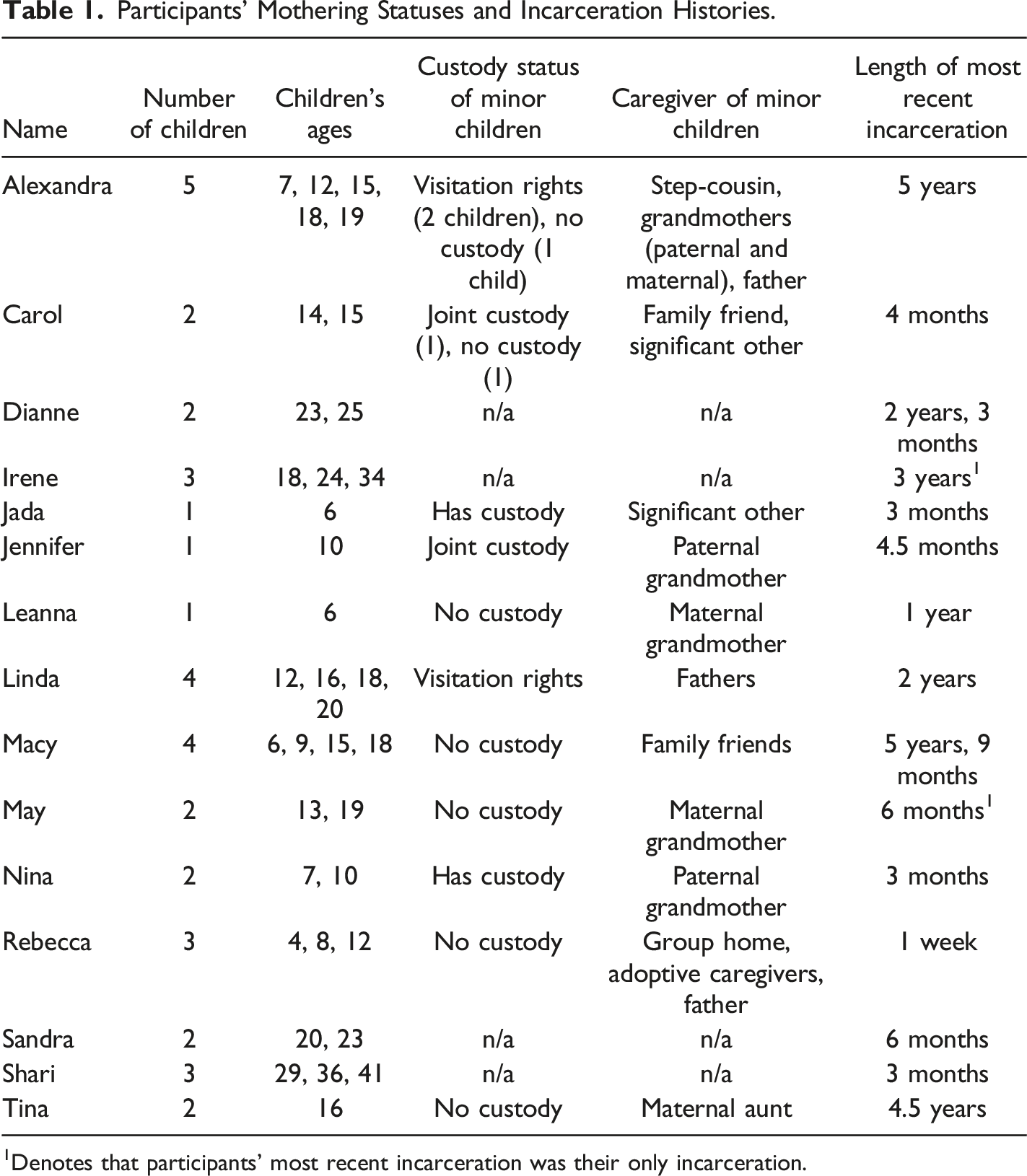
1Denotes that participants’ most recent incarceration was their only incarceration.
Data Collection and Analysis
Due to ongoing concerns related to COVID-19 and to accommodate participants’ schedules, we allowed participants to choose their preferred mode of interviewing: In person, via telephone calls, or via video calls. Most women chose to speak with us over telephone calls, with only one interview occurring in person, and one via video call. 2 Before beginning the interview, we reintroduced ourselves and our research, explained the risks and benefits of participation, reviewed participants’ rights, and provided information on compensation. After confirming that participants had no questions or concerns about the research, we requested their oral consent to proceed with the interview. With participants’ consent, all the interviews (which lasted approximately 45 minutes on average) were audio recorded and later transcribed verbatim.
Both authors conducted interviews over a seven-month period, from December 2021 through July 2022. The fact that both authors are women (and one is a mother) likely influenced participants’ comfort in sharing intimate details about their challenges as women and mothers. In addition to questions related to participants’ basic demographic information (such as their race, age, marital status, and the custody status of their children), the interview guide covered three substantive areas: 1) Participants’ early life-course experiences; 2) participants’ attitudes toward motherhood; and 3) participants’ mothering experiences during reentry.
Data collection and analysis occurred simultaneously, and we used preliminary findings to inform continued data collection efforts. To increase our exposure to our population of interest (Small & Calarco, 2022), we intentionally used a semi-structured but open-ended interview guide that allowed participants to speak at length about the issues most important to them. Although we had a set of questions that we asked all participants, allowing participants to veer away from this guide allowed them to share deeply personal information about which we may not have thought to ask. As a result, we have several hours of rich data across our 15 interviews. Additionally, to ensure that we were capturing a wide range of formerly incarcerated mothers’ reentry experiences, we intentionally recruited both those early-on in their reentry and (later) those further along. Here, our iterative process of data collection and analysis was particularly important: Following our initial interviews and preliminary analyses, we found that we lacked data from women further along in their reentry process. To address this, we worked with Reentry ORG staff members to identify potential participants from the organization’s independent living program. Staff members distributed flyers to women living in Reentry ORG-sponsored apartments and offered us the contact information of interested women. Although our final sample ultimately consisted of a majority of those early in their reentry, this strategy allowed us to recruit more participants in the independent living program than did initial recruitment attempts. After several rounds of data collection and analysis, we were confident that we had reached the point of saturation, when continued data collection was unlikely to yield new findings (Charmaz, 2014).
We offered participants a $25 e-gift card at the end of the interview as a token of our appreciation for their time and their willingness to share their stories. We employed an inductive grounded theory approach to analyze the interview data (Charmaz, 2014). This data analysis was not purely grounded, as our interview questions were guided by research on reentering women’s relationships with their children (Arditti & Few, 2008; Garcia-Hallett, 2019a) and their own maternal identities in light of their criminal-legal contact (De Coster & Heimer, 2020; Garcia-Hallett, 2019a; Robison & Hughes Miller, 2016; Williams et al., 2021). We used ATLAS.ti (a qualitative data analysis software program) to store, organize, and analyze the data. We began our analysis with open, line-by-line coding of transcripts. During this initial stage, coding was both descriptive and analytic. For example, codes included “marital status,” “number of children,” as well as “feeling dehumanized.” After this stage, we reviewed and edited codes using a constant comparative method (Charmaz, 2014; Tracy, 2013). During this secondary coding stage, we refined and clarified codes, and we used memos and coding maps to trace connections between codes and the categories to which they belonged. This final staging allowed us to identify the key themes that form the basis of the findings we describe next.
Findings
We present our findings in two sections. First, we explore how participants processed and articulated past experiences of adversity, including those related to abuse, poverty, addiction, and contact with the criminal legal system. Next, we describe how participants incorporated these experiences into the stories they told about themselves as mothers and about their mothering practices. We argue that these stories reflect “narrative resilience”—the process through which participants incorporated themes of strength and perseverance when talking about their maternal identities.
Narratives of Adversity
Participants’ narratives revealed histories of cumulative and connected adversities related to childhood abuse, victimization, substance use disorders, homelessness, poverty, criminal legal contact, and the loss of children. When reflecting on their past adversities, women identified how these early life-course experiences were linked to future challenges. For example, Shari (Black, 58 years old), described the lasting impact of the disbelief she encountered when she disclosed that she had been sexually assaulted as a child. She stated, “They heard me, but nothing was done about it. So, I grew up just not as I was…Grew up just not telling people things. If something happened to me, I just kept it to myself and tried to deal with it on my own.” Carol (white, 36 years old) similarly shared that the emotional and physical abuse she faced throughout her childhood generated feelings of inadequacy and an inability to connect with people in her life, including her children: (…) not everyone, but the majority of us, we do love our kids. We just don’t know how to love ourselves, and that’s where we go wrong. It’s never that we don’t love our kids because we do. It’s that we don’t love ourselves. And that impacts everything because if you don’t love yourself, you can’t love nobody else.
Women also identified their substance use as a product of past and ongoing traumas. For example, Nina (white, 32 years old) explained how past traumas led to her substance use, stating, “But the reason I got high was to forget the memories and to forget the things that happened. And when you don’t get high anymore, all that stuff comes back…” Although women often discussed their substance use as a coping mechanism for past adversities and traumas, they also identified the hardships caused by cycles of addiction and criminal legal contact. Indeed, most participants had experienced multiple periods of incarceration that ranged from relatively short, week-long periods to over five years, and they described the criminal legal system as inescapable, uncaring, and deceptive. Macy (white, 38 years old), for example, described prison staff as “emotionally destructive,” and she described the trauma she endured when she was forced to give birth while handcuffed to her hospital bed only to have her newborn taken away shortly after birth. In her words, “it’s about the most hurtful thing that somebody can do to you.” Nina (white, 32 years old) echoed Macy’s feelings of dehumanization when she voiced the sense of helplessness she felt when the criminal legal system defined her by her past substance use, regardless of her current actions. She shared: I felt like no matter what, no matter what I did, because I was an addict, regardless of whether I was giving clean urines or doing what I was supposed to be doing, it didn’t change the fact of how they looked at me. They didn’t view me as a fucking human being anymore. They viewed me as a drug addict.
Every single participant also experienced challenges related to being away from their children—whether permanently (due to loss of custody) or in the short term (while going through incarceration or Reentry ORG’s programs). When asked about her worst memory as a mother, Irene (white, 52 years old) emotionally described the day she got incarcerated as “the worst, because I had to tell my kids I wasn’t coming out.” Rebecca (white, 31 years old) expressed that she felt “empty” as she went through the motions of relinquishing her parental rights, and she spoke wistfully of missing the everyday aspects of motherhood, such as “waking up with them at my house, making breakfast, making them baths (…).” The trauma of losing children pushed some women back towards substance use and criminal legal contact. For example, Linda (white, 38 years old) explained how her contact with Child Protective Services “fueled [her] addiction even more.” In her words, “I already lost custody of my kids (….) I have to fight to get visitation and everything. I lost custody of my kids. I might as well just keep going.” Similarly, Tina (Black, 41 years old) explained that substance use served as a coping mechanism so that she “didn’t have to deal with the reality of being such a shitty mom.”
Together, mothers’ stories of childhood traumas, dehumanization at the hands of the criminal legal system, and pains of losing their children reveal their long and intertwined histories of adversity. Now involved in a reentry program designed to support them in their efforts to break the cyclical patterns of adversity that had thus far defined their lives, participants worked intentionally to bridge the gap between their past traumas and criminal legal contact and their current roles as mothers in reentry. Next, we reveal how women incorporated the narratives of adversity we have described in this section to connect and harmonize their past and present selves.
Narrative Resilience
In this section, we explore how participants embraced their histories of adversity and criminal legal contact as they constructed their maternal identities. Rather than drawing on entirely new narratives or reconstructing their ideals of motherhood, these women harmonized their criminalized identities and their past traumas with their maternal identities by engaging in narrative resilience: The process through which they connected seemingly conflicting identities through stories of strength and perseverance.
Participants recognized the dissonance that society perceived between being a “good” mother and one with criminal legal contact. Carol (white, 36 years old), for example, was acutely aware of societal expectations of good motherhood and how these exclude certain mothers. When asked what she thinks society expects of her as a mother, Carol shared, “Perfection. They say they don’t, but they do…” She went on to explain that she perceives this expected “perfection” to mean, “Somebody’s not an addict. Somebody that makes time for their kids.”
Like Carol, Linda (white, 38 years old) reflected on the negative judgements that system-impacted mothers face, sharing that they are “looked at the wrong way.” She stated: (…) Society just looks at us really badly, just because of what we’ve been through and what we’ve put our kids through, how long it took us to get back on track. It’s a lot of negativity and being looked at the wrong way, versus, “We made mistakes. We’re all human.”
Interviewed mothers were thus aware that system-contact is often perceived as incompatible with good motherhood, and they harmonized this gap by acknowledging their difficulties in living up to conventional mothering ideals while also emphasizing their own strength in overcoming these difficulties. Nina (white, 32 years old) expressed her awareness of the judgement she faced as a system-impacted mother, but she simultaneously connected her maternal identity to the adversities that she had survived. By framing her motherhood and survival against the backdrop of the adversity she has faced, Nina highlighted both her resistance to stigma as well as her resilience: (…) other people might see me as a bad parent because the choices I’ve made in my life. But then I tell myself, if they only knew half of what you’ve been through in your life, would they still be here?
Women’s persistent self-reminders of their resilience, however, were not always successful in warding off the resentment they felt toward those who negatively judged their mothering identities. Macy (white, 38 years old), for instance, described the frustration she sometimes felt towards the family members who had custody of her child because they “…sat back, and basically watched me lose my child, and then took my child.” Macy engaged in very purposeful narrative work to move past her feelings of anger toward these family members when she explained that she could not fully blame them because (in her view) they simply did not have the capacity to understand the circumstances that led to her losing custody. Macy’s vacillation between resentment and understanding was evident in her acknowledgement of her own mothering efforts in the face of immense challenges: I know that they just don’t know no better because they’ve never been in my shoes. So, they don’t know what it’s like to not have transportation…I mean, I can’t blame them for not knowing, but the circumstances is, is that I tried, but I really didn’t have a support system.
When asked how she believed others in her life saw her as a mother, Carol (white, 36 years old) did not attempt to distance herself from her history of addiction (De Coster & Heimer, 2020; Gunn et al., 2018; Opsal, 2011; Robison & Hughes Miller, 2016), nor did she try to redefine what it meant to be a good mother (De Coster & Heimer, 2020; Opsal, 2011; Robison & Hughes Miller, 2016; Stone, 2016). Instead, she pointed out that the sacrifice and unconditional love associated with conventional mothering was actually quite compatible with her addiction. In contrast with the reentering women in other studies (Gunn et al., 2018; Opsal, 2011; Robison & Hughes Miller, 2016), Carol did not contend that others were incorrect in how they defined “good” mothering; she simply emphasized that addiction was consistent with traditional mothering ideologies. In Carol’s words, those who disagreed “just don’t get it.” Through narrative work centered on the strength it took to “suffer” through addiction as a parent, Carol was thus able to harmonize her identities as both “an addict and a parent.” Well, it depends if they’ve been an addict themselves. If they’ve never been an addict, they just don’t get it. They just don’t understand how you can say you love someone and do the things you do, but those who have suffered through addiction and know what it looks like when you’re an addict and a parent, they know that I’m a good mom and I try to be a good mom.
Nina (white, 32 years old) went so far as to express optimism that her own resilience could protect her children from the stigma they faced because of her actions. Nina framed the tenacity required to confront the challenges she faced as “ammunition” that her children could use to “fire back” if they ever experienced stigma. Nina had already internalized the negative labels marshaled against her and she employed common narrative techniques to distance her current self from her past when she asserted she “used to be” those things but “was not that person anymore.” This narrative work mirrors past findings on how reentering women’s narratives may construct themselves as new, or reborn (Gunn et al., 2018; Opsal, 2011; Stone, 2016). Notably, however, Nina did not present labels such as “whore” or “drug addict” as irrelevant relics of her past, nor did she try to distinguish these labels from her “core” or “real self,” whether past or present (Stone, 2016). Instead, she reconciled her past and current mothering identity by focusing on the perseverance she displayed in overcoming the stigma associated with these labels. Interestingly, Nina’s narrative resilience did not manifest through a “redemptive suffering” story in which she emphasized that her struggles were necessary for her to become the person she now was. There was instead a fierce resistance to the stigma she faced that was rooted in the pride she felt because she had persevered through adversity. Her resilience, then, generated her resistance: I was an escort. And looking back at the things I’ve done, and it’s like, I don’t want somebody else’s child saying, “Oh, your mom was a whore.” And it’s like, “that’s my mom. Don’t say that. She was not.” And then it’s like, “oh, well, yeah, she definitely was. I can prove it.” Those are things that I worry about now. “Oh your mom’s a drug addict.” Yeah. She was. She’s not anymore. And I guess that’s what makes me feel good because now they have ammunition to fire back. “Oh, your mom’s…” She used to be. She’s not that person anymore.
Women discussed their perseverance most emphatically in narratives about mothering during reentry, when they noted the validation they had received—often from their children—for their tenacity as mothers. For example, when discussing her best memory as a mother, Nina stated, “The day I got clean. I’ve worked so hard to get where I’m at right now and just to see my kids smile and my oldest daughter tell me, ‘Mommy, everything’s going to be okay because you’re okay now.’ It’s the best moment I had in a very long time.” For women like Nina, the most rewarding dimensions of motherhood were intricately tied to hardships that had been successfully overcome. Other women invoked their perseverance in overcoming the hardships generated by poverty, addiction, abuse, and criminal legal contact as evidence of their potential to be good mothers. In so doing, they connected and harmonized their two seemingly incongruous identities as both system-impacted women and mothers. Sandra (white, 42 years old), for example, explained that she tried to teach her son that his past mistakes did not define him, just as hers did not define her: Even though he’s gotten in trouble, he doesn’t have to let it define him. He can learn from it and choose to go a different path. And I hope that he stays on that path because even though I’ve made bad choices, I’m not trying to let this define me.
Similarly, Dianne (white, 45 years old) explained that after her son was incarcerated, she used her own incarceration to set an example for him. Dianne described her resilience in overcoming the challenges associated with criminal legal contact as a mothering tool with which she could reach her son more effectively. In her words, “He made this mistake, and he wound up in jail…And I got him to understand that, look, I have an addiction, so my mistake keeps me making my mistake over and over. It’s not a one-time deal for me.” As her son struggled with his own contact with the criminal legal system, Dianne reflected on her own history with the system, stating, “I’ve made some mistakes and whatever, but I can move on. I don’t lie about the things I’ve done and I’m not proud of them either, but it is what it is.”
Alexandra (white, 40 years old), on the other hand, explained that she was not present during her children’s teenage years, and she blamed herself when they got into trouble. Diverging sharply from the narratives of mothers who frame their system-contact as beneficial for their children (for example, their development of independence and mental toughness) (Opsal, 2011), Alexandra identified how her actions harmed her children. Through her emphasis on her own transformation, however, Alexandra conveyed her conviction that her past failures did not define her—as a mother or as a person. In fact, her narrative reflected her view that her identity as a mother could be redeemed by using her own resilience as an example for her children. In her words, “…I really just want to show them that change is possible.” Rather than cognitively distancing themselves from their past criminal legal contact or redefining “good” motherhood, women like Alexandra thus embraced this past and used it to connect with their children. For these mothers, past adversities and the perseverance needed to overcome them were thus important in shaping their mothering identities and behaviors.
Other women used narratives of perseverance to emphasize their capacity to be good mothers by emphasizing that they remained active in their children’s lives despite the challenges and hardships that characterized their own lives: Much as Carol highlighted how difficult it was to parent through addiction, Leanna emphasized her maternal fortitude in light of what she has “been through,” and Sandra similarly noted that even in periods of disruption, she always persevered in her role as a mother. And even when I’m incarcerated or doing whatever I’m doing, I’m still a part of his life. I don’t just abandon him… Whether I’m doing good or not, there’s going to be people out there that see only the bad that I do. But then there are people out there that even after everything that I’ve done and been through, can still see that I am a good mom. I do care about my son and love him. (Leanna, white, 29 years old) I’m there to support them, but I want them to see that I’m there for them, to be in their lives. I want them to know that I’m present and I have been, even though I had windows of disruptions, but I want to rebuild. (Sandra, white, 42 years old)
The women’s emphasis on their perseverance—whether framed as a parenting tool or as indicative of their capacity as mothers—connected their past selves to their current selves. Participants took pride in their ability to overcome hard times, they were honest with their children about their criminal legal contact, and they cast their ability to work through criminal legal contact while remaining active in their children’s lives as positive attributes. Instead of completely constructing new identities as individuals in reentry, these women thus weaved a harmonious narrative that connected their past mistakes to their present maternal identities.
Conclusion
Using in-depth interviews with mothers in reentry, we have argued that formerly incarcerated women use narrative resilience to harmonize their criminalized and maternal identities through stories of strength and perseverance. Our findings extend research on motherhood and reentry by revealing how formerly incarcerated women’s resistance to dominant mothering ideologies—and the stigma that these ideologies generate for those unable to live up to them—was in many ways connected to the stories they told of their resilience as mothers. Rather than simply distancing themselves from their hardships and criminal legal contact or rejecting others’ negative evaluations of them, the women also centered the strength they needed to survive these experiences of adversity. Importantly, we do not suggest that narratives of resilience are entirely distinct from narratives of resistance; instead, we have demonstrated how the latter were embedded within the former as mothers reflected on their efforts to overcome often-lifelong histories of adversity.
In interpreting our findings, it is important to note again that we focused not on acts of resilience, but on how participants constructed stories of resilience. Our findings thus contribute to the burgeoning body of work in narrative criminology and (more recently) narrative victimology. Whereas much of the existing research on motherhood and reentry has explored how women renegotiate their conceptualizations of motherhood (De Coster & Heimer, 2020; Robison & Hughes Miller, 2016) or resist their past criminal legal contact by presenting alternative experiences (Stone, 2016), we point to how women also framed their histories of adversity as compatible with—and even conducive to—the development of positive maternal identities.
This article represents an effort to shift attention away from desistance processes to instead explore how women’s criminalized identities are intertwined with other roles and identities, such as motherhood. Our findings support existing research that has called attention to the ways in which criminalized and conventional identities can exist in harmony (Wilkinson et al., 2009). Interestingly, Stone (2016) found that mothers whose substance use persisted were less likely than their desisting counterparts to engage in redemption narratives that differentiated between their “good core” self and their substance use. Although our study did not focus specifically on desistance, our current findings suggest that even women who are successful in reentry and recovery do not necessarily feel the need to draw a sharp distinction between their past and present selves. Rather, through narratives of strength and perseverance, they incorporated past substance use, trauma, and criminal legal contact into their current narratives as mothers in reentry. Whereas “redefinitions” (of crime as well as identity) are no doubt important in individuals’ desistance processes (Giordano, 2022; Stone, 2016), our findings thus underscore the significance of reconciliations as system-impacted women reflect on the different dimensions of their own histories and identities.
As noted earlier, all but one of the women in our sample were still receiving services from Reentry ORG during their reentry period. In addition, while living in Reentry ORG housing (an opportunity for which many women had to apply), mothers were unable to physically reside with their children. Given that the majority of our participants were actively involved in reentry programming and were not living with their children, the findings we have described may not extend to formerly incarcerated women further along in the reentry process, to women whose children live with them, and/or to women who are unable or unwilling to receive reentry support. Rather than generalizability, however, our goal was to illuminate the narrative techniques that formerly incarcerated mothers may employ to make sense of their mothering identities—techniques that are likely to vary based on time and life circumstances. Past research consistently suggests that the reentry and desistance processes evolve over time, and as such, are best captured using longitudinal methods (Giordano, 2010; Leverentz, 2014). Longitudinal research is particularly useful in the context of motherhood and reentry, as it can provide in-depth understandings of the impacts of the criminal legal system on families over time (Giordano, 2010). Future researchers should thus seek to explore how the harmonizing narratives we have described here shift as women move through the reentry and reintegration process and as they gain (or perhaps lose) custody of, and access to, their children.
Footnotes
Declaration of Conflicting Interests
The author(s) declared no potential conflicts of interest with respect to the research, authorship, and/or publication of this article.
Funding
The author(s) received no financial support for the research, authorship, and/or publication of this article.
Notes
Author Biographies
