




Abstract
The relationship between gender, self-esteem, narcissistic traits, and aggression was evaluated in a sample of justice-impacted youth (JIY). Forty-two audio-recorded interviews (n = 21 boys; n = 21 girls) with equal representation of low, moderate, and high self-esteem scoring JIY were selected. Narcissistic features could be reliably coded retrospectively; common features included: arrogance, interpersonal exploitation, and lack of empathy or shame. No gender differences emerged in feature frequency or type. Correlational analyses revealed that narcissistic traits were significantly correlated with self-report measures of aggression; only girls evidenced this relationship. A potential gendered relationship between narcissistic features and aggression merits further investigation.
Introduction
Scholars have been researching delinquent and criminal behaviour for well over a century. However, these constructs have traditionally been studied in boys and men rather than in girls and women (Brown & Gelsthorpe, 2022; Hubbard & Pratt, 2002). Nevertheless, it is imperative to determine whether traditional measures used in correctional settings encapsulated within the Risk-Need-Responsivity rehabilitation framework originally proposed by Andrews et al. (1990) are relevant for justice-impacted girls and women, as the rate at which girls and women are encountering the criminal justice system has significantly increased since the year 2000 (Blanchette & Brown, 2019). We acknowledge that gender is a socially constructed term that captures social expectations about gender role conformity, whereas sex solely connotates biological differences. Throughout this article we use the term gender, rather than sex. Further, when our study was conducted, we did not measure gender diversity; thus, our manuscript treats gender as a dichotomy.
Gender Neutral versus Gender Responsive Models of Correctional Rehabilitation
While gender-neutral models of correctional rehabilitation have demonstrated empirical validity (e.g., the Risk-Need-Responsivity rehabilitation framework originally proposed by Andrews et al., 1990), research suggests that these models may insufficiently underscore the importance of hypothesized gender responsive needs. Consequently, the high prevalence of gender responsive needs (e.g., mental health, trauma related to past experiences of abuse, parental stress) experienced by justice-impacted girls and women may ultimately go unaddressed. For justice-impacted girls in particular, self-esteem may be a need that merits more attention as many justice-impacted girls evidence low self-esteem (Hubbard & Pratt, 2002; Van Voorhis et al., 2010) which in turn may impact their ability to meet educational goals, form prosocial friendships, and develop prosocial skillsets necessary to live law abiding lifestyles.
To explore the potential impact of needs that may be specific to girls/women that were not included in the original RNR model (Andrews et al., 1990), Van Voorhis et al. (2010) assessed multiple samples of justice-impacted women at various points during the correctional process (i.e., pre-release, probation, and prison). The authors used a supplementary measure comprised of various gender-responsive items such as self-esteem, adverse childhood experiences, and adult victimization. An examination of recidivism rates at a fixed, 24-month follow-up period supported the value of supplementing a gender-neutral risk tool with gender-responsive items. Overall, the results demonstrate the value of using gender-responsive items to supplement current gender-neutral tools; however, the value of each item differed depending on the point in the correctional process. Moreover, the results were mixed regarding self-esteem (e.g., self-esteem was significantly negatively associated with recidivism in the probation sample, but it was not consistently associated with misconducts in the prison sample). Consequently, further research is required to gain a deeper understanding of the role that self-esteem plays when assessing it’s influence on criminal behaviour.
A subsequent study conducted by Thapa et al. (2021) analyzed the relationship between self-esteem, criminal attitudes, and recidivism rates in a sample of justice-impacted youth (n boys = 200, n girls = 100). Criminal attitudes predicted recidivism in both genders. However, self-esteem in and of itself did not predict recidivism in either gender. Interestingly, it was the girls with high self-esteem (>76th percentile) and strong criminal attitudes who were more likely to recidivate. The same pattern did not emerge for the boys; whether these findings will replicate warrants investigation.
Self-Esteem, Narcissism, and Aggression
Scholarship from the general personality and social psychology fields have underscored the complexity of self-esteem. Further, it has been suggested that some self-esteem measures may be erroneously detecting related but distinctly different constructs such as narcissism (e.g., Salmivalli, 2001). The findings revealed in the Thapa et al. (2021) study leave scholars questioning whether high self-esteem really is correlated with higher rates of recidivism, or whether there may be other confounding variables at play, such as narcissism. It is possible that the girls in the Thapa et al. study evidenced genuinely high self-esteem. However, it is also possible that the self-esteem measure was erroneously detecting an inflated sense of self, or narcissism.
Although narcissism and self-esteem are similar (both measure a form of high self-regard), it is important to underscore the distinction. Specifically, high self-esteem is associated with a normative self-regard, an understanding of one’s limitations, and a preference for getting along with others (Rosenthal et al., 2020). In contrast, narcissism is associated with a grandiose sense of self-importance and superiority, which has been linked to aggression and violence (Baumeister et al., 1996).
Generally, self-esteem is defined as a positive or negative evaluation of the self, including feelings and thoughts that are related to the self (Rosenberg, 1965). One of the most widely used self-esteem scales is the Rosenberg Self-Esteem Scale (RSES; 1965). Self-esteem has traditionally been conceptualized as a dichotomy: high versus low; however, it is becoming apparent that self-esteem is more complex. For instance, Baumeister (1993) conceptualized self-esteem as being either a global trait (i.e., it remains relatively stable over time) or a situational state (i.e., it fluctuates depending on the environment). Further, some scholars recognize that they may be differences between cognitive self-esteem (i.e., attitudes and beliefs about the self), versus affective self-esteem (i.e., emotions and feelings about the self; Mruk, 2013). Finally, it is recognized that gender may play a role in self-esteem, as it has been documented that boys and men typically report higher levels of self-esteem than girls and women, regardless of age or culture (Bleidorn et al., 2016).
Historically, the general agreement in the psychology literature has been that low self-esteem is related to aggressive behaviour (Adler, 1956; Horney, 1950). Scholars have also found this to be true in youth samples. For example, Sprott and Doob (2000) analyzed the correlation between conduct disorder/physical aggression and self-esteem in a sample of 10- and 11-year-old Canadian children (n = 3000). The authors found that the most aggressive children had the lowest self-esteem, regardless of gender.
Conversely, a second body of literature has suggested that aggressive behaviour is related to high self-esteem. Wormith (1984) assessed the influence of self-esteem, identification with delinquent behaviour, identification with criminal others, and attitudes towards the judicial system, among others, on recidivism rates in a sample of incarcerated men (n = 50). Wormith found that the participants’ whose self-esteem had increased, when paired with identification with delinquent behaviour, had the highest rates of recidivism. Similarly, a more recent study conducted by Schanz (2017) measured the relationship between self-esteem, violent behaviour, and self-destructive behaviour in a sample of incarcerated adults from a County prison in the United States (n men = 156, n women = 25). The authors found that the participants with high self-esteem were more likely to engage in violent behaviour, and the participants with low self-esteem were more likely to engage in self-destructive behaviour.
Due to these conflicting findings regarding the relationship between self-esteem and aggression, scholars have suggested that there may be an additional construct, specifically narcissism, that may be accounting for the mixed self-esteem results (Baumeister et al., 1996; Rosenthal et al., 2020 Salmivalli, 2001). Baumeister et al. reviewed the relevant empirical evidence in which they challenged the traditional views that low self-esteem is linked with violent behaviour. The authors concluded that grandiose ideas of self-importance and superiority are common among people who engage in violence. Specifically, Baumeister et al. noted that this is not genuinely high self-esteem, but an inflated sense of self-worth, or narcissism, that characterizes individuals who engage in violence. Additionally, the authors suggest that this inflated sense of superiority is fragile, meaning that when individuals living with narcissism experience perceived disrespect or criticism, they may resort to violence because of their threatened egotism. Moreover, the authors suggest that this finding may be relevant to delinquent youth and bullies as well.
Clinically, narcissism is classified in the Diagnostic and Statistical Manual of Mental Disorders Fifth Edition (DSM-V, 2013) as Narcissistic Personality Disorder (NPD). NPD is characterized by a grandiose sense of self-importance, imaginations of success or power, beliefs that one is special or unique, demands of excessive admiration, a belief of entitlement, interpersonal exploitation, a lack of empathy, a perception that others are envious of them, and arrogant behaviours or attitudes. Although there are diagnostic criteria for NPD, it is not uncommon for individuals to have some narcissistic traits without meeting the full diagnostic criteria. Theoretically, narcissism is depicted in the literature as being a pathology characterized by grandiosity, superiority, hyper-sensitivity, and reactiveness (Rogoza et al., 2020).
The mixed literature regarding the relationship between self-esteem and narcissism has led some scholars to posit that current self-esteem measures may be erroneously detecting narcissism instead of true high self-esteem. As a result, Rosenthal et al. (2020) created a scale to distinguish narcissistic grandiosity from high self-esteem, as the authors hypothesize that it is narcissistic grandiosity that, when present, traditional self-esteem measures are accidentally detecting. The authors examined the construct validity of the scale in a sample of university students (n men = 71, n women = 76). Rosenthal et al. found that narcissistic grandiosity was highly correlated with other constructs related to narcissism such as entitlement, competitiveness, behavioural aggression, lack of shame, and superiority. Further, it was found that self-esteem was more strongly correlated with constructs related to genuinely high self-esteem such as satisfaction with life and optimism. Rosenthal et al.’s study provides valuable evidence that narcissism, or narcissistic grandiosity, is a distinctly different construct from high self-esteem.
The Current Study
In summary, it remains unclear whether high or low self-esteem is related to aggression, or whether standard self-esteem measures may be erroneously detecting narcissism instead of genuinely high self-esteem (Baumeister et al., 1996; Rosenthal et al., 2020; Salmivalli, 2001). Hence, our study aims to further explore the relationship between self-esteem, narcissism, aggression, and violent recidivism in a sample of justice-impacted youth—boys and girls. A sub-sample of the data from the Thapa et al. (2021) study was analyzed to determine (1) whether narcissistic traits would be more present in justice-impacted youth who score high on self-esteem versus those who score low, and whether gender would moderate this difference, and (2) whether narcissistic traits and self-esteem would correlate with aggression, and whether narcissistic traits and self-esteem would predict violent recidivism. It is hypothesized that (1) justice-impacted youth who score high on self-esteem will evidence more narcissistic traits than those who score low on self-esteem, and that this relationship will be consistent across genders; and (2) that the presence of narcissistic traits will have a positive relationship with both aggression and violent recidivism, and that self-esteem will have a negative relationship with both aggression and violent recidivism.
Methods
Participants and Procedures
Ethical clearance was obtained for a larger study (see Brown et al., 2021). For the larger study, participants were recruited from an out-patient mental health centre (vis-à-vis face-to-face recruitment interviews with assessment staff), a probation office (vis-à-vis recruitment posters), and two custodial facilities (vis-à-vis face-to-face recruitments interviews with trained research assistants). Each recruitment site provides various services to justice-impacted youth in urban areas within central and eastern Ontario, Canada. For a more detailed description of participant recruitment (e.g., consent and participation rate), see Brown et al.
Data collection occurred between 2009 and 2012, recidivism information was obtained in 2014 and 2016, respectively. The total sample for the original study was 300 justice-impacted youth – 66.7% (n = 200) boys, and 33.3% (n = 100) girls aged 12 – 21, (M = 16.8, SD = 1.25). Of the 300 participants who were interviewed, 200 participants consented to have their interviews audio-recorded which were then transcribed; only participants assessed while in custody facilities or on probation were included in this study, as the out-patient mental health centre did not record interviews.
Of the 200 transcribed interviews, stratified sampling was used to obtain an equal number of boys and girls, as well as an equal number of participants who scored either low (<33rd percentile), medium (33rd – 66th percentile), or high (>66th percentile) on a self-report self-esteem measure, the Rosenberg Self-Esteem Scale (RSES; Rosenberg, 1965). The participants for the sub-sample (n = 42) were 50% boys (n = 21) and 50% girls (n = 21). There were more than seven girls and boys who fell into each self-esteem category, thus the selection of seven from within each self-esteem category was random. When the interviews were collected the youth in the sample had either been convicted for a crime(s) or were remanded to custody pending trial outcome. The youth had been convicted (or were standing trial) for a range of crimes including homicide, assault-related charges, robbery, theft, property damage, breaking and entering, arson, fraud, drug-related, and weapon-related crimes.
The sub-sample ranged in age from 13 – 19 (M = 16.69, SD = 1.22). With regards to gender, the boys ranged in age from 16 – 19 (M = 16.86, SD = 0.91), and the girls ranged in age from 13 – 19 (M = 16.52, SD = 1.47). The magnitude of the gender difference was small (Cohen’s d = .28; Hyde, 2005). Consistent with the total sample, the sub-sample was predominantly White (35.7%, n boys = 5, n girlss = 10) and Black (23.8%, n boys = 4, n girls = 6). There were two youths who identified as Indigenous (n boys = 1, n girls = 1), and the rest of the sample (n = 15; n boys = 11, n girls = 4) identified as being a member of another racialized group.
Measures
Semi-Structured Pathways Interview
Audio-recorded, semi-structured interviews were conducted face-to-face with the youth; trained graduate student researchers conducted the interviews in the probation office and the custody facility. The semi-structured pathways interview was designed to collectively measure the Hare Psychopathy Checklist: Youth Version (PCL:YV; Forth et al., 2003), the Youth Assessment Screening Instrument (YASI; Orbis Partners, 2009), and the Youth Level of Service – Case Management Inventory 2.0 (YLS-CMI, 2.0; Hoge & Andrews, 2011). The PCL-YV taps into many traits congruent with narcissism (e.g., grandiose sense of self-worth, callous/lack of empathy). Similarly, both the YLS/CMI and the YASI semi-structured interview questions lend themselves readily to the assessment of narcissistic traits as they allow the person being interviewed to express their attitudes, thoughts and feelings about their crime(s), family, peers, romantic partners, and criminal justice institutions in a relatively open-ended fashion. Only the YASI will be reviewed in greater detail, as it is not as well known in the peer-review published literature relative to the PCL-YV or the YLS-CMI.
Youth Assessment Screening Instrument (YASI)
The YASI (Orbis Partners, 2009) is a risk/need/strength assessment measure designed to assess several static and dynamic factors associated with criminal behaviour (i.e., criminal history, family, social networks, mental health, substance use, school, attitudes, social/cognition skills, free time/employment, violence/aggression). Risk and strength scores from the YASI have demonstrated predictive validity for recidivism in a sample of justice-impacted youth – boys (AUC = .64) and girls (AUC = .62; Scott et al., 2019). Additionally, the YASI has demonstrated moderate to strong inter-rater reliability (ICCs rangins from .76 to .93) and internal consistency (ranging from α = .59 to α = .91) for each domain in a sample of justice-impacted boys (Geck, 2013).
Narcissism Scale (NS)
The NS (Brook, 2021) was developed specifically for our study. Using both the Narcissistic Grandiosity Scale created by Rosenthal et al. (2020) and the diagnostic criteria for narcissistic personality disorder (DSM-V, 2013), a measure was created to assess the audio-recorded semi-structured interviews (that were designed to measure the PCL:YV, the YASI, and the YLS-CMI) for the presence of narcissistic traits. A total of ten items were created and defined. Once the measure was created, the author coded three interviews (that were not one of the 42 chosen interviews) to determine whether the items could be detected in the audio-recorded interviews. Once it was determined that the items could be detected, inter-rater reliability was obtained using two raters. First, the rater was trained on the coding manual. Next, the rater coded one practice interview, and then met with the researcher to discuss any challenges encountered when using the coding manual. After this meeting, the rater coded one more practice interview, followed by another meeting with the researcher. No further challenges were encountered, so the rater was assigned 20 cases (47.6% of the sample) to code for inter-rater reliability. Finally, inter-rater reliability between the two raters was high (ICC = .91). All coding was completed using the NVivo software (QSR International, 2020).
The NS includes the following ten items: (1) displays a grandiose sense of self-importance, and/or the belief of being special, high-status, or successful; (2) is dominant, authoritative, or powerful; (3) requires excessive admiration; (4) displays a sense of entitlement; (5) is interpersonally exploitative; (6) displays a lack of empathy and/or shame; (7) displays feelings of prominence; (8) displays a competitive nature; (9) displays arrogant, haughty, or disrespectful behaviours or attitudes; and (10) displays a vulnerability in self-esteem. Each item was scored as either absent (0), mildly present or alluded to (1), or present (2). Thus, total scores could range from 0 to 20 with higher scores being indicative of higher levels of narcissism. How each of these ten narcissistic traits manifested themselves among the youth is presented in the results section.
Rosenberg Self-Esteem Scale (RSES)
The RSES (Rosenberg, 1965) is a self-report measure designed to assess global self-esteem using a Likert Scale to score 10 items from ‘strongly disagree’ (0) to ‘strongly agree’ (3). Total scores can range from 0 to 30, with higher scores indicating higher self-esteem, and lower scores indicating lower self-esteem. The items include general statements designed to capture feelings about the self, such as “On the whole, I am satisfied with myself” and “At times, I think I am no good at all” (Rosenberg, 1965). Moreover, the RSES has demonstrated construct validity when measuring global self-esteem in a youth sample comprised of boys and girls (Bagley & Mallick, 2012). Finally, the RSES has shown good composite reliability in a sample of formerly justice-impacted adults, men and women (Boduszek et al., 2013).
Aggression Questionnaire Physical Subscale (AQ-PHY)
The AQ (Buss & Warren, 2000) is a self-report measure that captures anger and aggression. The physical aggression subscale has a total of eight items and is scored using a Likert Scale ranging from ‘not at all like me’ (1) to ‘completely like me’ (5). Higher scores are indicative of more physical aggression, and the scores can range from very low aggression to very high aggression. Some of the items include “I may hit someone if he or she provokes me” and “I have threatened people I know” (Buss & Warren, 2000). The measure has demonstrated strong construct validity, test-retest reliability, and convergent validity with a trait anger measure in several adult samples (Webster et al., 2015).
Direct-Indirect Aggression Scale (DIAS)
The DIAS (Björkqvist et al., 1992) is a 24-item self-report scale that assesses physical, verbal, and indirect aggression. Only the total indirect score reflecting the 12 indirect aggression items will be analyzed. Some of the items include “When you have gotten angry or have had problems with someone how often have you shut the person out of the group?” and “When you have gotten angry or have had problems with someone how often have you become friends with another as a kind of revenge?” (Rawana et al., 2009). The DIAS is scored using a Likert scale ranging from ‘never’ (0) to ‘very often’ (4), and higher scores are indicative of higher levels of aggression.
Violent Recidivism
Criminal recidivism was coded by collecting 2-year follow-up recidivism rates from the Ministry of Community Safety and Correctional Services (MCSCS) and the Royal Canadian Mounted Police (RCMP). Violent reconvictions for uttering threats, weapons-related crimes, robberies, assaults, or homicides were included. For youth initially interviewed in the community, recidivism was coded 2 years after the community-based interviews occurred. For youth initially interviewed in custody, recidivism was coded 2 years after being released from custody. Inter-rater reliability was 90% for each variable (Thapa, 2017).
Results
Descriptive Statistics
Descriptive Data for Self-Esteem, Aggression, and Violent Recidivism.
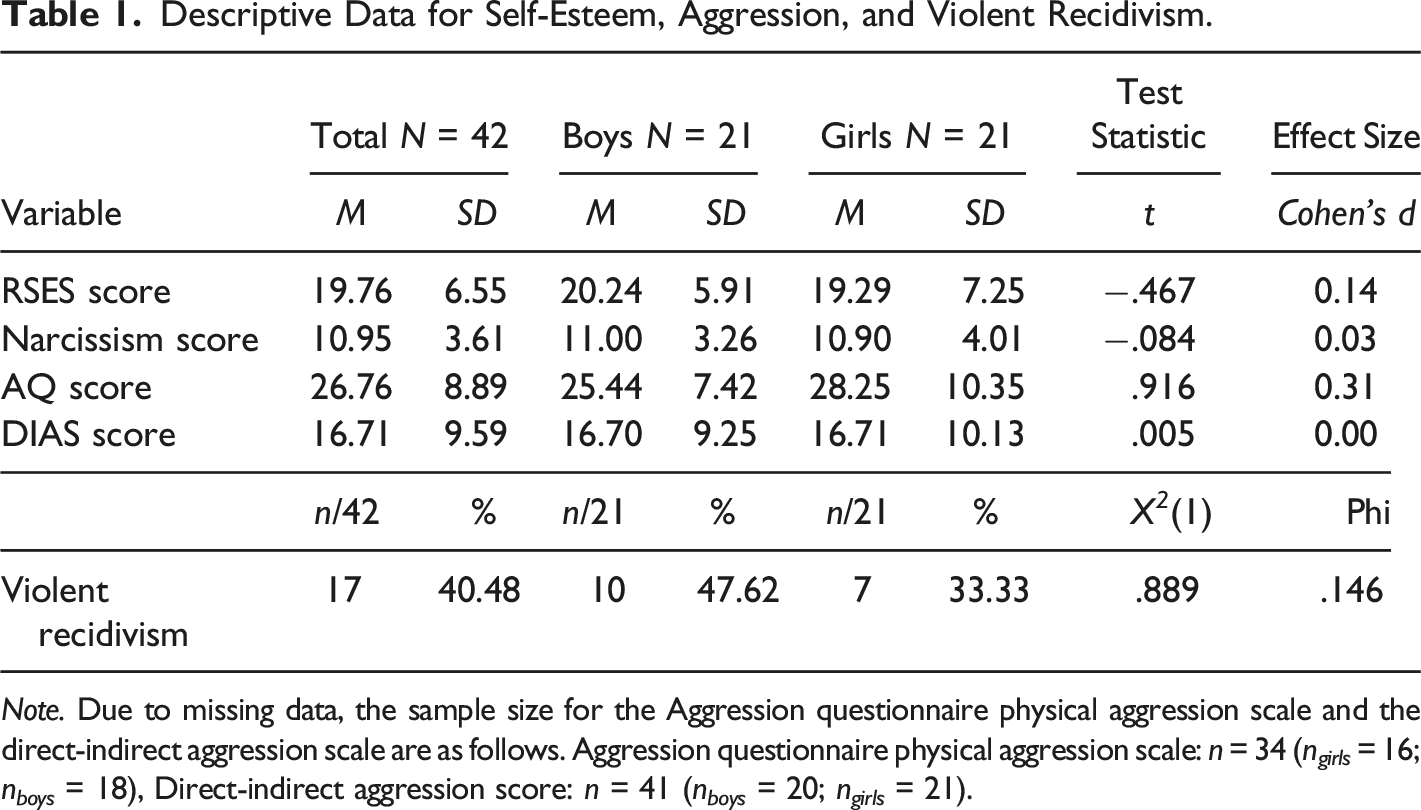
Note. Due to missing data, the sample size for the Aggression questionnaire physical aggression scale and the direct-indirect aggression scale are as follows. Aggression questionnaire physical aggression scale: n = 34 (n girls = 16; n boys = 18), Direct-indirect aggression score: n = 41 (n boys = 20; n girls = 21).
Frequency of Each Narcissism Trait.
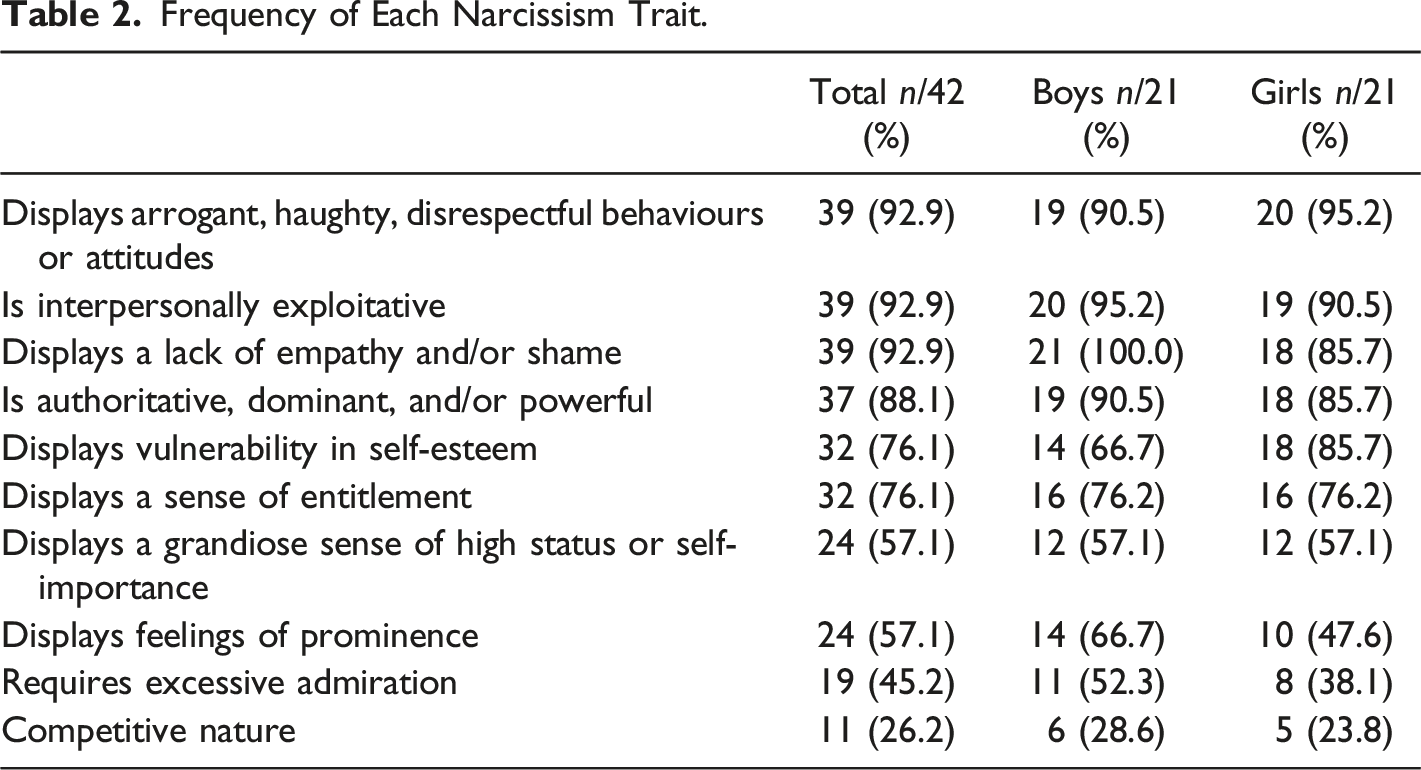
Displays Arrogant, Haughty, Disrespectful Behaviours or Attitudes
The three most common recipients of these attitudes were the police, parents, and other youth and staff in correctional facilities. First, an arrogant opinion of the police is demonstrated when a 17-year-old White girl was discussing her opinion of how the police have handled the case for her assault charge. Specifically, when the interviewer inquired how the police and the courts have handled her case, the youth responded with “like idiots”. When asked for further elaboration, she continued: “because the police are just stupid pigs, and I wouldn’t even be here if it weren’t for them. And the courts are ridiculous. Like, I hate getting remanded every time I go to court”.
Second, the youths often demonstrated arrogant attitudes when it came to their parents’ rules at home. This is demonstrated by a 16-year-old boy who identified as White states that he can frequently find ways to get out of punishments by his parents: “I’d just ignore it completely and do whatever I wanted. Or like, leave and go to a friend’s house or whatever. Or I’d just find my way around it”.
The following quote from an 18-year-old boy of Jamaican descent demonstrates these attitudes towards the staff at the correctional facility in which he was carrying out his sentence, and his social worker: I get angry really easily. I hold everyone to like, a standard, I find. And if you don’t hit my standard of how I think you should be acting or your job, I look down on you. […] Like, the staff here. […] I hold all staff to a certain level; you know what I mean? You should act a certain way being a staff in a group home, a custody facility, social worker. If you don’t hit that standard […] I just lose it. […] you’re just- you know? Do your job better. […] My second social worker was not on the same level as [my first social worker]. I was 18 so like, I was more mature than I was at 15. But again, I told her: I was like “step your game up. You’re a social worker. You should be doing this, this, and this”.
Is Interpersonally Exploitative
The most common behaviours that emerged were theft for personal gain, lying for personal gain, or manipulating someone for personal gain. This is demonstrated when a 17-year-old girl who identified as White discusses how she makes money: “Mostly rob people. Go car hopping. […] We broke into a couple of houses. We stole random shit and sold it”.
When asked about lying for personal gain, the most common instances were lying to parents, lying to police, or lying in court to evade consequences. For instance, when a 16-year-old boy of Haitian descent states that lying is “too easy”, his elaboration echoes many of the statements made by the youths: Because I got in trouble a lot, I had to learn what excuse works and what kind of story goes, what not, and I have a good memory. So, if I am like, [if you are] going to ask me the same question in two weeks, I would be like “I don’t know what you’re talking about” or then “oh yeah, I said that, not what you said”.
Finally, manipulating others for personal gain was present throughout the interviews. For instance, a 14-year-old girl of West Asian/Arabic descent described manipulating a school mate to get her into trouble because the school mate had bullied one of her friends: There was a girl, [name], she walked by me and called me a bitch. That’s what I told [the police] but she didn’t actually do that. And they believed me, and she admitted to it, cuz she’s scared of me. […] And then I like, pushed her like this just to make her hit me. She pinned me against the wall, punched me three times. I started laughing and just grabbed her hair and punched her like, five times, I think. I got on top of her and just continued. […] No one would expect that from me, I’m such a tiny girl. […] No [we didn’t have problems before that]. [I did it] because my friend asked me to. […] She did something to my [friend] or something, and like, broke his phone.
Moreover, the same youth bragged about her ability to manipulate the police into being more lenient with her when asked whether she is usually compliant with them: Yeah. I’m really, really good. I’m good at convincing them. Like, I tell them I wanna be a cop one day and that if you breach me, I’ll never be able to [laughs] cuz it’ll stay on my record. And they’re like “okay, fine, you can have a chance”. And I’ve gotten like, eleven chances [laughs].
Displays a Lack of Empathy and/or Shame
Four main types of statements and behaviours emerged within this feature: (1) the youth would state that they possess a lack of empathy or shame, (2) the youth would laugh while they discuss manipulating or hurting someone, (3) the youth would demonstrate a flat affect while they discuss manipulating or hurting someone, and (4) the youth would only discuss feelings of remorse when it came to consequences, demonstrating that they regret the consequences, but they do not regret their actions.
The most obvious evidence of a lack of empathy or shame would be when the youths answered “no” to questions such as “do you feel bad about hurting someone?” or “are you ashamed of your actions?”. Second, it was common for youths to laugh while they discuss hurting someone, as is demonstrated when this 16-year-old girl of African/Caribbean descent discussed watching her friends and family members assault a stranger on the street: I just seen like, a group of light skinned girls attacking one Chinese lady, so… [laughing] like, it was kinda funny but like, what could I do? My cousin against a lady I don’t know. Obviously, I’m going to be on my cousin’s side. […] She got robbed and beat… almost to like, death. It was funny the way it was happening. She was screaming and [they] were trying to rob her. And then every time she got up someone else would like, attack her [laughing]. I don’t mean to sound like a bitch. It’s not funny, but if it was like, a video like on Facebook or something as like a big video, then it would be really funny. I guess it was just cuz it was that woman that it was funny.
Third, a flat affect would often demonstrate a lack of empathy or shame. For instance, this 16-year-old boy of African/Caribbean descent demonstrated a flat affect when he made the following statement about how he feels while he is robbing someone: “I don’t really feel anything […] I don’t really care […] [it] depends if I got money […] Then I’m happy”.
Finally, the fourth most common indicator of a lack of empathy or shame presented itself when the youths discussed only being remorseful that they are facing consequences, not that they committed the criminal act itself. This is demonstrated when a 17-year-old boy of Indigenous descent was asked about the most serious crime he has ever committed, and whether he would commit the same crime again. The youth identified assault with a weapon as the crime, and replied “no, definitely not” when asked whether he would do it again if he had the chance. Upon further elaboration, he indicated the following: Youth: I don’t like being in custody, first of all. Um… Second of all, it would have been worse if I would have accidentally killed him. I would have been in jail for life, and it’s just not worth it. […] I regret doing it cuz it led to this. Interviewer: So, you regret being in custody? Youth: Yeah.
Is Authoritative, Dominant, and/or Powerful
Broadly speaking, the youths showed disdain for authority figures, and this was often related to arrogant, haughty, or disrespectful behaviours and attitudes. For instance, the following 18-year-old boy of African/Caribbean descent demonstrated an arrogant and disrespectful attitude towards the staff in the correctional facility as a result of feeling as though he is not in control of his current situation: They have a points system here that you always have to follow. Respect with staff and stuff. So, staff manipulate that as “you don’t do this, it’s gonna reflect in your points. Don’t do this, it’s gonna reflect your points”. I’m so sick and tired of hearing that. It’s always a defense mechanism for them, you know what I’m saying? “You don’t do this, or you don’t act like that, it’s gonna reflect your points”. So, […] I just say “fuck the points, I don’t care what you think. You keep on fucking with me about with the points, then there’s gonna be a problem”.
Second, this feature would be demonstrated with relation to the youth and their friends or family. For example, the following 18-year-old boy of Asian/South Asian descent identified himself as a leader, and when the interviewer asked if his friends would ever use a knife on somebody to settle a disagreement, he used this as an opportunity to discuss how they would follow his direction if instructed: “If I told them to. I’m sure they would. […] They got me. They would even kill for me no questions about it if I told them to”.
Displays a Vulnerability in Self-Esteem
This feature most often presented as anger. Specifically, the anger was often a result of perceived disrespect, criticism, or defeat. These youths would describe themselves as “having a short fuse” or “having a bad temper”, often stating that they are unable to calm down when they get angry. This is demonstrated when a 15-year-old girl identified as White discussed getting angry and assaulting strangers on separate occasions when she perceived them as being disrespectful or rude: I was in the building and uh, she uh pushed the door and it smacked me right in my face. So, yeah, I got mad. […] The next [crime] was probably another assault charge. […] I was walking down the street. Again, intoxicated. [I] said “I like your pajama pants” and uh, she says it back to me. Me being intoxicated; I didn’t really know what she said. But okay. I snapped. But um, ended up getting assault with bodily harm for that. I ended up really hurting her.
It was also common for the youths to describe lashing out in anger at friends or family members when faced with criticism, as this 14-year-old girl of West Asian/Arabic descent describes: [A school mate] was like “you’re a little slut”. So, then I followed her until we got off school property and I like, literally beat the shit out of her so badly. Her face was all bleeding. I slammed her into cement twice. I was so mad. Like, I just lost it.
Displays a Sense of Entitlement
The most common forms of entitlement were entitlement in terms of legal consequences, entitlement at home, and entitlement at school. The most common was entitlement with regards to legal consequences, and this often presented as the youths breaking probation conditions, ignoring rules in custody, or discussing how their legal consequences were unfair. For instance, this is demonstrated when a 16-year-old boy of African/Caribbean descent was asked whether it is important to follow the law, and his responses were as follows: “No […] Nah [it is not important to follow the law] […] Because the law only applies to certain people […] People that call the police and rely on them”.
The second most common form of entitlement was when the youths would discuss their rules at home as being unfair. For instance, the following 16-year-old girl identified as White displays this type of entitlement when discussing her disdain for the rules at her group home: I moved into a group home in [city], and I got to this point one time when I hated it so much that I would just do whatever I wanted. I would just like… oh, whatever, I don’t care. I’d come and go whenever I wanted to. Come home, sleep, and leave the next day again without actually doing the things that I was supposed to do. Um, wouldn’t come home and all that stuff. And this was before I had probation or anything so I wouldn’t get in trouble with the cops or anything for it.
Finally, the last type of entitlement surrounded school. Some of the youths had challenges attending class all together, or when they were there, they would get in trouble for not following the rules. For instance, this 16-year-old girl identified as White echoes this sentiment when discussing her views surrounding school: Before [I moved] I hadn’t really been to school. Like, just… I don’t… I think it’s like, it’s not a waste of time, but when it comes down to it, it is a waste of time, cuz I have better things to do than to go to school. And I feel that we should be paid to go to school.
Displays a Grandiose Sense of High Status or Self-Importance
First, this theme emerged when youths answered ‘yes’ when asked whether they consider themselves as being smarter or more mature than youths their own age, and when they answered ‘yes’ when asked whether their opinion is usually right in a variety of different situations. Second, this item would present as the youths bragging about their abilities and their relation to high-status people. Sometimes this relation was with high-status anti-social individuals. For instance, one 18-year-old boy of Asian/South Asian descent described his status among the drug dealers in his community by stating that he gets drugs free from drug dealers. When asked why, as they usually charge, he responded: They can’t. They don’t charge me […] Because basically, I have a lot of say. […] I have a lot of say to the people they grab off. […] I have a lot of say once it comes down to them even getting stuff, you know?
Some youths also discussed their high-status in pro-social situations. For example, when a 14-year-old girl of West Asian/Arabic descent was discussing her aspirations for the future, she used it as an opportunity to boast about her intelligence, her athletic ability, and her family’s affluence: I really wanna go to Stanford. Like, I have the grades for it […] My dad can pay for that. […] I can get a sports scholarship. I’ll just like, train for something. Something that Stanford would accept […] It’s such a good school. They have the best league criminology program. And um, I wanna be a lawyer so I wanna study criminology, law, and business.
Finally, some of the youth demonstrated in inflated sense of self-importance when discussing how they have evaded law enforcement in the past, as demonstrated by this 18-year-old boy of Jamaican descent when discussing why he did not go into custody for charges such as perjury and motor vehicle theft: I have really nice parents that are like, good people in society. Like, I’ve always played high level sports, I’ve always been in school. Like, it’s never been like, a plus to put me in jail, you know what I mean? Like, I find judges try to use jail as like, a last solution. […] And I have a sports scholarship, right? So, like, I was doing something right. I’ve always been in school, so this is the first- not the first time I’ve ever been arrested, but the first time I’ve done jail time for a crime.
The youth then continued to discuss why his legal consequences are unfair because of his inflated sense of self-importance. When asked whether he thinks his sentence was fair, he responded: No because I have a scholarship. […] I have a scholarship to go play [sport x]. Got into college. Did everything I was supposed to, and the guy just took it away. The judge just took away my summer. […] No [I don’t still have the scholarship because] I can’t go train with the team over the summer. I lost my scholarship.
Displays Feelings of Prominence
Most often, this feature presented as the youths describing themselves as being popular in their social circles or at school. This is demonstrated when this 17-year-old boy of Lebanese descent was asked what kind of reputation he has at school: A very good one. When everybody knows you at school, that’s very positive. Everybody knew who I was. When they put me in here, everybody knew right away where I was. The rumors spread in no time. All the teachers, everybody knew like, the next day. Like, right away they knew. They’re just like okay, he’s at [custody facility]. Now everybody’s waiting for me. My Facebook already blew up. I probably have like, 6,000 notifications right now.
The second most common type of prominence was when the youths would describe how well-known they are to the police. This type of prominence is displayed when the following 16-year-old boy of Hispanic descent discussed the police force in his area: The division that’s doing it, they’ve known me since I was 12 and a half, 13. So, like, I think like, it’s the street crime unit that always arrests me, right? Like, when you go into their office like, you see like, the wall and it kinda looks like a big vine tree. […] It leads from the biggest people to the smallest people, you know? […] And like, I’m pretty up there for some reason. [I’m more] known to them where they’re like, I could say 98% of the police at XX division know my face and know where I chill and know the people I chill with, just because they have to. […] So, I’m pretty at the top of my area. […] I’m pretty known to the cops.
The last type of prominence was presented when the youths would discuss their reasons for engaging in criminal behaviour. Some of the youths describe their main objective when engaging in crime is to maintain a reputation, such as this 17-year-old boy identified as White who explained that his main reason for engaging in crime was to: “Um, to build a reputation. That’s number one”.
Requires Excessive Admiration
This feature usually presented as either pro-social bragging or anti-social bragging. For instance, pro-social bragging is demonstrated by the following 17-year-old girl of African/Caribbean descent when she was discussing why she stopped rock-climbing during her childhood: It got boring. I was too good at it, cuz my dad used to take me when I was a kid, man […] I just got so good at it cuz I’d always want to pass him, you know? So, I always had to make it to the top. Always. I always made it to the top.
Second, it was common for the youths to brag to the interviewer about their status on the streets, or their superior abilities at committing crime. This is evidenced when the following 17-year-old girls identified as White was explaining her drug dealing business: I remember hitting my sisters with $400 in fives across the face. […] [laughing] Of just like, five-dollar bills. It was like, that thick. Like, just like pimps. Like, that was chump change. Like, that was just fives. I had 20s, 50s, 100s. […] You can make a lot of money. […] Like, I was pretty high up in drugs. Like, I was definitely doing fine. Like, full wardrobe, everything.
Competitive Nature
The most common way this presented was when the youths described having to fight others to ‘win’ a disagreement. This is demonstrated when this 16-year-old girl of Trinidadian/Venezuelan descent was describing her need to win a fight against one of her peers: She was talking so much shit. She thought she could fight me and beat me up. Like, I wanted to prove her wrong, that she couldn’t. Cuz she’s been telling everyone that [she] can beat [me] up. No, you can’t. And then yeah. That was probably the worst fight that I got into.
Other youths demonstrated a competitive nature in their arguments with friends. This is demonstrated when the following 16-year-old boy identified as White discussed how disagreements with his friends usually go. In response to the interviewer’s question: What happens when you get into disagreements or fights with friends? The youth responded: I dunno, I just… they just don’t argue with me. Cuz like, they already know that like, they can’t win in an argument cuz I’m too stubborn. Cuz I’m like “yep, you’re wrong.” […] I’ll disagree no matter if they’re right or wrong. I’ll just make them look like they’re wrong, even if they’re right. So, then like, I don’t know. I look like I’ve won the argument, but I actually haven’t.
Pearson Correlation Matrix for Gender, Self-Esteem, Narcissism, Aggression, and Violent Recidivism (total sample).
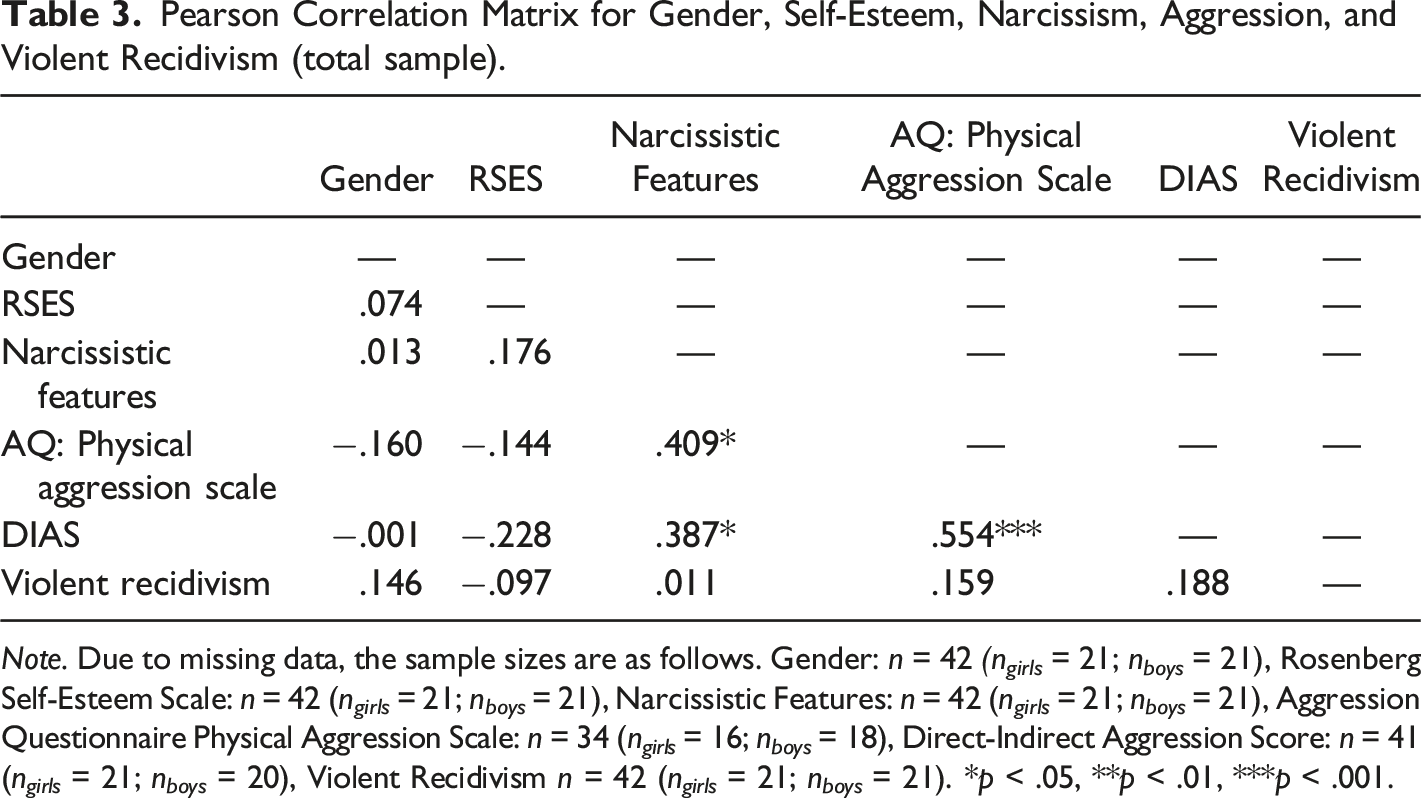
Note. Due to missing data, the sample sizes are as follows. Gender: n = 42 (n girls = 21; n boys = 21), Rosenberg Self-Esteem Scale: n = 42 (n girls = 21; n boys = 21), Narcissistic Features: n = 42 (n girls = 21; n boys = 21), Aggression Questionnaire Physical Aggression Scale: n = 34 (n girls = 16; n boys = 18), Direct-Indirect Aggression Score: n = 41 (n girls = 21; n boys = 20), Violent Recidivism n = 42 (n girls = 21; n boys = 21). *p < .05, **p < .01, ***p < .001.
Pearson Correlation Matrix for Self-Esteem, Narcissism, Aggression, and Violent Recidivism in the Justice-Involved Girls.
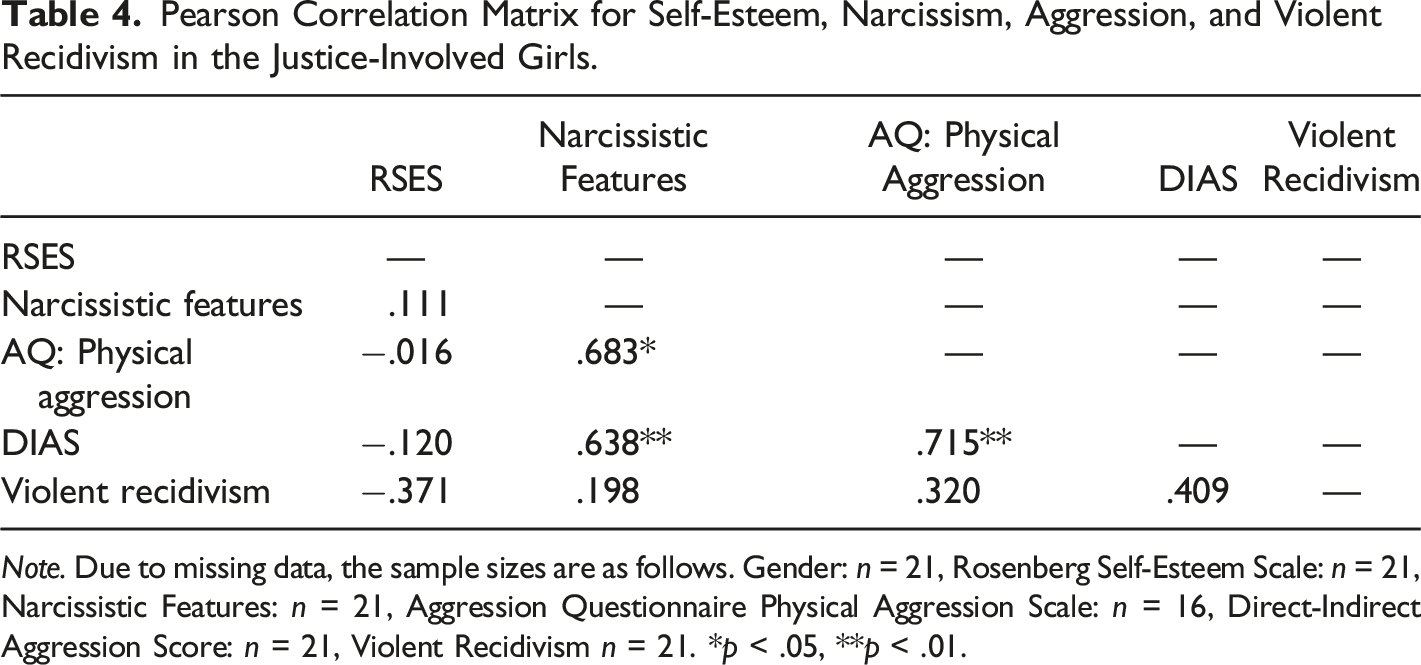
Note. Due to missing data, the sample sizes are as follows. Gender: n = 21, Rosenberg Self-Esteem Scale: n = 21, Narcissistic Features: n = 21, Aggression Questionnaire Physical Aggression Scale: n = 16, Direct-Indirect Aggression Score: n = 21, Violent Recidivism n = 21. *p < .05, **p < .01.
Pearson Correlation Matrix for Self-Esteem, Narcissism, Aggression, and Violent Recidivism in the Justice-Involved Boys.
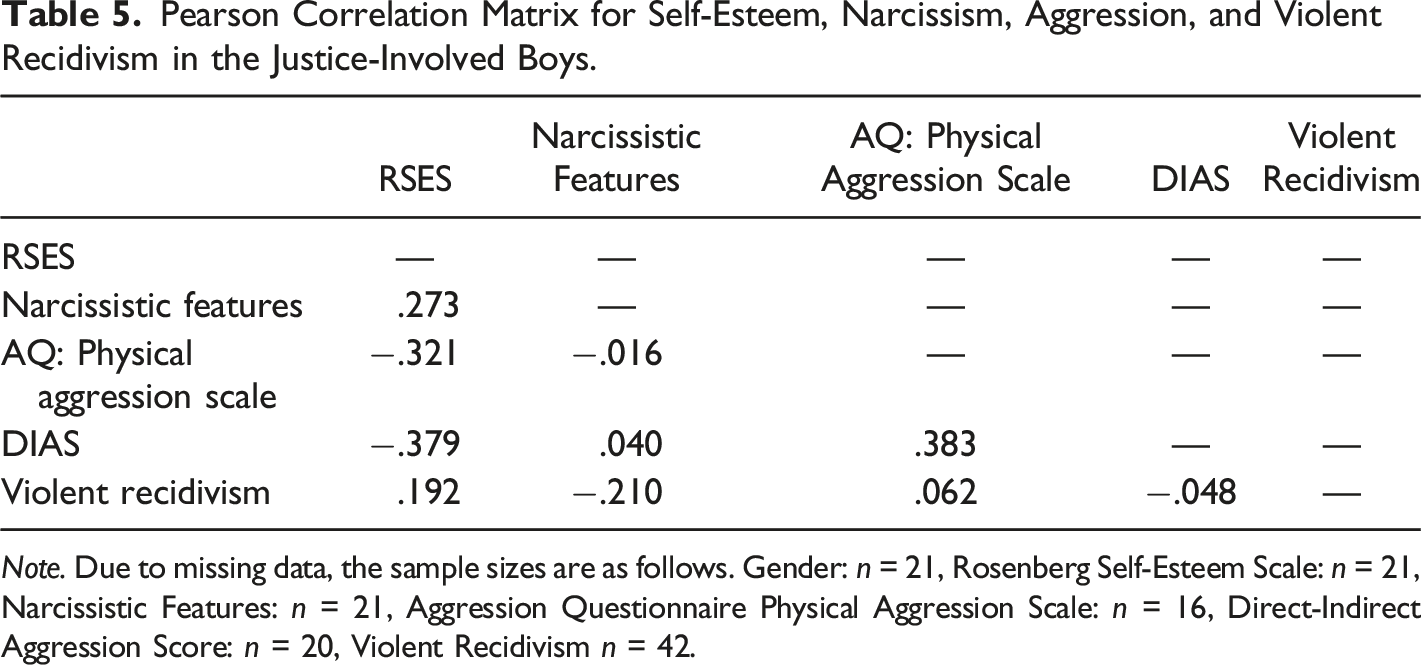
Note. Due to missing data, the sample sizes are as follows. Gender: n = 21, Rosenberg Self-Esteem Scale: n = 21, Narcissistic Features: n = 21, Aggression Questionnaire Physical Aggression Scale: n = 16, Direct-Indirect Aggression Score: n = 20, Violent Recidivism n = 42.
Discussion
The role that self-esteem plays in the criminal rehabilitation process is hotly debated. Gender-responsive scholars posit that low self-esteem is a gender-specific factor that merits more attention (Hubbard & Pratt, 2002; Van Voorhis et al., 2010). However, gender-neutral scholars argue that self-esteem should not be a high-priority treatment need (e.g., Andrews et al., 1990). Further, scholars such as Wormith (1984) have demonstrated that when high self-esteem exists alongside criminal attitudes the probability of criminal behaviour occurring increases. In an attempt to replicate the Wormith study, Thapa et al. (2021) also found that high self-esteem was related to recidivism alongside the presence of high criminal attitudes, but only among girls.
Recently it has been suggested that current self-esteem measures, such as the Rosenberg Self-Esteem Scale (RSES, Rosenberg, 1965) may be erroneously detecting narcissism instead of genuinely high self-esteem (Rosenthal et al., 2020). As a result, the purpose of our study was to better understand the Thapa et al. (2021) findings by using a mixed methods approach to qualitatively assess a sub-sample of the Thapa et al. study participants for features of narcissism. This data was then used to determine whether these features of narcissism were correlated with self-esteem, self-report measures of physical and indirect aggression, and violent recidivism within the entire sub-sample, and as a function of each gender.
The first goal of the study was to determine whether narcissistic traits could be coded retrospectively in a sample of justice-impacted youth. A proxy measure of narcissistic traits was successfully created using items from both the Narcissistic Grandiosity Scale (Rosenthal et al., 2020), and the Narcissistic Personality Disorder diagnostic criteria as outlined in the DSM-V (2013). Our proxy measure successfully detected all ten traits of narcissism in the interviews. Moreover, the high inter-rater reliability (ICC = .91) further suggests that the measure, and thus the findings, are reliable. The success of this qualitative analysis suggests that it is possible to detect traits of narcissism retrospectively (i.e., coding that occurred after the interviews had been conducted and was not originally measured) if measures such as the PCL-YV, YASI, and the YLS-CMI are used. However, it is always ideal to measure these constructs prospectively with participants (i.e., pre-planned and conducted during the interviews) using an empirically validated measure when possible.
Narcissism, Self-Esteem, Gender, and Aggression
Using the data collected from the quantitative analysis, it was hypothesized that the youths who scored highest on self-esteem would demonstrate the highest narcissism scores, and that there would be no gender differences. Contrary to the hypothesis, there was no statistically significant correlation between self-esteem and narcissistic traits in the entire sample, nor for either gender. The insignificant findings could be a result of the small sample size; however, it must be noted that it could simply be that while the two constructs measure a form of self-regard, they are inherently different and thus unrelated.
Second, it was hypothesized that the presence of narcissistic traits would have a positive relationship with both aggression and violent recidivism, and that self-esteem would have a negative relationship with both aggression and violent recidivism. The hypothesis was partially supported. In the entire sample, the presence of narcissistic traits was positively correlated with both indirect and direct aggression, but it did not predict violent recidivism. However, as hypothesized, self-esteem did not significantly predict violent recidivism for the entire sample. These findings are in support of the current literature that suggests that narcissism is linked to higher levels of aggression and violence (Baumeister et al., 1996; Rosenthal et al., 2020). Moreover, the qualitative analysis demonstrated how the different features of narcissism can present in relation to aggressive behaviours and attitudes. For instance, it was quite common for the features of narcissism to emerge when the youths were discussing their criminal behaviour; their aggressive or violent actions; or their aggressive criminal attitudes towards the police, the law, and the criminal justice system. However, it must be noted that aggressive attitudes and behaviours are inherent to certain traits of narcissism, for example, interpersonal exploitation. As a result, it would be valuable for scholars to conceptually and empirically disentangle the difference between these two constructs as they relate to criminal behaviour.
Furthermore, exploratory analyses indicated that the relationship between narcissistic traits and aggression was only significant for the justice-impacted girls, and not for the boys, even though the narcissistic traits were equally present within each gender. As a result, these findings may hold some insight into a potential gendered relationship between narcissistic traits and aggression. While purely speculative, this relationship could offer some insight into a potential gendered pathway into the criminal justice system that merits more attention. It may mean that narcissistic features are particularly salient among girls and women who perpetrate aggression in comparison to their boy/men counterparts. As such, this could mean that boys/men and girls/women who have engaged in violence may require tailored treatment approaches to rehabilitation by placing greater emphasis on personality features such as narcissistic features among girls and women.
Limitations and Future Research
Future research is required to further investigate the relationship between narcissism, aggression, self-esteem, violent recidivism, and gender. The small sample size used in the study may have impacted the inability to find statistically significant findings; the small sample size may have also produced spurious correlational coefficients that might not replicate in a larger sample. Replication is thus required before firm conclusions and hence, strong policy recommendations can be made. Should a significant relationship emerge between self-esteem and narcissism, it could possibly help explain the surprising findings found by Thapa et al. (2021) indicating that the girls with the highest self-esteem (when coupled with high criminal attitudes) demonstrated the highest recidivism rates. It is also important to underscore that our study retrospectively rather than prospectively coded the interviews for narcissistic traits. In sum, replication with a larger sample size and a more widely used, prospective narcissism measure is needed. Lastly, the youth studied in our study do not represent the typical low risk youth who encounters the criminal justice in Canada. Many of the youth had engaged in serious crimes including serious violent crimes.
Conclusion
The study demonstrated that features of narcissism can be reliably detected retrospectively in audio-recorded interviews with justice-impacted youth. This methodological finding is important for researchers who not only have access to similar databases but are also interested in examining the topic of narcissism, gender, and violence. Furthermore, although the relationship between self-esteem and narcissistic traits was not statistically significant, the significant relationship between narcissistic traits and self-report aggression (both physical and indirect), among the girls may be an indicator of a gendered relationship between these constructs that merits attention. However, again, our study is based on a small sample, particularly when the results were disaggregated by gender. Pending replication, it is premature to render meaningful policy or practical recommendations. However, the results do warrant further research using larger samples and prospective methodologies to better understand the potential gendered relationship between narcissism, self-esteem, and aggression. Crafting and implementing research designs that can inform the development of programs that empower girls by fostering genuine self-esteem and resiliency building, rather than the development of programs that may inadvertently enhance narcissistic traits, and hence potentially increase aggression, is warranted.
Footnotes
Declaration of Conflicting Interests
The author(s) declared no potential conflicts of interest with respect to the research, authorship, and/or publication of this article.
Funding
The author(s) received no financial support for the research, authorship, and/or publication of this article.
