




Abstract
Objective:
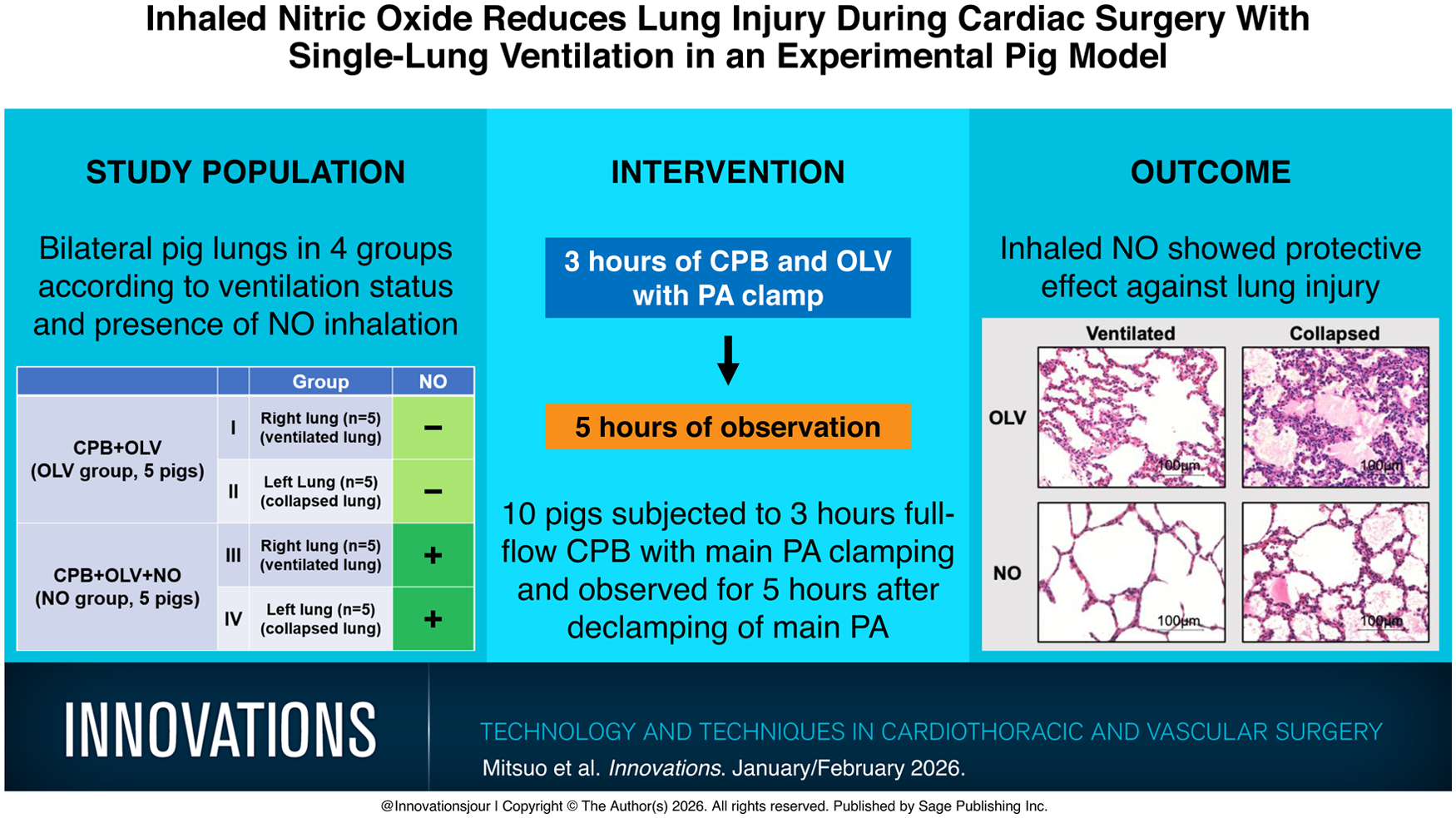
Minimally invasive cardiac surgery (MICS) may require one-lung ventilation (OLV) during minithoracotomy. One of the problems associated with MICS is postoperative unilateral pulmonary edema of the collapsed lung, which may be fatal. Several reports have demonstrated the effects of inhaled nitric oxide (NO) on lung ischemia-reperfusion injury. In this study, we created an in vivo pig model using cardiopulmonary bypass (CPB) and OLV, enabling us to compare bilateral lung injury at the same time point in the same individual. The aim of this study is to examine the effects of inhaled NO in a model that approximates MICS.
Methods:
Ten pigs were subjected to 3 h of CPB and OLV with clamping of the main pulmonary artery. The bilateral lungs of the pigs were categorized into 4 groups according to their ventilation status and the presence or absence of NO inhalation (n = 5 per group). Lungs were collected after the experiment, and inflammatory cytokine measurements and pathological evaluations were performed.
Results:
In the OLV group (group 1 vs 2), the levels of interleukin-6, interleukin-8, and myeloperoxidase in collapsed lung tissue increased, along with an increase in the number of apoptotic cells and exacerbation of pulmonary edema. In the collapsed lungs (group 2 vs 4), NO inhalation reduced the levels of interleukin-6 and myeloperoxidase, the number of apoptotic cells, and pulmonary edema.
Conclusions:
In an animal model using a combination of CPB and OLV, inhaled NO suppressed pulmonary edema and improved the exacerbated lung injury of collapsed lungs.
Keywords
Get full access to this article
View all access options for this article.
References
Supplementary Material
Please find the following supplemental material available below.
For Open Access articles published under a Creative Commons License, all supplemental material carries the same license as the article it is associated with.
For non-Open Access articles published, all supplemental material carries a non-exclusive license, and permission requests for re-use of supplemental material or any part of supplemental material shall be sent directly to the copyright owner as specified in the copyright notice associated with the article.
