




Abstract
Objective:
The aim of the current study was to analyze the clinical and surgical outcomes of patients undergoing isolated tricuspid valve surgery (ITVS) from the available literature. It currently remains uncertain whether arrested heart (AH) surgery has superior postoperative outcomes over beating heart (BH) for ITVS.
Methods:
A systematic review and meta-analysis were conducted by searching PubMed, ScienceDirect, Scopus, DOAJ, SciELO, and Cochrane databases from 2000 until November 2024. The protocol was registered with the International Prospective Register of Systematic Reviews under the PROSPERO registration number CRD42024622618.
Results:
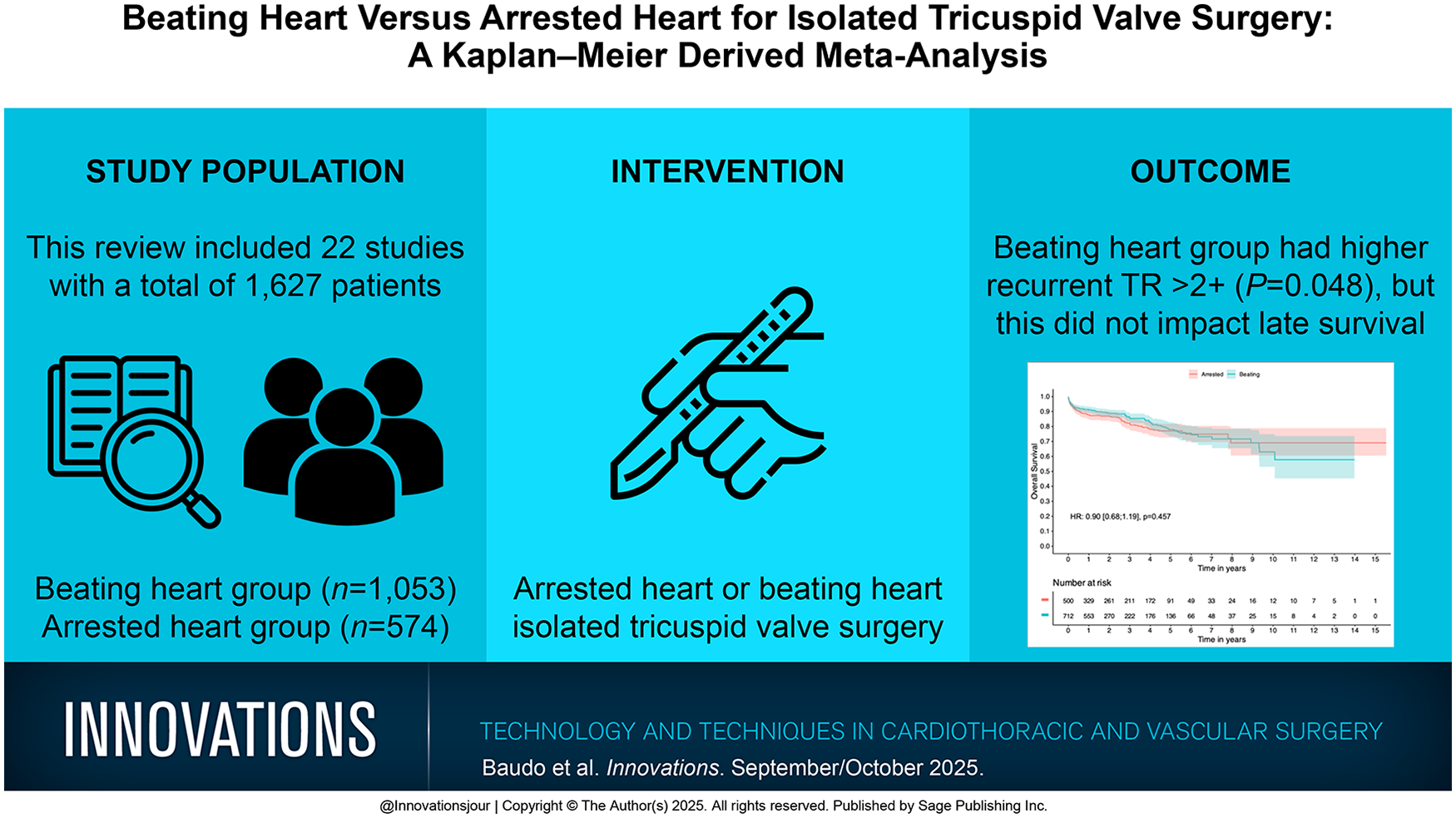
A total of 22 studies met the inclusion criteria. These studies were published between 2012 and 2023 and included a combined total of 1,627 patients, with 1,053 in the BH group and 574 in the AH group. The present analysis showed that patients undergoing BH surgery were generally more comorbid and more frequently underwent minimally invasive procedures as compared with patients undergoing AH surgery. The BH and AH groups reported no significant differences in postoperative outcomes. At follow-up, BH was associated with higher recurrent >2+ tricuspid regurgitation rates (P = 0.048), but this did not affect late survival (hazard ratio [HR] = 0.90, 95% confidence interval [CI]: 0.68 to 1.19, P = 0.457) or reintervention for TV (HR = 1.18, 95% CI: 0.61 to 2.29, P = 0.622) rates.
Conclusions:
A consensus between BH and AH for ITVS is still lacking. However, BH ITVS procedures appear to be the preferred surgeon choice for higher-risk patients. At follow-up, the BH group showed higher rates of recurrent tricuspid regurgitation >2+, without affecting late survival or rates of TV reintervention.
Keywords
Get full access to this article
View all access options for this article.
References
Supplementary Material
Please find the following supplemental material available below.
For Open Access articles published under a Creative Commons License, all supplemental material carries the same license as the article it is associated with.
For non-Open Access articles published, all supplemental material carries a non-exclusive license, and permission requests for re-use of supplemental material or any part of supplemental material shall be sent directly to the copyright owner as specified in the copyright notice associated with the article.
