




Abstract
Objective:
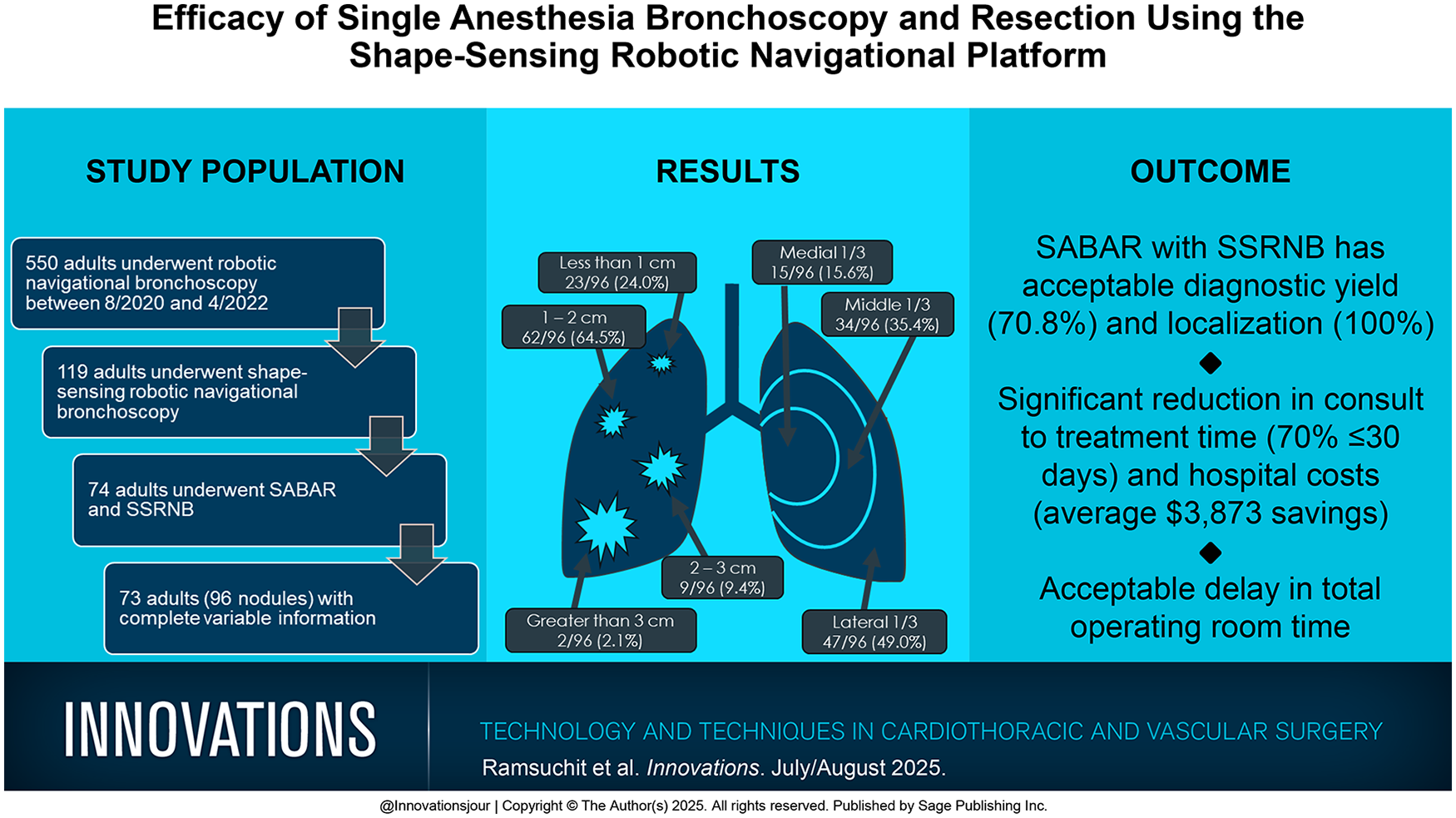
Robotic navigational bronchoscopy and endobronchial ultrasound have augmented diagnostic yield and localization of challenging pulmonary nodules. However, there is a paucity of literature regarding its role in decision-making during single-anesthesia bronchoscopy and resection (SABAR). We aim to describe our experience of SABAR via shape-sensing robotic navigational bronchoscopy (SSRNB).
Methods:
A retrospective observational chart review was performed of adult patients who underwent SSRNB between August 2020 and April 2022. Diagnostic yield, localization success, treatment timelines, and cost were analyzed. Patients were categorized on the preoperative intent of SABAR for either localization or diagnostic yield. Localization was intended in nonpalpable peripheral nodules and multifocal nodules, whereas diagnostic yield was intended in deep nodules and multifocal nodules.
Results:
A total of 73 patients and 96 nodules were analyzed. The average age was 67 years, with 43 of 73 (59%) being female. Approximately 58 of 73 patients (80%) identified as current or former smokers, and 12 of 73 (16.4%) had a history of lung cancer. The average tumor size was 1.4 cm. Localization confirmed by fluorescence imaging was achieved in 56 of 56 patients (100%) with localization intent and 76 of 76 (100%) of the entire sample. Successful diagnostic yield was obtained in 20 of 26 patients (76.9%) with biopsy intent who then underwent immediate resection. Diagnostic yield for the entire sample was 47 of 76 (61.8%). Eight of 14 benign nodules identified by SSRNB were resected due to persistent concern and concordant. Surgical resection occurred within 30 days of initial consultation for 50 of 73 patients (70%). A total variable cost saving of $4,000 was observed in SABAR relative to separate procedures.
Conclusions:
This novel study demonstrates that SABAR with SSRNB is an effective way to intraoperatively localize and potentially diagnose difficult lung nodules during planned resection. This efficacy accelerates treatment timelines and decreases hospital costs. Future studies are warranted to delineate patient populations who would benefit most from SABAR using SSRNB.
Get full access to this article
View all access options for this article.