




Abstract
Objective:
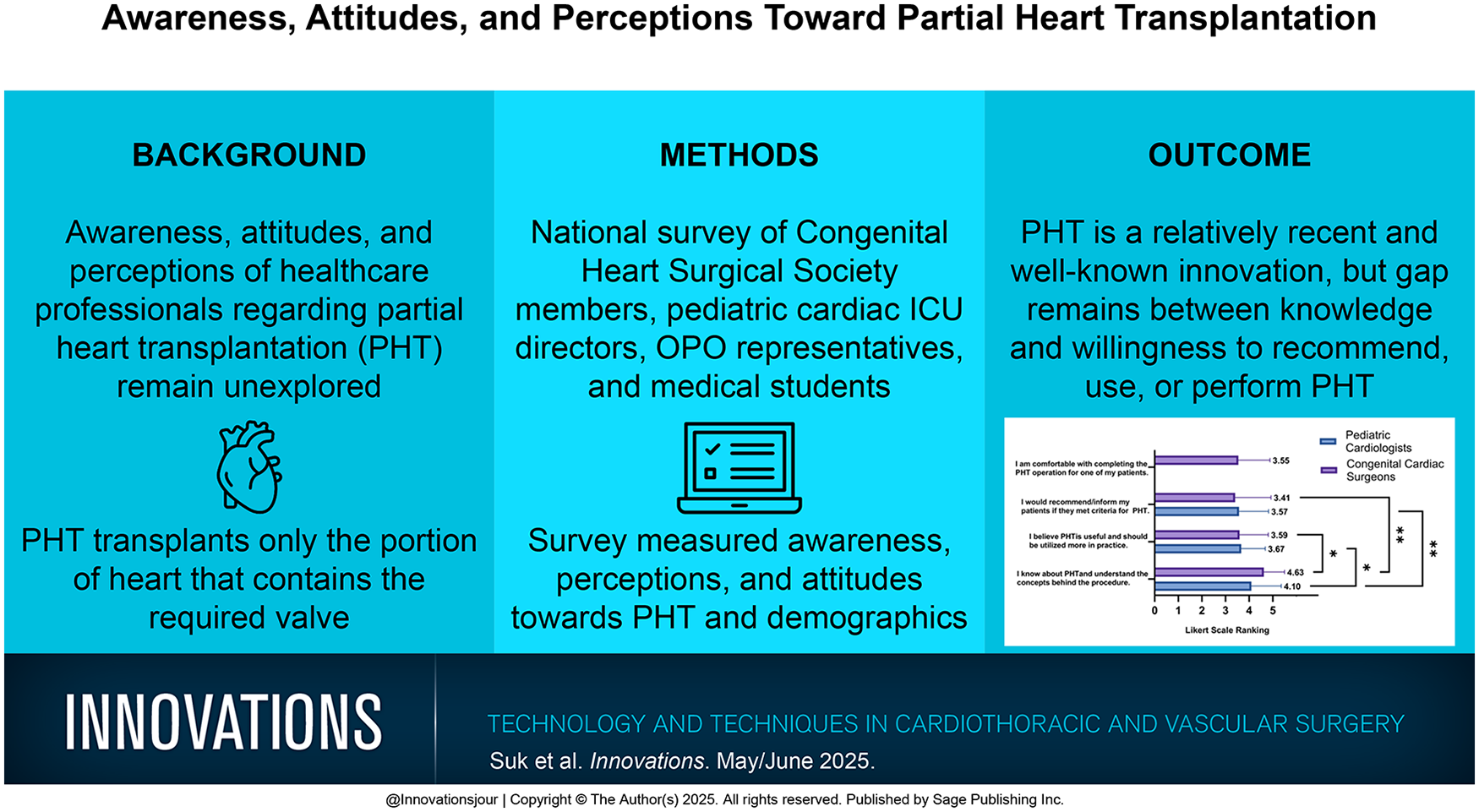
Partial heart transplantation (PHT) is a new procedure that delivers growing heart valve implants for children. However, awareness, attitudes, and perceptions of health care professionals regarding PHT remain unexplored.
Methods:
A national survey was conducted among members of the Congenital Heart Surgical Society, pediatric cardiac intensive care unit (ICU) directors, medical students, and organ procurement organization (OPO) representatives. The survey measured their awareness, perceptions, and attitudes toward PHT. Perceptions and attitudes were measured using a 5-point Likert scale. Statistical comparisons in ranked responses between survey questions were calculated using two-way analysis of variance, with multiple comparisons assessed by a Tukey post hoc test.
Results:
There were responses from 95 medical students (12.1%), 32 congenital cardiac surgeons (10.26%), 21 pediatric ICU directors (16.8%), and representatives from 8 OPOs (15%). Prior to survey distribution, 20% of students were aware of PHT. In contrast, almost all congenital heart surgeons (96.88%) and pediatric cardiologists (100%) were aware of PHT. Although surgeons and cardiologists understand the concepts of PHT, cardiologists were less likely to recommend and inform their patients about the procedure if they meet the criteria (Likert scale scores of 4.68 vs 3.14, P = 0.01 and 4.38 vs 3.69, P = 0.01, respectively). Surgeon and cardiologist perceptions regarding the use of PHT for different patient age groups were significantly different (P < 0.001).
Conclusions:
Even though PHT is a relatively recent innovation, it is well known among pediatric cardiac surgeons and pediatric intensive care directors.
Keywords
Get full access to this article
View all access options for this article.
References
Supplementary Material
Please find the following supplemental material available below.
For Open Access articles published under a Creative Commons License, all supplemental material carries the same license as the article it is associated with.
For non-Open Access articles published, all supplemental material carries a non-exclusive license, and permission requests for re-use of supplemental material or any part of supplemental material shall be sent directly to the copyright owner as specified in the copyright notice associated with the article.
