




Abstract
Objective:
Whether minimally invasive aortic valve replacement (MIAVR) offers an advantage over conventional AVR (CAVR) remains a matter of debate. Although some studies have suggested better postoperative outcomes with MIAVR, technical challenges and longer operative times remain major obstacles to the adoption of these techniques. In this meta-analysis, we compare the reported immediate postoperative outcomes of both approaches.
Methods:
Cochrane, MEDLINE, and Embase® databases were searched from inception until January 2022 for studies reporting immediate postoperative outcomes of MIAVR and CAVR. Studies were excluded if they reported on concomitant procedures or enrolled pediatric patients. Random-effects meta-analysis was performed using the restricted maximum likelihood estimator with Hartung–Knapp adjustment.
Results:
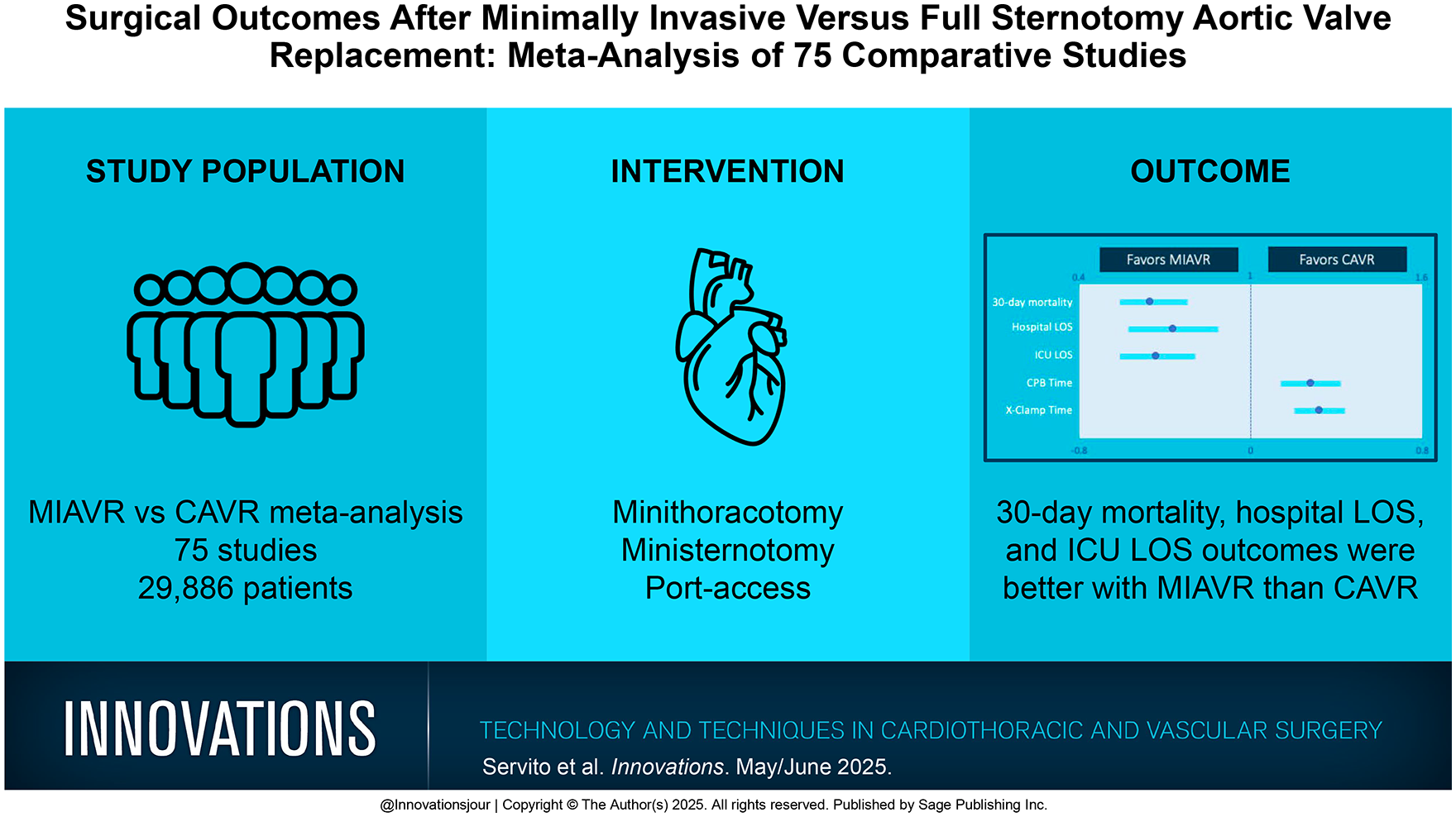
The literature search yielded 3,921 articles, of which 75 were included in this meta-analysis. The most common techniques were ministernotomy and minithoracotomy. MIAVR was associated with lower 30-day mortality than CAVR (odds ratio [OR] = 0.65, 95% confidence interval [CI]: 0.54 to 0.78, I2 = 0%, P < 0.001). The length of stay (LOS) in the hospital (standardized mean difference [SMD] = −0.44, 95% CI: −0.61 to −0.26, P < 0.001) and in the intensive care unit (SMD = −0.36, 95% CI: −0.57 to −0.15, P < 0.001) were shorter for MIAVR. Individual comparisons of ministernotomy and minithoracotomy to CAVR also yielded similar results. However, aortic cross-clamping and cardiopulmonary bypass times were longer for MIAVR.
Conclusions:
Our meta-analysis suggests that minimally invasive approaches to AVR may provide advantages beyond cosmesis. Despite longer operative times, MIAVR was associated with earlier recovery and shorter hospital LOS. These findings were consistent for both minithoracotomy and ministernotomy.
Get full access to this article
View all access options for this article.
References
Supplementary Material
Please find the following supplemental material available below.
For Open Access articles published under a Creative Commons License, all supplemental material carries the same license as the article it is associated with.
For non-Open Access articles published, all supplemental material carries a non-exclusive license, and permission requests for re-use of supplemental material or any part of supplemental material shall be sent directly to the copyright owner as specified in the copyright notice associated with the article.


