




Abstract
Objective:
Minimally invasive surgery determines shorter postoperative hospital length of stay (LOS) even in cardiac surgery. Potential preoperative factors affecting LOS are still not known in minimally invasive heart valve surgery (MIVS). We aimed to identify preoperative variables influencing prolonged LOS in MIVS.
Methods:
We reviewed 189 patients who underwent MIVS via minithoracotomy at our institution. Prolonged LOS was defined as more than 7 postoperative days. Poisson and logistic regression were used to screen the predictors.
Results:
The mean postoperative LOS was 9.13 days, and 64 patients (33.9%) experienced a prolonged LOS. These patients were older, more frequently in New York Heart Association (NYHA) class III or IV, showed worse left ventricular ejection function (LVEF), and had a higher incidence of reoperation and chronic kidney disease (CKD). At univariate analysis, the most significant preoperative factors affecting prolonged LOS were age (odds ratio [OR] = 1.04), NYHA class III or IV (OR = 3.03), reduced LVEF (OR = 3.22), CKD (OR = 2.7), and redo surgery (OR = 3.6). After adjustment, the most significant preoperative factors predicting prolonged LOS were age (OR = 1.03, 95% CI: 1.01 to 1.06, P = 0.02) and redo surgery (OR = 3.33, 95% CI: 1.29 to 8.9, P = 0.01).
Conclusions:
The most important factors affecting prolonged LOS after MIVS were represented by age and redo surgery, although other preoperative characteristics such as reduced LVEF, NYHA class III or IV, and CKD play a significant role in delaying recovery after MIVS. Further larger studies are needed to better identify potential preoperative predictors of prolonged LOS after MIVS.
Keywords
Central Message
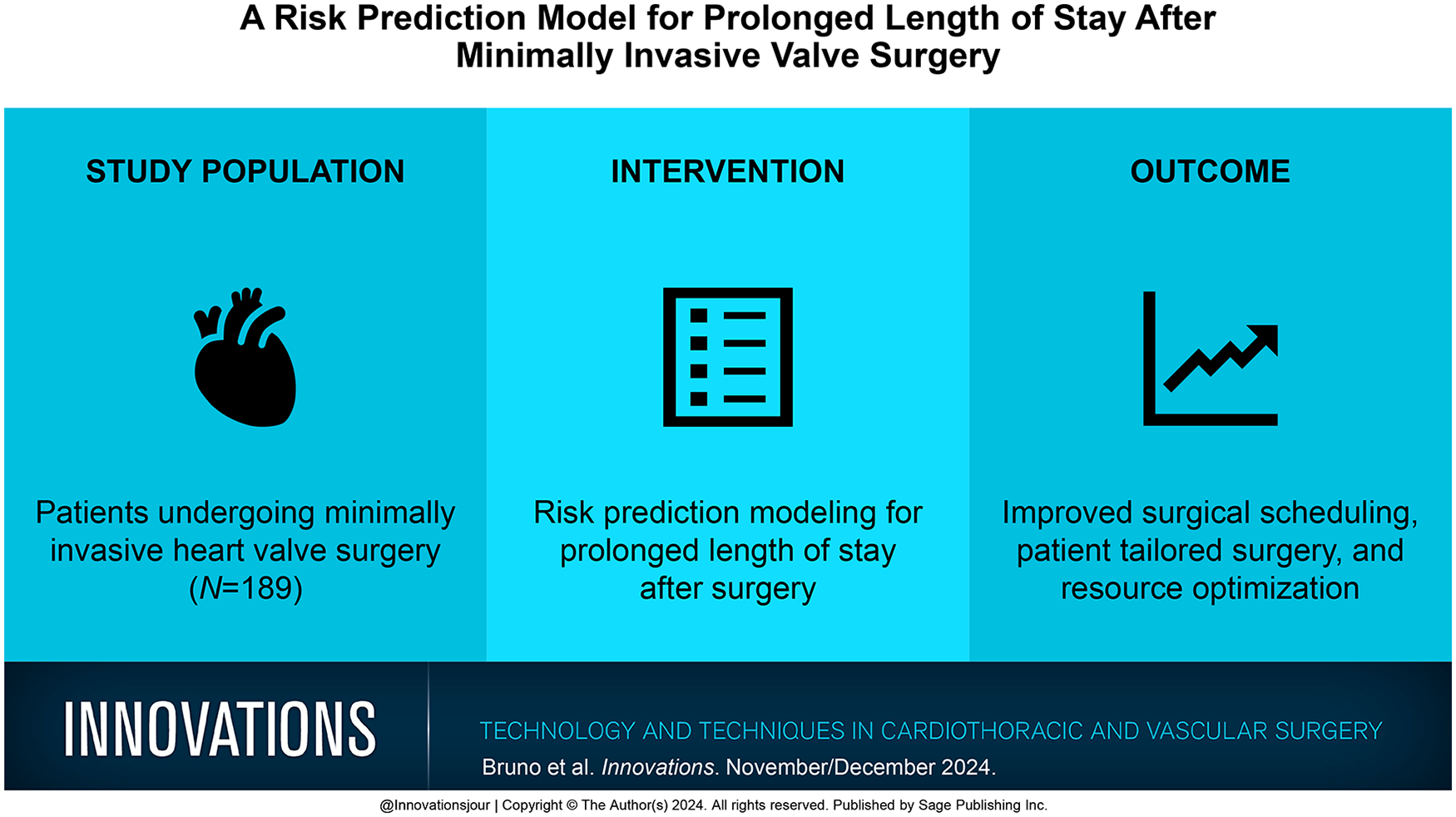
Predicting prolonged LOS after minimally invasive cardiac surgery is possible even using only preoperative variables. We identified preoperative independent predictors of prolonged LOS after MIVS. This type of predictive model can have beneficial effects on surgical planning and resource optimization in a minimally invasive cardiac surgery program.
Introduction
With hospital care costs accounting for most of the health care expenditure, strategies to control health spending have been implemented, particularly those based on the reduction in hospital length of stay (LOS), which is currently considered an important hospital performance indicator. 1 Postoperative LOS after cardiac surgery has remained constant over the past decade with limited measures adopted to shorten it. Minimally invasive cardiac surgery (MICS) is rapidly expanding as it reduces surgical stress, improves perioperative outcomes, promotes recovery when compared with classic median sternotomy, 2 and is often preferred over more invasive surgical approaches. Its beneficial effects in reducing the overall postoperative LOS have already been demonstrated,3,4 and recent results have confirmed that a MICS approach in valve surgery shortens intensive care unit (ICU), high dependency units, general ward, and overall LOS with significantly fewer associated costs 5 and a beneficial economic effect on the health care charge. Nevertheless, prolonged LOS after MICS may sometimes occur, and there are currently no reliable models to predict it. Therefore, it would be important to identify potential predictors for prolonged LOS after MICS, as this would allow better use of the clinical resources and improve the cost–benefit ratio. Most importantly, identifying the patients at higher risk of prolonged LOS before entering the surgical theater can be beneficial to improve resource utilization and optimize surgical scheduling. Recent studies have shown that a predictive model based entirely on preoperative variables can forecast ICU LOS after general cardiac surgery. 6 The aim of this single-center retrospective study was to identify potential preoperative predictors of prolonged LOS and to develop a reliable predictive model for this outcome in patients undergoing minimally invasive valve surgery (MIVS).
Methods
This is a retrospective, observational, single-center study conducted on 189 consecutive patients undergoing aortic, mitral, or tricuspid valve (TV) surgery via a minimally invasive approach at our institution.
The study involved patients operated between October 2018 and May 2021, and all surgeries were conducted via a minithoracotomy approach. This is a retrospective analysis of data prospectively collected and included in a dedicated electronic database at our institution. There were 119 patients who underwent isolated mitral valve (MV) surgery (83 repairs and 36 replacements), whereas 50 patients underwent isolated aortic valve (AV) replacement, and 5 patients underwent isolated TV surgery (4 repairs and 1 replacement). There were 15 patients who underwent a combined double-valve procedure (1 AV and MV repair, 3 AV replacement and MV repair, 5 AV and MV replacement, 4 MV and TV repair, and 2 MV replacement and TV repair). The study population was divided into 2 groups according to the length of the postoperative LOS. The first group (standard LOS) included 125 patients with a postoperative LOS ≤7 days after the primary cardiac surgical operation, whereas those who had a postoperative LOS >7 days (n = 64) were included in the second group (prolonged LOS). The cutoff of 7 postoperative days was chosen as it represented the median LOS in days for the entire population. Reduced left ventricular ejection fraction (LVEF) was defined as LVEF <50%, and elevated New York Heart Association (NYHA) class was defined as class III or IV. Obesity was defined as per the World Health Organization (WHO) guidelines for adults, which defines overweight with a body mass index (BMI) greater than or equal to 25 and obesity with a BMI greater than or equal to 30.
The primary endpoint was total postoperative LOS, defined as the number of days from surgery until the patient was discharged either home or to a rehabilitation center. Secondary endpoints included in-hospital complications and 30-day mortality.
Operative and Postoperative Management
Our minimally invasive surgical techniques for AV, MV, and TV surgery have been previously described.7–9 Briefly, minimally invasive MV and TV surgery were conducted through a right anterior thoracotomy (5 to 7 cm skin incision) placed at the third or fourth intercostal space. After incision, 2 ports were inserted in the thorax to allow positioning of a ventricular vent, CO2 insufflator, camera device, and pericardial stay sutures. A soft-tissue retractor was inserted, and ribs could be spread with a small retractor. AV surgery was conducted either via a right minithoracotomy at the second intercostal space (5 to 6 cm) or via an upper inverted J-shaped ministernotomy; no additional ports were used, except in some cases in which a single port was used for the camera. After heparin administration, a percutaneous venous cannula was inserted through the femoral vein into the superior vena cava, under transesophageal echocardiographic guidance and using the Seldinger technique. Either arterial femoral cannulation or direct aortic cannulation was performed, according to the clinical indication of each patient. After cardiopulmonary bypass (CPB) was established, the patient was cooled to 34 °C and the ascending aorta was clamped. Antegrade cold crystalloid cardioplegia was delivered directly into the ascending aorta by a needle vent catheter. The MV was approached through the Sodengaard grove while the TV was exposed via a longitudinal incision of the anterior part of the right atrium, and both were exposed using an atrial retractor held by a mechanical arm inserted through a right parasternal incision. The AV was exposed via a transverse section of the mid portion of the ascending aorta. The heart valves could be either repaired with rings or other methods or replaced with a biological or mechanical prosthesis.
After surgery, sedation was discontinued within 6 h of arrival in the ICU, and the endotracheal tube was removed. After extubation, patients were allowed to breathe spontaneously through a face mask or nasal cannula. In some cases, a high-flow nasal cannula was required during the first 24 h. After discharge from the cardiac ICU (CICU), the patients were transferred to a cardiac surgical ward for the following 5 to 7 days, unless complications occurred. The urinary catheter was removed on postoperative day 2, and the central venous catheter was removed on day 3. Chest drains were usually removed on day 1 or 2, and mobilization (from bed to chair) began immediately after drain removal. After surgery, patients spent an average of 18 to 24 h in the ICU and 5 to 7 days in the cardiac surgery unit. Discharge could be to home or to a rehabilitation center, depending on the clinical condition and the preferences of the surgical team. The patients involved in this study did not receive an enhanced recovery after surgery (ERAS) protocol.
Statistical Analysis
Continuous numerical variables are reported as mean ± standard deviation and categorical variables are reported as count and percentages. Normality was assessed with the Shapiro–Wilk test.
All study group comparisons were unpaired. Categorical variables were compared using either Pearson χ2 or Fisher’s exact tests, and continuous variables were compared using the Student’s t test for normally distributed data or the Wilcoxon rank sum test for non-normally distributed data where appropriate. The numerical distribution of the postoperative LOS (in days) was not normal. Therefore, used the zero-truncated Poisson regression methods to model this discrete variable.
To model the categorical variable of prolonged LOS (defined as >7 postoperative days) and to develop a risk nomogram, univariable and multivariable logistic regression analyses were used. After running univariable regression models, multiple regression models were run including the following variables: age, gender, reduced LVEF, BMI, chronic kidney disease (CKD), NYHA class III/IV, and redo surgery. Backward stepwise selection (Akaike information criterion) was used to obtain the adjusted models. Internal validation was used, and the receiver operating characteristic curve and area under the curve (AUC) were used as measures of performance. For the variable of age, the optimal cutoff points for binary classification were established using the Youden’s Index metric. All tests were two-sided, and the alpha error was set at 0.05. The statistical analysis was conducted in R version 4.1.2 (The R Project for Statistical Computing, Vienna, Austria).
Results
The overall mean postoperative LOS was 9.13 days (median = 7 days, interquartile range [IQR]: 6 to 8 days), and it was steady throughout the period of analysis, except for the first quarter of the year 2019, and with a trend toward a shorter LOS in the last period of observation. The median CICU LOS was 1 day (IQR: 1 to 2 days). Table 1 shows the preoperative characteristics of the patients. Those in the prolonged LOS group were significantly older (68 ± 14 vs 61 ± 12 years, P < 0.01), more frequently in NYHA class III or IV, and had worse LVEF, a higher incidence of reoperation, and CKD (all P < 0.01). No other significant differences were found among the remaining preoperative variables. Table 2 describes the intraoperative and postoperative variables; although there were no significant differences in terms of CPB or cross-clamp times, the prolonged LOS group included more urgent surgeries and more MV and combined surgeries. This group was presenting a higher number of complications and especially respiratory and arrhythmic complications (Table 2).
Preoperative Characteristics of the Patients.

Abbreviations: BMI, body mass index; CKD, chronic kidney disease; COPD, chronic pulmonary obstructive disease; LOS, length of stay; LVEF, left ventricular ejection fraction; NYHA, New York Heart Association; PVD, peripheral vascular disease.
Data are reported as mean ± SD or count (%).
Intraoperative and Postoperative Characteristics of the Patients.

Abbreviations: CPB, cardiopulmonary bypass; CVA, cerebrovascular accident; TIA, transient ischemic attack.
Data are reported as mean ± SD or count (%).
At univariate analysis, age was one of the most significant predictors of prolonged LOS with an odds ratio (OR) of 1.04 (95% confidence interval [CI]: 1.01 to 1.07, P < 0.01). The mean age of the sample was 63.37 ± 13.27 years, but the cutoff point for prolonged LOS was at 61.33 years, with an AUC of 0.65. This association was proportionally correlated with the age classes and was already significant in patients older than 60 years (OR = 3.04, 95% CI: 1.21 to 7.73, P < 0.01) and even more evident in patients older than 65 years (OR = 3.25, 95% CI: 1.6 to 6.87, P < 0.01). An elevated NYHA class (III or IV) was also an independent factor for prolonged LOS, with those patients having 3 times higher risk of prolonged LOS compared with those with lower NYHA class (OR = 3.03, 95% CI: 1.55 to 6.00, P < 0.01). Similarly, a reduced preoperative LVEF represented an independent risk factor for prolonged LOS (OR = 3.22, 95% CI: 1.35 to 7.94, P < 0.01). A reduced LVEF was also significantly associated with the discrete distribution of the postoperative LOS (relative risk [RR] = 1.26, 95% CI: 1.10 to 1.43, P < 0.01), and the actual measurement of LVEF was inversely related to LOS (RR = 0.98, 95% CI: 0.98 to 0.99, P < 0.01). The presence of CKD was independently associated with both the categorical (OR = 2.70, 95% CI: 1.31 to 5.64, P < 0.01) and the discrete distribution of LOS (RR = 1.22, 95% CI: 1.09 to 1.36, P < 0.01). Similarly, reoperation was also an independent predictor for the categorical (OR = 3.61, 95% CI: 1.49 to 9.19, P < 0.01) and the discrete LOS (RR = 1.24, 95% CI: 1.08 to 1.41, P < 0.01).
BMI was not related to the categorical variable of prolonged LOS (OR = 1; 95% CI: 0.98 to 1.03, P = 0.90); when classified per the WHO definition, overweight (OR = 1.39, 95% CI: 0.71 to 2.69, P = 0.34) and obese (OR = 1.10, 95% CI: 0.35 to 3.10, P = 0.86) patients appeared to have a slightly higher risk of prolonged LOS, although this was not significant. Nevertheless, Poisson regression found that BMI was proportionally and significantly correlated with the discrete distribution of the postoperative LOS in days (RR = 1.05, 95% CI: 1.03 to 1.06), and obese patients had a significantly higher risk of long LOS (RR = 2.17, 95% CI: 1.90 to 2.46) with a longer mean LOS in obese patients (17.5 ± 43.39 days) versus overweight (8.44 ± 5.01 years) and ideal weight (8.08 ± 4.19) patients. In contrast, gender (male vs female patients) did not appear to be an independent risk factor for the main outcome (OR = 0.61, 95% CI: 0.33 to 1.13, P = 0.12) nor for the discrete distribution of postoperative LOS (RR = 1.00, 95% CI: 0.91 to 1.10, P = 0.96). Table 3 describes the adjusted regression models for prolonged LOS >7 days (logistic regression analysis) and for the numerical distribution of the postoperative LOS (Poisson regression). After backward variable selection, the final multivariable logistic regression model included age, redo surgery, reduced LVEF, and CKD (AUC = 0.68). The most significant preoperative factors predicting prolonged LOS were age (OR = 1.03, 95% CI: 1.01 to 1.06, P = 0.02) and redo surgery (OR = 3.33, 95% CI: 1.29 to 8.9, P = 0.01). The Poisson regression model again showed the relevance of age (RR = 1.02, 95% CI: 1.01 to 1.02, P < 0.01), redo surgery (RR = 1.32, 95% CI: 1.15 to 1.51, P < 0.01), and BMI (RR = 1.05, 95% CI: 1.04 to 1.06, P < 0.01).
Multiple Regression Models (AIC Stepwise Selection).

Abbreviations: AKI, Akaike information criterion; BMI, body mass index; CI, confidence interval; CKD, chronic kidney disease; LVEF, left ventricular ejection fraction; NYHA, New York Heart Association; OR, odds ratio; RR, relative risk.
The predictive models were then adjusted for the presence of at least 1 postoperative complication (Table 4); the final model in this case included age, reduced LVEF, and redo surgery with an AUC of 0.68. As expected, the presence of complications significantly affected prolonged LOS (OR = 5.7, 95% CI: 2.92 to 11.5, P < 0.01), but age (OR = 1.03, 95% CI: 1.003 to 1.06, P = 0.03) and reduced LVEF (OR = 2.8, 95% CI: 1.07 to 7.6, P = 0.03) were confirmed to be independent predictors of prolonged LOS after backward selection. A similar result was found for the Poisson model, with complication having the highest impact (RR = 1.81, 95% CI: 1.63 to 2, P < 0.01), followed by BMI (RR = 1.04, 95% CI: 1.03 to 1.05, P < 0.01), age (RR = 1.02, 95% CI: 1.01 to 1.02, P < 0.01), and redo surgery (RR = 1.16, 95% CI: 1.01 to 1.34, P = 0.03).
Multiple Regression Models Adjusted for Complication.

Abbreviations: BMI, body mass index; CKD, chronic kidney disease; LVEF, left ventricular ejection fraction; NYHA, New York Heart Association; OR, odds ratio; RR, relative risk.
Discussion
The usefulness of MIVS in promoting early recovery after valve surgery has been broadly confirmed, favoring better physical and social functioning 10 and reducing pain 11 after surgery when compared with conventional cardiac surgery. The financial benefits of MIVS have also been demonstrated with a significant cost reduction in patients undergoing MIVS compared with standard median sternotomy and a saving of nearly 10% in the patient bill. 5 However, further optimization can be achieved to better define surgical planning, tailor patient management, and enhance resource allocation, hence promoting a productive and cost-effective MIVS program. Reducing postoperative LOS is a potential target for improvement. Through this study, we were able to find and model 6 preoperative risk factors that independently predict prolonged postoperative LOS after MIVS. Between these 6 variables, age was the strongest predictor for the main outcome. The role of age in prolonging LOS after cardiac surgery has been well known for many years and recently was confirmed by a large retrospective analysis on more than 200,000 cardiac procedures. 12 Our study confirms this trend even in MIVS showing that, after the age of 60 years, there is an incremental risk of prolonged hospital stay with increasing age. Another significant factor was the left ventricular systolic dysfunction, which is also well known to be among the strongest predictors of negative outcomes after cardiac surgery and therefore is included in the most relevant risk-scoring systems. 13 Even in our study, a reduced LVEF had a significantly negative impact on postoperative LOS, prolonging it for 1.26 days, when compared with patients with normal LVEF. Similarly, NYHA class III or IV proved to be detrimental for postoperative LOS, and this is most likely related to the poorest clinical condition of these patients at admission with negative impact on CICU LOS and general time of recovery. On the other hand, BMI appeared to have a less relevant effect on LOS after surgery, although obese patients (BMI ≥ 30 kg/m2) experienced significantly longer LOS. In a recent study on data from the MIMIC-III dataset, obesity was associated with prolonged ventilation after cardiac surgery and longer hospital stay; 14 we confirm these findings even in a minimally invasive setting.
The introduction of ERAS in MICS proved to be an effective measure in reducing the overall LOS, and ERAS 15 resulted in a financial benefit of almost €2,000 per patient. 16 Hence, an early recognition of the patients who can benefit from an ERAS program can be valuable. Our study aimed to predict prolonged LOS before admission using only preoperative variables. This task proved to be difficult because prolonged LOS is in some cases related to the presence of complications. Previous studies have shown that complications such as atrial fibrillation (AF), renal injury, and deep sternal wound infection prolong CICU and overall LOS following cardiac surgery. 17 Even in our study, the presence of complications was more common in those patients with a prolonged LOS. Interestingly, the most common complications were mostly respiratory and arrhythmic. With regard to the relevance of postoperative respiratory complications after cardiac surgery, many studies have reported and our study confirms its relevance with an incidence of this complication almost 6 times higher in those experiencing prolonged LOS. Moreover, the presence of pleural effusion was also shown to be important in prolonging LOS, thus supporting the findings of other studies. 18 In our series, other important complications were represented by AF and permanent pacemaker insertion. However, even in the presence of a complication, we were able to identify 2 independent preoperative predictors (age and reduced LVEF). Interestingly, these 2 factors were already found to be predictive of prolonged LOS even in the context of percutaneous valve replacement. 19
Limitations
There are several limitations in this study. First, its retrospective, single-center nature may pose the risk of uncontrollable biases. Another limitation is related to our discharge protocol that sometimes involves a rehabilitation center. Moreover, our study did not include an ERAS protocol, which could have potentially reduced LOS, as demonstrated previously. 15 This study also has intrinsic statistical limitations related to the small sample size, risk of sampling error, unaddressed residual confounding factors, and high risk of model overfitting.
Conclusions
The most critical preoperative factors affecting prolonged LOS after MIVS are represented by age and redo surgery. When adjusted for postoperative complications, age and reduced LVEF remained independent predictors of LOS. Reoperation, NYHA class III or IV, preoperative CKD, and obesity have also been found to be associated with prolonged postoperative hospital stay after MIVS. However, the most critical factor affecting prolonged LOS after MIVS is represented by the presence of at least 1 complication. Considering the single-center and retrospective nature of the present study, our results are difficult to generalize, and further larger multicenter analyses are required to better define a prognostic model for LOS after MIVS.
Footnotes
Declaration of Conflicting Interests
The authors declared no potential conflicts of interest with respect to the research, authorship, and/or publication of this article.
Funding
The authors received no financial support for the research, authorship, and/or publication of this article.
