




Abstract
Objective:
To develop a novel endoscopic system that reduces trauma to the patient and declutters the surgical field for the surgeon in minimally invasive heart valve surgery.
Methods:
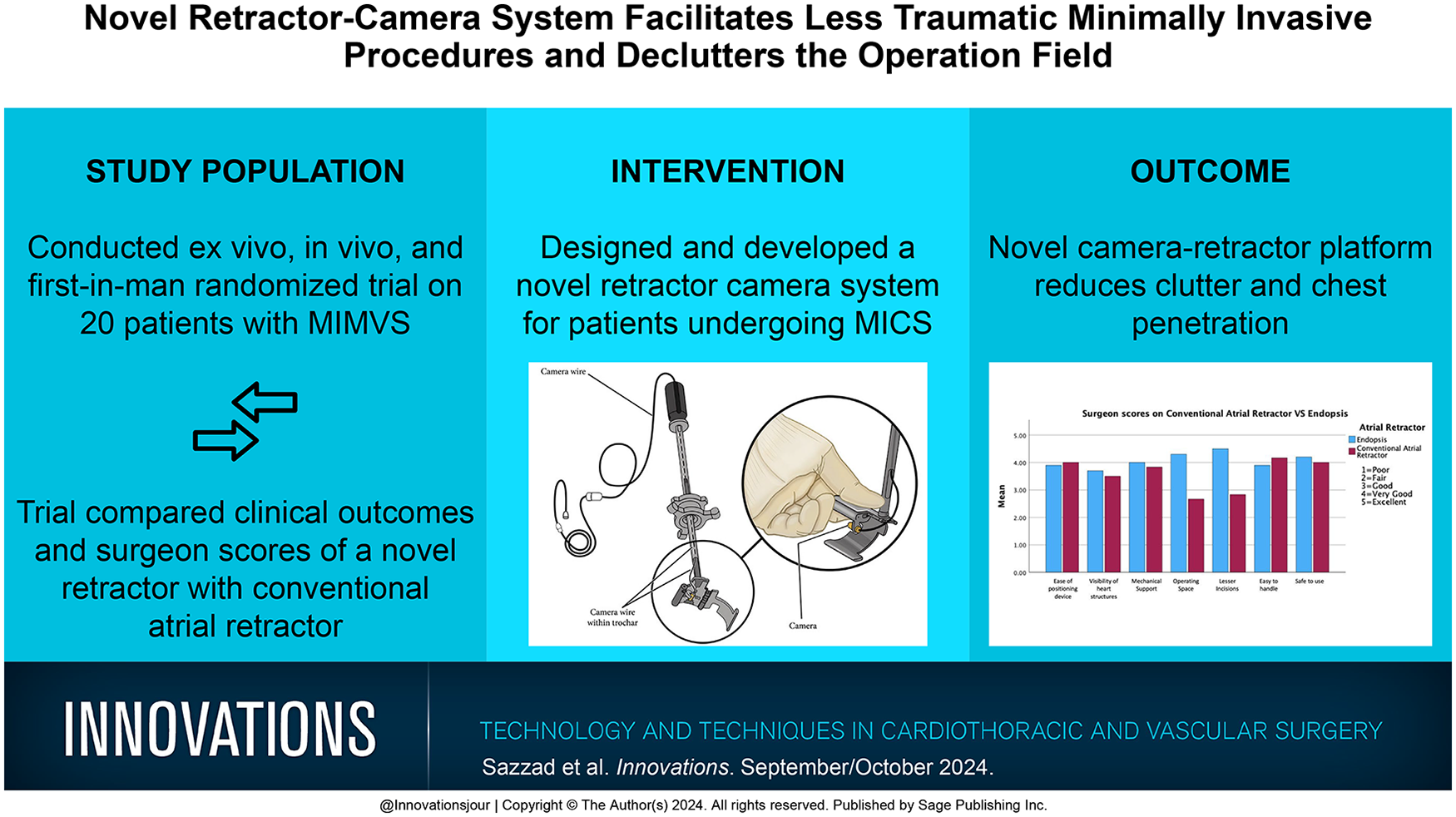
We designed and developed a retractor–camera combination for minimally invasive heart surgery; the cable and camera were connected to the underbelly of the left atrial retractor blade to provide an illuminated, wide-angle view of the mitral valve. We conducted ex vivo, in vivo, and, ultimately, a first-in-man randomized, nonanonymized clinical trial on 20 patients who required minimally invasive mitral valve surgery. Data from the preoperative period and the immediate postoperative period were gathered, and patients were followed for 3 months.
Results:
Our camera–retractor combo demonstrated safe and efficient exposure and vision in all detailed studies. The total operation time for the intervention group (316.5 ± 65.1 min) was slightly shorter than for the control group (317.5 ± 50.8 min). There was no significant difference in the ability to provide exposure of the mitral valve and surrounding left atrial tissue for both control and test articles. The novel camera–retractor reduced clutter in the operation field substantially and eliminated chest penetration for the camera. We also observed that the camera did not fog, did not stain with blood, and did not require frequent corrections to its position.
Conclusions:
We launch a novel atrial retraction–imaging platform that is less invasive for the patient and eliminates clutter and redundant movements for the surgeon.
Get full access to this article
View all access options for this article.
References
Supplementary Material
Please find the following supplemental material available below.
For Open Access articles published under a Creative Commons License, all supplemental material carries the same license as the article it is associated with.
For non-Open Access articles published, all supplemental material carries a non-exclusive license, and permission requests for re-use of supplemental material or any part of supplemental material shall be sent directly to the copyright owner as specified in the copyright notice associated with the article.
