



Abstract
Objective:
Patients with diabetes have poorer outcomes with coronary artery disease (CAD) and pose a unique clinical population for revascularization. We performed a pairwise meta-analysis of randomized trials (RCTs) and propensity-matched observational studies (PMS) to compare the clinical outcomes of coronary artery bypass grafting (CABG) and percutaneous coronary intervention (PCI) in patients with diabetes.
Methods:
A comprehensive literature search was performed to identify RCT and PMS studies comparing CABG with PCI in patients with diabetes with concurrent CAD. Studies were pooled using the random-effects model to perform a pairwise meta-analysis. Primary outcomes included long-term all-cause mortality, cardiac mortality, myocardial infarction (MI), major adverse cardiac and cerebrovascular events (MACCE), and repeat revascularization. Meta-regression was used to explore the effects of baseline risk factors on primary outcomes with moderate to high heterogeneity.
Results:
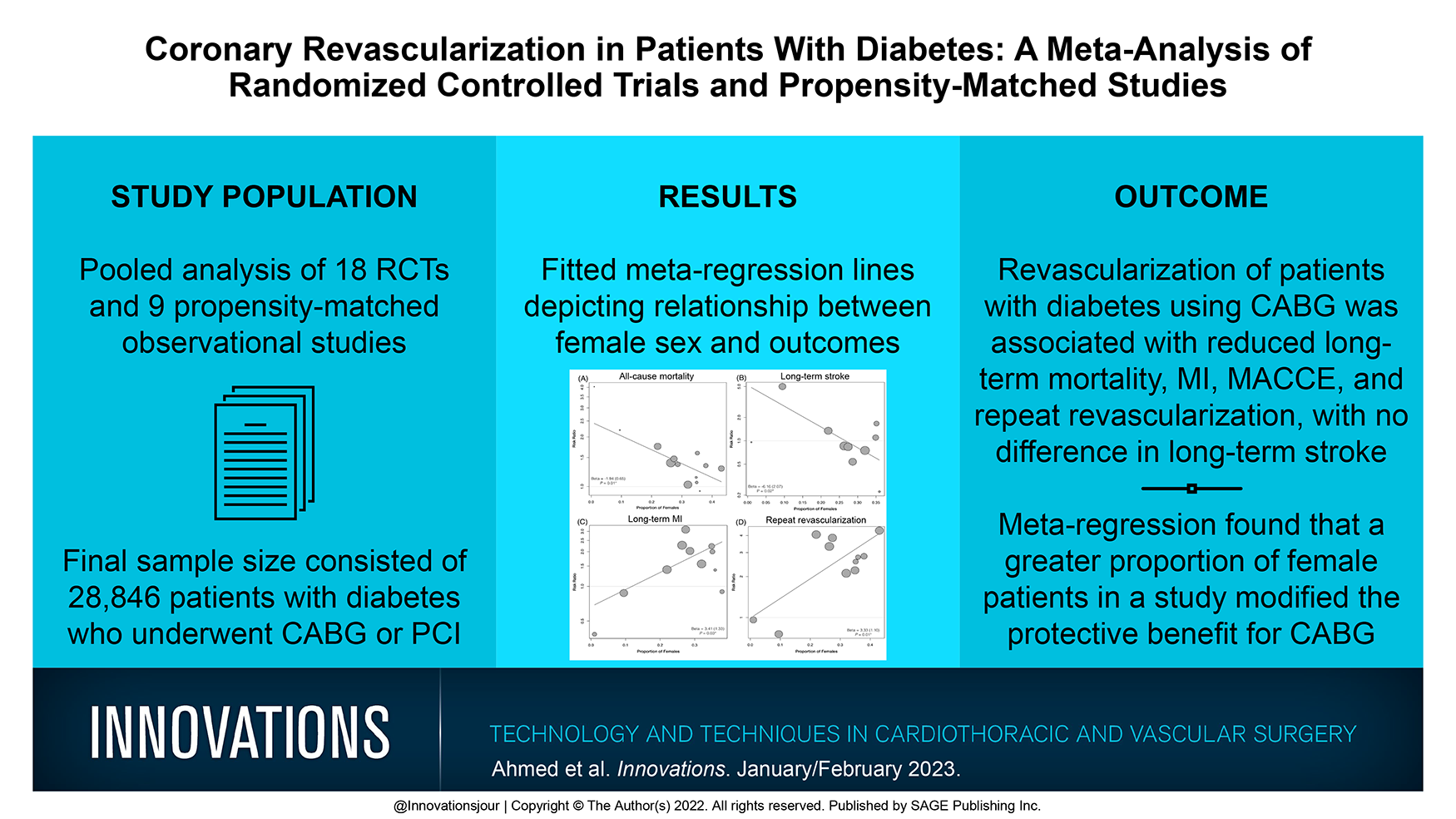
A total of 18 RCTs and 9 PMS with 28,846 patients were included. PCI was associated with increased long-term all-cause mortality (risk ratio [RR] = 1.34, P < 0.001), cardiac mortality (RR = 1.52, P < 0.001), MI (RR = 1.51, P = 0.009), MACCE (RR = 1.65, P < 0.001), and repeat revascularization (RR = 2.48, P < 0.001) compared with CABG. There was no difference in long-term stroke between the 2 groups (RR = 0.95, P = 0.82). At meta-regression, a greater proportion of female patients in studies was associated with a decreased protective benefit for CABG for long-term all-cause mortality but an increased protective benefit for long-term MI and repeat revascularization.
Conclusions:
Revascularization of patients with diabetes using CABG is associated with significantly reduced long-term mortality, MI, MACCE, and repeat revascularizations. Future studies exploring the influence of gender on revascularization outcomes are necessary to elucidate the ideal treatment modality in patients with diabetes.
Get full access to this article
View all access options for this article.
References
Supplementary Material
Please find the following supplemental material available below.
For Open Access articles published under a Creative Commons License, all supplemental material carries the same license as the article it is associated with.
For non-Open Access articles published, all supplemental material carries a non-exclusive license, and permission requests for re-use of supplemental material or any part of supplemental material shall be sent directly to the copyright owner as specified in the copyright notice associated with the article.
