




Abstract
Objective:
Despite the common occurrence of extracorporeal membrane oxygenation (ECMO)–associated acute ischemic stroke (AIS) and intracranial hemorrhage (ICH), there are little data to guide optimal anticoagulation management. We sought to describe antithrombotic therapy management after stroke and outcomes.
Methods:
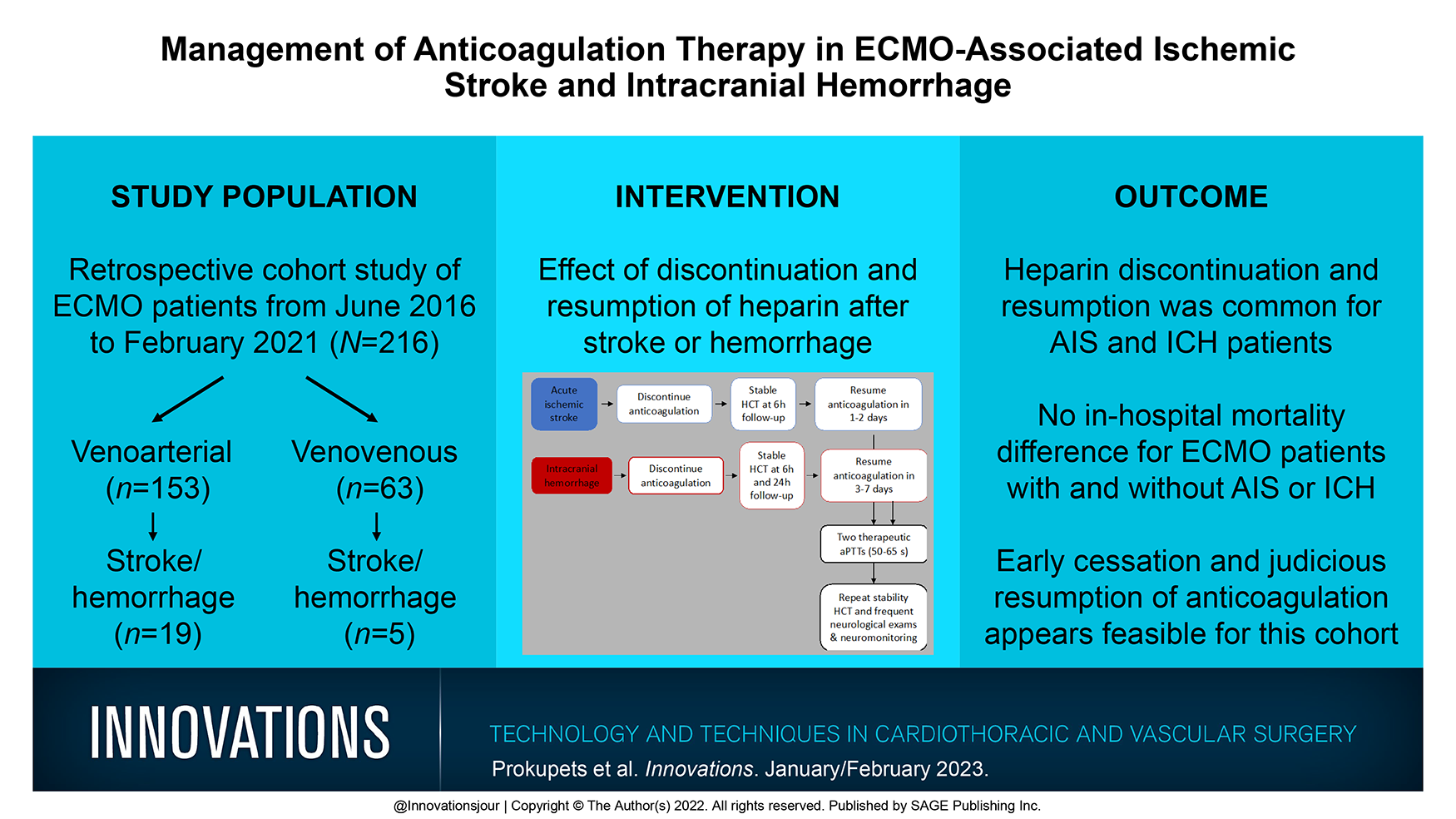
A retrospective analysis was conducted of venoarterial (VA) and venovenous (VV) ECMO patients treated at a tertiary care center from June 2016 to February 2021. Patients with image-confirmed diagnosis of AIS or ICH while receiving ECMO were included for study with data collected regarding anticoagulation management and clinical outcomes.
Results:
Overall, 216 patients (153 VA-ECMO, 63 VV-ECMO) were included in this study. Of the 153 patients on VA-ECMO, 13 (8.4%) had AIS and 6 (3.9%) had ICH. Of the 63 patients on VV-ECMO, none had AIS and 5 (7.9%) had ICH. One patient (9%) received anticoagulation reversal after ICH. Anticoagulation was discontinued and later resumed in all 5 ICH survivors (median cessation time, 30 h) and 1 of 2 (50%) AIS survivors (median cessation time, 96 h). While off anticoagulation, 2 of 11 patients (18%) had thromboembolic events and none had new AIS. Upon resumption, there were no cases of hemorrhagic transformation of AIS or ICH expansion. There was no difference in in-hospital mortality between patients with ICH and those without in both the VA-ECMO and VV-ECMO cohorts nor between VA-ECMO patients with AIS and those without.
Conclusions:
Early cessation and judicious resumption of anticoagulation appeared feasible in the cohort of patients with ECMO-associated AIS and ICH.
Keywords
Get full access to this article
View all access options for this article.
References
Supplementary Material
Please find the following supplemental material available below.
For Open Access articles published under a Creative Commons License, all supplemental material carries the same license as the article it is associated with.
For non-Open Access articles published, all supplemental material carries a non-exclusive license, and permission requests for re-use of supplemental material or any part of supplemental material shall be sent directly to the copyright owner as specified in the copyright notice associated with the article.
