



Abstract
Participant input in determining ethical conduct in research has the potential to play a greater role in shaping research ethics. Our study explored perspectives on ethical conduct in Scholarship of Teaching and Learning (SoTL) research from forty-two students from two universities, one in Sweden and one in Aotearoa New Zealand (NZ), where ethics review requirements for tertiary SoTL research significantly differ. A combination of global and local values informed participants’ decisions. Commonly, students expected participation to be voluntary and informed, with grades protected. Students considered participation in SoTL research based on the trustworthiness of the teacher. We found two local differences. Firstly, a utilitarian justification was present within participatory decisions of the Swedish cohort, while a justice lens predominated among NZ students. Secondly, hands-on learning experiences may help nurture the capacity for moral judgment about research and research ethics. This appeared more likely in Sweden, where fewer ethics review restrictions exist for SoTL research.
Introduction
Research within the Scholarship of Teaching and Learning (SoTL) involves academics adopting evidence-based methods to explore and share ways to improve student learning (Prosser, 2008). Commonly, the academic is both lecturer and researcher, and the student is both learner and participant. Such dual roles can be seen as problematic in the SoTL setting, as the lecturer is responsible for facilitating learning whilst also enacting a commitment to advance knowledge through their research project (Ferguson et al., 2006). Therefore, a robust ethical framework is needed to protect the project's participants and the researcher (Cousin, 2009). However, the nature of this ethical framework varies nationally and internationally, as not all countries or institutions require ethics approval regarding SoTL research. If required, ethics review can take many forms, including formal consideration from a research ethics committee (REC), devolvement of approval to a faculty or departmental body, or a formal exemption from review (Lees et al., 2021). There can be challenges in navigating ethics review processes for SoTL projects in jurisdictions where ethics review is required (Wright et al., 2011), with arguments that the biomedical origins of ethics review are inappropriate for social science research (Israel, 2015). There have been suggestions that REC members may benefit from additional training in social science research (Wassenaar & Mamotte, 2012), which may be particularly relevant for considering SoTL projects, given that REC members may be less familiar with the nature of SoTL (Martin, 2013). If challenges to conducting SoTL research exist, including issues with the ethics review process, lecturers may avoid undertaking SoTL research, missing opportunities to evaluate their practice. Furthermore, there is growing recognition of the role of students as partners, which renegotiates “traditional positions, power arrangements, and ways of working in higher education,” characterised by a more interactive, less hierarchical pedagogy (Matthews et al., 2018, p. 958). Therefore, organisational barriers to undertaking SoTL projects may mean fewer opportunities for students to contribute to and learn from SoTL research. Not only can an intentional co-creation approach to learning and teaching be affirming for students and academics (Cook-Sather, 2022) but direct engagement with aspects of research, including participation, is considered vital to knowledge acquisition (Matos et al., 2023).
In this study, we compare views on ethical conduct in SoTL research between students at two universities, one in Sweden and one in Aotearoa New Zealand (NZ). We chose these locations because they differ in ethics review requirements, especially for SoTL research. We begin by outlining the organisational structure of ethics governance within these two countries, along with the principles each uses to guide and assess ethical research. With this foundation, we aim to explore the role and impact that jurisdictional ethics review plays in shaping students’ views on both ethical conduct in SoTL and the relationships between ethics review, research ethics, and education.
In Sweden, the regulatory framework for ethics review has a broad reach encompassing universities, research institutes, national and local governmental agencies, and private companies (Swedish Ethical Review Authority, 2024). The Ethical Review Act 2003:460 concerning the Ethical Review of Research Involving Humans (the Act) mandates the approval process for research (Swedish Parliament, 2003: 460). Additional statutes focusing on medical devices, products, and care offer further specific guidance for medical research. The Swedish Ethical Review Authority provides ethical oversight for research, and since 2019, this has been at the national level. As a result, Swedish universities do not have institutional RECs overseeing local research 1 .
Many types of research in Sweden do not require ethics review. Specifically, the Act outlines that “research that does not use personally sensitive data, and does not entail physical encroachment, aim to affect subjects physically or psychologically or entail an obvious risk of harming subjects is not to be reviewed” (Swedish Research Council, 2024, p. 61). While students’ grades would not be classified as personally sensitive data, as this classification pertains to factors such as racial or ethnic origin, political opinions, religious beliefs, and sexual orientation, grades are still considered personal data and therefore require protection, such as through anonymisation. Obvious physical harms may not be prevalent in SoTL research; however, the harms Wassenaar and Mamotte (2012) highlight in social science research may also affect student participants in SoTL projects, such as “embarrassment, deception, stigma and stereotyping” (p. 271). Specific examples where students may need protection might include where students are asked to reflect on experiences of traumatic or stressful learning, experience performance-related stress or comparison anxiety, or potentially feel coerced into participation. These scenarios would likely require ethics approval, otherwise it would not normally be required (Swedish Ethical Review Authority, 2024). In addition, ethics review would not generally be required for activities carried out by undergraduate or master's students for the purposes of learning research methods, even when this involves personal data, provided that any findings are not used for publication outside the educational context. However, ethical review may be required if students’ work is subsequently considered for publication (Swedish Ethical Review Authority, 2020).
Importantly, while some situations are exempt from requiring approval, Swedish researchers are not exempt from conducting ethical research. Good research practice in Sweden should not detract from the need to apply one's own “moral judgement” (Swedish Research Council, 2024, p. 22). Where core principles underpin research human dignity should be respected, human rights observed, and risks balanced with scientific benefits (Swedish Research Council, 2024). Irrespective of the type of research being conducted or whether formal ethics approval is required, researchers are responsible for adherence to these principles (Swedish Ethical Review Authority, 2024). The All European Academies’ (2023) European Code of Research Integrity, which highlights reliability, honesty, respect and responsibility, also informs Swedish research ethics.
By contrast, within the NZ university setting, the ethics review process is more demanding than in Sweden in that all research involving human participants requires ethics review. At the same time, the reach of ethics review is more limited. While there are independent ethics panels that can offer ethics advice to government agencies and community researchers (Tolich & Smith, 2015), outside of universities, ethics oversight is only required for health research (National Ethics Advisory Committee, 2021b). Unlike Sweden, there is no overarching regulatory framework for research in other settings (MacDonald, 2018).
All universities have a REC; however, there is a lack of conformity among the different institutions. Some universities separate committees into different types of research. For example, some have committees that distinguish health from non-health research (University of Auckland, 2024), others have separate committees for health-related, and then facets of Māori and Pacific research (Massey University, 2024), while some have a single REC overseeing all human participant research (Auckland University of Technology, n.d.). All university RECs deem some activities exempt from review, such as analysing publicly available material. Additionally, surveys conducted solely to evaluate university courses or inform teaching practices are usually exempt, but not if findings are disseminated or published as research. In NZ, it is usual practice for all SoTL research where the academic is the researcher, and their students are participants, to require ethics review and approval.
The National Ethics Advisory Committee – Kāhui Matatika o te Motu (NEAC) sets ethical standards for health research in NZ. NEAC's (2023) guidelines contain a “partnership of principles” reflecting Te Ara Tika Māori (indigenous to NZ) ethical principles in health research, namely tika (research design), manaakitanga (cultural and social responsibility), whakapapa (relationships), and mana (justice and equity), along with Western bioethical principles of beneficence, non-maleficence, respect for persons, and justice. However, there is no cross-university ethics framework guiding social science research (Israel, 2015).
Methods
This research sits within a broader international multi-site nested case study exploring ethical conduct within SoTL research. This study specifically aimed to compare students’ perspectives of ethical conduct from two distinct tertiary contexts within Sweden and NZ. Our study was an instrumental case study given that our findings have potential relevance beyond the bounds of our study locations (Stake, 2006). We were interested in the following questions: What are students’ perspectives on ethical conduct in SoTL research, and how do ethics review processes for SoTL research impact students?
Participants and Recruitment
We invited students to participate by visiting their classroom (NZ) or approaching students online (Sweden) and disseminating participant information. Forty-two students were recruited, with eight from Sweden and 34 from NZ. All participants studied health-related degree programmes within paramedicine, oral health, public health, sports coaching, physiotherapy, physical education, general health, and sports science. Students were not required to have prior experience participating in SoTL research.
Ethical Considerations
A range of ethical considerations shaped this study, broadly categorised as examples of procedural ethics and “ethics in practice” (Guillemin & Gillam, 2004, p. 261) which together contributed to the overall quality of the research. In terms of procedural ethics, the study, including data collection at both study sites, was approved by the local NZ university ethics committee (approval no. 19/48) on March 4, 2019. Expert advice was sought from Swedish academics and policy documents to confirm that ethics approval was not required from the Swedish Ethical Review Authority.
An aspect of the study design reflecting ethics in practice was that a pilot study was conducted before the main study took place. This pilot was an opportunity to involve the student community in informing the study design. The pilot was multi-faceted, aiming to explore design options such as whether questions would be semi-structured or unstructured. It was also an opportunity to review the choice and number of vignettes and gauge feedback on which elicited the most interest. We considered our pilot to be a form of upstream ethical reflexivity, as purported by Woods (2019), allowing us to work with the broader student community ahead of the main study. From the pilot study, we learned that convenience was an important factor for participants and that contributing to a focus group consisting of classroom peers was preferable. We were then able to design the main study by scheduling most focus groups with students from the same course directly before or after their scheduled class. For more details about pilot studies as forms of ethical reflexivity, see Lees et al. (2022).
Data Collection
In NZ, the students participated in face-to-face focus groups in 2020 and 2021, directly after a scheduled class. Due to COVID-19, a pragmatic approach was taken to recruitment and data collection in Sweden. For this cohort, participation took place in 2021 and was online, with one focus group comprising five participants, one focus group comprising two participants, and one individual interview. Written informed consent was obtained in person or electronically from each participant. This process involved providing information about the study, explaining how the session would run, reiterating that we were inviting them to share their perspectives rather than seeking any ‘right’ answer, and providing opportunities for participants to ask questions. Each session, lasting between 42 and 74 mins, was facilitated by the primary researcher and recorded using a hand-held recording device or, for the online sessions, using Zoom. While video recording of online sessions was utilised to help build rapport, only the audio portion of the recording was retained, which was explained and consented to by all participants.
A series of four vignettes provided discussion prompts for each session (see Supplementary Material). Vignettes focused on examples of frequently published SoTL research designs, encompassing an anonymous questionnaire, an individual interview, a quasi-experimental design with control and intervention groups and a classroom intervention with grade correlations. The research vignettes included examples of the voluntary participation of students (for instance, Vignette 1 & 2) and where the available information indicated that the whole class had participated (for instance, Vignette 4). We particularly wanted our discussions with participants to be initially informed by what they considered important, rather than exploring with them the relevance of specific principles underpinning ethics review. Therefore, our initial prompt was to simply ask participants to consider how comfortable they would feel participating in the research featured within each vignette. From this, we facilitated discussions based on the issues raised by the participants. Follow-up questions probed the extent to which issues raised in the literature as being important to RECs when assessing SoTL projects were relevant to students. These prompts focused on the relevance of terms such as vulnerability, consent, and power imbalances, along with whether participants felt any external approval or guidance should be sought. Participants received a store voucher valued at $20 (NZ) or 120 Kronor (Sweden). Audio recordings of the interviews were transcribed.
Data Analysis
As qualitative researchers, our aim was to better understand the perspectives of our participants. To assist in this understanding, we utilised reflexive thematic analysis, a method for “developing, analysing and interpreting patterns across a qualitative dataset” (Braun & Clarke, 2022b, p. 4). The phases of analysis, depicted in Figure 1, began with familiarisation of the dataset and early coding, and ended with the writing up of the analysis. In between were a series of phases where themes were generated, developed, refined and named. Although these themes generally tracked forward, progress was often multidirectional (Braun & Clarke, 2022b).
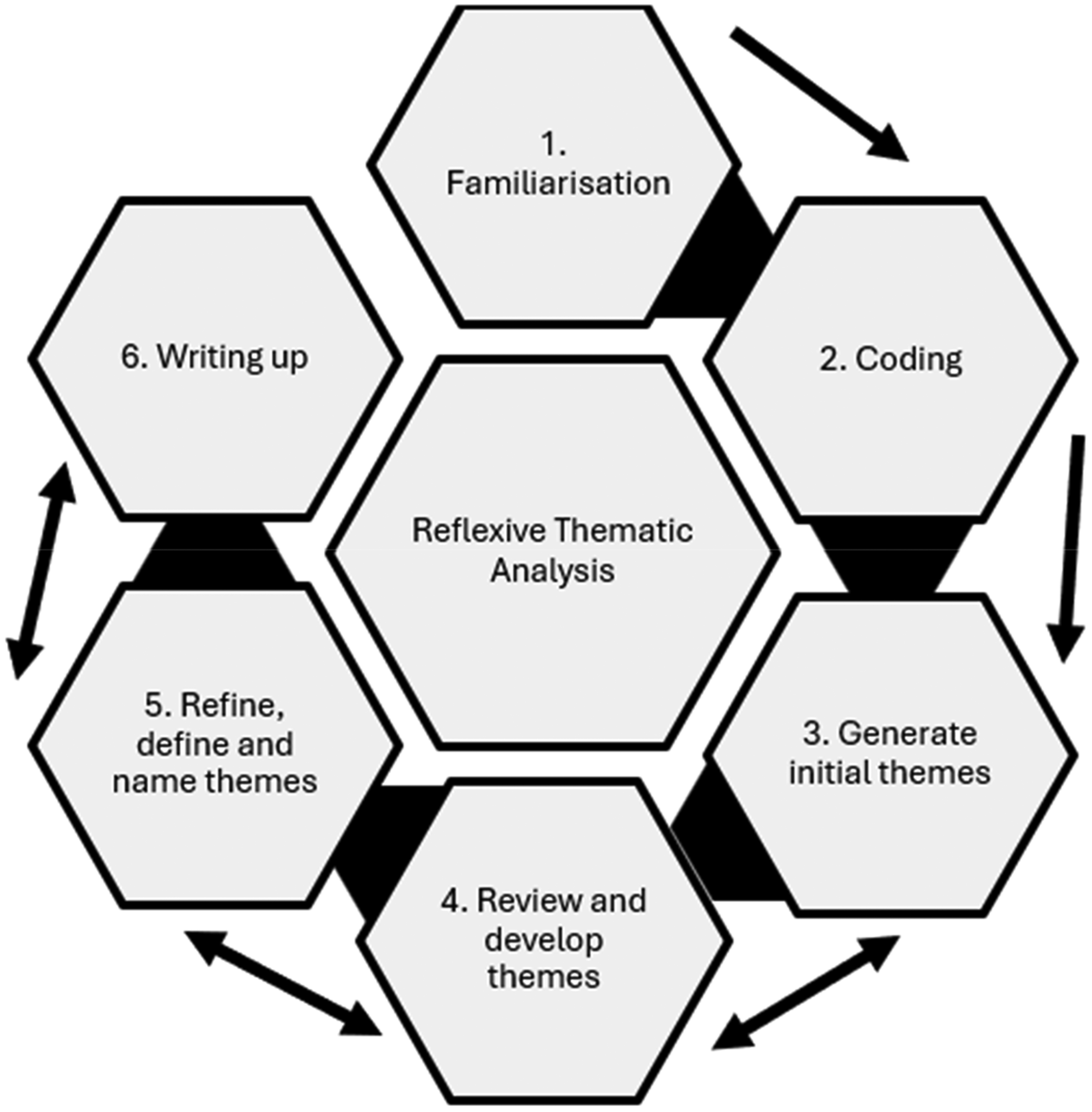
Phases of Reflexive Thematic Analysis based on Braun and Clarke (2022b).
The primary researcher undertook the thematic analysis, reflecting guidance from Braun and Clarke (2022a) that “a single coder/analyst is typical in reflexive TA [thematic analysis]” (p.9). Analysis began with making notes from listening to the audio recordings and reading the Swedish and NZ data transcripts. Through systematic engagement with each transcript, code labels were identified and written onto sticky notes. These were clustered around provisional themes, which underwent several cycles of review, refinement, and renaming. Meaning in the data was explored predominantly through a semantic focus, which Braun and Clarke (2022b) described as participant-driven, where meaning is explored by “capturing explicitly-stated ideas” (p.58). While opting to stay close to the overt meaning in the data, the primary researcher was mindful of their subjectivities and values as a researcher, which may have influenced the interpretation of the data. Fortnightly meetings with the research team provided an opportunity to discuss, explore and review themes. These meetings were augmented by the primary researcher keeping a reflexive journal throughout the project. A fellow academic familiar with Braun and Clarke's work but not a disciplinary colleague acted as a critical friend with whom aspects of the analysis process were discussed. A critical friend can aid reflexivity and integrity (Appleton, 2011), along with helping to demonstrate trustworthiness (Petroelje Stolle & Frambaugh-Kritzer, 2025). Sharing initial themes at an international conference provided a further opportunity for refining and reflection within the research team.
Findings
Forty-two students participated in the study. Eight were from a Swedish university, and thirty-four were from a university in NZ. Three themes were created from the combined data: prerequisites for participation, principled benefits, and ethics oversight as procedure or practice. The first theme, prerequisites for participation, reflects the provisions that must be in place before participants would feel comfortable participating in SoTL research. The second theme, principled benefits, reflects the ways in which ethical principles underpinned participants’ assessment of the beneficial nature of SoTL research. The final theme, ethics oversight as procedure or practice, reflects the ways in which the different cohorts considered the role and value of research oversight in relation to SoTL research. We present these themes with illustrative quotes from participants, denoted by the location of their university and the number of the interview group, i.e., S (Sweden) or NZ (New Zealand) and the participant number (P).
Pre-Requisites for Participation
Irrespective of location, there was clear consensus on specific principles underpinning decisions to participate in SoTL research. Prerequisites related to voluntariness, informed consent, and protection of grades. The right to choose was an expectation for all students. Swedish participants voiced the strongest opposition to a lack of voluntariness; several were incredulous and even “enraged” at the thought that they may not have a choice. “If it's not voluntary, then I am not cooperating irrespective of the research” (S1P2)
“
If you didn't have a choice in participating, it would definitely make you feel vulnerable” (NZ1P6)
Another shared concern was that participation should not impact learning or grades. Students preferred activities within SoTL research that augmented topics within their enrolled course, but not if participation might lead to a poorer grade outcome; a clear separation between research and course grades was deemed necessary. “You can't make research a mandatory part of a course where I am there to learn” (S3P2) “If I'm going to risk my learning, then no” (NZ3P1)
All participants valued their teachers, and many indicated a willingness to help those with whom they were more familiar. “It's easier to help someone if you know them. If you know the person you know their intentions” (S3P1)
Across both locations, some participants expressed a worry they might be treated differently if they did or did not participate, with particular concern for their grades, but at the same time assumed this would not be the case with their lecturer. Between the two participant groups, a greater proportion of Swedish participants voiced such concerns. “If it's a lecturer, it matters more, because the way that person sees me probably could affect my grades. Hopefully not, but it could affect my grades” (S1P5)
However, across both groups a decision to participate was often linked to the level of trust students had in specific teachers. “We have a lot of trust in our tutors and our tutors need to have a lot of trust in us because we're being sent out in their name…We want to have trust and we want to have respect” (NZ2P5).
In general, students across both groups expected to be suitably informed and, with this information, would exert their agency to make an autonomous choice about whether to participate.
Principled Benefits
Having clear principles motivating the decision to participate was important. “Being principled, whether that means fair to all or a focus on the greater good, you should participate for the right purpose” (S3P1)
Being principled was most commonly linked to participants’ determination of whether the benefits of the research were warranted. However, these principles differed between Swedish and NZ participants. Participants from the Swedish university seemed more likely to be motivated to contribute with future benefits in mind. While one participant was concerned about others having an advantage, generally, participants accepted that to bring about the advancement of disciplinary SoTL knowledge, they might not personally benefit, in fact, one participant was open to not personally benefiting, accepting that not all study designs would offer fair outcomes for everyone. “It's basically advancing our field, right…if the next class or next year people get better classes or better feedback, I just feel it's better. And that's motivation enough” (S1P5) “I feel the injustice is a part of the experiment so it wouldn't matter if it were sort of unfair” (S1P4)
By comparison, a critical factor in the decision to participate for NZ participants related to equal opportunities. They commonly mentioned everyone being “all on the same playing field” and voiced an expectation that research designs would avoid unfair treatment of themselves or their peers. Benefits were justified if everyone had the potential to benefit. “We want to be all treated equally. We want it to be transparent” (NZ2P5)
The sense of fairness for the NZ participants extended to a concern for their peers when SoTL research may not involve the whole class, including that everyone should have the same opportunity to participate and is only fair if fair for all. “But what about those other students in the class” (NZ1P3) “Yeah, especially the people who don’t want to do it - that they don’t lose anything from not doing it” (NZ1P5)
Ethics Oversight as Procedure or Practice
Sweden and NZ participants differed in how they viewed the role of ethics oversight and the source of ethics guidance for research. Participants from the Swedish university, where ethics approval would likely not have been required for the scenarios presented in the vignettes, discussed hands-on opportunities within research methodology modules to test out various data collection methods for research, while navigating expectations of ethical practice. “We have had teaching about interviewing. We did an interview and then we transcribed it…To make good questions is not easy” (S2P1)
There was a clear sense that learning about research ethics was a regular feature in the curriculum, with participants building familiarity and referring to research ethics and national guidelines for ethics in research as “usual” or “standard stuff”. Swedish participants could explicitly link what they had learned to their participation expectations and expressed confidence in seeking guidance from their teachers. “If there is no choice then it's unethical and goes against all the ethics we’ve been taught” (S1P4) “We have very close relationships with our teachers. We always go to our teachers and ask things if anything is unclear. You know, we get a lot of help from our teachers” (S2P2)
Swedish participants demonstrated knowledge of key process-orientated steps in terms of informed consent and data management. They also spoke of ethics as a process of learning mastery that would equip them to undertake research either as part of a capstone project or in future practice. “I know now, but it has been a bumpy road because I didn't know so much from the beginning. We don't need to have ethics approval, but ethics is very important. It's not easy, but I think I know more now” (S2P1)
In contrast, those NZ participants who had had personal experience of the ethics review process predominantly reflected on its administrative properties over its purpose. “I had to do the ethics approval form for my co-op [undergraduate student project], and it's pages and pages long. So, I know how long it takes” (NZ3P2) “I think that it's not necessary that you have to go through all the paperwork and stuff” (NZ3P5)
Most NZ participants felt that layers of external accountability and refinements to research design could add value to SoTL study designs. Examples included low-level consultation processes such as having other academics provide peer review for SoTL research proposals or for students to be involved and consulted. The sufficiency of these strategies to enhance SoTL research meant that students mostly felt that REC approval was unnecessary and having the lecturer “just explain it” would be adequate. “I think this research is not too invasive, and if everyone gives their consent, then probably you wouldn't need to go to an ethics committee” (NZ1P2)
Those who felt there was value in a REC considering a proposal indicated that the REC's familiarity with what was required would bring key insights. “[The REC would offer] a specific ethics mindset, just looking out for specific types of things. The committee would be the one that would have a lot of knowledge…an extra set of eyes” (NZ4P4)
There was an assumption that the REC's understanding of ethics would be broader than that of the researcher. For these participants, there was a sense that the REC would provide impartial, objective guidance on the right thing to do and pick up where the research may have ‘missed something”.
Discussion
Our findings reflect a consensus of expectations when considering participation opportunities in SoTL research. Students expect research to be voluntary, fully informed, and not to impact grades. Agency, through an awareness of the basic freedom to choose, trumped any pressure to participate. As a result, it was unsurprising that some participants felt “enraged” at examples of SoTL research with mandatory participation or where student learning or grades were at risk. While Bartholomay and Sifers (2016) report US psychology students feeling some pressure to participate in educational research, in contrast, US medical students did not feel pressure (Sarpel et al., 2013). A further, more recent study also supports our findings. Bunnell et al. (2022) undertook an international study drawing on perspectives from Australia, Canada and the US, finding that science and social science students indicated an ability to freely choose whether they participated and, like our participants, were cautious that their grades were not impacted.
Students in our study evaluated participation opportunities based on the degree of trust they felt for the researcher. The importance of trust in research is acknowledged by the Swedish Research Council (2017), determining that “Good research depends on robust, well-founded trust.” (p.10). There are indications that participants generally open up more when talking with researchers who are familiar with their experiences, suggesting that trusting the researcher has implications for data quality (Ahern, 2012). Researchers in Sweden and NZ are cautioned about dependent relationships due to the inferred problem with participants enacting their rights (National Ethics Advisory Committee, 2021a; Swedish Ethical Review Authority, 2024). However, within the educational setting, it is argued that students develop trust in their lecturers by assessing the lecturer's ability (knowledge and skills), benevolence (concern for others), and integrity (sound ethical principles) (Hiatt et al., 2023). This trust model was evident in the views of many of our participants, who were aware of the impact of unequal relationships, especially risks to the grading of their work, but indicated that they could assess the trustworthiness of their lecturer if they were also the researcher and make participatory decisions based on this assessment. Often, such decisions were based on reciprocating the helpfulness their lecturer had shown. Commonly, students from both countries commented positively on relationships with their teachers. Given trust is pivotal in building interpersonal relationships and social cohesion (Niedlich et al., 2021), there is an argument for tertiary education to be a site for facilitating trust development to enhance contributions students can make to their future work and society. Opportunities to enact agency through accepting or declining research invitations may help students develop important ways to develop and assess trust as a graduate attribute.
Our research highlights some jurisdictional differences. Of particular interest is that we interpreted more of a utilitarian lens at work within the Swedish data. Future beneficial outcomes were prioritised with an acknowledgement that not everyone would necessarily benefit. This approach to research participation seems to mirror the views of the Swedish Research Council (2017) which advocates for balancing benefits and harms but that “it is not reasonable for a trivial amount of harm to hinder important research” (p.13). More prevalent among NZ participants was a sense of fairness to current students over benefits for future cohorts. Such views support claims that the ethics review system in NZ has evolved to evaluate risk at the expense of the consideration of beneficial outcomes (Tolich & Smith, 2015). While further research is needed to explore these findings, we suggest that the values underpinning each jurisdiction's research ethics landscape influence how our student participants view ethical conduct. This raises questions about whether universal ethical principles should govern research or whether our findings support an argument for a more situated ethics for SoTL research.
Ethical universalists argue that key ethical principles should be applicable in every setting, while moral relativists argue for the legitimacy of the local context (Gallagher et al., 2016). Both views are contested in the literature. Leentjens and Levenson (2013, p. 397) call for “international standards for research with students that are in line with standards that apply in research with other subjects, and on which researchers, review boards and editors can base their policies, opinions and decisions”. By contrast, there are strong arguments that the principles and practices, especially of Western ethics, may not meet the needs of local settings (Sikes & Piper, 2010) with arguments that an understanding of complex local nuances is necessary for sound decision-making (De Luca, 2012), justifying local culture having a seat at the research ethics table (Israel, 2015).
Challenging the primacy afforded to universal principles, Stutchbury and Fox (2009) argue for a situated ethics lens in educational research ethics, which highlights the socio-political context while upholding fairness to disadvantaged groups with a recognition of broad research practices. With similarities to situated ethics, Amundsen and Msoroka (2021), based in part on a case study situated within the NZ context, argue for a ‘responsive ethics’ approach to research in education settings. Such an approach would acknowledge and consider universal principles alongside the ethics of both the researcher and the participant. Our findings add to the argument for local input into research ethics, specifically in relation to SoTL research, but potentially applicable in other research settings. Greater input from the local participant community, in this case, students, would play an important role in designing research underpinned by the extent to which more widely applied global principles and locally shared values matter to potential participants.
Finally, our research revealed a marked difference in the way students regarded research ethics as a governing system. We interpreted these differences as either an internal capacity developed over time, as reflected in the Swedish participants, or an external system of checks, as in the case of the NZ participants. Swedish participants were more likely to conceptualise research ethics within a learning process, something to be mastered whilst at university, with guidance from their teacher and equipping them for future research. In the Swedish setting, where formal ethics approval is required for far fewer types of research, a novel finding was that they seemed more able to centre the responsibility for research ethics internally, thus providing evidence that they were upholding both the guidance of the Swedish Research Council (2017) to apply one's own “moral judgement” (p.17) and the mandate from the Swedish Ethical Review Authority (2024) that where no ethics approval is required, the researcher is “still responsible” for upholding ethical principles (p.2).
In the main, NZ participants did not think that an REC should consider all SoTL research. In fact, for many, low-level input, such as feedback from another academic or a group of students or even having the lecturer explain the research, would suffice. Some NZ participants did see a role in RECs providing external expertise. Others focused on the onerous administrative processes of the REC, mirroring observations that researchers view ethics review paperwork as overly bureaucratic (Brown et al., 2020) and overly focused on the procedures of approval.
Our findings reveal a tension between the role of education and ethics review. Having a local ethics review body may create a reliance on them to decide what is ethical. Ethics review bodies also only focus on the current research being undertaken. However, a primary objective of the SoTL environment is to help students prepare to engage and participate in the world beyond university; to “produce learners who flourish in modern society” (Eady et al., 2021, p. 262). Therefore, there is an opportunity or a responsibility to facilitate student ethical competence beyond any current research they are planning, seeking approval for or considering invitations to participate. Not having the requirement for ethics approval but having a clear mandate for “moral judgement” and “robust, well-founded trust” (Swedish Research Council, 2017) may equip students to apply an ethics lens to consider research currently before them, but also to take an internal ethics mindset out into the world.
Relying on one's moral judgment provides a rationale for developing a curriculum that helps build that capacity. Evaluative judgment is the ability to assess the quality of one's work and the work of those with whom one interacts (Boud et al., 2018). Ultimately, the aim of helping students develop evaluative judgement is that they can self-assess whether work meets certain standards beyond graduation and identify when they need to seek guidance from others. Swedish students in our study discussed regular opportunities throughout their studies where they could try out research methods, enabling reflection of ethical considerations and contributing to a developing moral judgement. They were familiar with key components of research ethics and were steadfast on the necessity of these being in place while also making links to where these components had been learned and how they would help in the future. In NZ, the mandate for having research approved by an ethics review body is narrow; it is only required for human participant research that takes place at a university or, outside of universities, for all health research (Tolich & Smith, 2014). If conducting future research outside these settings, graduates may need to rely on their moral judgment to ensure ethical research practices. Therefore, there is an argument that the university could be a vital environment for helping students develop evaluative moral judgment. Yet, paradoxically, the presence of RECs lessens this potential.
Strengths and Limitations
A strength of our study has been our approach to seeking views of ethical conduct from the participant community. If a core goal of ethics review is to ensure the adequate protection of participants, then it is necessary to privilege their voices. A further strength of our study was the novel comparison of student perspectives of ethical conduct in two countries with differing ethics review regimes.
A missed opportunity of our study was that, due to COVID-19 travel restrictions, the primary researcher could not travel to Sweden to collect data. An opportunity to spend time in Sweden creating connections may have resulted in more participants or participants with a broader range of views. A limitation of our study was that it was conducted in English. While English has widespread use in Sweden, potential participants may have judged their proficiency insufficient to participate in an international research project. Finally, our data provide a snapshot of what these participants viewed as the most important ethical considerations when considering participation in the specific vignettes presented in the study. Further research, drawing on a broader range of SoTL scenarios, may help develop a better understanding of the types of data that student participants might consider sensitive or personal, and whether elements of SoTL projects are perceived as physical encroachment or have the potential to affect them physically or psychologically. Additional research with other student cohorts in various tertiary settings will help build a more comprehensive understanding of students’ perspectives on ethical conduct in SoTL projects.
Conclusion
Our study sought perspectives on ethical conduct within SoTL research from members of student participant communities representing NZ and Sweden. We wanted to explore jurisdictions and institutions where ethics review approval requirements differed considerably to gauge how those differences impacted students as research participants and learners. Our findings reflect a consensus on some core principles students value, namely participation in SoTL research must be voluntary, informed and not impact grades. Student agency means these are non-negotiable. We found two situational differences. Firstly, Swedish students were more likely to give weight to broader beneficial research outcomes, whereas NZ students considered fairness a key criterion for participation. Secondly, perspectives differed on the role of ethics oversight in research. Swedish students developed an internal capacity for identifying and implementing key ethical considerations through the curriculum and practical exposure. In contrast, NZ students were more likely to want to defer to others for feedback or approval, albeit with a preference for low-level checks from academics or students.
We consider that embedding opportunities to experience research first-hand, within the curriculum or through research participation, has the potential to play a key role in providing beneficial opportunities for students to learn about research ethics first-hand while co-contributing to the learning environment. For a number of reasons, SoTL can be seen as an important setting for students to develop moral judgement. Many SoTL projects are recognised as not posing the same level of harm as other, more invasive research. Students can learn about assessing trustworthiness, given that the lecturer may also be the researcher, and the researcher is equipped with teaching skills to enhance student learning opportunities for each phase of research, including recruitment, participation and dissemination. These benefits may be more likely where there are fewer ethics review restrictions.
Best Practices
Not all principles underpinning traditional ethics review may necessarily apply to nonmedical research. SoTL is a unique environment. It is a research setting, yet it is primarily a learning environment. There are opportunities to better recognise the nexus between research ethics and education with hands-on learning about research and research ethics. Recognising the value of this nexus is especially important in jurisdictions where ethics approval will not be formally required for specific types of research, thus placing a moral responsibility on educational institutions and educators to equip students with ways to plan and implement ethical research practices beyond the academy. Embedding research ethics vertically within degree pathways and hands-on learning experiences may normalise research ethics in practice more than relying on an ethics review process. Seeking the perspectives of the participant community helps researchers assess the type and level of protection students participating in SoTL research need and expect.
Research Agenda
A growing body of international literature is building a critical analysis of ethics review processes. However, seeking participants’ perspectives of what constitutes ethical conduct is less prevalent in the literature than the views of researchers or REC members. Since student participants are at the centre of SoTL research and ethics review, building a research ethics landscape that centres students’ perspectives is vital in optimising positive SoTL research outcomes. While our study has studied two sites within two countries, there is scope to consider further student participant communities to ascertain global and local student priorities for ethical SoTL research participation.
Educational implications
Traditionally, RECs have enacted ethical standards for research based on their institution's mandate or some unifying national policy or guideline. In the main, such standards have biomedical origins. Research highlighting participant perspectives on what constitutes ethical conduct within SoTL research should be presented to RECs and SoTL researchers as a way to respect the value and values of the student body. Incorporating student participant perspectives is especially important, given that our research indicates that their views do not universally align with those underpinning ethics review. Students report having agency for assessing the trustworthiness of their teachers as the basis of participatory decisions and freely consenting to SoTL research participation.
Supplemental Material
sj-docx-1-jre-10.1177_15562646251360463 - Supplemental material for Relationships Between Ethical Conduct, Ethics Review and Education Within Scholarship of Teaching and Learning Research: Exploring Student Perspectives from Sweden and Aotearoa New Zealand
Supplemental material, sj-docx-1-jre-10.1177_15562646251360463 for Relationships Between Ethical Conduct, Ethics Review and Education Within Scholarship of Teaching and Learning Research: Exploring Student Perspectives from Sweden and Aotearoa New Zealand by Amanda B Lees, Rosemary Godbold, Simon Walters, and Inger Eliasson in Journal of Empirical Research on Human Research Ethics
Footnotes
Acknowledgements
The authors would like to acknowledge the students who participated in this study.
Consent to Participate
All participants provided written consent to participate
Consent for Publication
The written consent process for participants included an acknowledgement that their de-identified data may be published.
Declaration of Conflicting Interest
The authors declared no potential conflicts of interest with respect to the research, authorship, and/or publication of this article.
Ethical Considerations
This study was approved by the Auckland University of Technology Ethics Committee (approval no. 19/48) on March 4, 2019.
Funding
The authors received no financial support for the research, authorship, and/or publication of this article.

Supplemental Material
Supplemental material for this article is available online.
Notes
Author Biographies
References
Supplementary Material
Please find the following supplemental material available below.
For Open Access articles published under a Creative Commons License, all supplemental material carries the same license as the article it is associated with.
For non-Open Access articles published, all supplemental material carries a non-exclusive license, and permission requests for re-use of supplemental material or any part of supplemental material shall be sent directly to the copyright owner as specified in the copyright notice associated with the article.
