



Abstract
Introduction
The fight against the HIV/AIDS pandemic continues as certain parts of the world have seen HIV infections increase in the past decade and become further compounded by COVID-19 (UNAIDS, 2022). It is vital that effective HIV prevention products are developed and made available to those at risk (AVAC, 2022; UNAIDS, 2022). In response to this need, there is a robust pipeline of biomedical HIV prevention interventions in various stages of research and development, from preclinical and early phase trials to efficacy trials, to regulatory approval, licensure, and product introduction (AVAC, 2022).
Stakeholder engagement is increasingly recognized as a key component of ethical research (CIOMS, 2016; HPTN, 2021; UNAIDS, 2021; WHO, 2011). Stakeholder engagement is the process whereby researchers involve a broad range of stakeholders that can influence or be affected by clinical trials, across the entire lifecycle of clinical trials, in a manner that is responsive to context and dynamic over time in order to achieve a range of ethical and scientific goals (Slack et al., 2018; UNAIDS & AVAC, 2011; Wilkinson et al., 2022). In 2011, the second version of the Good Participatory Practice (GPP) guidelines addressing this topic were released for biomedical HIV prevention clinical trials, to facilitate meaningful engagement in such studies, and to set out mechanisms and approaches to yield scientific and ethical benefits (UNAIDS & AVAC, 2011). These principles and practices have been applied to clinical trials for TB drugs (CPTR, 2012), for TB vaccines (AERAS, 2017), and for emerging pathogens (WHO, 2016) to encourage stakeholder participation in such studies. Engagement practices have been recommended for health research generally (including behavioral trials) in CIOMS (2016). Also, leading frameworks such as Emanuel et al. (2008) recommend that researchers engage community stakeholders as well as policymakers to avoid exploitative studies. Furthermore, other ethics commentators (as described below) have argued that stakeholder engagement has various beneficial outcomes both in HIV prevention research, as well as research more generally.
Engagement Outcomes in HIV Prevention Research
An established network of HIV prevention advocates, Vaccine Advocacy Resource Group (VARG), argued that stakeholder engagement in HIV prevention research “is critical to ensuring that vaccine research happens in an open, accountable and rigorous manner where the power dynamic of communities is shifted from “buy in” to “ownership”; and political powers, clinical trial leadership, and donors are conscious of the needs of the populations they serve.” (VARG, 2018–2019, p. 5). MacQueen and Cates (2005) suggested in early work that prevention research falls on a continuum of three stages - conceptual, experimental, and applied – and that community awareness is important at the conceptual stage, community engagement is important at the experimental stage and community ownership is important at the applied stage (MacQueen & Cates, 2005). Day et al. (2018) conducted a systematic review of HIV clinical trials and noted that engagement has beneficial outcomes for HIV clinical trials including better “research implementation, procedures, and outcomes” as well as recruitment and retention (Day et al., 2018, p. 5). Furthermore, engagement is important for “building effective and sustainable collaborations” (Day et al., 2018, p. 5). Asuquo et al. (2021) conducted a scoping review investigating youth engagement in HIV prevention research. They acknowledged that stakeholder engagement helps to increase HIV knowledge and reduce stigma.
Baron et al. (2018) examined how GPP implementation can strengthen HIV research in sub-Saharan Africa. They noted that not only does engagement help to improve participant retention and address misinformation, but it is also responsible for “strengthened relationships and intangible trust” as well as “shared visions and partnerships” between researchers and local, national and regional stakeholders (p.33). Liu and Meyers (2020) evaluated the implementation of GPP in two HIV prevention studies in China. It was found that engagement in these studies mitigated “power imbalances”, “increased solidarity with other community stakeholders” (p.1372), and “increased clinical literacy and capacity building for stakeholders” (p.1373). It is recognized in the literature, that many stakeholder engagement goals are aspirational and may not be perfectly realized in practice (Pratt et al., 2020; Sariola, 2020).
Engagement Outcomes in Health Research More Generally
Nyirenda et al. (2019) engaged various stakeholders (including researchers, Research Ethics Committee (REC) members, local and national government members, and members of the pharmacy, medicines, and poisons board) in a workshop to explore possible engagement strategies in low literacy contexts in global health research. They found that many workshop participants valued stakeholder engagement for enhancing collaborative partnerships, ensuring research relevance, and “enhancing protection and maximizing benefits for participating communities” (Nyirenda et al., 2019, p. 5).
Pratt and colleagues (2020) explored the issues of community engagement and solidarity in global health research in a conceptual paper and recommended that solidarity or ‘partnership’ should be a major goal in stakeholder engagement, which gives rise to “moral imagination, mutual recognition, empathy, understanding, and mutual respect” (p.47). Adhikari et al. (2020) explored how stakeholder engagement can achieve the overarching goal of promoting good ethics practice in health research and found several goals or outcomes that can help achieve good ethics practice. These included: building trust and social relationships; determining appropriate benefits; minimizing risk, burdens, and exploitation; supporting the consent process; understanding vulnerabilities; gaining permissions/approvals; building legitimacy; and achieving recruitment/retention targets (Adhikari et al., 2020).
In a commentary paper on engagement in global health research, Sariola (2020) noted that engagement is recognized as striving to achieve goals such as “democratiz[ing] knowledge production” (p.57), empowering stakeholders and allowing for the resolution of power and privilege. This aligns with the theoretical perspective of deliberative democracy, which posits that decisions implicating stakeholders should be made by stakeholders through a deliberative process, ensuring that decisions have greater social value and legitimacy (Parker, 2006). The primary goal of deliberative democracy is to produce an outcome or decision that is informed by and implemented by those whom it affects (Gutmann & Thompson, 2009; Parker, 2006). Sariola (2020) recommends intersectionality and solidarity as a way to mitigate some of the complexities in stakeholder engagement goals.
Researchers have also argued that stakeholder engagement outcomes reflect five distinct and increasing levels that build on one another, including: inform, consult, involve, partner/collaborate and empower (Garrison et al., 2021; Salerno et al., 2021). Garrison et al. (2021) recommend short- and long-term outcome evaluations, but do not provide much detail. Empowerment is considered the “holy grail” (Garrison et al., 2021, p. 5), the most difficult measure to achieve and something that comes from sustained partnerships. Hickey et al. (2022) analyzed progress reports from the National Institute of Health and Care Research (NIHR) Global Health groups and conducted a workshop with 11 participants including experts in the field of community/public engagement and public contributors to explore what ‘good’ engagement looks like. They found several major themes including: “adaptations to local norms and customs”, “treat community members with respect”, “acquire permission from and work with local gatekeepers”, “seek community involvement in and ownership of the research”, “avoid overburdening communities”, and “investment in long term relationships and research goals” (pp. 4–5).
Despite “rich discussion about the ethical goals of community engagement” in the literature, scholars have pointed to a lack of “clarity” regarding the goals or outcomes of stakeholder engagement, as well as a lack of consensus on how to evaluate those outcomes (MacQueen et al., 2015, p. 3). Commentators have asserted that more evidence is needed to establish if stakeholder engagement strategies are in fact effective (Day et al., 2018; MacQueen & Auerbach, 2018). It has been recommended that engagement goals/outcomes be more clearly established to ensure better implementation and evaluation of stakeholder engagement (MacQueen et al., 2015).
Aims and Method
Our overall study aimed to explore achievements and complexities in stakeholder engagement, in ethics review, and in ethics review of engagement as perceived by critical stakeholder groups in the field of HIV prevention. We reported findings related to perceived complexities in another paper (Wilkinson et al., 2022). Here we report findings related to the beneficial outcomes of stakeholder engagement as perceived by key stakeholders, in response to questions from domains 1 and 2 of our interview schedule as well as spontaneously raised at any point in the interview process (see Appendix).
Ethics approval for this qualitative study was secured from the University of Kwazulu-Natal Biomedical Research Ethics Committee (BE38/19). Purposive and snowball sampling strategies were used to recruit interviewees who were invited because their expertise and/or experience were related to the study questions (Tong et al., 2007). Interviewees were also asked to nominate other possible individuals with experience and insights on the study questions (Etikan & Bala, 2017). We obtained permission from institutional gatekeepers to approach potential interviewees, for example, from REC chairs before approaching REC members, where relevant, as well as first-person written consent from each interviewee.
We conducted 28 individual interviews between April 2019 and January 2021, one of which was face to face and 27 were online via Zoom or Skype. The interviews were conducted by one of two interviewers. All interviews were conducted in English. A semi-structured interview schedule (SSIS) was used. The SSIS included questions about the definition of stakeholder engagement, the importance of engagement, the goals of engagement, and indicators of good stakeholder engagement, amongst others. (See Appendix 1). Participants were offered a reimbursement of ZAR 100. Interviewees were from 12 countries (Argentina, Botswana, India, Kenya, Malawi, Netherlands, Nigeria, South Africa, United States of America, Zambia, and Zimbabwe) and included various stakeholder groups, namely researchers, REC members, bioethicists, community advisory board (CAB) members, civil society advocates, and community liaison officers (CLOs) who implement engagement activities with community stakeholders e.g., education. See Table 1.
Interviewees.
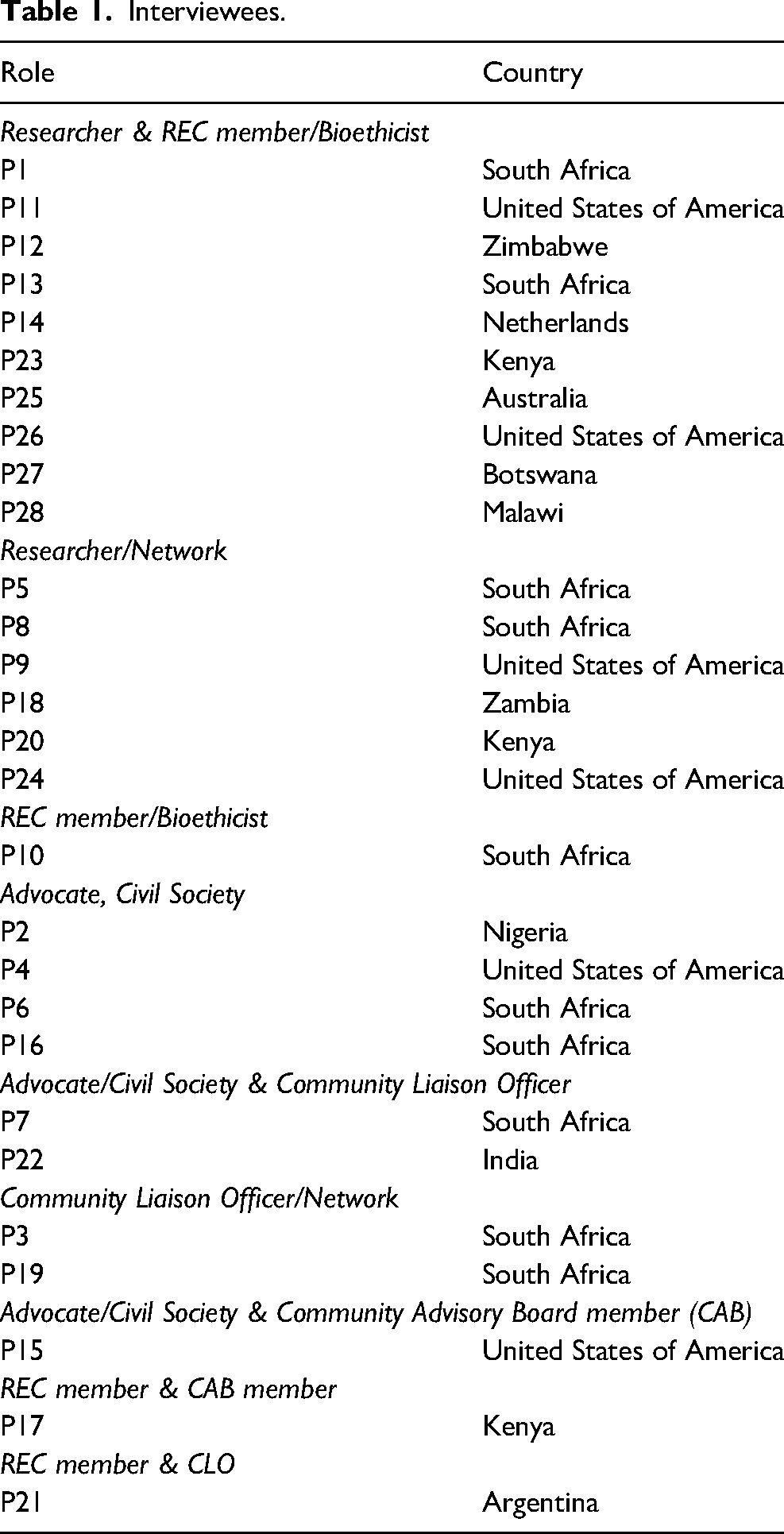
Thematic analysis was used to analyze the interview transcripts (Braun & Clarke, 2012, 2021). A coding strategy was used that combined inductive and deductive approaches i.e., where some themes and codes emerged from the interviews and others from the literature (Sandelowski, 2010). Two independent coders coded the transcripts using NVivo and coding differences were resolved by “reconciliation discussions” (Boyatzis, 1998, p. 152). Prior to data collection, the study concept was discussed with relevant stakeholders, and study results regarding key complexities have been disseminated to those affected stakeholders. Findings regarding the beneficial outcomes will also be shared with affected stakeholders.
Results
Three major thematic benefits were identified - namely emPowerment where engagement strives to empower stakeholders through the engagement process, Partnerships where engagement strives to build equitable relationships with stakeholders, and Protections where engagement offers protections to clinical trial participants, communities, and strengthens the science – which we have termed the “Three Ps”.
Most interviewees mentioned beneficial outcomes in the initial spontaneous definition of stakeholder engagement, in response to an interviewer question regarding how stakeholder engagement should be defined. That is, most interviewees defined stakeholder engagement in terms of the goals or outcomes it aims to achieve, for example: “…if you engage both parties and you instill a sense of pride because the stakeholders will be able to voice out their concerns …” (P28, REC/Researcher, Malawi). Those interviewees who mentioned the outcomes of engagement in their initial spontaneous definitions often also mentioned other components, such as who should be engaged (i.e., stakeholders), how (i.e., activities) and when (i.e., at what timepoint). A few interviewees did not mention the goal/outcome of engagement in their initial spontaneous definitions but rather defined stakeholder engagement largely in terms of who, how and/or when (even though they mentioned beneficial outcomes at some point in the course of the interview) for example: “So, for me, I mean, in just plain layman's terms, it's about starting from before the beginning of the writing of a protocol, to beyond the publication of the results to involve folks from every discipline, to be meaningfully involved, in the thought processes, ethical review, design, and even deciding the appropriateness, and the appropriateness of settings for any given research work.” (P15, CAB/Advocate, U.S.A)
Theme 1 (em)Powerment
Many of the interviewees spoke about empowerment as a valued goal or valued outcome of ‘good’ stakeholder engagement - where it helps to “level the playing field of power.” (P6, Advocate, South Africa) and “equal the playing field” (P8, Researcher/Network, South Africa) by offsetting the power differentials between researchers and community stakeholders. Here it was seen to “transform the power relations between those who hold it (sponsors and researchers) and those who need it (the community).” (P21, REC/CLO, Argentina): “So, good engagement, in my opinion, and also from my experience, is engagement where … there is respect and a power balance across the different parties …” (P17, REC/CAB, Kenya) “…certainly my understanding of stakeholder engagement, is almost an attempt at beginning to chip away the inequality of voices at the table.” (P6, Advocate, South Africa) “And the second approach that stakeholder engagement should take into account is trying to create an atmosphere or environment that would balance the power relations… So in trying to define good stakeholder engagement is ensuring that you are bringing in the space… people or stakeholders who have the same power in the same room for them to be able to provide their perspectives about that issue altogether.” (P28, REC/Researcher, Malawi) “Stakeholder engagement is such that it, it's, one, builds competency in terms of knowledge and skills of the respective stakeholders to understand the issues, so they can come to the table with some sort of equity and engage in the discussions around the trials.” (P2, Advocate, Nigeria) “…the education, empowerment of your community is very important with knowledge.” (P27, Researcher/REC, Botswana) “…what should happen through stakeholder engagement, is increased capacity for individuals and communities.” (P13, REC member, South Africa)
Some interviewees noted that building the capacity of researchers and site staff regarding community knowledge, norms, and values is also important, “but I also appreciated that if we’re in that space, everybody was learning” (P2, Advocate, Nigeria).
“…see if there's any potential for mutual learning of committee members and of that research institution and research groups.“ (P23, Researcher/REC, Kenya)
A few interviewees noted that engagement enables community stakeholders to make decisions regarding their participation in studies, where “communities have the power to say no” (P25, Researcher/REC, Australia). Here, it was recognized that information-giving empowers stakeholders to become more informed decision-makers along with researchers:
“So the process would also give people lots of information, that would also make it very clear that if a study does engage with a particular community, that that whole community knows that as a whole, they can reject the study.” (P10, REC, South Africa)
“…the key goal of community engagement, should be ensuring that your communities, your participants, your stakeholders,… understand that the basic literacy on research… and it's laid out in such a way that they are made to understand what it's all about, so that when they do decide to.. or if they want to support.” (P16, Advocate, South Africa)
A few interviewees also noted that engagement empowers stakeholders to voice their inputs and concerns, and to make contributions to the research process:
“…they are then advised to bring forward their perspectives
“…the stakeholders are empowered enough to understand beyond the direct issues related to the research and then they can also sit on those tables if and when they’re engaging with the research team in a way that they can truly, critically appraise the research and give the necessary feedback that's at the end of the day the community's end up being better off as a result of the engagement with the trial.” (P2, Advocate, Nigeria)
Theme 2 Partnerships
Engagement was perceived to have benefits for the goal of building research relationships - where “it's about building those trusting relationships” (P18, Researcher, Zambia). Engagement was seen as striving towards collaborative partnerships between stakeholders, where “good engagement is probably like a partnership model” (P25, Researcher/REC, Australia) and “good engagement is collaborative” (P17, REC/CAB, Kenya). “…the involvement of both partners, the researcher and the community, the dialogue between the two, so that it kind of comes out as a partnership.” (P27, Researcher/REC, Botswana) “…involve [stakeholders] in a way that, you know, they feel engaged and they are able to, uh, they basically co-design and collaborate.” (P22, Advocate/CLO, India) “I think a proper respect for your community as partners in the research process [will make engagement successful].” (P1, REC/Researcher, South Africa) “You as a researcher, you need to gain trust and respect from the community, and the other way around. You can only respect each other if you recognise each other.” (P27, Researcher/REC, Botswana)
Several interviewees highlighted that engagement may also lead to co-ownership of research, where the study is perceived to belong to stakeholders outside of the study team who feel committed to the study and invested in its conduct and outcomes:
“I think, uh, my past work experience and in general I believe that there is a sense of co-ownership, when it is not just you who think that this is my study but the community and other stakeholders feel that this is our study.” (P22, Advocate/CLO, India)
“…it is absolutely imperative that the people around the table are not just stakeholders, but they are the owners of the research.” (P6, Advocate, South Africa)
Following co-ownership, some interviewees identified that engagement leads to the mutuality of benefit, where both research teams and stakeholders find value in and have needs addressed through the research partnership:
“…whatever is going to come out of the study, will be also for the benefit of that community, and there is like a mutual benefit as well, not only to the researchers, but the community as well.” (P18, Researcher, Zambia)
“…when that happens the research becomes owned by both the parties and it is not one that somebody is seeking the approval of the stakeholders to make it happen. It then becomes something that addresses our needs and then we own it and then we will see to the success.” (P2, Advocate, Nigeria)
One interviewee noted that in such relationships, groups that are engaged are viewed by researchers as experts:
“…to bring them onboard, you may actually tap into that knowledge or understanding, and you may get something else, which may be the true reflection of that community, and therefore, having them onboard, pays off.” (P18, Researcher, Zambia)
Lastly, a few interviewees endorsed engagement that leads to relationships of mutual respect:
“So good engagement, in my opinion, and also from my experience, is engagement where, one, there is respect and a power balance across the different parties” (P17, REC/CAB, Kenya)
“I suppose whenever I think of stakeholder engagement, it's very, I think, for me, very values-based, so you’re wanting to uphold respect and honesty…” (P13, REC, South Africa)
Theme 3 Protections
Interviewees perceived that stakeholder engagement impacted valued ethics and scientific outcomes through various pathways, which improved protections for participants and community stakeholders and strengthened science.
Enhanced Protections for Participants
Several interviewees noted that engagement in clinical trials for HIV prevention has improved ethics protections for enrolled participants. A few interviewees noted that engagement of community stakeholders can ensure inputs on the consent materials and process, which can strengthen the consent experience for participants, by making their decisions to take part in the research much more informed: “…were stakeholders meaningfully engaged, starting with the drafting of the protocol, the development of the informed consent, and mature educational materials, both at the participant level, and beyond, in the community?” (P15, CAB/Advocate, U.S.A.) “…in many contexts, you are consulting staff to sort of say that you know there is this consent form, can you help us to make sure that this consent form is culturally appropriate?” (P22, Advocate/CLO, India) “…without proper community engagement, it's likely that the research ... might not be able to pick up the sort of like, not so obvious risks, to these vulnerable populations. So, community engagement then plays a role in sort of mitigating and kind of identifying, and addressing those non-obvious risks, in advance. So I think that's one key goal for community engagement.” (P12, Researcher, Zimbabwe)
Also, a few interviewees noted that engagement from broader civil society (distinct from community stakeholders per se) reportedly facilitated access to a high standard of HIV prevention for enrolled participants.
“The science and your accolades and your special edition of the Lancet is all secondary, almost irrelevant, and what is important, is that if we know, that there is a pill there, that works, if you put it in your mouth and take it, to prevent HIV, why wouldn’t that be in the basket of care. So, we had a few days of intense meetings and at the end of the meetings [clinical trial network representative] basically announced the establishment of this PrEP fund…” (P6, Advocate, South Africa)
Enhanced Protections for Community Stakeholders
Many interviewees identified beneficial outcomes of stakeholder engagement for communities (as distinct from enrolled participants), by reducing risks and enhancing benefits for community stakeholders more broadly: “…it results in more benefits and less harm to the communities that the research is designed on behalf of.” (P15, CAB/Advocate, U.S.A.) “…it can also be important for community benefits in making sure they’re having benefits that are coming from research are the ones the community actually values.” (P26, Researcher/REC, U.S.A.) “…for those questions that we [CLOs] see… it might not be good for the community or maybe it puts the community members at risk somehow, and then those are the concerns that we take back to the sponsor.” (P3, CLO, South Africa) “…and all these things [stakeholder engagement] that could be done better, so that everyone benefits; everyone should benefit, it shouldn’t just be the scientists.” (P16, Advocate, South Africa) “For any research or for any program, for that matter of fact, what is critical is that, to make it successful, you have adequate, you respect the autonomy and knowledge of the community that you wish to engage with or the stakeholders that you wish to engage with.” (P22, Advocate/CLO, India) “ …it's also that like the slogan, it's about them, right? So it's important that they are involved in what they think is important, that should be studied, but that's for communities and participants.” (P14, Researcher/REC, Netherlands) “I think engagement is very important as an ethical principle of respect for persons, respect for, you know, autonomy, that is, recognition of the self-determination of the individual should be key, is the first ethical principle. By engagement, we are saying we are recognising the participant, we are recognising the community, also engaging them, makes them feel part of, you know, part of the process.” (P27, Researcher/REC, Botswana)
One interviewee perceived that engagement leads to enhanced cultural respect for communities:
Many interviewees viewed that engagement in some way countered the likelihood of exploitative research for participants and community stakeholders, for example countering research that is “here today, gone tomorrow…” (P8, Researcher/Network, South Africa) or where research does not benefit communities “and it may be an unethical thing to do” (P5, Researcher, South Africa). or where local stakeholders “don’t seem to have the entire liberty to do things in ways that are appropriate” (P2, Advocate, Nigeria):
“If you look back in the history of how clinical trials or clinical research used to happen, there were a lot of ethical concerns… people were treated like guinea pigs and from that to where we are, to firstly formally acknowledge the need for ethical community engagement, to having certain guidelines that at least guide the principles and have those principles and outlines written in a certain way, guidelines which give you a direction in terms of what are the processes that make ethical community engagement more ethical, we definitely have come a long way.” (P22, Advocate/CLO, India)
“I first felt that participants could actually feel like guinea pigs during a study… I think we did not carefully explain why it's important for research to happen in specific populations … We had a very hard-working person who was in charge of our community team and immediately after that she worked superbly to organise discussion groups with the group of women who were involved.” (P1, REC/Researcher, South Africa)
“I think that part of the responsibility of community engagement is creating a research literate population that cannot be taken advantage of in the research process.” (P1, REC/Researcher, South Africa)
Improved Science
Most interviewees reported that engagement confers several benefits for the science of HIV prevention research: “Well, I think the top-line of that is it [stakeholder engagement] makes for better, more productive research.” (P15, CAB/Advocate, U.S.A.) “But I also think, if you think of it a little bit broader, then in general, so also involving regulators, advocacy groups, governments, community advisory boards, that you don’t do research that eventually cannot be conducted in an ethically responsible manner, as in, that you ask the wrong questions, that you don’t come up with the design that is able to answer your question, that you cannot implement results in a way that's sustainable; I think, for all these reasons; you may even call that to increase the social value of your research, or to avoid research waste.” (P14, Researcher/REC, Netherlands) “ …partnerships can help make science better.” (P13, REC/Researcher, South Africa)
“…if you do not engage your results will not have an impact.” (P5, Researcher, South Africa)
“I think it's really about your study being understood and known about, within your stakeholder community; and participation, increased participation in your study; acceptability of your results at the end of the study; and potential uptake of whatever results would come out of your intervention or your study, would be, to me, I think, successful indicators.” (P19, CLO/Network, South Africa)
Engagement was perceived by many to lead to more acceptance of studies by community stakeholders, which facilitates their success:
“…there's a practical dimension as well, if people aren’t driven by their principles on this, and the practical dimension is that, if you are not being transparent and accountable to stakeholders, generally, then you may hurt them, they may get upset, they may not trust you, and they could really disrupt your research.” (P9, Researcher/Network, U.S.A.)
“I think, also, we see a success also, on the stakeholder side themselves in… appreciating science, appreciating research, and the social value that science and research brings, in society.” (P17, REC/CAB, Kenya)
Discussion
Interviewees’ perceptions of the beneficial outcomes conferred by engagement map closely onto many of the beneficial outcomes described in or envisaged by ethics guidelines (HPTN, 2021; UNAIDS, 2021; UNAIDS & AVAC, 2011) and in the literature (Garrison et al., 2021; Salerno et al., 2021). This suggests that outcomes claimed in ethics guidance are not likely to be challenged by stakeholders in the field and likely enjoy credibility with stakeholders.
Interviewee perceptions regarding emPowerment correspond with benefits set out in leading international ethics guidelines (HPTN, 2021; UNAIDS & AVAC, 2011; UNAIDS, 2021). Also, interviewee perceptions regarding Partnership are echoed in international ethics guidelines (HPTN, 2021; UNAIDS & AVAC, 2011; UNAIDS, 2021). Furthermore, in terms of the Protection of future beneficiaries through improved science, interviewee perceptions resonate with the views in guidelines about the benefits of engagement (CIOMS, 2016; UNAIDS & AVAC, 2011; UNAIDS, 2021).
The concordance between our findings and guidance is somewhat expected and not surprising, given considerable efforts in the past decade to raise awareness of the value of participatory practices in HIV prevention trials, for example by the AIDS Vaccine Advocacy Coalition and many other initiatives. Previous literature has noted that beneficial outcomes described in ethics guidance may not be achieved if stakeholder engagement is poorly implemented (Adhikari et al., 2020; MacQueen & Auerbach, 2018; Wilkinson et al., 2022).
Educational Implications
International guidelines have a key educational function. Guideline developers could consider clearly distinguishing between overarching and subordinate goals, as explicitly done by UNAIDS & AVAC (2011) that asserts that engagement seeks the goal of collaborative relationships aimed ultimately at the collective shaping of research. Also, HPTN (2021) suggests that the overarching goal of engagement is the improved scientific and ethical quality of research. Being explicit about goals may help researchers to evaluate whether outcomes are reached as pointed out by MacQueen et al. (2015) and MacQueen et al. (2016). The recommendation in UNAIDS & AVAC (2011) that community stakeholders have the right to refuse or to support research projects in a specific area was echoed by several interviewees in this study, however, there should be more direction in ethics guidelines on how to address this complex situation in a way that respects multiple values and principles.
Best Practices
Research Agenda
In general, future research should investigate with interviewees which beneficial outcomes are perceived to be the “ultimate” outcome, versus those perceived to be “subordinate” outcomes as well as perceived reasons why beneficial outcomes are not always realized in practice. In terms of Partnership, future research can explore strategies perceived to strengthen or undermine the partnerships. In terms of emPowerment, future interviews should explore how empowerment is perceived to be promoted (e.g., through capacity building that avoids reinforcing inequalities) or compromised across broader stakeholder groups (since many interviewees here focused on the community and clinical trial site relationship). Future research can also explore engagement strategies perceived to lead to more knowledgeable stakeholders who are empowered to make informed decisions about the research. In terms of Protection, future research should explore in more detail the explicit pathways through which engagement is perceived to protect participants, communities, and future beneficiaries of research.
Limitations
Firstly, our sample size is small, therefore, we cannot say whether different stakeholder groupings identify different benefits. While located in different countries, interviewees do not represent their nation, rather they provide insights about subjective experiences of a stakeholder group. Secondly, our study cannot support any claims that engagement really does lead to beneficial outcomes, and indeed this was not the aim of our study. It seems reasonable to assume there are many challenges in realizing these outcomes (and overcoming complexities). Thirdly, we cannot draw distinctions between perceived “ultimate” beneficial outcomes versus “subordinate” outcomes, because we did not make inquiries in this regard, and this was not offered spontaneously. For example, we cannot tell whether stakeholders perceive “empowerment” to be an outcome that is equal in importance to “enhanced scientific/ethics quality” or not. Fourthly, our findings may be more relevant to perceptions of large-scale clinical trials as our sample was focused on this type of research. However, it is unclear exactly what stage of the research pathway was being considered by our interviewees (e.g., phase 1 through licensure or only some segment of it), and their responses may have differed if more explicit questions were asked. This distinction could be explored in future studies. Finally, data was not collected from community stakeholders specifically (stakeholders residing locally around a clinical trial site, who represent populations from which participants are drawn) although we did recruit members of CABs as well as community advocates/civil society.
Conclusions
Interviewees’ perceptions of the beneficial outcomes conferred by stakeholder engagement map closely onto many of the beneficial outcomes described in or envisaged by ethics guidelines (HPTN, 2021; UNAIDS, 2021; UNAIDS & AVAC, 2011). It seems logical that empowerment and partnership could be intermediate goals that serve the ultimate goal of strengthening the scientific and ethical quality of studies, however, the perceived relationships between beneficial outcomes requires further empirical exploration, and conceptual work in the field. Future research and monitoring and evaluation should try to clarify the relationships between desired outcomes, and how outcomes can be achieved, in order to continue to strengthen practices in the field.
Footnotes
Acknowledgements
We would like to extend our sincere thanks to all the interview participants for providing their invaluable insights on this topic.
We would also like to thank Professor Douglas Wassenaar at UKZN for helpful advice, and colleagues at AVAC and USAID for helpful comments.
This research was funded by the US President's Emergency Plan for AIDS Relief (PEPFAR) and the US Agency for International Development (USAID). * Cooperative Agreement No. AID-OAA-A-16-00031 - Coalition to Accelerate and Support Prevention Research (CASPR).
Declaration of Conflicting Interests
The author(s) declared the following potential conflicts of interest with respect to the research, authorship, and/or publication of this article: Catherine Slack is a member of a DSMB that has oversight of several HIV vaccine trials.
Funding
The author(s) disclosed receipt of the following financial support for the research, authorship, and/or publication of this article: This research was funded by the US President's Emergency Plan for AIDS Relief (PEPFAR) and the US Agency for International Development (USAID). * Cooperative Agreement No. AID-OAA-A-16-00031 – Coalition to Accelerate and Support Prevention Research (CASPR).

APPENDIX - Interview Schedule Domains
The interview will explore the domains listed below. Refinements may be made to these domains informed by various cycles of data collection and analysis, in an iterative manner, in accordance with principles for qualitative research.
Domain 1 - Role and Experiences
Current and previous roles? Experiences relevant to Stakeholder Engagement (SE) and/or ethics review and/or clinical trials of HIV prevention? Definitions of stakeholder engagement? Perceived importance of stakeholder engagement? Perceived major successes in stakeholder engagement? Perceived factors enabling ‘good’ stakeholder engagement? Major stakeholder engagement practices, where relevant? Perceived complexities with stakeholder engagement? Critical incidents in stakeholder engagement - e.g., any stakeholder engagement incident from the past that caused concern? Perceived importance of ethics review? Perceived major successes in ethics review? Major processes and practices? (where relevant) Perceived complexities with ethics review? Critical incidents in ethics review? Perceived need for improvements to current practices where necessary? Perceived value of ethics review of stakeholder engagement? Perceived positive impact of ethics review of stakeholder engagement? Perceived concerns with ethics review of stakeholder engagement? Perceived negative impact of ethics review of stakeholder engagement? Other key concerns of significance to interviewees? E.g. Perceptions regarding stakeholder engagement for standard of prevention/care? E.g. Perceptions regarding power differentials and gender dynamics? Other?
Domain 2 - Stakeholder Engagement Achievements
Domain 3 - Stakeholder Engagement Complexities
Domain 4 - Ethics Review Achievements
Domain 5 - Ethics Review Complexities
Domain 6 - Ethics Review of Stakeholder Engagement Opportunities
Domain 7- Ethics Review of Stakeholder Engagement Complexities
Domain 8 Other Key Issues