



Abstract
The social and ethical implications of large-scale biobank donor recruitment campaigns have remained understudied. We use two recent campaigns of the population-based genetic biobank in Estonia as an example to demonstrate how campaign spokespersons try to persuade potential donors by appealing to (1) gaining self-knowledge, (2) gaining control over one's health, (3) fear of illness, (4) contributing to healthcare, (5) contributing to science, and (6) contributing to one's country. While these campaigns succeeded in recruiting 15 percent of the country's adult population as donors, we explain how the use of some of these appeals may (a) create unrealistic expectations regarding the benefits donors could receive and (b) conceal the risks regarding health data. The study lays a necessary groundwork for future empirical research on the ethics of biobank recruitment campaigns.
Keywords
Introduction
Individuals’ understanding of health and medicine may be influenced by large-scale campaigns aimed at recruiting new ‘gene donors’ to partake in genetic research (Snell & Tarkkala, 2021; Wienroth et al., 2019). Recruitment campaign messages may contain various persuasive appeals – rhetorical devices used to influence individuals to act in a particular way i.e., answers to the question ‘Why should something be done?’. Appeals in health-related recruitment campaigns have been studied in the context of blood donation, clinical trials, and direct-to-consumer genetic test marketing (Barton et al., 2014; Hunter et al., 2012; Lee et al., 2020; Schaper & Schicktanz, 2018; Wang, 2018). In these contexts, individuals are often persuaded by arguing that the act of donation or using genetic testing services will benefit themselves (by offering them personal health information that empowers them to change their health behaviour) and others (by contributing to common good). However, relatively little is known about the campaigning methods and messages of genetic biobanks and the ethical problems certain appeals may pose (Snell & Tarkkala, 2021; Wienroth et al., 2019).
To better understand this, we analysed the campaign messages of a state-owned population-based genetic biobank in Estonia which succeeded in recruiting 15 percent of the adult population of the country (150,000 individuals 1 ) during its recent nationwide campaigns in 2018 and 2019. Unlike many biobanks that focus only on conducting general biomedical research (De Clercq et al., 2017), the Estonian Biobank aims to use the results of genetic research to improve public health by offering all participants feedback about their genetic information. Moreover, the health authorities plan to integrate genetic data to the national healthcare system to offer personalised medicine services (The National Institute for Health, n.d.). These plans are contingent on several prerequisites that are yet to be implemented: new IT solutions, legislation, funding, and training for doctors. Despite these current limitations, the campaigns’ spokespersons promised that donating would bring both individual and collective benefits. Our study is the first to focus on argumentation strategies and document the use of self-oriented appeals in biobank recruitment campaigns.
While the campaigns were successful in attracting new participants, our detailed analysis of the campaign rhetoric uncovered two ethical issues: potentially misleading claims regarding personal benefits and the lack of discussion about the risks involved in collecting personal health data.
Exaggeration of potential value of a particular field of science or ‘science hype’ (Caulfield, 2018) can drive social support for health research (Roberson, 2020). However, when biobanks are actually unable to deliver on their promises, it may undermine the donors’ trust in them and discourage future participation in biobank research (Broekstra et al., 2020; Caulfield, 2018; Critchley et al., 2012). As returning research results to biobank participants is a global trend (De Clercq et al., 2017), the Estonian case study will offer governments and biobanks valuable and timely insight into ethical recruitment campaign development.
We first review literature on the persuasive appeals employed in donor recruitment campaigns and the ethical issues regarding these appeals. Second, we describe our data and method (argumentation analysis). Third, we present our results: a detailed account of the types of recruitment appeals. We conclude with a discussion of the broader ethical implications of the case study for the future of global biobanking.
Literature Review
Motivations and Appeals in Donor Recruitment Campaigns
One of the ways to recruit individuals to donate their biological samples for biomedical research is via rhetorical persuasion where individuals’ motivations are used as a basis for arguments to justify why one should become a donor. Individuals may be motivated to donate biological samples by their wish to benefit either themselves or others. The former include personal health improvements and information about one's health status, material incentives, and information about ancestry (Sheridan et al., 2020). The latter include motivation to help others, including to support science and patriotism (Sheridan et al., 2020; Wang, 2018). Previous studies in the Scandinavian countries and the United States suggest that other-oriented motivations are more important drivers of becoming a donor in genetic research (Domaradzki & Pawlikowski, 2019; Hoeyer & Lynöe, 2006; Skolbekken et al., 2005). These motivations can be used to create campaign messages that appeal to certain outcomes valued by the audience.
Self-oriented appeals include appeals to self-knowledge, self-empowerment, and fear. The first two are often employed in direct-to-consumer genetic testing services websites and marketing (Lee et al., 2020; Nordgren, 2013). The former suggests that one will receive knowledge about oneself when using these services, and the latter that one will be empowered to change their health behaviour if they use these services. In addition, health campaigns may appeal to fear by using vivid images or descriptions of damage that can occur unless some action is taken (Guttman & Salmon, 2004).
Other-oriented appeals include appeals to helping others, contributing to science and healthcare, and patriotism. For example, appeal to helping others has been used on the website of the UK Biobank to call prospective participants: they are depicted as altruistic people who do not expect anything in return (Tutton & Prainsack, 2011). Appeals to helping others by contributing to healthcare have been employed in the UK's National Institute for Health Research patient recruitment campaign where patients were depicted not only as recipients of the healthcare system but also as assets (Wienroth et al., 2019). Appeals to the contribution to science have been used in direct-to-consumer genetic testing marketing (Tutton & Prainsack, 2011) and appeals to patriotism in blood donation campaigns (Wang, 2018).
Ethical Issues in Donor Recruitment Campaigns
To be influential, the campaign messages should be understandable (explicit, simple, comprehensive, comprehensible) and come from credible sources, such as celebrities, public officials, or experts (Rice & Atkin, 2012). However, certain campaign messages may cause ethical problems (Barton et al., 2014; Snell & Tarkkala, 2021) as these may involve manipulative messages that interfere with people's autonomy (e.g., provocations, omissions) or privacy, and inadvertently harm the well-being of individuals and groups (Guttman, 2017). While persuasion can be defined as influencing individuals through offering reasons, manipulation means influencing by reasons disguised as good, but known to be faulty or bad (Rossi & Yudell, 2012). Presenting only benefits and withholding critical information can thus be considered unethical (Guttman & Salmon, 2004). Similarly to the health care setting, the relationship between the individual donors and the biobank as an organization is governed by a trust-based relationship that presupposes the vulnerability of the individual. This vulnerability derives from the imbalance of knowledge about genetics and biobanking between the experts and individuals, and from the importance of health and well-being for the individual participant (Goold, 2001).
Recruitment campaign messages that shape people's expectations regarding health outcomes and the implications of biobank participation may sometimes be misleading, and amplify certain misunderstandings in society. For example, genetics and personalised medicine are often portrayed in an exaggerated and simplistic manner by journalists and the proponents of genetics (Caulfield, 2016; Marcon et al., 2018), whereas scientific uncertainty of discoveries is downplayed (Ratcliff, 2021). While new therapeutic treatments and medicines are said to be around the corner (Petersen, 2006), the validity, utility and implementation of genetic information to fulfil these promises can fall short due to a number of clinical, social, scientific and ethical obstacles (Torkamani et al., 2018). Not being able to fulfil these promises may mislead the public and delegitimize the field of genetics and personalised medicine in the long term (Caulfield, 2016). Some studies conducted in the US indicate that both patients and healthy individuals feel that their expectations regarding clinical utility of the information received from genetic testing are not met and that they would have wanted to learn more personal information (Hoell et al., 2021). This suggests that individuals do not always possess enough knowledge about genetics to critically analyse the exaggerated claims about genetic testing in the media and form realistic expectations towards it.
The risks associated with biobanks and genetics – loss of control over personal data, loss of privacy, data breaches, risk of unauthorised re-identification, and potential discrimination or stigmatisation (Caulfield & Murdoch, 2017) – tend to receive little news media coverage compared to potential benefits (Ostergren et al., 2015). The selling of genetic data to private companies may exacerbate these risks. Commercialisation of biobanks is shown to reduce the trust between the biobanks and their participants, endangering future research (Broekstra et al., 2020; Caulfield & Murdoch, 2017). While all biobank participants sign an informed consent form, the forms often do not disclose the moral risks involved (Foster & Young, 2012) and individuals tend to have limited understanding of the information presented in these forms (Kasperbauer et al., 2022). The public's poor understanding of genetics (Chapman et al., 2019) can prevent them from making reasonable judgements about the benefits and risks associated with biobanking.
Debates over whether and how biobanks should return results are ongoing: while some argue for offering participants clinically actionable information, others claim that it would be too costly and the information might not yet meet the requirements for use in medical interventions (Burke et al., 2014; De Clercq et al., 2017). Patients themselves consider genetic information valuable beyond clinical utility, perceiving it as useful in and of itself, supporting lifestyle choices and improving one's self-awareness (Saelaert et al., 2021). However, returning research results to participants is not equivalent to clinical care since it is not its primary aim to provide the best possible medical services to the patient, but rather generate generalisable knowledge (Burke et al., 2014).
Becoming aware of genetic risks is associated with perceived moral obligations to mitigate those risks and maintain health. Yet, health outcomes are not always under the full control of the individual. Describing certain diseases as ‘lifestyle diseases’ manageable by ‘choosing healthy lifestyles’ or depicting genetic information as ‘empowering’ may create a false impression that individuals are easily able to control their health outcomes (Nettleton, 2020). However, access to genetic information alone does not promote behaviour change (Hollands et al., 2016). Health outcomes are largely mediated by socio-economic status, cultural factors, policies, and accessibility of health services (Guttman & Salmon, 2004; Nettleton, 2020). Arguably, individuals do not interpret genetic risk information as deterministic i.e., they do not take genetic risks as a certainty (Condit, 2019). But if the offering of genetic information to individuals is depicted as a solution to public health issues in the hope that each person would be capable of taking care of their own health, attention and resources may be directed away from environmental, social and economic factors that affect health outcomes (Caulfield, 2018). In our study, we are concerned with how these ethical challenges manifest in large-scale biobank recruitment campaigns.
Materials and Method
Materials
We analysed campaign messages from two recent consecutive recruitment campaigns in 2018 and 2019 by the Estonian Biobank which succeeded in recruiting 100,000 and 50,000 new participants respectively (15 percent of the adult population altogether) who donated their DNA samples to the biobank. Participants did not receive pre-test genetic counselling. The campaigns used more than 30 influential spokespersons who exhorted people to become participants by making appeals in news media interviews and press releases, on the campaign website, as well as in videos and posts on the social media accounts of the biobank. Some of these spokespersons (doctors, scientists, politicians, healthcare officials, biobank employees) may be seen as having a stake in increasing the biobank dataset since it benefits their professional objectives. The campaigns targeted all Estonian-speaking individuals aged 18 and older. The campaigns and their messages were approved by an institutional review board.
We collected the messages communicated by the spokespersons throughout the active campaign period between 20 March 2018 and 31 December 2019 in the top three Estonian news media outlets (Delfi, Postimees, and ERR) using their integrated online search engines to search for Estonian-language words and phrases referring to the biobank: ‘geenivaramu’ (biobank), ‘geenidoonorlus’ (gene donation), and ‘geenidoonor’ (gene donor). We also harvested all the campaign messages from all of the biobank's own online channels. Our dataset includes 188 news stories from the news media outlets and 427 posts and videos from the campaign website (www.geenidoonor.ee), as well as the Facebook (https://www.facebook.com/geenivaramu), Instagram (https://www.instagram.com/geenidoonor/) and YouTube (https://www.youtube.com/@eestigeenivaramu7534) profiles of the biobank. Some content was duplicated across platforms. In those instances we also counted the duplicates since they reached potentially different audiences.
Method
The persuasive appeals used by the campaign spokespersons are essentially arguments answering the question ‘why should one donate their DNA sample to the biobank?’. To identify and evaluate the different appeals used in the campaigns, analytic tools for a qualitative study of argumentative discourse are required.
Previous research on biobank recruitment messages has analysed the use of metaphors (Snell & Tarkkala, 2021), and how individuals are rhetorically constructed as patients and consumers of genomic information (Tutton & Prainsack, 2011; Wienroth et al., 2019). While the latter two studies identified appeals to contributing to healthcare and science, they neither described these in detail nor assessed their validity.
We suggest that Toulmin's (2003) functional model for analysing arguments could be a useful tool for unpacking persuasive appeals. This model has been fruitfully used to analyse health discourse (e.g., Labrie & Schulz, 2014; Yi et al., 2013) and political persuasion (e.g., Hansson, 2018) to identify and interpret the basic elements of arguments. These elements are:
– claim, a contestable statement that has to be justified; – data, i.e., facts, evidence, or reasons given to support a particular claim; – conclusion rule (warrant) that connects particular claims and data; it is often based on values or beliefs that are assumed to be shared with the audience and is not always expressed explicitly; it can be explicated in the form ‘if x, then y’ or ‘y, because x’.
In biobank recruitment messages, all spokespersons make the same basic claim: individuals should become biobank participants. However, the conclusion rules – or the types of appeals as we call them – that lead to these claims may vary and rely on individuals’ expected motivations to participate (e.g., ‘you should become a biobank participant, because then you will find out your genetic information’). Data to support these appeals may include, for example, evidence of how individuals have received their genetic information in return for becoming a biobank participant.
Any of these elements may be left implicit in the campaign message. For instance, a spokesperson may say ‘Become a gene donor and you’ll find out what you’re made of’, but offer no evidence of how becoming a biobank participant might produce that knowledge. In this case, she expects the audience wants to know ‘what one is made of’ and simply accepts the conclusion rule ‘if you become a biobank participant, then you will know what you are made of’. In our analysis, we unpack the appeals by explicating their three components. This enables us to make a clear distinction between different types of appeals, and subsequently evaluate whether the appeals are sound and supported by data such as scientific studies or statistics.
It should be emphasised here that Toulmin's model is not a normative one and we do not claim that campaign messages should always contain rigorous academic arguments and detailed scientific data. The argumentation-analytical approach helps to draw attention to a variety of conclusion rules (appeals) and data used in campaign messaging, but the norms for judging the appeals are derived from previous research on the ethics of recruitment campaigns explained above. Importantly, campaigns do not consist only of advertisements (that are necessarily short) but include much longer formats such as press releases, news interviews, and even informed consent forms (Dresser, 2002). We therefore include in our analysis all the various genres of campaigning to chart the whole range of appeals used to persuade the audiences.
As explained above, appeals can be either self-oriented or other-oriented. The former relies on individuals being motivated to become biobank participants for their own sake (‘if you become a biobank participant, then you will receive self-knowledge/avert a loss’), and the latter for the sake of others (‘if you become a biobank participant, then you are contributing to/helping others’). The spokespersons do not always state these appeals explicitly, so we have to look for linguistic evidence – the occurrence of particular words or phrases – in their text and talk as indicators that they are using a particular type of appeal (e.g., the use of phrases such as ‘know yourself’ and ‘know what you’re made of’ suggest that a spokesperson is appealing to the listener's wish to gain self-knowledge) (‘if you become a biobank participant, then you will receive self-knowledge’).
In campaign messages, different appeals may sometimes be joined by conjunctions, combined in a single phrase, or used in consecutive sentences. We will demonstrate the language of different appeals in more detail in the results section below.
Results
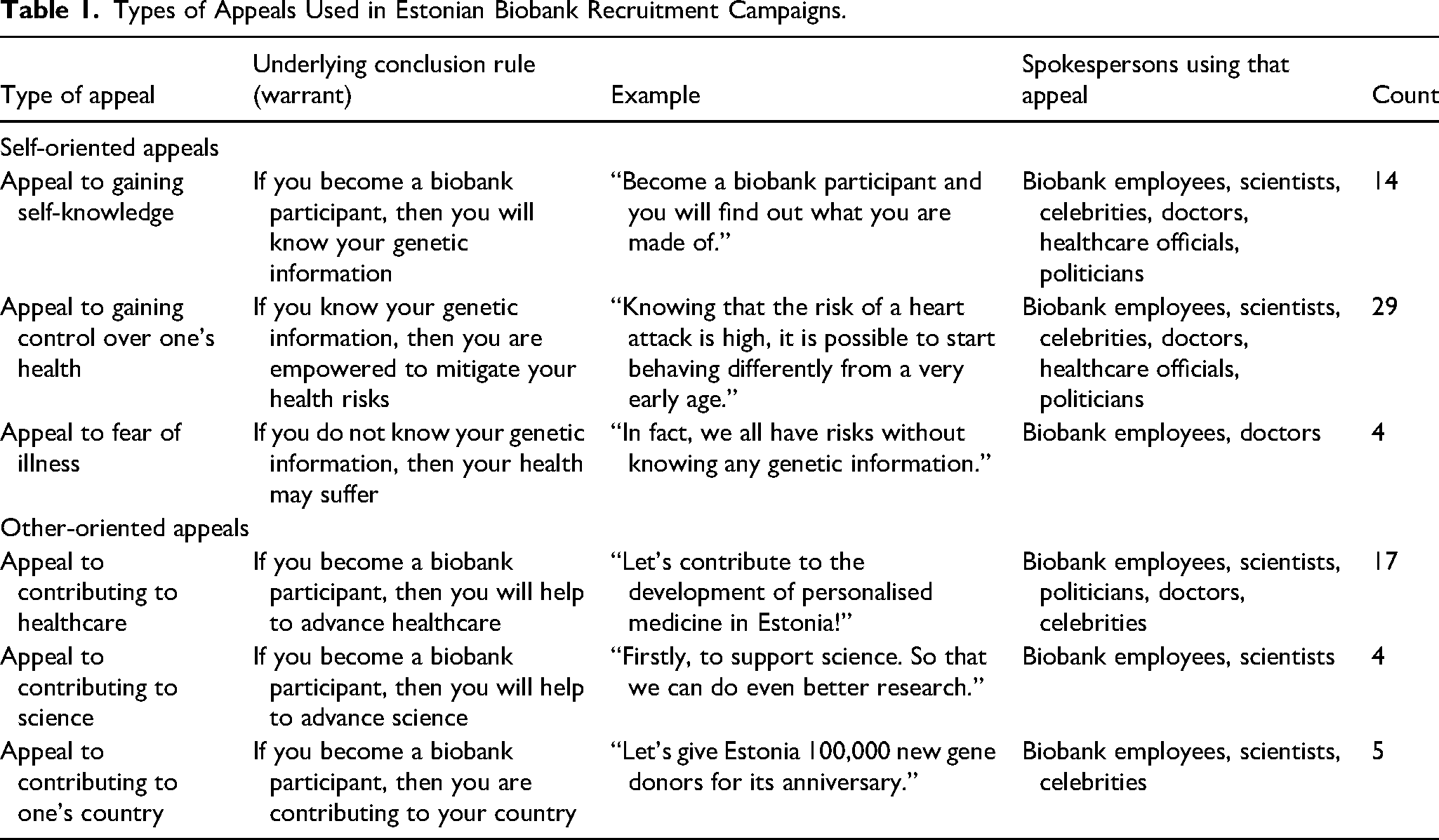
We identified 73 appeals that we categorised into three types of self-oriented and three other-oriented appeals (summarised in Table 1). 2 Two thirds of all appeals were self-oriented. Biobank employees (head of the biobank and leading scientists) were the most common spokespersons, making half of both self-oriented and other-oriented appeals. Below, we describe and exemplify each type of appeal in turn.
Types of Appeals Used in Estonian Biobank Recruitment Campaigns.
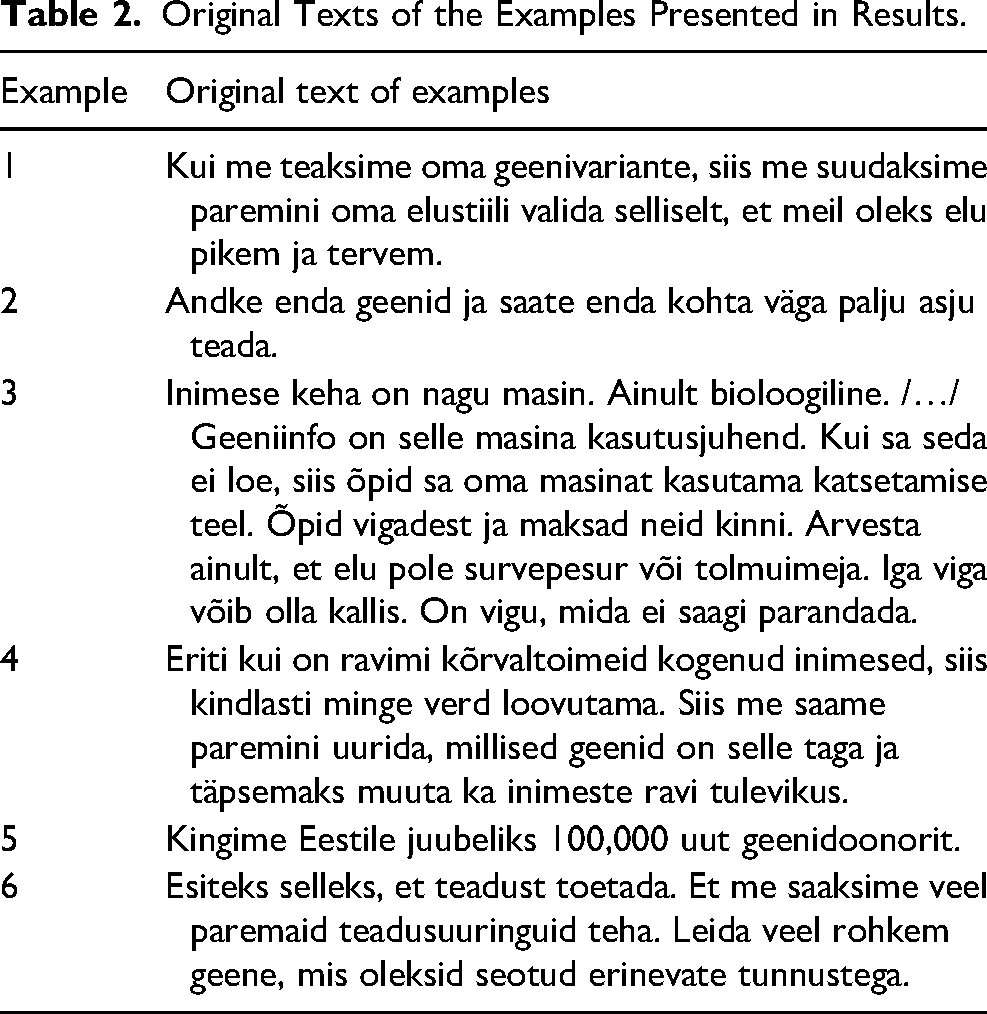
Original Texts of the Examples Presented in Results.
Self-Oriented Appeals
Self-oriented appeals are used by the campaign spokespersons to portray the act of becoming a biobank participant as personally beneficial to the particular individual.
Appeal to Gaining Self-Knowledge
This appeal relies on people's interest in obtaining information about their health status and ancestry and is characterised by the use of phrases such as ‘know yourself’, ‘know your genes’, and ‘see your genetic information’.
In our data, arguments that appealed to gaining self-knowledge seldom included any information on when and where an individual would receive self-knowledge after becoming a biobank participant. For example, in a campaign video posted on the Facebook page of the biobank, Estonian psychology professor Jüri Allik said: (1) Give your genes and you will find out a lot about yourself. (TÜ Eesti geenivaramu, 2018).
This claim is ambiguous: it could possibly create a misguided expectation that biobank participants would get information about both their health and genealogy. However, the Human Genes Research Act (2021) in Estonia states that the biobank participant ‘has the right to know his or her genetic data, except genealogy’ since the aim of the biobank is to improve public health and not be used to solve questions about paternity.
Allik does not specify any particular disease. The suggestion that ‘a lot’ can be found out about each participant's health may be seen as exaggerated because while there are a large variety of diseases with genetic components, current knowledge of the effects of genes on diseases and the amount of information with clinical utility is limited (Torkamani et al., 2018).
The spokesperson does not elaborate whether the individual will receive this information from the biobank, their doctor, or some other source, and when that would be available. It is left unsaid that gene donation is not instantly followed by receiving feedback about one's health status as one would, for example, after having one's blood pressure measured.
In the two studied campaigns, a third of appeals to gaining self-knowledge were ambiguous about the type of information the individuals would receive in return for their participation. Most appeals remained vague about when participants would receive this information, where from and about what diseases.
Having self-knowledge may be seen as a prerequisite for gaining control over one's health.
Appeal to Gaining Control Over One's Health
This appeal rests on people's motivation to take care of their own health. In the studied campaigns, this was the most frequently occurring type of appeal, constituting a third of all appeals. This appeal was constructed using phrases such as ‘make better choices’, ‘live longer’, ‘change (health) behaviour’, ‘make lifestyle changes’, and ‘take necessary medications’.
In our data, spokespersons seemed to suggest that receiving genetic information would guarantee that biobank participants would be able to mitigate their health risks, but no evidence was presented to support that. The spokespersons referred to specific diseases such as heart attack, glaucoma, coronary heart disease, type II diabetes, but also ‘health risks’ in general that were not specified. For example, professor Andres Metspalu, the head of the Estonian Biobank and one of its founders, said in a campaign video: (2) If we knew our gene variants, then we would be better able to choose our lifestyle so that we would have a longer and healthier life. (Eesti Geenivaramu, 2019)
This formulation is based on the assumption that the audience would understand that to know their gene variants (i.e., receive genetic information), they should become biobank participants. Metspalu does not specify how knowing one's gene variants would contribute to health or specify any diseases but rather speaks about a longer and healthier life. The spokesperson depicts genetic information as something that empowers individuals to ‘choose a better lifestyle’, which may be misleading since health behaviour is not solely dependent on individuals’ knowledge of health risks. While he uses a qualifier ‘would be better able’ to limit the strength of the argument, he does not provide any data to prove this.
In the studied campaigns, appeals to gaining control over one's health were constructed mostly in terms of gains (‘if you know your genetic information, then you are empowered to live a healthy life’). However, in some instances there were references to potential losses (‘if you do not know your genetic information, then you are disempowered from living a healthy life’), thus also appealing to fear (see 4.1.3). All appeals to gaining control over one's health presume that people need to gain self-knowledge – their genetic information – first.
Appeal to Fear of Illness
This appeal relies on people's wish to avoid illness. Some campaign messages suggested that people were more likely to fall sick without being aware of their genetic risks. For instance, campaign spokespersons talked of ‘avoiding the mistakes’ by becoming a biobank participant, said that ‘we all have risks which can be avoided’, and claimed that ‘average life expectancy will fall’ unless people knew their genetic information. For example, in a campaign video, an anonymous narrator said: (3) Human body is like a machine. Only biological. /…/ Genetic information is the manual of this machine. If you don’t read it, then you will learn to use this machine by experimenting. Learn from mistakes and pay for them. Just note that life is not a pressure washer or a vacuum cleaner. Every mistake can be expensive. There are mistakes that can’t be fixed. (Eesti Geenivaramu, 2019)
Here, the appeal is constructed via a metaphorical representation of a human body as a ‘machine’, suggesting that genetic information is the ‘manual’, ‘reading’ the manual is acknowledging and using genetic information, ‘using the machine’ could be understood as living one's life, and making ‘mistakes’ as not being aware of health risks, or using genetic information and learning through trial and error. The appeal rests on the assumption that the audience believes that becoming a biobank participant would help to mitigate genetic risks. The perception of threat is intensified by suggesting that there are some illnesses which cannot be cured. The narrator does not mention any other factors that affect health outcomes and leaves a possibly misleading impression that equipped with genetic information, one can simply choose the right health behaviour or have the necessary medical interventions and avoid genetic risks from materialising.
Other-Oriented Appeals
Other-oriented appeals are used to depict the act of becoming a biobank participant as benefiting actors and causes beyond the particular individual.
Appeal to Contributing to Healthcare
Contributing to public healthcare may be seen as an altruistic act which benefits other people and therefore rests on people's motivation to help others. Appeals to helping others have been traditionally used in clinical trials, blood donation, and biobank recruitment. The appeal is characterised by the occurrence of verb phrases such as ‘contribute to’ and ‘help’ combined with ‘the healthcare system’, ‘medicine’, ‘treatments’, and ‘medical care’.
In the studied campaigns, this was the most popular other-oriented appeal, probably because of the state's plan to integrate genetic data from the biobank to the Estonian national healthcare system and offer personalised medicine services. Most of the appeals to contributing to healthcare did not include any data to support the claims. For example, in an interview to the Estonian Television morning show, professor Lili Milani, a lead scientist at the biobank said: (4) Especially people who have experienced side effects from drugs, be sure to donate blood. Then we can better study what genes are behind it and make the treatment of individuals more accurate in the future. (Viirpalu, 2018)
The underlying conclusion rule of this appeal can be summarised as: ‘if you become a biobank participant, then you are contributing to healthcare’. Notably, the phrase ‘donate blood’ is equated here with becoming a biobank participant. This may give an impression that participants are only expected to donate blood. However, that is not the case: the data in biobanks is useful for biomedical research only when combined with other health data, such as whether one has experienced side effects with drugs. In the studied campaigns, most other-oriented appeals remained silent about the fact that those who sign up are expected to allow access to other data besides a blood sample and participate in future research. The use of the phrase ‘become a gene donor’ in some appeals also implies that only gene donation is expected.
Appeal to Contributing to Science
This appeal can be used since biobanks are research institutions and contribute to scientific knowledge. It rests on people's motivation to donate their biological sample to biobanks and clinical research to help science. It is persuasive only if science and scientists have a favourable reputation among the potential participants and the general public, as is the case in Estonia. The appeal is constructed using verb phrases such as ‘contribute to’ or ‘help’ combined with ‘science’, ‘scientists’, or ‘scientific knowledge’.
In the studied campaigns, making a contribution to science was generally depicted as a value to be pursued in and of itself. For example, professor Lili Milani, a leading scientist at the biobank, explained in a televised interview why individuals should become a biobank participant by saying: (5) Firstly, to support science. So that we can do even better research. Find even more genes associated with different traits. (Välba, 2018)
The conclusion rule of this appeal can be summarised as ‘if you become a biobank participant, then scientists can do better research’. Similarly to other appeals to contributing to science in our data, the spokesperson offered no further evidence or explanations to support the claim, probably assuming that it would be accepted as given since one of the aims of the biobank is to ‘promote the development of genetic research’ (Human Genes…, 2021).
Appeal to Contributing to One's Country
Appeal to contributing to one's country is used to depict becoming a biobank participant as a patriotic act. This type of appeal has been used in blood donation to persuade individuals that giving blood is something one does for the love of one's homeland. There is no previous record, however, of this being employed in biobank recruitment campaigns.
In our data, the appeal to contributing to one's country is constructed using verb phrases such as ‘give a gift’, ‘help’, ‘be part of’ combined with a reference to the country where the campaign is conducted: in the case of Estonia, ‘Estonian science’ or ‘Estonian scientists’, ‘Estonian healthcare’, ‘Estonia's international fame’. Appeals to contributing to one's country are essentially emotional: no rational explanation is provided as to why one should become a biobank participant, it is depicted as a necessary demonstration of loyalty towards one's country. The 2018 campaign coincided with the 100th anniversary of the Republic of Estonia and the campaign slogan, extensively used in social and news media, referred to this in the following way: (6) Let's give Estonia 100,000 new gene donors for its anniversary. (Estonian Biobank, 2018)
The conclusion rule in this example can be summarised as ‘if you become a biobank participant, then you will give a gift to Estonia’. Donating is rhetorically equated with making a positive contribution to the country, but no explanation is provided as to how this would actually benefit the country.
Discussion
We identified six different types of persuasive appeals in the Estonian Biobank recruitment campaigns, including three self-oriented appeals (appeals to gaining self-knowledge, gaining control over one's health, and fear of illness) and three other-oriented appeals (appeals to contributing to healthcare, science, and one's country).
Previous research on biobank recruitment campaigns has only documented the use of other-oriented appeals (Tutton & Prainsack, 2011; Ursin & Solberg, 2008; Wienroth et al., 2019). However, in the Estonian case, two thirds of the campaign messages appealed to self-benefit. This is noteworthy since studies elsewhere have shown that altruistic motivations are important to potential biobank participants (Domaradzki & Pawlikowski, 2019; Hoeyer & Lynöe, 2006; Skolbekken et al., 2005). So what could explain the prevalence of self-oriented appeals in the Estonian biobank campaigns? Unlike many other biobanks, the focus of the Estonian biobank has always been on common diseases and not on specific rare diseases (Kattel & Suurna, 2008). Therefore, both the biobank and the state healthcare system plan to start offering personal risk information to all of the biobank participants. The existence of such plans may have encouraged biobank officials to use self-oriented appeals in the campaigns as well. Indeed, the perspective of providing personal results to donors has been discussed since the launch of the biobank more than twenty years ago (Sutrop & Simm, 2004). This has shaped public attitudes towards becoming a biobank participant: research conducted in Estonia suggests that donors see gaining personal benefits as more important (Leitsalu, 2016). The campaigners may have thus calculated self-oriented appeals to be more persuasive compared to other-oriented appeals. As the offering of results in return for participation in biobanking is a growing trend (De Clercq et al., 2017), the analysis of how to use related appeals in an ethical (non-confusing, non-manipulative) manner is something other biobanks can learn from.
The campaigns were highly successful with 15 percent of the adult population of Estonia signing up, donating their blood sample, and completing a consent form. The persuasiveness of the campaign appeals could at least in part be explained by the fact that spokespersons appealed to personal benefits. They suggested that new biobank participants would receive genetic information (Example 1), be empowered by that information to live a healthy life (Example 2), and avoid falling ill (Example 3). Admittedly, campaign messages are supposed to be short and simple (Rice & Atkin, 2012) and provision of such data might not be feasible in every campaign format. We do not, of course, claim that advertisements should not be used in biobank recruitment campaigns, or that advertisements should contain rigorous academic arguments and detailed scientific data. However, as the campaigns do not consist of only slogans, and campaigns can be considered as the start of the informed consent process, our normative stance is that the campaign messages should be realistic regarding what participation in biobanking entails.
As noted above, individuals may be more vulnerable to manipulative messages delivered in a trust-based relationship such as the one between a biobank and its participants where there is an imbalance of knowledge. On the one hand, the spokespersons, mostly scientists working in the biobank, are in the best position to offer accurate and nuanced information. On the other hand, laypeople tend to know little about genetics and its implications for personal well-being (Chapman et al., 2019). Also, both patients and healthy people have been shown to be unaware of the limits of genetic testing (Hoell et al., 2021). Therefore, they cannot be expected to have enough pre-existing knowledge to critically evaluate the validity of campaign messages.
Creating Unrealistic Expectations
Genetics and personalised medicine have often been described in exaggerated terms by its proponents who promise new treatments and medicines to be around the corner (Marcon et al., 2018; Ostergren et al., 2015). In the studied campaigns, the self-oriented appeals were presented in the same spirit: the spokespersons did not specify the restrictions and necessary conditions which have to be met to return results to the participants, and where, when, and what type of information the participants may expect to receive in return for their participation.
The use of appeals to self benefit would only be warranted if a biobank could actually offer its participants personal genetic information and personalised health services in return for their participation. However, four years after the campaigns, despite 5,000 individuals receiving genetic counselling via various research projects, the promises of gaining self-knowledge and gaining control over one's health are yet to be fulfilled for the majority of participants (L. Milani, personal communication, August 10, 2021). It has not been announced when the participants will receive their results from the biobank, what that will entail and whether genetic counselling will be offered to explain the results. Simultaneously, the Estonian National Institute for Health Development is developing a national personalised medicine programme that would integrate the genetic data from the biobank to the healthcare system and offer biobank participants personalised medicine services (The National Institute for Health Development, n.d.). However, spokespersons did not mention the current lack of IT solutions, legislation, funding, and training for doctors necessary for providing personal feedback to participants. Thereby, they may have given a misleading impression that there were no obstacles to receiving self-knowledge, and created unrealistic expectations about the benefits of becoming a biobank participant. Furthermore, the consent form for becoming a biobank participant does not make things any clearer by stating that individuals have the right to know their genetic data and the results of the genetic research (Estonian Biobank, 2018). While the biobank itself can get in touch with its participants and invite them to join new studies, no mechanism for receiving personal genetic results has been created.
The campaign messages were mostly ambiguous regarding the type of information the participants would receive, with only a few mentioning a specific disease. This reflects the currently still limited use of genetic information for improving health outcomes: vaguely worded appeals enable spokespersons to conceal this limitation. This could potentially mislead people to expect information about diseases which are not genetically inheritable, have remained largely unpredictable or have no effective cures. The range of diseases which individuals will start receiving feedback about is currently quite narrow (type 2 diabetes, breast cancer, some pharmacogenetic recommendations), but this was not explained in the campaigns. Also, it was left unsaid that gene donation is not instantly followed by receiving feedback about one's health status as one would, for example, after having one's blood pressure measured.
Depicting genetic information as empowering can also create unrealistic expectations regarding people's individual capacity to mitigate their own health risks. The conclusion rule ‘if you know your genetic information, then you are empowered to mitigate your health risks’ may seem reasonable at first, but as explained above, genetic information alone may not be as empowering as promised. Disregarding socio-economic factors of health may lead attention away from community and state solutions to solving health problems (Caulfield, 2018), thus possibly exacerbating existing health inequalities.
The funding for the campaigns came from the Ministry of Social Affairs with set targets for the number of new participants, so the campaign messages were probably chosen to reach those goals. The biobank officials must have been aware of their limited capacity to provide personal risk information, but still appealed to people's wish to gain self-knowledge and improve one's health. Therefore, these appeals may be regarded as manipulative, even if we have no hard evidence of the campaigners’ intention to mislead.
While some of the campaign messages can be considered misleading, neither dissatisfied biobank participants nor journalists have publicly contested these. When the biobank launched more than twenty years ago, it was ‘not only a scientific project but a symbol of the post-Soviet reconstruction of Estonia that is advanced, innovative, and securely anchored within Western/European scientific history and practice’ (Fletcher, 2004: 12). The biobank has retained this positive popular image: it is often depicted as a symbol of the country's innovativeness and scientific progress (e.g., Kärmas, 2017). Similarly, university-led biobanks in several other countries, such as the United States, the United Kingdom, and Finland, enjoy high levels of public trust (Domaradzki & Pawlikowski, 2019) and may be seen as less vulnerable to criticism.
While we have not studied the reception of the potentially misleading appeals, we see it necessary to draw attention to the risk of creating unrealistic expectations as also suggested by previous research (Hoell et al., 2021). Inflated expectations have had real life consequences in Estonia as well. Biobank participants regularly contact the biobank to inquire when they will receive their results and ask for help regarding their medical histories (Lili Milani, personal communication, 2021). This indicates that some individuals have placed trust in the spokespersons. And since trust in individuals is intimately related to trust in institutions they represent (Goold, 2001), it can be argued that individuals also placed trust in the biobank to help improve their health and well-being. While the utility of personal feedback might increase in the future, it is important not to create unrealistic expectations in the present, since this can undermine participants’ trust in biobanking.
Concealing Risks
Risks involved with biobanking, such as increasing loss of direct control over personal data, loss of privacy, and data breaches (Caulfield & Murdoch, 2017) were not discussed during the campaigns. This seems to be a general trend in news media coverage of genetics and biobanking (Ostergren et al., 2015). Appealing only to benefits could create an illusion there are no risks involved and thus motivate more people to become a participant. This can further contribute to creating unrealistic expectations. In some instances, spokespersons depicted the act of becoming a biobank participant as only consisting of donating one's DNA, possibly creating an illusion that the biobank does not collect other types of personal data about the participant.
How likely these risks are to materialise is dependent on a variety of factors. In Estonia, numerous technological and legal safeguards have been put in place to prevent this (Human Genes…, 2021). However, data breaches involving medical data are increasing (Caulfield & Murdoch, 2017).
These risks might be amplified due to the data having commercial value and the biobank's plan to commercialise it which was not disclosed in the campaign. Commercialisation of voluntary donations may create distrust among the biobank participants and decrease willingness to participate in future research (Broekstra et al., 2020; Caulfield & Murdoch, 2017). Accordingly, the revelation of commercial activity in the campaign messages may deter some potential new biobank participants. However, hiding this may leave the participants feeling deceived when they later discover that their data could be sold since they were persuaded by appeals to common good, not to increase profits for private companies. All participants were asked to sign a consent form which merely mentioned that their DNA samples may have some commercial value. A balanced communication of both benefits and risks during recruitment campaigns, and the provision of clear explanations of what the data will be used for, would offer the potential participants a more accurate understanding of what it means to become a biobank participant.
Best Practices
Using ambiguous and emotional appeals which create high expectations and downplay risks can be effective in conducting recruitment campaigns. However, we suggest that large-scale campaigns concerning health and science should not only serve the purpose of blatant persuasion. Since these campaigns can create a serious mismatch between the expectations and the actual benefits received in return, they could potentially erode public trust in research institutions and (biomedical) research. Overpromising and hyping can and should therefore be avoided in recruitment campaigns. Long-term trust could be built by offering critical information during recruitment both in spoken and written form, and by revising the consent form to add more detail regarding benefits and also the potential risks involved. It would also be advisable to inform individuals that they are expected not only to donate their DNA, but also fill out various questionnaires, grant access to their medical records, and donate new biological material to continue contributing to the biobank.
Research Agenda
While the development of genetic research and personalised medicine depend on persuading more people to become voluntary biobank participants, only a few studies have analysed recruitment campaigns of human genetic biobanks. We researched the persuasive appeals used in recent successful campaigns and pinpointed the ethical issues the use of some appeals may pose. Using Toulmin's (2003) distinction between the basic elements of argument enabled us to better unpack the appeals and discover that the spokespersons seldom provided any relevant data to prove the validity of their claims. It also enabled us to reveal that spokespersons sometimes made misleading claims when arguing why individuals should become biobank participants. The presented typology of appeals provides necessary groundwork for future quantitative and experimental studies into their reception. Future research could measure the effects of different appeals on participants’ expectations and their motivation to become ‘gene donors’. Moreover, survey methods could be used to explore how ethically problematic appeals may affect the long-term trust in biobanks and biomedical research the world over. While our analysis focuses on the rhetoric of donor recruitment campaigns, some messages contain other elements such as images and music that can also have a persuasive effect and could be analysed using multi-modal methods.
Educational Implications
First, biobanks should aim to improve public understanding of genetics and offer a nuanced interpretation of health outcomes, instead of trying to quickly recruit as many participants as possible by making alluring but possibly misleading appeals to personal benefits. Taking the path of educating the public to improve their understanding of what research participation in a genetic biobank entails may increase the trust of potential donors towards biobanks and ensure their ongoing participation in research. Explaining the status quo of biobanking and genetics would also contribute to reducing the imbalance of knowledge between the biobank officials and biobank participants.
Second, the biobank officials who conduct and manage recruitment campaigns should learn more about the possible effects and ethical implications of various appeals to be able to devise more ethical campaigns and thus foster biobank participants’ long-term trust towards genetic research.
Finally, human research ethics committees would benefit from training on how to better recognise and avoid manipulative messaging in biomedical recruitment campaign materials. This would ensure that the donors are indeed informed about the risks and opportunities of participating in research.
Footnotes
Author Contributions
Martin Meitern: Methodology, Investigation, Formal analysis, Writing - Original Draft.
Sten Hansson: Methodology, Writing - Review & Editing.
Declaration of Conflicting Interests
The author(s) declared no potential conflicts of interest with respect to the research, authorship, and/or publication of this article.
Funding
The author(s) received no financial support for the research, authorship, and/or publication of this article.
