



Abstract
This case study examines the decision of the Westland Consolidated District Board of Trustees to rename Robert E. Lee High School in 2017, following 2 years of contentious discourse and community engagement. School name changes in the United States have gained traction over the last decade as school and civic leaders grapple with controversial historical figures’ legacies, which have included racism, oppression, and discrimination. Using Critical Race Theory (CRT) to examine this case, school boards may consider key players, including student activists and board members. It also warrants looking at whether or not the Westland Consolidated Independent School District’s (WCISD) course of action achieved justice, as it opted for a compromise with the new school name “Legacy of Exceptional Education,” still preserving “L.E.E.” as an acronym for the campus. Analyzing this case’s financial implications and legal considerations could help other school boards pursue similar changes to create more inclusive environments. At the same time, a careful study of the community response on both sides contributes to a deeper understanding of the intersection between history, identity, and education.
Keywords
Introduction
The discourse on school name changes has been a contentious issue in the United States over the past decade, with more than 80 schools nationwide changing their names since 2020 (Wong & Hagen, 2022). Proponents of name changes often cite historical ties to controversial figures or outdated ideologies, whereas opponents argue that such changes erase history. Deciding on school name changes involves dialogue between multiple stakeholders, including students, alumni, faculty, administration, and community members. School boards serve as the conduit between district administration and community members and deliberate policy that directly impacts students (Collins, 2021; Ravitch, 2010). The challenge for school boards lies in navigating these diverse perspectives as they negotiate changes to foster diversity, equity, and inclusion.
While school boards have traditionally engaged in dialogue over teacher salaries and instructional curriculum, their role in promoting equity and mitigating systemic inequity has recently come center stage (Daramola et al., 2022). Because voter turnout is notoriously low in school board elections, those elected do not always represent the values and viewpoints of the larger community they serve, and minority communities are not always represented by leaders who reflect and share their concerns (Collins, 2021, p. 343). Thus, many school boards can and do play a role in upholding and perpetuating systemic inequality and racist structures (Hall Sutherland, 2023; Tieken, 2017). Per Ladson-Billings (1998), Critical Race Theory (CRT) begins with the idea that racism has been so normalized in American society because it is ingrained and built into the very fabric of day-to-day life. Students attending a school named for a figure emblematic of racism may not even realize the issue because it has been so normalized. The debate over school name changes is a part of the more extensive examination of systemic, normalized racism nationwide. In a 2016 Texas Tribune article, 10 Texas School Names Honoring Confederates Have Changed. At Least 24 Haven’t., author Isabelle Taft details a contentious school board meeting in Austin ISD regarding name changes. A fitness instructor, Robert Reed, signed up to speak and shared: My great-grandfather was a slave. Robert E. Lee would have fought to keep my great-grandfather a slave. And you can sit here and talk about all the tremendous things he did. I’m sure he never forgot Mother’s Day. But the bottom line is he fought to keep slaves in bondage (Taft, 2016).
Background
This case study examines a school board’s role in the name change of Robert E. Lee High School, a public school in the Southwestern United States, Westland Consolidated Independent School District (WCISD). WCISD has six high schools in the district, four of which are Title I campuses, including Lee High School. When Lee High School opened in the 1950s, it served mainly White, wealthier families, but today, the school population of 2,400 is over half Hispanic and 35% Black. The campus was named after Confederate Civil War General Robert E. Lee, the highest-ranking officer of the Confederate Army during the Civil War (Brown, 2023). Lee was and remains a revered war hero for many close to the old South and those who experience nostalgia for its heritage (Brown, 2023; Keneally, 2018).
Until the early 2000s, Lee High School attendees were known as “Rebels,” with a Confederate soldier as their mascot and “Dixie” as the school song. The school had the Confederate flag on the football and band uniforms, and students flew that flag across the field during games to stir excitement among the fans. The school’s foyer even boasted a statue of Robert E. Lee, greeting visitors as they entered campus. The mere fact that school administrators in WCISD continued to permit a statue of a slavery-supporting Confederate general in a public school lobby illustrates Ladson-Billings (1998, p. 12) key point that despite society’s efforts to pretend it has moved beyond bigotry and racial discourse, racism remains embedded in elements of everyday American life.
In 2002, due to increased scrutiny from the community, the WCISD Board of Trustees voted to change the mascot to the “Lions.” The board also commissioned a new school song and stripped all Confederate imagery from the campus. Following the heinous, racially motivated shootings in Charleston, South Carolina, in 2015 and Charlottesville, Virginia, in 2017, debates about the appropriateness of naming schools after symbols of hate and racism came to the forefront between 2015 and 2017. The WCISD, home to a campus named in honor of Robert E. Lee, would be a hotbed of debate (Figure 1).
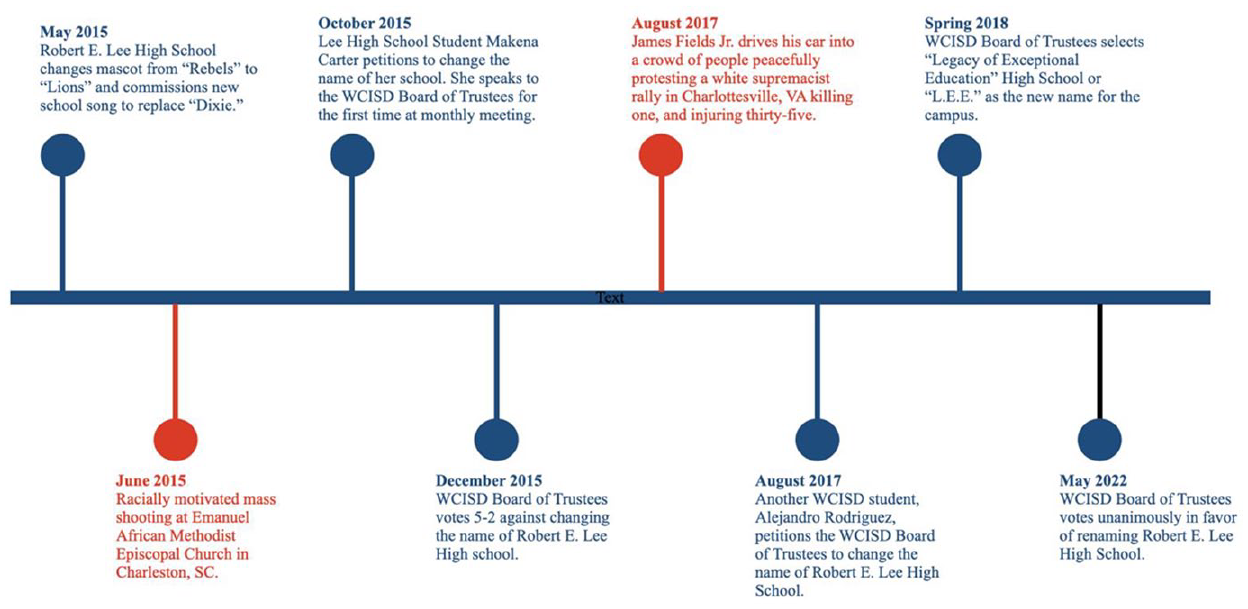
Timeline of the Renaming of Lee High School (Lipman, 2024).
Important Individuals
Board of Trustees President, Shea Kilpatrick
Board of Trustees President Shea Kilpatrick, a White female, was once a Parent-Teacher Association (PTA) President at her local middle school and, at the time of the case, was in her second term as a district trustee. She was a bubbly, energetic personality with two students enrolled at Oakstone High School, another Westland Consolidated School District campus. Kilpatrick presided over WCISD graduations and attended community events. Before 2015, the WCISD Board of Trustees concentrated on mundane policy adjustments and passing bonds to build or update schools. The board celebrated student and teacher accomplishments, managed the hiring of the Superintendent, and oversaw the budget process. Often, the board meetings would have few people signed up to speak. Trustees rarely waded into contentious issues, and politics seemed a million miles away from the dais. Kilpatrick would speak at building dedications and graduation ceremonies. Her position was one of honor and distinction in the community, but not one of conflict, until 2015. Little did Kilpatrick know that the Lee High School issue was only the beginning of a tumultuous few years that would include battles over sex education, gender identity, CRT, masks and COVID protocols, and book bans.
Student, Makena Carter (2015) Proposal
Makena Carter was a Black student at Lee High School who proposed changing the school’s name in 2015. Carter was a straight-A student, an athlete, and very active as a member of the student council. As an articulate, passionate 11th-grader, Carter felt it was grossly inappropriate for students, especially students of color, to attend a campus named for a proponent of slavery. Carter and her supporters made clear they wanted to see all relics of the Confederacy removed from a public institution of learning. “Everything to do with the Confederacy should be removed — the name, the statue, the (Confederate) flag, it’s very offensive,” Carter said in early conversations about the name change.
Trustee, Bebe Gray
Trustee Bebe Gray was elected to represent WCISD’s District 2 in 1996, a position she held until 2018. An eloquent speaker and pragmatic problem solver, Gray represented the only majority Black district in WCISD and was the only person of color on the board. Gray’s tenure saw WCISD expand and open four new middle and two new high schools, most serving wealthier, White communities. Gray also successfully advocated for renovating and refurbishing many campuses serving her district. She was often a dissenting voice on the board regarding spending money on WCISD’s two wealthier schools without providing equal investment into the Title I campuses. Gray relentlessly advocated for creating inclusive, equitable, and high-quality learning opportunities for students of all races and backgrounds.
Student, Alejandro Rodriguez (2017) Proposal
Motivated by the Charlottesville, Virginia, massacre that occurred at the protest of the “Unite the Right” march in August of 2017, Alejandro Rodriguez, a Hispanic student entering 12th grade at the time, started another online petition. Although he attended McDaniel High School, one of the wealthier schools in WCISD, Rodriguez argued that the times had changed, and it was offensive to keep the name Robert E. Lee on any building in the community. Rodriguez’s petition, titled “Denounce White supremacy by renaming Robert E. Lee High School,” gained more than 3,500 signatures. “Too many people have fought and died for civil rights. Having the name of a Confederate general on a place of learning is shameful,” states Rodriguez in his petition. Rodriguez eviscerated the WCISD Board of Trustees’ 2015 decision to keep the school’s name, saying that fighting for the Confederacy was “hateful and should not be honored by any community.”
Case Narrative
2015—A First Attempt
The massacre at the Emanuel African Methodist Episcopal Church was a racially motivated hate crime, a mass shooting that occurred on June 17, 2015, during a bible study. Nine people died, and one was injured, including the senior pastor of the church (Vinson, 2021). Dylann Roof, a 21-year-old White supremacist, published an anti-Black, hateful manifesto on a website before the shooting and also journaled about his associations with White supremacy, including his obsession with Confederate memorabilia (Vinson, 2021). Following the murders, the South Carolina General Assembly, led by then-Governor Nikki Haley, voted to remove the flag from the State Capitol grounds and later several other Confederate monuments (Vinson, 2021). The murders sparked a larger conversation about Roof’s influences and the impact of honoring Confederate war figures on public grounds.
The massacre and the resulting changes led Lee High School student Makena Carter to pursue a name change for the campus. Carter argued that every day she went to school, she entered an establishment named after a Confederate general who fought to preserve the enslavement of human beings and fought against the United States. She thought, with so many role models out there, how could the school district continue to propagate racism by keeping Lee’s name on the campus? Carter began collaborating with students at Lee High School shortly after the shooting in South Carolina to increase the likelihood of change. Carter circulated a petition that garnered more than 1,500 signatures from other students and community members and submitted it to her district administration. Carter and her peers used social media to help get the word out. As Carter made her case, the local media learned of the movement and began covering her efforts. She also received support from others in the community, including a former Mayor of the city, who praised her efforts on his social media accounts. Through the growing momentum of Carter’s movement, administrators remained silent on the issue. Teachers received a directive from district administration not to speak to their classes about the issue or to anyone in the media. The “gag order” came straight from the Superintendent, who declined to offer any background on the matter other than to instruct teachers to remain silent.
At the October school board meeting, Carter and several hundred supporters showed up to speak. Before open comments began, President Shea Kilpatrick shared with all attendees that the board could not directly address any speaker’s concerns but would consider all feedback. When it was Carter’s turn to address the board, she passionately articulated her case, noting she was speaking for herself and all those who felt marginalized attending Lee High School. Carter stated, “I understand we can’t erase our past, but I don’t think we should celebrate it,” she said. The WCISD Board of Trustees listened intently to Carter’s feedback but remained silent.
Over the next month, the board solicited feedback from the community through social media platforms and e-mail communication. Behind closed doors, Kilpatrick tussled with Trustee Bebe Gray, the only Black representative on the board, for the primarily Black neighborhood in the district. When it comes to Lee High School, Trustee Bebe Gray made her position abundantly clear: “Personally, the name Robert E. Lee has always been offensive to me as a Black American,” Gray told the board during the discussion. Over the years, Gray said, the district had attempted to make Lee a more “palatable” figure by stripping away the corresponding Civil War symbolism from its athletic teams and spirit groups — the Confederate battle flag on uniforms and, more recently, the band’s renditions of “Dixie” during football games. Gray bristled at the idea that the surface-level changes to “clean up” Lee had any real impact on solving the district’s tacitly bigoted approach to solving the problem. In Gray’s view, keeping any version of the name Lee perpetuated systemic racism. Kilpatrick pushed back, arguing that history was a valuable learning tool for all involved, invoking Winston Churchill’s words from his 1948 speech to the British House of Commons, “Those who fail to learn from history are condemned to repeat it” (Geller, 2018).
Community members continued speaking out on both sides, many in favor of the changes, others against. Constituents who emailed the board received a standard form response thanking them for their feedback. Behind the scenes, the board continued to bicker, with most trustees hoping this “noise” would blow over if they just held their ground against changing the school’s name. Trustees reconvened in December once more to hear feedback from the community and render a vote. After listening to several more hours of heated speaker arguments, Kilpatrick called for a vote on the issue, citing the need to “move things along” in the interest of “other business.” In the end, the trustees voted 5-2 to keep the school’s name and possibly revisit the issue at a future time to be determined. Kilpatrick articulated, “History is there for us to learn from in both a positive and a negative way. . .we can’t rewrite history.” She added, “Slavery was wrong, but we can’t rewrite history or change that it happened.” After the meeting, Makena Carter expressed outrage and disappointment with the trustees’ decision but reaffirmed her commitment to moving the cause forward.
2017—Round Two
Two years later, in August of 2017, James Alex Fields Jr. drove his car into a crowd of people peacefully protesting a White supremacist “Unite the Right” rally in Charlottesville, Virginia, killing one person and injuring another 35 (Keneally, 2018). The Federal Bureau of Investigation (FBI) called Fields’ attacks an act of domestic terrorism, and he was convicted of first-degree murder (Keneally, 2018). Fields made no secret of his neo-Nazi and White supremacist views and drove from Ohio to attend the rally, designed to protest the removal of a statue of Robert E. Lee in Emancipation Park in Charlottesville (Keneally, 2018). When Fields saw the group protesting the rally, he drove his car into pedestrians at nearly 30 mph (Keneally, 2018). Fields’ heinous act was the latest escalation of the debate over Confederate monuments in public spaces.
A few weeks later, Alejandro Rodriguez, a 17-year-old student at McDaniel High School, one of the two wealthier campuses in the WCISD, created an online petition in response to the Charlottesville, Virginia, massacre. His petition labeled all homages to the Confederacy as systems of White supremacy. It argued that changing the name of Lee High School was critical to breaking down one of these systems of oppression. Rodriguez’s petition picked up more than 3,000 signatures, reigniting Makena Carter’s efforts.
When it appeared that the WCISD Board of Trustees would again debate the name change, the environment surrounding the debate was significantly more heated. Board members received anonymous death threats through district email, and several described the sense that someone was stalking them at their homes. Shea Kilpatrick described an incident where she was running in her neighborhood, and a car drove by, honking the horn and screaming racist epithets out the window. Kilpatrick sifted through hundreds of e-mails from constituents, some berating the decision to entertain the discussion, ironically likening it to an attempt to “whitewash history.” Others expressed frustration that the board was distracted from the school’s “real” issues, such as declining enrollment and failing academic performance. On the opposite end, some shamed Kilpatrick and the board for their willingness to perpetuate oppressive, racist systems while ignoring the message of apathy sent to the students of color attending Lee High School. Kilpatrick continued to reflect on the tragedy in South Carolina and West Virginia. She considered other students in the community who could attend campuses named for a location or after a role model who better aligned with their values. Her children attended school at a campus innocuously named for the school’s neighborhood. No controversy there.
The December board meeting was packed with community members carrying signs and wearing t-shirts. A crowd of protestors gathered outside the doors to the board room and spilled into the parking lot. Some wore sweatshirts with the phrase “LET LEE BE” and images of the Confederate flag printed on them. A pickup truck drove around the parking lot, flying the “Stars and Bars” off the back. Others carried signs and chanted, “STOP PLAYING GAMES AND CHANGE THE NAME.” Police officers surrounded the area. As she sat at the dias, looking at the crowd, Kilpatrick worried how tensions at the meeting might escalate. The pressure from both sides was tremendous. As in many cases she faced recently, everyone was talking, but was anyone listening?
That night, Carter and Rodriguez signed up to speak together. They pressed Kilpatrick, asking what her “legacy of leadership” would be in WCISD. Did she want to be remembered for “enshrining a beacon of the Confederacy and promoter of slavery” as the namesake of a minoritized campus, or did she want to be remembered for her courage to take a stand against systemic racism? They cited her apathy toward the issue as demonstrating her complicit bias. And they pressed her, “What would you say to your son and daughter if they were in our shoes?” A single tear rolled down Kilpatrick’s cheek as she took everything in.
At the end of the night, after listening to community feedback for more than 5 hrs, when it was time to vote, the final tally was a unanimous vote in favor of changing the name of the school, with nearly all of the board members who were on the board in 2015 were still on the board in 2017. In her final remarks, Kilpatrick indicated she thought it was time to move the district forward in a positive direction while also remarking it was time to “take the target off their [trustees’] backs,” a nod that the community outcry had influenced the board to change their position.
Aftermath and a Twist
The announcement of Lee High School’s name change elicited mixed reactions from various stakeholders. While some applauded the decision as a progressive step toward inclusivity, others expressed anger, disappointment, nostalgia for the old name, and concerns about erasing history. Navigating the legal and bureaucratic procedures involved in formally changing the school’s name added complexity to the process. Moreover, implementing the name change posed logistical and financial challenges for Lee High School. Updating signage, uniforms, official documents, and digital platforms necessitated considerable resources and coordination.
As the board discussed who or what to rename Lee High School, they asked the community for suggestions. The community response was robust, and ultimately, the board narrowed the process by opting to look only at “ideas” and not “people” for naming suggestions. They hoped to ease animosity by selecting a unifying idea and not honoring a single individual. The solicitation for ideas yielded more than 2000submissions for new names, but only a few hundred made the final cut for discussion. Sorting through the name changes proved challenging and emotionally charged for all trustees. The process of advocating for and implementing name changes often reopens wounds and can ignite tensions, as it forces individuals to confront the legacy of racism and colonialism (Ferguson, 2019).
Ultimately, keeping in mind Carter and Rodriguez’s remarks, Kilpatrick guided the board’s conversation toward “legacy.” She suggested a compromise, “Legacy of Exceptional Education” or “L.E.E.” as the new name for the campus. She also proposed relocating the statue of Robert E. Lee from the school’s main entrance to a separate museum on campus, documenting the history of the building. Kilpatrick explained that her plan would save the district over a million dollars by not rebranding school signage, logos, uniforms, and other markers district-wide. Sensing how this would play out, Trustee Gray viewed the dialogue cynically. After celebrating the decision to change the name, Gray again went on the defensive, asserting that adopting “L.E.E.” amounted to “trying to put lipstick on a pig.” Later that spring, the motion to adopt the acronym would pass 5-2.
In the weeks and months following the board’s decision to rename the campus, groups of Lee alumni continued to protest at school board meetings. Several prominent donors to the district’s educational foundation withdrew their contributions in anger over the name change, and Kilpatrick continued to receive anonymous threats to her district e-mail. The Tribune, the city’s local newspaper, ran a series of op-eds questioning whether the board solved any problems with its “twist on letters,” which preserved a version of Lee’s name over the school’s entryway. And, foreshadowing the upcoming unrest, a new political action committee in the community that branded itself as “pro-family” and “pro-patriot” began a calculated campaign to unseat those school board members who voted to change Lee’s name.
From the outside perspective, the name-change debate reignited deep-seated emotions on both sides of the issue. The board’s compromise, aimed at offering something for everyone, only further exacerbated tensions. Kilpatrick would face no shortage of controversy in her remaining tenure as Board President, including questions about her “agenda” and“allegiances.” During the next election, voters ousted two trustees who voted to change Lee’s name. Kilpatrick, however, retained her seat and continued to hold the line in an increasingly tumultuous environment on the WCISD Board of Trustees. She would stand firm in her commitment to giving her best for students, parents, and teachers.
Teaching Notes
Critical Race Theory
The case study explores several core tenets of CRT. CRT, which builds on critical legal studies and radical feminism, aims to study and transform the relationship between race, racism, and power (Delgado & Stefancic, 2023). CRT holds that racism is deeply embedded in social, political, and legal systems and not just a product of individual biases (Ladson-Billings, 1998; Bonilla-Silva, 2021). Discussions about removing Confederate monuments, or “ideology critiques,” can serve a larger purpose of revealing systems of power or social hierarchies that promote injustice through a radical assessment of the status quo (Bell, 1995; Burch-Brown, 2017).
In her essay, “Is it Wrong to Topple Statues,” author Burch-Brown (2017) argues that one way to fight against systems of oppression is to “refuse to go along” with the social and societal norms perpetuating the status quo. School name changes and removing monuments dedicated to those who promoted racist practices require a willingness to have challenging and possibly uncomfortable discussions. Bell (1995) asks, “Who is afraid of Critical Race Theory?” highlighting the criticism of race-based theories and the propensity of all sides to perpetuate systemic injustices by avoiding difficult, sometimes radical conversations that can drive change.
However, Ladson-Billings (1998) explains racism has been so normalized that often White citizens do not even see the issue, such as Robert E. Lee’s name on a school building, as aberrant or a problem worthy of solving. Bonilla-Silva (2021, p. xix) argues that the “systemic” in “systemic racism” is about expected behaviors and norms that do not raise a red flag for most Americans. In her article, Racism, Ideology, and Social Movements, Haslanger (2017) argues that the world around us influences our ideologies or social meanings and practices. To change ideologies will require changing paradigms, practices, and behaviors. This case study allows school board leaders to critically examine their systems and processes.
A Critique of Liberalism
Makena Carter’s petitioning to change the name of Lee High School aligns with one of CRT’s primary tenets, a critique of liberalism that demands a sweeping change but argues the system’s emphasis on incrementalism, or traditional solutions, provides an inadequate outlet for this change (Bell, 1995; Ladson-Billings, 1998; Delgado & Stefancic, 2023). Honoring figures associated with racism, colonization, or other forms of oppression perpetuates harmful narratives and undermines inclusivity (Brown, 2023). The WCISD changed the school’s mascot and Alma mater in the early 2000s but refused to debate a campus name change, thus perpetuating systemic racism. Following the events of the 2015 Immanuel church shooting, Governor Nikki Haley in North Carolina opted to remove the Confederate Flag from the state house, and many other states re-evaluated their colors (Vinson, 2021). Like the Lee High School name change, it took a mass shooting of a church to see the flag removed, and still, many argued against this action (Vinson, 2021). Other municipalities and cities across the nation began the process of evaluating Confederate monuments.
Students, especially those who attend public institutions, should learn that interpretations of history and art are living disciplines that will change over time (Buffington, 2017; Desai, 2010; Levenson, 2014). While the logic exists to change the name of schools, CRT shows us that the appetite may not. The debate surrounding name changes can catalyze broader discussions about systemic racism and the enduring impacts of historical injustices (Delgado & Stefancic, 2023; Ferguson, 2019; Vinson, 2021). The petitions and calling attention to this injustice could disrupt a system of oppression within this community and replace the namesake with someone who fosters courage and confidence in minority students.
Storytelling and Counter-Storytelling
Storytelling and/or counter-storytelling are also tenets of CRT, as using voice or naming one’s reality shows how much of that reality is socially constructed (Bell, 1995, p. 35; Delgado & Stefancic, 2023; Ladson-Billings, 1998, p. 13). For marginalized groups, seeing institutions named after figures associated with oppression or racism can evoke painful reminders of past atrocities and ongoing systemic inequalities, but sharing those reminders can help others overcome ethnocentrism. Both Carter and Rodriguez’s efforts critically analyzed the impact of glamorizing a namesake who fought for slavery on the students at not only Lee High School but also the entire community. Carter’s descriptions of the pain of attending a school named for a Confederate General and the frustration of walking by Lee’s memorial statue every day paint a clear picture of one student’s darkened experience. As seen in Carter and Rodriguez’s story, advocating for and implementing name changes can also reopen wounds and ignite community tensions, forcing individuals to confront the legacy of racism and colonialism (Bonilla-Silva, 2021; Ferguson, 2019).
Lee High School was once a wealthy, primarily White campus that, through White flight, became populated by predominantly minority students. Those White alumni provided a counter-narrative that detailed their pride and patriotism for attending an institution named after Lee. The alumni promoted maintaining the status quo, which the board embraced in 2015. For those favoring the name change, the resistance movement worsened resentment, isolation, and oppression among advocates, further exacerbating existing divisions. Thus, while school name changes are necessary steps toward fostering inclusivity and equity, school boards should approach this topic with sensitivity and awareness of the potential emotional toll on those affected by racial trauma.
Interest Convergence
As students pushed for change and renaming the school, the Westland Consolidated ISD’s vote to keep the name of the school in 2015, in essence, was a vote by a primarily White school board to maintain a system of oppression over students at Lee High School. In 2017, when the board voted to change the name, it also did so in a manner where the interests of White people and Black people “intersected,” another tenet of CRT (Ladson-Billings, 1998, p. 12). Affirmative action remains one of the most significant examples of interest convergence, where a policy passed that purportedly benefits Black people benefits White people equally or more (Bell, 1980; Delgado & Stefancic, 2023; Hoag-Fordjour, 2020; Ladson-Billings, 1998).
In this scenario, WCISD expressed concerns about racism and the expense of changing the school name, logos, and signage. By keeping the name “L.E.E.,” White people may have continued to benefit more than Black people in this change by preserving the racist history and capitalizing on cost-saving measures. Citing scholar Bell’s (1980) Interest Convergence Theory, Hoag-Fordjour (2020, p. 3) argues that racism is a “bad look,” and silence in the wake of racist events is “even worse.” For the members of the WCISD Board of Trustees, one could argue the name change represented an effort to “do something” in response to the shootings in Charleston and Charlottesville.
Discussion Questions and Extension Activities
The events in this case study illustrate a significant policy issue facing many school boards and communities nationwide. As districts navigate the challenges of building new schools and naming these campuses, other districts grapple with existing namesakes and the issues surrounding their past actions. Students attending these campuses will view the honoree’s name on the building daily. School athletic teams and fine arts groups wear attire and uniforms with the namesake printed on them. Many argue the need to understand all elements of history, including the darker parts, but the question of who deserves honor and celebration remains unclear. Traditionally, naming a building after someone highlights an individual’s positive contributions to or impact on society. Impressionable students looking for role models should be able to learn how their school’s namesake has positively shaped our world. School board members can unpack the case study above to examine the soul-searching and courage required to reach a consensus in name-change debates.
The following questions and activities can help school board members further evaluate the complexities of this case:
How could naming issues illustrate one of the primary tenets of Critical Race Theory, a critique of liberalism (Bell, 1995; Delgado & Stefancic, 2023; Ladson-Billings, 1998)? Why does keeping the name of the school the same reinforce the idea that liberal and conservative values both serve to maintain White dominance while also perpetuating systemic racism? What are the most important factors when considering naming issues? How could a district elicit community voices in these types of conversations?
Additional questions for a group discussion. Consider the idea of counter-storytelling (Bonilla-Silva, 2021), and discuss how the renaming of Robert E. Lee High School fails to confront the legacy of racism. How does retaining the name Lee High School reinforce racism as a norm? What messages are sent, intentionally or unintentionally, to students by honoring the names of individuals who supported slavery?
In smaller groups of three or four, what might have led the WCISD Board of Trustees to change their view in just 2 years from a 5-2 vote against the name change to a 7-0 unanimous vote in favor of it? What factors could have led to the shift in board member thinking, and how could this be replicated in other locations? Were the changes motivated by a real effort to confront systemic racism, or is this another example of interest convergence (Bell, 1980)?
School board elections are, by nature, nonpartisan. However, in recent years, they have become increasingly polarized. What role does politics play in the debate surrounding school boards and name changes? How are both parties responsible for perpetuating systemic racism through incrementalism, and how does this relate to school naming issues (Bell, 1995)? What, if anything, can school board members do to remove politics from discussions surrounding student welfare?
How do student leadership and activism play a role in the debate about school name changes? What responsibility do school board members have toward students versus their parents? How can school board members engage with student leaders to learn more about their perspectives?
Activities
In smaller groups, generate a set of policies or guidelines for a district that wishes to name a school in honor of local activists within the WCISD community who contributed to the Civil Rights Movement. Then, generate a set of policies or guidelines for a district committed to removing the name of someone who supported or enabled the enslavement of people racialized as Black.
Board members are divided into two groups. They will create a chart identifying the values of their communities. These values should lead to a conversation about what values are essential for students to learn from attending school. How do schools drive difficult discussions about race in the United States? What role do school boards play in facilitating these discussions as liaisons between the community and the district? How do school boards ensure the voices of coalitions of people committed to addressing systemic racism are heard?
Draft a policy implementation plan for a school name change. Detail everything involved in this change, including school signage, logos, mascot changes, merchandise, and correspondence. What is the timeline for implementation? Who are the key players impacted? What are some of the ramifications of implementing the name change? What happens to students or adults on campuses who continue to wear symbols that celebrate the Confederacy?
Footnotes
Declaration of Conflicting Interests
The author declared no potential conflicts of interest with respect to the research, authorship, and/or publication of this article.
Funding
The author received no financial support for the research, authorship, and/or publication of this article.
