



Abstract
The association between playing digital games and watching esports has, to date, been an explicit assumption of many works, specifically that there is a strong and direct correlation between playing games and watching esports. The conflation of game play and esports serves to create conceptual confusion and a lack of clarity in research, both in HCI and beyond.
This exploratory, atheoretical work demonstrates that some correlations exist between game play and spectating esports; however, many measures were not found to have statistically significant associations. Furthermore, the observed correlations were found to have small effect sizes and explained little variance of esports spectating measures.
Results question fundamental assumptions of many works, which assume a strong association between playing games and spectating esports, raising concerns about their validity and applicability. Furthermore, they highlight the need for further research into the interactions of digital games and the systems which have emerged around them.
Introduction
Esports is defined as the competitive play of video games, typically conducted via leagues and tournaments; a large ecosystem has emerged around the phenomenon linked to the professionalisation of play (Hamari & Sjöblom, 2017; Macey & Hamari, 2019; Formosa et al., 2022). While many specific areas have been addressed via a range of disciplines, several diverse lines of enquiry have begun to emerge, including, but not limited to: esports and questions of sustainability (Nyström et al., 2022); esports technologies (Cranmer et al., 2021); and issues of gender and accessibility (Ruvalcaba et al., 2018). Although originating from different disciplines, these questions all concern the ways in which players interact both with and through games, and with the systems and structures which have grown around them.
A fundamental question that has been overlooked to date, and which significantly impacts understanding of the interactions between players and these different systems, is the nature of the relationship between playing games and spectating esports. Prior work has found statistically significant, albeit weak, associations between playing games and watching game streams (Cabeza-Ramírez et al., 2022). However, there is no work which specifically focuses on the relationship between game play and the spectating of esports. Indeed, many studies make the explicit assumption that esports spectators play games themselves (Rietz & Hallmann, 2024), moreover, that they play the same games that they watch (Jang, Byon, Baker et al., 2021; Jang, Byon, Pecoraro et al., 2021). Similarly, it is also common to conflate all forms of esports consumption under the same umbrella, whether that be watching or playing esports, while others go so far as to conflate playing games with playing esports (Jang, Byon, & Song, 2021; Rietz & Hallmann, 2023). Even more troubling are approaches in which some game players are labelled as esports fans simply because the digital games they play simulate traditional sports; specifically, that if someone plays simulated football (FIFA) or basketball (NBA) games, they are an esports fan (García & Murillo, 2020). These approaches are problematic as many diverse and distinct interactional structures and practices are rendered invisible, and potential insights into player experiences and practices are obscured.
While it may be logical that esports spectators play games, it is surprising that this presumption has gone unchallenged and unexplored for so long. It is understood and accepted that while many sports fans and consumers may play the sport themselves, many do not, and are not presumed to do so (Shank & Beasley, 1998). It may be that while digital games are now a more visible part of contemporary culture, esports is not; as such, esports is considered to be something associated with only the most engaged gaming communities. Given these problematic, albeit understandable, assumptions about the relationship between game consumption and esports spectating, it would be beneficial to ascertain whether the presumed relationships are, or are not, present. The aim of this study, therefore, is to conduct an empirical investigation of the associations between the consumption of digital games and the spectating of esports. It is guided by the following research question:
Answering this question will address the assumptions which underpin many works investigating esports and esports consumers and contribute theoretical insights to the growing body of work in which the interactions between digital game play and esports are discussed with more nuance.
Given that there is little prior empirical work which has explicitly measured relationships between playing digital games and spectating esports, and that this work seeks to test common assumptions, an exploratory approach has been deemed to be the most suitable. Accordingly, no specific hypotheses will be tested. However, many works conflate digital game play with esports consumption; if this perspective were true, it would suggest that a strong association between digital game play and spectating esports would exist.
Background
Spectating has always been an important part of playing video games, whether this be in respect to early arcade culture, the long history of TV shows featuring games and gameplay, or the role of the “secondary player” in domestic environments (Borowy & Jin, 2013; Newman, 2002; Taylor, 2015). This relationship is only to be expected, reflecting as it does the importance of shared experiences between player and spectator presented by theorists of play (Huizinga, 1938/2014; Sutton-Smith, 1997/2001). Indeed, early work on esports was primarily concerned with locating it in reference to established approaches to play and game studies or focusing on the practices and appeal of competitive video gaming. There was a notable dearth of studies which were concerned with the fundamental practice of watching esports (Carter et al., 2017). Research specifically addressing the nature of spectating esports became more prominent after the first decade; it was then that esports began to be defined in relation to spectatorship, most particularly on the multifaceted role of the spectator-participant (Seo & Jung, 2016; Taylor, 2016).
The majority of existing research that investigates relationships between playing games and esports is usually focused on questions surrounding the economic interactions, for example how spectating esports influences intention to play and to purchase games (Abbasi et al., 2021; Macey et al., 2022) or on the interplay between game play, esports, and gambling (Denoo et al., 2021; Macey & Hamari, 2018). To this day, work in which the development from player of digital games to esports fan is presented in a more nuanced manner is much rarer (Bányai et al., 2019; Huston et al., 2022).
The concept of fandom lies at the heart of both sports and esports research. Fandom is considered a sense of affection or enthusiasm for a particular subject and which is expressed through behaviours that signify belonging to a like-minded community of aficionados, a shared culture of appreciation. It is unsurprising, therefore, that when discussing fandom, many works have made use of the similar, but distinct, perspectives of Identity theory and Social Identity theory (Hirshon, 2020; Jacobson, 1979). While there are differences between the two, primarily based on their respective roots in psychology and sociology, they share many similarities. Not least among these is that they both understand the influence of society in forming concepts of the self and, in fact, do not believe the self can exist independent of society. Furthermore, they both adhere to the concept that the self is a collection of different identities dependent upon and formed through occupation of different roles and practices (Hogg et al., 1995).
As a consequence of this focus on the formation of identity through interactions with others, attempts to understand why individuals choose to align themselves with certain social groupings have centred on the goals and motivations that drive membership of such groups and, similarly, the needs that membership gratifies. Prior work has primarily focused on the Theory of Reasoned Action (TRA), Self-Determination Theory (SDT), and Uses and Gratifications theory (U&G) to understand motivational drivers for consuming esports (Anderson et al., 2021; Jang & Byon, 2020; Pegoraro, 2013; Qian, Wang, Zhang, & Lu, 2020; Qian, Zhang, Wang, & Hulland, 2020; Tang et al., 2021; Xiao, 2020). While findings have been somewhat mixed, notably in respect to online and in-person spectating (Hamari & Sjöblom, 2017; Sjöblom et al., 2018, 2020), there is evidence that the motivations of information-seeking, drama, expression of skill and social integration are significant positive predictors of spectating esports (Sjöblom et al., 2020). This suggests that links exist between the games people play, the communities of which they are a part, and esports.
Video games have become increasingly widespread in contemporary societies, and there are many different types of game players and ways of interacting with games (Yu et al., 2022); it is not the case that someone who is considered a “gamer” is interested in all types of games or all types of game-related content. Even the term “gamer” is one which has a specific cultural meaning and interpretation, with its usage being reflective of certain socio-political considerations (Shaw, 2012; Thornham, 2008). At the same time, individuals are both consuming and producing more game-related content through online services, which, while connected to games, are not esports (Burwell, 2017; Hamari & Sjöblom, 2017). It is clear that there are many different types of video game players with their own motivations and preferences; video game players are not a monolithic or homogenous community, despite how they are often presented.
Other factors driving the increasing diversification of esports audiences reflect the growing penetration of game play in contemporary society, most notably in respect to mobile gaming and the new interactional opportunities mobile technologies afford. Indeed, the recent growth of mobile esports is opening esports up to new markets which may not reflect traditional ideas of engaged video game players (Chou et al., 2023). The impact of this shift is unclear, with questions currently being asked as to whether mobile esports is attracting new demographics to esports or if they are simply offering greater diversity of content to existing fans. Additionally, mobile games are closely connected to the Free-to-Play (F2P) business model, which has come to dominate the contemporary video game industry. All six of the mobile esports games present in the top 20 most viewed esports titles utilised the F2P model, while nine (60%) of the remaining 14 PC/console games were F2P (Esports Charts, 2024). Overall, of the top 20 esports titles of 2023, the majority of games (75%) used the F2P model, which does not require any upfront investment and, as such, are considered to be more easily accessible than non-F2P games.
While the emergence of new forms of games has both highlighted and encouraged diverse types of play, for example, the casual versus hardcore (Poels et al., 2012), increased attention has also allowed recognition of previously marginalised or under-represented players. Female players have become increasingly visible, and there is growing acknowledgement of their status within the gaming communities. However, despite constituting approximately 50% of game players, they are still subject to prejudice, harassment, and abuse, as are others who do not fit the traditional stereotype of “gamer” as a straight, white, male (Kuss et al., 2022; Shaw, 2012; Thornham, 2008). Indeed, digital games have been presented as an extension of the heavily gendered techno-space, which is skewed toward certain ideals of masculinity and male values (Massanari, 2017; Taylor, 2008). It is no surprise that esports also suffers from a male bias, whether in terms of culture, of institutional structures or, consequently, of research (Rogstad, 2022; Taylor & Stout, 2020). It has been proposed that the association of esports with more engaged forms of digital game play, specifically self-identifying as a “gamer”, may mask the degree to which females are perceived to participate in esports-related activities (Jang & Byon, 2021). This issue requires further investigation, particularly considering the logical fallacy inherent in some works in which players of digital games are considered as esports players/spectators, and vice versa.
Material and Methods
Participants and Procedure
Data was collected via an online survey distributed through the participant recruitment service Prolific in the summer of 2023. The authors requested an approximately even gender split in order to reflect the contemporary gaming population; no restrictions were placed on nationality or any other demographic markers.
While offering fair and clear compensation to study participants for their time spent is not inherently problematic (Largent & Lynch, 2017), taking steps to ensure the quality of data obtained in exchange for payment is important (Reid et al., 2022). In the current study, the quality of answers was ensured in multiple ways. First, three attention checks were included in the survey, and any participants who failed at least two of the three checks were disqualified. Second, participants who completed the survey in a notably short time were also not included in the sample. Finally, to ensure that participants had actually played digital games in the past 12 months, any participant who reported never playing free-to-play or other than free-to-play games was omitted from the final sample. We also note that, while using paid participant recruitment services comes with issues, in terms of data quality, Prolific has been shown to be a valid option for recruitment (Douglas et al., 2023; Geldsetzer, 2020).
The survey was published in English and was accompanied by information regarding the nature of the study and the rights of participants consistent with informed consent. In order to be eligible for inclusion, participants had to have played digital games at least once in the previous 12 months; just over half the sample (56.9%) had spectated esports at least once within the same period, while approximately one quarter (23.1%) had done so at least once a month. The sample, therefore, contains a range of playing and spectating behaviours sufficient to reveal any relationships between the consumption of games and spectating esports that exist. After data cleaning and screening for outliers, the final dataset contained 774 valid responses.
Participants’ ages ranged from 18 to 53 (mean = 28). The majority (49.5%) of respondents reported identifying as female, with 10 (1.3%) respondents identifying as non-binary. Most of the respondents played video games regularly, with 66% reporting playing free-to-play games at least once a week. 52.5% reported playing other than free-to-play games at least multiple times a month. Among the sample, 34.8% reported watching some form of esports at least once a month.
The survey had global reach, with respondents representing 31 different nationalities; however, some regions, such as Asia, Oceania, and the Americas were notably under-represented. 510 participants reported being from a European nation, and 240 participants from an African nation. All African respondents resided in a single nation, South Africa, making it the largest country represented, the next highest being Poland (144), Portugal (108), and the UK (48).
The study procedures were carried out in accordance with the Declaration of Helsinki and conform to all guidelines issued by the Finnish National Board on Research Integrity (TENK), meaning no separate ethical review was required. All subjects were informed about the study, and all provided informed consent.
Measures
In this study, consumption habits were measured for the following three activities: playing free-to-play games, playing other than free-to-play games, and spectating esports. Free-to-play games were explained to the participants as: “… games that you don’t have to spend money on to initially access and play (the game may contain microtransactions that you can pay for).”
Other than free-to-play games were described as: “… games that you have spent money on to initially access and play. This also includes subscription-based payment methods, such as monthly fees, or payment for a rotating catalogue of games (e.g., Xbox game pass).”
Regarding esports spectatorship, the survey clarified: “This includes any form of esports spectatorship, such as watching tournaments, individual matches, or individual streamers participating in competitive matches.”
Each of these activities were measured using the following variables: “frequency”, “hours spent weekly”, and “money spent yearly”. For both free-to-play and other than free-to-play games, the variables of “frequency of play” were scored from 0 (“never) to 4 (“daily”). Weekly hours spent playing were scored 1 (“upto 1 h per week”) to 4 (“more than 2 h per day”).
Weekly hours spent spectating esports were scored similar to the above items. However, the low number of participants who reported either daily spectating, or spectating more than 2 h per day meant these categories were combined. As such, for time spent spectating esports, category 3 reflected “1 h per day or more”.
Money spent yearly was a continuous variable with a free-text entry field; to facilitate the planned analysis, these entries were converted into five categories of spending, from 0 to 4. A value of 0 reflected those who did not spend any money. The remaining participants were separated into interquartile ranges, i.e., four approximately equal groups. The bands are provided below in Appendix A for reference.
Analysis
Each of the three Esports spectating measures was cross-tabulated with age, gender, and six measures of game consumption (F2P games: frequency, weekly hours, and annual spend in euros; other than F2P games: frequency, weekly hours, and annual spend in euros). In situations where the number of cells with fewer than five cases numbered 20% or more of the total number of cells, the χ2 statistic cannot be considered reliable, and other tests are preferred. Given that most measured variables were heavily skewed toward the lower-ranked categories, the majority of the contingency tables produced by the cross-tabulation displayed cells with fewer than 5 cases. As such, Fisher's exact test was used in place of Pearson's c2. Most variables were ordinal except gender, which is a nominal variable; consequently, Somers’ D and Goodman and Kruskal's Gamma (g) were extracted to show the strength and direction of the relationship for ordinal variables, while Cramer's V and the uncertainty coefficient were used for nominal variables (IBM, 2020). Goodman and Kruskal's tau (τ) for an increase in predictive quality was extracted for all variables. For all square tables, tau-b is provided, and for all rectangular tables, tau-c is provided. In all asymmetric tests, measures of esports spectating were considered as dependent variables with measures of game consumption considered as independent, or predictor, variables.
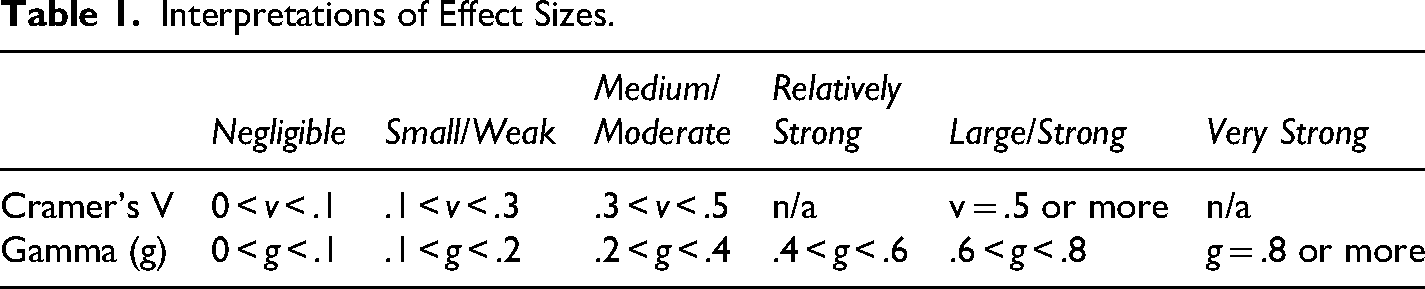
Gamma and Cramer's V assess the strength and direction of association between categories. Table 1 shows thresholds for interpreting effect sizes. The thresholds for Gamma are taken from Rea and Parker (2014), while Cohen's standardised thresholds for effect size are adjusted for use with Cramer's V (Cohen, 2013). All analysis was performed using SPSS version 29.
Interpretations of Effect Sizes.
Results
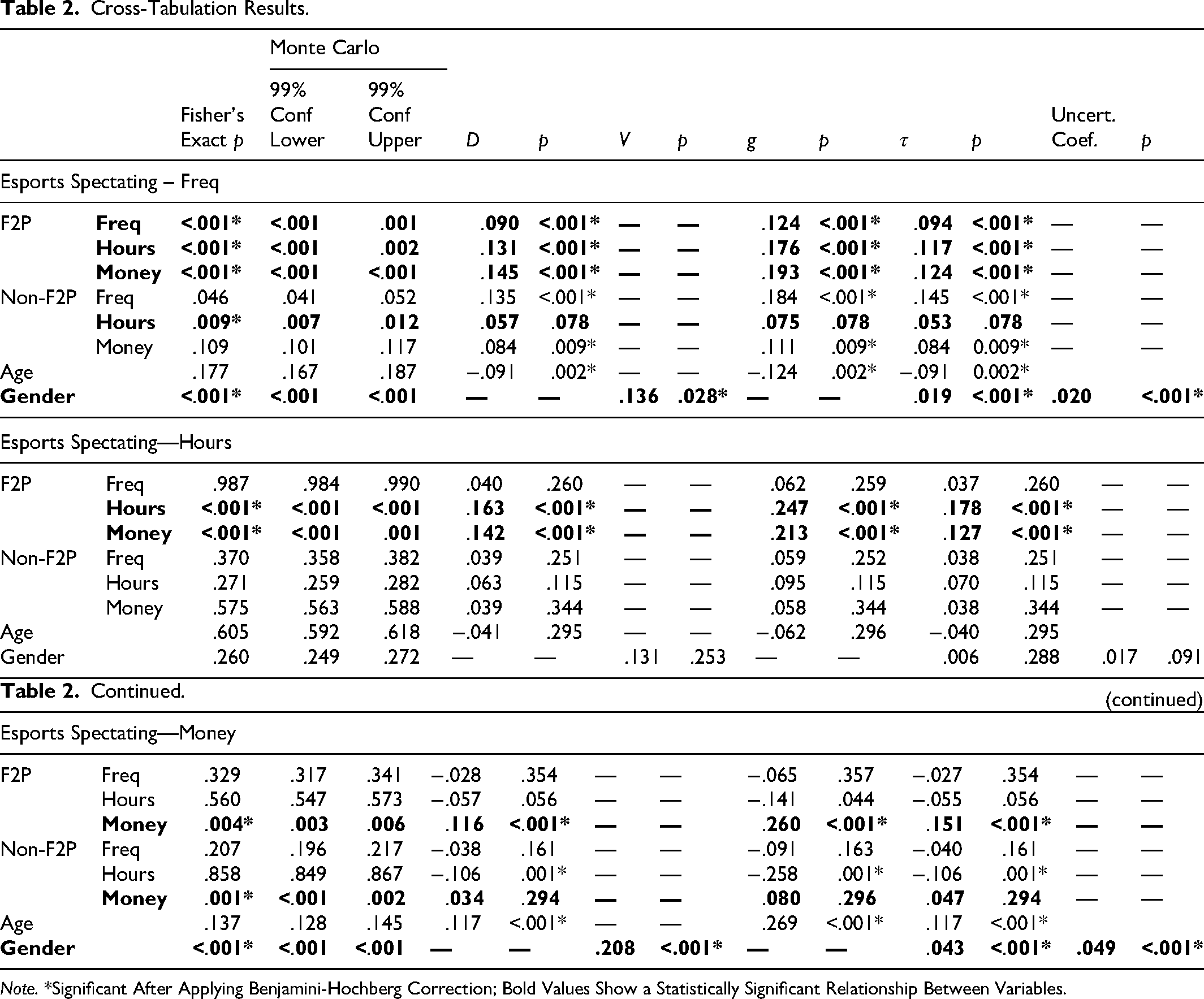
The results were corrected to control for the possibility of false positives (type I errors); while common, the family-wise Bonferroni correction has been criticised as being overly conservative (Perneger, 1998; Tutzauer, 2003), thereby producing more type II errors (false negatives). As this research is exploratory, the Benjamini-Hochberg correction was applied in order to balance both power and parsimony (Hochberg, 1988; Zaiontz, 2018). The false discovery rate (FDR) was set at the standard .05; all results in Table 2 have been marked with an asterisk (*) if significant after applying the correction.
Cross-Tabulation Results.
Note. *Significant After Applying Benjamini-Hochberg Correction; Bold Values Show a Statistically Significant Relationship Between Variables.
Fisher's exact test showed that the frequency of spectating esports was found to be significantly associated with all measures of F2P game consumption, but only with average weekly hours spent playing non-F2P games. Furthermore, a statistically significant relationship was observed with gender, but not with age. Gender, and all F2P game consumption measures showed positive but weak relationships: gender (v = .136, p = .028), annual spend (g = .193, p ≤ .001), average weekly hours (g = .176, p ≤ .001), and frequency of play (g = .124, p ≤ .001). However, the relationship between average weekly hours sent playing non-F2P games and frequency of spectating esports was unclear (g = .075, p = .078).
Weekly hours spent spectating esports were found to be significantly associated with only two measures of game consumption: weekly hours spent playing F2P games and annual spend on F2P games, both of which had moderate effect sizes, g = .247, p ≤ .001 and g = .213, p ≤ .001, respectively.
Annual spend on spectating esports was found to be significantly associated with gender and with annual spend on both F2P games and non-F2P games. Gender was found to have a small effect size (v = .208, p ≤ .001) and only accounted for approximately 5% of predictive value (uncert. coef. = .049, p ≤ .001). Annual spend on F2P games had a moderate positive effect (g = .26, p ≤ .001), while annual spend on non-F2P games had a negligible but ultimately unclear effect (g = .08, p = .296).
Discussion
To date, a direct and strong association between playing digital games and consuming esports has been an explicit assumption of many works in the field. While this is an understandable and logical position, the degree to which game play and esports have been conflated serves to create conceptual confusion across many fields of research. This lack of clarity directly impacts the potential validity and applicability of research results.
This research found that although several simple indicators of game consumption were associated with measures of esports spectating, the majority were not. Furthermore, for those measures where statistically significant associations were observed, the effects were typically small or negligible, as were their predictive qualities. As such, the nature of players’ relationships between digital game play and spectating esports is not as simple as is commonly presented in much research. Indeed, work that assumes that esports spectating is the result of, or equivalent to, digital game play is fundamentally flawed and likely to provide inaccurate or misleading results.
All measures of F2P consumption were found to be positively associated with frequency of esports spectating, of which annual spend on F2P play displayed the strongest relationship. However, only weekly hours spent playing and annual monetary spend on F2P games were associated with hours spent spectating esports, and only annual spend on F2P games was associated with annual spend on esports. These findings are potentially explained by the changing ways in which players interact with games as a result of the F2P model. The early emergence of the F2P model, in Western markets at least, was primarily associated with social media gaming before new distribution models facilitated downloads to mobile devices via app stores. These games, and the ease with which they can be accessed, have been credited with attracting a wider range of individuals to gaming and the growing presence of games in mainstream society (Leaver & Willson, 2016). The financial successes of the F2P monetisation models were such that they began to be adopted by increasing numbers of more traditional games, for example, by introducing loot boxes as a way to generate higher revenues. The adoption of F2P practices continued apace, with many games moving away from more traditional models and fully transitioning to the F2P model (Williams, 2022). Many popular esports titles, such as Counter-Strike and Rocket League, are examples of games that have adopted the F2P model, while other titles, such as League of Legends (LoL), have been F2P since initial launch. F2P games currently account for the majority of esports titles, with three-quarters of the top 20 most-watched esports titles in 2023 being F2P (Esports Charts, 2024). It is conceivable, therefore, that the correlations between the same F2P and esports measurement items are explained by the fact that they relate to the same game titles. For example, someone who frequently plays LoL may also prefer to watch others play the same game in competitive situations, whether for pleasure or as a means to learn new techniques and strategies (Sjöblom et al., 2020).
In contrast to consumption of F2P games, very few measures of non-F2P game consumption were found to have statistically significant associations with all measures of esports spectating. Weekly hours spent playing non-F2P games were associated with frequency of esports spectating, while annual spend on non-F2P game consumption displayed the strongest relationship with annual spend on spectating esports. However, no post-hoc tests were statistically significant, meaning the nature of the relationships remained unclear.
It appears that the assumed relationship between playing digital games and spectating esports only holds true for F2P games, albeit at a very low level, likely due to the fact that the majority of popular esports titles are published using the F2P model. This finding supports previous works, which take a more nuanced approach to the study of esports and esports consumers (Huston et al., 2022; Ma et al., 2021) while highlighting the fact that consuming digital games has very little effect when considering different measures of esports spectating. Further work, therefore, is required in order to identify what aspects of digital game play give rise to an interest in esports. More importantly, such approaches should be promoted in mainstream media discussions about esports and gaming in order to actively dispel simplistic treatment of game players and esports fans.
Of the demographic characteristics investigated, only gender was found to have statistically significant relationships with esports spectating. However, it was only found to be significantly associated with frequency of esports spectating and annual spend on spectating esports; effect sizes for both were found to be small and only provided 2% and 5% or predictive validity, respectively. What is noteworthy is that while a larger proportion of males (67.37%) reported spectating esports than female participants (47.79%), only 15% of these males reported making any kind of payment in comparison to 39% of female esports spectators. Indeed, the results highlight that females outspend males across all categories, both proportionally and in absolute terms (see Appendix B). This finding seems somewhat counterintuitive, particularly when considering that males typically earn more than females and would be expected to have more disposable income. Furthermore, the potential association between self-identification as an engaged game player, or as a “gamer” with male gender and, subsequently, with esports fandom would suggest that males would be more likely to spend money on esports. One possible explanation for this finding is that females may choose to spend money spectating female esports teams, players, or streamers in order to express social support and to counterbalance the toxic behaviours that they experience as a result of being female in esports. There is growing evidence of female esports spectators preferring social aspects or affordances of esports streams (Tang et al., 2021) and for female peer support (Madden et al., 2021).
The work presented here is exploratory in nature and uses crosstabulation of reported behaviours to conduct a contextual analysis of associations between the consumption of video games and spectating esports. However, considering the findings in light of prior works which investigated self-reported motivations for playing and spectating can inform understanding of the results. Prior work using the Uses and Gratifications framework to investigate esports spectating found that of five motivational constructs tested, cognitive motivations had the weakest association with the amount of esports hours spectated (Sjöblom & Hamari, 2017). This is in contrast to works investigating the spectating of games in general, which stressed the significance of learning new strategies and personal skill development to be among the most influential motivations (see Krieglstein et al., 2020). This disparity appears somewhat counterintuitive, given that esports is defined as the competitive play of video games and learning about the game and potential play strategies would appear to be beneficial. These findings may explain the lack of strong associations between playing digital games and spectating esports observed in this research.
Alternatively, prior work using the Motivations Scale for Sport Consumption (Trail & James, 2001), adapted for esports, found that the motivational construct Acquisition of Knowledge displayed the strongest association with intention to watch esports. Furthermore, the same research found that intention to watch esports was a strong predictor of intention to purchase and intention to play games (Macey et al., 2022). Taken together, these findings may suggest that while an interest in games does not necessitate an interest in esports, per se, it is likely that an interest in esports necessitates an interest in playing games. They may also provide support for the potential for esports to attract audiences who do not themselves play digital games, at least in the initial stages of esports spectating.
This latter interpretation may also explain why both works using the adapted MSSC and the Uses and Gratifications framework found escape (part of the motivational construct of Tension Release) to be significantly associated with esports spectating and to have among the largest effect sizes of all motivations (Sjöblom & Hamari, 2017; Sjöblom et al., 2017). Furthermore, the increased accessibility and casual game play afforded by mobile devices may also influence esports viewing habits (Chou et al., 2023; Jang, Byon, & Song, 2021; Sjöblom et al., 2018), with short viewing sessions used to alleviate boredom and reduce stress. This could explain the larger number of significant associations between esports spectating frequency with measures of video game consumption, in comparison to hours and money spent spectating esports.
Those who spectate esports are, as with any other form of sports, commonly referred to as being fans; however, esports is often conceived as a homogenous entity, unlike traditional sports, where fandom is usually discussed in reference to an allegiance to a specific team. However, fandom, the route to becoming a fan, is different not only for individuals but also related to the sports they follow; it is not a universal concept and is not easily captured (Gantz, 2011). Historically, the majority of fans have consumed sports as part of a social group and built connections with other fans; more often than not, these connections have centred on a physical locale, one further supported by other spaces for consumption, discussion, and exchange. This is now being complemented and expanded through the creation of digital spaces and communities. Traditional sports fans are shifting to online consumption, including not only spectating online via mobile technologies, but also consuming news and commentary, following players/teams on social media, and producing their own content from tweets to blogs and videos (Pegoraro, 2013). These activities are intimately connected to the rise of esports; indeed, in fact, it is virtually impossible to separate the rise of streaming and online content from the rise of esports (Burroughs & Rama, 2015; Seo & Jung, 2016).
The rise of mediated sports consumption, first via television and later the internet, is associated with weakened local affiliations and a more “gentrified” consumer; these identities are more fluid, more contractual than earlier forms (Williams, 2007). This contemporary manifestation is inherently tied to the development of a performance, or spectacle society – that is, that sport is used as a medium for identity construction and social performance, one that has grown as other social ties and community have declined (Crawford, 2004). Taken together, the combination of increased digital media consumption and the growth of online communities and social groupings which emerge around these media impact concepts of identity and fandom. It is unsurprising, therefore, that when discussing the nature of esports fandom, a common approach is to make a direct connection between the play of digital games and becoming a fan of competitive game play. Indeed, many current views of esports fans seem to be based on the dominant doctrines of social identity theory and identity theory. Essentially, if an individual plays games, they are part of a gaming community, members of these communities either seek gratification through spectating others play, or they play the role of a “gamer”. These gratifications and roles are enabled via esports; therefore, there is a clear pathway wherein they construct an identity as an esports fan (see, e.g., Barney & Pennington, 2023).
In contrast to the positions outlined above, the results of this study suggest that there is no such clear and obvious connection between consuming games and spectating esports, particularly in regard to the consumption of games that require payment to access. Accordingly, the perspective of Performative Sport Fandom (PSF; Osborne & Coombs, 2013) may offer more insights into the particularities of becoming an esports fan. PFS develops the ideas of Identity Theory and Performative Gender Theory to build the picture of a fan as someone who becomes a fan through the performance of fandom, of performing activities that mark you out as a fan. As with traditional sports fans, these activities include both consuming and creating online content connected to esports. This is a more dynamic reading of identity construction and one more in line with the concepts of liquid modernity (Bauman, 2013; Macey & McCauley, 2021) and participatory culture (Jenkins, 2018; Qian et al., 2022).
The theoretical perspective of PSF is particularly relevant to esports, as the behaviours and activities that can lead you to become a fan of esports are rooted in game culture more generally (Qian, Wang, Zhang, & Lu, 2020; Qian, Zhang, Wang, & Hulland, 2020). However, performing certain activities, such as viewing online content related to a favoured game, has different outcomes which are dependent on the cultures around those games. For example, for certain games which are not popular esports titles (e.g., Assassin's Creed), “let's play” videos or walkthroughs are common, but for games that are esports titles (e.g., Counter-Strike or Fortnite), it is far more usual to see tactical breakdowns or competitive matches featured in online videos. A regular viewer of Assassin's Creed content is unlikely to be presented with esports content, whether recommended via members of their network or via algorithms, unlike a viewer of Counter-Strike content. Consequently, exposure to an increased amount of competitive play and to streams of esports players themselves could potentially explain the establishment of an identity as an esports fan. This is directly connected to the findings of previous research in which the play of esports games is associated with spectating esports (Jang & Byon, 2020; Qian, Wang, Zhang, & Lu, 2020; Qian, Zhang, Wang, & Hulland, 2020; Wohn & Freeman, 2020). Finally, the limited financial resources needed to access both esports titles (F2P), and online esports-related content (Twitch, YouTube, Kick, etc.) allow the performance of esports fandom in developing countries. Thus, PSF could potentially explain the explosion of esports in countries like Brazil, where both Social Identity Theory and Identity Theory would find it harder to explain in a culture dominated by football.
A counterpoint to this hypothesised pathway to esports fandom via PSF would be games like Farming Simulator, which, as they are essentially single-player games, are not inherently competitive in the same way as MOBAs, Battle Royales, or FPS games. However, small but vibrant esports communities have coalesced around Farming Simulator and other unexpected titles such as Age of Empires, or even non-gaming media such as GeoGuessr or Microsoft Excel. A potentially fruitful line of future research would be to investigate fans’ journeys to see how the performance of certain activities may influence their path to being an esports fan, particularly in respect to such niche titles and communities.
Limitations and Future Work
This study suffers from the standard limitations that apply to those using self-reported data, including social desirability bias (Van de Mortel, 2008) and self-selection bias. Specifically, while the gender split is roughly 50%, certain nationalities were more heavily represented; there were a total of 240 replies from South Africa, representing a total of over 30% of the sample, while participants from Oceania, Asia (including Middle-Eastern nationalities), and the Americas together made up only 3% of total replies (Appendix C). It is likely that the time at which the survey was released directly impacted responses from different regions, as, due to resource constraints, the survey closed once a set number of responses had been recorded. Furthermore, it is worth noting that the sample consisted only of over 18-year-olds. This means that, while gaming and esports are particularly popular with younger audiences, this study cannot go into detail on how age might affect esports viewership.
While a range of game consumption measures were found to be associated with esports spectating, all were found to have small effect sizes and to offer very little predictive value in explaining esports spectating. As such, we can state that the assumption that esports spectating derives from playing digital games is somewhat oversimplistic and further research is required to identify the precise relationships between players’ interactions with digital games and esports. Moreover, those works that conflate game play and esports fandom are not justified in doing so. Such approaches serve only to create conceptual confusion and offer incorrect interpretations of those relationships and interactions that exist between players and different systems centred on digital games and gaming media. In future, it is recommended that work investigating factors which influence esports spectating should incorporate a range of measures together, rather than in isolation. For example, utilising demographic information alongside both observed measures and psychometric constructs would enable a more coherent and cohesive picture to emerge. Indeed, given the findings discussed above, it may be that gender operates as a moderator, or even a mediator, of relationships between game consumption and esports spectating, as has been found in respect to motivations for playing esports (Jang & Byon, 2021). Therefore, utilising techniques such as structural equation modelling or regression is likely to offer meaningful insights into these relationships.
Finally, the measures used to capture different aspects of the specific activities do not wholly encapsulate an all-encompassing metric for a participant's “engagement” in that activity. Rather, we used substantial metrics of the frequency of playing/spectating, hours spent weekly on the activity, and money spent yearly to provide an overall picture of the participants' time and money spent on the activity itself. While this method allows us to analyse the differences between the participants’ playing and esports spectating habits, other potential engagement measures, such as reading about, or researching the activity, or writing about it on forums, were not included in this study.
Conclusion
The steady rise of esports has been accompanied by a comparable growth in academic research on the topic, with recent works covering increasingly diverse fields addressing questions related to the interactions between players and systems. Unfortunately, many works have made explicit assumptions about the nature of the relationship between the consumption of digital games and esports. Specifically, there is a strong and direct correlation between playing digital games and consuming esports, whether as a player or spectator. Indeed, some works have gone so far as to equate game play with esports. While the assumption of a strong positive link between game play and the consumption of esports is logical, it is surprising that it has gone untested for so long.
To the best of our knowledge, this is the first empirical work to directly investigate relationships between measures of digital game play and spectating esports and, therefore, the first to test this assumption. While results demonstrate that there are some correlations between game play and spectating esports, not all measures were found to have statistically significant associations. Furthermore, those correlations that were observed were found to have small effect sizes and explained very little variance in esports consumption measures, typically only around 2%.
The results of this study, therefore, highlight the fact that an interest in esports is not a natural or inevitable consequence of digital game play, and that the consumption of free-to-play games in particular has limited associations with spectating esports. Of the measures tested, gender displays the most notable correlations with esports spectating, yet it also offers surprising results. While the male gender displays the strongest associations with frequency of esports spectating and weekly hours spent spectating esports, the female gender was most strongly associated with paying money to spectate esports. This finding may potentially be explained by behaviours in which female spectators support other female esports players, teams, or streamers.
This work provides some support for the assumption that there are correlations between digital game play and spectating esports. However, it questions the strength of these relationships and highlights the need for further dedicated research into the ways in which players interact both with digital games and the systems and structures which have emerged around them. Finally, it shows that taking such relationships for granted and treating digital game players and esports spectators as homogenous groups can create conceptual and theoretical confusion. Such an approach limits both the validity and applicability of works which assume a direct and strong association between playing games and spectating esports.
Supplemental Material
sj-docx-1-gac-10.1177_15554120251376073 - Supplemental material for Paying, Playing, and Spectating: Relationships Between Digital Game Play and Spectating Esports
Supplemental material, sj-docx-1-gac-10.1177_15554120251376073 for Paying, Playing, and Spectating: Relationships Between Digital Game Play and Spectating Esports by Joseph Macey, Topias Mattinen and Juho Hamari in Games and Culture
Footnotes
Acknowledgements
n/a

Ethical Considerations
The study procedures were carried out in accordance with the Declaration of Helsinki and conform to all guidelines issued by the Finnish National Board on Research Integrity (TENK), meaning no separate ethical review was required. All subjects were informed about the study, and all provided informed consent.
Consent to Participate
All subjects were informed about the study, and all provided informed consent.
Consent for Publication
n/a
Funding
The author(s) disclosed receipt of the following financial support for the research, authorship, and/or publication of this article: This work was supported by the Suomen Kulttuurirahasto (grant number 00230796), and the Research Council of Finland (grant numbers Personal Grant, 337653, 353268).
Declaration of Conflicting Interests
The author(s) declared no potential conflicts of interest with respect to the research, authorship, and/or publication of this article.
Data Availability Statement
Access to the data is available on request.
Supplemental Material
Supplemental material for this article is available online.
Author Biographies
References
Supplementary Material
Please find the following supplemental material available below.
For Open Access articles published under a Creative Commons License, all supplemental material carries the same license as the article it is associated with.
For non-Open Access articles published, all supplemental material carries a non-exclusive license, and permission requests for re-use of supplemental material or any part of supplemental material shall be sent directly to the copyright owner as specified in the copyright notice associated with the article.
