



Abstract
This article is a qualitative study of work and play in the miniatures wargames industry. It was conducted over 5 weeks in Nottingham, UK and consists of 26 semi-structured interviews with freelance workers and employees of two studios, Mantic Games and Warlord Games. Interviews concentrate on worker motivation, encounters with history through games, and the role of gender in miniatures wargames. Key findings reveal that sector workers see their work as a more honest form of craft than that found at Games Workshop, publishers of the Warhammer series of games, and that sector workers engage in hybrid forms of work-play through their professions. Lastly, it locates what Paul Gilroy calls postcolonial melancholia in design practices.
This article is a qualitative study of work at two miniatures wargaming studios, Mantic Games and Warlord Games, with three additional interviews with freelance workers in the miniatures production sector. These firms are in the “Lead Belt,” an area concentrated in Nottingham, UK which serves as the global hub for miniatures production. The Lead Belt, home of Warhammer producer Games Workshop, is the global center of miniatures production. Miniatures are small statues which serve as playing pieces in a variety of analog games, including tabletop roleplaying games (TTRPGs), boardgames, and especially miniatures wargames. Miniatures are made of metal alloys, plastic, or resin and serve as representations of game figures or objets d’art (Stuart, 2015). In a TTRPG such as Dungeons & Dragons (D&D), miniatures serve as representations of a player's individual hero or a gamemaster's NPCs. In a miniatures wargame, miniatures serve as representations of individual soldiers, historical figures, or fantasy heroes. Miniatures are collected, painted, gamed with, displayed, and used for storytelling in a meta-practice which Merilainen et al. refer to as miniaturing (Meriläinen et al., 2020). I use the miniaturing framework throughout this work to refer to this assemblage of activities.
The miniatures industry is in the midst of a global boom, as I note below. This popularity alone makes it worthy of scholarly interest. Additionally, the social and communicative dynamics within the industry provide insight into the games sector (analog and digital) more broadly. Miniatures reference either historical figures (soldiers, monarchs, etc.) or elaborately imagined fictional worlds (the ubiquitous Space Marine of Warhammer 40,000). In my interviews, it was clear that the largely British workforce at my research sites navigated both complex assemblages of masculinity and what Paul Gilroy calls postcolonial melancholia (Gilroy, 2005). As I illustrate, these negotiations of masculinity and mediatized history both confirm and complicate relevant studies of work and play in games (Burrill, 2008; Keogh, 2021; Muñoz-Guerado & Triviño-Cabrera, 2018; Trammell, 2018).
Additionally, the production of miniatures relies on workflows which disrupt traditional conceptions of craft as the opposite of industry, an instance of what Michael Palm calls “mass craft” (Palm, 2024). A miniature is sculpted by an individual artisan, either by hand or with computer assistance, whereupon it is mass produced for global circulation. Both artisanal and industrial production methods often occur in the same building, in contrast to other craft-oriented businesses, which center on individual artisans or small group work. These more traditional crafty industries also occlude the industrial sides of production. For instance, knitting relies on a complicated network of extraction (imported metal and wool for tools and yarn, respectively) and big box stores like Michael's, but these overtly industrial and logistical aspects of craft are deemphasized or invisibilized. Craft is thus often imagined as “pure” compared to its industrial counterpart in ways that are simply not true (Buszek, 2011).
Two matters are at the core of this study. The first is narrow: how are miniatures produced and why would one go into the field of miniatures production? Despite the prevalence of miniatures in analog games, miniatures as a cultural form are underexamined in comparison to other aspects of analog gaming. More attention to miniatures is due if for no other reason than the fact that Games Workshop is at least as dominant in miniatures wargames as Wizards of the Coast (WotC) is in TTRPGs and card games, with revenue in 2022 of £385 million (Games Workshop, 2022). It is difficult to separate Dungeons & Dragons’ sales from Magic: The Gathering's for a proper comparison. As a subsidiary of Hasbro, WotC's publicly reported revenues for its analog games come as a conglomeration of the sales of all its properties. WotC's reported revenues in 2021 were $816 million, according to a CNBC article (Whitten, 2021). Knowing that Magic: The Gathering makes more than D&D allows us to make an informed guess that the latter accounts for around $300–400 million of that total figure. Even if we take the generous approach of placing D&D at $400 million in revenue, Games Workshop's Warhammer products outstrip it. Further, Games Workshop is a comparatively healthier company than WotC parent company Hasbro; it is regularly one of the top-performing stocks on the London Stock Exchange (Venkataramakrishnan, 2020). Locally, the Lead Belt as a general tourist destination in the UK's East Midlands is also a burgeoning industry of its own, consisting of guided tours and art exhibitions. Lastly, going into miniatures production is an odd job to choose when an artist or industrial worker stands to make more money in other sectors. Why one might choose miniatures as their profession is one of the few common questions I asked of participants.
The second matter is broader. Besides Palm's vinyl records production and the miniatures industry, instances of observable mass craft are few and far between. The nature of modern global logistics chains and just in time manufacturing create conditions in which design and production within one facility is a rare occurrence. While I do not make a direct comparison of my findings with the work of Palm or others, the comparison is implicit.
Before moving to methodology, I warn against considering this study an exhaustive cataloging of miniatures production in the Lead Belt. It is difficult and perhaps impossible to provide a full list of miniatures studios in the area. The incorporated studios are simple enough to find, but the Lead Belt is peppered with small home studios and one or two persons sculpting shops, while the churn of openings and closings within the miniatures market is ubiquitous. The nature of Games Workshop's sector dominance and the ways it treats labor means that new studios created by disaffected miniatures designers, producers, and distributors open regularly, to varying degrees of success and longevity. Rather, this study should be taken as insight into what may be deemed as “normal” at two of the largest non-Games Workshop studios and which may be read as typical of incorporated studios of that second tier.
Methodology
This study consists of 26 semi-structured interviews conducted over two summers in Nottingham, UK. I spent a total of five weeks there. The first summer visit, in 2022, was a pilot study aimed at gaining access to my research sites. The second, in 2023, was focused on interviews and observation. I conducted 23 interviews at two sites, Warlord Games and Mantic Games, and three more with local miniatures sector freelancers. Warlord Games concentrates on publishing historical miniatures wargames, primarily WWII, and is the second largest miniatures wargames studio in the world. This should not be read as Warlord being a massive company, as it is exponentially smaller than industry leader Games Workshop, the publicly traded publisher of the Warhammer series of games. Mantic is a smaller studio than Warlord but still successful within the sector. It publishes licensed boardgames, such as Hellboy, and several successful fantasy miniatures wargames, most prominently the fantasy game Kings of War.
Games Workshop proved to be inaccessible, even though I had professional contacts at the company from my journalistic career prior to academia. Games Workshop is notoriously secretive and my contacts at Games Workshop proved useless in gaining research access to the site. This turns out to be of little impact to my research, as almost everyone I interviewed worked at Games Workshop in the past and they were eager to speak about their time there and about Games Workshop's relationship to the rest of the miniatures wargames industry. Indeed, I believe that they felt freer to speak openly about negative experiences at Games Workshop given the fact that they no longer worked there.
My interviews drew from a convenience sampling of available employees (Berg & Lune, 2017, p. 38). My one request of management at my research sites was to provide a cross-section of employees from every division of their respective companies, which they agreed to. While I do not consider my pool to be a representative sample of the entire industry, I am satisfied that the mix of participants addresses the complexities of my research sites. While interviews were designed to be semi-structured, I left ample room for these questions to evolve into informal conversational interviews (Patton & Patton, 2002, pp. 342–347). My intent was to remain reflexive in the face of what I did not know, which was quite a lot, and participants were content to talk about a variety of unforeseen topics. Interviews thus varied in their length and topics, with some as short as 20 min and a few extending to an hour in length. I endeavored to let them lead the interviews. Participants in the design studios were prompted to address the following:
Describe their motivations for choosing the miniatures wargames industry over other creative work. What was engaging about miniatures wargames production in comparison to past work in other creative sectors. Whether they engage with miniaturing as a leisure practice and, if so, how they started and which aspect of the practice they gravitate toward. What technologies they used during a workday.
On the shopfloors, I asked an additional question:
How often do they use the products from the studio and, if so, which and how.
I did not ask questions about craft directly. Asking questions about personal definitions of craft or whether they consider their work to be craft threatened to limit the range of possible answers or to nudge participants toward particular answers. I did ask participants to elaborate on craft (whether they consider what they did craft, what craft means to them, etc.) during interviews but only if they used the word “craft” unprompted. Instead, I approached interviews in a fully reflexive manner, allowing participants to lead our conversations and to talk about topics of their choice with minimal steering on my part. As such, questions were not limited to the above. Rather, the above questions served as a starting point for often lively discussions about the nature of work, meaning, and play.
I approached my interviews from the standpoint of intimate outsider or “acafan” (Gillespie & Crouse, 2012). I first encountered miniaturing in 1988 and I am still an active miniaturist. My grounding in the world of miniaturing greatly assisted the process of gaining access to Warlord and Mantic. I was treated by most participants as a peer due to my easy use of miniaturist jargon and prior knowledge of the basics of miniatures production. This follows Jodie Taylor's description of the intimate insider's capacity to use existing knowledge of a given object of research to cultivate more intimate relationships with study participants (J. Taylor, 2011). Despite this intimate insider status, I attempted to reflect upon my own experiences within miniaturing so as to prevent skewing my research (Langdridge, 2007, pp. 75, 80).
I provided anonymity to all participants except for five individuals. Their data is included in the raw findings alongside the anonymous participants. None of the five objected to this arrangement and two requested ahead of time that they not be anonymous. The reasons for these exceptions are as follows:
Ronnie Renton and John Stallard. Renton and Stallard are the owners of Mantic and Warlord, respectively. When I organized my research proposal, it felt unfair to their employees to quote them as though they were lower ranking employees of their respective firms. In addition, they are influential figures in the cultural scene of the Lead Belt as a whole. This is particularly the case for Stallard, who is a central cultural and economic figure in the Nottingham industry. Rick Priestley. Priestley, perhaps more than any other living person, is a revered figure in miniaturing. He is the original designer of Warhammer and Warhammer 40,000, among other games over a 40 + year career. As the creator of Games Workshop's most successful games and, by extension, the closest figure to a “father” of modern miniaturing, his responses carry enormous weight and provide particular insight into how the industry evolved. However, this weight is only apparent if his name is attached to that insight. Lastly, Priestley has become a prolific and visible interview subject on YouTube and in books in recent years, particularly on the topic of the early days of Games Workshop. He sees this project as an extension of those activities. Chris Peach and Patrick Taylor. Peach and Taylor ran a successful YouTube painting channel called the Painting Phase, which has only recently split, with Peach starting his own channel called Peachy Tips. They requested that their names be attached to their interviews. Their reasoning was that there are only three large YouTube channels run by former Games Workshop painting instructors, the others being headed by Duncan Rhodes and Louise Sugden. They expressed fear that remaining anonymous might cause anyone reading my research to believe it was Rhodes or Sugden speaking to me rather than them, which might lead to reprisals against those figures from Games Workshop. They were especially concerned about Sugden, a close friend of Peach, running afoul of Games Workshop, as she left the company on bad terms which she has acknowledged but never publicly elaborated upon.
Data for this study was coded in Atlas.ti and visualized in Excel. Participant responses were lightly edited for clarity and to preserve anonymity where responses might compromise it.
Findings
In this section, I detail and discuss participant demographics. These include race, gender, age, and nationality. I have also broken participants into groups based on job category, specific job title, whether they miniature in their spare time, which aspect of miniaturing they find most engaging, and whether they reference craft in relation to their work. The topic of craft includes direct reference to craft as well as references to topics like finding meaning in work. I also provide breakouts along the following lines, which are based on coding that revealed topics which were especially relevant to participants: whether they had worked at Games Workshop in the past and whether they started miniaturing via historical miniatures wargames. Percentages are rounded to the nearest ones digit.
Raw Demographics
Of 26 participants, 25 (96%) are male (see Figure 1). All 26 (100%) are white. The average participant age is 45. I note here that white identification is different in a UK context than in the United States (I am an American) and I am wary of describing the racial demographics as self-evidently uniform through my American lens. I am more comfortable describing miniatures production as it exists in relation to imperial histories of the UK later in this article.
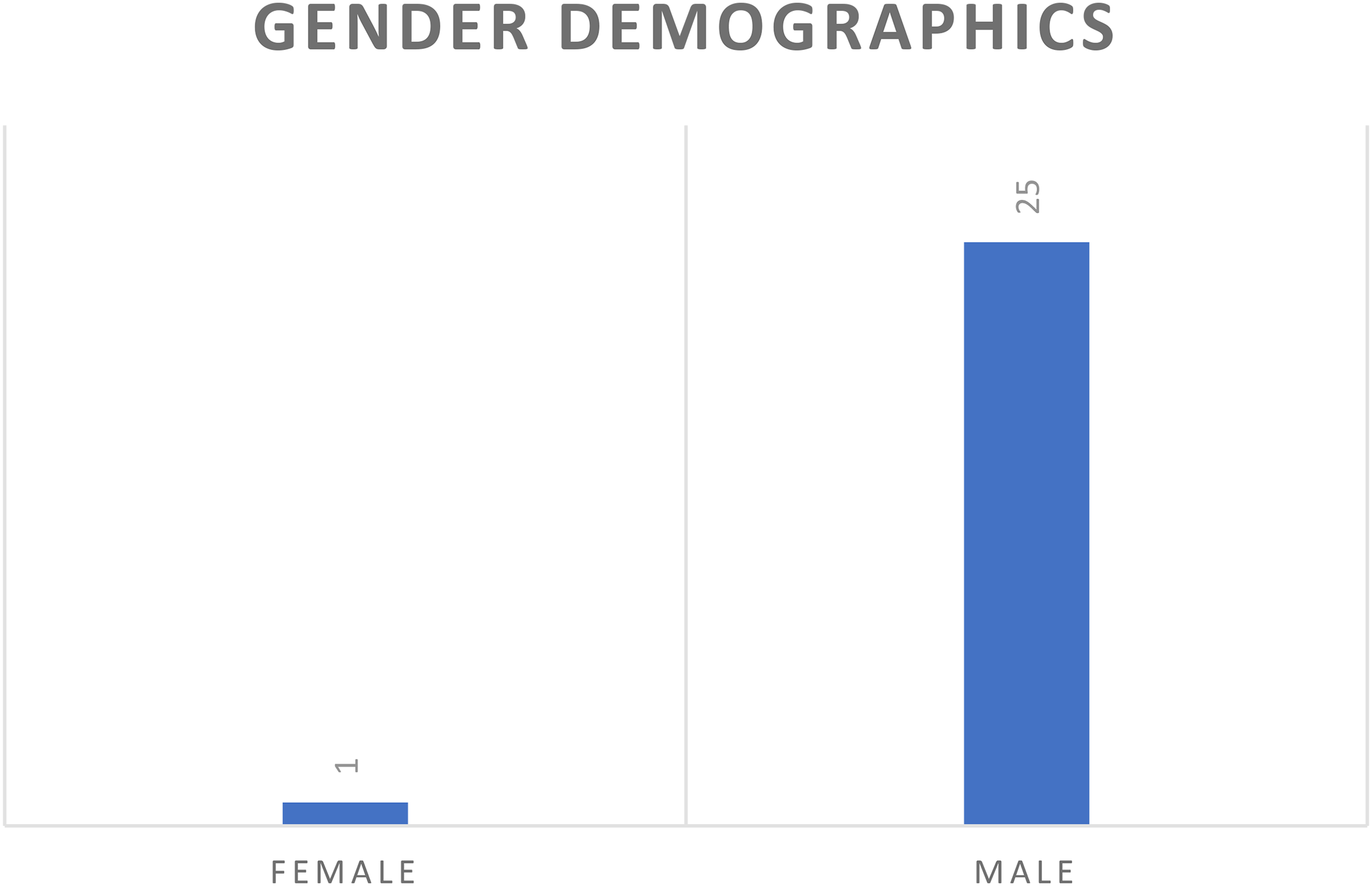
Gender demographics.
I recorded participants’ nationalities to hopefully provide a glimpse into the different construction of whiteness in the UK. Of the 26 participants, 23 (88%) are British. Two participants (8%) are Polish and one (4%) is Italian (See Figure 2). The presence of Polish respondents is of particular interest in an otherwise overwhelmingly British workforce. Poles occupy a fraught space in UK discourse around immigration, particularly in both the immediate leadup to and aftermath of Brexit. Poland is now the second most common non-UK birthplace for UK residents (Sudarshan, 2017). Polish immigrants’ “in-betweenness” as a white but perhaps not white enough for Western European conceptions of whiteness allowed for the matter of Polish immigration to the UK to serve as something of a calling card for proponents of pro-Brexit politics (Narkowicz, 2023). Notably, Poland has a robust miniatures industry of its own, with companies such as Kromlech being prominent firms. Taken together, I was surprised there were not more Polish employees at my research sites, though this surprise comes with the caution that I did not speak to every employee. It is also the case that the overall percentage of Polish immigrants at my research sites is higher than that of the UK population overall, which is 1% (UK Office for National Statistics, 2021).
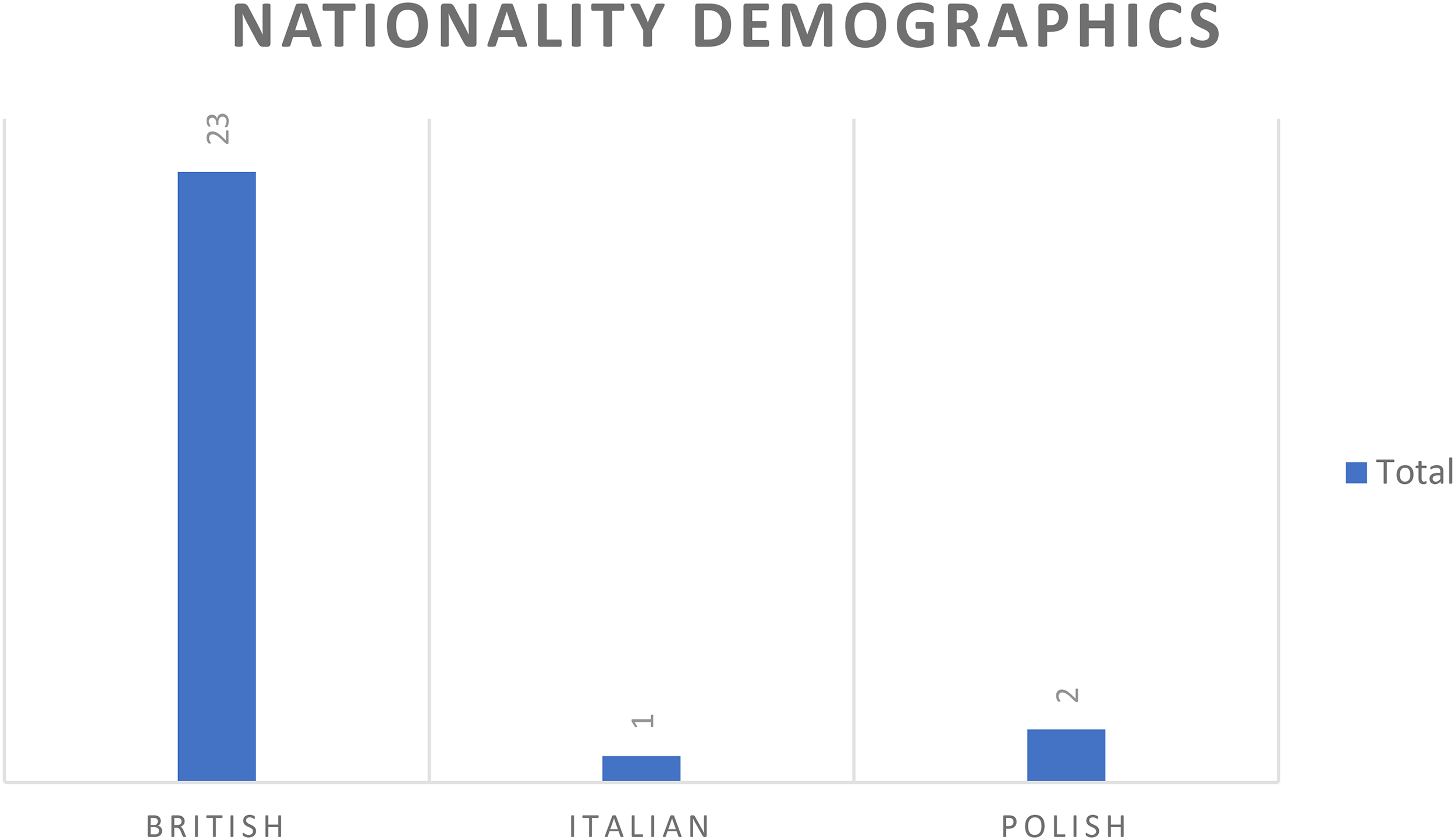
Nationality demographics.
Participants’ gender identifications map to the best available data we have on gender participation in miniaturing, which has women at around 1.5% of miniaturists overall (Karwansaray Publishers, 2024; Winkie, 2021). The sole woman (Participant 6) I interviewed worked in the creative office of one of the sites and gave unprompted statements on the complexities of being a woman in a space dominated by men. Participant 6, a 44-year-old woman, describes her first encounter with miniatures: I was 11 years old when I started. I walked past the Games Workshop store in Croydon and saw they had really cool stuff, went in, came out with a couple of dragons and some Genestealers. And I just kept going back. And I thought, these are really, really cool. I went back again and the next time I got given an intro game of Warhammer, it was fourth edition back then. And I utterly, utterly trounced my little brother.
Participant 6 went on to recount that she dropped out of college to work for Games Workshop, first in their retail arm for 2 years but quickly moving over to their creative studio. Her rejection of formal schooling with an eye toward creative work, instead opting for on the job craft training, complicates Angela McRobbie's theorization of feminine creative work, which focuses on formal schooling as a key component when working in the culture industries (McRobbie, 2016). I also find her origin story, tied up in an early game of Warhammer with her brother, telling and she confirmed the ways that she had to conform to certain gendered expectations of behavior: Playing toy soldiers has always been a boys thing, right? My mum was Dutch. Never let anyone deal her any shit in her life whatsoever. And so back when I was 11, I tried going to the Girl Guides and thought they were utterly vapid and empty-headed nonsense. She persuaded the local scouts troop leader to let me join the Scouts instead. I was the first girl ever to join the Scouts in London. This was back in 1990, I think it was. And the very first night we were there, we were putting up tents in the vicarage garden around the back of the Scout hut, and the boys decided to try it on. And I nearly broke one kid's arm and gave as good as I got in the punch up that followed. And it was great. And I stayed there for six and a half years and they never gave me any nonsense any more after that. And to be fair, I took that attitude with me everywhere, which included going to the Games Workshop in Croydon, and I don't think after the initial surprise of there's a girl in our shop, anyone actually noticed, because I just acted like the rest of them.
Participant 6 transitioned to describing what I read as a component of fitting in with the male-dominated sphere in which she both plays and works: Which is the difference between a girl gamer and a gamer girl? One is the type that does it for show and makes a big show of I play computer games and war games to try and get attention versus the person who's sitting there with the controller swearing at the screen and who actually plays. It's a very stark contrast. In fact, I think I'm going to go with the gamer girlfriend in LARP terms. It's the healer girlfriend who comes along for a weekend and basically plays a healer so that they can keep their boyfriend up whilst they go out and do everything, as opposed to the one who has their own character and their own costume and does their own thing.
At no point did I think Participant 6 was explicitly asked to shed feminine pursuits to conform to the studio's gender, leisure, and workplace expectations. Rather, I believe she had internalized a habit of gender policing through the cultural expectations of what constitutes a real identity around the figure of the geek girl. Megan Condis describes this discourse as one which sets the author up as a true geek girl, one who conforms to a gendered system of power in which most women are suspicious outsiders and only a select few are worthy of being considered an honorary one of the guys—and then only when they go out of their way to disparage a straw woman of their own gender. (Condis, 2018, p. 64)
I linger on this participant because her experience speaks to her status as a complicated and complicating figure. Even as she spoke with real disdain for the fake geek girls she considered herself in opposition to, she spoke in nothing but glowing terms of her male coworkers and bosses. This was not just an approval of the social and cultural tone of the studio but a matter of appreciation for her male coworkers’ and bosses’ defense of her in the face of particularly noxious manifestations of male-dominated workplaces: she spoke of an unelaborated upon, solitary instance of sexual harassment directed toward her at the studio which was dealt with in a matter of days. That such an incident happened is not surprising; that it was rectified with such promptness given the demographics of the studio is.
In the cases of both race and gender, there were non-participants who presented as non-white and/or women. I simply did not have the opportunity to interview them. The reasons for this are complicated. First and foremost were safety concerns. The metal casting area of Warlord had several women working the forge but, due to regulations and my lack of access to proper safety equipment, I was unable to conduct interviews and close observations of that work. In contrast, the looser regulations around resin casting created more open access; the resin casting station was staffed by men.
A related dynamic held in Warlord's picking and packing room, where miniatures are sorted and packaged for shipment: the pace of work was such that interruptions by a researcher were a potential problem. There were quite a few women and people of color in the picking operation—the room in question was surrounded by glass windows, allowing for passive observation—but I was unable to speak to them for the above reasons. There is a fraught implication: that I was kept away from these workers because their jobs were particularly dangerous, in the case of the forge, or particularly menial, in the case of the pickers.
I do not think it is that simple, though I cannot rule it out. Rather, I think the safety concerns and worries about workflow interruption were unique to those roles and that my limited time prevented me from planning around those unforeseen restrictions. The heavy presence of women in the distribution area of Warlord, where they worked in non-specialized and miniaturing agnostic roles, points to a concern within the broader demographics within miniaturing: there are few women employed at Warlord and Mantic because there are few women who practice miniaturing, and there are few women who practice miniaturing because, in part, there are few women at studios like Warlord and Mantic. This feedback loop is immediately recognizable to anyone who pays attention to geek subcultures of any category and extends to other identities such as race and sexual orientation. This is a known problem for management at both companies, who floated more inclusivity at the amateur hobbyist point of entry into miniaturing as a possible solution. Participant 11, a 50-year-old male who works in finance and has long had an eye toward increasing diversity in miniaturing, expressed a worry which spoke to the matter of simulated mass violence as a stumbling block in diversifying the hobby: I think the idea of war, death, and misery doesn't appeal so much to women as to men maybe. Yeah, that's a sweeping generalization, of course. I think most women enjoy playing games, but probably don't see the benefit of blowing up tanks, death, and that sort of thing. So that is probably going to restrict the number of women you'll get coming into, specifically, our hobby. I mean, I was at Adepticon. And the demographic was a certain type. But certainly more women now than there were 20 years ago, there were… I don't think I remember seeing any women then.
Job Categories
I asked participants what their job titles were and what duties they performed. I used this data to create three job categories: Creative, Industrial, and Hybrid. Creative jobs are those with a focus on design, sculpting, painting, and other artistic roles. Industrial jobs are those which focus on the mass production and logistics of miniatures and games. Hybrid jobs are those which serve as bridges between these two, such as mold makers, who make the molds from master sculptures and gauge whether the masters are suitable for mass production and shipment as part of their duties. One participant fulfills multiple jobs: Participant 18 (50-year-old male) serves as both warehouse manager and a game designer.
Thirteen (50%) participants worked in Creative roles, nine (35%) in Industrial roles, and four (15%) in Hybrid roles (see Figure 3). I am satisfied with this spread, as I received a variety of responses related to job roles. Where it is uneven, I believe it is simply that those in Creative roles had more leeway to attend interviews due to the nature of their work and scheduling demands. This fact may point to one reason for pursuing work in a creative field: flexibility in the demands on their time. I categorized Renton and Stallard, the studios’ owners, as hybrid.
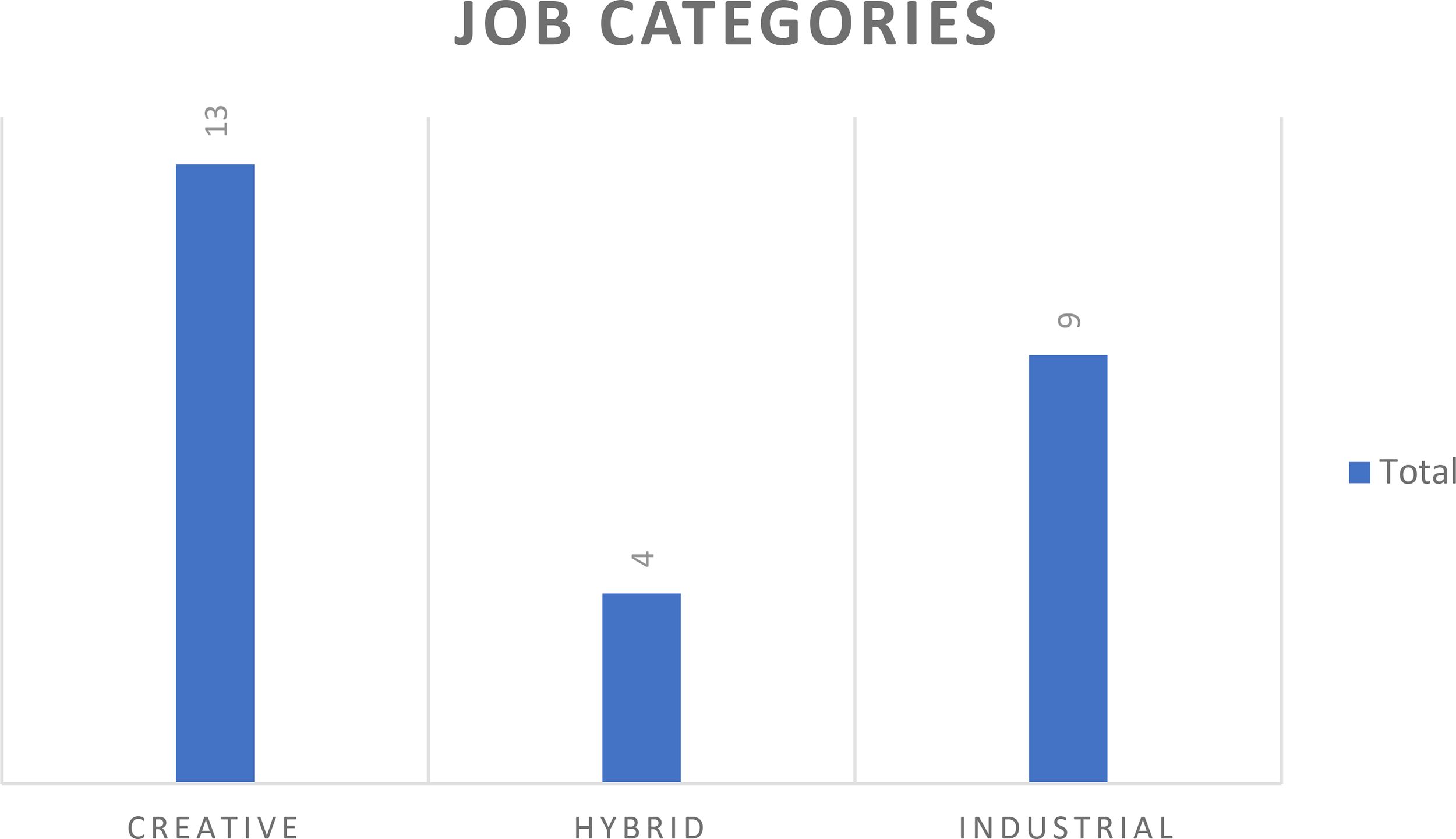
Job categories.
References to craft mapped to participant job role (see Figure 4). Eight participants in a Creative role referenced craft in interviews, while only two in an industrial role did likewise. Conversely, seven participants in an industrial role did not reference it, while five in a creative role did not. My interpretation of this difference and the specifics of the interviews, themselves, leads me to believe that perceived creativity or freedom in one's job and idealizations of craft are linked.
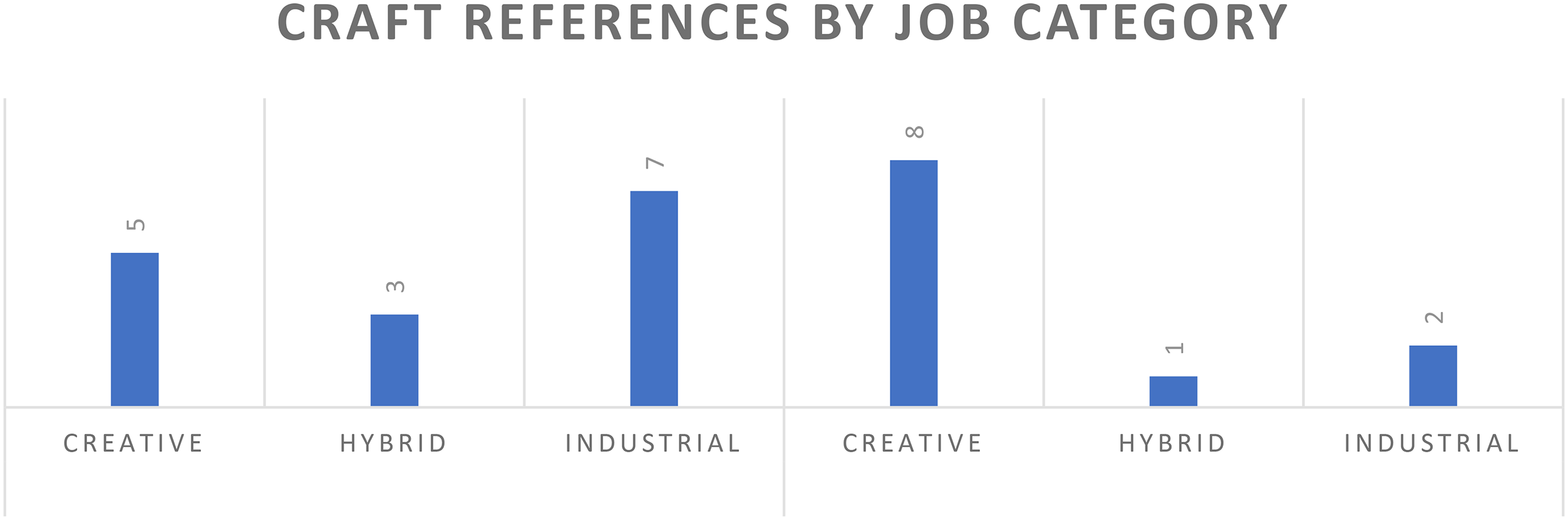
Craft references by job category.
Historical Miniaturing and Nostalgia
During coding, I noticed a trend of older participants starting out in miniaturing through historical wargames, or “historicals.” Of 26 participants, 13 (50%) first entered miniaturing through historical wargames (see Figure 5). This is strongly correlated with participant age: the average age of participants who started in historicals is 53, while those who did not have an average age of 38. This points to the encroachment of Games Workshop's market dominance, as first instances of miniaturing moved from historicals to Warhammer.
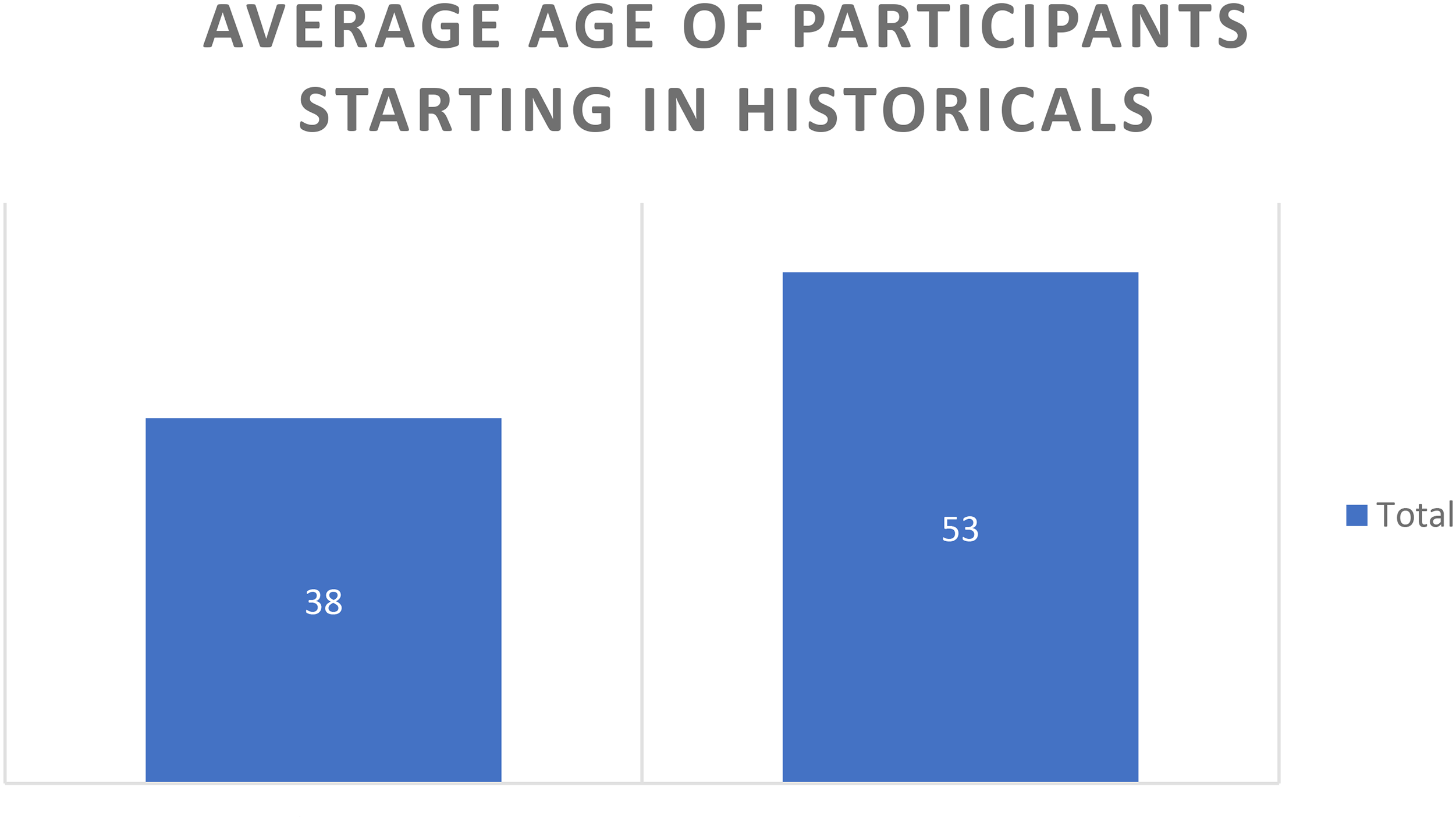
Average age of participants starting in historicals.
Participants who started in historicals expressed a strong interest in both history and masculine relationships. The historical miniaturists I interviewed related personal histories of time spent as children playing with a father, uncle, or grandfather. In turn, those older family members played to navigate personal experience during the WWII years, whether they were veterans or not. This is not primarily, and somewhat to my surprise, an exclusively reactionary mode of engagement: participants expressed a variety of emotions, including regret at British colonial practices and a desire to make sense of older family members’ experience in the World Wars.
These participants also related how deeply enmeshed their childhoods were with what they describe as the ubiquity of WWII in the British media of their childhoods. As Rick Priestley told me when I asked him about how he became interested in miniatures: If you look at all the war movies and everything, if you look at British TV, and we had comics that were… not entirely but often focused on war stories from our uncles and fathers. In my case, I don't think there were any immediate family, but there were great uncles, uncles, and such. So it was just something that everyone was steeped in. Didn't seem strange in any way. Everyone you talk to, especially in this country, you will hear that same story.
During these interviews, I came away with the sense that the historical miniaturists were grappling with their relationships with men, the legacy of British imperialism, and the import of violence. Participant 9, a 57-year-old male game designer, spoke of history and British media as the drivers of his interest in miniatures: WWII was effectively the end of the Empire. Lots of elements of the British Empire were starting to look for independence. We'd had to cede territories rights, et cetera, to the Americans for their help. There wasn't a wonderful picture there. And obviously, there were still reparations and all that went with the end of a major global conflict. So I think to get round that, comics, television, et cetera, stepped in with the heroic. Let's forget about the bad stuff. And here's the cool stuff. Yeah, this is us winning. Bombing the dam on the Ruhr, comic books had all manner of heroes and antiheroes. And I think that just fed into the national psyche of, right, let's ignore the really bad stuff and focus on winning.
Participant 9 went on to describe how he had developed a fuller understanding of the depredations visited upon colonized people by the British Empire and how he believes that this creates what he views as a pervasive sadness in British cultural life. When I commented that he offered a nuanced understanding of modern British history and media's role in the creation of a less nuanced public view of the British Empire, leading me to wonder about his lifelong participation in historicals, he smiled and replied, “I guess I’m a bit sad, too.”
Paul Gilroy calls this feeling postcolonial melancholia, a deep well of sadness in the British psyche. According to Gilroy, the British won the war but lost the colonial accoutrements which made them a great power and which they had no right to in the first place. He refers to this as a narcissism turned inward via a moral framework that assures them that they are still good people (Gilroy, 2005, p. 89). His way out of this trap is to celebrate a multicultural Britishness which moves forward rather than glancing back. Susan Stewart's theorization of the appeal of the miniature, here meaning small, is also useful (Stewart, 1993). Miniatures are ultimately tiny statues. For Stewart, small things which can be held are representative of interior space and time, while large things are authoritative and public (p. xii). Participants, especially Participant 9, grappled with history through these small statues. Some responses felt like postcolonial melancholia, but others seemed to be grappling with something too large to comprehend just by reading history. Instead, they navigated the violent, complicated history of the UK through design, painting, and play. H.G. Wells, who published the first truly successful commercial miniatures wargame, was explicit on this point in his rulebook: his aim was to make war small in order to make it rational and sane (Wells, 2018).
Miniaturing as Pastime for Professionals
I asked participants which aspect of miniaturing they were most interested in as a leisure activity. Meriläinen et al. theorize miniaturing as a set of interlinked practices which they taxonomize as crafting, gaming, storytelling, collecting, socializing, and displaying/appreciating (Meriläinen et al., 2020). Most miniaturists maintain a focus on one of these over the others at any given time. I did not prompt them to choose one of these practices by name. I instead asked them if they engaged with miniatures wargames in their spare time and, if so, what they did. I then matched their responses to miniaturing categories during coding. My intent was to gauge whether engaging with miniatures wargames at work caused their interest in miniaturing for pleasure to wane. A further intent was to explore the aforementioned feedback loop of leisure and work: who came to professionalize their interest in miniaturing because of their pre-work interest in miniaturing and who was not interested in it at all?
Most participants miniatured in their off-hours with a strong majority (15, or 58%) preferring the gaming aspect of miniaturing over others. Eight participants (31%) preferred crafting and one participant (4%) preferred displaying their miniatures. Only two participants (8%) did not engage with miniaturing outside of work at all; one of these was in finance, the other in graphic design (see Figure 6).
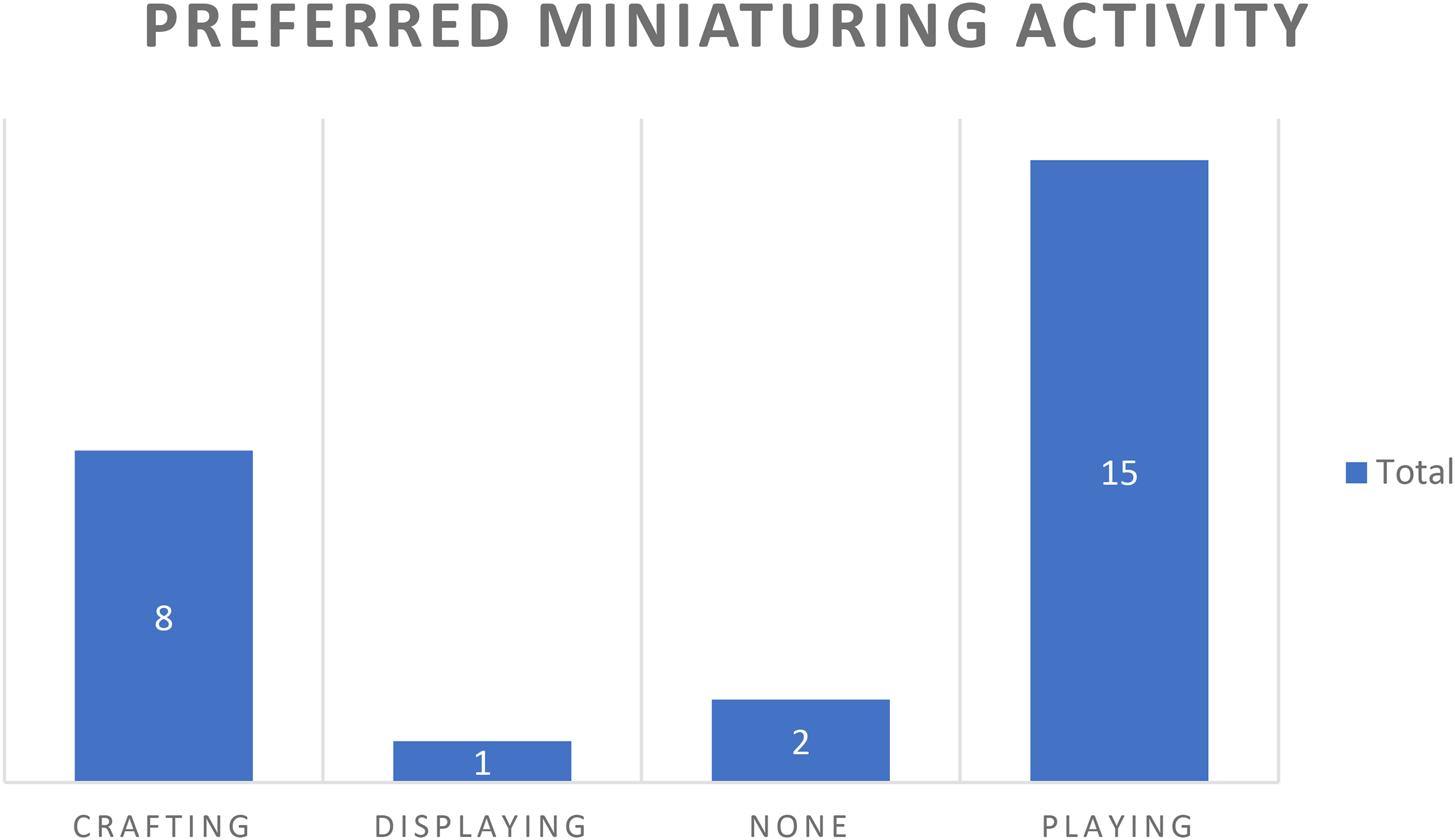
Preferred miniaturing activity.
The leisure/work split around miniaturing is not a firm binary, however. In several interviews, participants saw their creative or crafty work at the studios as a satisfying stand-in for miniaturing as leisure. Participant 9 offered insight into this dynamic: Well, when I first joined Games Workshop, one of the sculptors I was talking to said, ‘you didn't realize this is the end of your hobby.’ No, that can't be. I'm joining the hub of every part of it. ‘You don't understand. You'll either be so sick of miniatures at the end of the day that you won’t want to do it or you'll be too busy.’ No, no, no. Yes, it was right. Early Games Workshop was a studio which existed strictly on a nine to five with an hour lunch. And there were no people staying over late. So, if I got into work early, they’d have a paint station set up. You got around to 12 o'clock right, I got an hour with painting. Then do some work and then go home and I can do some painting. Yeah. Those are the glory years for me from a hobby perspective because I got to do my hobby in between things. Whereas now, work kind of takes over. By the time I finish working in an evening, I just want to go to sleep.
He went on to state that his hobby and work are deeply imbricated in his current role but that he had few complaints about that configuration: I guess partly because I'm working in the design studio I'm immersed in miniatures, and games, artwork, painters, sculptors. So I kind of live my hobby through that. And I do see it as one of the best jobs in the world. It's just that I put everything into that and making the studio contribute to the hobby as much as I can. And I kind of live that through other people enjoying it. Not so much myself. So, yeah, I'm certainly not decrying that it'd be nice to play a bit more. Paint a bit more. Maybe in the future.
This interview recalls the work of scholars and journalists writing about the interplay between meaning, leisure, and work, both those who write about these matters in the broader economy (Jaffe, 2021; Tokumitsu, 2015) and in the games industry, specifically (Keogh, 2021, 2022; Williams, 2013). Participant 9 entered the miniatures industry because he loved it. He found numerous frustrations awaiting him, as his leisure activity and the pleasures he derived from it muted in the process of turning it into a job. Finally, he found some equilibrium in which he could consider his work as a new, imperfect manifestation of his hobby, notably one which is far away from the highly corporate environs of Games Workshop.
Working at Games Workshop
Most participants worked at Games Workshop in the past. Eighteen (69%) had done so, while eight (31%) had not. Participants’ status as ex-Games Workshop cut across job category and title.
During my coding, the common thread of being formerly employed by Games Workshop stood out to me. As I detailed in the introduction, the Lead Belt exists in the form it does because of Games Workshop's presence and discussing miniatures in any capacity without discussing Games Workshop is akin to discussing American animation without discussing Disney. The company is massive. This demands attention on its own. A further consideration is that Games Workshop hires young and/or new workers to the industry and trains them in their craft to their own corporate standards. This is the reverse of what one might expect, where a large firm like Games Workshop in other sectors might be considered as the pinnacle of one's career. Instead, Games Workshop trains crafty workers who burn out over what they consider a mismatch between their goals as craft workers and the more financialized apparatus of a large multinational corporation. The unrealized promise of professionalizing one's hobby or craft is a theme in all of my interviews, particularly for those participants mentioning craft as an aspect of their work.
Patrick Taylor offers an articulation of this dynamic: It was quite a culture shock. I think because I’d been self-employed for a long time, right? Going into an office with a ton of people and being told to do stuff like you’re stupid, I don't want to do that. As much as I think the company was at fault, I’m hopefully self-aware enough to think like, oh, yeah, I was self-employed, and I'm used to being my own boss. And then someone tells you no do this instead. Not that I didn't do my job. So yeah, I think I left because I didn't like the work environment.
Chris Peach, Taylor's partner on the Painting Phase and employee of Games Workshop for 21 years in various roles, elaborated further: I had all these years of knowledge of painting and I was pretty much told to shut up, get in my little box, and do as I’m told. Duncan [Rhodes] was the same. So why are we here? What does that experience actually equate to? Because no one's listening to the experts. They just hear some random guy above him, push that. Push that, make that, make that thing. It's creators being managed by non-creatives. So, there are a lot of weird decisions. And I think that got to Duncan here. But he had enough and they went off and did their own thing. I stayed for a lot longer because I wanted to and because I had security and got a decent wage.
I give these two responses prominence because they are direct about the relationship between craft and fields like finance and marketing at Games Workshop. They are also typical of the experiences of ex-Games Workshop employees at Warlord and Mantic. Without fail, they felt something went wrong for them in terms of their creative or crafty work at Games Workshop which went right at the smaller studios, where they felt free to express themselves and work at a slower pace. Many of the older respondents were made redundant by Games Workshop, including Priestley, Renton, and Stallard. These older figures related how they were captured in the cold economics of the global miniatures trade. Priestley and Stallard saw themselves as representatives of an older, more intimate style of work which was fading as Games Workshop expanded; they were part of a cull of the first generation of Games Workshop staff during the years 2008–2012.
Conclusion
From my interviews, my expectation that miniatures production is a complex assemblage of craft and industrial modes of work was confirmed. While I do not quote the hybrid workers in the preceding pages, they are key figures within their studios. Nothing happens without their skill at making the artisanal work of the design teams realizable as mass produced miniatures. A statue without this mass production is simply a statue. A miniature must be mass produced, and the hybrid workers are the ones who facilitate that transformation. Likewise, their ability to negotiate on behalf of the shopfloor due to the specifications of their roles brings them status with the more straightforwardly industrial workers at these firms.
Coding my interviews fed a feeling which accompanied me after I left Nottingham: that the Lead Belt resembles a lively industrial arts scene, one in which everyone within it had one another's back. Everyone I spoke to who had worked at Games Workshop in the past spoke in unflattering terms about management there, but never about the other crafters, casters, molders, and the rest. They kept in touch with one another, especially with the crafty, creative workers still working at Games Workshop, sometimes going to that company's on-site pub, Bugman's Brewery, for after work beers. This spoke to a class-based solidarity which allowed for a sense of conviviality. This conviviality extended Mantic and Warlord's management due to everyone's shared (and unpleasant) experiences working at Games Workshop.
They also helped one another in starkly material terms. While I was there, John Stallard told me a story which I later confirmed with Ronnie Renton. Metal miniatures are being phased out at most studios due to costs: the minimum inventory buy of raw materials is higher than for resin or plastic and the molds must be replaced more often due to wear, but they also sell less, creating a potentially ruinous feedback loop when a studio has an order which they do not have enough metal to fill but not enough to meet the minimum buy. This exact situation happened at Mantic, a much smaller studio than Warlord. Stallard heard about Mantic's predicament from Renton (they, like everyone else, are friends) and offered some of Warlord's metal to cover the order with no strings attached and an informal repayment timeframe.
Everyone I interviewed was thoughtful about the big questions of why they chose their field, matters of representation within miniaturing, and popular historical inquiry. The political and ethical valances of this are, I stress, ambiguous: I interviewed people who gave only some thought regarding those matters and others who thought about them quite deeply, but there was never an absence of thought, even as their conclusions differed. Ultimately, I return to Participant 6's description of her sexual harassment case and the speed with which it was settled to her satisfaction. It was resolved so quickly, in a male-dominated workplace, because there were links of care and interest present which resemble those of what E.P Thompson describes as a moral economy (Thompson, 1971). Such links are absent at larger corporations like Games Workshop, even as sophisticated human resources departments are theoretically better equipped to handle such matters.
Desire and personal preference are not guarantors against exploitation, however, and, as such, a moral economy is always finite in its beneficence. Is such a moral economy in the Nottingham miniatures industry better than an economy which is worker determined through unions and co-ops? I would argue no and Participant 6, at least, shared a recognition of the necessity of unions despite her enthusiasm for her job and boss: she cited unionization efforts at Games Workshop, scuttled by management, as the source of a great deal of her personal anger toward that company. But neither can I argue that this moral economy, centered on the comity of craft and shared interest in miniaturing, is somehow inferior to the more theoretically advanced technocratic organizational structure of a large firm like Games Workshop. I base this not on my theoretical and philosophical commitments in this instance but on the words of the workers themselves. They considered it superior, and not just somewhat so. Not one of the 26 people I interviewed expressed a desire to either go back to Games Workshop or to use their current employment as a steppingstone toward employment with a larger, richer, or more prestigious company. On the contrary, Peach and Taylor's vociferous disdain for Games Workshop was only the most straightforward articulation of a shared feeling toward that company as, at best, tangential to proper modes of working in miniatures production and, at worst, actively malignant. This was regardless of where they worked, their workplace role, or their demographic. Viewed as participants in a moral economy this is perhaps unsurprising. But they did not see themselves as particularly atomized or unhappy; at times they were frustrated or bored, but they were, overall, happy in their work and with their fellow workers. Whether that would prevail if they were to unionize is another matter. My suspicion is that Stallard and Renton, as part of the business owning class, have their limits, but that the comity of craft and shared interests create the conditions for which their personal (and always relative to others) generosity exists at all.
Footnotes
Declaration of Conflicting Interests
The author declared no potential conflicts of interest with respect to the research, authorship, and/or publication of this article.
Funding
The author received no financial support for the research, authorship, and/or publication of this article.

Author Biography
Ian Williams is a doctoral candidate in Communication at the University of North Carolina-Chapel Hill. Drawing from cultural studies, media studies, and political economy, he is working on a communicative history of miniatures wargaming.