



Abstract
This paper presents a research project oriented on the qualitative and quantitative analysis of puzzles present in the modern-day (published after 2015) puzzle-oriented gamebooks (i.e., Journal 29) and book escape rooms (i.e., Cypher Files). The research presented included two stages. The qualitative stage aimed to apply the concepts from the fields of ludology and interaction design to interpret the play experience in selected gamebooks. This part resulted in research notes describing the interaction process with each puzzle in analyzed gamebooks. The result of the analysis of those notes is the proposition of the typology of riddles and puzzles present in those books and a general reflection on the puzzle-solving process structure. In the second part of the project, we intended to apply the typology to address research questions of a quantitative nature related to puzzle uniqueness, dissemination of particular puzzle types, and similarity of design practice between authors.
Introduction
Recent years brought about significant commercial success and wide circulation of a new type of gamebook. Riddle-oriented and mixing the concepts from escape rooms with classic logical or mathematic puzzles and creative destruction of interactive books like Wreck This Journal those books appealed to broad audiences in the English-speaking world and other markets in their translated versions. The particular appeal of this genre of gamebooks could be linked to the atmosphere of mystery, challenge, and creativity surrounding most of those publications. The trend started with the The Librarian's Almanac, followed by probably most successful Journal 29, as well as many others, that is, Trip 1907 The Master Theorem, Codex Enigmatum, and Tachyon. The second group of the titles that are the subject of this study are the book escape rooms, which are very similar to the first group in terms of content but wrapped in a different narrative. They are marketed not as an enigmatic book of mystery but rather as an escape room experience delivered through a medium such as a book. This group includes titles such as The Escape Book, The Cypher Files, Daedalian Depths, or Sherlocked!.
This paper explores the variety of puzzles present in the two mentioned above groups of gamebooks. Three main goals of our analysis include:
Creating a proposition of typology of puzzles present in the puzzle-based gamebooks, based on the empirical analysis of the actual process of puzzle-solving; Describing the role of physical affordances of paper books as a medium used in the process of puzzle design; Estimating the level of proliferation of certain types of puzzles among various publishers, authors, and types of gamebooks.
Theoretical Background
The concepts used in this paper come from three primary areas of research and theoretical reflection on the puzzles, problem-solving as a cognitive activity, and the impact of the design upon the interaction with a physical book as a medium through which the problem-solving experience is delivered.
First of all, when considering the puzzle as a ludic activity, there's a wide area of materials concerning them in ludology literature. Most researchers and experts in this field classify puzzles as a valid, albeit a bit controversial, object of ludological research. Both Schell (2008, p. 209–220) and Katie Salen and Eric Zimmerman (2003) address the classification of puzzles as games, arguing that they fit most definitions of games. Salen and Zimmerman propose this definition of puzzles as a type of games: [..] puzzles are games with a single correct answer or set of answers. Puzzles can take various forms, but the ones we cite are single-player games that use simple materials such as pencil and paper. (Salen & Zimmerman, 2003)
In his comprehensive analysis of puzzles (Danesi, 2004) as a form of cultural practice, Danesi highlights their importance through human history as a manifestation of a general interest in mystery and intellectual challenge. In his book, puzzles are both a cultural trope present throughout history and a signifier of distinctly human intellectual features of imagination, the need for intellectual challenge and catharsis, or the social practices related to puzzle solving as a social activity and a form of serious leisure. Puzzle-solving is so prevalent in human history and various cultures that it could be argued to be a manifestation of a sort of inherently human instinct that presents strong ties to other forms of intellectual development, especially scientific inquiry. Danesi analyzes in his book various forms of puzzles present throughout human history, focusing on categories such as language, visual, logical, numeric, and algebraic puzzles, as well as puzzles based on manipulating games’ rules and components. Danesi also argues that various types of puzzles present strong ties to other forms of intellectual or cultural activity—especially mathematics, logic, and linguistics.
Several other researchers address the more specific problem of collecting and classifying puzzles. Up to this day, the most extensive collection of published puzzles is still the work of Sam Loyd, titled Cyclopedia of 5000 Puzzles Tricks and Conundrums with Answers (Loyd, 1914). Although rich in detail, this book lacks any typology and classification. Other works that propose a typology of puzzles are oriented at game designers and thus prefer the applicability over systematic description and categorization. Selinker and Snyder (2013) divide puzzles into three main groups: perception puzzles, word puzzles, and logic puzzles. Clontz divides them into eight groups: cryptic puzzles, logic puzzles, mathematic puzzles, mechanical puzzles, trivia puzzles, word puzzles, pattern guessing, and riddles. Adams (2015) does not propose a clear typology but provides a series of dimensions to classify puzzles, where particular puzzles can fit almost any combination of those traits. Essential aspects of puzzles considered by Adams include time (real-time or turn-based), multiplayer or single-player character, mode of construction (randomization or preconstruction by designer), and mechanic of the puzzle (combination lock, tile-matching, construction, hidden objects, lateral thinking, codes, and trivia). Fernández Vara presents other typologies of puzzles in her dissertation focused on digital adventure games (Fernández Vara, 2009). She lists five macrocategories of puzzles: navigation puzzles (related to the game's representation of space and movement through it), state of affairs (related to objects and systems manipulation), language puzzles (find-a-word and classical riddles), exploration puzzles (related to finding specific objects in the game area), and mini-games (implementing other game or traditional puzzle as interaction in the main game).
In our research, we use some familiar terms presented by other researchers. Still, our classification is derived mainly from the autoethnographic part of the research. It does not intend to replicate any existing typologies, as we found them not 100% relatable to the gamebook content.
An essential part of this paper is the analysis of the process of problem-solving conducted by the player during the interaction with a gamebook. Here, we reached the terminology used in problem-solving models created at the intersection of cognitive psychology and mathematics, both general and high level (i.e., Polya, 1954; Zeitz, 2007) and detailed and analytical (Wang & Chiew, 2008; Wang & Ruhe, 2007). In the part of the paper considering the puzzle-solving process, we found the formal model created by Wang and Chiew (2008) particularly useful in describing the cognitive aspect of interaction with puzzles in gamebooks.
We also reviewed the research on the cognitive impact of games and game-based learning for possible interpretation and models of problem-solving activity inside the game environment. This type of research is focused mainly on logical reasoning and strategic decision-making and is aimed at measuring the temporary or permanent improvement in human cognition capability as an effect of playing games, but usually does not provide insight into the detailed cognitive process resulting in in-game decisions (Assapun & Thummaphan, 2023; Eseryel et al., 2011). The most promising research, similar to the analysis conducted in our paper, is related to the detailed analysis of gameplay and interactivity in logical and strategic games performed in the field of human–computer interaction research (Haworth et al., 2010, 2013; Sedig & Haworth, 2012; Sedig et al., 2015). From this research, we derive the concept of “cognitive gameplay,” understood as the cognitive processes that emerge through the mutual dialogue between the player and the game (Haworth et al., 2013), which is our fundamental area of research. Our paper aims to expand this concept into an analog medium like puzzle-based gamebooks.
Finally, the third area of the terminology used in this paper comes from the design theory. We will refer to the researchers from this field in two critical aspects of our work:
The impact of the design of gamebook content on the process of puzzle-solving (particularly in the aspect of visual design as a source of hints and cues for the player (i.e., Horowitz Murray, 2012; Kress & van Leeuwen, 2006; Leborg, 2006; Norman, 2013) Usage of particular affordances of the paper book as a tool in puzzle design typical in (i.e., Ferris, 2013; Shen, 2016; Tare et al. 2010)
When referring to design principles, we should also address the professional discourse of puzzle game designers, which is published primarily online via forums such as the Game Designers Conference. In such work, there are examples of more field-specific best practices related to visual and gameplay design in games (Grant, 2021; Long & Varjo, 2024). Unfortunately, those materials refer strictly to digital games. While some are useful in other media, others are specific to digital games only and thus do not expand our understanding of visual design principles in puzzle-based gamebooks.
Research Design
The research presented in this paper consisted of two main stages. At first, we used the autoethnographic method (Adams et al., 2021, pp. 3–5). We aimed to record the interaction process with a gamebook and make it a subject of systematic analysis. This process is partially perceptible by an outside observer, but a large part of it (the content perception, interpretation, sense-making, and problem-solving activity) is subjective and inaccessible to the direct perception of an external researcher. Faced with this challenge, we decided to reach for the autoethnographic method, which is especially effective in analyzing the subjective processes of perception and problem-solving, which constitute most of the activity during the interaction with a gamebook (Adams et al., 2021, p. 4). The autoethnographic approach in the game research has been gaining popularity in recent years, although it seems limited to research on the Massive Multiplayer Online Role-Playing Games and the aspects of community participation and identity (McArthur, 2019; Nardi, 2010; Taylor, 2006), the research on gamer community (Shaw, 2012), and social and cultural impact of games (Borchard, 2015; Miller, 2008).
The goal of the first stage of the research was to gather a set of research notes describing the puzzle-solving process and interaction with each book as perceived from the players’ perspective. Our primary focus in this stage was on creating a collection of research notes describing the cognitive gameplay for each puzzle in its two main aspects:
Reasoning, including the perception of the puzzle, interpreting the clues, and identifying the procedure to solve the puzzle; Behavior, including the physical manipulations and alterations, applied to the book as a physical artifact.
The result of this stage was a general model of interaction with the gamebook and the typology of challenges present in puzzles. This typology was later used in the second stage of the research.
In the second stage of the research, we used the content analysis approach (Neuendorf, 2016) to quantify particular types of puzzles in selected gamebooks and discuss their proliferation. Our primary research questions at this stage were:
How unique are the riddles present in each book? Are certain riddle types present in all books or are there some unique or specific to a particular author or publisher? Is there a particular quantitative “fingerprint” of preference for certain types of riddles among different authors? How prevalent are the puzzles that use affordances of a nondigital book printed on paper? Are the puzzles that include rotating, bending, folding, writing on, and placing near mirrors, an essential feature of analyzed books or rather a marginal and seldom-used gimmick.
This approach has several significant benefits and methodological limitations that should be considered.
The most obvious benefit of using the autoethnographic method is the ability to introspect on the subjective process of solution-finding and problem-solving in a more precise and in-depth way than in any declarative method (i.e., in-depth interview with players). Subjectivity is sometimes considered a drawback of the autoethnographic method (Chang, 2008), but in this case, it seems perfectly fitted for the task. The open approach to the player experience and minimalization of the precatgorization in the first research stage is similar to the grounded theory approach (Charmaz, 2006, pp. 13–24) and focuses more on the personal insight of the researcher than on the preexisting typologies of puzzles to get the final typology as related to the gameplay experience as possible.
However, some aspects of the autoethnographic research process also require control and researcher self-consciousness because they can seriously impact the conclusions. First of all, the researchers are people from specific backgrounds with particular cultural and social capital that influences the process of problem-solving and thus may affect the observations about the interaction with the gamebook. This is a significant factor that must be considered in virtually every complex problem-solving research (Greiff & Neubert, 2014). The second aspect that needed control in the research process was the change of perception of the researcher as an effect of learning of means and methods used by gamebook designers. This factor implied that the first recorded experiences with the gamebooks were most important in describing the approach of a person that is “fresh” to the topic and only starts their adventure with solving gamebook puzzles. The third important caveat that was important to control was the effect of attrition and frustration with a particular gamebook. The experience of play in certain books was far from being pure amusement, sometimes nearing the “hard fun” category and, in some cases, purely frustrating due to the design flaws, problems with translation, or the puzzle complexity. Bearing those three caveats in mind, we tried to avoid the analysis and comparison of puzzles from the point of their difficulty, and challenge level, as these factors are heavily impacted by the players’ personal traits, cultural background, the level of experience with gamebooks as a medium, and the current level of attrition with particular gamebook. In the case of puzzles heavily impacted by a person's cultural capital (especially those requiring high general knowledge and the ability to identify some recurring puzzle genres), we tried to record the external experience/knowledge level needed to solve those puzzles. It is also worth mentioning that team members had different levels of previous experience with game and puzzle design. The first of the authors had no experience as a game designer, the second had some experience as a designer, but no experience in puzzle design, and the third had previous experience as a puzzle designer.
A detailed list of games included in both stages of research, with information on the number of puzzles and research notes taken, is listed in Appendix 1.
Research Results
In this section, we will cover the three most important results of the project:
A general model for the process of puzzle-solving observed during the analysis of autoethnographic notes, and its relation to the models of cognitive activity in problem-solving; The typology of puzzles observed in the gamebooks, with particular focus on the type of puzzles using physical affordance of the printed book; Estimation of the proliferation of certain types of puzzles between publishers, authors, and particular works of a specific author.
Process of the Puzzle-Solving
As a first task in the qualitative data analysis process, we wanted to identify a general pattern that would apply to all of our research notes describing the process of problem-solving. We would choose two sets of research notes to compare the effect of learning how to solve puzzles in gamebooks and getting more acquainted with the medium. The first set would contain the notes from the first books solved by each researcher, and the second one would consist of notes from the last game book the researcher was working on.
Examples of research notes from both stages of the research look like this: Early note: “The puzzle description focuses my attention on plates with strange signs resembling Chinese ideograms (direct reference). I use Google Translate to check for their translation, but it doesn't match. Maybe they are not real ideograms? I rotate the page and try to look at them from a different perspective. Finally, I figured out they resemble letters reading “seven,” “eight,” and “two.” But what's their proper order? The puzzle tells of three men—father, grandfather, and great grandfather—whose plates are marked as their property. Then the number from the plate of the great grandfather is first etc. Let's try—728. “728” comes to be the proper answer.” (Puzzle 7, book: Trip 1907) Later note: “Puzzle description focuses on the code to decipher (indirect association using keywords ‘code,’ ‘cipher’). But there's no code on the page. I look again to find some code. I rotate the book. There's also a hint with the word ‘reflect’ suggesting using a mirror. The use of a mirror doesn't help. I look again for the code and find a series of dots and lines. This could be a morse code. I translate it, but it doesn't make sense. But then I use the mirror again, and the code reveals a word. The word is a solution to the puzzle.” (Puzzle 4, book: 404)
Comparing those two notes is a good example to discuss the impact of various factors on the puzzle-solving process. Those factors listed in the research process include:
Individual competence related to the puzzle (i.e., ability to do the logical reasoning, perception, and focus, or an external knowledge) The effect of learning how to solve puzzles in gamebooks in general (a media-related competence that improves with each book played) The puzzle's complexity Precision (or vagueness) of hints and tips provided with the puzzle Level of fatigue with solving particular gamebook Situational factors (environmental, social, etc.). The effect of learning—the universal competence that increases with every puzzle solved. The general impact of this competence is based on the cognitive availability of puzzle patterns for the player, which increases the probability of identifying critical actions needed to solve the puzzle. Fatigue with a particular gamebook—the level of attrition that generally increases with progress in a certain gamebook, but the scale of this increment varies greatly. In more accessible and more casual gamebooks (i.e., Cypher Files or books from the polish series A Travel with Puzzles [pol: Dziennik. Zagadkowa Podróż]), this attrition effect is insignificant, while in books with more complex and multilayered puzzles (i.e., 404 or books from Master Theorem series) it can reach a high level very fast. Individual competence related to the puzzle—depends on the actual competence needed to solve a particular puzzle. Authors tend to mix those competencies, so there's usually not a single dominant individual competence helpful throughout the book (although, as we will see in the quantitative part of the research, there are clear preferences for some types of puzzles among specific authors). The puzzle's complexity—varies greatly even throughout a single book, as even the books that contain more complex puzzles (like 404) tend to mix them with simple or event sometimes trivial puzzles used as a means of relaxation for the player or as an element of narrative progress in the book's story. The precision (or vagueness) of hints and tips provided with the puzzle—in a particular book, those can be either very clear and helpful or completely misleading, the second case being impacted significantly by the process of translation and cultural localization, which we will address in the discussion section of this paper. Situational factors (environmental, social, etc.) are independent of the player and vary significantly as the surrounding of plyers’ puzzle-solving activity changes throughout the day. The perception-based challenge of finding the Morse code pattern. The cultural competence-based challenge of translating the pattern. The physical affordance-based challenge of obtaining the solution from the translated code using a mirror. The orientation stage—the first stage of the work with the puzzle, when a player tries to use all of the hints and clues (which we discuss in detail in the next section of the paper) to identify the general goal and mechanism of the puzzle. At this stage, the player gathers all that information and starts formulating hypotheses on the puzzle construction. When they identify possible puzzle patterns, they proceed to the solution-seeking step. Solution seeking—when the player identifies a possible procedure to solve the puzzle, they apply it to the available data and check whether they get meaningful progress (usually as a set of words, letters, or numbers). This set that we call the “product” of the puzzle can be a possible final solution or input data to the second layer of the puzzle. In the first case, we proceed to the codebreaking stage. In the second case, we repeat stages one and two for the second layer (possibly shortening stage one because the player might already have a concept of the general puzzle pattern from their cognitive work on the first puzzle layer). Codebreaking—when the player has obtained a set of letters, numbers, or words, they check for the answer—usually with the web app that accompanying the book or on the solution list in the back. If the solution is correct, they move to the next puzzle. If not, they often use one of the hints provided by the app (if available) and return to the orientation stage or the solution-seeking, depending on the assumption of their mistake. If the player assumes they missed the whole point of the puzzle, they return to stage 1 and to the second stage if they presume they correctly identified the type of the puzzle but made an error in the execution of the solving procedure.
Those factors’ impact can vary greatly, and only two have a predictable influence on the puzzle-solving:
All other factors vary greatly and can change from puzzle to puzzle in a nonpredictable way:
Keeping those factors in mind, we can progress to the presentation of the model of problem-solving cognitive activity identified during our research. This process consists of a number of stages dependent mostly on puzzle construction. We call this factor “puzzle complexity,” and it is connected to the observation that puzzles in gamebooks seldom consist of a single problem to solve. More often, they employ two or more challenges mixed. In the example from the 404 book, we can identify three challenges:
Thus the general model of puzzle-solving consists of several stages:
We can relate this model to some of the general models of problem-solving activity. Pólya (1954) proposes a model of four stages: understanding the problem, devising a plan, carrying out the plan, and evaluation. We can easily connect this scheme to the model observed in our research. Polya's “understanding of the problem” could be compared to our orientation stage. Devising and carrying out the plan are similar to the solution-seeking phase, and the evaluation is carried out at the codebreaking stage. What differentiates our model from Polya's is the possibility of multiple trial-and-error repetitions of stages 1 and 2 during the play. At the same time, Polya focuses on the linear structure, where an analytical approach at the stage of understanding the problem most of the time leads to the problem description allowing proper analytical solution. Previously cited work by Wang and Chiew (2008, p. 6) addresses the problem as their formal model of the cognitive process of problem-solving (deriving from the general Polya's concept), more clearly includes the recurrence and trial-and-error possibility. In their model, the evaluation phase is not a postmortem stage of the problem-solving process but an integral element that, when no satisfactory results are obtained, returns the solver to the conceptual phase to reevaluate their previously identified goals and methods (and not only the execution of solution as in Polya's scheme).
This stage of research shows that the general problem-solving models are well suited for modeling cognitive activity during the puzzle-solving, bearing in mind two aspects that are distinctive to the gamebook puzzles:
The puzzle authors try to obscure the procedure of puzzle solution purposefully; thus, the orientation/problem definition stage takes a long time and is subject to more trial and error evaluation than in most formal or well-defined types of problems. The puzzles in gamebooks often consist of multiple layers, which implies that obtaining the final solution requires the player to complete the problem-solving process several times. The “products” of a particular stage are input data for the next one. The initial orientation/problem definition stage may provide insights into solving the first layer as well as the consecutive ones.
Role of Hints and Clues
The second essential element of puzzles presented in the analyzed gamebooks is the role hints and clues used to lead the players to the proper solution. The puzzle author is in the position where they have to make the puzzle challenging and engaging but solvable, sometimes even by a person with limited or no experience in puzzle-solving (the books marketed as “difficult” and oriented to “experienced” players are rare in our research material). The authors try to hide the data and procedure needed to solve the problem to make the game challenging. Still, they also encode the gamebook narrative, instructions, and graphic design with hints leading to the proper answer. We reach for the visual and design field while constructing the typology of those hints and clues (Leborg, 2006; Norman, 2013, pp. 123–161). All of the mentioned clues fall into one of two categories: signifiers—the information pieces suggesting how to operate a particular puzzle or affordances—design decisions that limit the space of action possible or accessible to the player (Norman, 2013, pp. 10–13).
A group of signifiers includes:
Using keywords in text: using words that can indirectly guide the player to the procedure or action required in the puzzle. They often use words that associate with a particular element of the puzzle, synonyms, metonymies, or phrases related to the book's structure (i.e., “before” that codes the need to look for the answer in previous pages) or the action needed to decode the physical affordance (i.e., “reflect” coding a need to use the book's reflection in the mirror). Graphic highlights of particular keywords: an effect that boosts the visibility of words and phrases listed in the previous bullet. Examples and fragments of solutions used in puzzles based on pattern recognition and filling the gaps that present the result of applying specific solution rules. Using visual information: working in the same way as keywords but transferring the meaning through a means of images (i.e., arrows, “X” marks). Defining and limiting the puzzle output: presenting a constraint to the answer (i.e., stating that it has to be two words, five letters each) is a tool helping to look for the solution. Graphical indicators pointing at specific parts of the puzzle, text, or the book page that are essential for the puzzle-solving process (using all spectrum of visual grammar, notably arrows and other structural indicators, size differentiation, color highlights, composition structure manipulation, vertical, or horizontal symmetry, and distribution of elements on the page; Leborg, 2006).
A group of affordances includes:
The design of gamebooks is in interesting relation to the common rules and guidelines of good information design (Wilson, 2009). We see that gamebook designers consciously use many practices and ideas from this field. Still, their primary purpose in the design process is not the smoothest possible transfer of knowledge about their designed objects’ meaning or function. The designers carefully apply the rules of interactive and visual design in a way that leaves some level of ambiguity, mystery, and space for error. Yet, at the same time, they place clues and hints that, when discovered, help the user navigate through this ambiguity.
Puzzle Typology
The third part of the research was constructing the qualitative typology of puzzles used in analyzed gamebooks. Before we present those types, we must acknowledge that puzzles in the gamebooks are rarely based only on one challenge. Some use a multilayered model, with two, three, or more tasks mixed or put in a sequence. In our typology, we try to separate, name, and describe those single blocks of challenge used in the puzzles, bearing in mind that, similarly to the model proposed by Adams (2015), they can and usually are mixed together to form the final puzzles that constitute the gamebook content. Our final model suggests 13 types of challenges used in gamebooks:
Knowledge/trivia: a challenge based on the knowledge of some facts, dates, and names that test players’ cultural competence and general knowledge (i.e., knowing the name of capital of Sweden). Code translation: challenges based on a meaningless set of signs that, when the decoding rule is found, is translated into another meaningful set of characters (i.e., classic substitution cipher). Logic puzzle/deduction: a puzzle based on a set of known rules and initial data that require applying a sequence of logical operations to find the only possible solution (i.e., sudoku or nonogram). Find a rule in a set: a puzzle based on a sequence or array of objects that behave according to a specific rule that requires the player to identify this rule to find the missing piece of the series. Some of those puzzles take the form of mathematical formulae (i.e., finding a missing value in the magic square). Classic riddle: classic riddle using a variety of literary techniques (metaphors, associations, metonymies, rhymes) to prepare a vague description of an object that has to be discovered (Kaivola-Bregenhøj, 2018) (i.e., Sphinx riddle or Gollum riddles from “Hobbit”). Physical affordance-based: a puzzle that requires some alteration to the book's physical structure (i.e., bending, folding, cutting, puncturing holes) that, when applied, provides the solution or its part. Simulation/imagination: a challenge that requires the player to imagine the effect of some process described or pictured in the book (i.e., imagine the movement of the balloons on the picture). Perception: a puzzle based on the players’ perception that requires identifying some information hidden among other content of the page (i.e., using microscopic patterns of dots and lines on the side of the page to convey a message using Morse code). Word association: puzzle based on the set of words that together form a semantic network of another common association (in a way similar to party games like Taboo or Charades). Classical letter-based puzzles: usually anagrams or palindromes that require a conventional operation performed upon a set of letters or words. Chore: a trivial task, but solving the puzzle requires the player to perform a set of operations (sometimes very tedious) to uncover the final solution (i.e., the cross-out puzzle or connect the dots task). Going out of the book: a puzzle that requires external multimedia or sources provided by the book creator (i.e., listening to the multimedia recording of a bell to decode the cipher hidden in the sequence of its sound). Going through the book: a puzzle that requires the player to find some information scattered throughout the book (i.e., writing down the numbers of pages with a specific symbol the player previously didn't pay attention).
When we compare this typology to the typologies of Clontz and Adams (2015), we see that only one category identified in our model is directly present in previously mentioned typologies (trivia and knowledge-based questions). There is also a visible but partial overlap of our typology with all cited typologies. Thus, the proposed typology could be used to integrate other typologies of puzzles (bearing in mind the focus on the analog, book-based medium of gamebooks). Still, our typology has most common points with Clontz's typology, as the types of puzzles discussed by Adams and Fernández Vara are more directly oriented toward digital games.
Affordances
At the beginning of the paper, we posed a question of using the physical affordances of paper books as a tool for puzzle building. The puzzles that use as their base the physical alterations or manipulations with the physical book are not the most prevalent. Still, they are highly represented in the research material. We also classified all identified varieties of those puzzles to see how creative authors may become using the book's physical structure. We divided those operations into three categories: alterations, which impact the book's structure, manipulations that require the movement of the book but do not alter its physical form, and manipulations with additional items.
Alterations:
Writing or drawing in the book Folding the pages Cutting elements of the book Piercing the page Rotating the book (usually at 180° or 90° angle) Comparing two fractures of print in book Leaning the page Looking at the page at an unusual angle Looking through the page against a source of light Bending two pages together Looking for the information on the book cover Placing a dedicated artifact (measuring device, obscuring device) over the page to discover some information Using a regular household item (i.e., a CD) over the page to find some information
Manipulations:
Manipulations with additional items:
Physical affordances listed in this part of the paper are pretty unusual, as most of the current research on gamebooks (usually in an educational context) focuses on digital gamebooks designed as ebooks, apps, or hypertext documents (i.e., Palumbo & Paternò, 2021). Richness and creativity visible in this area is an important argument for more systematic design, use, and research on the effects of physical gamebooks as an educational and entertainment medium.
Quantitative Analysis
In this final stage of the research, we used the classification of the puzzles to calculate the frequency of various types of challenges. We analyzed a total of 795 puzzles and coded each occurrence of a specific kind of challenge. For Figure 1 we present the main type of challenge in each puzzle, for Figures 2–4 we present the total number of coded challenges, which is greater than the number of puzzles. Many of them included more than one layer of challenge, thus effectively mixing two challenge mechanisms into one puzzle in the book (Figures 1–4).
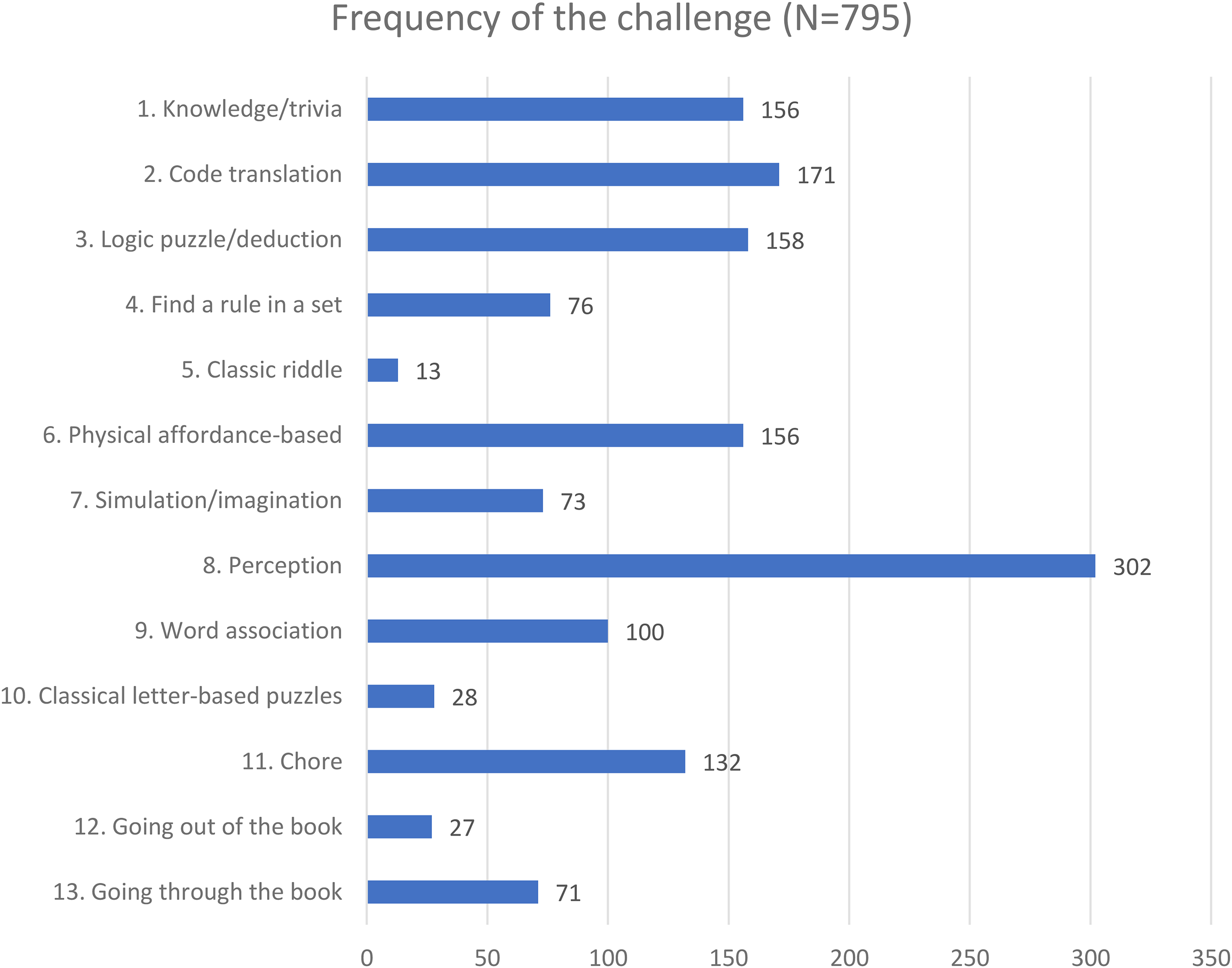
Frequency of occurrence of each puzzle type. In total, 795 puzzles were analyzed, and there was a possibility of coding of multiple puzzle types in one analyzed puzzle unit if the puzzle had complex or multilayer structure.
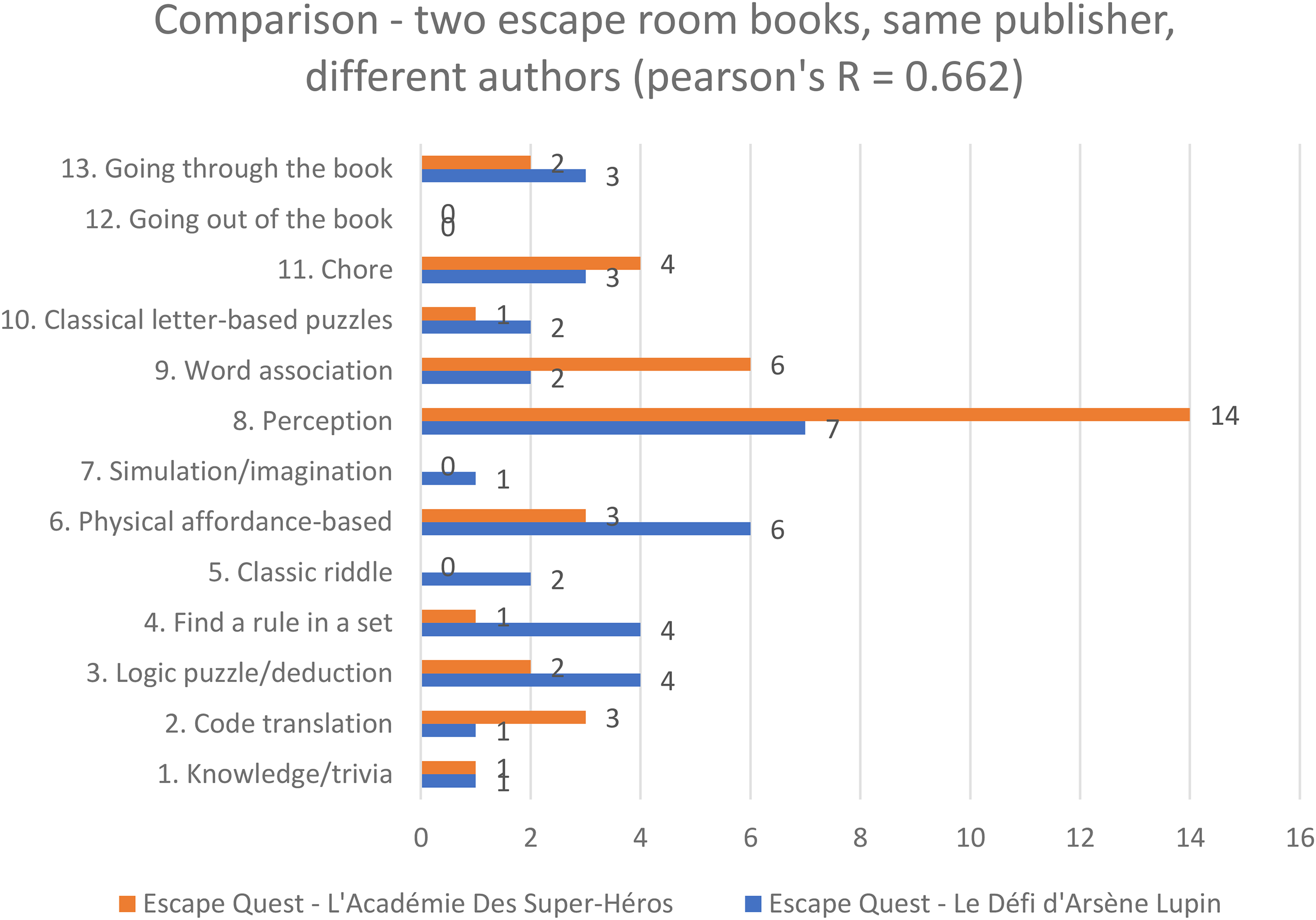
Comparison of the frequency of occurrence of each puzzle type in two gamebooks: Escape Quest - L'Académie Des Super-Héros (2019) and Escape Quest - Le Défi d'Arsène Lupin (2019).
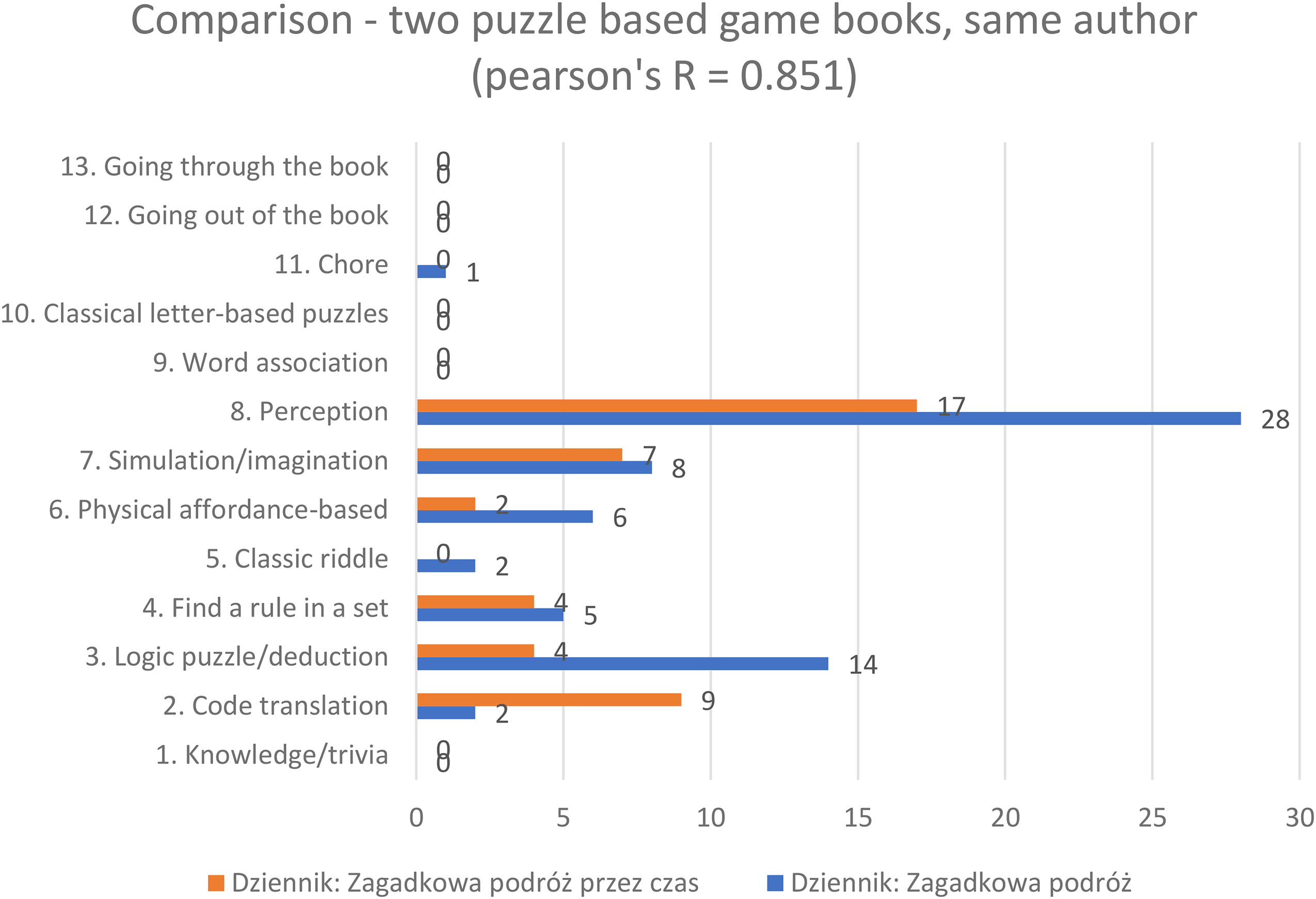
Comparison of the frequency of occurrence of each puzzle type in two gamebooks: Dziennik: Zagadkowa podróż (2020) and Dziennik: Zagadkowa podróż przez czas (2021).
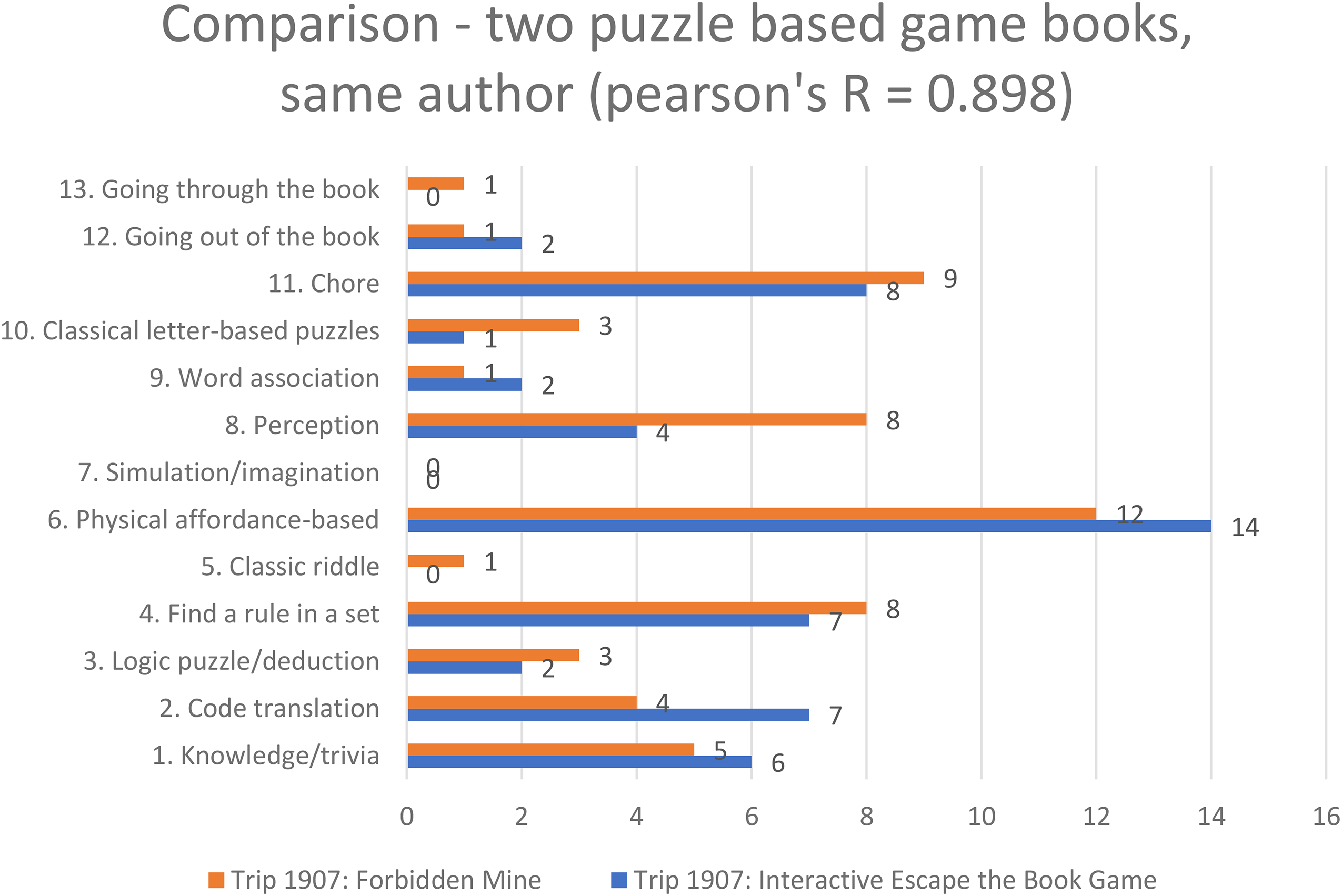
Comparison of the frequency of occurrence of each puzzle type in two gamebooks: Trip 1907: Interactive Escape the Book Game (2018) and Trip 1907: Forbidden Mine (2020).
The final calculation of the puzzles shows us three categories of challenges in the analyzed gamebooks. The single most prevalent type of challenge was the perception-based puzzle. The second group is the puzzles frequently present in most of the books, including all categories with a number of occurrences between 70 and 175. The most interesting type is the puzzles rarely used in analyzed gamebooks. This group includes two categories that we initially expected to be more prevalent—classic riddles and classical letter-based puzzles like anagrams, and a third group that requires using external material supporting the book. All those three types of puzzles frequencies are a surprise, as we thought the classical riddles and letter challenges would be easily accessible to the authors and thus frequently used. Instead, they are replaced by similar categories with different mechanisms. Many puzzles could use classical riddle instead use the word association type of challenge. Many challenges with letters use either a code/translation pattern or a chore (usually a task with crossing off selected letters). The group of puzzles strictly requiring going out of the book (and thus using some form of multimedia) is relatively infrequent. When speaking of paper gamebooks, it shows that authors prefer to rely on paper-based affordance and player skills than on external multimedia or transmedia content.
The second part of the quantitative analysis was oriented at calculating the similarity between certain books. Since we have limited space to present all the calculations, we selected three comparisons that best illustrate the general trend visible in the data. We measured the frequency of occurrence of particular challenges in puzzles in a specific book and then calculated Pearson's correlation between the distributions of frequencies for two books. We also only used the codings from the model and excluded all the codes and notes listed as “other.”
This analysis is an important argument about the existence of a visible “style” of gamebook design, where particular authors (to a large extent) and editors (to some extent) tend to produce similar distributions of types of puzzles. This does not imply a lack of originality or copying particular puzzles but a clear preference for some kinds of puzzles over the other. As an expansion of this research, we plan to perform more complex calculations and try to segment authors and publishers, further analyzing relations between their work and the changes in preference for some types of puzzles over time.
Discussion
The analysis of puzzle-based gamebooks revealed a diverse and innovative game environment. It gave us a unique opportunity to reflect on the nature of the puzzles and puzzle-solving as a leisure activity. Gamebooks of this sort are a large field of innovation, developing and improving new types of puzzles and intellectual challenges, expanding the toolbox of puzzles, riddles, and challenges, as well as an area, where classical types of puzzles are reinvented, reinterpreted, and mixed with other to form interesting challenge for the player. Although the preparation of this paper was a very complex task, we still only touched on some of the topics that could be very potent research fields. Here, we would like to address three of them.
First of all, as we mentioned during the analysis, we worked on the gamebooks individually. Actual interaction with gamebooks includes various contexts—solving the puzzles with partners, children, friends, or alone in different locations, providing an external environment that could facilitate puzzle solving or interfere with the process. The extended ethnographic study of the collective puzzle-solving process could be an important analysis that could contribute to the theory of collaborative problem-solving and distributed cognition when people of various backgrounds and competence work together on a complex and (initially) poorly structured problem.
Secondly, we could analyze the factor that was an issue in our research but was treated rather as a disturbance than a full-scale research problem. This problem was related to the role of translation and localization of the gamebook when translated to a different language and cultural context. Most of the analyzed books have at least a few translations (and some are big international successes with more than 10 language versions), and the problems of translating the lexical associations, idioms, codes, or design of alternative graphical elements that fit local context but use the same type of puzzle mechanism is a challenge worthy of deep intercultural analysis.
The third problem in which the gamebooks would provide excellent research material is the concept of “hard fun.” A lot of our play, even though distributed over a long time and as casual as we managed to, was marked with significant attrition, fatigue, and sometimes frustration. The puzzle-solving is specific leisure where players willingly decide to challenge, occasionally complicated, puzzles and check their abilities against the book. Even though the analysis of negative emotions and fatigue during the gameplay in some books would be an excellent and valuable material not only for game designers but also for other interactive media authors, as some of the fatigue is motivating and rewarding, and some purely frustrating to most of the players. A good designer should consciously choose between those two types of frustration and understand the factors of their occurrence. The difficulty in the games is also related to the problem of immersion. Although this was not the primary research objective, all researchers related to each gamebook's narrative as a supporting information source that could help solve the puzzle. We identified that there are visible and different approaches to the issue of narrative and immersion in analyzed gamebooks. Some used no overall narrative at all, being a set of puzzles; some used coherent esthetics, but no actual story and some tried to use the gamebook as a storytelling medium, in which particular puzzles were a means of progressing the main story. The use of puzzles as a narrative medium proved to be a challenging task for nearly all of the gamebook authors, as intellectual challenge and fatigue provided by the puzzles often hampered the perception of the intended narrative.
Another element of the study that could be expanded is the insight (or “aha!” or “eureka!”) moment. Clearly, based on our research notes, in most cases of analyzed puzzles, the insight moment was present only at the last stage of gameplay, when the answer to the puzzle was validated by a mobile app (or answer list in the back of the book). In most puzzles, there was no precise moment of certainty of solution before external validation. In this sense, there is a possible interesting space for design improvement, as the moment of revelation of certain answers is extremely rewarding when we know the answer is true and we are confident that the chain of thought that led to the answer is correct. However, based on our material, this moment rarely occurs in a strong way when the player waits for app validation of the solution.
A possible limitation of the study is the focus on basic building blocks of puzzle challenges (the so-called microperspective). This is a research decision related to the linear form of the solving process taken by all researchers in our team, where even complex or multilayered puzzles were broken into more straightforward tasks that were solved in a sequence. Although this approach is derived from the actual puzzle-solving process, we could focus only on complex puzzles in upcoming research and compare the process of solving multilayered challenges to solving simple puzzles from a cognitive and phenomenological perspective.
Footnotes
Declaration of Conflicting Interests
The author(s) declared no potential conflicts of interest with respect to the research, authorship, and/or publication of this article.
Ethical Approval and Informed Consent Statements
The project involved the study of textual material, hence, it is not subject to the University of Warsaw's regulations for evaluation by an ethics committee.
Funding
The author(s) disclosed receipt of the following financial support for the research, authorship, and/or publication of this article: The research is funded by polish Ministry of Science and Education as part of the project “Excellence Initiative: Research University,” in the task “II.3.4. Gamification of worlds in the service of the modern society of the twenty-first century.” Ministerstwo Edukacji i Nauki, (grant number Excellence Initiative: Research University: task I).

Author Biographies
Appendix 1: Source material
All mentioned gamebooks were used in the qualitative analysis. In the column “Number of notes,” we included the number of notes taken in the qualitative analysis. Number of notes may vary from the number of puzzles, as in some cases there were more notes taken than the puzzles. In the column “Number of puzzles,” we recorded final number of analysis units taken into account in quantitative analysis. The books marked “X” were excluded from the quantitative analysis (books unavailable in paper format during the analysis).