



Abstract
The art museum or gallery is not a neutral space for housing works. As much as it accepts new types of media, they have to adapt to suit the context of viewing and the conventions of an art-historical discourse. This type of institutionalized aesthetic underpins the evaluation of art objects and even imposes a definition on what art is. Working critically through this discourse, this article examines the limitations of art museums and galleries in presenting, evaluating, or addressing the ludological and temporal aspects of video games. First, it outlines how assumptions pertaining to the visual arts carry over into the selection of games as well as their placement within exhibitions. Second, it examines how this discourse, which is invested in the architecture and structure of the art museum, also privileges a particular regime of spectatorship based on shared viewing, the autonomy of art, and aesthetic contemplation.
The art museum or gallery is not a neutral space for housing works—a simple container or box in which artworks are placed or hung—and as much as it accepts new types of media, these must adapt to suit the gallery's context of viewing and the conventions pertaining to an art-historical discourse. This type of institutionalized aesthetic underpins the evaluation of art objects and even imposes a definition on what art is, rather than allowing art to be defined in terms of the specific aims of the medium. Working critically through this discourse, this article examines the limitations of art museums and galleries in presenting, evaluating, or addressing the ludological and temporal aspects of video games. First, it outlines how assumptions about the nature and value of the visual arts carry over into the selection of games as well as their placement within exhibitions. Second, it examines how this discourse, which is invested in the architecture and structure of the art museum, also privileges a particular regime of spectatorship based on shared viewing, the autonomy of art, and aesthetic contemplation. This second aim draws upon literature analyzing how new media, in particular video art, has been incorporated into exhibitions and collections without properly attending to the specific conditions of viewing, which has direct implications for the study of video games. Rather than examining a full range of types of installation, interactive art, and so on, the article focuses on cinema and video art because, like video games, they involve screens, have extended times of viewing, and are generally viewed and played outside of gallery spaces. Other types of exhibition, most importantly the video game museum, are discussed only to draw attention to the structural limits of gallery viewing and the discourse of art that informs it. Moreover, the article addresses art games only to demonstrate that such games are much more easily accommodated within the structure of spectatorship within a gallery, rather than to herald their intrinsic aesthetic value. The aim here is to explore how art galleries can and do accommodate games as a medium. It is about the affordances of the medium in relation to the discourse of the gallery, and this might involve existing games displayed in a gallery space or games created or designed to be exhibited in that space. Importantly, this is not an issue that only relates to games, for many other media, from films to photographs, comprise works that were created for display in nongallery contexts and without being nominated as artworks.
Art, Discourse, and the Gallery
The concept of art has expanded to include a range of new art forms from film and video games to performance and interactive art. Contemporary art museums now display art that is mass-produced or machine-made alongside paintings, drawings, and sculptures and even include performance works that thoroughly rethink the space. For example, the performance artist Joseph Beuys in his theatrical, I Like America and America Likes Me (1974), occupied a gallery room with a coyote and allowed the artwork to write itself at the time of performance. Many other works collapse the distance between the viewer and the work by requiring audience participation. Nicholas Bourriaud uses the term “relational aesthetics” to describe the development of a type of art in the 1990s that emphasizes intersubjective relationships, where the work comprises problems and actions that require direct involvement of audiences and in which the work develops as a process (2002, pp. 43–44). These developments provide new ways of thinking about how games should be categorized within the gallery? Should they be incorporated into existing art movements and mediums, or regarded as yet another example of digital art? On a simple structural level, video games could be placed under the banner of interactive art as they require a player to directly engage with the work (Hepdinçler, 2022, p. 136). Nevertheless, such categories do not really respond to the specific history of games or their technical requirements such as the digital screen or controller. Moreover, interactive art usually draws attention to the act of playing the game, and under such conditions the game is meta-discursive (Kluszczynski, 2010, p. 8). A seemingly broad category such as interactive art—an art form that depends on an audience member to complete it—is actually much narrower than video games because it develops its meaning and purpose by responding directly to an art-historical discourse, including the demands of curators and a gallery-going public.
Works are evaluated by a range of people from collectors to art historians, whose discourse assesses the role of the artist and distinguishes the artistic work from other comparable objects (Bourdieu, 1996, p. 292). Artistic discourse operates within a tradition and yet tests the boundaries of art by addressing new objects, positing new predicates about what constitutes art, and providing the conditions under which new artifacts can be compared with past ones (Danto, 1994, p. 481). For example, Tate includes such works as Tracey Emin's My Bed (1998), comprising a room with a bed, detritus, and a wall hanging, as well as Doris Salcedo's Shibboleth (2007), involving a 167-m crack that breaks the floor of the Turbine Hall. At first, such exhibits appear to challenge the very idea of the gallery space, and yet in many senses, they are more readily accommodated by galleries than video games because they have been created by established artists and encourage a type of type of disinterested aesthetic engagement. In other words, they align with what David Carrier and Joachim Pissarro refer to as the values of the “Art World,” which is driven by experts trained in art history who select works based on what they believe is art's historical trajectory. The definition of art depends on curatorial exclusion and value judgments based on what those in the art world consider to be “most representative” of art history (2019, pp. 118–119). This representativeness does not comprise strict criteria of quality, technique, or craft, and depends rather on how the works are situated within the dominant narrative of art history. An established artist could display a work that ostensibly appears kitsch if they also demonstrate that they do so knowingly and with irony (Carrier & Pissarro, 2019, p. 127). The work is no longer kitsch because it makes references to art history and the avant-garde's role in challenging bourgeois taste.
In Western art, the art museum or gallery is the primary means by which the public engages with visual artworks, and placing a work in that space brings it into a particular aesthetic discourse and visual regime. The art museum functions like a map with its cartographic structure imposing classificatory principles, criteria for evaluation, and often a narrative, such as a chronological explanation of stylistic development (Whitehead, 2012, pp. 24–26). In juxtaposing works and foregrounding formal and stylistic differences, the art museum operates within what Rancière calls the “aesthetic regime of the arts,” which recognizes the autonomy of art as “a sensible mode of being specific to artistic products” (2004, p. 22). This autonomy derives from a heterogeneous range of aesthetic practices including the belief in artistic genius and the independence of aesthetic experience from other social functions (2004, p. 23). Moreover, art museums do not simply house art but create a structure that prescribes how the work should be viewed. The institutional and historical function of the art world and gallery, from the training of individuals in the analysis and appreciation of art to the incorporation of gallery- and museum-going into ordinary leisure, is largely responsible for initiating a “pure aesthetic” approach to spectatorship (Bourdieu, 1996, p. 288). This cultivation of the “pure gaze” derives from a long period of “purification,” evinced as a shift from the appraisal of the moral value to heralding purely pictorial properties and the autonomy of both artistic production and reception (Bourdieu, 1996, p. 299). This is demonstrated in the structure of the art museum or gallery, where artworks are generally isolated, often with spotlights to help the viewers attend to the work's visual and formal elements (Whitehead, 2012, p. 25). This emphasis on the purely visual appraisal of the work has reached its apotheosis in the “white cube” gallery structure, the preferred mode for showing contemporary art, with high key lighting and white walls creating a solipsistic architectural space designed to direct attention to the work by preventing the viewer from seeing beyond its walls (O’Doherty, 1986, p. 15). To situate a video game within a contemporary museum or gallery necessarily changes its function, for it is brought into the aesthetic regime of images, where each artwork is compared with others in the gallery according to common qualities that suit the structure of display—visual and formal properties take precedence over narrative and gameplay aspects.
The Video Game as Museum Exhibit
The foregrounding of an aesthetic regime of images and a pure aesthetic by art museums plays a significant role in what objects are chosen for those spaces. Despite the broadening of the range of works and the apparent flattening out of the distinction between popular and high art in Postmodernism, the division between major and minor arts still plays a large role in deciding what is included (Carrier & Pissarro, 2019, p. 29). Galleries may exclude based on implicit claims about aesthetic interest or what should be categorized as fine art: We continue to police the boundaries of art closely, guarding entrance to an only-gradually-expanding category of fine art, which no longer contains just painting and sculpture but also drawing, conceptual, video, digital, sound and installation art, but not yet quite comic book illustration, television programmes and advertisements, while objects like an Olivetti typewriter, a Robin Day “Polyprop” chair, an early Apple Macintosh or a contemporary ceramic piece are mapped in nearby territories of “design” and “craft.” It is as though where it is perceived that an artwork is (even putatively) for something other than its own contemplation then it is not fine art (an idea with Kantian overtones). (Whitehead, 2012, p. 30)
Many exhibitions place greater value on historical progression than aesthetic value because games are developed alongside mainframe computers as well as types of portable computers and consoles (Naskali et al., 2013, p. 233). Consoles are displayed alongside video games to highlight technological progression and the status of games as a mass-produced object. This differs from film, which in most cases can be displayed on a wide range of screens (Naskali et al., 2013, p. 231). Moreover, the quality of video game images and sounds strongly depends on the technology, and the developments over the short history of video gaming are much more significant than painting or drawing over the same period. Consequently, museums mostly have dedicated gaming exhibitions or exhibits rather than games incorporated into the collection. The Computerspielemuseum in Berlin (founded in 1997) is a permanent institution narrating the development of video games and videogame hardware, as well as offering the opportunity to play games on old platforms (see Figure 1). In addition to the historical function, this dedicated museum differs from the typical art museum due to the emphasis on the pleasure associated with playing rather than the appreciation of games according to a pure aesthetic, as the promotional material states: “instead of tiptoeing and speaking in hushed voices, here you are allowed to run and turn around and encouraged to have fun” (Computerspielemuseum, 2023). In 2012 in Australia, the Australian Centre for the Moving Image (ACMI) hosted a video game exhibition titled Game Masters: The Exhibition, which “showcased the work of leading videogame designers and their creative processes” again within the context of the “development of videogame culture” (ACMI, 2012). The exhibition definitely features include games, independent creators, and industry representatives, with games including Fez (2012), flOw (2006), Flower (2009), and Journey (2012), but only at the end of a longer exhibition outlining gaming history and the role of arcade machines. In these types of exhibits or museums, individual games are included for their historical relevance as examples of popular culture. Even small-scale indie games are positioned in the context of broader popular gaming culture, even though they have relatively small audiences and often explore themes germane to the high arts.
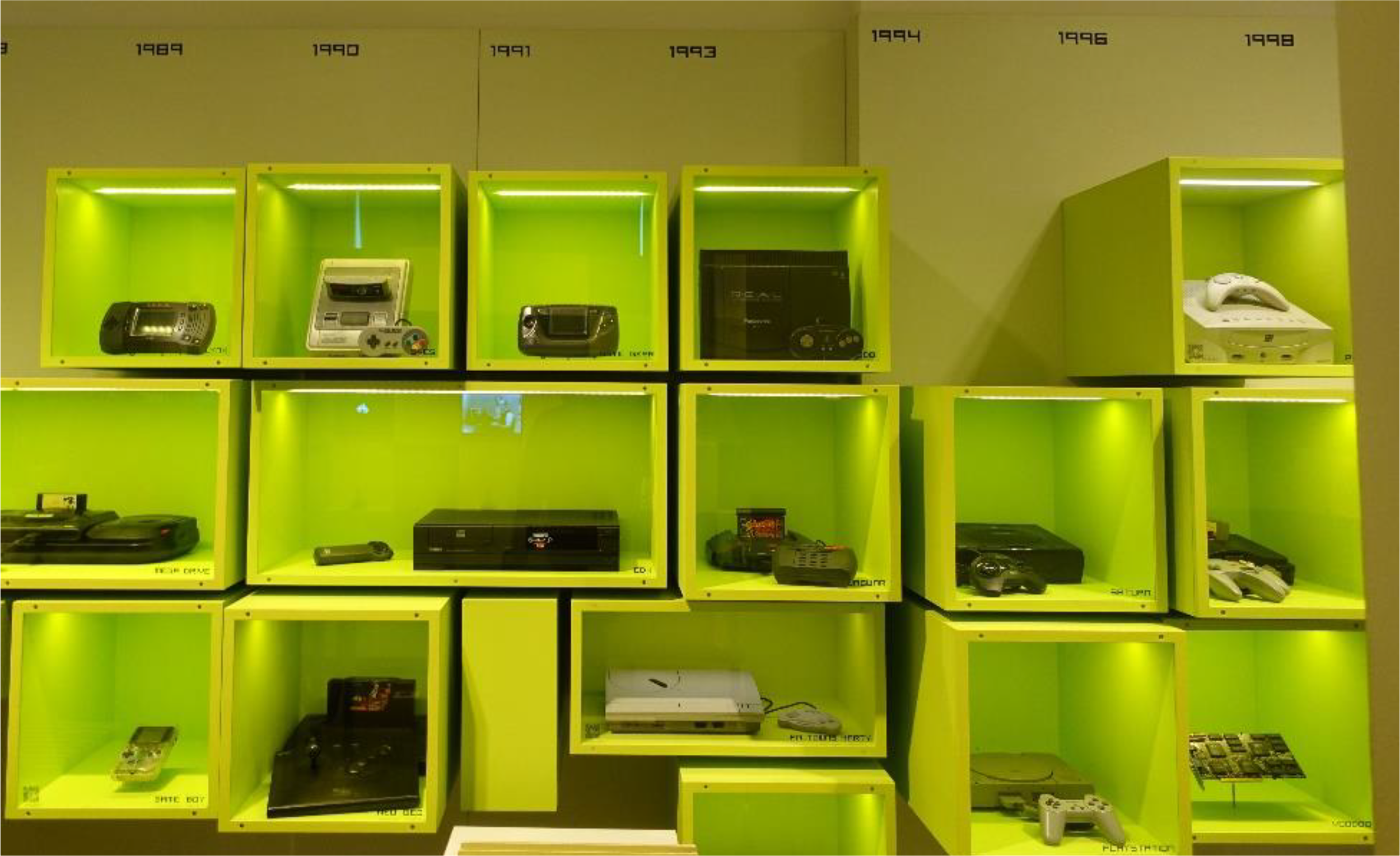
Computerspielemuseum's historical exhibit of platforms.
Games, Temporality, and the Pure Aesthetic
Museums in general, since the turn of the millennium, are less “elitist” in their presentation of their collections, commonly achieved through designing exhibits that invite participation often in the form of “gamification” and augmented reality (Camps-Ortueta et al., 2021, pp. 194–196), and traditional works are increasingly displayed using new media, for example in The Lume exhibition of Van Gogh's works using moving images projected across the walls. Nevertheless, art museums still privilege the discourse of the pure aesthetic and a form of enduring attention to the plastic and formal properties of works, due to the presence of existing collections largely comprising paintings and sculpture and to the structure of the space. This requires that the spectator spends time scrutinizing works rather than immersing themselves in gameplay or narrative. Andrew Benjamin argues that an aesthetic disposition to painting involves spending time with the work and developing a more formal, conceptual form of spectatorship rather than an immediate sensual pleasure (2004, p. 26). The spectator seeks to discover how the image is designed, formed, or developed and by so doing, enters into the creative and material world of the artist (Rawson, 2005, p. 52). This aesthetic contemplation is pictorially, conceptually, and formally open, where the time of viewing is determined by the spectator rather than by a fixed duration inherent in the work itself. Although the work will suggest particular patterns and forms of navigation (lines, paths, sequences), the duration of viewing is not finite, as the viewer could dwell on a particular mark or feature for as long as it maintains their interest.
Questions arise as to why art galleries want to include video games and why spectators, who may be avid players of games, would want to address games in a context that privileges an open time of viewing and the pure aesthetic? Why go to a gallery to play or see a game, or some derivative of a game, when that game could be accessed through a computer or game console? Indeed, why do video game designers and artists want their works installed in a gallery when they know that this generally decreases the scope and playability of the game? These questions are not limited to video games. Music, dance, and literature do not commonly feature in galleries except in truncated form, for example, pages from an illustrated book or short dance videos extracted from longer performances, because they are much more suited to their own structures of display, from the book to the stage. Likewise, the video game clearly has its own lineage organized around the interface and platform (handheld devices, computer screens, virtual reality headsets, and so on).
These issues underpinning the display of video games in galleries and art museums compare directly to the display of films in galleries; a medium that also has its own common sites of projection and display from the cinema to the computer screen. Again, the question remains: why do galleries show films when the cinema is a better site for reception? The answer relates to the role that the art world believes it plays in managing art history. Erika Balsom argues that galleries usually include films under a logic of memorialization, with curators seeking to rescue films from their dilution in contemporary mass culture and commercialization, and by so doing, also demonstrate that they have reached a higher level of “quality and substance” (2013, p. 38). This memorialization brings with it an idea of purification, with the gallery promoting the idea of the autonomy of art where the film is judged in terms of its intrinsic and aesthetic value without being subject to the deleterious effects of promotion in mass culture. Yet this claim about autonomy elides the strong role that the institution plays in determining the value of art and how spectators address the works (Balsom, 2013, p. 39). To examine a segment from a film on a gallery wall alongside other segments or even in a theatrette requires a form of viewing that downplays narrative, places the works in relation to the history of the visual arts, and removes them from the context of other, often popular, films. Attending to compositional and plastic features outside their role in the narrative is like watching Hitchcock without the suspense.
The art museum promotes itself as an ideal structure for viewing because it foregrounds a pure aesthetic, separates the object from a wider culture of distraction, and purports to educate gallery-goers. It provides a structure whereby the viewer can compare works by the simple fact of walking through the collection as well as spend time lingering on specific works. As such, the art museum purports to be the “institutional space where one encounters original artworks in the best conditions possible,” and yet this does not easily apply to film designed originally for the cinema, where the works are subject to many of the problems leveled by critics at home viewing: “frequent lack of material specificity, a preponderance of spectatorial inattention, a distortion of image scale, and unfavorable viewing conditions” (Balsom, 2013, p. 40). The gallery displays long-duration works in a way that allows for movement in and out of the spaces which means that viewers are only watching the films in passing (Balsom, 2013, p. 41). Ironically, this fragmentation somewhat mirrors the fragmentation of film and other cultural objects and artifacts in “mass culture,” all of which undermine the primary “plenitude” of film and the spectatorial experience (Balsom, 2013, p. 30). Despite the pretensions of the art museum to place cinema properly alongside the other arts, it only does so by eschewing the conditions for viewing that are integral to its status as an art form. Cinema, in contrast to video art, requires a form of saturated experience in which viewer attention is not distracted by adjacent works or even the material space of screening, hence the use of the darkened room. Looking at multiple works within the restricted time of gallery viewing can lead to a fragmentation of the whole.
The self-directed time of the visual arts, in which spectators walk through the gallery and determine how long they should spend with each artwork, differs from spectatorship in cinema and the performing arts, where viewers stand still before a screen or stage for a predetermined period of time and cannot really control how long they attend to particular aspects of the work. This leads Volker Pantenburg to argue that the inclusion of video and film works in galleries and art museums since the 1990s requires an additional temporal concept, “institutional time,” describing the time of viewing occasioned by a particular place and separate from the film's screen or narrative time (2014, p. 46). In the institution of the art museum or gallery, a number of factors (the space, placement of the film among other works, and the spectator's overall viewing time) mediates how viewers watch a film. Importantly, gallery works “compete” for the viewer's attention which does not easily meet narrative film's demand for continual, sequential attention (Pantenburg, 2014, p. 47). Video games also operate within the aesthetic logic of cinema and the performing arts due to long durations of engaging and playing a scene or level. Indeed, playing a full game often takes much longer than a film depending on the genre: much longer for adventure games, much shorter for arcade games. However, unlike cinema and closer to the visual arts, the duration of play is somewhat negotiated between player and game, in addition to the institutional constraints. Stopping, starting, restrategizing, and repeating sections are common to videogame play, which involves a much more malleable concept of time.
Irrespective of whether the duration is negotiated or fixed, players/viewers of video games cannot easily cultivate an intentional spectatorial time, devoted to aesthetic aspects, over and above the game's story world due to the demands of the gameplay and narrative. Of course, there are many exceptions, as a player of an open-world game can theoretically spend long periods observing the visual form of the world without progressing the narrative (Atkinson & Parsayi, 2021, pp. 525–526). Games such as walking simulators are better suited to galleries because they give the player “more time to see things,” which suits the principle of disinterestedness often hailed as a key feature of aesthetics in the visual arts (Juul, 2018). For example, Bill Viola's and USC Game Innovation Lab's The Night Journey (2007–2018) foregrounds the exploration of space and includes a “reflection” function, initiated by the X button on a PlayStation controller, that invokes images from many of Viola's video works. The player's dexterity and reaction speed are not central to the gameplay, thus allowing for a slowness of movement akin to walking through a gallery. The controller merely facilitates new occasions for spectatorship with the viewing time determined by the exploratory movement mainly determined by the spectator's willingness to continue observing. The game is now available to be played on home systems, which afford a time of exploration and contemplation, but it was first exhibited in galleries where gallery-goers had to queue to play the game on a small screen and thus were also subject to the demands of an institutional time invested in a space designed for group viewing.
In a gallery, the viewer always manages two times—the time of the medium and the time of the institution—which is appropriate to the visual arts because the viewer can easily moderate the duration of viewing depending on their level of interest. If too many spectators are gathered around a particular work, spectators can glance at it and turn to other works, and when the crowds have dispersed they can return for a much longer period of aesthetic contemplation. Moreover, short periods of viewing do not overly disrupt cognition of most visual artworks, for an artwork can be readily appraised as a whole in a brief first viewing. Because the work does not change in any intervening period, subsequent viewings can be regarded as an extension of the first. With media that have a definite duration (i.e., cinema and the performing arts), the viewer knows that they may only see a short segment of the work in each viewing, and indeed may never see the whole. Few gallery-goers would have seen a complete screening of Douglas Gordon's (1993) 24 Hour Psycho, a slowed-down version of Hitchcock's Psycho that endures for a full 24 h, never mind works that extend for 20 or 30 min.
The film theorist Laura Marks (2012) addresses this issue with regard to single-channel experimental films (one screen and linear) created for cinema viewing and yet exhibited in galleries (p. 14). These films were designed to be watched for the complete duration with the viewer immersed in the unfolding events, something that the filmmaker can definitely control in the cinema (Marks, 2012, p. 19). The typical art gallery does not afford the same level of immersion because the institutional time is largely controlled by the gallery structure and the spectator rather than the filmmaker. When watching a film in a cinema, what we’re probably not doing is trying to decide, minute by minute, how much longer we will stay there. We’re not busy deciding whether we have a good enough idea of the movie that we can leave. As prisoners of the film's duration, we’re free from such calculations that grip the visitor to an installation. (Marks, 2012, p. 19)
Play and Communal Spectatorship
The pure aesthetic foregrounds the external plastic and formal properties of works, which are present to the gaze in an instant and yet will take time to properly consider, hence the emphasis on aesthetic contemplation. Because each viewer requires an indeterminate time of viewing, the viewing structure must be flexible, and the easiest way to accommodate this flexibility is to display works to a large number of gallery-goers at the same time—a large painting, sculpture, or installation can easily do this. However, video games do not reveal their sensual form immediately or at a distance, and much of the formal structure is found in rules and types of gameplay; one must be in the game for it to be visible. Just as the cinema creates an optimal space for viewing a film by using a darkened room to remove visual distractions, video games displayed in communal environments such as the arcade often use game cabinets that create closed visual spaces, with the screen only visible to those playing or those looking over the player's shoulder (see Figure 2). This sequestering of space does not allow multiple viewers to engage with the work in a common time, and ironically it is the cabinets, which have designs that attract attention in an environment replete with distractions, that most readily open up to communal spectatorship and aesthetic contemplation. The arcade game differs from console and PC games because its physical structure is designed to provoke the interest of would-be players. As early as 1989, the Museum of Moving Images in New York hosted the exhibit Hot Circuits: A Video Arcade comprising arcade machines from 1971 to the year 1988, including Computer Space (1971), PONG (1972), Space Invaders (1978), Galaxian (1979), Pac-Man (1980), and NARC (1988) (Kim, 2012, p. 8). The exhibition encouraged a type of aesthetic interest in the sculptural presence of the hardware and its overall design rather than the game because the cabinets were arranged at a sufficient distance from each other. This contrasts with the positioning of cabinets in many arcades where “[m]aximizing profit in a commercial setting meant that the cabinets were crammed side-by-side with no room in between to gaze upon the colorful designs” (Kim, 2012, p. 8). Arcade game cabinets can be viewed easily within the structure of a gallery and in many respects operate as a form of Pop Art, and yet unlike works in the Pop Art movement, they still remain ancillary to the functional object—the game itself—and this is why they are exhibited under the rubric of design rather than the history of the fine arts. Pop Art fits within the discourse of the pure aesthetic because the images are no longer functional—Lichtenstein's comic book images are no longer part of a comic narrative, and Warhol's soup cans do not contain any soup.
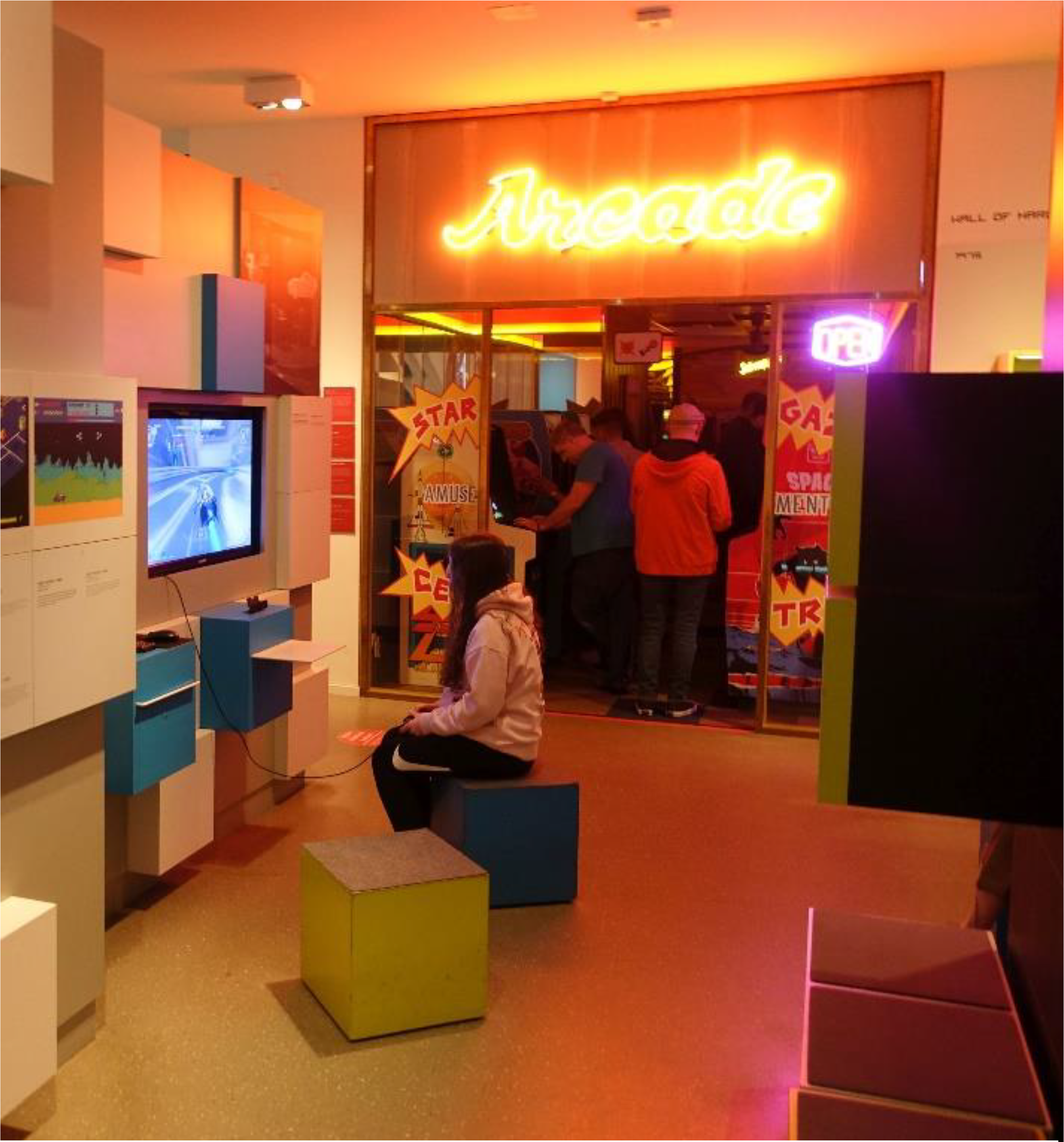
At the Computerspielemuseum players must queue to play some games and the seats generally only allow one or two players.
Although art galleries and museums are often regarded as austere, they are increasingly interested in the spectacle, evinced in blockbuster exhibitions of prominent artists that attract large crowds and in works with physical properties that dominate the space of the room. Picasso's Guernica presents much more of a spectacle than Da Vinci's Mona Lisa due to its size and the dynamism of its theme, and it is not surprising that the Mona Lisa was originally painted to be housed in a home rather than stand out within a gallery. With the rise of the public gallery increasingly more works are created for this space in a way that holds the gaze of the visitors. Video art, cinema, and video games differ from most installations and visual artworks because the screen size can be easily changed without any creation of new content. Video art did not really receive much interest until it eschewed the small monitor screen, most notably after the Documenta 9 exhibition in 1992, which used projection rather than the televisual monitor (Balsom, 2013, p. 36). The monitor has two main limitations in gallery viewing: it only allows for a few viewers at a time and does not have a strong presence within a room. In contrast, the projected image can increase the scale considerably and achieve a type of cinematic spectacle using the gallery's architecture that “allows the video image to claim space within the gallery itself” (Balsom, 2013, p. 43). Unlike films in the cinema, gallery films are more concerned with organizing and gesturing toward the three-dimensional physical and conceptual space of the gallery than treating the screen or projection as a window onto another time or place (Butler, 2010, p. 308). For video games, the main object of aesthetic engagement is the visual world of the screen and incorporating video games into art museums and galleries can involve rethinking the role of screens to allow for extended viewing by a number of gallery-goers. In the exhibitions of Harun Farocki's Parallel series (2012–14), which examines changes in computer graphics and game worlds, the images are projected onto walls rather than displayed on much more intimate computer screens: they occupy the space. As suggested by the title, having two images in parallel draws attention to the visual aspects of computer graphics over and above their narrative function. The viewer's glance moves across the screens rather than fully into the world.
The installation Long March: Restart (2008) by Feng Mengbo 1 at ZKM Center for Art and Media in Karlsruhe—an art museum combining analog and digital arts in a common space—demonstrates the importance of screen size in fostering aesthetic interest. The game addresses the Chinese Long March, with numerous references to the Chinese communist party and associated iconography, although its design derives from Super Mario Bros and Street Fighter. Despite affording individual play, the screens cover the facing walls of a very large, dark room, allowing all the occupants visual access to the images and breaking down the separation between private play and public viewing. The viewer can observe the work over an extended period of time without monopolizing the space or preventing access to other gallery-goers. The size and position of the screens also defamiliarizes the visual content and composition: saturated colors dominate large areas of the space, and large pixels draw attention to the ambiguity of aliasing. Playing the game is less important than the iconography and immersion within the space, and indeed, while playing, the viewer cannot engage so readily with the visual content.
Accommodating the Space Through an Aesthetics of Reduction
Adapting visual content to suit the gallery space involves separating images from a narrative and gameplay context for two main reasons: galleries do not lend themselves to long-duration narratives or gameplay due to the constant movement of spectators and because a pure aesthetic presumes the isolation of formal and material properties specific to a medium. Playing a game does not readily encourage aesthetic attention to color, movement, and form because the player mainly attends to those features that afford further gameplay. The player may scan the visual field but cannot easily focus on individual visual qualities, such as the color value of a pixel, when playing at speed and looking to progress the narrative. One of the most important aspects of playing a game is flow, where actions and perceptions combine in a sequence to create the impression of connected action and movement (Grodal, 2003, p. 132). As with immersion in cinema, being in a state of flow precludes contemplation of the visual world or even the meta-discursive elements of gameplay. Drawing on Mihály Csíkszentmihályi's work, Brian Schrank argues that cultivating the feeling of “optimal flow” in video games operates in a similar fashion to naturalism in the visual arts; the notion of art as a window onto the world. However, avant-garde games like avant-garde art must disrupt naturalistic vision and compel the viewer to engage with the work as art (2014, p. 38) by breaking the flow of the gameplay, investing in a structure of reward and enforcement, and frustrating action (Schrank, 2014, p. 45). Removing much of the functionality of gameplay undermines the relationship between gameplay and immersion as well as between visuality and transparency and, therefore, shifts attention to other aspects of the aesthetic space and to the medium. Schwingler (2019, p. 189) argues that art video games provoke the player to reflect on the nature of the medium and its “operating principles” by removing and introducing components: “In a way, video games are being stripped, as their structures are laid bare and made visible. This constellation may even lead to the creation of paradoxical artifacts—namely unplayable, dysfunctional games.” In other words, their dysfunction provokes a type of meta-discursivity common to interactive art as well as attention to visual form and structure. But again, the dysfunction still needs to meet the institutional constraints of the gallery with relatively short viewing times and only limited options for playability.
In addition to accepting this modernist aesthetic, art games are much more suited to the gallery because they do not require that a player immerse themselves in the gameplay over long periods to become accustomed to the procedural structure and ludic goals of the game. Unlike literature, film, dance, music, or video games, it only takes a moment to grasp the main aesthetic intervention of a visual artwork—a viewer can see that Salcedo's Shibboleth is a crack in the floor of the gallery or that a fauvist work uses nonnaturalistic colors—and this acts as a prelude to the much more enduring attention to the plastic, compositional and visual properties of the work. For a video game to operate successfully in a gallery space, it must also constitute an immediately graspable spectacle.
One of the most celebrated examples of the transformation of a game into a gallery spectacle is Cory Arcangel's modifications of Nintendo or Nintendo-style game cartridges to remove many of the active elements central to gameplay. Similar to Arcangel's previous game, Super Mario Clouds (2002), MIG 29 Soviet Fighter Plane and Clouds (2005) involves hacking the cartridge of the CAMERICA video game MiG-29: Soviet Fighter (Chaney & Codemasters, 1989) to show only a few elements—the fighter from the title sequence and the clouds that constitute the background of the original game. Arcangel explains that he “singled out the plane from the intro screen of the game, and programmed a new cartridge with just that, and then stole the clouds from later in the game, and made another cartridge which just has those” (Arcangel, 2017). The game/installation was originally displayed on four CRT monitors mounted on stands at the Lisson Gallery in Basel, each of which displays a different element: the first, the plane from the title sequence, and the other three, the moving clouds. In line with much video art, the installation has since been reworked with large screens hanging from the ceiling in a darkened room, allowing the audience to walk between and in front of them. The separation of the game elements and the removal of playability fundamentally changes the audience's relationship to the original game. The plane from the title sequence is no longer something glimpsed amid flight—in the original game, the plane enters the screen on a diagonal from right to left before holding its position—for it stays fixed in position for as long as the viewer chooses to look at it, and as such the focus shifts away from the overall movement of the plane to the jets at the rear, which are reduced to nothing more than the oscillation between image elements; an effect that is analogous to the Ben-Day dots in Lichtenstein's work. Likewise, the clouds extracted from the game move diagonally across the screens, with each cloud remaining in a fixed relationship to the other clouds. In such a configuration, the clouds no longer create the illusion of movement or depth (two forms of naturalism) and instead appear as a flat surface sliding laterally across the screen, thus exposing some of the operating principles and animation of early games. The display of the individual elements on separate screens also highlights the artificiality of the visual world by drawing attention to the frame and the flatness of the image, a trope that was central to Clement Greenberg's artistic Modernism. The viewer can only attend to the work's visual and formal properties if they are not drawn into the illusion of depth. In MIG-29, the sequential arrangement of the screens obliges the viewer to look at the frame and the intervening space, highlighting their nondiegetic flatness. When looking across the three screens, it is difficult to follow the perspectival cues of a single screen. The same applies to the hanging screens, which by allowing the viewers to walk around them, prevent the viewer's immersion in the pictorial space. The display is in some ways similar to Mengbo's Long March: Restart and Farocki's Parallel, which also ask the viewers to divide their attention between screens, thus defamiliarizing the gameplay or the visual construction of the virtual world.
Placing video games in gallery spaces also raises questions about the materiality of games, for artworks are often classified according to material differences (watercolor, gouache, on canvas, and so on) rather than narrative or representational content—the latter is reserved for genres within an art form such as landscape painting or portraiture. Accentuating materiality aligns with the pure aesthetic that foregrounds formal features as well as work's facture—how the work is made and the role of the artist. In the visual arts, the activity of the artist appears to manifest in material marks and the qualities and limitations inherent in the chosen material (Gilson, 1966, p. 29). The materiality of most visual artworks can be apprehended directly by the senses in the short time of viewing, for example, the viewer sees directly the chisel marks in a sculpture or a brushstroke in a painting. How can video games make visible this materiality in such a way that it is directly accessible to a viewer?
One strategy adopted by art video games is to highlight the less visible or tangible role of the game engine in the gameplay and the game's visual structure (Sharp, 2015, p. 29). The code, and the many programs and technologies associated with creating the game world, constitute an invisible layer. By making these aspects visible, art video games explore the boundary between “transparency” and “opacity,” where the transparency of playing is rendered opaque by references to the medium (Schwingler, 2019, p. 189). Rather than simply displaying the code alongside the image, Schwingler argues that one of the key strategies used by video game artists is the “reduction and abstraction of the source material,” in which the artist modifies a game by reducing the visual interface and placing limits on playability to give it a more abstract formulation (Schwingler, 2009, p. 190). Alexander Galloway states that this “foregrounding” of the data structure of the game environment privileges “aestheticism” for the player cannot follow a definite set of rules, thus separating the gameplay from the narrative (2006, p. 115). This is definitely a feature of Cory Arcangel's work, but it can also operate in playable games. The much discussed SOD game, created by the artists Joan Heemskerk and Dirk Paesmans working under the name JODI, modifies the 1992 video game Wolfenstein 3D to the point that it is unrecognizable, and, although it retains loosely architectural forms, the player will find it difficult to distinguish the walls from the targets (Heemskerk & Paesmans, 1999). Although retaining many of the sound effects, the modified game removes most of the spatial indicators of depth. The player can see some of the frames, such as doors and wall panels, but there are no consistent textures to articulate the continuity of the space, with the floor inferred through negative space and the gun little more than a black dot. The game's controls remain intact, but, as Sharp notes, “due to the radical transformation of the game's original 8-bit graphics into stark monochromatic images, the play experience is disrupted” (Sharp, 2015, p. 42). Schwingler argues that these modifications “demonstrate the true essence of video games, namely their being image and space machines” (Schwingler, 2009, p. 192). Although the tautological phrase “true essence” is a little distracting, this argument raises the important idea that art games adumbrate a conceptual space between the simulated environment and the structural properties of the game engine. Similarly, the development of a pure aesthetic in the art museum attends to the space between representation and the material construction of the work, something that is demonstrated by the material presence of the work—the viewer does not go to a gallery to see reproductions—and the implication that gallery-goers should scrutinize a work as something constructed and created by artists. Where video games differ is in the fact that much of this fracture is virtual and hidden beneath the visual surface, and the artist's action is not directly visible in any one action such as a brushstroke.
Attention to this conceptual space between image and game mechanics may best be revealed through individually playing a modified art game rather than observing that same game in a communal gallery space. Displays of video games on large, communal screens might reveal an abstract conceptual space in a way that suits the movement of viewers through a gallery, but not necessarily a type of abstraction intrinsic to game playing, such as grappling with the limits of a haptic interface. This raises the question as to the degree to which a video game should be fully operational rather than a visual installation or something that mimics video art or film (Martin, 2013, p. 352). One way to address this issue is to create art games that defamiliarize, reduce, and abstract playing while also engaging a number of gallery-goers at the same time. This was demonstrated by Mary Flanagan's [giantJoystick] (2006), a 3 by 3 m recreation of the Atari VCS controller, which has been replaced by a large NES controller at the Computerspielemuseum (Figure 3). Because the joystick is larger than a human figure, it has to be played collaboratively and by so doing, draws many people into a communal art space. This, according to Sharp (2015), “defines a new space of possibility that critically engages notions of game design, interface, co-play, and the contexts of play” (p. 92). Despite the obvious pleasure of using the installation/sculpture, it still operates according to the logic of the pure aesthetic because it defamiliarizes haptic movement not just visual form, as well constitutes a directly graspable visual spectacle. Likewise, Patrick LeMieux's Octopad, appearing at the Smithsonian American Art Museum's Arcade: Game Spaces exhibition (2018), allows multiple players to engage with a single game. The Octopod is an NES controller ramified into eight controllers each containing only one of the buttons of the original system, which forces collaborative action: Even the most seasoned game players are transformed into novices in the same standing as their less-skilled friends and relatives due to the modified controllers. Suddenly, players must coach one another rather than compete and on occasion, roles among players are reversed as the expert becomes the student. (Totten, 2022, p. 10)
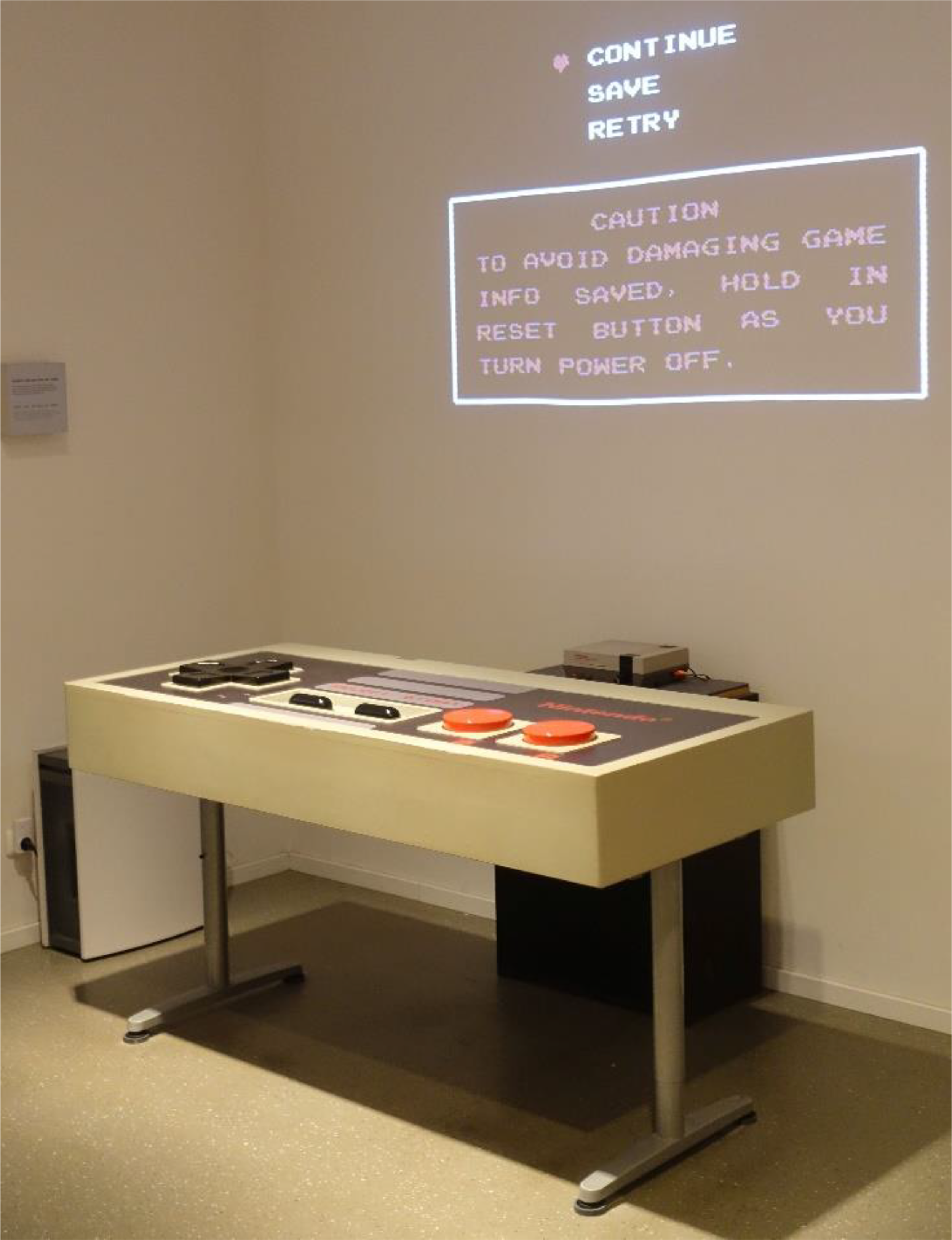
The [giantJoystick] is no longer at the Computerspielemuseum because it was too readily damaged by the energetic movements of the players, and has since been replaced with an oversized NES controller without, however, the same degree of collaboration and defamiliarization.
Conclusion
When considering how art games fit within the broader history of the visual arts, the role of the art world and the institutional context of display are crucial factors. Video games have often been placed within the category of design and the popular arts due to their short history and because they are produced by collectives rather than the efforts of an individual artist. In terms of display, the foregrounding of a pure aesthetic in the visual arts in part derives from the development of the art museum or gallery in which disparate works from a range of eras are placed alongside each other. This requires some common principles by which to compare and judge the art, which has up to this point largely involved attention to the material, formal, and compositional aspects. To walk through a gallery is to engage in a system of viewing that involves looking at a number of works in a relatively short time, and where the viewer has control over the time they attend to each work. Regardless of their quality, the modes of display of video games must differ significantly from the other visual arts due to the complexity of a medium that combines gameplay and narrative. Video art and film have had a similar struggle in adapting to the demands of a gallery's institutional time, where the constant movement of gallery-goers does not always befit the types of long-duration play demanded by many games. Game designers must also think about the installation and development of new structures of the display. Games may be stripped back or reduced to give the spectator time to both observe and reflect on the act of observation, or displayed in ways that defamiliarize the texts and foreground their formal properties. This is clearly a feature of Mengbo's Long March: Restart and Farocki's Parallel series, which also recognize that galleries are communal spaces in which spectators share points and modes of observation with other gallery-goers, and yet such works do not sufficiently attend to what it means to play a game. One way of entering into the aesthetic discourse of the gallery is by developing new forms of defamiliarized gameplay that allow people to participate in a common space and yet still attend to the formal and material properties of the medium. In short, including video games in exhibitions requires a rethinking by gallery directors and artists on how best to use the space rather than assuming that games will just slot into a system of viewing best suited to the visual arts.
Footnotes
Declaration of Conflicting Interests
The author(s) declared no potential conflicts of interest with respect to the research, authorship, and/or publication of this article.
Funding
The author(s) received no financial support for the research, authorship, and/or publication of this article.
