



Abstract
This study analyzes representations of women—protagonists and NPCs—in Assassińs Creed games between 2007 and 2024, to explore the impact of the last decades’ work for gender rights on the English language AAA game industry. Through close playing, we explore game bodies with attention to the surface level of narrative, graphics, sound, and underlying mechanics of actions and reactions. Through netnography, we add promotional material, retail sites, and social movements of importance to the analysis. Results show four eras for female protagonists: nonexistent, protagonists in side games, defined by their male coprotagonists, and choose your gender. Over the 17 years studied, women are more present, and NPCs are more complex. Though female protagonists remain sidelined or shallow representations as female skins on male characters. We discuss how discrepancies and conflicts between artistic visions, marketing, and brand choices impact how women are represented, and the impact on representation by external cultural events, for example Gamergate/Metoo, during this period.
Introduction
Research on how women are stereotypically represented, and underrepresented, in games has been studied for decades (Cassell and Jenkins, 1998; Kafai et al., 2008, 2016). Today game characters are increasingly female and those we have are less sexualized than previously due to factors such as identity politics and activism, the rise of the indie game industry, and more (de Bruin-Molé, 2020). In previous eras, social changes and advancement for women in society have gone hand in hand with changes in portrayals of women in media (Knight, 2010). Studying representation in games might therefore allow us to explore how the last decades’ work for gender rights has impacted the game industry and the state of women in the industry, which can be further tied to women's role in society at large. To begin exploring changes in female representation over the last decade and a half we look at the way women are represented as NPCs and protagonists—main playable characters—in one game franchise.
The Assassin's Creed (AC) franchise by Ubisoft has seen around 30 games, main and spinoffs, since the first installment in 2007. Ubisoft's series is currently one of the best-selling AAA game series, with over 155 million copies sold, with ever-increasing commercial success (Ubisoft, 2022; Statista, 2023). Male protagonists have been the norm throughout, but in the later games, we have seen an increase in playable female characters. We explore the representation of female protagonists in Assassin's Creed games and interaction with NPCs in games with playable female characters, to analyze the changing ways in which women have been and are portrayed in AAA video games. To the timeline, we add social events of importance for gender representation debates. The Assassin's Creed series offers an interesting case study as it allows us to observe one game series owned by the same game company. This makes it possible to focus on how female characters, their presence, representation, and being playable or not have changed through this period of 2007–2024. The series has also, like many others, been the object of criticism from the player community and others for the lack of female representation (Campbell, 2014; LeJacq, 2014). Engaging in a holistic study of the entire series allows a more in-depth study of female representation in games than we have seen previously. We follow suit with contemporary recommendations in game studies of looking in-depth at representation, and not staying on the surface level of visual presence (Chang, 2017). We thus investigate not only the visual and narrative level but also turn to mechanics and interaction.
We ask: How have female protagonists been represented in Assassin's Creed games in the last 17 years?
Literature
Theoretically, we use a framework where we see femininity as performed. We draw on notions of games as ergodic systems (Aarseth, 1997) that require effort from the player to traverse, and where meaning is produced as players interact with the game. Through traversing a game, gender is repeatedly performed and so done, it comes to be as players interact with various aspects of a game such as the mechanics or the story. We use Judith Butler's work where gender is not a stable nor an essentialist identity, but performative (1990): acting out gender, we create it. Gender is not, it becomes in a series of repeated and stylized acts. Thus, what women “are” in the games is not only appearances, but also what they can do in the game world, what actions are possible and not, and how the game responds to their actions (Eklund et al., 2024). As Butler states, gender, femininity—or masculinity—is about performing acts and the association of these acts to certain bodies (1990). In calls to further studies on game representation Chang (2017) distinguishes between “flat” versus “informed” representation. Flat representation is on the visual level, whereas when mechanics deepen and inform representation it becomes more worthwhile, that is, informed. We study what happens as players traverse the game world through nontrivial effort. Game bodies are made through a mesh of player actions in and with the game which in turn consists of such things as narrative, graphics, sound, etc., and the mechanics as actions in the game, both limiting what the player can do and how the game reacts to player actions. It is thus when looking at multiple levels that we can gain an in-depth understanding of representation.
Representations of Women in Video Games
Research on female representation has focused on marginalization, female characters as rewards and plot devices, the impact of the male gaze on portrayals of women, as well as the intersections between gender, sex, race, ability, and more, (e.g., the edited volumes From Barbie to Mortal Kombat [Cassell & Jenkins, 1998], Beyond Barbie and Mortal Kombat [Kafai et al., 2008], and Diversifying Barbie and Mortal Combat [Kafai et al., 2016]). Early research showed how women were hypersexualized, nonplayable characters for male heroes to rescue (e.g., Kennedy, 2002), perpetuating ideas about women as passive and men as active. The mid-2000s saw research on the representation of women in, for example, game reviews online (Ivory, 2006) or game covers (Burgess et al., 2007), showing that women were less frequently represented and more often sexualized (Burgess et al., 2007; Ivory, 2006).
As the 00s advanced, the trope of strong women, engaging in combat emerged (Knight, 2010). In the video game world, Lara Croft of the Tomb Raider series and other strong female characters from, for example, Parasite Eve or Resident Evil came to represent this trend (Inness, 2004). Research in this era identified more female characters than previously, yet showed how these were sexualized (Jansz & Marts, 2007).
This hypersexualization of female protagonists started to change as identity politics and critical theory embedded themselves into the gaming industry (de Bruin-Molé, 2020). Additionally, the notion of “player choice” and the linked trend toward avatar customization: choosing, for example, gender, abilities, and sexuality opened up for more diverse female protagonists. For example, see Corneliussen's (2008) work on World of Warcraft. In the industry and player culture, the importance of players being able to choose how they play opened up gaming as a space for queer and feminist experiences in an otherwise often traditional cultural sector (Eklund et al., 2024).
In the following years, a combination of critical theory making an impact on many sectors, activist movements (e.g., Feminist Frequency) that sought better representation, the new indie games industry which challenged the logic of AAA games, and new market logics for increasing audiences resulted in more female player characters, reflecting the gender politics and assumptions of society as well as the gaming industry (de Bruin-Molé, 2020). Yet, research still showed that there was much to be done in terms of the frequency, intersectionality, and paratextual framing of female representations (de Bruin-Molé, 2020). At the same time, the proportion of women in the industry increased over these years, yet there is still a lower percentage of women working in games than female gamers, and women are located in lower-paying positions and are less often leaders (Bailey et al., 2021).
Consalvo in her 2012 article on confronting toxic gamer culture called for academic studies that do not only look at isolated cases or examples but engage with the larger context. The first Assassin's Creed game featuring a female protagonist, Assassin's Creed III: Liberation, came out that same year. Following this, we explore how gaming culture has changed since then when it comes to representations of women.
Assassin's Creed in Previous Research
A massive economic success and cultural juggernaut, the AC franchise has gained substantial academic attention. For instance, El-Nasr et al.'s study of the original game (2008) focused on the orientalist tropes drawn from Bartol's literary work, as well as the seeming authenticity of spaces and peoples depicted, or studies concerning architecture, historical accuracy, and colonialism, to name a few (Mukherjee, 2017; Sepinwall, 2021).
Discussions concerning historical accuracy in the franchise have been a throughline of research. From El-Nasr et al.'s first piece (2008), to Bondioli et al.’s work (2019). While each title is praised for high technical fidelity, more recent work (Draycott & Kate Cooke, 2022; Politopoulos et al., 2019) acknowledge that the AC games remain highly unreal, cloaked in seeming accuracy. It is in the disjuncture between instances of accuracy deemed necessary or not that scholars can probe shifts across the franchise, especially in terms of gender, race, and class.
Murray's (2017) work on Liberation (2012), was the first engagement with gender as the primary vector of analysis. Here, the focus was on the “complex persuasions and social engineering” that Liberation, and AC in general trafficked in (2017, p. 78). This installment represented, in Murray's view, a “watershed moment in terms of visibility and press coverage of the ongoing culture war around the presence of women and social-defined minorities in games” (81). This engagement is essential because it brought gender into discussion with the orientalist fictions of the franchise. Though critical, Murray's account was also optimistic about Liberation's potential as a kind of “playable representation” (78). Following this, literature concerning gender, and its historically accurate depiction increased drastically. Steenbakker returned to Liberation, analyzing the representational economy of gender and race drawing attention to the commodification of “countless enslaved people to create another outfit option” (2021, p. 105). Gender representation was not without colonial undertones.
The releases of AC Origins (2017) and AC Odyssey (2018) stimulated much new writing. Both main titles, set in classical antiquity, featured women in deuteragonist (a secondary main character in Origins’ Aya) or protagonist roles (Kassandra in Odyssey). Yet, their inclusion once again triggered discussions of historical accuracy and cultural authenticity. Bondioli et al.'s 2019 work compared the characterization of Aya and NPC Cleopatra with historical documentation. The authors were concerned with how the game might “[try] to speak for the ancient people,” through voice lines, narrative, and dress (2019, p. 3). In particular, they concluded that Aya's “agency seems to be more connected with present issues concerning female protagonism in society rather than a historical account of female lives in Egypt” (8–9).
The most recent engagement with the issue of gender in this franchise comes through Draycott and Cook's edited book Women in Classical Videogames (2022). A significant portion of this book is devoted to the study of Aya and Kassandra as protagonists, the historical Cleopatra and Aspasia from Odyssey as antagonists, and further delves into the role of sex workers in classical Greece. Draycott's examination of Cleopatra reveals that she is exoticized as more Egyptian than Greco-Roman, to help “consumers in their differentiation and identification of her” (167). Persyn's work measures the broader demographic division of gender in games set in antiquity, among them Origins, concluding that the male protagonist was still dominant and that the demographics of the nonplayer characters also featured male characters more prominently and often (2022, p. 47–48). Tuplin's chapter deals with the representation of the heterae in Odyssey, as a form of sacral sex worker with political aspirations that is eventually vilified, with the antagonistic Aspasia as the focal point (2022). Further, Cole examines the protagonist Kassandra's gender-coded position within the promotional material leading up to release (2022). He sees Kassandra depicted as “empowering […] but this empowerment appears to come not from her character, but from the way in which she embodies the masculine” (195).
However, despite this wave of in-depth analyses, relatively little analysis has been devoted to a series-level overview of gender across titles. It is with these issues in mind that we turn to our study.
Methodology
Game analysis is a widely used method in game studies. In a recent special issue, researchers called for greater methodological transparency in research engaged in game analysis (Jørgensen & Aarseth, 2022). In this study, we thus draw on Daneels et al.'s (2022) DiGAP protocol for conducting game analysis. It contains seven steps: (a) rationale and objectives, (b) researcher background, (c) game selection, (d) boundaries, (e) analysis approach, (f) coding techniques and data extraction and (g) reporting and transparency. These steps allow for transparency and analytical rigor while being adaptable to various study and research traditions (ibid.). We draw on the later six protocol sections in the description of our methodological approach, some are combined when relevant. Number 1 is dealt with in the introduction.
Besides the games, we focus on certain paratexts. In particular, we look at initial release material and trade shows, as indications of developer objectives, key product selling points, and the rollout of each installment as an innovation characteristic of blockbuster media (Acland, 2020; Fernández-Vara, 2015). We focus on release videos mainly from E3, and now Ubisoft Forward, which is a regular streaming event hosted by Ubisoft to share news about upcoming games. We have also included representation on sales platforms such as steam as it is aimed toward potential players and acts as representatives of the games.
We coded the data according to our theoretical approach where we looked at the story, game mechanics, interactional affordances, and how the game world reacted to the protagonists. We also looked at female NPCs, their interaction with the protagonist, the story, and in-game affordances.
Finally, we performed a meta-analysis where we compared the games to each other. From this we divided the history of female protagonists into several key periods, (a) 2007–2011 the early day of no women, (b) 2012–2015 the first female protagonists, (c) 2015–2017 women as defined by their relationships with men, (d) 2018–2024 choosing your gender.
The games are presented in order of release yet divided into analytical periods regarding female representations in AC games. We further detail some key societal debates on the importance of female representations in the AC games. Finally, we present a timeline.
Assassin's Creed Protagonists
Ubisoft's Assassin's Creed series comes with the motto “History is our playground.” Ubisoft often releases one game a year, most of which explore different locations and periods. The series can mostly be classified as a historical “action-adventure.” Players have access to three core activities: fighting (melee or ranged), stealth, and “parkour” (climbing, jumping, and running on, over, across, and through a built environment). The vast majority of actions a player can take ultimately revolve around setting up and executing assassinations.
The Beginning, 2012–2015: Women as Protagonists in Side Games
Liberation
In 2012, Aveline de Grandpré became the first female protagonist in the side-game Liberation set in 18th-century French Louisiana. Aveline was not only the first female game protagonist but also a first for Creole representation, amid a game centered around chattel slavery (Murray, 2017).
It received mixed reception, with many citing the disjointed storyline. The game uses the Assassin's Creed III engine with a few custom animations for Aveline. It plays like a main AC game yet is much shorter playing at 10–20 h. In comparison, AC III takes around 20–30 h. It also had a smaller budget than the main AC games of the time.
Aveline has three distinct modes, each represented by sets of clothing, gear, and weapons. The assassin is the, perhaps, main persona, with access to an array of weapons and parkour abilities. The slave persona can run, has some weapons, and can blend into crowds and enter certain places unnoticed. Finally, Aveline's day persona is of an upper-class lady engaged in the trading company her father runs. As a lady, Aveline cannot run or climb but still assassinates using hidden poison. She can also bribe guards and use charm.
As a protagonist, while Aveline is distinctly female she is defined by multiple subject positions. Murray (2017) has pointed out the many complex intersections of race, class, gender, etc., Aveline inhabits. In the game, we not only play with gender expectations, to be a businesswoman or marry and run a house but also with complex issues of race and slavery of the period, and issues of social class through Aveline's different personas. All of these intersections are represented in both narrative and game mechanics, for example, the way that the characters raise suspicion with guards works differently for the three personas. What makes her distinct among AC protagonists is precisely how her gender, as well as race and social class, impact how she is played. Previous research has seen problems with the way that the game plays with gender and race (Steenbakker, 2021), yet has also been optimistic about the game as an example of changing representations (Murray, 2017).
The game is populated with several women key to the story, such as the smuggler Élise Lafleur, who becomes a close friend. The game also has the first female Templar antagonist in Aveline's stepmother Madeleine de L'Isle. Initially, she is an ally working on her own to transport slaves north to freedom. However, she ends up an evil stepmother stereotype: power-obsessed and evil.
Chronicles
A few years after AC Liberation in 2015 came a series of three side games named AC Chronicles. The first has AC's second female protagonist, Shao Jun. The game takes place in 16th-century Imperial China, during the Ming dynasty. The game is a 2,5D game moving from left to right and promotes a sneaking, silent play style. The game mechanics are simpler than standard AC games and it plays much shorter roughly 10 h.
Shao Jun is a former concubine turned assassin. She is a classic assassin, throwing out snappy action hero one-liners and dressed in an assassin robe, black and red, a deep cowl hiding the face save for a feminine mouth. She sneaks, runs, jumps, and battles her way through the game. We eventually learn that the Chinese brotherhood had stormed the palace and freed her and the other concubines there, whereupon she joined the assassins. She explicitly states that in the brotherhood she saw freedom.
The only other woman with any significance is an Empress whom Shao Jun knows as a former concubine whom Shao Jun asks for help. The Empress is shown as powerless as the Chinese Templars get to her first and force her to betray Shao Jun.
Shao Jun is portrayed as a former concubine to motivate her actions, and the other woman present is powerless. In a side-mission, she has the option of rescuing three other unnamed concubines. She does rebuild the Chinese brotherhood in the end but loses a box she is guarding for Ezio.
Aveline and Shao are still today the only two main female protagonists of any AC game and they share a background as slaves set free by the assassin brotherhood they later join. Although, the underdog backstory is not uncommon in an AC game, for examle, Mirage (2023) features street thief Basim rescued by the assassins.
Interlude: AC Unity 2014: Women Are too Hard to Animate
In 2014 Ubisoft released the multiplayer game Unity. It quickly rose to infamy as almost unplayable upon release. However, what stuck in public opinion was creative director Alex Amancio's comments about there not being enough time to animate female avatars (Farokhmanesh, June 10, 2014). Or as it was picked up, women are too hard to animate. It can be argued that the designer intended to explain the lack of production time and stress to release as the reason for not being able to create female playable avatars, but the critique was staggering. Even from the industry, for example, former employee Jonathan Cooper argued in several Twitter posts and interviews that creating these extra animations should have been a few days’ work at most and that the time argument was thus not valid (Farokhmanesh, June 11, 2014).
Interlude: Gamergate
In 2014–2015 #Gamergate came to define game culture. For those unfamiliar, Gamergate was a widespread cultural movement that purportedly wished for ethics in game journalism and production, but in practice lashed out against corners of the games industry, journalism and academia that they saw as encroaching on depoliticized spaces of leisure (Dowling et al., 2020). Gamergate has been well-covered in previous research (e.g., Mortensen, 2018). The breadth of antifeminist attitudes and masculinist boundary policing is still staggering (Dowling et al., 2020) and this period serves as a reminder of how the violent pushback from male-dominated gaming spaces can lead to targeted harassment campaigns, coordinated organization and physical violence. The cost of advocating for better female representation was the livelihood and safety of many visible women. Still, Gamergate did bring debates on representations to the foreground.
2015–2017: Women as Defined by Their Relationships With Men
Reformulation of the Start Screen Message
Before Syndicate in 2017, a player was met with this load screen message: “Inspired by historical events and characters. This work of fiction was designed, developed and produced by a multicultural team of various religious faiths and beliefs.” For Syndicate, and subsequent games the messages have been, “Inspired by historical events and characters, this work of fiction was designed, developed, and produced by a multicultural team of various beliefs, sexual orientations and gender identities.” The reformulated message pays greater attention to gender identities as well as sexuality while reformulating religious faiths and beliefs into beliefs. The existence of the message first signals a belief that a diverse team is better suited to provide diverse experiences. That who works on a game matters. The reformulation also signals increased attention to gender equality issues. The reformulation came in time for the Syndicate launch, with the first playable woman in a main series game and importantly after both “Women are too hard to animate,” and Gamegate.
Syndicate
The first playable woman in a main AC game is Evie Frye in Syndicate (2015). She is a deuteragonist, as the players also control her brother Jacob for the main part of the storyline. Syndicate presents an attempt to redress the franchise following the 2014 criticism.
Evie is not independent, in gameplay, narrative position, or even connotations. As assistant director of narrative design, Mel MacCoubrey explained, “We like to say here that you can’t have Evie without Jacob, and you can’t have Jacob without Evie” indicating that the twins are two halves of a core (Stark, 2015). However, MacCoubrey also remarks that Jacob's humor is highlighted by his sister's serious demeanor, implying that Evie serves an auxiliary function. On the game's Steam page, Evie is quite present in the gameplay video, with slightly more screen time than Jacob. However, Jacob is still centrally positioned as the protagonist.
Evie's general look, especially when compared to later series protagonists, is quite sexualized. For instance, art director Thierry Dansereau's description of the character focuses on how “her hairs are well set and her braids are symmetrical and structured, showing her attention to detail” (Stark, 2015).
In terms of gameplay, there is more distinction to be found in the promotional material than in the game. In Ubisoft's 2015 reveal, Evie's only distinguishing features were her status as a “Master Assassin” and her “meticulous precision” (2015). This is in opposition to Jacob's “brash and reckless” style (2015). In reality, both characters can use the same weapons and, mostly identical skills. Evie does access two unique skills focused on stealth (e.g., “Stealth III”), while Jacob's specialities stress a brawling hooligan playstyle (e.g., “Mutilate II”). Still, their differences are mostly aesthetic and narrative and not rooted in gameplay.
Evie's part of the plot is heavily tied to Lucy Thorne, the female Templar counterpart. This frames a fairly evident “catfight” subplot where Evie and Lucy are pitted against each other, with Evie representing a low-class contrast to Lucy's high-society femme fatale aspects. Like Aveline, Eviés female antagonist perpetuates the stereotype that female heroes need female enemies.
Broadly, where her brother engages with the conspiracies and politics of London, Evie's arc builds to a shift away from life exclusively as a master assassin. This leads to a pivotal character moment where Evie has to choose to save her romantic interest over accomplishing her mission, foregrounding a move that Kassandra's character in Odyssey also follows: from warrior to wife. Evie does get room to grow as a character in the Jack the Ripper DLC, where she takes on a detective role, decoupled from her brother. Though, this is a small add-on.
Origins
In Origins (2017), Aya is the secondary playable character and wife of the main protagonist Bayek. Discussing Aya's overall place in the franchise's history is complicated as she was originally intended to be the sole main protagonist (Schreier, 2020) in a game centered on a grieving mother's revenge. However, in the final product, she is largely relegated to a handful of cutscenes, two naval battles, and a final mission in Rome.
Praise for Origins grounded plot, lavish open world, and centering of a man of color has largely occluded discussions of Aya's place in the game. Aya is indispensable to the story of Origins, and in the penultimate DLC for Odyssey is included in a cutscene as the canonical lynchpin between generations, and game titles. Yet her position as a playable character is diminished to a go-between for Bayek and Cleopatra. This dovetails with the Steam material, where Aya is not present in any of the videos or images.
Aya is introduced toward the beginning of Origins’ second act as fiery, humorous, and sexually adventurous. However, in the same cutscene, Aya's motivations as a bereaved mother are quickly brought to the forefront. Her ancestry is explicitly described as part Egyptian and part Greek, reinforcing Greco-Egyptian cultural hybridity that Bayek is divorced from. Like Evie, the weapons available to Aya are generally stealthier options: daggers and bow, whereas Bayek can wield these, in addition to heavier weapons.
Throughout the story, Aya is reduced to an enraged mother, estranged wife, and duped confidant to Cleopatra. This is narratively rooted in her sublimation of grief, rash attitude, and fixation with this installment's antagonist faction. The game ends with Aya in Rome carrying out the famed assassination of Caesar, after which the cinematic shows her settling in as a cofounder of the Hidden Ones. By the time of the first DLC she only appears as a helper for Bayek using the codename Amunet (in keeping with franchise canon). Despite the relative lack of game affordances, her representation from bereaved mother to Pharaonic secret agent, to Hidden Ones cofounder does display visual progression. She is absent for the final DLC, which abandons the grieving couple dynamic for a stronger emphasis on arrested fatherhood. Ultimately, Aya is alienated from what was reportedly her story.
In keeping with the original focus of the game, many female NPCs have storylines that mirror Ayás on bereaved motherhood. For example, Rabiah is a maternal village elder and healer in Siwa. Khaliset, a secondary antagonist, is a mother crazed by her daughter's passing who has turned to ritual sacrifice and witchcraft. Khenut is yet another bereaved mother whose tragedy serves as a vicarious outlet for Bayek's rage. These stories would surely have been played differently, had Aya been the one interacting with them.
Both Evie and Aya exist in relation to the main male protagonists and their gendered social role, as sister or wife, comes to define them. They are supporting characters, in both narrative and gameplay.
Interlude: Metoo and 2020 Misconduct Layoffs at Ubisoft
In 2017 the Metoo movement took shape and shook large parts of society. The games industry saw scrutiny as well in the years to follow, even if it took longer than in other industries. In 2020, several top employees left or were forced to leave Ubisoft after repeated accusations of sexual and related misconduct (Schreier, 2020). Among these the chief creative officer Serge Hascoët who in news reports is, besides misconduct, stated to have actively worked to suppress the use of female protagonists in several AC titles (Yin-Poole, 2020).
Even if press coverage stated that it was a little too late (King, 2020), Ubisoft seemingly changed how they put forward women as spokespersons in press events after this. In the 2022 Ubi Forward women took center stage, for example, Alice Terett (Senior Community Development, Ubisoft Montreal), Sarah Beaulieu (Narrative Director, Ubisoft Bordeaux), and Shohreh Aghdashloo (Voice Actor, AC Mirage). Also, in the years to come, women came to be the main protagonists in new games.
2018–2022 Choosing Your Gender: Yet Canonically Female Protagonist
Odyssey
AC Odyssey was released in 2018 and marks a new era for female protagonists. In Odyssey, players can explore the game as either Kassandra or her brother Alexios. Internally at Ubisoft, Kassandra was the main protagonist and it seems that for a while she was intended to be the only playable character, as claimed by a developer in a Twitter post: Ginger Au'ra (October 1, 2020) Hi, Dev for AC: Odyssey here. Kassandra was the office-wide favorite and the default character whenever we tested something we put into the game. And she was supposed to be the only one.
Odyssey plays out in Ancient Greece and Kassandra is a Spartan-born mercenary or misthios. She is strong and resourceful and moves freely about the game world. She can partake in the Olympics and participate in Plato's Symposium. As argued elsewhere, misthios is the male version of the Greek word (Eklund et al., 2024). Both Kassandra and Alexios are misthios in the male spelling, even though Kassandra is the canonical main character. It has been argued that Kassandra is represented as portraying normative masculine values through the way she moves about the game world (Cole, 2022). Resulting in a “creeping feeling that the woman you are playing is a visual pandering to an enraged fanbase still remembering the comment of women being too hard to design.” (Eklund et al., 2024).
While Kassandra enacts masculinity, Alexios in no way enacts femininity. In an earlier interview, former Ubisoft animator Jonathan Cooper said that while female characters can be rendered using a lot of the same animations as male characters, “the process doesn't work the other way around, as the male character then has a more effeminate set of movements” (Farokhmanesh, 2014). Something which we see repeatedly in Assassin's Creed games where female avatars reuse male animations, but not the other way around.
Odyssey is an exceptionally large game, with a normal play-through taking up to 100 h. Throughout the story, Kassandra runs into a vast cast of female characters, both heroic and villainous. Women are pirates and cultists, mothers, and lovers. There are many female characters in key positions in the game, some historical characters such as Aspasia of Miletus and some fictional ones such as Kassandra's mother Myrrine. None of the interactions with NPCs in the game change depending on which main character a player chooses. For example, for the first time in an AC game, Kassandra can engage in romantic relations with select NPCs, both men and women.
In the DLCS, we see increasing screen time for women while adding in both questionable and commendable roles for both Kassandra and the broader roster. However, the DLCs eventually move Kassandra from Assassin to Mother. Specifically, Legacy of the First Blade, released in three episodes (2018, 2019, 2019b), shifts Kassandra's misthios story toward introducing a love interest (2018), forming a heteronormative relationship (2019), having a son, and then having to chase down his kidnappers to save him (2019b).
Valhalla
Valhalla, released in 2020, follows Viking Eivor as they attempt to establish a colony on the British Isles. Valhalla offers players again to choose to play a man or a woman. The female name however stays the same, Eivor Varinsdottir. Eivor is a Scandinavian woman's name, still in use and Dottir, meaning daughter is an ending only a woman would receive. As with Odyssey, it seems Eivor was originally intended to be the only main character but reports claimed that executives believed a female protagonist would be detrimental to sales. During development, as mentioned above, the director Ashraf Ismail stepped down from the role due to sexual misconduct allegations.
Eivor continues the tradition of Kassandra, a physically powerful character whose traits and animations are distinctly masculine. In contrast to Odyssey, players can at any time rechoose gender in the game and there is the option to let the game choose for the player, which will default to female Eivor, except for fantastical scenes where Eivor will be male. This is explained in the game as a result of Eivor's relationship with Oden, the Norse god.
That Eivor is neither fully male nor female in the canon could be taken as inspiration from the Mythology of the “Asatro” where the gods themselves change between male and female when suited. However, Eivor completes the journey Kassandra starts, of enacting a typical male subject position while wearing a female skin. Eivor acts like a man, and while knowledge of Viking-era gender roles is scant, it is clear that Ubisoft draws on contemporary ideas from media on Vikings as mead-chugging, masculine warriors. The game also features much less sneaking and assassination in favor of raiding and hand-to-hand battles.
There are several central and important female NPCs in the game. Randvi is the chief advisor for the Viking settlement and is portrayed as strong and resourceful. Fulke is a scholar assisting and fighting alongside Eivor. Both are important to Eivor's journey. Yet most key characters are male.
Both Kassandra and female Eivor embody masculinity while being graphically represented as women. They are also almost absent in promotional material for their games.
2023: Where Are the Women?
Mirage
The most recent installment, Mirage (2023) is a smaller and more intimate game. It features Basim Ibn Ishaq, who was introduced as a mentor/rival to Eivor in Valhalla. Mirage follows Basim from his youth as a street thief to a master assassin. The story and cinematic trailer start with him being rescued by Roshan, a female character also introduced in Valhalla. A younger Roshan is now a master assassin in Baghdad. However, Basim is the main and only protagonist, as discussed in the promotional material and shown in the trailers for the game, despite the initially strong promotion of Aghdashloo, Roshan's voice actress. In the promotional material, there was a shift from the 2023 Ubisoft Forward conference, where producers focused on Basim, when earlier promotional material centered on Roshan. As with the controversy surrounding Odyssey and Valhalla, Roshan was seemingly set up to be the protagonist but is in the end not playable.
None of the games that have been announced have any public information yet on who players will embody to explore the worlds of feudal Japan (codename Red) or Medieval Central Europe during the witch hunt era (codename Hexe).
Discussion
Studying the representation of female protagonists in Assassin's Creed games from the last 17 years, we identified four eras. Table 1 shows these with games in each era, the type of playable female, release date, and how other women are portrayed in relation to the main female character. Figure 1 displays a timeline with the games and protagonists’ genders outlined.
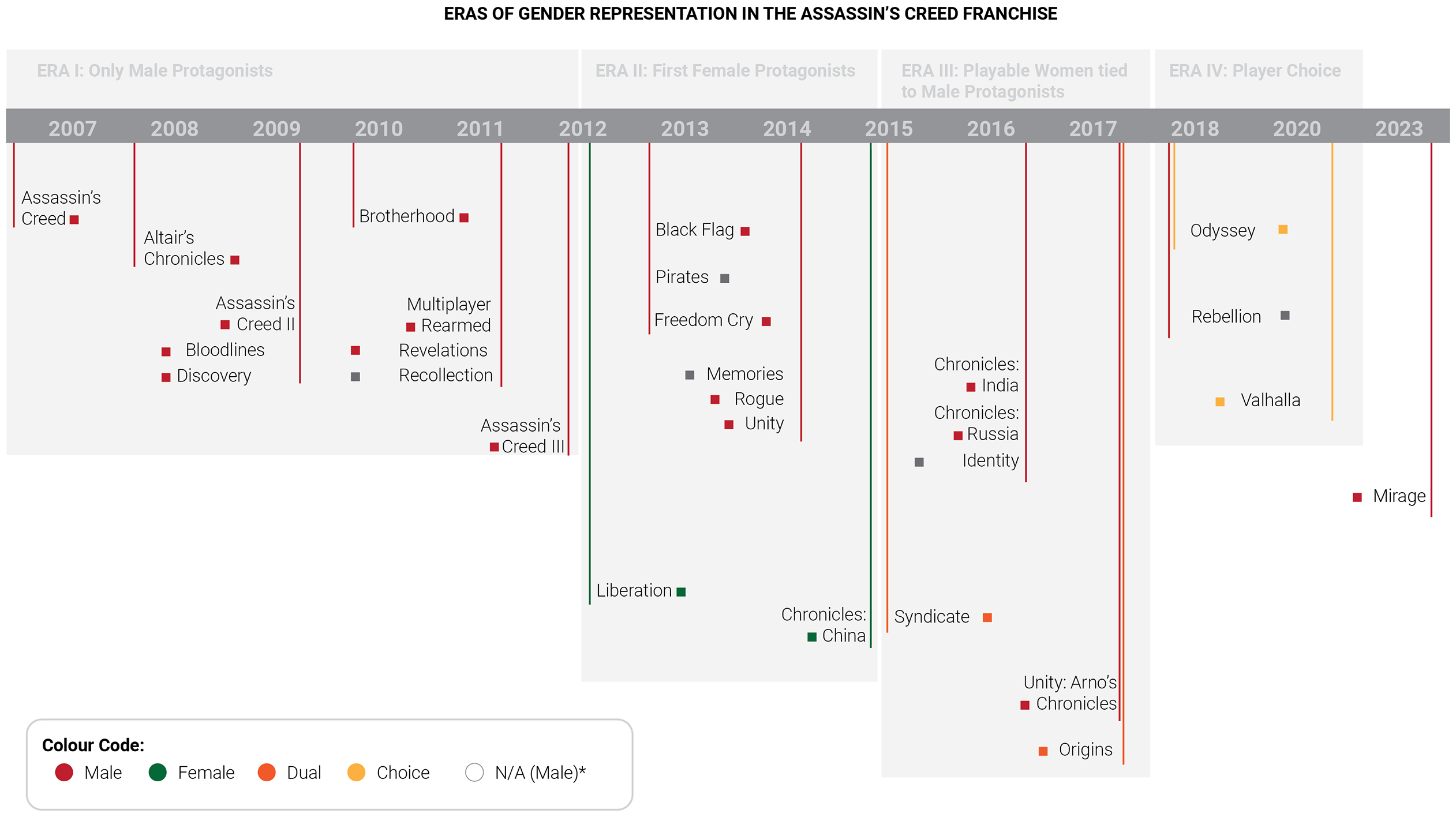
Eras of gender representation in the Assassin's Creed franchise.
Eras of female representation.
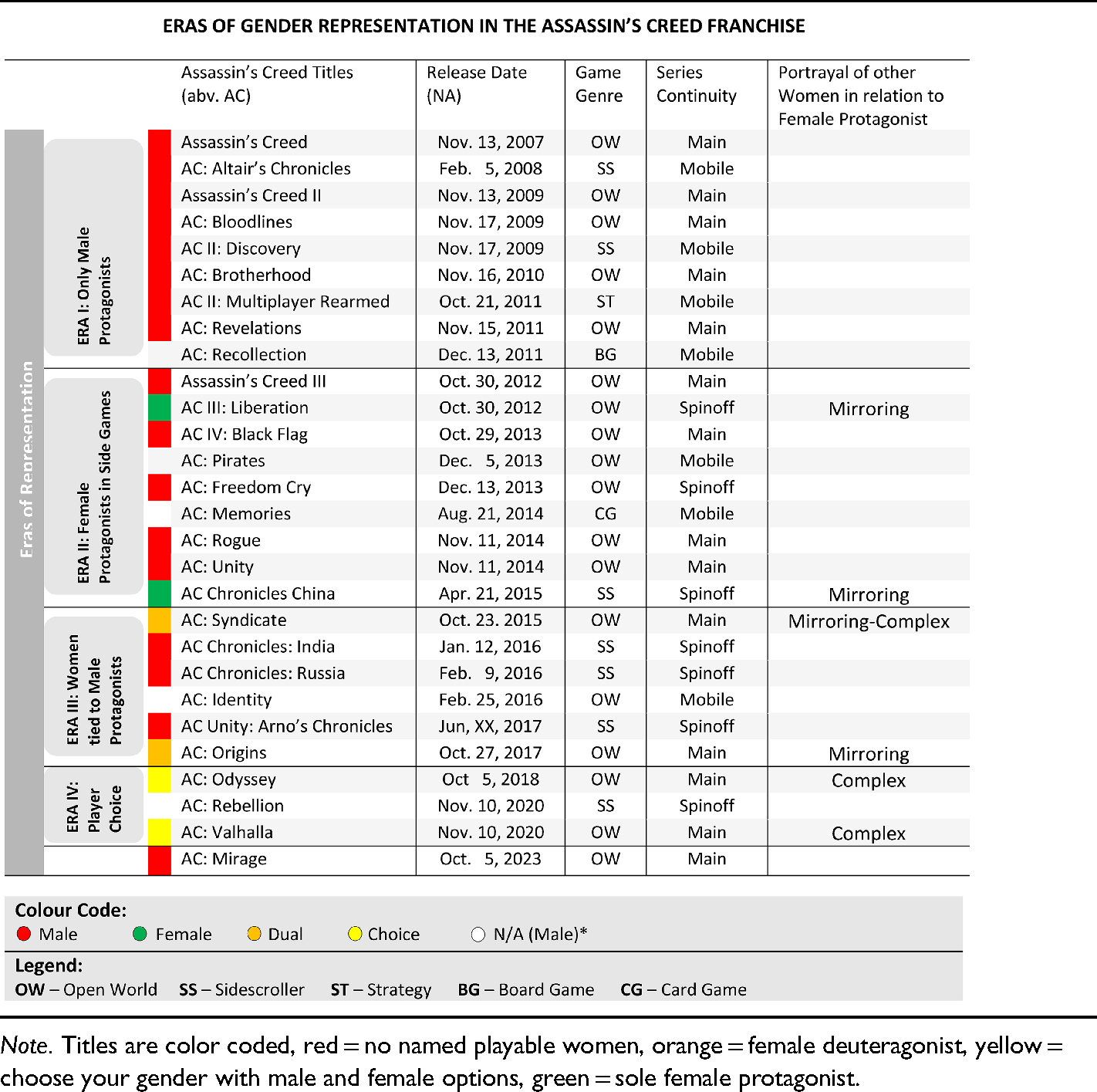
First, in a preperiod during 2007–2011 all playable characters are male. From 2012 to 2015 we see the first female protagonists appear in side games. AC has its series of main games which drive the story forward and on which the key studios work with large budgets. Side games are often outsourced, have smaller budgets, and are not considered part of the main story. Aveline and Shao are the only playable characters in their games and, to date, still the only sole female protagonists in an AC game.
Leading up to the third era is a time of political controversy regarding issues of gender and gaming, with both the “women are too hard to animate” scandal and later gamergate. In this era, we also see a reformulation of the load screen message to highlight the importance of gender and sexuality diversity in the development team. Signaling that Ubisoft at least would like to appear as if this is important to them. The era, 2015–2017, features playable women defined by their relationship with male protagonists. Both Syndicate and Origins have a male and a female protagonist where the male sees significantly more screen time and playability. In Origins, in particular, Aya is sidelined for Bayek to be the true main character. Aya becomes his wife. Aya was originally meant to be the protagonist, yet was replaced against some of the developers’ wishes (Schreier, 2020). Reportedly, this change occurred because of Serge Hascoët (Chief Creative Officer). Hascoët has recently been arrested along with Tommy Francois (Vice President of Editorial and Creative Services) for their role in the Ubisoft sexual harassment affair (Farokhmanesh, 2023). Evie, in Syndicate, sees some screen time yet significantly less than Jacob, and the developers state that she and Jacob are to be seen as a hero team.
The fourth era 2018–2022, is that of player choice. Here players can choose the protagonist's gender, in Odyssey between brother Alexios or sister Kassandra and in Valhalla between male or female Eivor. Player choice is one way of solving the issue of gender representation. This way studios leave the choice to players; they have their cake and eat it. In both games, the female protagonists are talked about by developers as canon, the ones whose stories will live on in the AC world. Despite this, neither female Eivor nor Kassandra are represented in any promotional material and are all but absent from Steam pages. They are also absent in other transmedia material like the official novels. The games say one thing, but the advertisements and promotional material something else. As other studies on Kassandra have shown, these protagonists can be seen as “shaped by marketing forces, industry preferences, and paratextual framing” that situates her within the “franchise's needs” (Cole, 2022, p. 199). They are presented as women, yet enact masculinity. In this era, we see the MeToo movement and significant critique against Ubisoft, even if it takes several years for the abovementioned arrests. For Mirage there seems like a shift occurred during development, yet we cannot be sure. In the future, due to the staff changes discussed, Ubisoft might have space to change their take on female protagonists.
In the third and fourth eras, we see many hidden women. There are rich and complex portrayals of women in side-quests and as NPCs that explore more complex experiences of feminine subject positions, both contemporary and historical. For example, in Odyssey, we see numerous side-quests where you aid women with their own stories such as raising children or ruling over pirates. In Origins, the overarching storyline of motherly grief and revenge is reflected in several quests and undoubtedly would have been read differently had we played as Aya. Side characters are allowed to be women, with female concerns and experiences. With the notable exception of Aveline, and to some extent Aya, this is not true for protagonists. In particular, Kassandra and female Eivor are flat representations. Women visually, yet lacking the anchoring in mechanics which Chang (2017) argues makes for an informed and deep representation. They can support queer readings and work to decouple gendered bodies from actions, yet it is hard to read them in that light considering the entire analysis.
There is an increase in women, and playable female characters in particular, over the 17 years we have studied. There is also increased complexity and depth in female representation with more nuanced backstories and motivations. While less clear, there is also some evidence of increased focus on female experiences such as the navigation of the intersections of gender, race, and class in Liberation, the focus on motherhood in Origins, or side stories in Odyssey. Yet astoundingly, there is still no sole female protagonists in a main storyline game in the Assassin's Creed series. The appearance of a female-coded playable character might be seen as progress in the AAA sector, yet as we have shown here, the presence of women is not the same as equal, deep representation.
Although determining the cause of this exclusion would require interviews with the decision makers, there is nonetheless a sense in which the AC franchise's largely young, male, and Euroamerican player base, which represents “79% of Ubisoft's sales” is a strong determinant (de Wildt and Aupers, 2022, p. 4). Likewise, the reportedly draconian attitudes of Hascoët et al., especially on the inclusion of women in Origins and Odyssey are indicative of profound sexism and/or fiscal conservatism that presumes sexism within that male audience. Whether or not the audience is still that male-dominated, or averse to female protagonists is certainly important, but registered only insofar as Ubisoft's upper management believes it will serve the bottom line: sales.
Furthermore, there is a mismatch between official paratextual material such as advertisements and teaser videos, which dominantly display male characters even in games with female canon heroes. Our conclusion is similar to what de Wildt and Aupers (2022) show in their developer interview study about religion in AC. They argue that “Marketing, editorial and production teams curb creative teams into reproducing a formula” (1). In our case, the promotional material across the board does worse in representing women. De Wildt and Aupers (2022) discuss how the editorial level of Ubisoft focuses on catering to the largest possible audience, thereby curbing creative visions and packaging the games to their vision of the market. In our context, the discrepancies and conflicts visible when we study women in the whole franchise make sense. The developers, squeezed in between editorial, brand, and marketing might have visions of female protagonists and stories, yet much of this gets scratched or reimagined before launch. This way we can understand the change from the female lead Aya to Bayek in Origins, while the game maintained its focal narrative on motherhood, transposed to fatherhood. Perhaps it also speaks about the changed focus in Mirage’s rollout from Roshan to Basim. This could also explain why side characters and side stories can be more progressive and well-represented, slipping past upper management.
The complex environment in which AAA games are made and envisioned makes it difficult to view games as representing a uniform vision or having one way of representing the world. While in one package they represent a multitude of visions, norms, and ideas.
Finally, cultural events matter when we look at changes in games. We here lifted four events with high media attention. The 2013–2014 Gamergate campaign, the 2014 Unity and Women are too hard to animate debate, the 2017–2018 Metoo movement, and the 2020 Ubisoft sexual misconduct layoffs. These events all concerned gender representation for Ubisoft in games as well as staff. As others have argued, changes in society both within and outside of gaming have changed how women are represented (de Bruin-Molé, 2020). In the AC universe, women are increasingly more present and, in some cases, more complex and well-grounded (see also Tuplin 2022), yet far from equal to men. We argue that during the 17-year period we have studied, these events have mattered as the franchise has navigated public appearances, creative desires, and markets.
Conclusions
We often discuss history from a Western perspective as constantly moving forward with clear trajectories for the better. In previous eras, social changes and advancement for women in society have gone hand in hand with changes in portrayals of women in media (Knight, 2010). However, in the AC series, there are clear discrepancies between the advertisement and design of the main protagonists and other women such as NPC and attention to female stories and experiences in the games. For Ubisoft, it is particularly complex with internal conflicts on gender representation and not unconnected lawsuits regarding sexual harassment. The resistance to female protagonists is still strong and outside cultural events such as MeToo have been part of lifting not only questions of harassment in development teams as well as questions of representation. We are again reminded how studying representation in media can be a way to understand the social position of women in both subcultures and society at large. The article thus delved into the complexity of polarized gender politics and how game companies struggle with different types of fans with distinct political views on gender inclusion, visions by various artists involved in the actual making, economic values, sexist work cultures, and a risk-averse game industry. There is immense pressure on the AC franchise to be successful and to continue to generate income for Ubisoft. Recently the studio has virtually canceled everything except Skull & Bones and their upcoming Avatar game, putting even more pressure on their flagship franchises to remain safe and profitable, veering into social and fiscal conservatism as a business plan (Zwiezen, 2023).
The investigation of how one AAA game series has dealt with gender across 17 years offers us a look into contemporary shifts in norms and cultural wars. As well as the complexity inherent in understanding representation in media. In the AC franchise, women are becoming more present and at least NPCs more complex, and interesting. Protagonists continue to be quite flat representations of female lived experiences. However, it is not a linear progression, and neither is it something that should be taken for granted.
Footnotes
Acknowledgments
We would like to acknowledge the invaluable contributions of Sâmia Pedraça to the design of tables and timelines found in this manuscript. Her perspective has been critical in shaping earlier data visualization to be more legible and accessible.
Declaration of Conflicting Interests
The author(s) declared no potential conflicts of interest with respect to the research, authorship, and/or publication of this article.
Funding
The author(s) received no financial support for the research, authorship, and/or publication of this article.
