



Abstract
In a fast-paced world of ever-changing trends, connecting historical roots by linking new movements to existing traditions can be a challenge. Similarly to how Mary Flanagan’s book “Critical Play” situates and contextualizes play in history, we propose and start similar work on game jams. While we don’t have as much room for self-expression in a paper, we focus on two main contributions. The first is to link existing definitions of game jamming and creativity. Secondly, we show how game jams build upon existing traditions of co-creation—sharing and confronting ideas with peers by using formal constraints to fuel creativity and direct the process. To this end, we examine four historic movements—the Danish film movement Dogma ’95, creators of audio visual programs from the demo scene, OuBaPo a group of French comic book writers, and the Japanese renga poets—and relate them to game jams.
Keywords
Introduction
The debate on whether or not games can be considered art is a widely recognized topic that is still being discussed in popular media. Opinions on this matter usually range from a confident “of course they are” to “some games are,” or even “who cares?” This discussion has been raging for decades. By now, most people who work in the field of video games, be it as a practitioner, researcher, journalist, or otherwise, at least acknowledge that games can be art (Smuts, 2005; Gee, 2006).
Despite the progress made, there is still a need to further explore the relationship between games, game development, and the broader context of art and creative endeavors. In this article, we focus on a small subset of game creation activities—game jams—and examine how they fit into the larger landscape of creative activities that are driven by constraints. By looking at established definitions and drawing parallels to historically recognized creative practices that rely on constraints, we aim to provide a more nuanced understanding of game jams as a creative process.
This article makes two significant contributions. Firstly, we establish that game making and game jamming are inherently creative activities. Although this claim may seem obvious to professionals, hobbyists, and academics working in the field, it is crucial for us as researchers to draw connections that can make this understanding more widespread. It is up to us to draw those connecting lines, which will make this thinking evident to all, not just those in our field who share our view of the world. We make these connections by combining Morean’s definition of a creative activity (Moeran, 2009) with Kultima’s definition of a game jam (Kultima, 2015). While Morean’s definition of creativity is well established, several competing definitions of game jam exists. These definitions have recently been surveyed by Lai et al. (2021). Two recent and widely used game jam definitions are Kultima et al. (2016) and Grace (2016). We prefer Kultima’s definition over that given by Grace, as Kultima produces a standalone definition. Grace’s definition works by comparing game jams to hackathons. This means Grace’s definition feels incomplete when comparing to other movements than hackathons. Moeran’s definition of creativity, as we will see, focuses on constraints and creativity as concepts that end up being part of a process and production. This fits very well with game jams, which as Kultima emphasizes (Kultima et al., 2016) are constrained by their very definition, and where the purpose is to work on the development of a game during a limited time period.
Secondly, we demonstrate that by examining the constraints involved, game jamming can be situated within a broader historical context of creative endeavors. While game jamming has gained popularity in the 21st century as a creative movement, we show that it shares similarities with other playful and creative activities that have existed for centuries. By highlighting these connections, we provide a deeper understanding of the historical roots of game jamming and its place within the wider landscape of creative expression. We are not the first to compare game jams to other movements. As mentioned earlier Grace (2016) compared game jams to hackathons, and hypothesized that while hackathons tend to be competitive and focus on the artifact produced by the participants, game jams instead focus on the process. Contrary to that work, instead of looking for differences, we take the reverse view and look to find commonalities by examining the impact of a specific part of the creative process, the constraints. The workshop Summer PIT 2017 1 had speakers focusing on game jams, hackathons and the demo scene and there were discussions focusing on the general commonalities and differences between the three movements.
In Critical Play (2013), Mary Flanagan contextualizes games and play in history showing how play can work as a subversive activity critical of society. In a similar manner, this article picks historic data points that describe playful activities characterized by creative constraints throughout history, and draw similarities to the internal processes and definitions of game jams. This is not to object to the idea that game jams represent something new and unique, but rather it is an attempt at providing part of the building blocks for a continuum of understanding of the game jam movement as it connects to creativity.
Overview
As argued earlier, for this article, we will be using Kultima’s definition of game jam (2015, p. 1). She analyzed 20 papers describing game jams, and distilled the following definition “accelerated, constrained and opportunistic game creation events with public exposure.” It is worth noting that the word accelerated in her definition, plays not only the role of emphasizing that a game is produced from beginning to end and in a short amount of time — the author is emphasizing a constrained situation. Thus, game jams are by definition creative moments played around constraints. For example, the limited amount of time in which participants have to make a game, is a major constraint in itself — a constraint that will impact how the game prototype is made and what goes in it.
This is not the first paper situating game jams as creative events. For example, Locke et al. (2015, p. 1) suggest that game jams are “disruptive, performative processes that result in original creative artifacts.” While that work focuses on game jamming as something that resembles an art piece, our contribution is to compare game jamming with other creative and playful processes. In the following sections, we will elaborate on these comparisons and highlight the similarities and differences between game jamming and other established creative practices.
Creativity and Constraints
Kultima’s definition of game jamming aligns well with Moeran’s idea of creativity as (2009, p. 4) “a meaningless concept unless considered in tandem with the constraints under which it operates,” since Kultima also focuses on the constraints. By combining those two definitions, we argue that game jams are best understood as formalized creativity. Jammers set aside a certain amount of time, often 48 hours, during which they endeavor to make a game, and as will be explained further, time is accompanied by other constraints, such as a challenging theme, the materials used (software or hardware), the skills each game jammer contributes to the team, and so on. Some game jams also offer additional voluntary constraints, such as the Global Game Jam’s (GGJ) Diversifiers (Gold et al., 2009), that act as micro constraints (Goddard et al., 2014). The diversifiers in particular, are a list of optional constraints that jammers can add on to their game to increase the creative challenge and make their game stand out. Diversifiers can increase the chance the game will be found via the GGJ website’s diversifier search functionality. A GGJ team can associate up to four diversifiers with their game. This focus on constraints in game jams resonates with Moeran, who creates a taxonomy of six types of constraints (material, temporal, spatial, social, representational, and economic) that together form a creative activity. In a domain close to game jams, Zimmerman (Zimmerman, 2002) closed in on a definition of independent games focusing on three factors: economic, technological, and cultural. While Moeran’s framework can be applied to various creative domains, Zimmerman’s definition is specific to independent game development. In the following, we will go through each of Moeran’s six constraints types in turn, and compare how game jams fit into the definition (2009, p. 4).
Material Constraints
The material constraints involved in game development can vary depending on the type of game being created and the context in which it is being made. Many game jams such as the GGJ encourage several different types of contributions (artifacts) such as video games, board games, pervasive games, big games, etc. No matter what game is being made, most game makers will require at least pen and paper to assist in brainstorming and eventually to write down and iterate upon the rules. Most games will also require some sort of token(s), such as a ball, bat, marker, etc. For video games, computers themselves are part of the material constraints—video games are made and played on computers. The software used is also part of the material conditions; this includes well-known software packages such as Unity (Unity Technologies, 2005), Unreal (Epic Games, 1998), GameMaker (YoYo Games, 1999), Photoshop (Adobe Inc, 1990), Audacity (The Audacity Team, 2000), etc. We see that longer game productions and game jam productions share the same type of material constraints.
Temporal Constraints
Game jams are by their very nature temporally constrained. For example, the annual GGJ—that usually takes place at the end of January—lasts a weekend (48 hours). The shortest game jam known to the authors, is the 0h game jam which lasts only 1 hour, from 2 a.m. to 2 a.m. during the change from Summer to Winter time (Sosowski, 2011). Other jams such as Double Fine’s Amnesia Fortnight lasts 2 weeks (Dou, 2012). In all cases, a time box for defining the activity is essential, as can also be seen in Kultima’s definition of a game jam (Kultima, 2015) through the use of the terms accelerated and constrained.
Spatial Constraints
While online only game jams exist, there are a number of game jams such as the Castle Game Jam (Newnorth, 2021), Exile (Garbos et al., 2011), Indie Game Jam (Hecker & Barrett, 2002), Survival Mode 2016 (Kultima et al., 2016), GGJ (Gold et al., 2009), Locomojam (Walker, 2021), Nordic Game Jam (Lai et al., 2006), Pirate Jam (McGee, 2017), Train Jam (Wallick, 2013), and more that all require jammers to be together in a physical location. Even some of the online game jams, such as Ludum Dare (Howland, 2001) that don’t require jammers to participate from a specific physical location, now have informal physical gatherings where jammers meet to participate in the jam. Even online participation in a game jam is spatially constrained, as even though people may be able to participate from the comfort of their home or other location, there is still the constraints that they have to be in a location with electricity, internet, and enough comfort to be able to focus for the length of the game jam.
Social Constraints
There are different types of social constraints. For example, Moeran (Moeran, 2009) suggests that team work represents a form of social constraint. In framing a definition, the author uses Becker’s (1998, p. 78) definition of social constraints as “a supply of interchangeable human parts. When you can count on replacing people with others just as good, you can carry on artistic work in a routine way. That is why the cooperative networks and conventions that make up an art world create opportunities as well as constraints.” Game making and game jamming is full of social constraints. Nearly all types of game creation require more than one person. Typically required skills at game jams are game design, art creation, sound design, and programing (Pirker & Voll, 2015). A person has to be a true renaissance person to cover all those areas, and even then, such a person might not have the time or economic resources to take on all the tasks of producing a playable prototype. This aspect of game making is also reflected at game jams such as the GGJ, where most games are made by teams (Global Game Jam, 2016). As Moeran (2009, p. 11) further clarifies “social conditions of creativity may be broadly distinguished into three sub-sets: those stemming from the fact that most forms of cultural production consist of close contact and communication among networks of cooperating personnel […].”
Representational Constraints
When we examine representational constraints, we interpret them as constraints related to the content of the game. For example, Moeran considers that esthetics is “the main representational constraint upon cultural production” (2009, p. 13). We suggest interpreting the concept “esthetics” to also cover the experience as a whole, not only the visuals and the sound design. For video games, this means that the narrative, game mechanics, controls, level design, and so forth are also covered by the term esthetics.
A game developer is always subjected to the expectations of the players. For example, if we take a game with high-resolution models and highly realistic graphics as players we may be brought to think that we have a game with a high price point and a lot of content, de facto further setting expectations about the play experience. A game featuring few colors and low-resolution graphics, might instill ideas of a game made by a smaller team and perhaps containing rogue-like features, and so on ((Smith & Bryson, 2014) provides an introduction to rogue-likes). Similarly, there are also content constraints related to ratings, such as who is able to legally buy the game, etc.
Content constraints can also relate to the material constraints. For example, the amount of memory and available storage space sets a constraint on the resolution of textures, models, etc. The resolution of the screen sets constraints and expectations of the graphics a player will see, regardless of the memory and storage available. The style of the game and the graphical power of a game will again set other content constraints. For example, with a first-person shooter or a racing game, there will be an expectation of 30 or even 60 frames per second (fps), which again limits the type of graphics that can be shown. A turn-based strategy game might not induce the same expectations.
For game jams specifically, there will often be slightly different content constraints than for a full game production. For example, while most commercial games require all of its graphics to be original, not all game jams will have such a restriction, as it is sometimes allowed to use a preexisting piece of content, as long the content’s license terms allows it.
Economic Constraints
Economic conditions have historically been a significant constraint on individuals’ ability to pursue creative endeavors, as not everyone may have the financial resources or the luxury of time to devote to their creative interests. The temporal constraint of game jams intersects with this economic constraint, making it more pronounced in both positive and negative directions. Game jams typically last for more than a few hours 2 , and participants must be able to commit to the event for at least a day or two, which may require taking time off from work or other responsibilities such as caring. This may partly explain why game jams typically attract a younger demography. On the other hand, the time-limited nature of game jams makes them a popular choice for individuals who are interested in game development but may not be ready to make a full-time career commitment. Game jams provide a low-pressure environment for participants to experiment with game development and gain experience without the long-term commitment and financial investment required to pursue a career in the industry.
Moeran’s definition only deals with creative activities, but it does not discern whether the aim is artistic, commercial or somewhere in between. That author’s definition, therefore, suits activities like game creation and game jamming well, as they also exist on a continuum between those two extremes.
Four Constraints-Based Movements
Now that we have established game jamming as a creative activity, we can start comparing it to other creative movements to find and analyze differences and commonalities.
The following sections present an attempt at providing the beginning of a continuum of historic understanding of game jams and creative constraint-driven movements. This section samples four historic constraint-driven movements in a backward trajectory. Obviously, a much larger work is needed to get close to a true historical perspective.
In the following, we describe in more detail four different creative constraints-driven movements and relate them to game jams. The four movements are the Danish film movement Dogma ’95, the demo scene—creators of audiovisual programs, OuBaPo a group of French comic book writers as well as the Japanese renga poets.
Methodology and Data Collection
The movements have been chosen based on the authors’ own experiences and interests and observations outside of game jams. The spark for this work was a combination of reading “Critical Play” (Flanagan, 2013) and attending the Summer PIT 2017 Workshop on Hackathons, Game Jams, The Demo Scene, and other kinds of rapid design events.[1] The workshop drew commonalities and connected conceptual lines between Game Jams and two other movements—Hackathons and the Demo Scene, while Flanagan in her book provided the inspiration of a contextual orthogonal historical lens.
The first two movements have been chosen because film and the demo scene are often compared to video games (e.g., (Kallay, 2013; Sandqvist, 2020; Jørgensen et al., 2017)), and one of the authors spent several years being active in the demo-scene, while the other author is a filmmaker and visual anthropologist. For the two other movements, in order to find a historic thread that provides breadth and depth to this work, we wanted trends that belong further back in history (depth), and which are not normally compared with game jams (breadth). Renga was chosen because of initial positive discussions with a friend on the similarities between renga and game jams, while both authors were doing work in Japan. Lastly, we were familiar with OuLiPo (Queneau & Lionnais, 1960) and its amazing creative output based on constraints. The subgroup OuBaPo, with its creative audience-focused output and even one instance of a board-game, provided the perfect last candidate. The focus on a formally constrained creative process and the creation of an artifact, provided a starting observation of obvious commonalities.
In general, we wanted to examine creative movements driven by formal constraints featuring participatory elements, and to compare against game jams, with some depth and breadth in terms of contextual adjacency along a chronological timeline. Using some light coding, this gave us a matrix as shown in Table 1. Note that both of the axes in Table 1 represent subjective measures based on the data set and the authors’ point of view. Note that Dogma ’95 was particularly difficult to place into Table 1. Film-making is a historic creative industry that is often compared to games, though on the other hand, only one game-focused author has ever compared the contemporary Dogma 95’ movement to games (Adams, 2001). For this selection, Dogma 95’ has partly been chosen as the movement representing film, and thus we put it in the corresponding cell. There is a similar dilemma with OuBaPo, which is a specialization of OuLiPo (Queneau & Lionnais, 1960). OuLiPo was founded in 1960 (OuBaPo in 1992). With the small selection of movements presented here, 1960 can still be seen as contemporary, while with a broader scope, it might have ended up in a near-contemporary category (possibly together with film).
Movements and Their Relation to Game Jams.

Dogma ’95
Famously, in Paris in 1995, at a celebration for the 100th anniversary of the first film screening, Lars Von Trier said “It seems to me that in the last 20 years, no, let’s say 10 then, film has been rubbish. So my question was, what can we do about this? And I made some little papers with words on it. It’s called Dogme 95!” (Dam, 2015) Before he left the stage, Lars Von trier proceeded to read out the Dogma 95’ Manifesto (Von Trier & Vinterberg, 1995) and the accompanying Vow of Chastity (Von Trier & Vinterberg, 1995). The latter spelled out 10 rules on how to make a film that follows their new doctrine. While the manifesto channels the spirit of the movement of a reformation of the film industry from the foundation up, the Vow of Chastity sets out specific constraints that filmmakers, who want to take part in the movement, must adhere to. In his analysis of Dogma 95, Geuens (2001, p. 192) puts an emphasis on the use of constraints by quoting an interview with Thomas Vinterberg, in which the filmmaker admits that “it might as well have been ten other rules” as the crucial point is the fact there are constraints and those constraints are what makes a film “real.” The primary focus here is on the act of constraining oneself creatively, rather than on the specific constraints that are being imposed. Likewise, Truffaut in his manifesto-like study of French film (1976) attacks some of the same tendencies of modern film-making as were later criticized by the Danish artists. In particular, the French filmmaker also channeled his criticisms towards an exacerbated attitude of planning shots and other set details. Despite those criticisms, Truffaut does not give direct rules that act as formalized tools to break the mold of cinema nor to avoid the fallacies he highlighted. For this reason, Geuens (2001, p. 193) suggests that for the French filmmaker of the Nouvelle Vague “good filmmakers (Rossellini for Bazin, or Truffaut himself) would know instinctively how to avoid such pitfalls” avoiding in this way to explicate what they meant.
We are not the first to connect the Dogma 95 movement to the games industry. In 2001, Adams published his Dogma 2001: A Challenge to Game Designers (2001). Inspired by Dogma 95, Adams argues that game developers have become too obsessed with technology, and issues his three-word manifesto “Technology Stifles Creativity,” and just like the Vow of Chastity has the intended consequence of decoupling technology from film production, he has similar intentions for games. In a gesture to Dogma ’95, Adams structured his blog post as the Vow of Chastity of the Danish artists, with 10 commandments, phrased as constraints which had to ignite the game developers’ creativity through a similar process designed by Dogma ’95.
Adams (2001) wrote his blog post in 2001, which was before the first documented game jam, The Indie Game Jam (Hecker & Barrett, 2002), was organized. Therefore, in presenting his Dogma 2001, he was not referring to game jams or similar activities. However, Adams’ Dogma 2001 shares many similarities with game jams in terms of its emphasis on constraints and limitations as a way to foster creativity and innovation. In particular, the Diversifiers (Global Game Jam Inc, 2019) of the GGJ have similarities to Adams’ very technical language, as both refer heavily to game related terms such as a game controller, first-person shooters, representational versus abstract games, and use tropes such as elves, knights, good versus evil, etc. It requires video game literacy in both cases to fully understand the constraints and their implications.
While the Vow of Chastity also uses technical terms from a film such camera and props, Adams’ language in framing constraints is far more technical, becoming a negative constraint in itself rather than a creative and positive constraint for game developers. For example, while the Vow of Chastity simply says “Genre movies are not acceptable” (Von Trier & Vinterberg, 1995) the equivalent item in Adam’s Dogma 2001 states “The following types of games are prohibited: first-person shooters, side-scrollers, any action game with ’special attacks’. Also prohibited are: simulations of 20th-century or current military vehicles, simulations of sports which are routinely broadcast live on television, real-time strategy games focusing solely on warfare and weapons production, lock-and-key adventure games, numbers-heavy role-playing games, and any card game found in Hoyle’s Rules of Card Games” (2001). Whether such difference in terms of technical language and challenges is needed between the two types of manifestos is because video games are a different medium to film or because video games are a new medium and still quite genre-prone, is something still left to be analyzed. In a similar manner, while the Vow of Chastity declares “The film must not contain superficial action. (Murders, weapons, etc. must not occur.)” (Von Trier & Vinterberg, 1995), Adams instead resorts to “Violence is strictly limited to the disappearance or immobilization of destroyed units. Units which are damaged or destroyed shall be so indicated by symbolic, not representational, means. There shall be no blood, explosions, or injury or death animations” (2001). Again, the original is more readable to the layman, as well as imposing the strictest set of constraints of the two. In fact, the concept of conflict seems so embedded into the definition of a game, that a large part of commercial games contain some sort of violence. While games without violence exist in increasing numbers, it is especially true with games at the higher end of the production cost spectrum, that the absence of violence still represents a significant break with tradition.
In this sense, the diversifiers of the GGJ represent a continuation of Adam’s ideas, and by extension also Dogma ’95. Examples of diversifiers from the GGJ 2019 (Global Game Jam Inc, 2019) are “use only black and white colors in your design. There should be no other colors, not even gray,” “the game begins when you place your finger on the screen, and ends when you take your finger away,” and “create all visuals programmatically or in the scene editor, and avoid any importing of image files, sprite sheets, 3D models etc.” While there are exceptions among the diversifiers, most tend to be very technical but easy to incorporate into game creation and to recognize by a player. This is in direct contrast to another type of constraint, the theme of a jam, as they are often more abstract and used as a starting point for further brainstorming. While it is frequently impossible to verify post-jam that a theme has been used as the spring-board for a created game, diversifiers, like the dogma rules, are designed to be independently objectively verifiable. Interestingly, sometimes we can also find parallels to the diversifiers in the Vow of Chastity. For example, while the above GGJ diversifier suggests the color coding of the image by limiting it to black and white, the Vow of Chastity declares that all films must be made in color. The third example of a diversifier resonates with the Vow of Chastity’s rule that shooting must be done on location and no props be brought in.
The Demo Scene
In his book, Times of Change in the Demoscene, Reunanen (2017) analyses the demo scene. As elaborated below, the demo scene is a digital subculture that has a lot in common with game jams. While Reunanen talks about different cross-over and touching points between the demo scene and the games industry, he does not refer to game jams. In fact, he completely avoids making any comparison between digital subcultures as “they do not share similar origins and history” (2017, p. 80). For this reason, we will not attempt a full comparison between the two cultures—game jamming and the demo scene—but focus on the use of formal constraints in the two. The workshop Summer PIT 2017, [1] talked about the commonalities and differences between game jams and the demo scene (as well as hackathons) from several perspectives, including as rapid design events.
Several definitions of a demo exists, but ultimately they are very similar. Reunanen (2017, p. 11), defines demos as “demonstrations, audio-visual computer programs, which, in general, tend to be non-interactive and showcase their creators’ skills.” Polgar (2008) instead uses the definition of a demo provided by Gruetzmacher (2004) who states that “Ultimately, a demo(nstration) in a demoscene sense, is a piece of free software that shows realtime rendered graphics, while playing music. Often, the music is tightly connected/synced to the visuals. Modern pc demos run linear from start to finish and are non-interactive.” These definitions are similar enough that we see no real conflict between them. Realtime here means that the graphics are calculated in real time by the computer program, and not prerendered into a film before being shown. Here realtime and prerendered, has a similar meaning to how Togelius et al. used online versus offline about procedural content generation for video games (Togelius et al., 2010).
Reunanen’s 2017 definition of a demo also tells us about the community around the creation of demos, the demo scene. The focus points of the demo scene are the demo parties, where groups and individuals gather to compete against each other in different categories, such as pc demo, amiga demo, fastdemo, 256k intro, 64k intro, 4k intro, wild demo, procedural graphics, etc. Except for wild demos, where anything is permitted, for most of these categories, the constraints that drive them are indicated by the name. For example, pc demo and amiga demo designate the platform the demo must run on. Fastdemo most often indicates a demo put together in-situ, much like game prototypes at a game jam. For fastdemos both the time frame and the theme are announced at the party. For 256k intro, 64k intro and 4k intro, the category tells the participants of the permitted size of the file (executable) that runs the demonstration. For an intro, all assets are typically expected to be bundled as a structural part of the executable. This means that the size restriction applies to the combined size of the assets and the executable.
While the demo scene precedes game jamming by almost two decades and has its roots all the way back to when the home computer was first made available (Reunanen, 2014), similarities between game jams and demo parties are starting to become clear. Like most game jammers, demo sceners also work in groups. The speciality skills of each group member help in creating an artifact for the event—in the case of game jams, the artifact is always created at the event, while for the demo party, where the artifact is created depends on the type of competition. With its heavy focus on technology, the formal constraints that the demo scene uses are typically either platform based or mechanical. Initially, like the demo scene still is, game jams were also focused on technology. For example, at the very first documented game jam—the Indie Game Jam—all participants had to use the same game engine. Several game jams such as the Nordic Game Jam and the GGJ have now transcended those technological requirements, and invite game creations of all types, including board games, big games, physical toys, etc. 3 Even if jammers make a video game, most game jams remain software and hardware agnostic, and there are often no set platform or maximum size requirements for the final delivery.
Reunanen (2017) and Tyni and Sotamaa (2014) described a tension between the demo scene, games and the games industry. In particular, many computer parties, which used to be demo scene focused now attract a large section of gamers, who are not immediately interested in the creative endeavors of the demo sceners and not all demo sceners welcome the presence of gamers in a space that used to belong solely to them. Similarly, it is also typical for video game and other IT companies to have hiring booths at demo parties. Without erasing the differences between game jams and the demo scene in founding culture and ethos, both Reunanen (2017) and Tyni and Sotamaa (2014) talk about a natural cross-over in interest between game creators and some of the demo sceners. Tyni and Sotama reported that over half of the respondents at the Assembly demo party reported that “they were much or very much interested to work in the games industry” (2014, p. 117). In fact, some well-known game companies such as Remedy, Housemarque, and DICE have had demo sceners among the founders.
OuBaPo
OuLiPo (Queneau & Lionnais, 1960) could be defined as a movement with literature constraints at its core. As Miller described, OuLiPo means “the Ouvroir de Litterature Potentielle, [and it is] dedicated to the use of constraints as a mechanism for the production of literary texts” (2007, p. 117). Founded in 1960 by Raymond Queneau and other intellectuals the group is still active. Like game jammers, the members of OuLiPo embraced formal constraints as a way to change the medium and drive creativity. A number of subgroups quickly formed, each with their own acronym and specialized purpose. Examples are Ouhispo (history), Outrapo (stage performances), and OuBaPo (comics).
The focus on formal constraints, makes OuLiPo and any of its many offshots groups fit well into the overall theme of this article. We have chosen to focus on OuBaPo (Ouvroir de bande dessinée potentielle), as much of this group’s work has a playfulness to it, where the user goes on a journey of discovery within the comic, and might be encouraged to interact with it, is not much different from how a player interacts with a game. The mission of this group was to assert the potential for comic books to deliver mature stories and shed itself of overused tropes (Miller, 2007), and as such it shares the experimental nature of game jams.
The group even released a game, Scroubabble (Lécroart, 2005), which is a hybrid between a comic book and the classic board game Scrabble (Butts, 1938). In Scroubabble, players use a regular scrabble board but instead of letters and words, they place comic book frames with the aim of composing a strip. The point system is replaced by a general judgment based on the likability of the strip created. Unfortunately, it seems the game is no longer being published.
Generally, OuBaPo divides the constraints they work with into two categories; generative and transformative (Kuhlman, 2010). Generative constraints create something from nothing, while transformative constraints change existing material. Some of these constraints are only of interest to the comic book creator, while other constraints also affect the reader and the experience of reading the comic book. In this sense, the comic book reader becomes like a player of a game, who is encouraged to interact and explore with the artifact.
An example of generative constraints described by Kuhlman (2010) are strips which “can be read both left to right, and top to bottom in a grid” (2010, p. 131). This constraint presents a challenge for the writer to create a story that can be read in a non-linear fashion, and it also encourages the reader to engage with the comic in an interactive way.
Like game jammers, the members of OuBaPo embrace formal constraints to hone their skills and drive creativity.
Renga
Renga is an ancient Japanese form of collaborative poetry that has a long history in that country. The first example appeared already in the Manyoshu poetry collection (CE 759), and became more established and famous over time. One of the most prominent poets was Bashō whose productions dates back to the 17th century (Keene, 1977). Renga compositions originally consisted of 100 verses which were reduced to 36 during the time of Bashō (Sato, 1995). A Haiku was just the opening of a renga and consisted of 17 on (syllables), divided into three strophes of 5, 7, and 5. The 7-5-7 verses would be followed by a 7-7 verse and then the meter would have gone back to the start. Renga parties were highly formalized events, where each poet took a turn, each creating a part of the longer, complete poem.
While it is easy to see the structural constraints of the verses, renga compositions had many more constraints. For example, Sato (1995) describes the complex way renga had to be redacted on paper, “a hundred-part sequence was written on four sheets of paper, each folded once” and “the front of the first sheet had the first eight parts of the sequence; the back of the first sheet, the front and backs of the second and third sheets, and the front of the fourth, each had fourteen parts; and the back of the fourth sheet, eight, making a total of one hundred parts. Nothing was written on the insides of the four folded sheets” (1995, p. 26).
Renga compositions are highly constrained not only in the medium used and format of the writing, but also the content. The overall theme of a renga could be decided by a judge, or decided by the opening part—the hokku (later haiku). Each poet takes a turn making their part of the renga, by making a new verse and also referencing (linking to) preceding verses. The contents of a verse are usually highly constrained through the use of four types of rules (Sato, 1995):
Certain words and images that are not allowed in the first 10 parts. Words and phrases can be constrained by how many times they can be used. Words and description of images that need to be placed apart by a certain amount of parts. Sato (1995) gives the example that say a house has been described in the 17th part, then it might be that you can only use the word hermitage after the 20th part. Rinne (avoidance of recurrence/repetition). Poets should avoid describing similar images, even if they use different words to do it.
These rules have a gamifying effect, potentially making the entire process quite playful. In addition, anything could be of inspiration. For example, it is enough to recall the influence of Genji Monogatari or the Tale of Genji on renga production. Poets would take ideas from the characters, chapter, and place of the famous tale written by Murasaki Shikibu (Shikibu, 1990) and “new genres of Genji-specific renga, in which poets composed links exclusively related to the narrative and its poetry (Genji kotoba renga), came to rival traditional modes of linked verse” as McCormick (2018, p. 7) described in her work.
We see that even ancient traditions like renga parties have strong similarities to game jams. Creatives (poets or game jammers) work collaboratively with formal constraints to create an artifact (a renga or a game). Sato (1995) describes competitions held by the retired emperor Gotoba, who liked to gather renga poets, divide them into two groups and let them compete against each other, in something similar to a Uta-awase. Uta-awase were tanka competitions (a 5-7-5-7-7 poem), where the participants would be divided into two teams, and then compete pairwise against each other. The team with most winning tankas, would be announced as the overall winner (Ito, 1982). While uta-awase was a competition on single compositions, renga-awase dealt with linked-poetry production. Despite this minor difference, both events could be sided to modern game jams as we are talking about playful competitions where an artifact is produced while juggling a number of formal constraints.
Analysis
Game jams, like the other four movements described here, include creative and constraining elements. In this section, we look at two commonalities between the surveyed movements: all of them result in the creation of an artifact and all of them contain traces of participatory design (Muller & Kuhn, 1993).
The Artifacts
Having thoroughly described these five different types of movements; game jams, the demo scene, Dogma ’95, OuBaPo, and renga parties, we can start to analyze and identify some commonalities. Two clear commonalities between these creative movements are that they produce an artifact and that the artifacts are created through a creative process embracing formal constraints. The different types of formal constraints for the different movements are listed in Table 2, together with the artifact they produce.
Movements and Their Related Constraints.
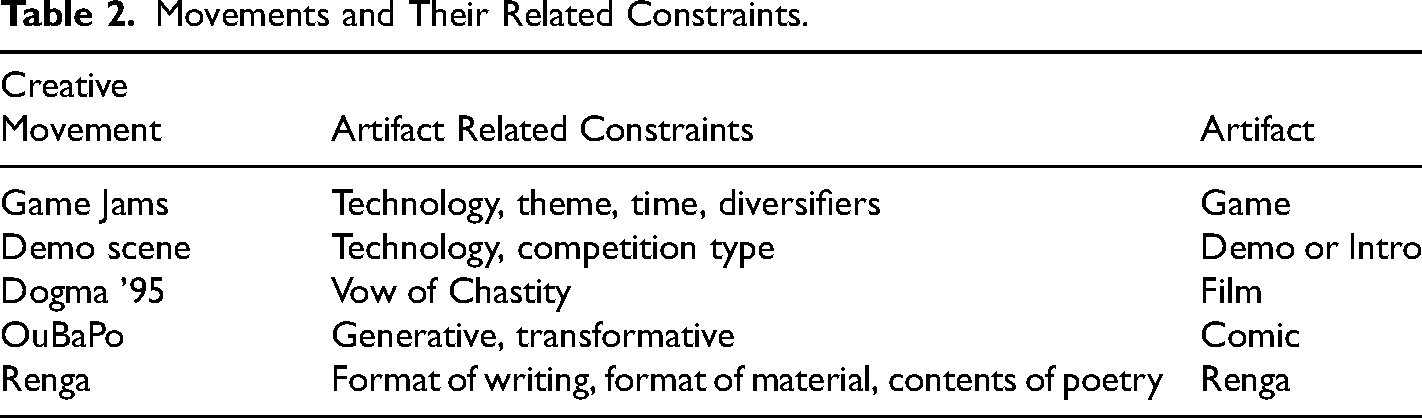
Looking at Table 2, we see that one thing that the all creative five movements have in common is the embracing of formal constraints. This connects well with Moeran’s focus on the importance of constraints as well Von Trier & Vinterberg (1995).
It is tempting to highlight the creation of an artifact as something that ties the creative movements together, especially as Moeran’s definition is particularly production oriented. However, looking at Moeran’s six types of constraints they all describe under which conditions an artifact is being made, and do not focus on what is being made. This ties well into how (Grace, 2016) says that “the language used to describe many game jams the focus is not as much on the product as the process.” Grace continues: “The game’s viability is not essential, only that it was made within the constrains provided by the community.”
Thus we find that while all these movements produce an artifact, the process of (constrained) creativity in the creation of something is the important factor. As in game jams or a casual evening of renga, the artifact itself can be ephemeral, and its existence is only important as a focus for channeling creativity.
Participatory Elements
One point that we haven’t touched upon yet, is how game jams and the other creative movements described in this paper hold elements of participatory design. While it is entirely possible for a game jam to consist of just one person, the majority of game jams contain strong elements of participatory design, from beginning to end, such as starting with agreeing on a common theme (e.g., Ludum Dare (Howland, 2001)), communal pitching and group forming exercises, games being made by multi-disciplinary teams, teams are often quite democratically structured with all skill-sets having equal input on the game, other teams acting as end-users giving feedback to each other, and games being presented at the end to other teams and the public. Though many game jams productions are made publicly available after the events, in practice, most game jam prototypes are abandoned, and thus the game jam participants who try, judge, and feedback to each others’ games make a closed loop, and participants end up playing the role of several types of stakeholders.
While we are the first to connect game jams with participatory design elements, several works have studied general game development in connection with participatory design practices. Wanick & Bitelo (2020) provided a survey on participatory design literature for game design. In the other direction, game design have also been used to explore participatory practices (Muller et al., 1994).
Looking at the other four movements, they all contain participatory elements. The demo scene is perhaps the most similar to game jams in regards to how feedback and communication are promoted at events, between and internally in teams. The demo scene has a more competitive structure than game jams, in that productions are often prepared by teams beforehand, or at least be mostly done by the time the demo party starts. On the other hand, the end-users or viewers of demo productions, are most often demo creators themselves, and there is a strong sense of community, dissemination of ideas through events and zines, and it is easy to catch up on the latest trends.
As seen in the Dogma ’95 Manifesto (Von Trier & Vinterberg, 1995) and the accompanying Vow of Chastity (Von Trier & Vinterberg, 1995), dogma films are made in quite a democratic way, a co-creative camaraderie brought about by formal constraints—the director is not supposed to be credited, swear not to be an artist and declare that the moment is more important than the whole. In addition to other constraints such as not being allowed to bring in props, not to add artificial lighting and sound, etc., this suggests a setting where actors are trusted to contribute to the film with their own perspective and personality. Similarly, since the camera is handheld, light cannot be artificial and sound cannot be added after, the work of people who are not usually highlighted so much in film productions, such as the camera person, lighting expert and sound designer become more present in the moment on location. All postproduction is disallowed, so everything stays as it is in the instant it was made. In that sense, the whole film production becomes a participatory design affair as the director is present, but their role steps into the background. Even the set itself ends up becoming a stakeholder in the production, as the team is not allowed to bring props on-site.
Except for a master and a scribe, renga parties mainly consisted of the participants. Though competitive, with the defining terms set out by the master, the ping-pong between poets forms a perfect co-creative democratic circle, where poets create an artifact, the poem, together.
Like game jam prototypes, OuBaPo comics stand out in how they have the potential to connect the creator and the reader. For example, like game jam prototypes, which are by their very nature, subjective interpretable experiences, the comics of the OuBaPo group add an extra co-creative layer, where the reader/player takes an existing artifact with its specific constraints, and creates their own personalized design. Not all comics of this group have this possibility, as it depends on the constraints used, as only some of the constraints reach across the page on how they interact with the reader. An example of a constraint that works like this is given by Kuhlman (2010) as strips which “can be read both left to right, and top to bottom in a grid” (2010, p. 131). The comics were far from always the creation of a lone artist. Instead, the artists would often work on a comic album or series of strips together, starting with the same constraints. Examples include Mickey All-Stars (Alfred et al., 2020), a celebration of Mickey Mouse’s 90th birthday, where each artist had a page to design a strip. The constraint is that Mickey had to enter through a door at the beginning and exit through a door at the end. Working to the same constraint, is similar to how game jammers work from the same starting theme or renga participants co-creatively bring a poem into existence.
Discussion and Conclusion
As game jams have become ubiquitous inside and outside the games industry, there is a need to strengthen the theoretical foundations. Our contribution has been to tie existing definitions of game jamming and creativity together, by combining the theories of (Kultima, 2015) and (Moeran, 2009). Secondly, to further strengthen and tie those creative foundations to a theoretical basis, we compared and found commonalities between game jams and the four constraints-driven movements Dogma’ 95, the demo scene, OuBaPo, as well as renga poets. We argued that while these creative movements all produce artifacts, what actually connects them is the creative participatory formally constrained process and not the characteristics of any potential output.
While game jams work well as historic anchor points, a future version of this study should broaden its scope and collect formal constraints-driven creativity under one umbrella, and link those in a study of timeline, participants, format, contents, and general study of the events’ or movements’ historic contexts.
All five movements described in this paper are formally constrained, creative participatory activities that produce an artifact. There is still further work to be done to make sure that these commonalities are the only necessary and sufficient conditions to enter into our timeline of game jam-related movements. We can ask if the identified categorization is too broad to be interesting, and/or can we imagine movements that match this description, but that we can argue are not related to game jams? In that case, such a discourse could help us narrow down and further define the scope of our on-going study even more.
Likewise, Moeran’s definition of a creative activity is fabrication-oriented, almost reminding us of Marx’ modes of production and the constraints on the workers and their processes described and implied therein. Could we also apply other theories of creativity and combine them with the game jam definition, and still include a similar set of movements? How do these theories combine with Moeran’s in this context?
Footnotes
Acknowledgements
Thank you to Dr. Jeanette Falk Olesen and Professor Kim Halskov for arranging the Summer PIT 2017 Workshop on Hackathons, Game Jams, The Demo Scene and other kinds of rapid design events,[1] which provided part of the foundational idea layer for this work.
Thank you to an associate professor Reiji Suzuki for our chats on similarities between game jams and the renga movement.
Declaration of Conflicting Interests
The author(s) declared no potential conflicts of interest with respect to the research, authorship, and/or publication of this article.
Funding
The author(s) disclosed receipt of the following financial support for the research, authorship, and/or publication of this article: This work was funded in part by the EPSRC Centre for Doctoral Training in Intelligent Games & Game Intelligence (IGGI) EP/L015846/1.
Notes
Author Biographies
