



Abstract
Games are valuable cultural phenomena — they might indicate social, cultural, and even political trends and agendas. Moreover, they might bare an accurate representation of a common structure of a feeling. Conversely, video games might be studied and understood based on up-to-date cultural trends, one of which is metamodernism. This paper contributes to determining what metamodern games in terms of synopsis and gameplay are. After considering the methodological features of studying video games from a metamodern perspective, it presents a metamodern study case of Hideo Kojima's Death Stranding. Examining oscillation, empathy, constructionism, and object-oriented relations in Kojima's game, the paper proves it to be a shining example of metamodern gaming. Furthermore, analyzing Death Stranding gameplay features from a metamodern perspective determines metamodern-related gameplay elements and strategies.
Introduction
The ways of modern cultural product analysis and description are at least as multifaceted as these cultural products are. Though we see some coherent trends in literature, music, photography, art, architecture, cinema, video games, and even mass media, they are being described through the lens of multiple concepts. Unlike postmodernism, acknowledged as the cultural logic of late capitalism (Jameson, 1991), post-postmodernism seems to be a new ‘umbrella term,’ including many different strategies for describing the products of art and culture. To name a few, it includes pseudomodernism (Kirby, 2006), digimodernism (Kirby, 2009), hypermodernism (Virilio, 2000), performatism (Eshelman, 2008), altermodernism (Bourriaud, 2009), metamodernism (Vermeulen & van den Akker, 2010) and automodernity (Samuels, 2009). Given that those cultural products vary tremendously (see Morgado, 2014 for the detailed overview), such vastness was needed to provide methodological space to those who will dare to analyze them now. Moreover, each of these multiple attempts to describe today's world is needed to provide a detailed and comprehensive model.
Metamodern seems to be the most growing and expanding among those concepts. Besides becoming a trendy word to reflect on new products, it is a popular subject of academic debate, embodied in websites (https://metamoderna.org; https://whatismetamodern.com/), associations (Arts and Humanities Research Council Metamodernism Network), conferences and publications, numerous checklists of ‘metamodernity’ (see Freinacht, 2015; Timmer, 2010) and interviews with academics studying it (Syundukov & Svishchenko, 2016). Significantly, the term is also used by those creating art products (see Puchko, 2022). Why so? One of the explanations would be that metamodern simply fits to describe contemporary culture. Another one is that it is elaborated enough to explain specific cultural product features and elements (though this assumption seems slightly preliminary). Finally, it is crucial that metamodern aims describing the ‘structure of a feeling’ (Vermeulen & van den Akker, 2010, pp. 1–2) rather than the world, society, level of technology, or the way these technologies affect the culture. Following this strategy introduced by Frederick Jameson (1991), metamodern is descriptive on the most basic level of cultural process drivers — feelings and societal desires of human beings. From this general and abstract level, metamodern concepts describe today's cultural world in specific terms, simultaneously absorbing features and elements of other branches of the post-postmodern tree. Despite the limited criticism (Eve, 2012; Kardash, 2019), it continues to develop and grow, expanding the horizons of the academic debate (see van den Akker et al., 2017). It is applicable and efficient for analyzing different cultural objects, revealing their inner logic, the structure of a feeling, focus, and aspiration.
This paper is doing just that — applying metamodernism to understand better one of the most significant video games of last years — Hideo Kojima's Death Stranding (Kojima Productions, 2019). It aims to reveal the game messages, how they work and collide, and what has made it outstanding in the game design landscape of the last few years. Being extremely complicated and meaningful, Death Stranding rapidly divided the audience and fostered intense discussions on its messages and the level of success in delivering them. Though Metacritic users’ score rated the game 7.8 out of 10 for the exceptional experience and incredible story, it has also been considered boring, monotonous, and repetitive. 1 Similarly, critical reviews mentioned that the game “can’t consistently get the balance right despite possessing equally lofty ambitions and countless inventive ideas” (Ogilvie, 2019) and “imbued monotony with the intangible subjects of the extraordinary” (Maher & Lynch, 2021). They also addressed the game as “both breathtaking and boring” (Webster, 2019), particularly mentioning the plot as its “weak link” (Kelly, 2020).
Studying Death Stranding as an essential piece of modern culture will shed new light on Kojima's product's values, concepts, and messages. I analyze Death Stranding from a metamodern perspective to provide its cultural understanding and locate it in contemporary art. To a large extent, this analytical method is transdisciplinary: it allows performing the literary analysis of the video game, leaving the space to discuss specific gameplay mechanics.
Another aim of this text is to take part in the search for metamodern gaming specific elements and the ways they are expressed in Death Stranding gameplay. “In order for the concept of metamodernism to possess explanatory power for not just the theorist but also the critic of culture, however, the usefulness of the category must be able to be demonstrated at a deeper level than synopsis alone — that is: at the level of specific textual detail which is the proper realm of criticism” (MacDowell, 2017, pp. 26). I am trying to contribute to the issue from the perspective of video gaming, searching for those exclusive features that indicate metamodernism in a much different type of art products. This requires an accurate and solid methodological approach that will carefully adapt metamodern concepts to the needs of this specific study.
Methods and Metamodernism
Methodological Note
Using a large-scale concept, such as metamodern, to characterize a specific cultural product, I analyze it deductively. I define and describe metamodern through its characteristic features in the first step, using the concepts and ideas of Timotheus Vermeulen and Robin van den Akker (2010, 2015) and other scholars who worked on the topic. Onward, I define the particular elements these features express themselves through. Finally, I search for the specific imprints of these elements in the product I am working with to conclude whether something ‘is’ metamodern and in what way (Figure 1). Doing that for videogames, I am utilizing the methodological setup of close reading — an established strategy of textual analysis, that has been recognized as an effective way of analyzing video games (Fernandez-Vara, 2015). Close reading implies “a detailed examination, deconstruction and analysis of a media text” to “excavate previously hidden qualities of a media artifact” (Bizzocchi & Tanenbaum, 2011, p. 289). For this research I am focused specifically on applying close-reading to determine and analyze metamodern features of Death Stranding as they defined further.
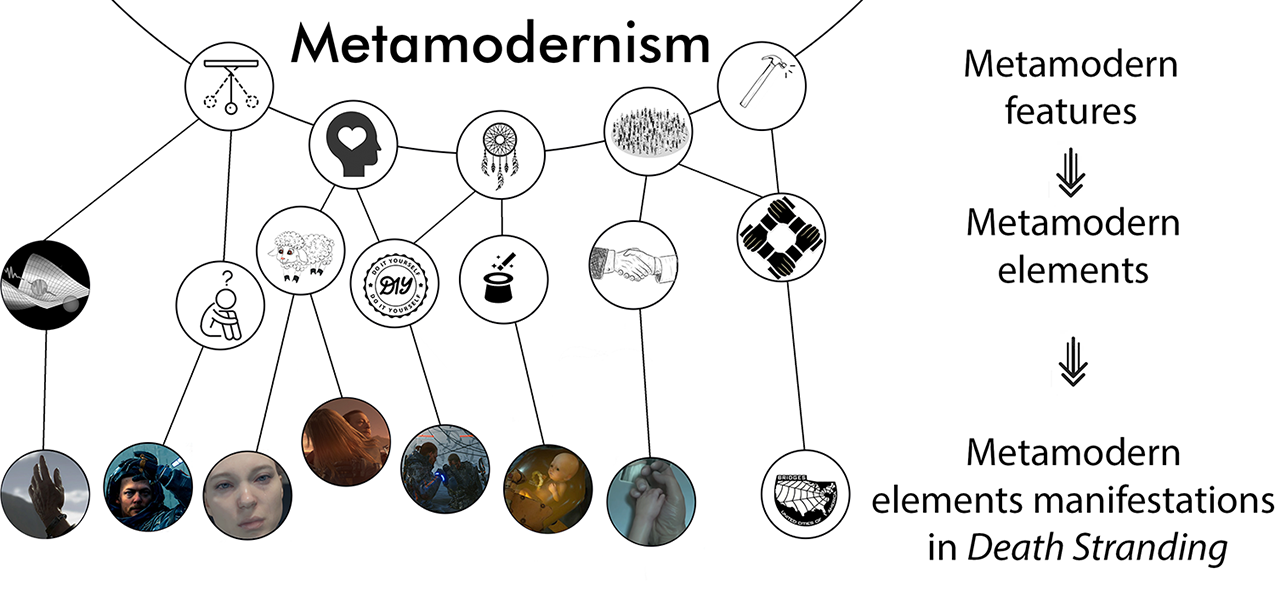
Conceptual scheme of the methodology of this study.
One of the tremendous methodological concerns regarding metamodernism and its applicability to the analysis of different cultural products is the unconsciousness of the research methodology when it comes to the empiric study. On the one hand, the broadness of the concept and multiplicity of ‘metamodern features lists’ makes the methods we use in our research diverse and incoherent, introducing different aspects of studied phenomena but producing barely comparable data in exchange. Even though the basic concepts are probably the same, the number of facets prevents almost all summarization of research efforts. This issue, however, sometimes remains hidden due to the scarcity of clarity regarding specific research methodologies. In order to provide methodological coherence to the issue, at least for the small dataset, this research follows the methodological structure already adopted and tested for analyzing literature pieces (Radchenko, 2019; Radchenko, 2023) and video games (Radchenko, 2020). Though the details of defining specific elements of metamodernism elaborated and slightly changed over the last four years, the basic definitions and the overall approach remain the same.
On the other hand, it is crucial to adjust the methodology to the specific type of cultural products we are discussing. In a broad sense, metamodern features are the same disregarding the study case. Therefore, every cultural product close to being defined as ‘metamodern’ might be described with the general ‘feature checklist.’ However, the elements these features express themselves through might vary for literature, cinema, architecture, video games, etc. As the literature study represents the fundamental analysis of the synopsis and narrative strategies, the methodological solution is comparatively well-developed (see Gibbons, 2015; Gibbons, 2017; Moraru, 2013). However, the simple application of this approach to the study of other cultural products does not lead to the desired level of their understanding, as it is straightforward for cinema (see MacDowell, 2017; Rustad & Schwind, 2017), contemporary crafts (van Tuinen, 2017), and video games (Radchenko, 2020). Particular progress has been made recently in defining the specific metamodern strategies in moviemaking and arts (Dember, 2018). Some of Raoul Eshelman's ideas on performatism fit the analysis of metamodern photography (and possibly, other kinds of visual arts; see Eshelman, 2008, 2017).
Regarding video games, one needs to search for specific gameplay solutions that would express different elements of metamodernism by their nature. This is because video game, or cybertext, is not only a text that “produces verbal structures for aesthetic effect” (Aarseth, 1997, p. 3). It also “centers attention on the consumer, or user, of the text, as a more integrated figure than even reader-response theorists would claim” and proposes “…physical construction that the various concepts of “reading” do not account for” (Aarseth, 1997, p. 1). Unlike literature or cinema, this product involves a third party — a player, who constantly doubts, feels and travels with the plot characters. Thus, video games almost exclusively give their customer a greater extent of constructive power on a level that is barely comparable with other arts (except for several specific products — i.e., I Ching, Rayuela by Julio Cortazar and Milorad's Pavic novels). This is evident for those projects that provide a gamer with spatial freedom (i.e., The Witcher 3: Wild Hunt (CD Project RED, 2015)), power to affect the storyline (i.e., Detroit: Become Human (Quantic Dream, 2018)) or freedom to interact with other players on the net (i.e., World of Warcraft (Blizzard Entertainment, 2004)). This incorporation “creates the potential for a more intense emotional experience, whether satisfying or frustrating, than non-ergodic media provide” (Calleja, 2011, p. 135). Such immersion opens new horizons in transferring messages and emotions to the user and must be considered during the study of video games as cultural products.
Metamodernism as Analytical Tool
For over a decade, metamodernism has been defined as a structure of a new feeling. It has been outlined and developed by a solid amount of research and overviews. All of them are trying to be somewhat more descriptive than prescriptive and, following the claims of Vermeulen and van den Akker, do not aim to create any kind of theory, strategy, or philosophy (Vermeulen & van den Akker, 2015). Briefly described, the metamodern feeling might be outlined as a struggle to [re]construct the structures after the long holidays of deconstruction (Huber, 2014, p. 7). This [re]construction cannot be done by ironic self-sufficient postmodern heroes that desire to stay alone and avoid being close to one another. On the contrary, it requires people to stay together, bringing a “structural desire for ‘we’ (a desire for connectivity and sociality)” (Timmer, 2010, p. 359). This connectivity is enabled through the new level of emotionality and sincerity, one of the dominant pieces of metamodern feeling. It has been described in terms of new sincerity (Wallace, 1993) or, more elaborated, return of affect / metamodern affect (Gibbons, 2017). However, as this constructive agenda is constantly crashing over postmodern irony, skepticism, and disbelief, the dominant feeling of the time is a metamodern oscillation between optimism and pessimism, construction and deconstruction, modern and postmodern. “Metamodernism … oscillates between a modern enthusiasm and a postmodern irony, hope and melancholy, between naïveté and knowingness, empathy and apathy, unity and plurality, totality and fragmentation, purity, and ambiguity. Indeed, by oscillating to and fro or back and forth, the metamodern negotiates between the modern and the postmodern” (Vermeulen & van den Akker, 2010, pp. 5–6). This very general frame was elaborated and upgraded with the (not exhaustive) list of metamodern trends, such as “postirony, constructive participation endeavors, a communicative form of affect, craft development, and storytelling” (Syundukov & Svishchenko, 2016). All in all, it comes to the following main features to be revealed in the metamodern cultural products:
Oscillation between modern and postmodern, old and new, skepticism and faith, and other poles. The reason for doubts and oscillation lies in a desire to search for the truth, for the depth of the ‘third dimension’ (Dempsey, 2015), while the postmodern experience teaches us that such a search is fruitless. The consequence is the nostalgia for the good old days of postmodern skepticism when avoiding adopting a position and staying neutral were efficient. Recent advances in the study of metamodern oscillation expanded its assessment beyond the simple pendulum, introducing its four modes — structural oscillation, braiding, juxtaposition, and hermeneutic oscillation (Dember, 2023). The latter is of particular interest as it describes the movement in the audience's perception of the object — a vital matter considering the incorporative nature of video games. The metamodern affect, which is a crucial idea, lies in understanding that “irony, poker-faced silence, and fear of ridicule are distinctive of … features of contemporary U.S. culture” (Wallace, 1993, p. 171), so feeling and sharing become very important again. Thus, a metamodern text is intended to be emotional and provoke emotions simultaneously. “The post-postmodern novel is not ‘beyond irony,’ or itself completely ‘irony-free,’ but it no longer uses irony as the default ‘language’, irony is no longer the cultural convention or cultural norm in the novel itself” (Timmer, 2010, p. 360). As metamodern characters can no longer be ironic and skeptical, they need to have faith in something, for instance, in the endless search for the truth. As the affect and desire to search arise, new heroes no longer want to be sarcastic postmodern loners. Instead, they struggle to belong to some structure or system, to be together. The will to belong to some social formation is connected to the need for sharing emotions and choosing a side — because belief is always about choosing sides. Metamodernism reinvents social rules, and hierarchies considered flawed and silly during the postmodern era. Of great importance is the constructive nature of metamodern. This is the reason for and the consequence of all other aspects. As destructive postmodernism left the social and cultural horizons empty, there is a need to [re]construct, [re]invent a new truth, new sincerity, new sociality, and new systems. It is essential to share and belong to something, and yet, without emotional sharing, sociality, and efficient communication, the construction of a new world is impossible. Consequently, constructive participation and search are the metamodern worldview's main aspects (Radchenko, 2020, pp. 249—250). Last but not least, object-oriented ontology seems to be the natural pairing to the metamodernism that follows it in different cultural aspects. As it suggests belief in the objects’ independent agency and ability to transform the environment (Harman, 2005), characters inevitably exist in the magical or mystical world, surrounded by objects they do not understand. Why some objects or natural phenomena perform in the way they do is not the question anymore, as they are free and capable of any kind of active agency. Such a concept requires trust and respect — strains brought back by the metamodern affect (Nezabytovskyi & Radchenko, 2022). Considering object-oriented ontology as a pairing to the metamodern structure of feeling gives a different explaining potential to the theory as a whole.
These five metamodern features — constructivism, social connectivity, metamodern affect, metamodern oscillation, and object-oriented ontology — are represented through the numerous elements that appear in particular products and are the objects of this study. Constructionism leads to the desire for the creation or [re]construction of social structures, unification, and will to build something more significant, even if the result is not observable directly (‘think global — act local’). A structural desire for ‘we’ brings the will to communicate and build bridges between human beings. Moreover, it makes metamodernists uncomfortable to be alone and feel weak without one another. Metamodern affect brings emotional and passionate characters to the screen. Not only are they not afraid to express their feeling, but their motivation is also wholly dependent on their emotions in particular moments. It enriches metamodern texts with nostalgia and naiveté. Intertextuality in metamodernism contributes to this very function — it is a ground for mutual understanding and emotional cohesion between the text, the author, and the reader (Radchenko, 2022). Oscillation forces characters to doubt, change their mind and vacillate in their tune and decisions. It forces them to ask questions and be anxious about the world, their path, and the meaning of their struggle. Moreover, as it means more than a simple pendulum, it often brings the whole world to the “meta” state — in-between opposite conditions, “here and there,” “dead and alive,” etc.
Moreover, “oscillation might be introduced not by movement within the object or a character, but in the audience [emotional] response to the subject” (Dember, 2023) or other complex relations between modernism and postmodernism. Finally, an agency of objects leads to their perception as ‘more than the objects,’ negotiating with them, and an excellent level of caution regarding the powers and structures they do not entirely know or understand. Furthermore, craft development is also a part of object-oriented thinking — since the craft objects introduce themselves through their specific personal value. This intermingles with the craft to manifest the new sincerity — hand-made products seem more “sincere” and original than regular ones.
The research methodology utilizes the abovementioned features to determine video games’ metamodern aspects. The selection of this particular analytical setting is based on the general theoretical frame of metamodern studies (as presented by Vermeulen & van den Akker, 2010; van den Akker et al., 2017). It has been coined and tested by Radchenko for contemporary literature (2019, 2022) and video games (2020). Previous research showed that by absorbing of and referring to different elements of metamodern settings, this selection holistically structures metamodern features for game studies. However, in this research, the framework is upgraded and expanded according to the recent advances in metamodern studies to include object-oriented ontology as an essential part of the metamodern frame (as shown in Nezabytovskyi & Radchenko, 2022). Further analysis is based on searching and interpreting these elements in the specific video game — including its synopsis, narrative strategies, and gameplay mechanics. The latter is of particular interest as they can show the uniqueness of metamodern solutions applied to the cybertext. The way these elements appear in Death Stranding will indicate the presence of specific metamodern features and, thus, the whole game's metamodern nature.
Metamodernism in Death Stranding
In the landscape of AAA projects of recent years, Death Stranding appears to be quite a unique one. Hideo Kojima's first product after he left Konami Studios was, upon its release, considered ambiguously and titled a divisive game (Kelly, 2020) and sometimes losing the balance between realism and escapism (Ogilvie, 2021). “Fans – as well as critics – are split between hailing it as a masterpiece or labeling it downright boring” (Sevak, 2021a). What was beyond dispute is that Death Stranding is a talented game by a talented author (Bose, 2021). Moreover, its “courage to be different” (Sevak, 2021b) was noticed and appreciated both by critics and users. No wonder such a unique and intensively discussed piece of modern culture drew the scholars’ attention and fostered the study of its narrative strategies (Bostan & Aker, 2022), political and social message (Kurasov, 2022), and post-apocalyptic landscapes (Kagen, 2022). Amy M. Green explored Death Stranding's work in-depth with themes of ruin, nostalgia, and connection, providing a solid study of the game's central messages and topics (2021). All these studies outline the interest in Kojima's game and provide a solid background to locating it on the map of modern culture, defining if Death Stranding is a metamodern by its nature, plot, and gameplay features.
The game places us in post-apocalyptic America, some decades after the cataclysmic event known as “Death Stranding” broke the regular flow of history. Due to that event, invisible creatures originating from “the Beach” (a uniquely personal space that each being visits during the near-death moments throughout its life) — Beach Things (BTs) — wander the Earth's landscapes and cause timefalls. Consuming a living (or recently past) human being, BTs provoke a massive explosion called “the voidout” that provokes even more timefalls and deaths. The catastrophe destroyed the countries’ infrastructure and reduced the possible living spaces to separate locations, known as “Knot Cities,” forming the remaining “United Cities of America.”
Under such circumstances, the courier profession becomes topical, risky, and crucial to the cities survival. The game protagonist, Sam Porter Bridges, is a freelance courier who takes a big quest to connect all Uniting Cities of America into one network during his travel to the West, where he must find a future nation leader — his estranged sister Amelie. Sam's reluctant consent starts a giant quest for America unification.
In terms of narration mode, Death Stranding is the third-face adventure with external focalization that sometimes switches to internal (Arjoranta, 2017), showing Sam's subconscious, dreams, and personal Beach. Neither Sam nor any other active character is the narrator, which remains hidden behind the scenes. This choice of protagonist and his role makes a game, basically, a hiking simulator, generously watered down with abundant cut-scenes (the game contains more than eleven hours of video cuts). Such a concept made the gameplay perception monotonous and boring at first glance. However, after further look, it feels engaging and entertaining enough to go through the entire game (Bose, 2021; Kelly, 2020; Sevak, 2021a). As Sam progresses along the quest, he receives new weapons and means of transportation with tons of plot information and cut-scenes while approaching the endgame.
Constructionism
The overall formulation of Amelie's — and thus Sam's — quest brings constructionism to the table. Amelie is focused on reforming and recreating America to make the devastated country whole again. As Sam proceeds with searching for his sister, he connects more and more cities to the “Chiral network” (in-game analog of the Internet), creating a net of United Cities of America. This is the ultimate goal of most people Sam meets on his way (except for several antagonists) — recreating and reconstructing their world and country. Thus, all members of the “Bridges” — an organization that hires Sam and helps him throughout his quest — are dreaming of reconstruction. They articulate it in a pronounced and distinct manner, saying that what Sam is doing is helping to “reconnect … make America whole … [I]f we don’t come together again, humanity will not survive… Alone we have no future” (Kojima Productions, 2019, Bridget) or “reconstruct, like the dinosaur from the fossil” (Kojima Productions, 2019, Heartman). This concept is almost verbatim to Imtraud Huber's definition of post-postmodernism's goals: “After desire for deconstruction, it seeks to be [re]construct” (Huber, 2014, p. 7).
As Die-Hardman puts it, “For too long we lived as strangers to one another, divided by walls built to keep us safe. But now, with the completion of the chiral network, we may at last move forward as a people united. Today, we come together to celebrate the birth of a new nation … let there be no walls between us, nor masks to hide who we are” (Kojima Productions, 2019).
Such devotion to constructionism is not only part of Death Stranding's story. It is also actively embedded in the gameplay, making it a remarkable constructive feature of the game. Though single-played, it bears the mechanics of creating a mutual space by distant and unacquainted players. Sam can spend some of his resources building structures, simplifying traveling between locations — bridges, stairways, etc. Once the player connects the central Knot of the location to the Chiral network, he can see and use other players’ constructions, significantly simplifying the gameplay — and share his own ones. Considering the amount of backtracking and the general monotonous nature of the gameplay, such a feature is incredibly helpful and time-saving. Moreover, distant players can share reactions to the specific space modification, evaluating the impact and efficiency. Thus, the game creates a community of shared practice of world inhabitation that changes the gameplay and forces to appreciate other players’ efforts, helping to overcome the complexity and bore of gameplay solutions.
Struggle to Belong to the Social Structures or Systems
These mottos, ideas, and actions explicitly describe Sam's role as manifested by gameplay — as he moves from one location to another, he builds bridges (connections) between different groups of people, connecting them into an extensive network. Some of them are initially opposing, but the general feeling is that “if all the motherfucking terrorists are coming together like one big happy family, might be time for us to do the same” (Kojima Productions, 2019, Craftsman), and its time to become “whole again.” The game is filled with metaphors for connection and “bridging,” starting from the main character's last name and United Cities of America toponyms (knots) to the plugging in Bridge Babies — devices for sensing and detecting the Beach Things, consisting of the fetuses of human being that have been taken from the brain dead mothers (that amplifies fears and stress sharing memories and emotions to the user) — and an umbilical cord as a symbol of connection.
Therefore, the game NPCs also struggle for reconnection and “desire for ‘we.’” One of the main ideas that foster the plot development and affect Sam is that “living is no different from being dead if you’re all alone” (Kojima Productions, 2019, Amelie). Fragile chooses to be together, having a common path even though their goals are different and reuniting to face their mutual antagonist — just like New Yorkers described by the metamodern “Bleeding Edge” by Thomas Pynchon (Radchenko, 2019); Mama's choice is to reconnect with living, not dead, to continue her life and work.
Metamodern Affect
It is hard to describe this passion for being together in postmodern terms. Moreover, decisions to reunite are usually connected to vulnerability, or ‘defenselessness’ (Timmer, 2017) — being sincere, honest, and open to others. Such a state is brought by the return of emotional affect and the game's overall tone. Each important NPC Sam meets during his travel has its own emotional personal story he will inevitably share. Moreover, stories are accentuated by the game's conditional division into chapters, titled after these characters’ names. They will likely have close-up scenes and share the whole spectrum of emotional vulnerability with other characters and the player themselves. This also applies to Sam — losing his wife and foreseen child due to a voidout made him withdrawn and grim… and fostered the emotional connection to his Bridge Baby, Lou. Moreover, Sam accepts the main quest due to his personal issues (same as Mama, Fragile, and Unger) — his will to find Amelie as she is essential to him. His explanation is empathic and emotional in the deepest possible sense: “… the only thing I cared about was making it to the next sunrise. Sure as hell didn’t care about America, or “The Future.” I was living a lie, hung up on past regrets. I was broken. But somewhere along the way, I started changing. I started meeting people that made me think that maybe it was not all bad. People that put their faith in tomorrow and me. That kept the lights on and waited for hope to arrive” (Kojima Productions, 2019, Sam). This transformation is embedded into Sam's psyche — his haphephobia (fear of being touched) fades as the plot develops. Finally, the culmination of the game pushes him to hug the antagonist, making empathy the main driver of the optimistic game's ending. Moreover, as in another metamodern video game, “The Last of Us” (Radchenko, 2020), the game does not leave the choice to the player — sharing emotions, beings vulnerable, and hugging despite haphephobia is the only possible way to move the game further. Only one way leading to the world's survival is a metamodern idea per se. Here it featured the struggle for emotional affect. Last but not least, the source of positive emotions and affect — oxytocin — is an essential component of the Knots’ everyday life that keeps them emotionally sustainable.
Besides all that, the specific features of the empathy game (Jerret et al., 2021) are powered by emotions and affect. Some of Death Stranding's landscapes are brought to life by Clifford Unger's “enduring emotional attachments” (Kojima Productions, 2019, Deadman). Moreover, NPCs and distant gamers can reward players with their ‘likes.’ There are not only the source of oxytocin but also the experience points and the strengthening component of the connection between players. The likes you receive for your actions, and your constructions shared with others are needed to develop, build more, and see more of other players’ impacts on the world. Therefore ‘liking’ and ‘sharing emotions’ are essential components of the “community of shared practice,” which transforms gameplay, making Death Stranding empathy-focused gameplay.
One brighter example of such gameplay and the metamodern affect in the game is given by the relationships between Sam (the protagonist) and his Bridge baby. It is represented not only by the solid emotional affection the protagonist experiences towards his BB, treating it like a child instead of just using it as equipment (as Deadman suggested) but also by the presence of specific actions to comfort and take care of the kid. The BB can experience and express emotions and might be stressed by the events around him. Lou starts crying if Sam is not careful during his journey or takes a hard fall. To fix it, the player can soothe the baby by moving his controller at a steady pace and thus cradle the fetus. This gameplay feature is illustrative of meta-cute mechanics — imitation of expressions of love and care with the controller to reach further the player's emotional incorporation — fits perfectly to the definition of metamodern affect. The connection that emerges between Sam and Bridge Baby is emphasized by several hours of gameplay without the device when the player faces how useful and efficient BB actually is.
Oscillation
However, this linear affection to empathy, society, and reconstruction does not necessarily means that the game is deprived of metamodern oscillation. It is revealed in several different aspects of Death Stranding. To begin with, Sam's transformation is not instant. On the contrary, he is the hero of doubts, tormented between his desire to step aside and the will to help Amelie. Even though this decision is made comparatively quickly (especially considering the overall length of the game), he continues to avoid direct associations with The Bridges and its team, escapes the Deadman friendship, and tries to be enclosed and safe from the affective involvement in his quest. As the game proceeds, he becomes more and more incorporated in the process, obtaining will and hope, and thus, moving towards construction, awareness, and involvement from his postmodern safety and self-sufficiency. More fundamental questions remain unanswered even though a specific decision has been made. One of them is ethical: does the Chiral network ‘good’ (or ‘worth it’) if brought by the conscious sacrificing Bridge Babies? Is it acceptable to sacrifice them for the benefits the Chiral network gives? Though the quick answer seems to be positive, the general doubt persists.
Another discussion point is existential, with a strong relation to the Camus philosophy: Do human beings (particularly The Bridges) need to fight to prevent the extinction that is meant to be? Should they stay in the way of natural processes? And if yes, what losses are acceptable? Here the game answers univocal, without giving the freedom of choice to the player. However, the presence of doubts of this kind indicates metamodern text.
Another sign of oscillation in the game is the easily traceable juxtaposition between life and death in the setting and the characters’ faith. Starting with Sam, who is repatriate, meaning his soul always returns to his body, whatever happens, NPCs are placed right in-between life and death, living their ‘metalife.’ The world is in a similar state as it struggles from the timefalls that break the temporality and mix the future and the past. The NPCs’ ideas manifest this ambivalence and juxtaposition of life and death or past and future: “The past informs the present and aids us in building the future” (Kojima Productions, 2019, Heartman). Moreover, it is symbolized in several concepts and objects: “umbilical cord” is a metaphor and, in its most immediate sense, provides the connection between life and death; BBs (bridge babies) are neither alive nor dead. The same might be stated of game characters: Fragile is suffered from timefall being both young and old; Heartman is regularly ‘dying’ by stopping his heart to search for his family on the Beach; Deadman is a “Frankenstein's monster” (Kojima Productions, 2019, Deadman), composed from the dead people's organs; Mama is connected to her dead child with the umbilical cord, constantly feeding a dead being, etc. Neither normal human beings nor dead ones, they are a new rendition of zombies, featured with emotional and ethical judgments (Kraft, 2022). As the world's past is the way to [re]build a future, their death is a way to live.
Object-Oriented Ontology
As magic as the presence of real-life zombies can be, other objects throughout the game show their own magical power, agency, and active role in the world curation and transformation — those values one seeks to characterize through the position of object-oriented ontology and object-oriented relations between human and non-human beings. Death Stranding is full of magical and mystical objects starting from the Bridge Babies, who are both human beings and equipment. Sometimes the magic is ‘justified’ by the advances of science before the voidout. However, as these advances are lost, and the object's agency is active and non-explainable, they are considered and treated as magic and require relevant respect. Some objects are even more valuable as they are “the symbols and agents of [Sam and Amelie's] connection … singular, irreplaceable totems — embodiments of [the]ir shared memories” (Kojima Productions, 2019, Heartman). This unexplainable materials and details are the main drivers of the plot. They are independent and vital, even though the game tries to act as post-apocalyptic fiction rather than fantasy. Negotiation with objects, trusting them, and being emotionally connected with them is barely possible in the postmodern world, while is easily explainable for metamodernism. It is noticeable that the most critical magical objects are not even trying to be ‘scientific’ — it is Sam's dreamcatcher and Amelie's quipu — handmade products of craft.
To some extent, the whole game is the same handmade product of craft — the one that features Hideo Kojima's unique style with self-irony, uniqueness, and the unbelievable efforts of many people to make it sincere. Unlike many other games, each cut scene is a subject of recognizable actors playing their roles (some characters are iconic to the specific actor) in their specific manner and with horrific attention to the tiniest details around them. This is coherent with the original crafted and licensed soundtrack. Last but not least, Hideo Kojima's passion for experiments is ironically featured with the naïve references to his classical products. The perfect example of such a nostalgic branded chip would be the gimmick fight between Sam and Higgs in the game's final part, cast in the best traditions of Metal Gear Solid 4 final boss fight. The way Kojima carefully builds up this scene in the middle of the almost solemn gameplay makes it a personal object of craft and an excellent point to finish Higgs's story.
All these features — constructionism, desire for ‘we,’ empathy and affect, oscillation, and object-oriented relations — work together to indicate one cultural and emotional concept or, simply saying, one structure of feeling. Metamodernism.
Conclusion
Games like Death Stranding are bright and noticeable in today's cultural landscape. They present a feeling and a cultural agenda that is being shared by many human beings across the world. Not only do they deserve to be considered and studied as cultural phenomena, but such study also appears valuable and fruitful for understanding modern culture and state-of-the-art in the field. Paying attention to them is vital and requires developing the testing appropriate methodology that would be relevant to our research questions.
Hideo Kojima carefully crafts his world and synopsis to bring us his main messages — connectivity and unification for the reconstruction's sake. His language is coherent — it aims to present the desire to [re]construct the world and avoid being alone through sincere emotions and defenselessness. Sharing all features of metamodernism, this language can be described as a metamodern one. It is expressed in the characters’ behavior, decisions, motives, and the whole world organization. Moreover, the personal and crafted nature of the game also contributes to the task. These metamodern features are embodied into several elements of metamodern feeling presented throughout the game and manifested in Death Stranding synopsis and gameplay.
Kojima shows his metamodern ideas through several strategies unique to video games. At the same time, these strategies contribute to the product's metamodern nature, forming the elements to look for during the further analysis of metamodern gaming. Thus, the analysis of Death Stranding reveals this metamodern game to be an empathy game with the meta-cute gameplay mechanics of love and care expression and the empathy-focused gameplay that creates a community of shared practice, where even the distant players feel constructively connected. These strategies (empathy-focused gameplay, meta-cute gameplay imitations of emotional affect, and the community of shared practice) are representative of what metamodern gameplay looks like. Together with the metamodern elements found in the game's plot, they give a solid basement to the reasoned and accurate study of what are modern video games in terms of the feeling structure they bring. Another vital aspect is that they created a complex and contextually-rich game that fits the players’ affect. It brings us hope, awareness, and emotions, just like Sam delivers oxytocin to the divided United Cities of America.
Footnotes
Acknowledgements
I am grateful to both anonymous reviewers for their useful suggestions for improving the paper. I would also like to thank Linda C. Ceriello and Greg Dember for many valuable discussions on the topic.
Declaration of Conflicting Interests
The author(s) declared no potential conflicts of interest with respect to the research, authorship, and/or publication of this article.
Funding
The author(s) received no financial support for the research, authorship, and/or publication of this article.
