



Abstract
Video games present a complex medium for the study of paratextuality due to their fringed textual, authorial, and material borders. This paper addresses how previous and current research in video game paratextuality informs analyzes of authorial intent, player agency, and materiality with regard to the text–paratexts relationship established in video games. The first part of this article revisits Genette's concept of paratexts in light of video game scholarship. It then offers a detailed analysis of authorial intent and player agency as well as materiality in terms of paratexts by looking at sandbox games, narrative games, and first-person shooter games as case study groups. Distinguishing between instances of high, medium, and low paratextuality shows that ancillary material is located at different distances from the text and with varying influence on its reception, proposing paratextuality as a gradient scale.
Introduction: Video Game Texts and Paratexts
When we engage with a video game, the experience we have of it is not only generated by the act of playing but also by material surrounding the game. A video game is not a fixed entity existing in a vacuum bare of history, culture, or society, but a complex network of different elements that require a player's conscious efforts to create meaning. We can appreciate video games as weaves that consist of a “text” created by the game maker(s) and expanded by our personal engagement with it. This is reminiscent of Gracia's proposition of an idea of text not restricted to any medium by defining it as “a group of entities, used as signs, which are selected, arranged, and intended by an author in a certain context to convey some specific meaning to an audience” (Gracia, 1995, p. 4). As such, this text forms relationships with other elements, either situated in close proximity to it or further away from it, termed paratexts by Genette (1991 [1987], 1997a [1982], 1997b [1987]). Paratextual elements are manifold in form and function as well as in the relationship they establish with a text, but connected in that they make the text itself visible to an audience and position it in a sociohistorical context. They thus possess a threshold function (Seiwald, 2021, p. 294), filling the spaces between the text, its producer(s), and its audience (Gray, 2010, p. 23). However, this gamut of forms of paratexts and paratextual relationships has also resulted in a spread of definitions to the effect that it is not always clear what is meant when we speak of paratextuality.
In the previous paragraph, I have used three terms that are closely related yet their different meanings will be important in the study that follows: paratextuality is the collective noun used to describe the complex of paratextual relationships established between a text and its ancillary material; paratext is a single instance of a text relating to another text; and paratextual is a characteristic a text possesses in relation to another text. In this article, I argue that paratextuality is expressed on a gradient scale of high, medium, and low, mapping authorial intent and player agency on one axis and materiality on the other axis. The study presented here is, therefore, a study of the intensity of the connections formed between a text and its surrounding material. The appreciation of paratexts as being located at varying distances from a text is important because it allows us to talk differently about different ancillary material without running the risk of either expanding the term paratext too far or excluding some texts. The use of proposing degrees of paratextuality is, therefore, that we gain a way of recognizing that links between texts and their individual paratexts are not equally strong. This is an important insight because the kind of relationship formed between a text and its paratexts influences how player perceive and engage with a game.
High paratextuality occurs if games grant players a large degree of freedom in world-building processes, notably through different kinds of materiality. The case study here will be sandbox games, with Minecraft (2011), No Man's Sky (2016), and Animal Crossing: New Horizons (2020) serving as examples. Medium paratextuality is present in narrative games that combine predefined stories with player agency in its implementation, which is often established through various forms of materiality. I will look at Dear Esther (2012), Gone Home (2013), and Red Dead Redemption II (2018), each of which allows players different degrees of freedom to form the game-as-text. Low paratextuality applies when players possess hardly any agency apart from executing the predesigned rules of the game. This mix of low player agency and low variation in materiality is notably pronounced in first-person shooter (FPS) games, and the examples here will be Half-Life 2 (2004), BioShock Infinite (2013), and Doom Eternal (2020). An illustration of the placement on this scale of the case study games for this article can be found at the beginning of the section “Degrees of Paratextuality,” which discusses the paratextuality of these games in more detail. The three case study genres help to illustrate the three degrees of paratextuality, but it is important to understand that different paratexts associated with a game can fall into different categories. For this reason, a linear diffuse gradient scale of paratextuality is presented, which considers the unique text–paratexts relationship of video games expressed in authorial intent and player agency on the horizontal axis and materiality on the vertical axis.
The discussion that follows addresses various text–paratexts relationships established in and around video games. I will begin by revisiting the basis of paratextuality studies, drawing upon Genette's analysis of the codex book medium, before shifting the focus to the critical engagement with the term and the concept in game studies. The introductory section defines what the text and paratexts of video games are and maps out the kinds of relationships formed between these elements. Next, I will introduce two layers of text–paratexts relationships central to games: the layer of authorial intent and player agency as well as the layer of materiality. These two theoretical sections are followed by case study analyses of groups of games by mapping degrees of paratextuality as high, medium, and low by combining both layers of textual relationships. These three degrees are valuable because they allow us to conceptualize the relationships between games and their paratexts in a spherical shape, placing a game at its center, with various paratexts orbiting it. They therefore enhance the current use of the paratextuality framework by demonstrating that there is a difference in intensity that paratexts possess. This view of paratextuality follows Dunne's proposition that “[paratexts] can be thought of effectively as a progressive spectrum that with each iteration either is closer to or further from the text” (Dunne, 2016, p. 281). Dunne's proposal also suggests that paratexts are prone to changes over time and in relation to other manuscripts to the effect that if we fix paratexts, we fix texts, thus ignoring their fluidity.
From a theoretical perspective, paratextuality is a concept that has attracted the interest of games scholars since the establishment of game studies as a discipline in 2001 (Aarseth, 2001). Recent interventions in game studies have encouraged critics to reflect on their usage of the terms paratext and paratextuality, which is a stance mostly driven by Barker (2017) and Švelch (2020). An earlier generation of games scholars, notably Consalvo (2007, 2017) and Jones (2008), have expanded the application of paratext to (almost) every element of and surrounding a game. For Jones, this means that video games are “predominantly paratextual. That is, the formerly limited role of the paratext, to serve as a threshold or transactional space between the text and the world, has now moved to the foreground, has become the essence of the text” (Jones, 2008, p. 43). It becomes difficult to distinguish between the text and the paratext because if a text is solely seen as the sum of its paratexts, any idea of textuality becomes redundant because it is, in essence, paratextuality. This is particularly the case for interactive media, which have, according to William Uricchio, “upset the long-standing borders between text and paratext” (Uricchio, 2016, p. 155), but this is not to suggest that this distinction should be abandoned. With reference to Lunenfeld's claim that “it is impossible to distinguish [the paratext] and the text” (Lunenfeld, 1999, p. 14), Consalvo proposes a similarly broad appreciation of paratexts by shifting the interest away from the text to its ancillary material (Consalvo, 2007, p. 9) and by “demonstrat[ing] the danger in ‘fixing’ some texts as central and others as peripheral” (Consalvo, 2017, p. 177). This idea has been picked up in Švelch's argument that “a text as an object is, in a sense, always paratextual, as it could not be otherwise approached by the audience” (Švelch, 2020). However, Švelch does not say that all texts are paratexts, which Jones and Consalvo imply, but instead that paratextuality is a characteristic text possesses and, as I will further elaborate below, to different degrees. Jones's and Consalvo's ideas associated with paratexts thus lead to an imprecision linked to the usage of the term because it is unclear where the borders between texts and paratexts as well as any other external elements lie.
Barker and Švelch take a step back and ground their approaches in Genette's plea to avoid “rashly proclaiming that ‘all is paratext’” (Genette, 1997b [1987], p. 407) and propose redefinitions of the term that counter its previous proliferation while simultaneously considering the use of the term in relation to texts that differ significantly from Genette's codex book medium. The approach Barker and Švelch share is their move away from seeing paratext as a textual category or genre, and both prefer a terminology that indicates a textual quality instead. Barker expresses this by proposing the idea of “ancillary or paratextual … materials” that come into existence “because of and in relation” to “works,” which are themselves mosaic, “quite formed,” and, in a sense, “long past being simply ‘texts’” (Barker, 2017, p. 242). Barker thus accentuates the intricacy of the network constituted by games, which not only makes it difficult to clearly define the text that is the game but also how material surrounding it impacts this textuality. In his historical analysis of terminology associated with the use of paratext in game studies, Švelch identifies three different definitions of the term, which he labels “original,” “expanded,” and “reduced” (Švelch, 2020). The first closely resembles Genette's use of the term, the second utilizes paratext in relation to all building blocks associated with games, and the third only considers ancillary material created by the game's makers, thus ignoring, for example, fan-made material or Wikis. The conclusion Švelch draws from this comparative analysis of terminological usage groups is that the problem does not lie with the degree of expansion of any definition, but rather with the static textual characteristic associated with the term paratext itself. To counter this, he proposes using the term paratextuality instead, seeing it “as a quality of a cultural artifact that grounds it within a socio-historical reality while acknowledging that the same element can also exhibit other qualities” (Švelch, 2020).
Barker and Švelch offer helpful tools for critically evaluating paratextual elements of video games and encourage us to think about textual relationships for games, their authorship, and hierarchies established between individual elements. I will therefore adopt their conceptions of paratextuality in the analysis that follows, foregrounding Barker's proposal to see paratextuality as a relationship because it can only exist in connection to a text. This allows us to appreciate paratextuality as fluid because, on the one hand, multiple paratextual relationships can be formed between texts, while on the other hand, textual statuses can change over time. This understanding of paratextuality thus also considers ideas proposed by the first generation of games scholars addressing ancillary material, notably Consalvo's proposition that we may encounter “situations when games themselves become paratexts—supporting texts—to other more central media artifacts,” demonstrating “their contingent nature in the realm of meaning-making—and the contingent placement of any such text” (Consalvo, 2017, p. 6).
The next two sections address two layers that have a strong impact on the relationship between a text and its paratexts, namely authorial intent and player agency as well as the materiality of video games and their surrounding paratextual elements. For both layers, flexible ideas of space and time are crucial (McCracken, 2013, pp. 110–111; Stewart, 2010, pp. 59–60), which might result in shifts from textuality to paratextuality and back, constituting the text–paratexts relationship as one of variabilities and impermanence (Dunne, 2016, p. 281). At the center of the analysis that follows, we can therefore place the argument that “hierarchies of value or importance are never predetermined” (Brookey & Gray, 2017, p. 102) but dependent on their context.
The Layer of Authorial Intent and Player Agency
The gradient scale between authorial intent and player agency helps us map out the degree of paratextuality attached to a game. It also helps us understand that the borders of the game-text are fluid because solely defining it as playable content disregards that a game is not homogenous but multilayered and bound to an individual's experience of the game and their ability. In this sense, I align my idea of player agency with Miguel Sicart's research in “Against Procedurality,” in which he states the following: [P]rocedural rhetoric argues that it is in the formal properties of the rules where the meaning of a game can be found. And what players do is actively complete the meaning suggested and guided by the rules. … Game designers are supposed to create play, that is, a particular behavior in players. Proceduralists believe that those behaviors can be predicted, even contained, by the rules, and therefore the meaning of the game, and of play, evolves from the way the game has been created and not how it is played; not to mention when and where it is played, and by whom. (Sicart, 2011)
For proceduralists, the rules of a game are the game, while anything else, including the player, becomes a paratext. Sicart, however, draws our attention to an alternative to this procedurality by emphasizing the linking points between the game, its rules, play, and the player: Games structure play, facilitate it by means of rules. This is not to say that rules determine play: they focus it, they frame it, but they are still subject to the very act of play. Play, again, is an act of appropriation of the game by players. (Sicart, 2011)
The game, as text, is thus not solely defined by an author with a specific intention in mind but also, or foremost, created by the player in each iteration of play. Against procedurality, Sicart adds the player to the game, who is “a living, breathing, culturally embodied, ethically and politically engaged being that plays not only for an ulterior purpose but for play's sake” (Sicart, 2011). Surrounding this game-text and its unique author–player relationship are paratexts, which influence how a game is approached and how the player, as a “social being” (Sicart, 2011), engages with it. After all, paratexts situate a given cultural artifact within a sociohistorical framework without denying that it may also possess other characteristics (Švelch, 2020), meaning that solely through paratexts, a text becomes anchored in a given (metaphorical or literal) surrounding. Using Tzvetan Todorov's terms (1966, p. 132), we can ask whether the text, then, is a game's histoire rather than its discours, or “what is being played” (the story in general, gameplay mechanisms and all their various options) instead of “how it is being played” (how a specific playthrough translates the affordances made by the game into actual story- and gameplay-implementations). The line of action the player takes therefore impacts the way the story is presented and the player authors their own experience of the game. In this sense, the game-makers function as the authors of the histoire, while the discours is authored by the individual player.
The difference between histoire and discours in the context of determining what the text of a game is and how various paratexts relate to it is also grounded in the question of game authorship. Authorship and authorial intent are complex notions for video games. Genette (1991 [1987]; 1997b [1987], p. 2, 5) connects the concept of authorship to ideas of authority over the text, particularly when considering the official status of paratextual material surrounding it. Rockenberger makes a vital distinction when determining the functions of video game paratexts: instead of using the term authority, she speaks of authorization, which is the author's consent to release the text “into the wild” (Rockenberger, 2016, pp. 25–26). Authorship thus becomes less hierarchical but defined as a text's source because “new technology has provided a host of new ways for audiences to create and disseminate their own additions to the text” (Birke & Christ, 2013, p. 81). In her reading of Genette, Rockenberger also argues that an authority ascribed to a text would imply an authority ascribed to the textual status of paratexts (Rockenberger, 2014, p. 269, 2016, p. 26), while authorization implies that something can be a paratext to a text without being produced as such, changing its textual status over time or simultaneously being a text and a paratext. Nonetheless, Rockenberger (2014, p. 275) still distinguishes between paratexts in their narrowest definition and “framings,” which are all elements lying in the periphery of a game and not created by its makers (Rockenberger, 2014, p. 276).
Genette's concept of authority is also linked to spatiality, which becomes vital in his differentiation between peritexts and epitexts. Peritexts are situated “around the text, in the space of the same volume, like the title or the preface, and sometimes inserted into the interstices of the text” (Genette, 1991 [1987], p. 263). They are thus more textual than paratextual due to their closeness to the text, which often goes hand-in-hand with shared materiality. Epitexts, by contrast, are “any paratextual element not materially appended to the text within the same volume but circulating, as it were, freely, in a virtually limitless physical and social space. The location of the epitext is therefore anywhere outside the book” (Genette, 1997b [1987], p. 344). In a sense, the epitext is therefore more paratextual than the peritext and can be materially different from the text it frames.
The notion of the author also poses a problem for video games because they are mostly not authored by one person. 1 Consequently, the idea of an author is too restrictive for games because it is not applicable to a collective, which would include anyone involved in the process of making a game, such as storywriters, graphic designers, programmers, and marketing experts. Concurrently, the medium's interactivity invites players to become authors, as implied in Sicart's study of players addressed above. This is a perspective that would be ignored in a more restrictive consideration of the game-text and its precisely defined authorship as proposed by Wolf (2006) and Jara (2013, p. 42). Fiadotau has therefore suggested utilizing creatorship to refer to everyone involved in making a game, which avoids the use of loosely defined ideas associated with who is and who is not the author of a game (Fiadotau, 2015). This also includes fan communities, who, according to Henry Jenkins, also create content and artifacts relating to the game, which further decentralizes the idea of authority over a text and its paratexts (Jenkins, 2013, pp. 278–279). Based on Fiadotau's and Jenkins's notions of creatorship, I propose to locate authorial intent on the one side and player agency on the other side, with a gradual move from the one to the other. We thus maintain the authorization of the game maker(s), while simultaneously acknowledging the player's role in the creation of the game-as-text through their engagement and in consideration of different kinds of paratextuality attached to their play experience. This also means that our repertoire of material possessing paratextuality in relation to a text can be expanded because it is detached from authorial intent without negating it. The move away from a focus on authorship can subsequently lead to games that are more paratextual than if we were only taking “official” paratextual material into consideration.
This approach to authorship indirectly asserts that this concept is simply incompatible with video games and, arguably, all digital media, but it simultaneously raises the question of whether Genette has overemphasized the importance of authorial intent in the first place, even in relation to literature. Barthes (1977 [1971]) has aptly shown that the centrality of the author for a text is an illusion—an argument that is further developed by Jon Saklofske in the present article cluster. The idea of creatorship in video games might therefore find its roots in D.F. McKenzie's notion of the book as being born out of intricate networks, noting that “[l]ike every other technology [the book] is invariably the product of human agency in complex and highly volatile contexts which a responsible scholarship must seek to recover if we are to understand better the creation and communication of meaning as the defining characteristic of human societies” (McKenzie, 1999, p. 4). Just like books, games, too, are the results of negotiations within networks established by humans and they consequently mirror these networks as their final (yet not finite) products. The gradient scale between authorial intent and player agency allows us to address the degree to which paratextual input shapes the textuality of games and the experience we have with them.
The Layer of Materiality
Considering authorial intent and player agency in determining degrees of paratextuality has a strong impact on our understanding of the materiality of video games, which, as cultural artifacts, communicate certain meanings to the player in a form decided upon by their maker(s). Like other artistic products of culture, those meanings are not linked to finite goals or purposes but function as mirrors of sentiments present in their time of production. The expression of such meaning is bound to a material form, which is unique to specifics of the group of cultural artifacts the medium belongs to: literary fiction relies on typed or handwritten words or symbols; films on the projection of recorded images (and nowadays mostly also sound); music on instruments, voices, or audio devices; and video games on electronic devices that can reproduce the programmed content. These elements support the creation of paratextual relationships that surround the game and constitute a link to the users of the specific medium. This materiality can be distinguished as physical materiality—that is, something that can be touched by the player and experienced by touching it, such as the disc, the controller, or the keyboard—and digital materiality (Drucker, 2009; Kirschenbaum, 2008; Leonardi, 2010)—that is, things that have material existence within the digital space but no physicality outside of it, such as people, clothes, buildings, fauna, and flora within the game-world as well as other digitally realized elements, such as the menu design.
Video games are located in a space between physicality and digitality. This status is bound to a certain amount of processuality and ephemerality because the existence of video games in a digital space makes them easily alterable; one might think of modding and game versions here. Recent developments in VR have moved physical and digital materiality closer together because our movements in the real, physical world are directly translated into actions committed in the digital world. 2 The same is true for the idea of embodiment associated with VR: while the player, in a sense, “owns” the body they occupy within the VR space, they still occupy their own body in the reality realm (Kilteni et al., 2012, p. 373; Ross, 2012, pp. 386–387). This digitally coded space is supplemented by paratexts that lie outside of it and they might not possess the same physicality. Paper posters, interviews recorded as videos, conventions, or collectible figurines relate to the game-world, yet their artifactuality is bound to a different mode in comparison to it. For video games and their surrounding texts, materiality therefore has many different meanings. It also refers to the materials we consider worth studying (or eligible or available for study). In this sense, to ask “what is the materiality of video games?” is another way of asking “what kinds of objects can game scholars study?” The materiality of video games is therefore two-fold and roughly follows the conventional distinction between hardware and software. In both cases, paratexts play a vital role in creating this materiality, yet to different degrees. Physical materiality is created out of paratexts that make the experience of the text—the playable content of the game—possible. Digital materiality, by contrast, is made up of textual and paratextual elements. In addition, paratexts can be used to reproduce digital materiality as physical materiality. Merchandising products make this argument evident because their objects make the game-world tangible, equipping the digital world with a degree of physicality that has the potential for strengthening the player's connection with it.
The example of merchandising products also points toward a difference between facultative and obligatory paratexts regarding physical and digital materiality. The methodology of such a classification of paratexts according to their necessity for a game and for the player follows a long tradition of scholars who have structured paratexts in a similar vein: McCracken distinguishes between centrifugal vectors, which are either located in the same medium (an e-device for reading in McCracken's study), and centripetal vectors, which “modify the readers’ experience” by encouraging to “engage with new paratextual elements” (McCracken, 2013, p. 106). Stewart divides paratexts into those that are “on-site,” that is, in the text, and “off-site,” that is, those that are further away from it, for example, in a different medium (Stewart, 2010, p. 64). He makes a further distinction between “in-file” and “out-file paratexts” (Stewart, 2010, p. 68), which separates paratexts according to their location within or outside of flash files (Stewart, 2010, p. 60). Gray, on the other hand, classifies paratexts temporally, namely into “entryway paratexts” (Gray, 2010, p. 23), which have the function to attract a potential audience, and “in medias res paratexts” (Gray, 2010, p. 23), which are created while or after engaging with a medium (films in Gray's study). Finally, Wolf proposes for temporal media, such as video games, that it is important to consider the “location of framings in the reception process,” resulting in a distinction between “initial, internal and terminal framings” (Wolf, 2006, p. 21). Initial framings occur before the text itself is accessed, for example, opening credits or creating an avatar, internal framings are found within the text, for example, save points, and terminal framings are located at the end of a game, for example, end credits.
What these classifications of paratexts—including my own distinction between facultative and obligatory—share is an assumption that the medium's audience is aware of the distinction between texts and paratexts. This is a limitation that is, unfortunately, symptomatic for researchers to the effect that a blind spot is created which does not allow for a noncritical engagement with a medium. A player playing a game for fun probably does not think about the reception of the game and how it is influenced by paratexts. Despite this limitation, classifications are helpful because they show us what paratexts are and which functions they can fulfill when presenting and contextualizing a text, thus emphasizing how we can look at our object of study from different angles.
The distinction I draw here between paratexts that are vital for the existence of a game and those that are simply additions to it is inherently linked to the functions paratexts fulfill in generating this materiality. Players do not need merchandising products and marketing material, such as posters or trailers, to be able to play the game. For example, if a “player” only experiences the Aperture Science website thoroughly researched in Alan Galey's article in this cluster, could they be said to “know Portal (2007)?” And what about games that never fully materialized but that are somehow “there,” as traces? The interactive playable teaser P.T. (2014) should function as a trailer for the canceled Silent Hills. While the playable trailer—celebrated as a rare but definitive survival horror game experience—remained, the game never fully materialized. Does this mean we have a paratext without a text or did the paratext become the text? Ruffino (2012, pp. 114; 118) argues that the fact that we talk about nonexistent games such as Silent Hills as games justifies and confirms, in a sense, their being as games. After all, as Ruffino so pointedly proclaims, “if the possibility of discussing a story that was never published is still disputed, then it is preferable to take a look at the thousands of comments written in game community forums” (Ruffino, 2012, p. 122). We can therefore think of nonexistent games as possessing textuality in a discourse, which is different from the textuality of a text that has existence. P.T., then, is still a paratext and it is also a text that is surrounded by its own paratexts.
Although they are not vital to playing the game, facultative paratexts make it visible to the players in the first place and assert their presence in the ever-growing corpus of newly released games. Obligatory physical devices, such as the console, the disc, or the controller, on the other hand, create very specific paratextual relationships that are needed to access the game, with games mostly demanding different elements depending on the platforms on which they are played. That is, the extent to which games need physical materiality to function varies, meaning that their degree of paratextuality also varies. Online games, for example, do not require the player to own a physical component that stores the game and is separate from the device on which the game is played, such as a disc or a cartridge, while offline games need a storage device to run the game. Simultaneously, players’ nostalgia and a sense of longing for physicality are shown in the success of Limited Run Games (https://limitedrungames.com/), which sells physical copies of games that were formerly only available as software. Similarly, most games nowadays do not require a physical copy, while many players still purchase them. Digital games sales have started to overtake physical ones (Roach, 2020), and whether this is down to changes in attitude toward materiality or simply because of the inability to go to stores during the majority of 2020 and beyond remains to be answered. In any case, the shift from physicality to digitality also shifts the kind of paratexts we encounter—which, however, does not mean that one is more paratextual than the other.
Digital paratexts can also be facultative or obligatory. Facultative digital paratexts already give the player an idea of the game-world they are about to enter, while they are not necessary components for establishing the game's digital universe. Opening and closing credits, for example, can be used effectively to introduce players to the game-world they are about to enter, generating certain expectations in the player toward it. Obligatory digital paratexts, by contrast, are often prerequisites for the establishment of the game-world or have an impact on it, such as avatar creation and setting gameplay elements, particularly the level of difficulty. Although this rather mechanical paratext mostly does not contain any narrative features, it impacts the whole game and the gaming experience. Other obligatory digital paratexts are connected to legal requirements, which share some features with Genette's factual paratexts, consisting “not of an explicit message (verbal or other) but of a fact whose existence alone … provides some commentary on the text and influences how the text is received” (Genette, 1997b [1987], p. 7). Paratexts relating to information on the game-makers fulfill a double function because they not only assign the game to a specific genre or style but need to be included for legal reasons to signpost copyright ownership.
For some digital paratexts, however, it becomes difficult to decide whether they are facultative or obligatory. A game could, for example, focus on a predesigned avatar but for many, notably RPG games, the paratextual act of creating one's avatar becomes one of the key distinctions in the game itself, which cannot be achieved in the same way in games with predefined avatars. The mode in which the avatar is designed, however, does not necessarily bear an impact on the way the game is played. The effects particular characteristics assigned to the avatar have on the course of the game are minimal in some cases, such as hair or eye color, and more substantial in other cases, such as gender, sexual orientation, or ethnicity, but they might not have an impact on the gameplay mode or the game's narrative. That is, although design choices influence certain aspects of the game, such as how relationships are formed, many actions depend on the way players navigate their avatars. Although games that let us create our avatars highlight the prominence of this paratext, games that do not allow us to do so also emphasize this paratext, albeit through its absence. In some ways, the most interesting examples of avatar creation might be games where the choice of avatar has no consequence whatsoever on gameplay. It means that avatar choices become entirely symbolic, not strategic, and that can affect the experience of the game in other ways.
The materiality of paratexts can thus be categorized in the following matrix: on the one hand, we can identify physical and digital paratexts, while on the other hand, we can distinguish between facultative and obligatory paratexts. Depending on where a game is situated on this matrix directly influences its degree of paratextuality, which will now be concretized by combining authorial intent and player agency with materiality and discussing their relationship in the context of the chosen case studies.
Degrees of Paratextuality
The previous two sections individually addressed the layer of authorial intent and player agency as well as the layer of materiality. This section will now combine these two layers to address degrees of paratextuality present in games and surrounding their existence. Rather than looking at individual game instances, I discuss case studies of game classes or genres. That way, it will be possible to map the analysis that follows onto other games of the same genre while simultaneously expanding the corpus of research with games situated beyond it. The degree of paratextuality of the case studies can be visually represented (Figure 1).
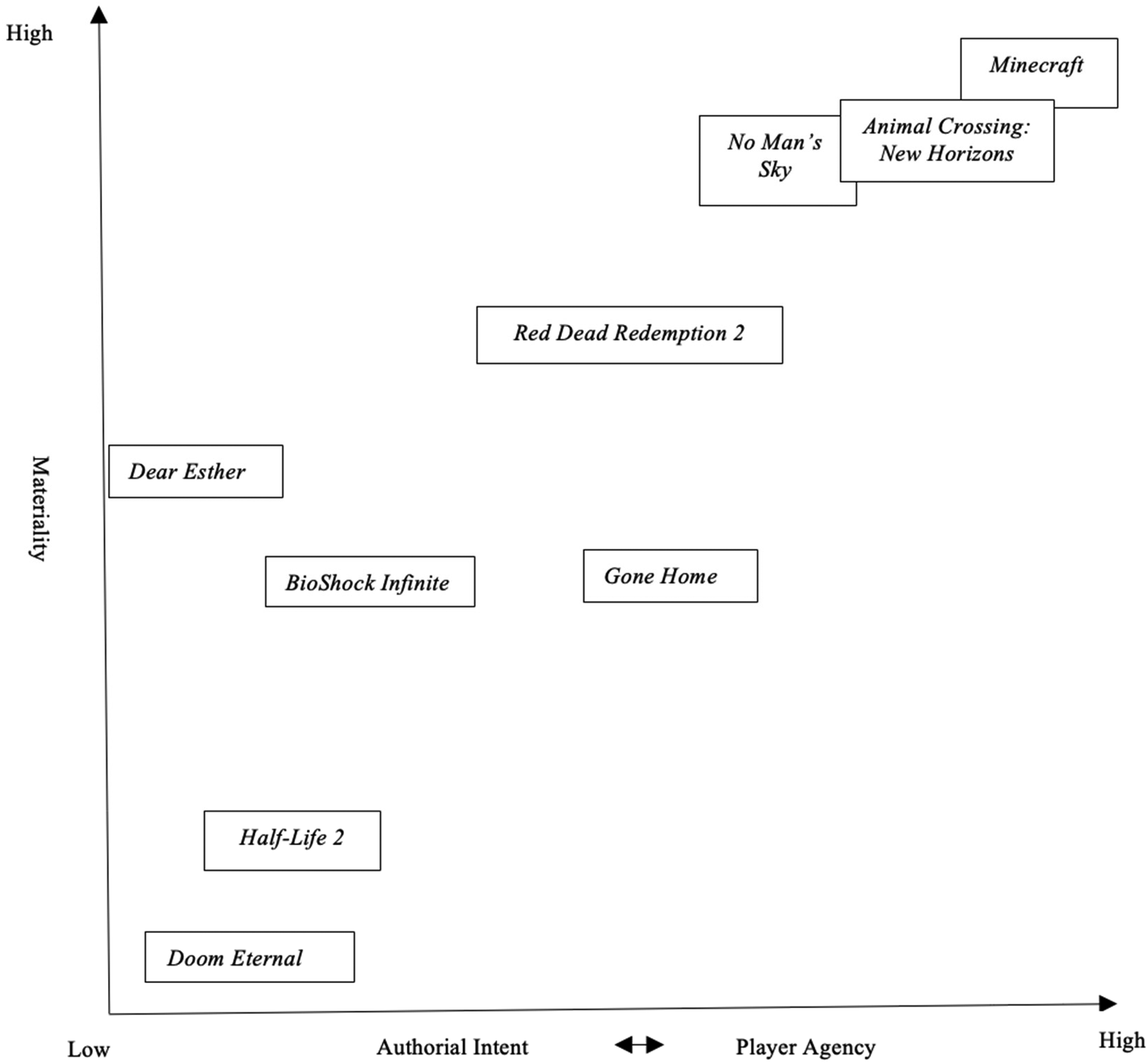
Situating the case study games according to their degrees of paratextuality.
The analysis begins with instances of high paratextuality, particularly pronounced in sandbox games, continues with those of medium paratextuality, notably present in narrative games, and concludes with low paratextuality, as seen in FPS games. For each group, three exemplary games will be discussed in more detail to illustrate variations of paratextuality through means of concrete illustrations. It is important to note here that while I will assign games to a particular group, they may also possess characteristics that would allow them to be categorized in another group. For example, BioShock Infinite is an FPS, but it also exhibits many characteristics typical of narrative games, such as diary logs, especially with regard to two of the chosen examples, Dear Esther and Gone Home.
Case Study 1: High Paratextuality in Sandbox Games
Sandbox games afford the player a large degree of freedom in interaction with and creation of the game-world surrounding them, while the game-makers offer the building blocks necessary to do so. Due to this freedom, these games often do not follow predefined narratives of a linear progression but basic story elements (if even) that the player can realize depending on the parameters valid in the world they have created for themselves. A popular game of this genre is Minecraft, which has sold 238 million copies as of April 2021 and hence ranks second (after Tetris) on IGN's list of most-sold video games of all time (Sirani, 2022). The game allows players to explore, build, and even expand the game-world via user-generated content, such as mods, skins, textures, custom maps, and many more (Watson, 2019). Game authorship here is clearly replaced by creatorship as player agency does not only affect one player but can also be moved to other players who can purchase these additions. However, despite this shift from the author to the player in creating the game-world, authorial intent is simultaneously fulfilled because the core intention of the game is for the player to build their own universe. We thus encounter a large degree of paratextuality because the preprogrammed elements of the game-world require extension through player agency with elements carried from outside of the game-world into it. The in-game layer of materiality is directly influenced by these player-generated elements, which affect digital materiality. It thus becomes difficult to draw a line between playing, modding, and hacking (Christiansen, 2014, pp. 23–37) as well as between facultative and obligatory materiality because one element can be both; a new texture, for example, could be purely decorative in one case, but in another instance, it may help a specific gameplay mechanism, for example, by allowing for the identification of a friendly tribe. Similarly, the layer of materiality surrounding the game also possesses a large degree of paratextuality as it is made up of physical materiality, for example, merchandising products such as the LEGO Minecraft sets, and digital materiality, such as fan-created videos.
The idea of spatially expanding the game-world (almost) ad infinitum is even more pronounced in another sandbox game, No Man's Sky. Players can explore over 18 quintillion planets that spawn out of seed as soon as the player comes close (Hogeweg, 2021). The idea of authorship is thereby strongly linked to its code and thus its digital materiality because algorithms lead to the creation of planets from one seed number, which players can explore. They can make changes to the planets, such as collecting resources, but these changes are not permanent, meaning that another player arriving at exactly the same planet will find it in its original, untouched state. One option for players to advance the game is therefore to explore the universe, build constructions, and conduct research, while they can also follow the game's plotline by uncovering the mystery surrounding the obscure entity called The Atlas. Although authorial intent and player agency in No Man's Sky is less paratextual than in Minecraft because players have less freedom in shaping their digital surrounding, they can still freely move around the universe, explore as much as they want, and follow the game's plotline (or not). The paratextuality of both layers is strongly expressed in the “Galactic Atlas,” launched by Hello Games in 2018 (O’Connor, 2018). Players can upload their in-game discoveries to the website for other players to see, while they can also rename them if they are the first to find them. On the one hand, player agency is expanded while the platform is still initiated and managed by the game creators, while on the other hand, materiality is moved to the paratextual realm by expanding the game with a website.
The final sandbox game discussed here, Animal Crossing: New Horizons (2020), situates players in a smaller world in comparison to the other two games but simultaneously offers a large amount of freedom in the formation of the island they inhabit. As the game was released at a time when most countries announced nationwide lockdowns due to COVID-19, the game has been used by many as a replacement for in-person socializing. Paratextuality here thus moves from the reality realm to that of the digital world. However, authorial intent is still strongly present but since the game provides a platform rather than a predefined course of action, player agency concerning the design of the island is very much opened up; even Joe Biden ran an election campaign on Animal Crossing (Kelly, 2020). The freedom the game affords in terms of player agency also impacts materiality. Besides official merchandising products, such as t-shirts, soft toys, and socks, fans have created many paratexts that are materially different from the game, such as comics, a trading website called “Nookazon,” and even a virtual talk show hosted on Twitch. The game's core objective of creating and shaping one's island is thus opened toward reality as players expand the digital world by means of other material, thus constituting a large degree of paratextuality surrounding the game.
Case Study 2: Medium Paratextuality in Narrative Games
The second group of games, medium paratextuality games, are those that can be described as narrative. In her analysis of video game storytelling, Green has stated that for the study of such games, “story is the primary form of consideration, with mechanical, or game-play, elements considered in terms of how they may or may not serve that story” (Green, 2018, pp. 6–7). This is a methodological focus also taken in this present case study as it avoids the rekindling of the ludology versus narratology debate because the choice of games forming the corpus clearly shows that video games can tell a story through playing. In contrast to the sandbox games analyzed above, the focus will now be on more predefined storylines in combination with various ideas of materiality surrounding the game to determine gradients of paratextual framing and also expand the digital (narrative) space.
Red Dead Redemption 2 allows players to make (moral) choices to the effect that the protagonist, Arthur Morgan, is perceived differently by NPCs depending on responses to certain situations. Players can therefore influence the story's progression by making choices, but the overall path is predefined through authorial intent, heavily focused on realism. The game's narrative is strongly connected with its gameplay because while the player can seemingly make choices, Arthur and his gang realize that their fate is determined by a changing society, which does not allow for their independent existence. Red Dead Redemption 2 therefore emphasizes that making choices is “limited by the game's own restrictions and possibilities” (Muriel & Crawford, 2020, p. 139) by playing upon the idea that decisions do not influence the overall story. Although players may view this determinism as an important part of the story, one instance, however, has led to a wish for more agency in combination with material expansions, and one that goes against the game's designed progression: When Morgan contracts tuberculosis at the end of the game, the game makers decided to make it incurable, but players have subsequently tried to find a way of saving him. In 2022, Ruffino researched fan-made YouTube videos as “paratextual practices” that “remediate (in the double sense of restoring upon and healing) players’ agency” (Ruffino, 2022, p. 345). In all four endings to the game, Morgan eventually dies because of tuberculosis, and as the game does not offer an apparent way to prevent this from happening, players moved to a materially different platform in an attempt to reclaim control over “their” avatar. Player agency is thus moved to a paratextual realm whose materiality is not connected to the game itself. Paratextuality is therefore only present outside of the game, both on the level of authorial intent and player agency and on the level of materiality, while the reason for its existence can be found in players’ perceived limitation to their agency (Ruffino, 2022, p. 348).
Two other narrative games, Dear Esther and Gone Home, emphasize the possibility to create textuality out of paratextuality even more strongly than Red Dead Redemption 2. Dear Esther does not require a lot of action from the player because as soon as they move to a new area on the uninhabited island forming the game's setting, an anonymous man reads out a letter to his deceased wife, Esther. The player learns about her death and the relationship she and her husband had. The audio recordings differ in each playthrough, and hence the textuality of the game also differs. Player agency is fairly limited, and the scripted narrative is defined by authorial intent, which is also highlighted by the emphasis on writing and the written word, which needs to be uncovered by the player. The game therefore challenges the text–paratexts relationship by positioning the text as an experimental novel that has been medially transformed into a video game. In this sense, Dear Esther makes the narrativity of video games a paratext to the story of the text. Gone Home does the same, but it places more agency on the player, who navigates a young woman returning to her family home to find it empty. To uncover what has happened, she explores the house and pieces together the story by studying journals and various items. Although the game does not afford a lot of interactivity, it presents itself as an artwork that needs to be explored and experienced by the one engaging with it. The game does not have a set narrative but instead is shaped by the player's exploration. Authorial intent and player agency are thus balanced as the former requires the latter to generate a text out of individual paratexts, making paratextuality an essential aspect of the game. Materiality, contrarily, is limited to the game-world but the stimulation of the avatar's (and hence the player's) senses is important in the creation of the game's narrative.
The three games analyzed here possess different degrees of paratextuality with regard to the authorial intent and player agency as well as materiality. In all of them, paratextuality assigned to both elements is present, but in some cases, it is so minimal that it does not strongly affect the game's textual status.
Case Study 3: Low Paratextuality in FPS Games
First-Person Shooter games present a mix of freedom of action on the side of the player and restrictiveness due to the prevalence of preprogrammed content. Their aim is that players navigate through the game-world, but their actions are often guided by a clearly defined narrative. Tasks, objectives, and missions are set at various points of the story to ensure its development. In that sense, an FPS game, as Morris points out, “creates for the player a highly immersive media experience, in which a first-person point-of-view, player agency, and the operations of interactivity combine to create a sense of primary identification” (Morris, 2002, p. 95). Due to this strong potential for immersion forming a core characteristic of FPS games, paratextuality is severely limited. On the one hand, authorial intent clearly dominates player agency because the course of action is well-defined, and the scope of creativity allowed for the player is minimal. The paratextuality we find in FPS games is therefore located in-game and, according to Dunne, “the focus is on the surrounding support for the game (menus, system mechanics, videos, commentaries, loading bars), which are not direct elements of gameplay (core to player control)” (Dunne, 2014, p. 19). On the other hand, the layer of materiality is largely limited to the digital space, while multiplayer options allow players to engage with each other via direct communication, thus expanding the game-world into the reality realm.
BioShock Infinite plays with the idea of paratextuality by adding various layers atop each other. Although the game's setting breaks away from that of its predecessors by moving from the underground city of Rapture to Columbia, a city in the sky, the game still stays true to the series’ aesthetics. Rockenberger has emphasized this in her close reading of Infinite's opening sequence, which presents a mix of conventional paratexts we can (and often must) expect for all games, such as copyright information, the production company's logo, and information regarding the game's engine, and more unconventional, ludic elements. This blend constitutes “two ontological layers: The centered typographical elements—which of course have two distinguishable modal layers themselves: the iconic/visual and the symbolic/linguistic quality of the text—are located on an extra- and non-diegetic level …. However, the dynamic 3D-visuals ‘in the background’ are—unlike the distant carnival music—clearly diegetic” (Rockenberger, 2014, p. 255). This gradual blend between the two diegetic levels also mirrors the blend between authorial intent and player agency: Although the extra-diegetic set of conventional paratexts is solely author-focused, the extra-diegetic group of paratexts slowly eases players into action, but one that is still strongly controlled by the game-makers. The game's opening sequence (and the game itself) therefore uses in-game paratextuality as a means to invite the player into the game, but due to limited possibilities for players to take agency, this paratextuality is fairly low. The paratextuality of additional material available through the game's opening sequence is also limited to the digital space: The player can obtain a season pass and additional downloadable content, but none of these paratextual elements are obligatory. Essentially, while BioShock Infinite engages with paratextuality in a ludic mode, it nonetheless stays within the conventions of additions to a game.
The two other games serving as case studies here are even less paratextual. Half-Life 2 expands the conventions of FPS games by adding a strong focus on storytelling and solving puzzles. The game's narrative heavily relies on its predecessor, Half-Life (1998), which, according to Nohr, constitutes Half-Life 2's paratext (Nohr, 2008, p. 131). Apart from this, however, the game possesses a low level of paratextuality. As the narrative is predefined, the player's agency is reduced to following the story and their actions do not significantly alter it. Regarding materiality, the game also does not require a lot of variation but mainly follows FPS conventions: the player needs to fight their way through hostile grounds, using equipment they acquire on the way. Conventional paratexts, such as fan-created wikis, playthrough videos, and official merchandising products exist, but none of them impact the game directly. Doom Eternal possesses a similarly low paratextuality. In their role as the Doom Slayer, the player must follow a scripted storyline to defeat demons from hell, which does not require any alterations in materiality. Although this indicates a very low degree of paratextuality on both layers, an issue surrounding copyright protection expands the game's paratextuality: Publisher Bethesda initially wanted to release the game with a Denuvo rights management (DRM) protection to avoid it being cracked, but due to an error, a DRM-free copy was included with the game (Orland, 2020). Anticracking software was later added to all game versions, but these patches resulted in poor performance and the Windows-version potentially even increased the device's vulnerability (Guinhawa, 2020). Bethesda has subsequently decided to remove all anticheating software (Lee, 2020; Taylor, 2020), with the effect that players can now influence the game from a different paratextual level of materiality to the game itself, expanding authorial intent with player agency.
Conclusion
In this article, I have presented paratextuality as a gradient scale on which games are positioned according to the relationships they form with their paratexts. This way of representing ancillary material links to Švelch's suggestion that the word paratext is less valuable than the more flexible words paratextuality and paratextual, which point to qualities, not categories. For the analysis of video games, paratextuality is a useful concept when we want to talk about elements that surround a game but are not (yet) the game itself. My proposed system therefore takes Švelch's suggestion to the logical next step by giving us a framework for how paratextuality manifests as a quality, which may be present in different degrees. Although the precise definition of the term remains at the center of much critical debate, games scholars appear to agree that these peripheral components frame a game in a particular historical, generic, and social context. Genette's early definition of paratexts in relation to the codex book medium certainly provides a strong foundation, but since it does not take the unique concepts of authorship and materiality of video games into consideration, it simply is not flexible enough to account for the analysis of their paratexts.
The paratextuality of authorial intent and player agency as well as materiality gave a direction to the expansion of discussions concerning ancillary material within and outside of games, which has been conducted on the background of recent research in game studies. By proposing that paratextuality can be high, medium or low, it has been demonstrated that texts form relationships with other texts that vary in intensity with regard to their connection. Original concepts, such as Consalvo's, which, after all, still is the core theory for research into paratextuality in game studies (Švelch, 2020), do not recognize this important characteristic and therefore make the concept too broad or too narrow. This means that some texts might be excluded in the analysis of paratexts of a given text, but it could also lead to the inclusion of texts as paratexts that do not possess the same status or intensity of connection as other paratexts do. My framework means that we can find a middle ground—with specific, systematic language—that avoids making the concept of paratextuality too broad or too narrow. The great value of such an approach is that it gives us the language to have a better conversation than simply “does this count as a paratext?” In other words, by looking at paratextual relationships as degrees rather than one class, we are able to talk about the different kinds of relationships formed between a text and material surrounding it. The choice of games for the three case study analyses put these theoretical considerations into practice and hopefully encourages further discussions in this field. The framework proposed here recognizes paratextuality as a highly flexible complex that accommodates shifting agencies and intents along a gradient, but, in practice, can help scholars better understand the current landscape of games with constant updates and ancillary content.
Footnotes
Declaration of Conflicting Interests
The author(s) declared no potential conflicts of interest with respect to the research, authorship, and/or publication of this article.
Funding
The author(s) received no financial support for the research, authorship, and/or publication of this article.
