



Abstract
This article reflects on the resurgence of Full Motion Video (FMV) games, focusing on Her Story (2015), The Infectious Madness of Dr Dekker (2017), Telling Lies (2019), Contradiction (2015), and The Shapeshifting Detective (2018). Such titles have been derided for their lack of interactivity, and indeed afford the player limited agency in terms of concrete actions. They rely on the player's imagination in suturing the images together and in forming an empathetic understanding of the main characters’ actions and motivations. By virtue of this lack, FMV games challenges players’ analytical and hermeneutic abilities and further cognitive patience. An absence of “rules of notice” by which the details in a narrative are hierarchically organized, including editing and other attention-guiding devices, is part of these games’ procedural rhetoric. Priming the player to obtain a vigilant player attitude, such games foreground the mechanics dis/trust in our reception of fictional narrative.
Introduction
William James famously defined attention in terms of focused concentration: an act of zooming in on one out of many possible objects. In our current hypermediated moment, such acts of focused attention have become more difficult, to the point where we have come to rely on multiple sources of input in order to be able to concentrate. How to decide what to attend to and what to disregard becomes a pressing aesthetic, ethical, and even political issue (if it had not always been). Traditionally, literary studies have celebrated the close reading of texts in a mode of “deep,” focused attention, as a core skill. However, as a reader, it is impossible to pay equal attention to all details in a text. Narrative texts are written in a way that helps us modulate our attention. Certain elements are “foregrounded,” causing heightened attention, and others are “backgrounded,” nudging the reader to read them in a more superficial manner. In 1987, Peter Rabinowitz compiled what he called the “rules of notice” by which the details in a narrative are hierarchically organized in such a way that a reader knows on what elements to focus.
A lot has changed since then. In our present attention economy, where we are bombarded with texts and images from myriad sources and channels on a daily basis, attentional flexibility and modulation are arguably more important than ever. 1 Yet, the rules of notice seem to be missing: reading online, we are not always given a clear, hierarchical structure, and no one is telling us when to pay attention and when we can comfortably skim or fast-forward. We do not always know beforehand what might turn out to be of importance. What is more, because of a growing uncertainty as to truth and falsehood online, there is always the possibility of being misled.
In this article, I argue that experiences of this kind are foregrounded and reflected upon in present-day Full Motion Video (FMV
The second section of the article zooms in vigilant modes of attention. Here, I relate these attentional modulations of viewing and listening to issues of trust and reliability in discussions of Contradiction, The Shapeshifting Detective, and The Infectious Madness of Doctor Dekker. With reference to conspiratorial narration and paranoid affects, I argue that, in addition to attention and patience, such games foreground the mechanics dis/trust in our reception of fictional narrative. These games are populated by unreliable narrators, and their conspiratorial narratives and lack of editing invite a suspicious and paranoid player attitude. In the conclusion, I argue that the lack of interactivity the genre is often derided for by parts of the gaming community, is precisely its strength, through which this new generation of FMV games challenges players’ analytical and hermeneutic abilities and trains their cognitive patience.
FMV games
Back in the early 1990s, the use of FMV was a novelty in computer games. It was enabled by the increase of memory on carriers like CD-ROM, which, with roughly 650 megabytes, made possible the use of higher resolution graphics, better sound, and the embedding of video clips. Advances in computer animation led to more photorealistic graphics. A franchise that was highly influential in this history of FMV is Wing Commander, the first installment of which appeared in 1990. These titles, especially from the third installment onwards, made use of extensive cutscenes of live action filming as an integral part of their storytelling, and starring well-known Hollywood actors.
In 1995, the launch of the Sega Saturn and the Sony PlayStation in the United States offered the technical abilities to integrate quality FMV with better visuals in CD games (Wolf, 2008). As game computers were not able to draw fluent, realistic images, designers turned to cinema to copy its styles of representation (Van den Berg, 2019). This got better results than using large chunks of texts to evoke surroundings and event or using low-quality animation. FMV games had their moment of niche popularity during the early and mid-nineties with titles like Mad Dog McCree (American Laser Games, 1990) and Night Trap (Digital Pictures, 1992).
The primacy of CD-ROM technology in these years benefited slow-paced genres with relatively simple gameplay mechanics. Often, this involved voyeurism, especially spying on scantily clad women (Night Trap; Voyeur [Philips Interactive, 1993]; Tender Loving Care [Landeros, 1998]). However, in part due to their lack of interactivity, such games were unable to withstand the competition with established franchises and gameplay innovations of that time. The decline of Sega further led to the genre's obsolescence.
Since a couple of years, we are seeing a revival of this style of game making. Recent titles include Splendy Games’ The Bunker (2016), and from Wales Interactive: romcom game Five Dates (2020), action game Bloodshore (2021), interactive thriller Night Book (2021), and sci-fi thriller game The Complex (2020). More generally, crossovers between games and cinema are gaining momentum, as evidenced by Transference (Ubisoft, 2018), an escape room game that stars Elijah Wood and uses VR (originally made for PSVR), sold as “A psychological thriller that merges movies with games.” Late Shift (Ctrlmovie & Wales Interactive, 2016) was advertised as “The World's First Cinematic Interactive Movie.” With Bandersnatch, Black Mirror produced the first interactive movie on Netflix.
Acknowledging that there is considerable overlap between the two genres, this article focuses on FMV games rather than interactive cinema. Wolf (2008) uses the latter term for games that exist of video clips, branched off based on player action. The player has limited freedom of movement or action, and the story unfolds in a largely linear way. Perron (2003) argues that in interactive movies, interactivity and storytelling are separated, whereas in movie games they occur together. In this aspect, most FMV games would be closer to the first, 2 although they are not typically produced by film companies. Perron et al. (2008) distinguish between the film-game (video games, usually in the adventure or shooting genres, featuring live-action sequences), interactive film/television (produced by film companies), and interactive new media works (artistic experimentations that use live-action video sequences). The FMV games discussed in this article do not fall into any of these categories, although some, like Barlow's titles, could be considered as interactive new media works. Classification, however, is not among my main goals in this article. I argue they have to be understood in our present media context of the attention economy, where the allocation of attention becomes a daily challenge.
The FMV game's “comeback” could be considered surprising, as including cinematic episodes was a rudimentary technique and already felt to be outdated in the nineties; since then, technological advancement has obviously opened myriad new possibilities for game design. What is it then about these eccentric, nostalgic games, that speaks to us in a time in which gaming technologies are so much more developed than they were in the mid-nineties, when the genre was already passé? I argue that it is precisely the lack of interactivity they afford, and, in some cases, a notable absence of “rules of notice” for the player, that enable these games to emulate, and thus reflect on, common experiences in the attention economy.
“It is not a game!” Interactivity
Just as their predecessors from the 1990s, recent titles are low on interactive affordances. The playing “action” consists in large part of passive acts of listening, watching, waiting, and paying attention while actors speak in front of a camera: in most cases, the cinematic clips cannot be fast-forwarded, played at double speed, or skipped. These clips are not additional material, where a short cinematic clip precedes each new level; on the contrary, they form the core of the narrative. The player agency (Koenitz, 2018), the impact of the player on the narrative, resembles that of a novel or film more than a regular adventure or action game. Even when we take Nick Montfort's broad definition of “interactive” as any work that reacts to input in a meaningful way (Montfort, 2005), FMV games notably reject the traditional mechanics of first-person experience (Bogost, 2016). They share this feature with the contemporary genre of environmental story-games such as Gone Home and Dear Esther, pejoratively called “walking sims.”
It has therefore become a meme on YouTube and Twitch to leave the comment “It's not a game” under videos related to the genre (see Juul, 2019), often followed by a discussion ensues in which other users defend the “game-ness” of the game (see Figure 1). It is our common expectation that our efforts will influence the outcome of a game in a way we feel emotionally related to, so that “doing well” will give us a good feeling, and performing poorly will not (Juul, 2003). Like “walking simulators,” FMV games reduce our options for interaction with the game world. Whether this means we also feel affectively disconnected from the outcome of the game, remains to be seen.
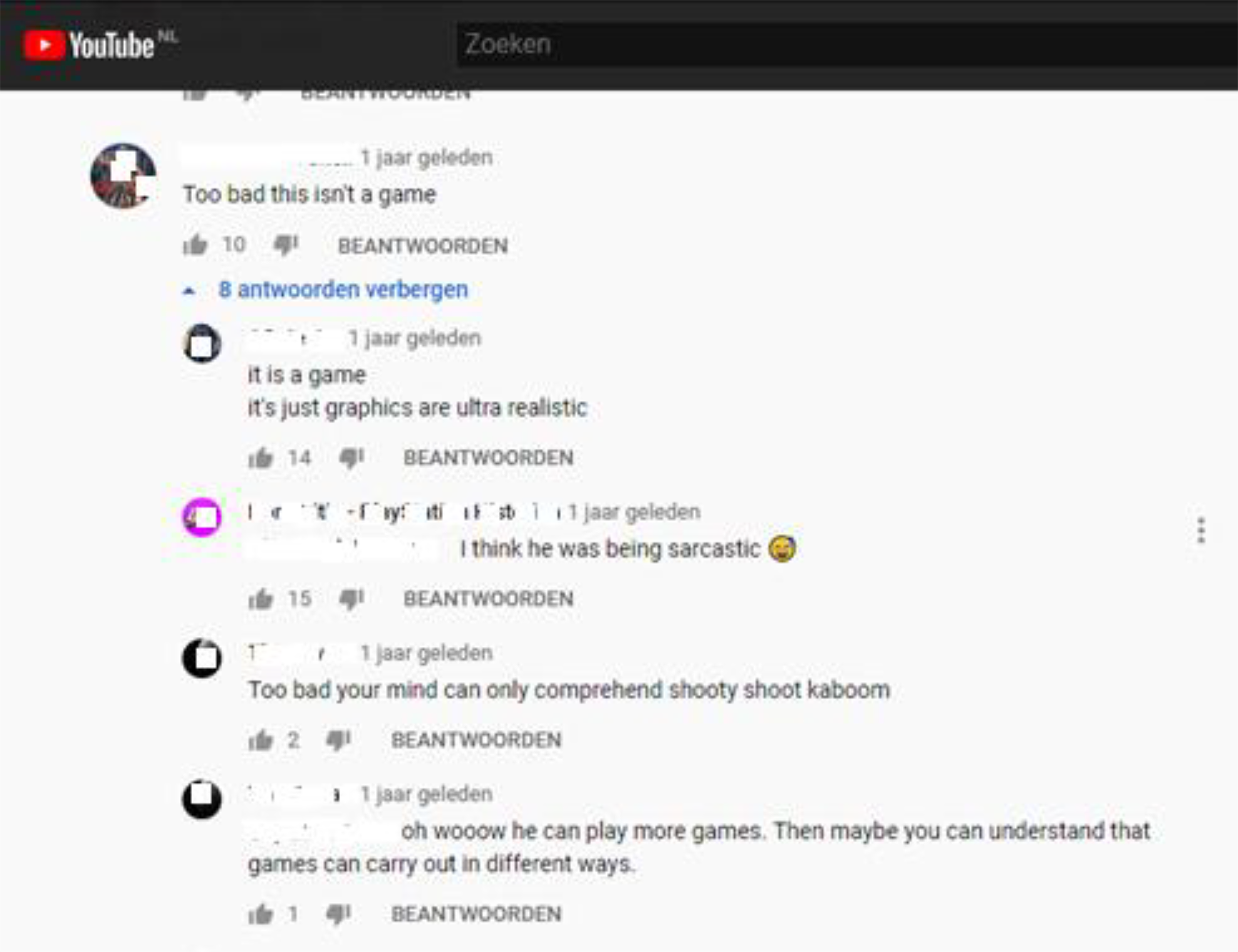
Youtube Comments to trailer for The Infectious Madness of Dr Dekker (2017).
It first needs to be noted that debates of this kind, regarding audience activity versus passivity in media, are by no means news: in fact, we see echoes of the debate between defenders of avant-garde or modernist representations versus realist forms of representation in screen culture. Notably, a key starting point for these discussions was the “realist text debate” in the British journal Screen from the mid-1970s, which focused on realism and modernism in cinema (at times as if the two were mutually exclusive). The editors and writers of this journal sought to revive a preexisting film culture by drawing on continental (mostly French) intellectual currents (Rosen, 2008). Defenders of avant-gardist screen culture like Colin MacCabe (1974; 1976; 1978) typically promoted difficulty and experimentalism. They understood realist cinema as unselfconsciously transmitting dominant ideologies (Kouvaros, 2008), which paved the way for a strong current of antirealism in 1970s film scholarship. This strong binary opposition between modernism and realism was later nuanced by scholars like Laura Mulvey, who argued that both the avant-garde and classic realism were “emblems and icons of modernity” (1975), as well as in empirical studies which showed that it is a fallacy to believe that “predictable” stories necessarily produce predictable responses, and vice versa. Ivone Margulies, in her edited volume Rites of Realism (2003), also addressed some of the problems inherent to the critique of realism and nuanced the supposed opposition between modernism and realism.
What is more, claiming that FMV are not interactive is missing the mark. Rather than offering no interactivity, these games are characterized by a closed interactivity: one in which “the user plays an active role in determining the order in which already-generated elements are accessed” (Manovich, 2001, p. 40). The already-generated elements are the movie clips, and not only their order is determined by the player, but also which elements are accessed at all. The games work according to the operating principles of the database, where the player actualizes a sequence out of an implicit paradigm. Her Story and Telling Lies are not goal-oriented, and the games do not provide any explicit signals of player progress.
The extent of players’ agency and freedom that underlie such mechanics has been debated. Thomas Elsaesser wrote of the related genre of interactive cinema, that while a self-selected narrative and open-ended storyline suggests freedom and choice, this is only an illusory freedom: “you can go wherever you like, so long as I was there before you” (1998, p. 217). In that respect, interactive cinema does not differ from a traditional narrative where at any given point, an “open,” undetermined future is suggested, yet the course of events has been preprogrammed and structured: the teller knows the ending in advance. Interactivity, as Ernest Adams wrote, is almost the opposite of narrative: “narrative flows under the direction of the author, while interactivity depends on the player for motive power” (1999). FMV games are decisively “authorial,” with limited possibilities for action and control on the part of the player.
For this reason, Bernard Perron (2003) has proposed to refer to the users of games like Tender Loving Care as players instead of gamers: “[n]ot being able to occur at the same time, interactivity and storytelling are well separated” (p. 242). The player remains outside of the diegetic world, in contrast to the gamer in what he calls movie games: live-action video games like the Tex Murphy series. A game, he writes, has a result, which is either win or lose. Rather than gamers, FMV games have players who use their editing skills to bring the pieces of the puzzle together (Perron, 2003). Perron would therefore be reluctant to call them “games” at all.
In what follows, I contend that in the newest generation of FMV games, a lack of interactivity and player agency or control is operationalized in a way that tasks the player with a hermeneutic assignment aimed at understanding. It is precisely through a lack of action that other skills are called upon: problem-solving, listening, understanding.
Rules of Notice
To comprehend a text, we condense information. This requires strategically allocating attention to text that seems significant, at the expense of text deemed less significant (Sanford & Emmott, 2012). Reading and discourse processing are comprised of selective dynamics that combine bottom-up and top-down processes of attention. Narrative texts are designed to help us modulate our attention: their details are hierarchically organized in such a way that a reader knows on what elements to focus. Through the Rhetorical Focusing Principle (Sanford & Emmott, 2012), authors cause readers to pay particular attention to certain elements. Peter Rabinowitz (1987) lists the “rules of notice” by which this priming and hierarchical structuring occurs, with three general subclasses: rules of positioning (e.g., (sub)titles, beginnings and endings, epigraphs), intratextual disruption, and extratextual deviation. These affect, first, “noticeability” (where to place our attention), and, second, “scaffolding” (the notion that our interpretation of the text's overall meaning should be able to account for those elements).
Through a range of techniques, certain elements in narrative are foregrounded, causing heightened attention, and others are backgrounded, nudging the reader to process them in a more superficial manner. An example of backgrounding, the de-emphasizing of information, is a technique called “burying,” where the writer hides a piece of information in a subordinate clause. In detective fiction, this is often done in such a way that a clue can be introduced and barely decoded by the reader, so that it will only in retrospect be discovered as a clue. In Agatha Christie's Sparkling Cyanide for instance, the character who will turn out to be the murderer is first introduced in an -ing clause embedded in a description of another character, surrounded by new information (Sanford & Emmott, 2012, p. 92).
Unlike more traditional narratives (like short stories or detective novels), I argue, FMV games withhold their rules of notice. This is part of their procedural rhetoric, the arguments made “through the authorship of rules of behaviour, the construction of dynamic models” (Bogost, 2010, p. 29). Such arguments set the given rules the player must follow, which dictate what can and cannot be done within the confines of the programmers’ coding for the game (Bogost, 2007). They are in effect a dialogue between the programmer and the consumer. 3 In games like Her Story and Telling Lies, the procedural rhetoric lies in an unwillingness to instruct the player regarding what is important and what therefore deserves attention.
The Art of Attending: Her Story and Telling Lies
Her Story (HS), an interactive movie game for Windows, Mac, iOS, and Android, is not interactive in the narrow cause-and-effect sense of a branching narrative where players’ choices determine the events. Rather than a “choose your own adventure” story, the player is here presented with just one story, and their agency lies in piecing it together. HS features an antiquated computer desktop. The interface displays an aesthetic of hypermediacy, a layering of different windows and applications that compete for our attention. It has a 3.1-style Minesweeper-like game, a ReadMe file explains the computer's mechanics, and a “L.O.G.I.C. Database” with 271 video clips. The embedded story is set in 1994. There is only one actor and one setting, the police interrogation room. One plays the game by browsing through this database of clips from fictional police interviews to solve the case of a missing man whose murdered body is later discovered.
Barlow expressed his wish to move beyond the “choose your own adventure” that is about cause and effect, and in which the interactive part of the narrative is the branching, the choices a player makes. He intuited [t]here's a lot that we’re doing just by interfacing with a computer that isn’t about the systemic aspect. So I said: “I’m going to make a detective game, and there’ll be no 3D exploration, there’ll be no variables and no meaningful state changes.” Because really, in Her Story, all of the things happen in your head. They are not necessarily happening in the system of the game. (Martín-Núñez & Navarro-Remesal, 2021, pp. 142–143)
The player watches clips with alert attention to the smallest details and testimonial discrepancies. Player agency consists mostly in listening and observing. In teasing out the plot, we pay attention to verbal and visual clues. Why does the woman have a tattoo in some clips that seems to be missing in others, a bruise that seems to disappear and reappear? Why does she request black coffee instead of tea at some point?
The interviews are all with the victim's girlfriend Hannah Smith, played by the British musician Viva Seifert. The video clips are not interactive; the game offers no explicit mechanical objectives or index of progress. In the search bar, a single word is loaded up: “MURDER.” Hannah's answers have been transcribed; fragments can be found by entering words in the search bar. Sorting can be done by inventing user tags, which are then available as searchable items.
After a number of clips that depends upon the order of search terms, it becomes clear that either two women are interrogated instead of one, and they are sisters, or that Hannah pretends to be her sister Eve in certain fragments. Consecutive hints are dropped, a doppelganger theme is present in many fragments. Hannah sings a song about one sister drowning the other in water out of jealousy, as both love same man. At times, Eve seems like an imaginary friend she blames for thing that she herself has done. Hannah insists on the subjective nature of each woman's account of events: “All these stories we’ve been telling each other: they’re just that. Stories.”
In addition to unearthing the course of event, the player needs to figure out who they are as they play. As a case long gone cold, videos are years old, and it is unclear who you are and why you are searching. Every now and then, during moments of great intensity in the clips, the lights flicker, providing a glimpse of “your” face looking into the old CRT monitor. The game confronts the player with their own assumptions and frames. When we all too readily hypothesized that someone might have had an affair, Hannah reproached us: “you’re reaching here. Why are you so obsessed with sex and affairs?”
True to its database form, the procedural game lacks closure. At one point, randomly assigned for each playthrough, a chat window pops up and you are asked whether you think you understood. You done?
[Yes/No]
So… you think you know why your mother did what she did?
This implies that “you,” the anonymous detective, are Hannah's daughter. If the player chooses that they have understood, they can leave the station. In stark contrast to the voyeuristic aspect in scrutinizing testimonial clips from the safety of the interface, the deictic second person address draws the player into the diegesis.
In the opening scene of Telling Lies (TL; Barlow, 2019), we see a woman sitting down in front of a laptop with a confiscated National Security Agency database. The player, who plays this character, uses Retina, a program that captures video conversations, to search through a dataset. Again, you play the entire game sitting in front of the laptop searching through videos for clues. Barlow has elucidated that this game is about intimacy in the digital age, the lies we tell to others and ourselves, and the omnipresence of government surveillance (C.Ip, 2019). As webcams and other surveillance technology from dating apps to social media, have transformed people's intimate and professional lives, it makes the player feel how susceptible we are to deception and misinterpretation.
In TL, the videos are subtitled; clicking words allows one to search the database for other occurrences. The retrieved clips start playing from where the keyword is mentioned, and the player must rewind the clip not to miss potentially important preceding information. The player is not reminded to do this; another example of the procedural rhetoric remaining largely implicit.
TL has four main protagonists: David (Logan Marshall-Green), Ava (Alexandra Shipp), Emma (Kerry Bishé), and Max (Angela Sarafyan). Besides, there are over 30 characters, some of whom might not even come up, depending on your game play. There is no way of knowing who is important; a new character can pop up late in the game depending on your searches and turn out to play a key role in a plotline. Others, who occur in multiple clips, seem to be of little significance. The word “love” is loaded up in the search bar (as a counterpoint to HS’ “murder”), nudging the player to first explore romantic entanglements. Navigating its database, you follow the private video chats of these four main figures, which have been tapped by the NSA over two years.
All videos have one common interlocutor: David Smith (Logan Marshall-Green). David is an undercover FBI agent on a mission to investigate Green Storm, a radical (terrorist) environmental organization that plans to blow up a bridge to stall construction of a pipeline which would feed oil into the local Native American environments and poison their water sources. He has left his wife Emma and kid Alba at home, falls in love with activist Ava, and befriends webcam girl Max. After Ava gets pregnant with David's child, David becomes unhinged. He assaults a corporate spy, becomes aggressive with his superior, and starts to ignore orders. Meanwhile, he has developed true feelings for Ava and does not want to incriminate her.
TL has approximately 10 h of footage: almost five times as much as HS. The individual clips are longer: conversations of up to 15 min have been captured in full, and an added affordance is the ability to move backwards and forwards in them. There is, however, still a limit of five clips per search that are retrieved. Again, we could say that explicit procedural rhetoric is largely missing at the outset. The goal of the game is to find key videos, yet it is never made explicit which videos these are, and when you have found them. Once you seem to have achieved some grasp on the narrative, the desktop interface changes, and you can send the package of videos onwards. At that point, it is not clear whether you have truly unraveled all there is to know.
Conversations between characters are not accessed in the original, linear order. Most videos are of one side of a dialogue captured by a webcam; somewhere in the database, there is a separate video file containing the other half. To understand these conversations, we need infer what was said by the interlocutor. With these decontextualized snippets of interactions, the player is primed to be maximally vigilant with respect to possible intentions of the speaker. We do not know who is talking on the other side; we only see nonverbal responses and minimal facial movements of the listener (like the raise of an eyebrow in surprise), and are able to closely scrutinize these. We are witness to every little movement and expression of emotion, granting intimate knowledge. When the Green Storm group congregates, David secretly records. Sometimes he winks at the camera, for instance when he has just improvised to get out of some tricky questioning (“Where did you learn to shoot like that”?). As a viewer, you get a sense of being made his accomplice.
One person's silence when another speaks can take up to minutes. As she often finds the counterpart much later, the player has to observe, remember, and suture them together in their mind. Tellingly, the desktop interface features the card game Patience. The deck is one king short, which might foreshadow something about the game as a whole: you need infinite patience, for the puzzle will never be complete. The lifelike, meandering nature of the dialogues calls upon players’ patience even more. Lacking the agency to determine for herself whether she has seen enough, the player has to go through the flirtations with the cam girl, the domestic fights with his wife and the romantic chitter-chatter with Ava to complete the game. In some cases, these contain information that is crucial to the story, “buried” in footage that is not directly vital to the plot.
This footage, however, does give us a sense of characters’ intimate connections and everyday lives. We see Emma washing dishes for 7 min. We watch Alba fall asleep through the eyes of her father. The game taps into the voyeuristic appeal of earlier FMV games like Night Trap and Tender Loving Care. There is suggested webcam sex with wife and girlfriend. But even more intimacy lies in these everyday scenes, which makes watching some of them feel like an invasive act. It is possible to fast forward such clips or skip them altogether. Yet, there is always a chance that something meaningful will slip by. Small actions and words and can get meaning in retrospect, in light of other conversations. The length of the clips, the inclusion of elements that do not directly further the plot, and the lack of editing can be said to have the effect of a non-linguistic equivalent of “burying” important narrative elements.
Barlow designed the game, with its ample footage, to nudge viewers to follow their own, more subjective leads: “I didn’t want people to watch clips and strip mine them for clues and proceed in that orderly way. I wanted to encourage people to lose themselves, fall down a rabbit hole” (C.Ip, 2019). The game's scale and affordances, like access to entire conversations rather than edited fragments as in HS, and the ability to search from subtitles, facilitates this following of personal nuggets of interest. The lack of rules of notice encourages each viewer to find their own “punctum” in Roland Barthes’ sense: an aspect that “rises from the scene” to capture our attention (1981, p. 26).
This is reinforced by the fact that clips are not edited in a way that pays heed to their implied audience, as in cinema, where edits move the action forward. Editing also works as an index: it helps a filmmaker point the viewer's attention to important plot elements. Video games usually lack cinematic editing, as continuity of action is essential to interactive media: “If ‘edit’ is the verb that makes cinema what it is, then perhaps videogames ought to focus on the opposite: extension, addition, prolonging.” …. “to linger on the mundane instead of cutting to the consequential” (Bogost, 2010a). Though interactive to a far lesser extent than the horror games that Bogost mentions, in TL, an absence of editing and other attention-directing devices, like camera direction or conventional framing, has this effect of extension. The player is left to determine by herself what elements might be of significance. Refusing to cut its scenes, it invites players to dwell on the meanings and implications of mundane, yet potentially meaningful events.
If “[g]ames have results: they define a winner and a loser; play does not” (Frasca, 1999), then we are clearly players when engaging with these games. We do not play to get a high score; there are no cheats; and it is not a puzzle, there is no palpable or quantifiable result. HS and TL ask you to practice empathic engagement as you imagine the protagonists’ motivations. Where puzzle games often have a predetermined set of solutions, Barlow has found a way to bypass their technological limitations with his use of video. In HS and TL, the “pieces of the puzzle” lie in the acting, in minutiae of facial expressions and body language which are hardly quantifiable (Van den Berg, 2020). As these games do not reveal the total number of videos, it is unknown to the player whether they have seen everything there is to see. Important questions are left unanswered; there is a pervasive sense that we are missing crucial information. This engenders a suspicious viewing attitude: one that is shared by other contemporary FMV titles, and that I will address in the remainder of this article.
Vigilant Attention in Contradiction, Dr Dekker and The Shapeshifting Detective
In addition to demanding more attention and patience than conventional puzzle games, contemporary FMV games foreground the mechanics of trust and distrust in our reception of fictional narrative. They are populated by unreliable narrators, and their conspiratorial narratives and lack of editing and other attention-guiding devices and rules of notice invite a vigilant, suspicious or even paranoid player attitude. I discuss unreliable narrators, close ups, red herrings, supernatural elements, conspiratorial narration, and randomization of outcomes.
Unreliable narrators are a popular device in videogames, featuring prominently in titles like The Wolf Among Us (Telltale Games, 2013), Tales from the Borderlands (Telltale Games, 2014), Call of Juarez (Techland, 2005), and Spec Ops the Line (Darkside Game Studios, 2012). Their presence can make the player take on a more active and vigilant role. The device is especially effective and frustrating considering the logic of games, in which winning and losing usually plays a central part. This is different in a movie, where you are witnessing rather than embodying the investigator (Van den Berg, 2020). The search for the culprit is your responsibility as a player. Every character is a suspect and everyone is potentially lying, which asks for an active hermeneutic attitude. It creates an affect of paranoid reality in Eve Kosofsky Sedgwick's (2003) sense of paranoia as an epistemological practice: a way of seeking, finding, and organizing knowledge. FMV mystery games are particularly topical in the context of a prevalence of paranoid viewing practices and the mainstreaming of a “hermeneutics of suspicion” (Ricoeur, 1970).
The titles under discussion are ambiguously supernatural, partly depending on the player's interpretations, and which characters they believe to tell the truth: Contradiction features a supernatural cult, Dr Dekker psychokinesis. In the game-world of The Shapeshifting Detective, “shapeshifting” is unambiguously real, but abduction by aliens and a killer possessed by an interdimensional traveler are ambiguous. This ambivalence between supernatural and realistic readings of the plot works very effectively with the “reality effects” afforded by the video clips, and further the paranoid affect.
Contradiction, The Shapeshifting Detective and Dr Dekker are more linear than HS and TL (which work with a database interface). They each have a chapter structure which makes sure the player receives the appropriate information in the right order, or at least enough of it to proceed. They have more conventional mystery plots and are less realistic, with over-the-top acting (and, especially in The Shapeshifting Detective, sleezy innuendo). The actors are relatively unknown and look natural, with every little flaw brought sharply into view. This contributes to an authenticity that is offset by the overall nightmarish aesthetic and slight overacting. Other than in HS and TL, these games have no embedded narratives: you enter into dialogue with the characters in real time. They are a little more interactive in the traditional sense as they have multiple outcomes, but still limited. They have the character of a puzzle game, meaning that, unlike the aforementioned titles, it is indeed possible to “get it wrong,” by choosing the wrong perpetrator.
In Contradiction: The All-Video Murder Mystery Adventure (Baggy Cat Ltd, 2015), quirky and theatrical Inspector Jenks is sent to Edenton, a small, fictitious English village, to solve the case of a mysterious murder. All characters are hilariously shady. Contradiction uses live-action video for the entirety of the game play. The player chooses prompts for Jenks’ dialogue, then a conversation plays out. You can wander around the game environment, collecting evidence and witnessing events. This happens through a small amount of simple point-and-click gameplay: selecting locations on a map, selecting objects to interact with, and gathering clues. The main activity, however, is to interrogate the suspects, questioning them about the evidence collected and trying to catch them lying or, more accurately, contradicting themselves. When you spot contradictions in their answers, you pair them together and see how the suspects try to argue their way out of them. The solution to the game is rather anticlimactic, as it builds up an elaborate supernatural conspiracy narrative, to then reveal a far more mundane turn of events and motif (romantic jealousy).
More important than the plot is the role of acting and performance in such games. As in TL, it captures and communicates the nuances of truth and lies. In L.A. Noire (Rockstar Games, 2011), the player likewise interrogates suspects, looking for tiny clues in body language and facial expressions to determine who is speaking the truth and who is lying. That game uses a motion capture technique that translates the acting of real actors to animated models, but live-action video of real actors is more effective, especially when seeing their faces in close-up.

Close-up (still from The Infectuous Madness of Dr. Dekker).
In cinema, the close-up is an aspect that generates intimate entanglements. Close-ups draw viewers’ attention; they work indexically, like a finger pointing to something that would otherwise have gone unnoticed. For Mary-Anne Doane (2003), the expressive face is a gateway to intersubjectivity: seeing it in close-up, it is hard not to wonder what the person is thinking or feeling. In games like Contradiction and The Infectious Madness of Doctor Dekker, we learn how to read the characters’ expressions, their faces become legible to us (Figure 2: still from Doctor Dekker). Determining whether interlocutors are reliable is something we do all day, almost subconsciously: in a split second, research shows, we make a calibration of likely trustworthiness by scanning people's faces (Willis & Todorov, 2006). Part of the challenge in FMV mystery games lies in this hypervigilant mode of screening for intentions.
D'Avekki Studios’ consists of Tim and Lynda Cowles, who formerly produced mystery party games. Their first videogame, The Infectious Madness of Doctor Dekker (2017), was made for under £3000 over the course of nine months. Dr Dekker was awarded the Guinness World Record for most full-motion video in a video game. It features over 1600 responses and about 7 h of film.
The premise is that psychiatrist Dr Dekker has died, and you are hired as his replacement. He has been murdered by one of his patients or his secretary. You investigate his death by talking to them: “He was a good listener. I hope you are.” This comes down to picking certain key words out of their responses and repeating these in the form of a question (among the Hints: “A new study in Psychology Yesterday suggests using the same words as your patients increases trust”). Players can manually input text or choose between pre-formed options. The aim is to collect “evidence” (footage of Dekker's conversation with a professor Alderidge, his resignation letter, patients’ referral letters, a toxicology report, Maryanne's loan agreement, a crime scene report, etc.). All conversations, and hence the gameplay, take place in a single room: a typical psychiatrist's office with a green wall and a leather couch, with Rorschach tests on the wall. The lighting is low-key, giving off a sinister vibe with high contrast.
Dekker's patients each turn out to be highly untrustworthy: they include a Siren, a shapeshifting nurse who is an “angel of death,” a time-traveling gravedigger, a lady with an undead husband, a man who masters the art of teleportation and a man stuck in time after losing his girlfriend in an accident, suffering from “leap days.” As a player, you catch them out on fibs and inconsistencies (“My favorite nightclub sells cheap vodka shots”; “I don’t drink”).
A possible game strategy is to go along with the characters’ perceptions of reality: telling Elin it is not wrong to keep her patients’ gifts after they die while believing she is their close relative, or flirting with Maryanna. When Bryce asks “What would you do [if you had an extra hour]?,” you can answer “spy on people,” ignoring the morally correct alternative “Help people” in the hopes of eliciting a confession. This strategy can be taken too far, in which case the characters get suspicious.
Doctor Dekker himself seems to have encouraged his patients’ “special powers.”: Bryce claims that “Dr Dekker made me this way.” Jaya the secretary hints that you should find patterns in patients’ stories. She mentions a book titled The Cult of the Kinetic Mind, which describes how cult leaders can turn followers into disciples, making them see anything and then believe it. Dekker encouraged his patients to develop psychokinesis, the ability to change the physical world using one's mind. He demonstrated how he could jam a spike through his hand with no pain, and be healed the next second. At one point, patients tell you, Dekker changed: he became distracted and stopped listening. He gets more and more paranoid and starts drinking.
The player character is at risk of meeting a similar fate. Each new chapter starts with a montage of fragmentary flashbacks from past conversations, but with patients’ faces weirdly distorted and the images unsteady, like you are slowly losing your grip on “reality.” When not in conversation, the patients flicker eerily in and out of view, you see them waiting nervously, fidgeting or pacing back and forth as if they are there and not there, figments of your imagination. You cannot trust your own perceptions. On other occasions, you see a patient holding a flame in his hands and you see a glass disappearing. Patients start expressing concern about “your” wellbeing.
The murderer is chosen randomly at the beginning of each game, and multiple endings can be unlocked. There are three player strategies: play a benevolent psychiatrist and cure your patients by showing them their powers are delusions, follow Dekker in convincing them they have kinetic powers, or going so far in convincing them that you start to believe them as well. Because of the randomization of the killer and the relative randomness of the outcome, the meaning of the game does not primarily lie in its plot. It is rather about the fine line between sanity and insanity, and about confirmation bias: what starts out with a conscious choice to see reality a certain way might end with believing what you see. Dr Dekker exploits the pleasure that lies in experiencing narrative worlds in such a mode of “paranoid reality” (Sedwick 2003).
In D’Avekki's The Shapeshifting Detective (TSD, 2018), you find yourself in the shoes of a figure indicated with the gender-neutral “Sam.” You arrive in a small town called August, filled with suspicious folk. During a mysterious introduction (Sam: “Who are you?” – Agent X: “Exactly. Rewind”), it is implied you have an old bill to settle with a Chief Dupont (played by Rupert Booth, the same actor who plays Inspector Jenks in Contradiction) which you can do by helping him investigate the murder of a young girl and talented cello player named Dorota Shaw (Tori Nagay), who was found dead with a gold coin in her mouth. Main suspects are Bronwyn (Anarosa Butler), Lexie (Olivia Noyce), and Rayne (Nicholas Pople), a group of out-of-town tarot card readers who managed to predict the murder. Like in Dr Dekker, the killer is chosen at random with each new game.
Sam has a unique skill to help you in your quest: they can shapeshift into any of the characters, thereby eliciting different pieces of information from any character, depending on whom you embody. You can choose between different, preformed alternatives to further the dialogue. You can opt to inject meaningful silences by discarding questions and answers (when you ask Agent X “Who are you?,” he rewinds the game to the beginning until you delete the question). As in Contradiction, main objective is to catch characters out on their lies. In some cases, this is very easy, for instance with Lexie who is an extremely inept liar. Her alibi is different every time someone asks; she claims she and Bronwyn played Solitaire the night of the murder, which is supposed to be played alone. When she lets slip that she and the other Tarot readers came to August to do a job, she claims that she didn't say job, but “chob,” spinning an elaborate lie about how the group performs a divination ritual using a cheese obelisk, called a chob.
Another time, Lexie asserts she and Bronwyn were painting their nails, but when asked to show her nails, she claims to have immediately removed the polish. It is not just the suspects who lack in trustworthiness. As the main, shapeshifting character, you are hardly reliable: you can bluff (saying for instance that other suspects have given you certain information), manipulate, and even flirt with characters to get what you want from them. As it is suggested that the killer is also a “traveler,” there is a vague sense of complicity that is never explained.
In addition to the main cast, these three titles figure myriad characters who pop in and out of the narrative. Some have their own back stories yet turn out to be unimportant. The games include many red herrings, like Dekker's relationship with his mother and his habit of dating his patients. These extra characters and dead ends have the effect of a backgrounding or “burying” technique, where the crucial information is hidden within a jumble of extraneous and inessential material. A general atmosphere of confusion is created, and a hermeneutic of suspicion is thus triggered, where one feels the need to take note of everything, whereas upon completion, many elements turn out to be random.
The camera work aids in inciting a mode of restless vigilance: the action is interspersed with by jarring zooms and jump-cuts to restless hands in laps, fingers picking at clothing, and other details of nervous and neurotic behavior. More than HS and TL, these games make the player experience how attention and listening could go over into paranoia.
They have the character of a puzzle game with slightly more conventional mechanics, meaning that, unlike aforementioned titles, it is indeed possible to “get it wrong,” by choosing the wrong perpetrator. Still, for the playing experience, winning or losing does not make a great difference, as the experience is not shortened or prolonged, enriched or impoverished based on the choices you make. Often, to the contrary: in TSD, if the correct perpetrator is chosen and reported to Chief Dupont, they are locked up. This means you do not get access to scenes where the killer kidnaps the player-character, and the ending is cut short.
In sum, because of a lack of rules of notice in these FMV titles, they engender a suspicious playing attitude and vigilant or even paranoid mode of attention. They have this in common with narratively complex TV-series, especially of the “conspiratorial” subgenre (Brinker, 2012). These train their viewers to decode complex narratives, and in effect offer a “cognitive workout,” a honing of problem-solving and observational skills (Mittell, 2006). Like such TV-series, FMV games demand a “meticulous, almost obsessive attention to detail and the readiness to engage in time-consuming and laborious close readings of scenes and even individual frames” (Brinker, 2012, p. 1). A certain extent of media literacy and information skills are expected of the player.
Conclusion
The “comeback” of FMV games in recent years might be seen as surprising: after all, considered in light of the current state of the art of video game technology, the genre is rather limited. The reason why film is traditionally thought to sit uneasy with games, is that it is lacking in interactivity: when you are playing, you are not watching, and vice versa. Bogost went as far to say that video games are “better without stories” (2017). He argues that games tell their stories in a different manner, by approaching everyday objects in novel ways. HS and TL, we have seen, indeed afford the player a limited sense of agency in terms of concrete actions: the player is asked to patiently search, select, watch, and bookmark videos. In this respect, they rely on the player's imagination in suturing the images together and in forming an empathetic understanding of the main characters’ actions and motivations, while acknowledging the picture can never become complete and insisting on the subjective and partial nature of memories.
This is in line with Perron's assessment of movie games which, according to him, “require an amount of effort, patience, skill, or ingenuity. The gamer has to reflect, make decisions, and perform certain actions until he or she finds success” (2003, p. 243). Though they borrow from cinematic works, these new FMV games would not “work” as movies. Even when you are excluded from the diegesis as a player, you are vital in supplying media literacy, “reading” body language and facial expressions with an eye to (un)reliable information, and using your imagination to “edit” the images, to decode them, suture them together in an attempt at understanding. Because you are (suggestively) embodied or instantiated in a narrative layer, you feel more responsibility for the story (after all, a movie will also end if you fall asleep halfway through). Yet, because of the relatively low level of agency and control, the focus is on acts of watching, listening, and patience. It might even be said that they could hone our skills in what Maryanne Wolf calls “cognitive patience” (Wolf 2018). Wolf argues such skills are furthered by reading novels, and fears we are collectively losing this ability because of the amount of skimming we do (which is in turn caused by an overload of information). Cognitive patience is needed for immersing ourselves in books, to read for hours on end without checking our phones every few minutes. It is related to focused attention and the ability to wait, to delay gratification. Like all indie games, FMV games explicitly set off against “the present” of game-making, characterized by the modern large budget (AAA) video games full of heroic deeds and superpowered characters, with their fetishism of technically better graphics, as well as the supposedly exploitative casual games that the general population plays on mobile phones and tablets. (Juul, 2019)
Through a lack of interactivity and notable absence of “rules of notice” these games emulate, and thus reflect on, common experiences in the attention economy: a fear of missing vital information, not knowing what will turn out to be of significance, leading to potential vigilance and even distrust. This demands a more active approach than a typical choose-your-own-adventure format, where viewers get to direct the action by selecting among options, but then merely watch the plot unfold. There is always the chance that we have not fully understood a situation, which makes such works typical for our experiences in an information age. Every little gesture or detail could be a clue. With its media-specific characteristics of maximum extension and minimal interactivity, the FMV game found its new niche in a time when we often use media for exposure and self-expression, but rarely just attend.
Footnotes
Declaration of Conflicting Interests
The author(s) declared no potential conflicts of interest with respect to the research, authorship, and/or publication of this article.
Funding
The author(s) disclosed receipt of the following financial support for the research, authorship, and/or publication of this article: This project has received funding from the European Union's Horizon 2020 research and innovation programme under the Marie Sklodowska-Curie grant agreement No 894909.

Notes
Correction (October 2023):
The Funding section of the article has been updated since its original publication.