



Abstract
Game accessibility aims to ensure that every player has a chance to interact with a video game and overcome its challenges. This paper presents a game analysis tool in two steps that identify accessibility achievements and pitfalls to improve current practice. First, a game's accessibility features are reviewed through a checklist that integrates guidelines developed by users, industry, and academia. Second, user reviews are analysed to determine the suitability of the game's accessibility features. As a pilot study, the analysis tool is applied to The Last of Us Part II, released by Naughty Dog in 2020. The checklist shows that the game offers a great number of accessibility features, although users clarify in their reviews that not all interaction barriers are prevented. In that sense, the analysis tool emphasises the key role of users with disabilities in designing and assessing accessibility features so that video games may be enjoyed by all.
Introduction
Despite their widespread popularity and economic impact, video games are still not widely accessible, especially for players with disabilities. This is due to disabling situations, which occur when there is a mismatch between a person's abilities and the object they are interacting with, in this case, video games (IGDA-GASIG, 2021b). For example, if buttons cannot be reconfigured or remapped, some players may not be able to use the controller comfortably or at all.
Game accessibility aims to remove or prevent such barriers while preserving the challenging nature of games. This does not mean making games easier or compromising the creativity of creators. As the definition of challenge varies from player to player, accessibility means providing a wide range of options to customise the gaming experience so that the game is usable by persons with different needs (Fahey, 2019). All players benefit from game accessibility – from persons with disabilities, to beginners, younger and older players, and users with various needs and preferences. For example, button remapping may be useful for players with permanent or temporary motor disabilities, two persons sharing a computer keyboard, or those who prefer using certain button combinations.
Accessibility is not only a matter of customisation, but a social and even legal issue. The Convention on the Rights of Persons with Disabilities (United Nations, 2008) urges States Parties to render electronic services accessible for persons with disabilities, thus advancing towards a more inclusive society. Regarding legislation, the Twenty-First Century Communications and Video Accessibility Act (Federal Communications Commission, 2010) dictates that communication services in video games in the United States of America must be accessible. There is also an economic argument in favour of accessibility, as an increase in the number of players means more revenue for the industry.
According to Yuan et al. (2011), video games pose three main accessibility barriers. Firstly, players may not be able to receive stimuli, which may or may not be crucial to progress in the game. For example, when sound effects are not addressed in the game's subtitles, deaf players may not notice that an enemy is approaching. Secondly, players may not be able to determine the in-game response to the stimuli, such as the solution to a complex puzzle. Thirdly, players, particularly those with motor disabilities, may not be able to physically provide input to trigger the in-game response through an input device, such as a keyboard, a mouse or a joystick. As a result of these barriers, players have a reduced gaming experience or, at worst, they are not able to interact with the game at all.
In recent years, game accessibility has become an emerging topic of discussion. For example, accessible hardware and software have been developed, and accessibility features have been implemented into games, such as button remapping or captioning. Moreover, features and recommendations have been systematised into guidelines for different purposes, from game analysis to game development. They are authored by one or more stakeholders, namely users, industry and academia. Some guidelines focus on improving users’ experience, while others show developers how to technically implement accessibility features into their games. While some are addressed to certain disability profiles, others aim to be beneficial for all players.
The great number and variety in approaches among game accessibility guidelines may hinder systematisation. For example, the Interactive Games and Entertainment Association (IGEA, 2021) lists as many as 66 guidelines, including accessibility lists, manuals and specific recommendations for visual, cognitive, motor and hearing disabilities. Different purposes and approaches among guidelines result in a lack of a common ground, making it difficult to choose a single guideline as a basis for designing or analysing game accessibility.
This paper presents an analysis tool in two steps that aims to contribute to the systematisation of game accessibility features. It adopts a mixed-methods approach, where quantitative data is collected through an integrated checklist and qualitative data is gathered from accessibility reviews written by users. The checklist integrates the recommendations made by all three stakeholders in game accessibility (users, industry and academia), and qualitative results emphasise the key role of users in assessing accessibility.
The paper is structured as follows: first, the latest developments in game accessibility are outlined. Second, previous efforts to integrate game accessibility guidelines are reviewed. Third, the proposed analysis tool, which includes the research design and method, is presented and then applied to The Last of Us Part II (Naughty Dog, 2020) as a pilot study. Lastly, the tool's contributions and limitations are identified, as well as future avenues for research.
Latest Developments in Game Accessibility
Game accessibility is gaining momentum. In the GDC State of the Game Industry 2022 survey, more developers claimed to be adding accessibility features in their games than those who were not (Game Developer, 2022). This is the first time that "Yes" outweighs "No" since the question is asked in the survey, which shows that efforts made in recent years are coming to fruition. Some notable examples are discussed hereafter.
Regarding software, the release of The Last of Us Part II (Naughty Dog, 2020) in summer 2020 was a major breakthrough for AAA accessibility. Dubbed as “the most accessible game ever” (Saylor, 2020), its more than 60 accessibility features contribute to overcoming interaction barriers. For example, players may use additional sound and haptic cues to receive stimuli, skip a puzzle when the in-game response cannot be properly determined, and fully remap buttons to better provide input. There are also three accessibility pre-sets that activate the recommended settings for vision, hearing, and motor accessibility. In addition, the remake of The Last of Us Part I (Naughty Dog, 2022), launched in September 2022, includes audio description in cutscenes (Bayliss, 2022b). This feature is a narration of visual elements, particularly addressed to persons with visual disabilities. Since 2020, Ubisoft audio describes game trailers in English (Ubisoft North America, n.d.).
While in-game accessibility features improve gameplay, hardware accessibility is key to accessing the game itself. This means that actions such as switching on the gaming platform, using the input device, navigating menus, and selecting accessibility settings should be accessible as well (Gohil, 2022). For example, Microsoft (n.d.) has launched the Xbox Adaptive Controller, a unified hub to connect external input devices like switches, buttons, or joysticks. This allows players to customise the way they provide input to the game, particularly when the default controller poses an accessibility barrier. In terms of consoles, Sony's PlayStation 5 (PlayStation, n.d.) provides accessibility settings, notably controller and text customisation, zoom options, a screen reader, closed captions, and chat transcription on games that support it.
Besides software and hardware developments, another important driver for raising awareness and creating action is users’ advocacy. Since 2003, the Game Accessibility Special Interest Group (GASIG), a group of volunteers within the International Game Developer's Association (IGDA), aims to ensure that every game can be played by any person, regardless of their abilities. It organises two conferences a year, GAconf USA and GAconf EU, where users, professionals, and scholars get together to discuss game accessibility. There are also specialised online resources written by and addressed to players with disabilities that review and inform about accessibility features in games, such as Can I Play That? 1 or the Accessible Games Database. 2
Academia is also researching game accessibility issues, such as the state of the art and users’ preferences. Aguado-Delgado et al. (2020) conduct a literature review, showing that research has mainly focused on evaluating or proposing accessibility solutions. Cairns et al. (2021) carry out a survey with 123 players with disabilities and 71 players from the general community about their motivations for gaming. Both groups play for entertainment and socialisation, but players with disabilities specifically mention that they also play to feel enabled, that is, on equal terms to other players.
These and other efforts by the three stakeholders in game accessibility (industry, users, and researchers) have been systematised into accessibility guidelines, which aim to be a resource for game development and analysis. According to Hamilton (2021a), two of the first guidelines on the topic were Guidelines for the development of entertaining software for people with multiple learning disabilities (Media LT, 2004) and Accessibility in Games: Motivations and Approaches (IGDA-GASIG, 2004). Since then, many others have been published, varying in scope and purpose. One of the most recent ones are Xbox Accessibility Guidelines (Microsoft, 2021), which include technical specifications for implementing accessibility in games. Other resources are more focused on the outcome of accessibility, that is, providing a more enjoyable experience for all players. This is the case of SIG Top Ten (IGDA-GASIG, 2021a), which suggests 10 questions that developers should ask themselves when designing video games. For example, the question “Could your controls be simpler, more flexible, less demanding?” highlights the accessibility barrier posed by input devices. Finally, some guidelines address the unique challenges and solutions of new technologies like virtual reality (Oculus, 2020).
Integrating Game Accessibility Guidelines
Game accessibility guidelines vary in their purpose, approach, and author. As a result, they suggest both similar and differing recommendations, which may hinder systematisation and complicate their application to game development or analysis. To overcome this limitation, researchers have integrated existing guidelines into new sets of recommendations for specific purposes. This section reviews some of these proposals.
González and Vela (2012) create a game accessibility checklist to be used in a master's degree course about accessible game design. The system is based on points – the game receives two points when the accessibility feature is always available; one point when it is offered only sometimes; and zero points when it is unavailable. Although the authors do not analyse any games in their article, they encourage the use of the checklist inside and outside the classroom.
Waki et al. (2014) develop their own integrated game accessibility guidelines. They focus on the needs of deaf players, drawing from five previously published guidelines. In a follow-up paper, Waki et al. (2015) analyse the accessibility of thirteen mainstream video games using their integrated guidelines, which are then evaluated and improved by researchers, deaf consultants, and prospective game developers, combining the perspectives of all the stakeholders involved in game accessibility.
Araújo et al. (2017) review five accessibility guidelines according to the recommendations addressed to persons with visual disabilities. From that basis, they create ten integrated recommendations for mobile audio games, assigning a relevancy score to each of them. Then, they assess ten mobile audio games with the assistance of two consultants with visual disabilities. This evaluation instrument is quantitative and hierarchical, as not every recommendation carries the same weight. For example, accessibility features that could be implemented with low or moderate technical effort are worth more points than advanced features that may benefit specific player profiles, such as totally blind users.
Borges and Campos’ (2017) focus is also on audio games. They systematically analyse the references in papers about game accessibility and identify 17 relevant guidelines. From those, they extract 466 recommendations that are then redesigned into 31 recommendations for developing accessible audio games for players with visual disabilities. The set is evaluated by audio game developers, a blind user, and through the development of an audio game. Based on the findings of the evaluation process, Borges et al. (2018) design a final set of guidelines for audio game development, composed of 33 recommendations. Similarly, Silva et al. (2019) aim to develop and evaluate accessible interfaces for blind persons on mobile devices. They extract 369 recommendations about game accessibility from 34 documents, which are then classified into design and evaluation guidelines.
Instead of first developing guidelines and then applying them to game analysis, Brown and Anderson (2020) start by assessing 50 video games to identify accessibility trends, pitfalls, and innovations. They note available features in games, such as subtitles, visual acuity options, colour options, controller remapping, or difficulty customisation. Results show that each game addresses accessibility differently and that publishers do not set accessibility standards across all their games. Drawing from these findings, they create their own accessibility recommendations regarding the input device, game interface, and output device.
Cairns et al. (2019) also take a unique approach. Their aim is to shift the focus from listing accessibility features to providing an enjoyable experience for players as a way of generating new solutions and broadening the scope of guidelines. They review two guidelines, Includification (Barlet & Spohn, 2012) and Game Accessibility Guidelines (Ellis et al., 2017), and extract 75 recommendations. These are classified into the design patterns proposed by Accessible Player Experiences (AbleGamers, 2018) – access and challenge. Access design patterns address the game's input and output, and they ensure the interaction between the players and the game. Challenge design patterns are about modifying the game itself, such as its mechanics, so that players can overcome its challenges. Then, Cairns et al. (2019), through qualitative analysis, identify common topics among the 75 recommendations, from which they create nine subcategories: input, control, presentation, and output options as access design patterns; and performance, training, progress, social, and moderation options as challenge design patterns.
In short, integrated guidelines, just as the game accessibility guidelines they are based on, vary greatly depending on their purpose. Some assess accessibility quantitatively, by the number of accessibility features, or qualitatively, by the gaming experience of accessibility users. Just quantifying accessibility features lacks information about users’ opinions about their adequacy, and purely qualitative results can hardly be generalised. Moreover, these previous studies focus on certain gaming platforms or player profiles. The lack of a unified criteria and, in some cases, user involvement hinders systematisation and implementation. Aiming to bridge this gap, this paper presents a game accessibility analysis tool in two steps that not only quantifies accessibility features, but also qualitatively assesses them through users’ reviews.
Research Design and Method
The proposed analysis tool follows a convergent mixed-methods design, meaning that quantitative and qualitative data are collected, and their results merged and compared in order to obtain a more comprehensive understanding of the issue (Creswell & Plano Clark, 2017). The tool consists of two steps:
Quantitative data collection through a checklist that integrates game accessibility guidelines. Data is obtained from playing the game and reviewing published information about the game's accessibility on websites such as the Accessible Games Database or the Family Video Game Database.
3
The checklist is available in Table 1. Qualitative data collection through accessibility reviews written by users. Reviews are obtained from websites such as Ability Powered Gaming,
4
Can I Play That?, or Game Accessibility Nexus.
5
This second step includes comparing the results of the checklist with the opinions voiced by users.
Accessibility Feature Checklist of the Last of Us Part II (Naughty Dog, 2020).
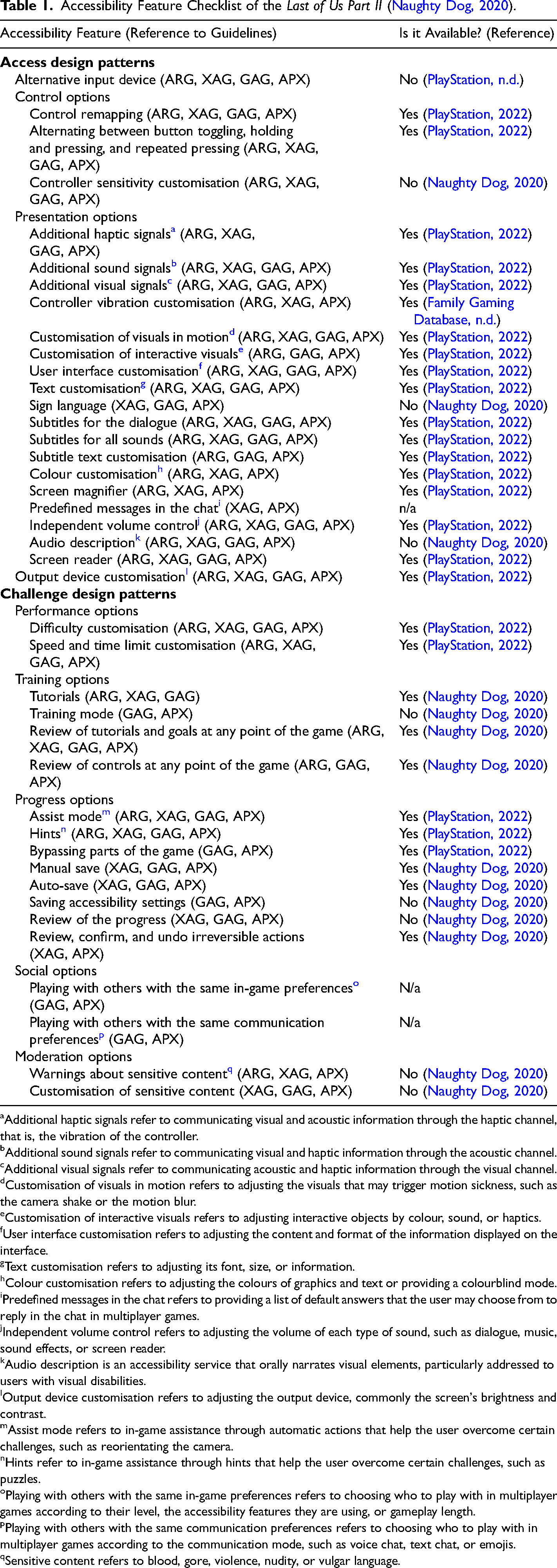
Additional haptic signals refer to communicating visual and acoustic information through the haptic channel, that is, the vibration of the controller.
Additional sound signals refer to communicating visual and haptic information through the acoustic channel.
Additional visual signals refer to communicating acoustic and haptic information through the visual channel.
Customisation of visuals in motion refers to adjusting the visuals that may trigger motion sickness, such as the camera shake or the motion blur.
Customisation of interactive visuals refers to adjusting interactive objects by colour, sound, or haptics.
User interface customisation refers to adjusting the content and format of the information displayed on the interface.
Text customisation refers to adjusting its font, size, or information.
Colour customisation refers to adjusting the colours of graphics and text or providing a colourblind mode.
Predefined messages in the chat refers to providing a list of default answers that the user may choose from to reply in the chat in multiplayer games.
Independent volume control refers to adjusting the volume of each type of sound, such as dialogue, music, sound effects, or screen reader.
Audio description is an accessibility service that orally narrates visual elements, particularly addressed to users with visual disabilities.
Output device customisation refers to adjusting the output device, commonly the screen's brightness and contrast.
Assist mode refers to in-game assistance through automatic actions that help the user overcome certain challenges, such as reorientating the camera.
Hints refer to in-game assistance through hints that help the user overcome certain challenges, such as puzzles.
Playing with others with the same in-game preferences refers to choosing who to play with in multiplayer games according to their level, the accessibility features they are using, or gameplay length.
Playing with others with the same communication preferences refers to choosing who to play with in multiplayer games according to the communication mode, such as voice chat, text chat, or emojis.
Sensitive content refers to blood, gore, violence, nudity, or vulgar language.
Quantitative Data Collection
The checklist is an integration of guidelines, which were chosen according to their author. The aim was to represent the perspectives of all the stakeholders involved in game accessibility: users, industry, and academia. Therefore, the resulting checklist is comprehensive in the sense that it compiles the recommendations that are deemed most important by those who play video games, those who create them, and those who research them.
The starting point of the checklist was reviewing IGEA's (2021) Game Development Accessibility Resources and Guides, a document that lists 66 game accessibility resources developed by all three stakeholders. Then, guidelines published in the last five years were revised. To keep the checklist relevant and brief, four were chosen:
- Accessibility Reference Guides (ARG) (Cassidy, 2019; Craven, 2019; Martínez, 2019; Pennant, 2020; Smith, 2020), created by users. They are published on the website Can I Play That?, which is a leading resource for information about game accessibility (Bayliss, 2022a; Toh, 2022). - Xbox Accessibility Guidelines V2.5
6
(XAG) (Microsoft, 2021), created by the industry. They are recommended by game developers (Dealessandri, 2022). - Game Accessibility Guidelines (GAG) (Ellis et al., 2017) and Accessible Player Experiences (APX) (AbleGamers, 2018), created with the involvement of researchers. Both are often quoted in research papers. For example, GAG is reviewed by Cairns et al. (2019), and Includification (Barlet & Spohn, 2012), the precursor of APX, is analysed by Araújo et al. (2017), Borges and Campos (2017), and Cairns et al. (2019).
ARG is composed of five game accessibility guidelines, each of them addressing the needs of a particular player profile: Cassidy (2019) tackles cognitive disabilities; Craven (2019), hearing disabilities; Martínez (2019), motor disabilities; Smith (2020), visual disabilities; and Pennant (2020), colour-blindness. There is a sixth guide about game public relations and marketing (Kingett, 2020), which was excluded from the checklist as it does not cover in-game accessibility features. ARG is brief, provides examples of good practices, and focuses on improving the gaming experience for all users.
XAG's approach is technical. It offers implementation guidelines that explain how to put into practice its recommendations, as well as scoping questions for game developers, background information to understand the accessibility barrier, examples of good practices, and additional resources and tools.
GAG is the result of the collaboration between the game industry and accessibility experts. Unlike ARG and XAG, where all recommendations are equally important, GAG prioritises some features over others, classifying them into three levels: basic, intermediate, and advanced. Then, they are further sorted according to accessibility type: motor, cognitive, vision, hearing, and speech. There is a sixth category for general recommendations. GAG introduces each accessibility feature with a quote from an accessibility user. Then, a short description of the feature and examples of best practices are provided.
APX is an alternative to prescriptive accessibility checklists. Instead, it focuses on player experience. Accessibility features are organised into two categories. The first one collects access design patterns, which aim to ensure the initial interaction between the player and the game. The second one gathers challenge design patterns, which allow players to personalise their experience and progress in the game. Each recommendation is composed of a title that aims to be broad, so that it may be applied to different accessibility barriers and contexts, a brief description of the design problem it tackles, a design solution, and examples of good practices.
These four guidelines understand accessibility in two distinct ways. For ARG and GAG, which classify accessibly features according to disability profiles, accessibility is providing specific accommodations for specific needs. By contrast, XAG and APX adopt an inclusive design approach, which aims to create products that may be used for the largest number of users as possible. Although this is the end goal, accessibility based on accommodations may be more effective as the starting point (Mangiron & Zhang, 2016).
After reviewing the guidelines, 244 distinct accessibility recommendations were identified: 54 from ARG, 62 from XAG, 105 from GAG, and 23 from APX. They were then coded according to the nine subcategories proposed by Cairns et al. (2019) that, in turn, are based on APX. Access design patterns are options related to input (customising the input device), control (customising a particular controller), presentation (customising the modality or format of the information), and output (customising the output device). Challenge design patterns are options related to performance (adjusting game mechanics), training (adjusting tutorials), progress (adjusting the progress in the game), socialisation (adjusting the interaction between players), and moderation (adjusting the emotional challenge of the game).
Once the 244 recommendations were classified into these nine subcategories, common themes among them were identified. These themes were reworded into accessibility features. The result is an integrated checklist composed of 41 accessibility features, classified into 23 access options and 18 challenge options (Table 1).
The checklist is organised into two columns: accessibility features (including a reference to the guidelines they appear in) and availability (including a reference to the sources where the information about the accessibility features was obtained from). Availability indicates if the accessibility feature is available in the game (“Yes”), unavailable (“No”), or if it is not applicable (“N/a”). Examples of quoted sources are the game itself, the developer's website, and accessibility reviews. Accessibility features are presented in rows and organised into access and challenge design patterns according to APX (AbleGamers, 2018) and into the nine subcategories proposed by Cairns et al. (2019). The Input and Output subcategories only contain one feature, so they have been respectively reworded into the descriptive titles of Alternative input device and Output device customisation.
Some accessibility features are linked to the gaming platform. For example, if the platform is compatible only with the official controller, an alternative input device will be unavailable, regardless of the game that is being analysed. Other accessibility features are related to the multiplayer mode, including communication preferences between players. If the game does not have a multiplayer mode, these features will appear as “N/a” in the checklist.
Qualitative Data Collection
Regarding the second step of the analysis tool, qualitative data is gathered by searching for accessibility reviews written by users and published online. They are thoroughly read to identify the accessibility features users find more adequate, as well as suggestions for improvement. They are chosen to represent different authors, needs, and preferences, including, but not limited to, the four main areas of accessibility: cognitive, visual, hearing, and motor. When reviewed, these opinions are presented in relation to the quantitative results obtained through the checklist.
Two main issues may be encountered when collecting user reviews – a limited number of publications and a limited representation of different needs. Games with a relatively small player community or released several years ago are especially subject to these problems, as well as particularly inaccessible games that received less online attention. To overcome them, users should be directly involved in assessing the accessibility of the analysed game. They may be recruited on a personal basis or through a call for interest addressed to the general population as well as persons with disabilities in order to represent heterogeneous needs. Then, interviews and focus groups may be conducted where participants play a specific game and point out its accessibility successes and pitfalls or discuss their experience playing the game independently.
In fact, this would be the ideal approach, as it allows users of the analysis tool to collect detailed and targeted feedback. For example, a development team could test the accessibility of their game before its release through the checklist and a live discussion with users. However, intentional collection of users’ opinions is costly in terms of time and human resources. The alternative, as exemplified in this paper, is analysing already published user reviews, while being aware that it may entail the limitations of finding a small number of publications that may not represent all accessibility areas.
In conclusion, the analysis tool aims to be broad enough to cover any game genre, platform, and technology, as well as any accessibility need and preference. It does not distinguish between player profiles, as everyone may benefit from accessibility features. Finally, its mixed-methods approach provides both quantifiable and qualifiable results where the adequacy of available accessibility features and the impact of unavailable features are assessed by their users.
Pilot Study
A pilot study was carried out to test the analysis tool. The chosen video game was The Last of Us Part II (Naughty Dog, 2020). This action-adventure game follows the story of the main characters, Ellie and Joel, 5 years after the events of the first game of the series. Set in a postapocalyptic world, players must survive, fight zombie-like creatures and other humans, and deal with the consequences of difficult choices.
The game is famously committed to accessibility, offering three pre-sets that automatically select accessibility features relevant for vision, hearing, or motor accessibility. These features may also be manually selected to tailor the gaming experience to specific needs and preferences. In fact, Naughty Dog recommends every player to try them: “We encourage everyone to take advantage of these features to create a gameplay experience that's right for them” (Gallant, 2020). Accessibility features are listed in a specific accessibility menu within the game and are explained in detail on PlayStation's website (2022).
Although the game's long-term influence in the industry remains to be determined, it is expected to become an important milestone in game accessibility (Hamilton, 2021b). So far, it has won the first Innovation and Accessibility Award ever conferred by The Game Awards (Stedman, 2020) and its accessibility features, designed together with accessibility consultants and users (Gallant, 2020), have been well received by players with disabilities (Hamilton, 2020; Sightless Kombat, 2020). Naughty Dog is already expanding on the series’ accessibility by adding new features, such as audio description, to the remake of the first instalment, called The Last of Us Part I (Naughty Dog, 2022).
Quantitative Results
The first step of the analysis is to collect quantitative data through a checklist that integrates the recommendations of four accessibility guidelines, as outlined in the paper's Research Design and Method section. The game was played on a PlayStation 4, using an official PlayStation 4 controller. When the information about the availability of accessibility features was obtained from playing the game itself, it is cited as “(Naughty Dog, 2020)”. Additional data was collected from PlayStation's website (n.d., 2022) and the Family Gaming Database (n.d.).
The checklist, available in Table 1, shows the accessibility features in The Last of Us Part II. Those accessibility options that are not self-explanatory are defined in footnotes. After the accessibility feature's name and between brackets, the guidelines they were extracted from are referenced. The Last of Us Part II offers 29 out of 38 accessibility features. It is important to note that, while the checklist includes 41 features, three of them are not considered in the analysis because they refer to the multiplayer mode, which this game does not offer, at least for the time being. These three options are marked as “N/a” in the checklist.
On the one hand, the game offers 18 out of 22 access features. The availability of additional haptic, sound, and visual signals is worth noting. For example, when the right note is played on a guitar, the sound is accompanied by vibration cues on the controller (PlayStation, 2022). As a result, players who cannot properly access the acoustic channel are able to interact with the game. Another example that may benefit these players are visual damage indicators, which spike in the direction from where the damage was taken (PlayStation, 2022). However, there is a lack of direct compatibility of the PlayStation 4 with alternative input devices, which may prevent users who cannot access the official controller from playing (Gohil, 2022).
On the other hand, The Last of Us Part II provides 11 out of 16 challenge features. It offers six out of eight progress options, including a wide range of automatic actions (reorienting the camera in the direction of the movement, swapping weapons, picking up objects, or targeting enemies), hints related to exploration and combat, or skipping puzzles (PlayStation, 2022). The lack of moderation options could be expected, as the game is not recommended for players younger than 18 years old and contains violence and vulgar language.
Qualitative Results
User reviews about the accessibility of The Last of Us Part II are mainly positive. For players like Branco (2020), who has low vision, the game is accessible from the very first moment of interaction: “I just… you know, grab the controller and play the game, and don't worry about anything.” Challenge options are particularly praised. For example, Craven (2020), who reviews hearing accessibility features, enjoys options related to performance (such as a reduced game speed in combats) and to progress (dodging enemy attacks). Branco (2020) uses navigation assistance to explore the game's world and skips puzzles when they require vision to complete them.
However, the unavailability of certain access options may prevent interaction or progress for some players. The incompatibility of PlayStation 4 with an alternative input device may result in players with motor disabilities not being able to access the game at all. This is the case for Stoner (2020), although he still considers The Last of Us Part II to be a step in the right direction: “It admittedly hurts to not be able to gush with excitement alongside my friends and colleagues, but it also fills me with a sense of pride to know that disabled individuals are actively making a difference.”
Having said that, the unavailability of some access features may be compensated by the availability of others. For example, The Last of Us Part II does not offer audio description. Sightless Kombat (2020), in a review for Can I Play That?, wishes the game provided it, although he states that it is not absolutely necessary to access the game: “At times, the [text-to-speech] will narrate additional pieces of information that are useful to be aware of for story reasons, thus making the lack of [audio description] even less of an issue than it otherwise might be.”
These results show that the adequacy of accessibility features depends on the players’ individual preferences and needs. However, the more features offered by the game, the more likely it is to be accessible for a wide audience. As Craven (2020) puts it, “The real value in what Naughty Dog has created with The Last of Us 2 is that it illustrates, indisputably, that customisation is key in creating an accessible experience.” Although there is still room for improvement regarding input options, the game has set a precedent for the game industry. Its impact is summarised by Brandon Cole (2020), an accessibility consultant who worked on the vision accessibility features for the game: “The Last of Us Part II is not the last of anything. It is, in fact, the first.”
Final Considerations
Game accessibility has become an emerging topic of discussion in recent years. Users, industry, and academia alike are making efforts to develop, spread, and promote an accessibility that may be used and adapted by a large number of players. Initiatives include creating accessible hardware and software, informing about game accessibility, and raising awareness about the topic among professionals. Another strategy is to systematise accessibility features into guidelines, which vary in their approach, depending on their author and purpose. This heterogeneity may hinder their implementation. As a result, researchers have developed their own instruments to assess game accessibility, often integrating recommendations collected from existing guidelines. However, they also vary greatly depending on their scope, which results in a lack of unified criteria, and they do not always involve users.
To bridge this gap, the analysis tool presented in this paper adopts a mixed-methods approach that not only quantifies accessibility features, but also qualitatively assesses them through users’ reviews. It consists of two steps. First, accessibility features are quantified through a checklist, which integrates recommendations developed by all three stakeholders involved in game accessibility: users, industry, and academia. Second, the impact on the gaming experience of available and unavailable accessibility features is assessed through reviews written by users and published online.
The analysis tool was applied to The Last of Us Part II (Naughty Dog, 2020). Results show that the game offers most of the accessibility features in the checklist. However, the qualitative step of the analysis highlights that the adequacy of accessibility features greatly depends on the users’ needs and preferences, although more user data is needed to draw generalisable conclusions. It is also important to note that the accessibility features in the game were designed alongside users and consultants (Bayliss, 2020), a good practice to ensure usability.
The main application of the analysis tool is to describe the accessibility of a certain video game. As such, it is a tool for research and not game design, because, with 41 accessibility features, it may be considered lengthy. Moreover, it does not provide implementation recommendations. To that aim, other guidelines may be used, such as Xbox Accessibility Guidelines (Microsoft, 2021).
Although the analysis tool aims to be broad enough to be applied to any genre, platform, technology, or accessibility need and preference, not every accessibility feature may be applied to every game. For example, games without a multiplayer mode will not provide accessibility options for communicating with other players. Similarly, visual features, such as colour customisation, will not be offered in audio games, where stimuli are acoustic and haptic. This is taken into account in the checklist through the “Not applicable” category.
Future avenues of research include validating the analysis tool with users and industry professionals and analysing a game corpus selected by genre, platform, or time period. It would be particularly interesting to compare the accessibility of mainstream games, such as the one analysed in the paper, to independent ones to assess the impact of resources in accessibility development.
Regarding the qualitative step, selection bias related to only analysing published reviews may be prevented by directly involving users as game developers, consultants, or testers. If resources allow, interviews and focus groups are especially recommended to obtain detailed insight about players’ accessibility use and suggestions for improvement.
In essence, accessibility will likely continue to play an important role in the future of video games, as it brings more players to the medium, promotes social inclusion, and provides access to culture and leisure. The analysis tool in two steps presented in this paper aims to contribute to these goals, so that video games can truly be enjoyed by everyone.
Footnotes
Declaration of Conflicting Interests
The author(s) declared no potential conflicts of interest with respect to the research, authorship, and/or publication of this article.
Funding
The author(s) disclosed receipt of the following financial support for the research, authorship, and/or publication of this article: This work is part of the Researching Audio Description: Translation, Delivery and New Scenarios Project, supported by the Spanish Ministerio de Ciencia, Innovación y Universidades, the Spanish Agencia Estatal de Innovación, and the European Regional Development Fund [PGC2018-096566-B-I00 (MCIU/AEI/FEDER, UE)]. The author is a member of the TransMedia Catalonia research group funded by Secretaria d’Universitats i Recerca del Departament d’Empresa i Coneixement de la Generalitat de Catalunya, under the SGR funding scheme (ref. code 2021SGR00077) and she has been awarded a PhD grant from the Catalan Government (2021FI_B1 00049).
