



Abstract
The “metaverse” and non-fungible tokens (NFTs), though not necessarily “new” terms or technologies, have risen to mainstream prominence post-2020. This paper, based on survey data obtained from Unity Technologies, examines the metaverse, NFTs, and the future of development within the Unity engine from the perspective of current Unity users. Specifically, the paper examines how users define the metaverse, their goals in metaverse and NFT development, and their future questions and concerns concerning these concepts. This data is then used to place the metaverse and NFTs into broader historical, present, and future contexts. The paper ultimately argues: (1) the metaverse and NFTs follow previous historical trends in communication technology development, (2) development within Unity will continue to be split between game development and non-game development, and (3) arguments of the “newness,” “uniqueness,” or “future-facing” of the metaverse and NFTs help to obfuscate legitimate concerns about these technologies.
Introduction
The “metaverse” and non-fungible tokens (hereafter NFTs) rose to prominence in 2021–2022. Though neither of these ideas or groups of technologies are “new,” the concept of the metaverse dates back at least to Neil Stephenson's 1992 science-fiction novel Snow Crash and NFTs are the combination of many previously established technologies (most notably blockchain and crypto currency), they did not attain mainstream relevance and recognition at their current level until recently. This can most likely be traced to increased attention from tech companies most notably Facebook which rebranded itself as Meta in October 2021 to draw attention to its commitment to the development of the metaverse (Meta, 2021).
However, with new attention comes new questions and issues along with increased scrutiny. What exactly is the metaverse? Who is it for? How will it make money? What will its connections to video games and video game development be? How will NFTs be integrated (or not integrated) into this new virtual world? These questions have become central to future financial outlooks of many companies (both those that have rebranded themselves and those that are looking to expand their current business models) and have also been the topics of numerous think-pieces, theorization, and online discussion by tech gurus and laypeople alike. While these perspectives are important to consider, this paper instead approaches these issues from the perspective of current Unity users through the use of survey data. Specifically, the paper utilizes survey data to examine how Unity users define the metaverse, the goals of Unity users within the frameworks of the metaverse and NFT development, and the concerns that Unity users have regarding the future of the metaverse and NFTs.
By applying qualitative coding methods to Unity-provided survey data, the paper finds that current Unity users have surprisingly little formal definition of the metaverse (and what does exist is non-standardized and un-unified), have varied development goals that expand beyond pure profit motivations or traditional game development, and many users have numerous, legitimate concerns about the future of development within the context of the metaverse and NFTs (including the propensity for scams, “bad” economic models, and continued ecological/environmental impact).
Furthermore, by reading these findings through theory in the fields of communication studies, game studies, and media studies, the paper puts forth three key arguments. Firstly, it argues that the “metaverse” follows previous developments in communication technologies as seen in its need for standardization, use of agreed upon but poorly defined terminology, and, to some extent, its development within Silicon Valley. Secondly, it argues that development of the metaverse within Unity follows established design practices within the tool (i.e., game development vs. other types of design work, professional development vs. amateur development, profit-motivated development vs. other development goals, etc.) in that it is varied and transcends pure profit motivations and traditional game development practices. Thirdly, building on these two arguments, the paper argues that focus on the inevitability and future of the metaverse, especially by established capital, mask legitimate concerns about the metaverse and NFTs in both the present and future.
Literature Review & Methodology
The terms “metaverse” and “NFT” have grown in popularity recently for a variety of reasons. In 2021 Facebook rebranded itself as Meta and announced a commitment to the development of a metaverse (Meta, 2021). Square Enix announced a commitment to blockchain and metaverse gaming that was met with immediate backlash but paradoxically, also received a jump in their share price shortly thereafter (Savov, 2022). NFTs sales also became newsworthy during this time, especially as they grew in value, such as when American digital artist, Beeple sold an NFT for $69 million USD (Kastrenakes, 2021). Starting in 2021, the metaverse and NFTs became ubiquitous terms as they appeared frequently in both mainstream and tech-focused news cycles. However, despite this ubiquity, it is valuable to briefly define and discuss the contexts of these terms.
“Metaverse,” though a term that has entered larger public discourse, is still ill-defined. This situation has become exacerbated by the recent uptick in “metaverse” development that has been coupled with the term's rise to prominence. This paper will refrain from providing its own definition of the metaverse as the focus is on the definitions provided by current Unity users. However, it should be noted that numerous scholarly works have already attempted to provide their own definitions for metaverse. Dionisio et al. (2013) provide a basic definition where they describe metaverse as a portmanteau of the prefix “meta” (meaning beyond) and “verse” (short for universe) as a result, the term literally means a universe beyond the physical world. Zhao et al. (2022) state that the term remains ambiguous and is best understood as a virtual world parallel to the real world. Rospigliosi (2022) refrains from providing their own specific definition and instead provides definitions from others, notably Snow Crash author Neil Stephenson and Facebook (now Meta) founder Mark Zuckerberg. Going further than this, Park and Kim (2022) chart the use of the term starting with Stephenson and ultimately list 54 unique definitions and accompanying characteristics of the metaverse dating from 1992 to 2021. They also provide a baseline definition where metaverse, “…is widely used in the sense of a virtual world based on daily life where both the real and the unreal coexist” (Park & Kim, 2022, p. 4211).
It is fair to conclude that there is currently no popularly accepted, unified definition of the metaverse, only vagaries and generalization. This has especially become the case as numerous companies begin to build a “metaverse” while creating their own definitions that fit into their view of what the “metaverse” is/will become. Indeed, it should be noted that the lack of a unifying definition is, in some part, purposeful. Knox (2022) argues that the metaverse represents a rehash of early Silicon Valley “frontierism” where confusion about the term is used by tech gurus as a way of maintaining power. In his words, “There is power in the maintenance of the frontier, where everyone but the tech gurus feels lost and confused” (Knox, 2022, p. 213). Within this system each individual or company is free to develop their own definition of the metaverse which is frequently tied to their own development, work, or prerogatives.
Unlike the term “metaverse," NFTs have been easier to define, though they do require an understanding of several overlapping technologies, such as blockchain and cryptocurrency. Clark (2021), writing for technology news website The Verge, provides an accessible FAQ-style article describing NFTs for the uninitiated. On the most basic level, an NFT is a digital file, image, artwork, etc. that is referred to as a “token” and has its ownership tracked and recorded through the use of blockchain technology. A frequently used video game use case for NFTs are as cosmetic character items and costumes that are limited in number or given unique characteristics while being backed by blockchain. The term “non-fungible” part of the term is used to indicate that each of these digital tokens are unique rather than interchangeable and can thus be owned and have discrete values. However, this is debated by detractors of NFTs. Ownership of an NFT, for example an NFT of a piece of digital art, does not prevent non-owners from creating their own copies of that NFT as they can, for example, copy/paste and save digital art that is “owned” as an NFT. In a case such as this, these non-owners do not gain blockchain backed ownership of the digital art, but they do create a digital copy of the NFT for their own personal use. NFTs are thus backed by blockchain and confer ownership but their “non-fungible” nature is, frequently, debatable.
For the purposes of this paper, it is less necessary to understand what NFTs are than how they have been received and perceived. While they are, clearly, valued by some (as evidenced by the aforementioned Beeple sale or the massive investment that they have attracted by companies such as Square Enix) NFTs have many detractors because of several key issues that go beyond the vagaries of ownership and their fungibility. As they are backed by blockchain technology, the storage, recording, and transferring of NFT ownership require large amounts of power, thus making NFTs environmentally unfriendly contributors to climate change. NFTs have also been viewed as “scams,” a view that has been buttressed by several notable thefts or robberies. For example, several NFTs that were stolen from American actor Seth Green became newsworthy in 2022 (Zwiezen, 2022). Finally, NFTs have faced backlash within large parts of the video game community because of feelings of their forced inclusion into video games. Fahey (2022) conveys these feelings well calling NFT implementation into 3rd party games as, “the latest unethical twist from Web3” in his coverage of Mojang's decision to condemn and ban NFTs from their popular game Minecraft. To summarize, NFTs have been embraced by some large companies and individuals because of their investment potential and interest in the technology but have been much less accepted by other companies and individuals because of their potential to damage the environment, perception that they are “scams,” and general confusion of the actual value of this specific use case of the underlying technologies (namely blockchain).
Currently, the definition of the metaverse and the arguments for/against the implementation of NFTs are representative of the important cultural clashes occurring within the video game and cultural industries as a whole. Within these clashes some larger established companies are pouring investment and capital into these new ventures while other companies and the public at large question their value, use case, and future. This paper acknowledges the continued fluidity of the “metaverse” and NFT implementation as essential context for its analysis of Unity user survey data.
The findings of this paper are based upon anonymized survey data provided to the author by Unity Technologies. The survey was run by Unity Technologies using internal software and data. Potential participants were identified and selected by Unity Technologies. The 12-question survey was targeted at current Unity users, some of which had been identified as “already interested” in the metaverse and NFTs and others that were selected randomly from a pool of all Unity users. The survey ran for one-month from March 23, 2022 to April 23, 2022. About 884 potential participants viewed the survey invitation while 716 chose to respond. Ultimately, 660 participants completed the survey while 56 provided some answers but dropped out.
All answers were included in the provided data whether the participant ultimately completed the survey or chose to dropout. This means that some questions have response tallies that exceed the 660 completed survey responses. Also, the survey split participants based on answers to specific questions in order to ensure that users were being asked relevant questions (i.e., current NFT developers were asked questions about that development rather than questions about why they were not developing NFTs). As a result, many questions have much fewer than the 660 responses. Finally, many responses were deemed irrelevant (mostly for providing either blank, nonsense, or unrelated answers to the question) which also curtailed the number of responses that were included in analysis. Final counts of relevant answers are included for each question as they are analyzed and discussed within this paper.
The survey consisted of both yes/no questions (used to “sort” respondents into different “streams” of the survey) and open-ended questions with space for short answers. In general, the survey was aimed at measuring interest in metaverse and NFT development and what tools would be needed to facilitate this development or, in cases where participants indicated that they had no interest in metaverse or NFT development, why there was a lack of interest.
For the purposes of this paper, questions that focused on the definition of the metaverse, goals for metaverse/NFT development, and concerns or critiques of the future of the metaverse or NFTs are the primary focus. Definition questions included: “Does your company have an official or working definition of the metaverse? If yes, what is it?” and “How would you define the metaverse?” Users who identified themselves as working on metaverse, NFT, or metaverse/NFT projects were asked, “What are your goals in NFT development?” Finally, users who stated that they were not developing NFTs were asked, “Do you consider NFTs to be fundamentally/intrinsically unviable? If yes, why?” and “Is there one primary issue with NFTs that make you not want to work with/develop them?” Questions that inquired about specific tools that users would require for future metaverse and NFT development also appeared in the original survey and raw data. However, these questions are not addressed here as they were deemed to be beyond the scope of this paper.
The data was provided to the author as raw data and was interpreted and analyzed using qualitative coding methods. To begin, inductive coding was used to familiarize the author with the general content and responses of each question and to identify relevant patterns, frequently used responses, and, in many cases, irrelevant responses. Guided by the results of this first pass through of the data, thematic coding methods were then applied. During this process, relevant codes were determined and applied to the data for the purposes of analysis. The codes attached to each specific question and their relevance will be discussed in each relevant section below.
However, as an example, the first open-ended question in the survey asked, “Does your company have an official or working definition of the metaverse? If yes, what is it?” After inductive coding the responses (i.e., reading through the responses to find important responses and relevant patterns) thematic coding was utilized using five identified codes. These were: (1) No or equivalent responses, (2) VR/AR/XR centric responses, (3) Company-based responses (i.e., mention other companies or products as an example of the metaverse such as Facebook, Second Life), (4) Environmental or Infrastructure based responses, and (5) Skeptical or dismissive responses. The use of qualitative codes allowed for a numerical accounting of the responses while simultaneously allowing for an analysis of the relevance of the larger identified patterns from the raw data.
The discussion, analysis, and conclusions of this paper are a combination of the results of the qualitative coding of the survey data and the application of relevant critical theory in the fields of game studies, communication studies, and media studies. Specifically, the paper puts the “metaverse” and NFTs into a better historical context through the use of Mattelart's (2000) ideas of standardization of communication systems and Jenkins (2006) analysis of a similarly ill-defined industry term, convergence. Additionally, analyses of the Unity platform/engine by Chia (2022), Foxman (2019), Nicoll and Keogh (2019), and Werning (2021) are utilized to contextualize and describe the power, usage, and significance of metaverse and NFT development within the Unity platform/engine.
Discussion of Data
Defining the “metaverse”
The cacophony of definition for the term “metaverse” discussed above has worked to both obscure the meaning of the term and create a space where “metaverse” can mean many different things for many different people and companies. However, the lack of a unified definition of the term metaverse also allows for users to interpret their activities uniquely and to create their own, flexible, definitions. In terms of this survey, two specific questions were asked regarding definition of the metaverse: “Does your company have an official or working definition of the metaverse? If yes, what is it?” and “How would you define the metaverse?” Within the data results the first of these questions (based on the company's definition) had 386 relevant responses that were coded into five categories (see Figure 1). The second of these questions (based on the participants’ personal definition) had 450 relevant responses that were coded into seven categories (see Figure 2).
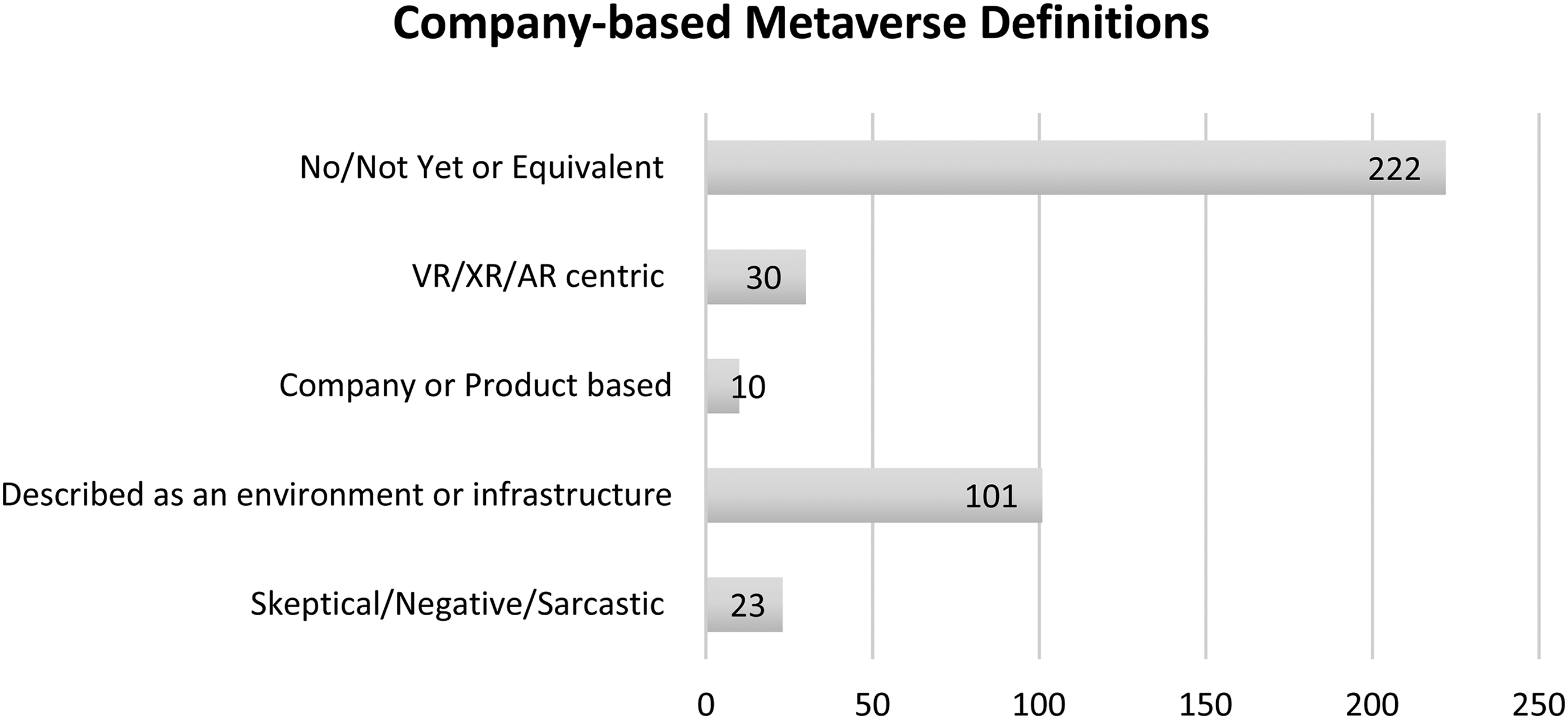
Coded results for question, “Does your company have an official or working definition of the metaverse? If yes, what is it?”
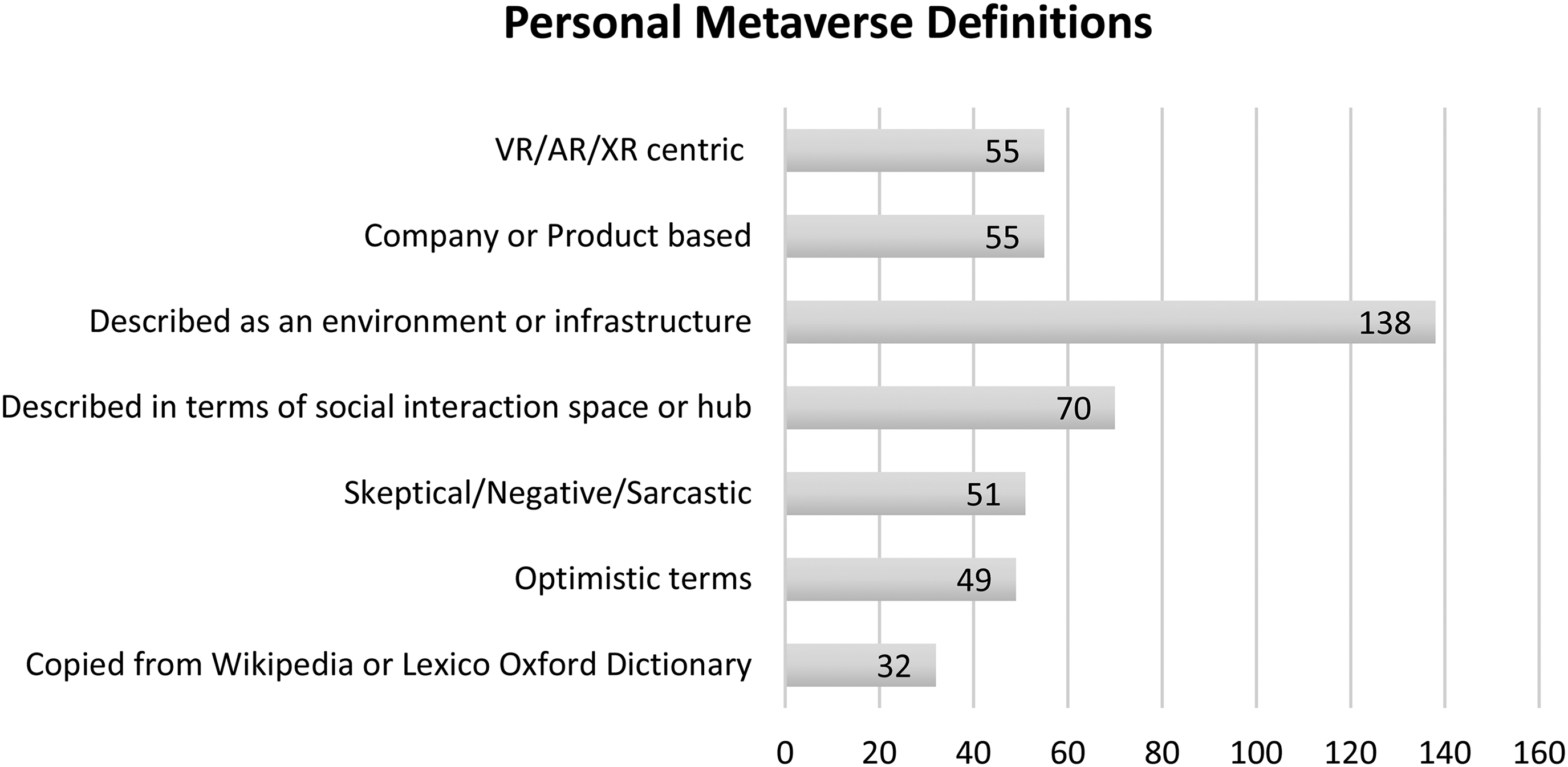
Coded results for question, “How would you define the metaverse?”
Unsurprisingly, definitions based on digital environments or infrastructure are prevalent among both the company and personal definitions. This follows the generally accepted or most common definitions of the metaverse. The “company-based” answers can also be seen as related to this as they mostly refer to well-known virtual worlds that either already exist (i.e., Roblox and Second Life) or are currently being built (i.e., Meta's metaverse development) and are used as examples of the metaverse. In a similar vein, answers that focus on user social interaction or the VR/XR/AR technologies that will allow for entry into the metaverse can also be seen as being closely linked to the more “traditional” definitions of the metaverse. All of these answers are linked to the technologies or uses of the metaverse as it is currently or commonly understood in public discourse.
Another set of answers that can easily be connected to the general understanding and discussion of the metaverse are the “optimistic” and “skeptical/negative/sarcastic” answers. It is insightful to examine examples of each type of these aforementioned answers. In terms of optimistic definitions of the metaverse one developer referred to the metaverse as, “A place open to everyone with unlimited possibilities of real people in a single place with tons of interactable objects around it.” Another optimistic answer called the metaverse, “A world where everything and anything is possible.” In terms of skeptical/negative/sarcastic, one developer defined the metaverse as, “A glorified MMORPG but with crypto so it sucks.” Another went further proclaiming the metaverse to be a “Waste of time fad that serves no purpose at all.” These optimistic answers mimic the positivistic definitions that come from those toting the metaverse as “the next big thing” or as “the future” (such as tech companies and investors) while the negative answers reveal a general skepticism against these definitions. These opposing views will be explored in more depth in the below section on future questions and concerns but are, nonetheless, important to note in the definition stage of the survey results.
Of particular interest, were two sets of answers that were unexpected before the process of inductive coding: the “No/Not Yet or Equivalent” answers and answers copied from Wikipedia and Lexico. The No/Not Yet answers were the most common single category over the two definition questions. They also did not typically have any follow-up even though the space was provided for these open-ended questions. These “No/Not Yet or Equivalent” were provided in the company definition question meaning that, potentially, many companies/individuals that identify themselves as engaging in metaverse development do not have a definition for metaverse. Of equal interest to the results were numerous answers found in the personal definition of metaverse question where numerous answers read, “In futurism and science fiction, the metaverse is a hypothetical iteration of the Internet as a single, universal and immersive virtual world that is facilitated by the use of virtual reality (VR) and augmented reality (AR) headsets. In colloquial use, a metaverse is a network of 3D virtual worlds focused on social connection” or “A virtual-reality space in which users can interact with a computer-generated environment and other users.” The wording of these answers was puzzling at first (especially the use of the term “futurism” in an unexpected context) until these definitions were identified by the author as being directly taken from Wikipedia and Lexico (the Oxford Dictionary online), respectively. This is significant because it indicates, at least on some level, that many users do not have a personal definition of the metaverse but given the option, will copy a popular or readily available definition.
The fact that current and future metaverse users may be in a position where they have no definition of metaverse may seem paradoxical at first. However, there is a wider significance to these observations when viewed through the lens of the history of communication and media. One of the keys of the development of all communication systems is standardization. Mattelart (2000) traces the importance of standardization of communication networks back to the 18th century and the wide-scale adoption of the metric system. He also provides the example of railways and how they led to the universal measurement of time. Despite the fact that the metaverse may seem to be vastly different from the 18th century examples of communication network development it still fits into this time-honored truth in its need for standardization. This standardization, even at the level of definition, has quite simply not occurred. This lack of a unified definition of the metaverse has, obviously, not prevented users and industry leaders from declaring the importance of the metaverse. In the rush to create the metaverse, an important discussion about exactly what the metaverse is and what it consists of (both at micro and macro technological levels) has been bypassed. At present, the “metaverse” is what each individual or company wants or needs it to be.
Looking to another more recent example from the history of communication systems and media, we can identify a parallel between how “convergence” seemingly developed in a similar, haphazard way. Jenkins (2006) perhaps most prominently wrote about convergence in his book Convergence Culture. In his opening chapter, which focuses partially on the New Orleans Media Experience held in 2003, Jenkins discusses how industry leaders were returning to the idea of convergence, an old concept, in order to make sense of a moment of disorienting change (2006, p. 6). He writes about meetings at the conference stating, “In every discussion, there emerged different models of convergence followed by acknowledgment that none of [the attendees] knew for sure what the outcomes were going to be” (Jenkins, 2006, p. 7). “Convergence” eventually did occur is specific ways as media and cultural industries grew and implemented new technologies just as the “metaverse” may also be achieved in some concrete way. The parallels between “convergence” and “metaverse” are striking. An older term is being brought to the forefront of the tech world in an abstract, ill-defined way and is being touted as the solution to current problems or “as the future,” even if those doing the touting are unsure exactly what that future is and how it can be achieved.
The lack of definition for metaverse by current Unity users may then be seen as intentional and largely by design. Until standardization of definition, technology, vision, and action occurs it is easier (and perhaps wiser) to engage in “metaverse” development without a concrete direction. This is practical for smaller users to some degree as it allows for flexibility as standardization gradually occurs. However, lack of definition and direction for the sake of future flexibility is not without issue. Knox (2022) argues the metaverse is a rehash of the digital frontierism of Silicon Valley where large companies wish to control the future development and direction of the tech industry by cultivating a “digital frontier.” This frontier is, by design, non-navigable by smaller users and individuals and requires the capital and expertise of Silicon Valley corporations and tech gurus. Looking within the survey data we can identify the use of common definitions for metaverse based on environments and infrastructure, the complete lack of definition, and even the copy-pasting of readily available online definitions from Wikipedia and the Oxford Online Dictionary as a function of both the technological optimism for the future that the metaverse currently represents and the digital frontierism of tech companies looking to define and shape the future to their benefit.
Developmental Goals
Given the widespread media coverage, and general vitriol directed towards NFTs in media coverage, it was assumed that Unity users would have formulated opinions on the development of NFTs. However, little was directly known about specific developer-defined goals at the outset of the survey. In order to ascertain the goals of Unity users who were already engaged in the development of NFTs, they were asked directly about their development goals. The question on the survey read: “What are your goals for NFT development?” Within the provided data this question had 255 relevant responses that were coded into three categories (see Figure 3).
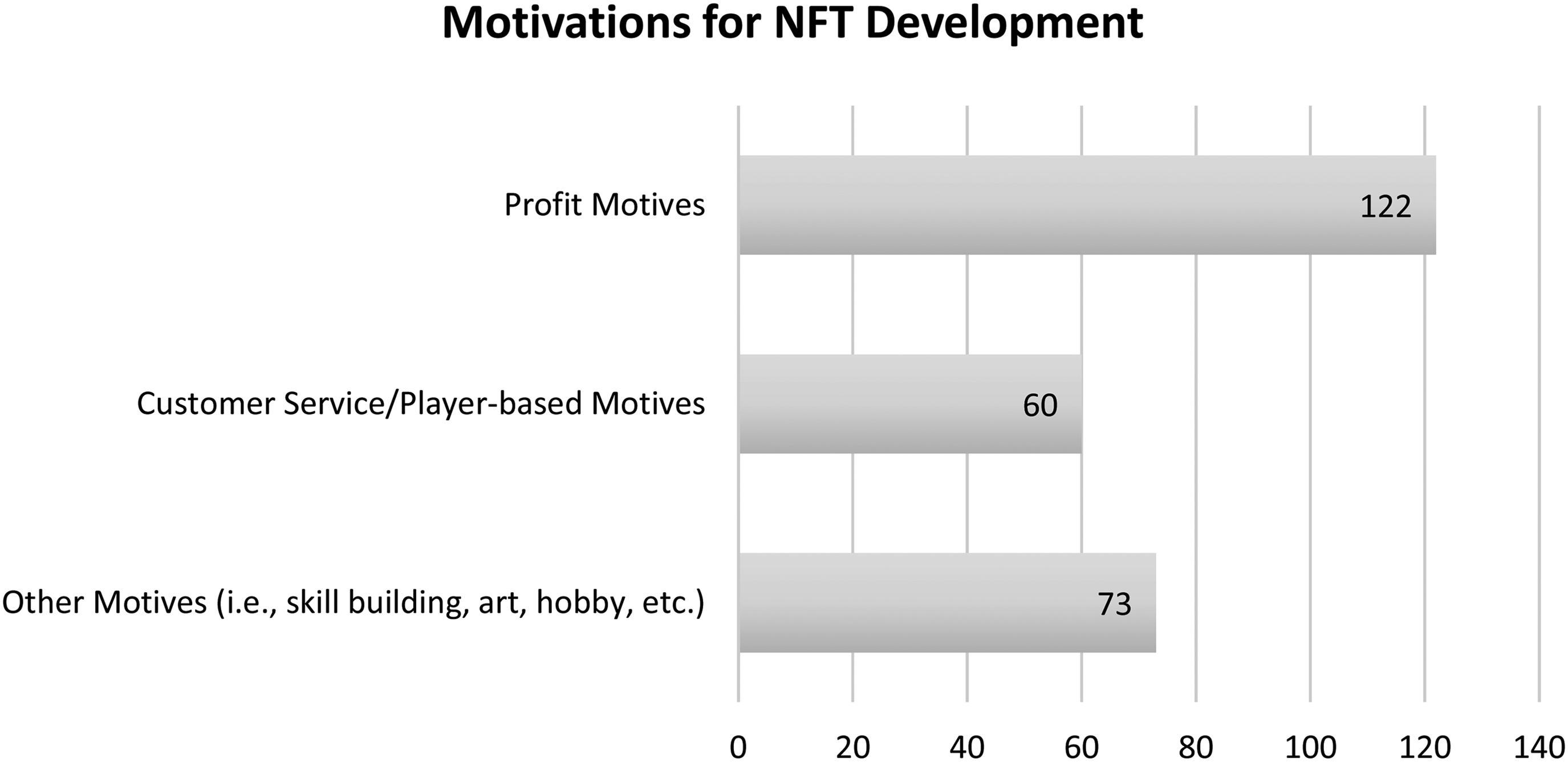
Coded results for the question, “What are your goals in NFT development?”
The responses to this question were much more uniform than those previously discussed and were thus easier to categorize into fewer codes. As expected, pure profit motives were the most common response by Unity users currently working on NFTs. Some of these responses were very straightforward and included examples such as one developer who described their goals in NFT development as, “Making a lot of money with little effort.” In a similar vein, another wrote of their goals, “Make a high revenue.” Other responses coded as being motivated by profit were more nuanced with varying degrees of planning/understanding of the market. For example, one developer expressed their hopes in NFT development as, “Develop several NFTs per month. We wish that one will blow up. The chances are very low, maybe 1 in 100 or even lower.” Another developer described how they would integrate their NFT development into their other projects stating, “I want to focus more with crypto integration but NFTs could act as cosmetics for characters.” It should be noted that, when coded for this study, “profit motives” as responses were those that did not mention “players” specifically. These responses are thus partially coded to indicate that these specific users are either not engaging in traditional game development or, at the very least, are not primarily engaged in traditional game development when they conceive of their NFT development.
Other users defined their NFT development through player experience and customer service motives. For example, one developer stated that they were developing NFTs as a way of “Offering rewards and value to players time.” The responses in these codes were not necessarily connected to profit motives as evidenced by responses that seemed to focus much more on the experience of players. For example, a developer wrote that they intended, “To create unique pieces of art for my games to either give as reward or as a 1-time limited offer perks. Or items, which could make my games more interesting and fun.” The primary dividing factor between responses that were coded as “profit motivated” versus those that were coded as “customer service or player motivated” was the focus on user experience as the primary reason for developing NFTs over profit (though, of course, profit was very likely to be a part of these motivations as well). Also, it should be noted that these responses frequently and specifically used terms such as “player(s)” and “game(s)” which is indicative that NFT development was connected to larger traditional game development rather than simply NFT development through the Unity engine.
Finally, there were numerous responses that fell outside of the first two codes. These responses were quite varied but generally fell into the categories of skill-building, art, hobby, or other motivations that would indicate that the NFTs were being primarily developed for the edification or benefit of the individual developer rather than for a wider audience (either for profit or connected to a larger game/player base). Some of these responses were quite short. For example, one developer simply answered the question with the word, “fun,” while another wrote only “New challenges.” Others provided more descriptive explanations of skill-building activities involving Unity development and NFT development. As an example, one developer wrote, “I am currently studying the best ways to connect a Unity application to the blockchain system.” While, of course, it is possible that these development activities may eventually lead to profit or integration into a game with an established player base, these responses were separated into their own category due the stated goals of the developer at the outset of development.
These varied responses and explanations for undertaking NFT development within Unity are indicative of how Unity, as a platform, has been used and may be used in the future. Unity is generally thought of and frequently referred to as a game engine and development tool. This may partially account for the survey responses that are closely connected to game development and specifically mention players. Indeed, development within Unity is affected by the affordances of the Unity platform which seeks to “lock-in” users and introduce them to Unity's specific system of governance (Foxman, 2019; Nicoll & Keogh, 2019). By these methods, Unity shapes design within the engine and, in many cases, defines what can be built within the engine or what users can conceive of being made in the engine. Werning (2021) describes this as how a game tool shapes the creator's view of the spectrum of possible outcomes within a design process. Answers that privilege “game(s)” and “player(s)” even as the users work on metaverse projects (which are not necessarily traditional “games” with “players”) are indicative of the ideas of “lock-in” and platforms shaping development. Many Unity users engaged in metaverse development show a dedication to traditional game development practices even as they approach the new “digital frontier” of the metaverse.
However, the Unity engine, as a tool or program, is used beyond game development. Chia (2022) argues that it should be thought of beyond simply being a game engine, especially as we consider the current and future development of the metaverse. Users that define their design processes beyond games, as many did within this survey, speaks to the Unity engine's versatility as a design tool beyond game development. While the participants of this survey largely define their NFT development goals through profit motives their answers also speak to this versatility. Beyond this, those that define their NFT development goals in terms of learning, skill development, or the creation of art also speak to the necessity of analyzing the Unity as a development tool that transcends traditional game development. Indeed, these early survey results show that many users are already moving beyond using Unity to develop traditional games. Metaverse and NFT development will most likely continue within the Unity engine especially if the engine is updated and retains its compatibility with the eventual standardization of the metaverse. This development will, of course, include traditional games with metaverse and NFT elements but will also include projects that increasingly move away from traditional game development and outputs.
Future Questions & Concerns
Despite industry leaders’ large-scale investment and optimism about the future of the metaverse and NFTs in general, there has been a pronounced hatred and backlash against their development and integration as well. This backlash has not necessarily resulted in financial losses for companies that are targeting metaverse development. Square Enix, traditionally viewed as one of the leaders of the Japanese video game industry, faced much vitriol from gaming communities online in the direct aftermath of their endorsement of the metaverse and blockchain based gaming, yet still were reported to see share growth during that same period (Savov, 2022). Regardless, opposition and skepticism around the metaverse and NFTs remains in numerous online communities and was found to be present within the survey data from this study. Anticipating that this may be the case, the survey asked participants that indicated that they would never work on NFT development (and potentially also metaverse development) two specific questions about their lack of interest. These were: “Do you consider NFTs to be fundamentally/intrinsically unviable? If yes, why?” and “Is there one primary issue with NFTs that make you not want to work with/develop them?”
The first of these questions (regarding the viability of NFTs) had 194 relevant responses that were coded into four categories (see Figure 4). The second question (asking specifically for one primary issue that the participant had with NFTs or NFT development) had 177 relevant responses that were coded into seven categories (see Figure 5). However, it should be noted that, despite asking for one primary concern, many participants provided multiple issues. In these cases, the first issue or primary focus of the response was used for coding purposes.
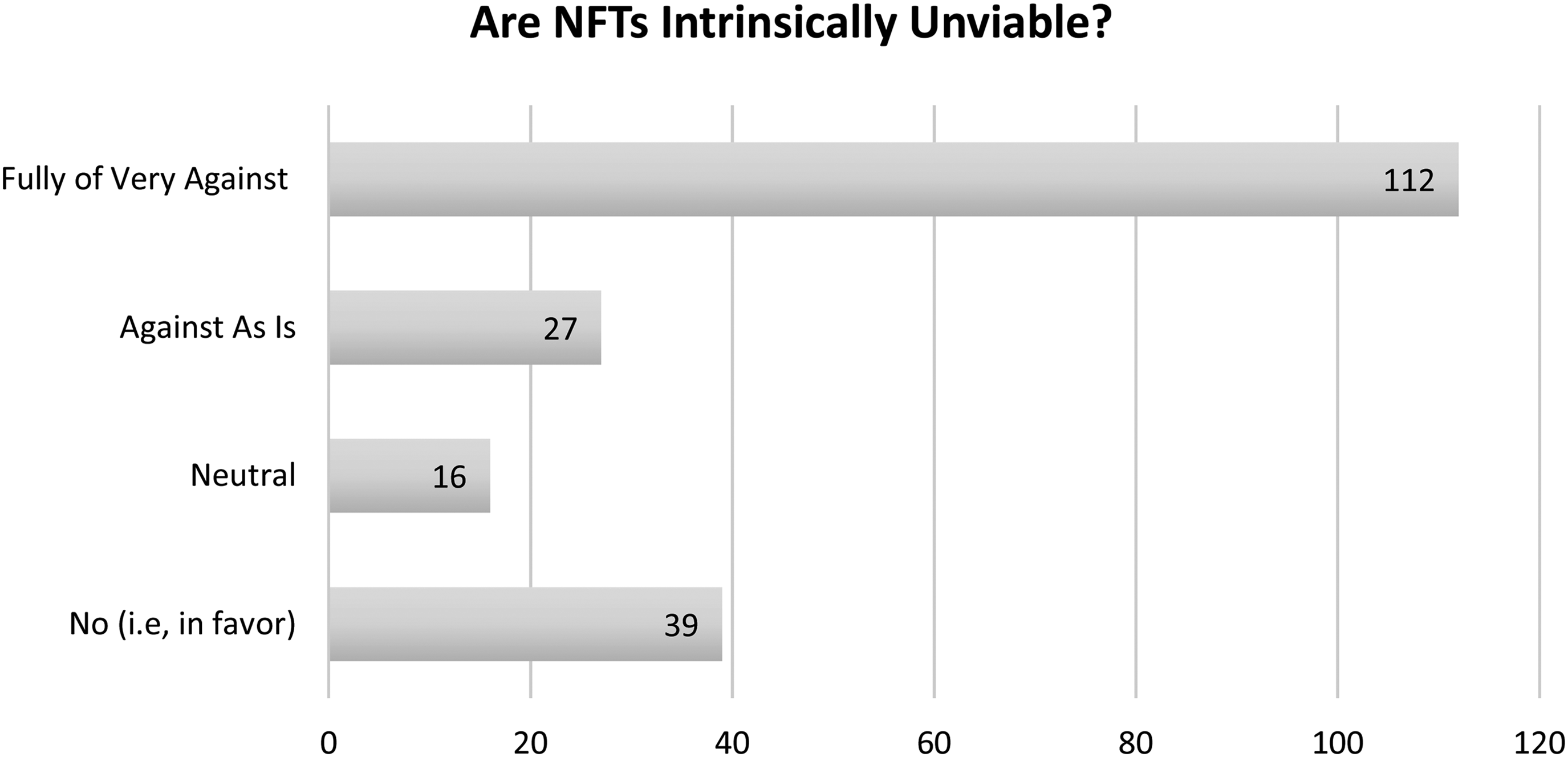
Coded results for the question, “Do you consider NFTs to be fundamentally/intrinsically unviable? If yes, why?”
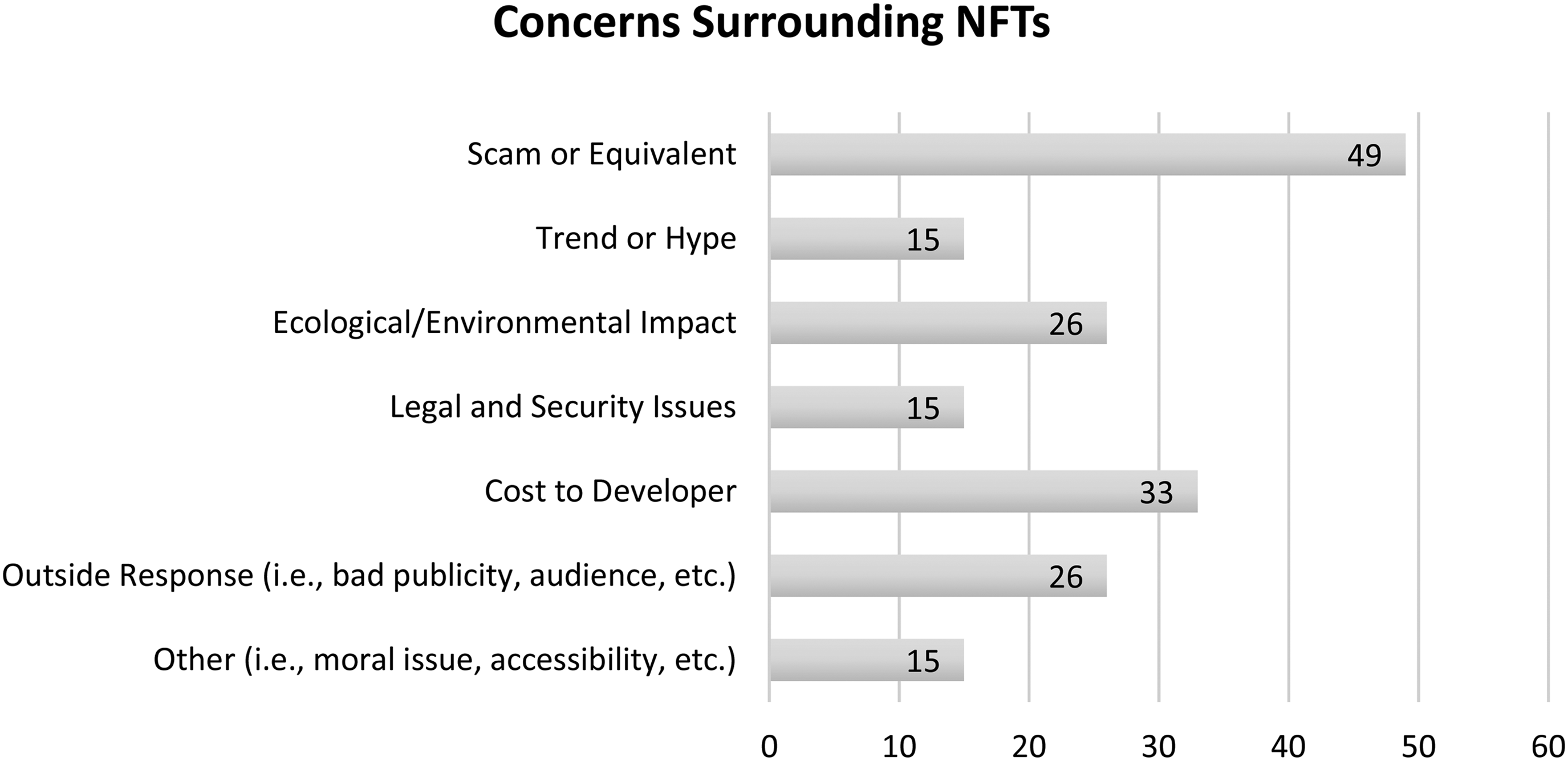
Coded results for the question, “Is there one primary issue with NFTs that make you not want to work with/develop them?”
As can be readily seen in the results the majority of participants that were not already engaged in NFT development believed NFTs to be “fundamentally/intrinsically unviable.” Given the aforementioned online discussion and public discourse of both the metaverse and NFTs where there has been considerable backlash, it is unsurprising to find a group of participants that were against the development and widescale adoption of NFTs. Many of the responses that found NFTs to be “fundamentally/intrinsically unviable” went beyond a simple “yes” answer hence the code label of “fully or very against.” For example, one developer stated, “NFTs are a speculative bubble built on destructive technology laden with ethical and financial liabilities.” These answers showcased not only opposition to NFTs but also a knowledge of how they are made and of specific issues surrounding their development. This was especially the case for answers coded as “against as is” as the users showed a knowledge and respect for the underlying technologies that allow NFTs to exist while remaining skeptical of the specific use case for those technologies (i.e., ownership of digital artwork and assets). For example, one developer answered, “Yes and no. I think it highly depends on the usage and what is done with it. Currently, selling JPGs for incredible amount of money is more like scam for me than useful usage of the technology.” Beyond these answers the “neutral” and “no” answers generally fell on a spectrum of general acceptance to a total lack of interest in NFTs. These attitudes may be best summed up by a developer who wrote, “I’m not gonna say that it will be unviable, there are a lot nft stuff that worked. Personally it's not appealing to me.”
Many users gave specific reasons for opposing NFTs in this first question, however, the next question that asked them to identify one particular issue allowed for better tracking of these reasons. As previously stated, despite asking for only one primary issue that concerned them about NFTs many responded with more than one issue. In these cases, only the first, or most prominent concern within the answer, was coded. Regardless, there were a multitude of reasons that users were concerned about NFT development and adoption. Many of these issues can be connected to economics or financial concerns. Many users expressed concerns regarding the financial stability of NFTs with many using terms such as “scam” or “pyramid scheme.” Others cited concerns that NFTs were merely fads, had major security issues, or simply cost too much to make.
Others focused on non-economic issues with many citing ecological or environmental concerns connected to NFT development. One particularly impassioned developer wrote on the ecological impact, “The environment. Definitely, the environmental impact. NFTs require a loooot of energy to function and this has been proven across many studies. Moreover, people seem to only care about monetary gain when it comes to the NFT. I have never seen an NFT made for the benefit of a group of people in need to help nor have I seen any positive effects from NFTs. For the time being, they have only been a fad that fucks with the environment and is all about greed whether intentional or not.” Still others framed the development of NFTs as a moral issue of sorts as one developer put forth the idea that, “Digital assets should be duplicatable and open.”
Finally, there were many answers that were coded with “outside response” that were generally connected to specific pre-existing or potential audiences. These answers had varying degrees of underlying financial concerns ranging from one developer who directly cited their business when writing, “As someone making educational/otherwise non-profit applications, they don't seem of much use to us” to another citing public sentiment surrounding NFTs by writing, “The current sentiment towards NFTs would turn my studio into a joke.”
Taken together these financial, ecological, and audience-based answers can be seen as both a response to general public backlash surrounding NFTs and an application of critical thought based on development and technical expertise. While some answers railed against NFTs with not-so-subtle or openly hostile language, these responses generally showed an under-lying understanding of the technologies, systems, and skills needed to create and distribute NFTs. The vitriol of the responses can perhaps be connected to this broader understanding of the negative impacts of the systems that will be needed to popularize NFTs (and to some extent the metaverse) coupled with a corresponding lack of ability to both voice concerns and stop what is seen as a dangerous implementation of technology. These users have identified issues with NFTs that will serve to undermine everything from traditional games and gameplay to extremely important issues such as the destruction of the planet. Yet, they find their expertise unheard or ignored.
While these answers may be seen as hyperbolic on their face, they must be placed into the proper context. Opinions such as these reflect legitimate fears in the face of great change that may be viewed as happening only for the sake of financial gain and profit in the face of legitimate concerns. Through their responses within this survey, users are expressing their concerns to Unity in an arena where they have not necessarily been valued or heard before. As NFTs and the larger metaverse are developed under the general auspices of Silicon Valley tech companies and gurus, it is essential to acknowledge the larger issues that have been purposefully obfuscated as big business pushes for a specific version and future of the metaverse.
Conclusions
It can be said that there is nothing new about the metaverse or NFTs. Though both rose to prominence in 2021–2022, they are both pre-existing terms and concepts based on established technologies. What is new is the interest and capital that has been placed on their development and the seeming inevitability of their future adoption (in an, as yet underdetermined form). The “metaverse” may very well be achieved, but its form, function, accessibility, and who it benefits most are still very much up for grabs. The data points in this study, based on Unity-provided survey data, will need to be expanded upon to extend their overall relevance. However, there are important preliminary conclusions. Through the use of qualitative coding methods of survey data and the application of theory in the fields of game studies, communication studies, and media studies, this study finds that current Unity users have a relatively ill-defined definition of the metaverse, that metaverse and NFT development within Unity is helping to diversify the type of development that occurs within the Unity engine, and that Unity users have concerns about the present and future of the metaverse.
These findings are important in the way that they speak to larger issues in the development, creation, and eventual adoption of the metaverse (regardless of what the final form of the “metaverse” actually turns out to be). The lack of an established definition for metaverse, even amongst those that are currently, will continue to be, or will develop it in the future, speaks to a need for standardization. This standardization will be necessary to develop a fully functional communication technology and cultural industry (just as has always been the case) and will incorporate not only a definition of what the metaverse is but also will include the specific technologies, systems, and governance of the metaverse. It is also important to recognize that continued confusion regarding the metaverse is to the direct benefit of tech companies and gurus that operate on the “digital frontier.” Maintenance and obfuscation of the frontier while actively preaching optimism for a golden future is to the direct benefit of those in power.
The need to understand Unity (and other tools) as more than game engines but instead as multi-media, multi-purpose development tools will continue to be relevant. Even in the early stages of metaverse and NFT development, there are signs that traditional game development practices amongst Unity users are being transcended, altered, and irrevocably changed by technologies and ideas such as the metaverse and NFTs. This is not to say that all development in the Unity engine will be metaverse or NFT-based but only to call attention to the need to understand Unity as a game engine and a multi-faceted development tool.
In the face of this need for standardization and continued race to be at the forefront of the development and creation of the metaverse it is essential to understand that the unbridled optimism of capital is not matched by all users. Indeed, the legitimate and sometimes grave concerns of these users have been obfuscated by this optimism. The concerns of users in this survey showcased a deep knowledge of the underlying technologies and systems that will be needed to realize the metaverse. Far from technological fears of the past about new technology having the potential to destroy society, these fears, especially ecological and environmental fears are based in a deep understanding of the issues that come with the implementation of the metaverse using block-chain and other potentially destructive technologies. These fears must be taken seriously. Strong opinions such as those found in this survey, show users are able to express their concerns through the exercise of their expertise and experience. But will these voices be heard in the race to build the metaverse?
Footnotes
Declaration of Conflicting Interests
The author(s) declared no potential conflicts of interest with respect to the research, authorship, and/or publication of this article.
Funding
The author(s) disclosed receipt of the following financial support for the research, authorship, and/or publication of this article: Mitacs.
