



Abstract
This article examines the prominent role of Patreon in the rapidly growing sector of crowdfunded pornographic games. Recent research has indicated that, on average, more people (patrons) are funding pornographic digital games on Patreon than other (non-adult) digital games (Lankoski & Dymek, 2020). Graphtreon’s ‘Top Patreon Creators’ list from 9 June 2021 includes six NSFW game projects among the top 50 projects (ranked by number of Patrons). 1 For example, Summertime Saga (Dark Cookie), the highest-ranked pornographic game, is third in terms of the number of funders, with 27,791 patrons funding $74,657 per month. While Wild Life – An Adult RPG (Adeptus Steve), which reportedly only had 9417 patrons as of 9 June 2021, receives a monthly income of $94,129 from those pledges. 2 The current funding levels for both Patreon projects are considerably higher than when we began our sampling: since January 2020, the funding level for Summertime Saga has risen by 27.86%, while for Wild Life – An Adult RPG it has risen by 21.45%.
Given the sustained growth of this sector of digital games under this relatively new model of funding, this article examines pornographic games funded using the Patreon crowdfunding platform to tentatively map content trends in adult indie game development. We assume that the games on Patreon that are most popular among patrons and receive the most funding from them can provide a useful initial indication of just what constitutes popular content within adult videogames. To understand what kind of adult videogames are funded using the Patreon platform, the article addresses the following research questions: 1. What kind of pornographic content do these games contain? a. Is there a difference in pornographic content between the top-funded adult games and those receiving less funding? 2. To what extent do the pornographic conventions in these adult games reflect the aesthetics and cultures of digital games more broadly?
These research questions were formulated using an exploratory approach selected to develop a better understanding of a relatively novel phenomenon.
While critiques of and discussion of the depiction of gender and sexuality in videogames are often at the forefront of recent scholarship (e.g., Chess, 2020; Phillips, 2020; Ruberg, 2019), with a few exceptions little has been published specifically on pornographic or adult-themed videogames (Krzywinska, 2015; Wysocki & Lauteria, 2015). In the following section, we briefly discuss the existing literature and position Patreon in relation to two other contemporary adult game-friendly platforms: Nutaku and Steam. Then, we outline the data gathering methods, analysis and preliminary results before developing the discussion. The discussion highlights the key issues found in the study: the remarkable orientation of pornographic videogames from a predominantly heteronormative perspective, the common depictions of non-consensual sex, the asymmetrical power relationships resulting in sexual exploitation and exotic othering through the deployment of aesthetics commonly associated with Japan (Galbraith, 2017). Finally, we acknowledge the limitations of the exploratory study and earmark several crucial areas for further research.
Literature Review
While scholars recognise the relationship between pornography and videogames, this area of gaming remains under-studied (Wysocki & Lauteria, 2015). In the research done to date on this type of gaming, three main topics have emerged: 1. the production and distribution of pornographic games (e.g., Payne & Alilunas, 2016) 2. how videogames depict sexuality (e.g., A. Brown & Gallagher, 2018) 3. how game technologies are used in porn production (e.g., Saunders, 2019).
The work we present in this article touches on all three of these areas because it considers how Patreon – a (relatively) new distribution and funding platform – has supported particular aesthetic and narrative themes, thereby shaping the depiction of sex and sexuality in digital games.
From a production and distribution perspective, pornographic games have been circulating informally since the early days of computers, although largely at a local level. For example, while several adult games were made available for the Atari console in the early 1980s (Brown, 2008; Mills, 2015; Payne & Alilunas, 2016), generally very few digital games with sexual or pornographic content were successfully marketed exclusively for adults. Related research regularly focuses on the Japanese games industry, primarily because Japan has a more extensively developed pornographic games sector that includes a wide spectrum of game genres, such as dating sims and visual novels (see Azuma, 2009; Taylor, 2007). The broader tradition of pornographic games that developed in Japan usually only involved local market distribution (Azuma, 2009, pp. 75–76; Pelletier-Gagnon & Picard, 2015), although some Japanese games were bootlegged and unofficially or officially distributed outside Japan (see Brathwaite, 2007).
New funding and distribution models have also removed barriers to the distribution of pornographic digital games within Western markets. The relative lack of pornographic games marketed to adults in the West has, in the past, been attributed to a retail wall created by retailers (and major publishers) refusing to distribute (or publish) such games (Brathwaite, 2007). The producers of pornographic content for videogames did develop ways, though, to circumvent the retail wall by using the Internet to distribute the games or modifying successful games by adding nudity and sexual content (e.g., Harviainen, Brown, & Suominen, 2018; Thompson, 2018). Dedicated adult gaming sites also offer a variety of free porn games, although such games intentionally guide site visitors to paid content (Passmore, Harrer, & Spiel, 2020). But the growth of digital distribution pioneered by platforms like Steam has meant diminished potential for active gatekeeping by publishers and retailers. That said, gatekeeping has not vanished. Rather, different forms of gatekeeping are emerging. For example, banks and credit card companies now have a major influence on the platforms that distribute pornographic content (e.g., Browne, 2021).
While depictions of sex and sexuality have appeared with some regularity in mainstream digital games in Western markets (see Brathwaite, 2007, pp. 26–54), a growing number of studies are currently examining sex and sexuality in digital games (see Harviainen et al., 2018). An important related research thread involves studies examining the sexualisation of game content, as exemplified in the recent work by Mejia and LeSavoy (2018) and Therrien (2019). How scholars choose to interpret such developments remains open, though. For example, Phillips (2017, 2020) points out that the sexualisation of the titular character in Bayonetta (Platinum Games, 2009) offers various readings (cf. Jenkins, 2014).
Another crucial line of contemporary research has identified pornography made with game engines as an important site for understanding the complex effects of contemporary pornography (Paasonen, 2018; Saunders, 2019). This particular collusion between digital games and pornography often relies on modifying dubiously sourced commercial character models and game engines (Saunders, 2019; Sihvonen, 2011; Thompson, 2018). Game engines are thus crucial for the production of some genres of relatively popular pornography (see Saunders, 2019).
Pornographic Gaming Platforms
Porn games on Patreon do not exist in a retail vacuum. Both Nutaku and Steam are also platforms that distribute adult games. Launched in 2015, Nutaku reached 50 million subscriptions in May 2020 (Adams, 2020). Steam, after refusing to distribute adult games for years, relaxed its rules in 2018 and allowed uncensored adult games featuring nudity and sexual activity to be released through the platform (Orland, 2018). As Steam saw increasing traffic for adult games, the platform decided not to ‘ship adult videogames that featured photos or videos of human actors’ (cited in Connor, 2020). Subsequently, several adult games featuring full-motion videos were suddenly removed from Steam in March 2020, including the prominent iStripper app. In addition to the spaces opened for pornographic gaming by these distribution platforms, crowdfunding platforms like Patreon have become important for funding pornographic game production as well as for independent games more generally (for more on the latter, see Tyni, 2017).
The Patreon funding model offers a way for developers to closely monitor the desires of their funders and cultivate new funders. Funders can influence development in various ways: voting on what comes to the game next (e.g., what quests, types of sex scenes, fetishes or types of characters) and even in some cases the possibility to design a sex scene for the game (Lankoski & Dymek, 2020). One of the perceived benefits of a funding a project is the opportunity to meet the developers and give them feedback. Furthermore, Patreon has created a reward mechanism that allows developers to give supporters various rewards before reaching their production deadline. Lankoski and Dymek’s (2020) results indicate that roughly 60 per cent of projects use influence-type rewards. Due to the nature of the funding model, (almost) perpetual development is likely to be desired by developers. This situation allows developers to cultivate funders without having to necessarily release the full game and start a new project from scratch.
The uptake of adult digital gaming content on Patreon may seem counterintuitive, as the platform quite publicly expanded its NSFW content policy in 2017 in a way that deliberately impinged on the utility of the site for sex workers (Curtis, 2019). The new provisions explicitly forbade using Patreon donations ‘to produce pornographic material, maintain an adults-only website or solicit money in exchange for a private webcam session’ (Cooper, 2017). The new content guidelines were much stricter regarding ‘bestiality, incest, sexual depiction of minors, and suggestive sexual violence’ (Cole, 2018), and they allowed much less leeway for erotic art (Cooper, 2017). Patreon implemented the changes as a result of external pressure from major banking networks as well as their payment partners Stripe and PayPal (Cole, 2018; Cooper, 2017); other platforms involved in the distribution of pornographic content, such as Pornhub and OnlyFans, have faced similar pressure.
Patreon’s policy team has thus articulated clear guidelines outlining just what constitutes pornography on the platform: We define pornographic material as real people engaging in sexual acts such as masturbation or sexual intercourse on camera (Patreon policy team, n.d. emphasis added).
The Patreon content guidelines treat game-based animated pornography quite differently than other forms of pornography: in their definition, it is not pornography. This gives game developers a great deal of flexibility regarding the kind of content they can present within the guidelines for 18+ content. We suggest that the flexibility created by the governance mechanisms of Patreon effectively gives adult game developers free rein to develop pornography with a variety of themes and mechanics, creating a situation where the production of pornographic games can flourish. However, the sample of 18+ game projects from Patreon that we examined revealed a remarkable level of thematic homogeneity in their pornographic content.
Method
Sample
We sampled 54 games that were in the process of obtaining funding for development using the Patreon platform. The inclusion criteria for the games in this sample were as follows: 1. the developer is funding the development using the Patreon platform, 2. we were able to obtain the game or inspect its content via posted videos of the game, 3. the game project uses the 18+ tag and contains explicit visual displays of sexual intercourse or manual/oral stimulation of genitals.
We complemented this sample with a list of the top 25 funded games (by number of patrons) from 25 February 2020. This meant that we added some games not included on Graphtreon’s list of Top 25 Adult Games (Graphtreon, n.d.), although if a developer had multiple games in the Top 25 at that time, we only included the (latest) completed game. After excluding games that did not fit the criteria, we analysed a total of 54 games: 20 games from the top 25 list and 34 games that fell outside the list of top-funded games.
For coding, we followed directed content analysis, where initial codes are first created based on theory or previous research and later revised based on observations (see Humble, 2009). The initial codes were based on suggestions by Tibbals (2010, 2014) and Vannier, Currie, & O’Sullivan. (2014). Both the gender composition of characters participating in sex and the type of sexual behaviour (e.g., vaginal, oral, anal, manual stimulation of genitals, condom use, spanking, masturbation and sex toy use) were included in the initial coding. The coding schema was expanded during coding to include phenomena observed in some games, thus introducing such codes as milking, HUCOW (when the in-game sex partner dresses up as a cow) and sex with a virgin. After adding new codes, previously coded games were reinspected.
Procedure
Materials used in the analysis.
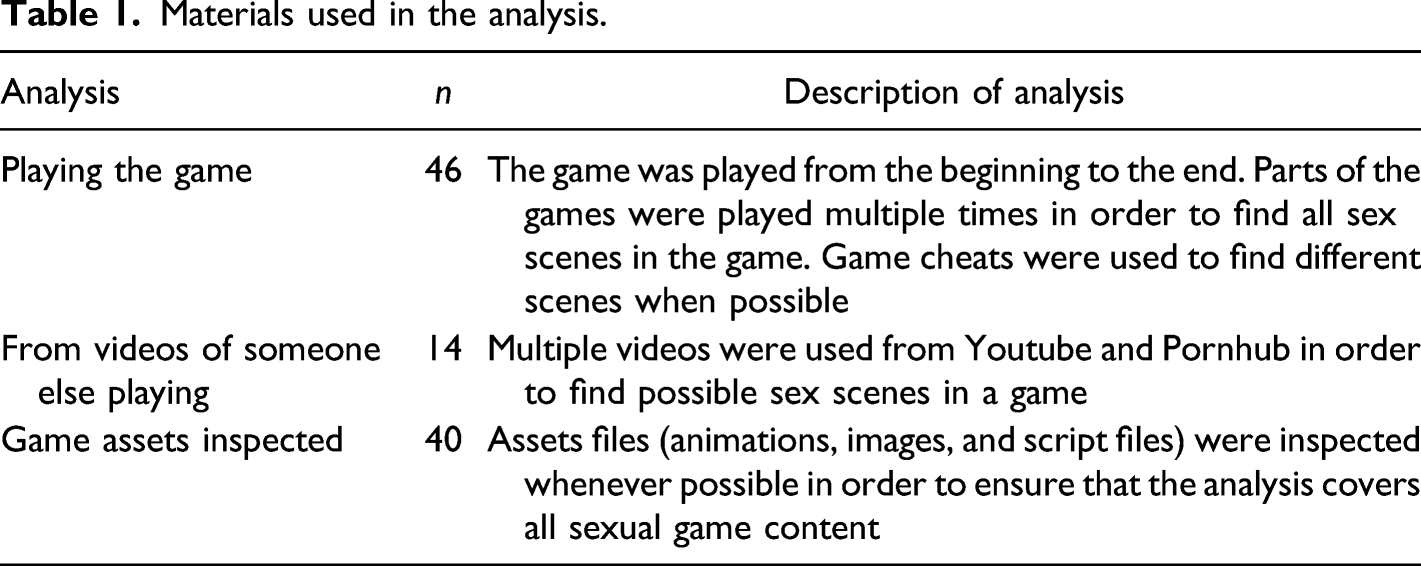
Analysis
The quantitative analyses are at this point explorative. Binomial 95% confidence intervals were calculated for the frequencies of sexual behaviour. Testing differences in frequencies of sexual behaviour between groups were calculated using the Chi-Square test of independence and Yate’s continuity correction. All analyses were conducted using R Language (R Core Team, 2019). We combined quantitative content analysis with qualitative observations of the content.
Results
Pornographic Content
Our first research question asked, ‘what pornographic content do these games contain?’ It quickly became clear that the adult Patreon games in our sample depicted a great variety of sexual behaviours. The most common sexual behaviour in the sample was the performance of oral sex on a player-controlled character by a non-player character, an activity present in all the sampled games. Both vaginal sex (94.5%) and hand jobs (96.3%) were present in almost all the games. Condoms were used in sex scenes in 9.1% of games, but even in those games condoms were only used rarely: for example, in Summertime Saga condoms are only present in scenes where the player character is paying for sex. Double Homework and Summertime Saga also present the pull-out birth control method. Figure 1 shows coded sexual behaviours. Sexual behaviours in sampled games, as analysed for top 25 funded games and other sampled games not on graphtreon’s top list, as well as percentage of the games where the behaviour is present and depictions of 95% confidence intervals.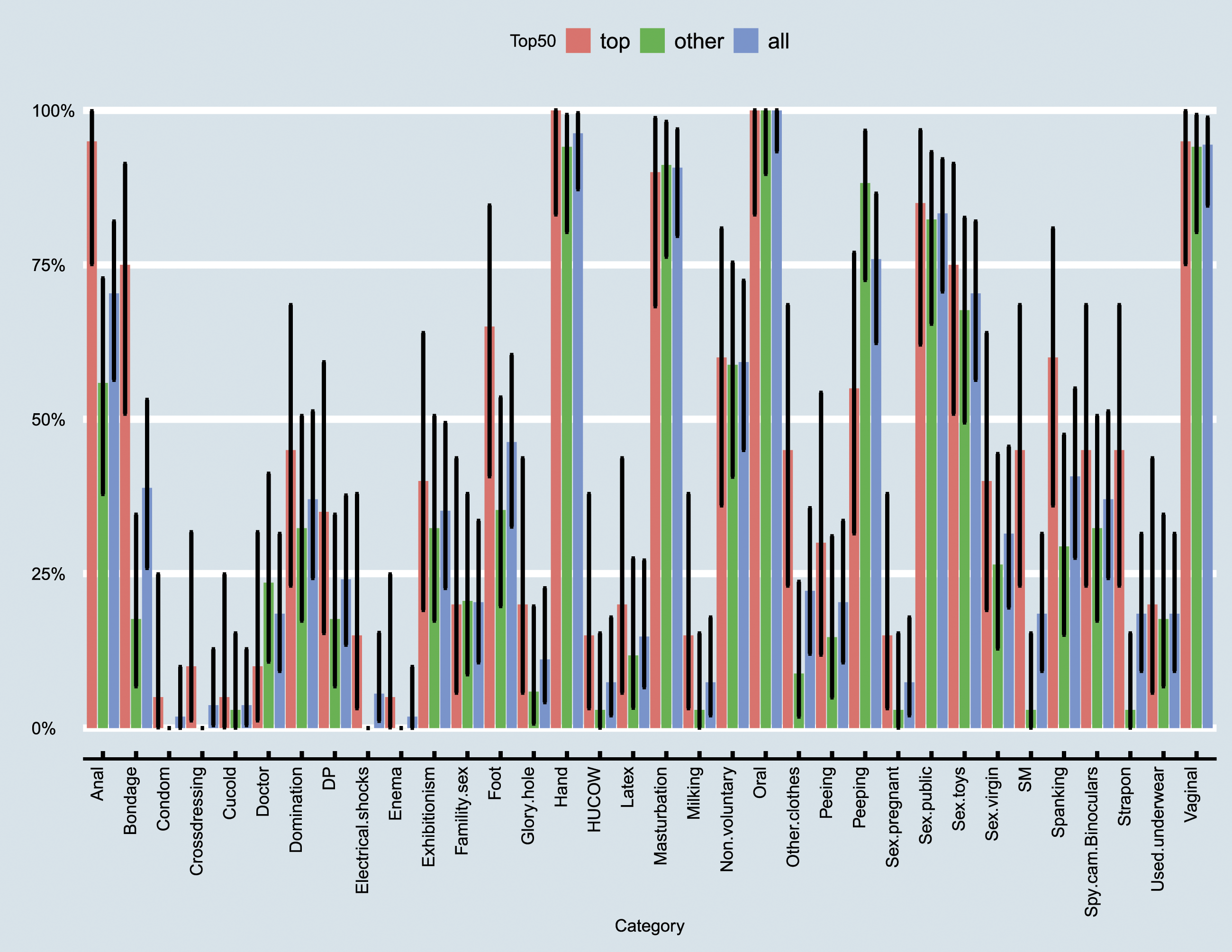
Sexual Partners
The games in the sample often showed the following sexual configurations: a great majority included depictions of heterosex between a male and a female (98.8%); threesomes involving one man and two women appeared in 59.3% of the sampled games; and sex between two women appeared in 64.8% of the games, while sex between two men appeared in just 11.1% of the games. Sex involving explicitly non-binary gendered characters was present in 11.1% of the games in the sample. Games containing sex with non-binary characters or male-to-male sex (e.g., Taffy Tales, Summertime Saga and Mid-life Crisis) often ask explicitly if the player wants to play through that quality of content, making the non-heterosexual content an opt-in feature. Two games, Hardcoded and Tales of Androgyny, almost exclusively depict sex between two non-binary characters. Sex with non-human humanoids – such as Djinn, minotaurs, elves and orcs – occurred in 35.2% of the sampled games, while 11.1% of the games included sex with tentacles. A detailed breakdown of participant compositions is given in Figure 2. Sexual behaviour, by composition. Per cent of the games where the behaviour is present; M = male, F = female, T = non-binary.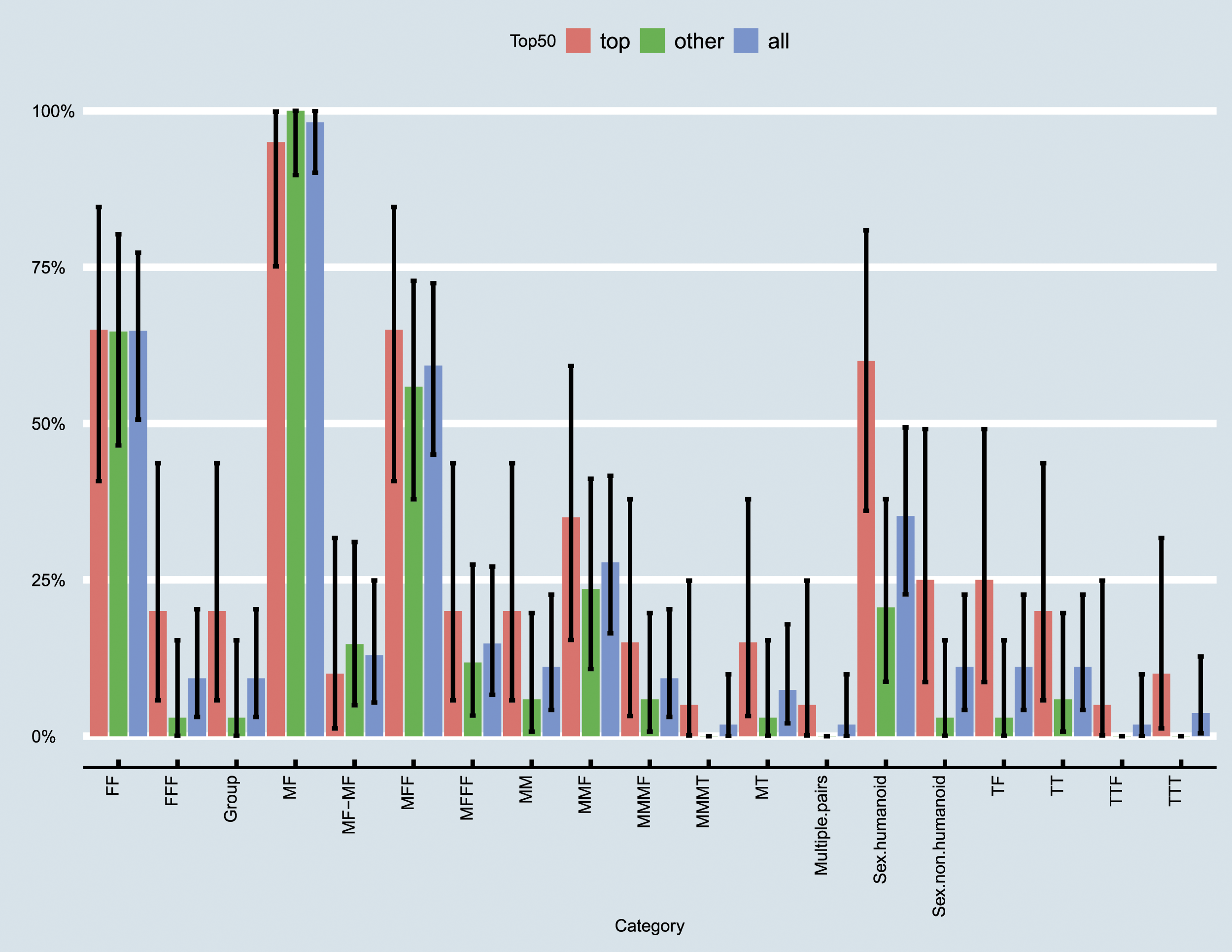
Stepfamily
‘Step’ sex – which depicts sex with family or stepfamily members – was a theme in 18.2% of the sampled games. In many cases, when the sampled games included sex with close relatives (mother, sisters), the mother is called ‘landlady’ and the sisters are ‘friends’ or ‘tenants’ (e.g., Dreams of Desire) so as to avoid Patreon banning this type of content while at the same time communicating the existence of such content to potential funders. One game, Double Homework, allows the player to choose the relationships between the male player character of the game and some other non-player characters that he is living with. In the games in the sample that depict sex with family members, the player character is always male.
Bondage, domination, sadism, and masochism (BDSM)
Bondage was present in 38.2% of the sampled games, while spanking was present in 40% and domination in 37% of the games. While many of the sampled games involved the depiction and glorification of sexual violence, we chose not to include representations of consensual BDSM play as glorification of sexual violence.
Exhibitionism and Voyeurism
Exhibitionist sex, which takes place in public contexts – toilets, parks and restaurants – when others are also present occurred in 83.6% of the sampled games. Voyeuristic behaviour was present in 76.4% of the games, while the use of spy cameras and/or binoculars to spy on others was present in 36.4% of the sampled games. In games such as My Cute Roommate, The Gift Reloaded, Naughty Magic, Dreams of Desire and Ring of Lust, successfully spying on women using binoculars or cameras was a prerequisite for the later progression to sexual intercourse.
Non-Consensual Sex
Non-consensual sex, which includes unwanted sexual touching, is understood as a broader category than sexual assault or rape. Non-consensual sex was present in 59.3% of the games. To further explore the power dynamics of non-consensual sex in the sampled games, we considered how the relationship between the victim and abuser was framed by the game. The abuser was the player character in 75% of the games, while in 25% of the games the player character was the victim and in 28.13% of the games both the victim and abuser were non-player characters. The player character abused non-player characters (χ2(1) = 14.01,p < .001) more frequently than the non-player characters abused the player character or the non-player characters each another (χ2(1) = 12.26,p < .001). In the eight cases where it was the player character being victimised, the player characters were male in 50% of the games, female in 37.5% of them and transgender in 12.5% (n = 1) of the games.
Non-consensual sex was also depicted through the use of magic or mind control in 20% of the sampled games, for instance in The Gift Reloaded, Naughty Magic, Dreams of Desire, Ring of Lust and Vampyr Dreams, and drugging in 9.4% of the samples games (e.g., My Cute Roommate). Non-voluntary sex was often used as part of the game’s progression structure: for example, games like My Cute Roommate, The Gift Reloaded, Naughty Magic, Dreams of Desire and Ring of Lust use attitude systems to make the characters ‘like’ the player character, while non-player characters must be forced to have sex. My Cute Roommate even includes a scene where, if the player character stops just before raping a woman, they lose the game, while continuing with the rape leads to the woman not pressing charges because she liked it. Elven Conquest is based entirely on non-consensual sex. The game is about the sexual exploitation of elven slaves or prisoners of war. Four Element Trainer contains a part where slaves can be sexually exploited to earn the money needed to complete the goals of the game. The content in the sampled games quite regularly glorifies sexual violence and sexual exploitation, and in theory, such content is against the content rules specified by Patreon. However, the content is not subject to those rules in the same way as other mediums of expression because it does not show real people.
Differences Within the Sample
In relation to the content, we also examined the differences between the games that we sampled from the top 25 funded games (n = 20) as well as the other games in our sample (n = 34). The data reveals that the top-funded games have somewhat different sexual content than the other set of games, including some more extreme content. We did not, though, find any significant differences in the presence of non-consensual sex between the top 25 funded games and other games in our sample (χ2(1) = <0.0001,p = 1). In general, the top 25 funded games contain more diverse content than the other types of games. This may be because games with more funding have the money to develop different and more diverse content, while also having to cater to a larger number of funders who may want more diverse sexual behaviours included. Non-heteronormative and even heterosexual fetish content are often opt-in features, suggesting that developers are trying to both appeal to heterosexual norms and more vanilla tastes while also catering to players interested in more diverse sexual experiences. Notably, both games with extensive representation of non-binary characters and sex between non-binary people in the sample – Hardcoded and Days of Androgyny – were among the top 25 funded games. This suggests that offering broadly heteronormative/vanilla pornographic games with potential opt-in, non-heteronormative and fetish content is not the only successful path for Patreon-funded adult games. Still, it remains to be seen whether the successful funding performance of such games indicates the beginning of a shift towards the funding of more widespread diverse content.
Game-Like Qualities
Our second research question asked, ‘To what extent do the pornographic conventions in these adult games reflect the aesthetics and cultures of digital games more broadly?’ While a game-like graphic user interface was present in all the games in the sample, only about half of the games (51.9%) had a visual location system that showed the player character moving through a game environment or locations on a map. Another common feature was the use of player characters and non-player characters. Several other aesthetic features from mainstream digital games were present in a reasonably significant number of adult games, such as attitude systems and resource management and gamified reward features that marked progression through the game with the depiction of increasingly extreme sexual acts (details below). The presence of such game elements as character statistics, an attitude system or resource management aligns the aesthetics and mechanics of some adult games strongly with contemporary popular digital games by smoothly integrating everyday interface elements and mechanics to facilitate an intuitive and game-like experience for the pornographic content.
Playable Characters/Avatars
Player characters are the point-of-view characters or avatars in games where players directly control their actions for part or all of the game. The player characters in the sample were mostly male (81.5%). Only 3.7% (two) games of the 54 games in the sample allowed players to choose between male, female and non-binary characters. Only 5.6% of the sample – three games – had a playable female character. The main player character was female in only two games. In one game, the game switched to a male player character from time to time. In the other game, the opposite situation occurred: the main player character was male and the female character only secondary. The player characters in the games in the sample were predominantly white (92.6%). The player character in Hardcoded was an android (1.9%), and only 1.9% of other player characters were explicitly non-white. In 3.7% of the games, the race of the player character was not explicitly signalled, and researchers could not clearly determine the race based on the information available. From the perspective of the ages of the characters, the player characters in the sample were mostly young adults (63%) or mature (27.8%). In 3.7% of games, the main player character was a young adult most of the time, but the perspective switched to that of mature characters from time to time. In 5.6% of games, we could not determine the specific age of the player character (in more detail than that they were adults) based on the available information.
Non-Player Characters
We also coded non-player characters participating in sexual acts or dialogue in the game but that were not controlled by the player. Almost all the sampled games (94.4%) contained white non-player characters, and more than half (55.6%) had at least one non-white, non-player character. In the two games that did not include white non-player characters, all non-player characters were non-humans (Monster Girl Island and Elven Conquest). In terms of anatomy, 66.7% of the sampled games contained non-player characters with large breasts (D cup or larger). A similar number of the sampled games (68.5%) contained characters with a large penis, although it is worth noting that in most cases it was the player character who had the large penis (e.g., Summertime Saga, Taffy Tales, Treasure of Nadia and The Visit).
Characteristics
Player characters possess common game characteristics – such as inventory (items carried), money and skills/qualities (hacking, charm) – in 53.7% of the games in the sample. These characteristics influenced how other non-player characters reacted to the actions taken by the player character or what the player character could do in certain situations.
Attitude Systems
An attitude system that modelled how much the non-player characters like, fear or obey the player character was present in 58.9% of games. An attitude system can determine the consequences of the player character’s actions: for example, a high ‘like’ score means that the player can make a choice that will lead to a sex scene, whereas if they made the same choice after receiving a low ‘like’ score they would have been rejected.
Sex as Progress
Sex scenes are often rare at the beginning of the game. As players progress, sex scenes become more common and players increasingly control when they will take place and how the scene progresses. The available sexual behaviours are often connected to the players’ progression in a game. A typical progression structure might begin with the (predominantly white, male) player character receiving manual stimulation of the genitals (with hands or feet), after which the player character receives oral sex, then vaginal sex. After reaching that stage, sex can typically be initiated freely. This is typical game progression logic, where rewards are used to guide players’ actions (Aarseth et al., 2003; Krzywinska, 2015; cf. Brown & Gallagher, 2018). This type of progression structure is used in, for example, Rogue-like, Harem Hotel and Four Element Trainer.
Resource Management
Several games in the sample, such as Rogue-like, Harem Hotel and Four Element Trainer, have a strong resource management dimension. In these games, effective resource management is the mechanism connected to progression and rewards through the range of sex acts available with non-player characters.
Choice
One quality commonly shared by the games in the sample is that the player’s choices influence how the game progresses. This means that almost all of the games (96%) had a branching structure, with long and (relatively) complex narratives. In some cases, the choices that the players make within the game have minimal impact on how the game progresses, but a range of choices is offered that allows players to control the camera angles that they use to view the sex scenes. Games such as Summertime Saga, Taffy Tales and The Treasure of Nadia use an interface very much like the classic point-and-click adventure games of the 1990s, where the player moves around the game world, collects items and uses them to solve puzzles. Other games let players make moral choices, such as in Four Element Trainer, where the player can choose between alternative ‘love’ and ‘slave’ paths, or like in Our Fate, where choice is between ‘love versus corruption’ paths.
Discussion
Heteronormative and Homonormative
The great majority of adult games in the sample assumed a default masculine heterosexual perspective. In much the same way as mainstream porn, they predominantly depict sex acts from a male point of view (see Neville, 2015). While this does not necessarily exclude other perspectives (Paasonen, Attwood, McKee, Mercer, & Smith, 2020), it does suggest that the game designers believe that this perspective suits their patrons. The most common sexual behaviours in the games that we sampled occurred between two characters who are unambiguously – and often explicitly stated to be – a man and a woman. When homosexual sex acts were depicted, they were often framed as what Tibbals (2010, p. 642) describes as ‘heterosexualized same-sex behaviors’. The interactive sex scenes followed the same structure and progression in both scenarios, only the gender of the sex partner had changed. The queer characters were integrated into the overarching heteronormative structure by reducing queerness to a sex act, a private matter of individual preference and freedom that could be accommodated by the system. In this respect, while many games in the sample provided representations of queer sex acts, such representations only served to reinforce heteronormativity through homonormativity. Duggan (2002, p. 179) introduces the term homonormativity to describe neoliberal forms of inclusion of gay culture that ‘do not contest heteronormative assumptions and institutions’. While allowing for some diversity in the sex acts being depicted, generally in the case of Patreon-funded adult games heteronormativity and homonormativity mutually reinforced a narrow scope of acceptable sexualities.
Pornographic content in the games and their frequencies were rather similar to the reported prevalence of sexual fantasies in general (Joyal & Carpentier, 2017; Joyal, Cossette, & Lapierre, 2015). This dominant portrayal of sex in adult games was supported by common elements from both traditional pornography and digital games. Many of the adult games in the sample relied on recognisable heteronormative pornographic tropes. As Paasonen argues: pornographic depiction draws on a limited and stylized range of terminology, characters, scenarios and acts. Since these are easily recognizable, they are also easy to access in the sense of requiring little preparation on the part of the user. (Paasonen, 2011a, p. 431, p. 431)
Patreon-funded adult games, like triple-A games in general, have predominantly male protagonists. Williams, Martins, Consalvo, & Ivory, (2009), in their discussion of mainstream digital games, note multiple reasons for this bias, including that the fact that the bias reflects the dominant developer demography. While our investigation did not explore the demography of the developers, we suggest that the bias towards male player characters in the adult games in our sample reflects a particular understanding of how the audiences of gaming and pornography intersect. Certainly, a relatively wide variety of pornographic scenarios and game genres and mechanics had been integrated into the selection of games included in our sample, but this did not lead to a noticeable diversity in perspective.
The dominant masculine heterosexual perspective accommodated the homonormative content. Sexual activity between two women was widely included in games on Patreon. While the sexual activity found in the games on the platform potentially offer a range of viewing pleasures, such activity is largely presented ‘as an exotic form of foreplay and exhibitionism’ (Hanson, 1999, p. 184), which has become a mainstay of heterosexual pornography. Sexual activity between two men appears to be slightly more threatening to the heteronormative status quo, as many of the games in our sample featuring such content only made it available to those who chose to opt-in. It appears that through such mechanics, game developers who rely on Patreon crowdfunding are hoping to ensure a large funder base, which allows developers to work on a game for a longer amount of time – and also gather resources for a new game project.
Based on the sample data, we suggest those persons who develop adult games on Patreon believe that their audiences mostly want the sexual content of the game to be framed in this heteronormative manner. In contrast to the wider audience, the perceptions of game developers may be skewed towards the interests and desires of patrons who offer high levels of ongoing funding, which the developers are more familiar with due to the relatively close relationships that exist between funders and developers during ongoing projects. Patreon-funded adult games thus predominantly depict a platform-produced heteronormativity that reframes queer sex acts in a homonormative manner.
The depiction of queer sexuality in adult porn games is notable given that the representation of diverse sexuality is a site of struggle in gaming cultures. Very few triple-A titles deal with queer issues or themes or have notably queer characters (Blizzard’s Overwatch is one notable exception). Though scholarship in the past decade has considerably expanded the scope for recognising the significance of queer games, queer developers and queer audiences within gaming cultures (e.g., Phillips, 2020; Ruberg, 2019; Shaw, 2009, 2018), we suggest that the homonormative framework adopted in many of the pornographic games in our sample means that their portrayal of queer sexuality may still sit quite ambiguously in relation to the kinds of representations usually discussed. One notable exception to the platform-produced heteronormativity in our sample is the game Hardcoded, in which the player character is a transgender, conscious sex robot. While space precludes us from providing a detailed analysis of the game, Hardcoded has been praised by some critics for showing a positive depiction of transgender sexuality and the transgender community rather than just fetishising transgender bodies (Johnson, 2018; Valens, 2019a). Notably, Hardcoded was also the only game in our sample that focused on satisfying others. In this regard, a key behaviour that Patreon-funded adult games share in their depictions of homonormative and heteronormative sexual activity is a focus on the player character’s – and by extension the player’s – pleasure. This suggests a very narrow perspective on sex when the notion of it also being pleasurable for a sexual partner challenges the hegemonic norms produced by the platform.
Rape, Sexual Assault and Sexual Exploitation
Interactive game sequences where the player character engages in rape, sexual assault, sexual exploitation and other forms of non-consensual sexual activity were present in 59.26% (CI95 = 45.03–72.43) of the sampled games. Such imagery has been part of gaming culture since the early videogame era: for example, the notorious Custer’s Revenge (1982). RapeLay (2006) is another well-known example of a game where rape constitutes a core play element. Game conventions often enable sexual power fantasies depicting rape, sexual assault, sexual exploitation and other forms of non-consensual sexual activity where the (usually white, male) player character is the rapist or abuser. Online pornography also offers content that portrays sexual exploitation and non-consensual sex (Paasonen, 2011b), so it may be the case that pornographic games are targeting the same niche audiences. Rape myths, specifically the notion that women enjoy rape (see Edwards, Turchik, Dardis, Reynolds, & Gidycz, 2011), were present in multiple games from the sample. Such games make rape, sexual assault, sexual exploitation and other forms of non-consensual sexual activity a part of the progression structure of the game, which will eventually open the option of having consensual sex if the rape is performed correctly. In such cases, sexual exploitation is highlighted and normalised as a transactional relationship through which consent can be manipulated and ‘won’ through gameplay. The games might be even drawing here from other areas of popular culture, such as forced sex by mind control in season one of the television series Jessica Jones (see Green, 2019) or vampire fiction and mind control. Monsters and involuntary sex often go hand in hand in these games: like involuntary, erotic transformations in vampire fiction (see Waddell, 2017). Notably, Patreon is particularly attentive to such areas as mind control, hypnotism and magic in content that makes use of models and performers (Valens, 2019b).
Whiteness
The player characters in the sampled games were mostly white (92.6%). In general, both player and non-player characters are predominantly depicted as white. In this respect, the Patreon-funded games in the sample are similar to triple-A games and television shows (see Williams et al., 2009), although scholars have noted that games often have a certain white-saviour figure as the default player character or avatar (Gray, 2018). The hegemonic whiteness of some of the games in the sample was further implied by the racialised elements of the portrayals, which are palpable in the aesthetic and thematic presentations of pornographic Patreon games. Many games draw on Western interpretations of aesthetics and conventions from Japanese adult videogames and visual culture and also apply Japanese terminology to describe the game in development as hentai, anime or eroge. Such labels and aesthetics often seek to communicate a particular notion of exotic sexuality to a Western audience via techno-orientalist undertones. Indeed, there is a close association between a nominal, abstract notion of ‘Japanese’ and some of the adult games, which suggests that part of what is on offer is the experience of virtual sexual tourism, wherein by playing a ‘Japanese’ game a white player can enjoy a taboo sexual experience while simultaneously dismissing it as perverted. We recommend that in future studies on the intersections between gaming and pornography, whiteness should be further developed as an issue.
Limitations and Future Work
Sample
Games falling outside of the list of top 25 funded games were gathered using convenience sampling, so the results might not be completely representative. As a result of greater amounts of funding, the top 25 funded games have plenty of development resources compared to other games, and the group of games in the sample falling outside the top 25 list only included games that we were able to acquire without becoming a patron.
Coding
Just what exactly counts as sexual behaviour is difficult to define, meaning we might have missed certain behaviours that some people would consider sexual in nature. In addition, some of the games in our sample were rather complex, and we might not have been able to meet the conditions for all sex scenes in a game in cases where we were not able to complement the analysis by directly looking at the game’s assets. Similarly, when complementing the analysis only with videos posted online, the video posters might not have covered all sex scenes. Since most of the games analysed were in (often perpetual) the developmental stage, the analysis might not represent the games in their later stages of development.
Method
Since we studied pornographic games using content analysis, our data and results tell little about the developers themselves, or the players. Therefore, multiple open-ended questions relating to players and developers still require further study, such as the motivations for developing or funding pornographic game development.
Future Directions
By tentatively mapping the pornographic content in adult games crowdfunded through Patreon, we have illustrated the kinds of pornographic conventions utilised in these games and in turn traced such relations both to the game and the pornographic conventions themselves as well as to certain cultural phenomena, such as rape myths. Several crucial topics are evident in our data. However, due to the type of data we collected the following topics still need to be explored in proper detail: 1. Gay, lesbian, non-binary and transgender representations in adult games, 2. Japanese pornographic games and their relations to Western adult games, Western adult game developers and Western audiences, 3. How rape, sexual violence and consent are depicted in adult games, 4. Different genres of adult games from the perspective of both aesthetics and game mechanics, 5. Depictions of non-human humanoids in pornography, 6. The multiple intersections between pornographic content and gaming culture, 7. Further developing a coding system that captures the complexities of analysing pornographic games.
Furthermore, funding platforms similar to Patreon have recently surfaced, such as OnlyFans and SubscribeStar. A question that should be addressed in more detail is, how do pornographic games funded via Patreon compare to games funded via other similar platforms, especially ones devoted to pornography?
Conclusions
The games in the sample illustrated a great diversity of content, but also a strong concentration on a straight heterosexual perspective, with 98.8% of the games containing depictions of heterosexual relations between a man and a woman. While many generic features in the games – such as ‘step’ sex, BDSM and voyeurism – match known pornographic conventions, Patreon-funded digital games stood out for the significant number (59.3% of the sample) that depicted non-consensual sex acts, which were being funded through the platform. We note that the sample games receiving more funding were more likely to have diverse sexualities represented that included homosexual sex acts and sex acts with or between non-binary people. The pornographic games often used recognisable aesthetics also found in everyday popular mainstream games, particularly the use of player character avatars and non-player characters. Many games made use of core mechanics, such as attitude systems and resource management, which are used in digital games of many different genres. Notably, the great majority of the games in the sample had branching structures, which allow players to control how the game progresses while also rewarding progress through the game by making increasingly explicit sexual acts available for the player to perform with non-player characters.
The dominant heteronormativity of the sample indicates that Patreon rules regarding adult content and the desire of developers to appeal to a ‘broad’ audience of potential funders help create a platform-produced heteronormativity. While content representing a non-heteronormative, non-masculine point of view does exist, it is often framed as ‘opt-in’ extra material that reskins the bodies involved rather than impacting the experience in a way that decisively queers it. Thus, we argue that such content is merely a homonormative presentation of the homosexual sex that presents it as a non-threatening option within a heterosexual framework. This suggests that even as Patreon is seemingly open to the creation of pornographic content that includes more diverse producers from outside the mainstream pornographic industries, queer, non-binary and transgender perspectives may struggle to articulate sexuality without reference to a heteronormative framework. Platform-produced heteronormativity illustrates how, when faced with multiple ways in which to configure sexual fantasies, the types of bodies and experiences that help diversify the dominant perspective are only included if they can also be comfortably accommodated.
Furthermore, even as queer, transgender and non-binary perspectives are marginalised by Patreon’s platform-produced heteronormativity, very little is being done to minimise the impact of gaming content that replicates misogynistic sexual behaviour. The sample indicates that a small majority of the games explore sexual relations that are based on non-consensual sex and/or sexual exploitation. While the games include a strong element of fantasy, it is concerning to note that the overwhelming majority of depictions show violence and/or power being deployed by a man against a woman. This suggests that while overt violence may be a fantasy, many Patreon-funded pornographic games demonstrate a palpable hostility towards women and a disregard for consent, supporting recent work by Sarah Banet-Weiser (2018), who argues that internet cultures are marred by ‘everyday misogyny’.
Patreon-funded pornographic games have a complicated cultural hybridity. Videogames more generally share this characteristic (Consalvo 2006). However, based on our observations, it is apparent that the process by which developers and potential funders communicate the qualities associated with Japanese pornographic games is based on very particular interpretations of what counts as ‘Japanese’. Western developers deploy a reinterpretation of ‘Japanese’ aesthetics (which may themselves be hybrid) to signal the ‘authentic’ sexual experience associated with ‘Japanese’ pornographic games to predominantly white, non-Japanese gamers.
Footnotes
Declaration of Conflicting Interests
The author(s) declared no potential conflicts of interest with respect to the research, authorship, and/or publication of this article.
Funding
The author(s) disclosed receipt of the following financial support for the research, authorship, and/or publication of this article: Thomas Apperley’s work on this article was funded by the Academy of Finland-funded Centre of Excellence in Game Culture Studies (CoE-GameCult, 312395).
