



Abstract
This article aims to illuminate how game analytics have discursively shaped the mainstream perception of Southeast Asia as a regional games market through a qualitative analysis of the data and discourses in three market reports by Newzoo, an influential game analytics company that played a pivotal role in pioneering market research about the region. By reconceiving the futurity of Southeast Asia in terms of capitalist temporality, these reports envision the region as a games market of perpetual capitalist growth through data-led approaches. Despite its limitations, the compelling conception of Southeast Asia as “the world’s fastest growing games market” has become a powerful myth that exerts profound influence on how the public conceive the region as a gaming space.
Introduction
The Southeast Asian games market has attracted much public attention in recent years as “the world’s fastest growing (mobile) games region/market” (Forde, 2019; Valentine, 2019). If one looks up the term “Southeast Asian games market” on the internet, two kinds of sources dominate the top search results: first, promotional information from game analytics companies, notably Newzoo and Niko Partners, that provide market research services and second, journalistic articles about the rapid development of the regional games market. In fact, the latter often cite the data provided by the former to support their claims. The heightened interests in the Southeast Asian games market could be attributed to the significant increase in the region’s game consumption as a result of the rapidly growing local internet penetration rate. Subsequently, the region caught the attention of game analytics companies and became the subject of their market reports. The circulation of these reports enables game analytics companies to play a pivotal role in shaping the public’s imagination of the “Southeast Asian games market.”
Numerous parties are involved in molding the public perception of the Southeast Asian games market, including the local game industries and various media outlets, but none equal the influence leveraged by game analytics companies. To better understand this situation, this article asks: How have game analytics companies and their reports discursively shaped the Southeast Asian games market? This research question unveils the immense influence of game analytics companies in shaping the public perception of regional games markets around the world, given such companies do not only collect but also interpret relevant market data for their clients. The core purpose of market-focused game analytics is to predict the future (revenues) of games markets via Big Data. Hence, an investigation into how the futurity of Southeast Asian games market is reconceived via the prediction of game analytics is also imperative to answering the question posed. By analyzing the discourses about Southeast Asia in the reports published by game analytics companies, I demonstrate how the region is envisioned as a games market of perpetual capitalist growth through data-led approaches. Despite the limitations of such data-led approaches, the image of a fertile regional games market has proven compelling to the public and has subsequently dictated much of the narrative surrounding the concept and futurity of the “Southeast Asian games market.”
This article will study the discursive formation of the Southeast Asian games market primarily through an analysis of a selection of market reports published online by game analytics companies, specifically those from Newzoo. While Newzoo and Niko Partners, as mentioned, are both highly visible in discourses about the regional market, Newzoo is chosen over Niko Partners as the focus of this chapter for its higher volume of publicly accessible data, which makes them more readily available for circulation among various media outlets and hence more influential to the public. To clarify, Newzoo is not the focus of this article. Rather, the reports of Newzoo are examined as samples representative of the discourses about the Southeast Asian games market from the perspective of game analytics.
In what follows, I first contextualize the rise of game analytics within the Big Data phenomenon and introduce Newzoo to lay the foundation for understanding how data are used to discursively construct games market. To accomplish the latter in the context of the Southeast Asian games market, however, requires additional knowledge about the historical formation of the region as a global market considering that the deployment of “Southeast Asia” as a market unit within the game industry does not occur in a sociopolitical vacuum. Accordingly, I borrow the three components that constitute the Big Data phenomenon as identified by boyd and Crawford (2012) as conceptual tools to analyze the Southeast Asian games market in the context of game analytics: 1. Technology: maximizing computation power and algorithmic accuracy together, to analyze, link, and compare large data sets. 2. Analysis: drawing on large data sets to identify patterns in order to make economic, social, technical, and legal claims. 3. Mythology: the widespread belief that large data sets offer a higher form of intelligence and knowledge that can generate insights that were previously impossible, with the aura of truth, objectivity, and accuracy (p. 663)
I analyze the discursive formation of Southeast Asian games market vis-à-vis Newzoo through these three components: first, the kinds of technology Newzoo utilizes to collect relevant data, especially those of the population; second, the manner in which Newzoo analyzes said data, including a business formula that calculates the return rate of an investment; and third, the larger implications of Newzoo’s analysis in the mythmaking of Southeast Asia as one of the fastest growing games markets in the world. While myth is commonly understood to connote falsehood, I use the term “myth” not to indicate that Newzoo’s analysis is somehow false or inaccurate but rather to emphasize that game analytics’ ideas and predictions in regard to Southeast Asia have become powerful narratives that shaped the public conception of the region as a gaming space.
Game Analytics: Interpreter of Big Data and Diviner of Revenues
The era of Big Data, precipitated by the increasing availability of diverse types of data, has brought about the so-called “data revolution” by which data-led practices have been normalized in various industries, including the game industry (Kitchin, 2014). With the permeation of digital technologies in our everyday lives, every move or click we perform potentially generates data that are collected in ways not immediately visible to us. Within an increasingly digitized game industry, as evidenced by the ubiquity of digital distribution and online games, various types of player information (from spending habits to in-game behavior) can also be easily obtained by game publishers over the internet. The harnessing of such data has created “a system of knowledge that is already changing the objects of knowledge, while also having the power to inform how we understand human networks and community” (boyd & Crawford, 2012, p. 665). Indeed, proponents of Big Data have dismissed other modes of analysis to shore up the superiority of numbers as the vessel of truth (Anderson 2008). Game analytics, which promotes the use of Big Data in decision-making, likewise insists on the primacy of numbers in providing the best business solutions.
Analytics, which makes extensive use of statistics and quantitative data to discover patterns as a guide to business decisions, is increasingly gaining attention in the game industry in recent years. It is now common for game studios to “employ at least one, if not (ideally) a team of data scientists to help it extract information from its games, to analyze and quantify [game] data and to explain it in a way that can help the studio improve—be that through bringing in more money, keeping people playing longer, getting more downloads or purchases in the first place, or whatever else” (Dransfield, 2016). In terms of game production, Jennifer Whitson (2019) observes that small-scale mobile games are commonly underpinned by what she refers to as “data-driven designs,” a system which relies on data analytics to tell developers “what players want and how to design for them” to mitigate commercial risks (p. 792). Outside of game production, data analytics is also used to gain market insights, which is the primary focus of this article. In this context, instead of information about players of a specific game, data analytics focuses on broad demographic information from certain geographical regions, which is especially useful for game companies that want to expand their businesses in markets which they still do not know much about. That said, it is important to not be overly focused on the data that we overlook the agency of those who present, or rather, interpret the data.
Game analytics companies are influential in shaping discourses about games market not merely because they sell data to their clients. Rather, their authority lies in their position as the interpreter of an overabundance of data. Hence, the true commodities sold by data analytics companies are not data as such but data-based narratives that can be readily translated into actionable business strategies. In fact, scholars have demonstrated that interpretation presupposes data collection. In the introduction to the anthology “Raw Data” is an Oxymoron, Lisa Gitelman (2013) propounds that “data need to be imagined as data to exist and function as such, and the imagination of data entails an interpretive base” against the “unnoticed assumption that data are transparent, that information is self-evident” (p. 2–3). Knowing that data are not “raw,” the true extent of the power possessed by the hidden “cooks” in the data analytics industry—those who give meanings to data—then becomes apparent to us. David Beer (2018), who laments that too little attention has been given to “the powerful role—both technical and rhetorical—played by the emergent industry of analytics that has come to fill this analytical space of social ordering,” further argues for the importance to “explore the seductive visions of data analytics that enable these analytics to spread out into organizations of different types as well as into individual lives” (p. 465–466). As such, it is necessary to examine not only how game analytics companies envision the markets they analyze, but also the broad, long-term effects of their other interpretive claims regarding said markets.
If Big Data represents a new knowledge system that changes how we perceive knowledge itself, then data analytics stands for a future-oriented use of such knowledge. In the context of game analytics, this means anticipating player behaviors or speculating future revenues to maximize profits. Data analytics attempts to create a safe world in which it is possible to predict the future and act accordingly in the present to secure that future; it creates self-fulfilling prophecies. In his analysis of the marketing materials of data analytics companies, Beer (2018) detects a narrative that presents data analytics as “not just as enabling future sight, but also are able to bring those desired futures into existence” (474). In the context of the game industry, Whitson (2019) similarly observes that data-driven designs can generate insights that enable developers “to predict future spending, tailor-marketing messages, and influence future behavior” (793). The implicit message promoted by game analytics companies like Newzoo to the games industry is that those who do not make use of data analytics will lose control over and hence unable to arrive at the desired future.
Newzoo emerged as an authoritative game analytics provider with regards to Southeast Asia when the company first published a high-profile report about the regional market in 2015 entitled “Introduction to the Southeast Asian Games Market: Opportunities in the World’s Fastest Growing Region.” Claiming to be “the world’s most trusted and quoted source for games market insights and analytics,” the Amsterdam-headquartered company sees itself as a consultant that helps “some of the world’s largest entertainment, technology, and media companies to target their audience, track competitors, spot opportunities, and make strategic and financial decisions” (Newzoo, n.d.). In comparison to the findings by Niko Partners and other analytics companies, Newzoo’s highly publicized market reports are more influential in shaping Southeast Asia as a games market in mainstream discourses due to their higher public accessibility. Market reports are proprietary materials that are usually locked behind a paywall and only available to companies willing to purchase them for a hefty sum. For example, Newzoo’s 2015 Southeast Asia market report was sold independently for USD$4900 or as part of a subscription package that includes 12 months of custom analysis support from Newzoo for $23,000. Similarly, Niko Partners was selling its 2018 “Greater Southeast Asia Mobile Games Report & Five Year Forecast” report for $7000. That said, Newzoo’s reports are more visible in mainstream discourses because of the company’s willingness to release parts of its premium reports as “light version” previews to the public at no cost. 1 Due to their wider circulation, the findings that Newzoo gives free of charge have become more important than those in Newzoo’s full reports in terms of influencing the public. This also holds true for Newzoo’s 2015 Southeast Asia market report, which has been widely cited in various publications, such as business magazine Fortune and the industry-oriented website Gamasutra (Gaudiosi, 2015; Stempniewicz, 2015).
Southeast Asia: A History of Marketization by Foreign Interventions
The concept of Southeast Asia as a “region” has been highly debatable since its invention because of its constantly shifting boundaries and diverse culture. Chou and Houben (2006) opine in Southeast Asian Studies that “to define Southeast Asia as a ‘region,’ that is a social-cultural entity bound to a particular geographical space, seems indeed questionable, since its boundaries are unclear and diffused” (p. 10). Considering the region’s lack of a common high religion, language, and classical culture, Anthony Reid (1999) suggests that “it is the diversity of Southeast Asia and its openness to outside influences which is its pre-eminent defining characteristic” (chapter 1). Indeed, the region endured profound violence at the hands of numerous colonial powers enacted to exploit its natural resources and labor powers. Nevertheless, the region’s vulnerability to external forces remains one of its defining characteristics until the present and is indeed one of the crucial factors that propelled its rapid growth as a global games market.
A cursory historical overview of the region as a global commercial hub reveals why the region continues to be open to external influences despite the violence it suffered from colonial powers. European powers arrived in the region in pursuit of commodities, especially spices, as early as the 16th century, spearheaded by the Portuguese and Spanish (Hall, 1981). By the 19th century, however, the major European powers in control of the majority of the region were Dutch, British, and French. The region was divided among these European empires as a result of their competition to control the production of commodities in the region. The further expansion of capitalism in Southeast Asia was subsequently triggered by the Great Depression in the 1870s, brought on by various factors, including overproduction of goods and decreasing transportation costs. The economic downturn led to the escalation of the competition between the European nations and the United States to control other regions of the world in search of sources for cheap raw materials and new markets for their manufactured goods. In addition, the colonial powers also forced people in many areas within the region to commit to the production of monocrops or specific raw materials to raise productivity (Wolf, 2010). However, the limitations of the colonial economic model, which peaked by the beginning of World War II, gradually became apparent in the postwar period. Seeing industrialization as the way forward, Southeast Asian nations turned to import substitution—domestic production for local consumption—but achieved limited success due to tough foreign competition and small domestic markets, among other factors. As a result, the region increasingly embraced industrial policies that welcomed foreign investments. Indeed, this economic turn toward foreign investments to boost domestic economy is also observable in the region’s emerging games industry.
Even before the region was touted as “the fastest growing games region in the world,” it already garnered interest from foreign game companies as a destination for outsourcing cheap labor due to its large pool of skilled workers. The growth of this labor pool was aided by the increasing availability of educational programs related to game developments (Tan, 2005). Furthermore, Some multi-national game companies have set up in-house studios in the region to better utilize local talents, such as Ubisoft and Electronic Arts in Singapore. However, these game companies were initially uninterested in establishing local publishing offices in the region to distribute their products due to rampant piracy (Elliott, 2008). Nevertheless, the increasing consumer power of the region’s growing middle class, as well as the stringent initiatives against digital piracy launched by local governments in recent years, has made the region increasingly attractive not only as an outsourcing destination, but also as an emerging market for foreign game companies.
The appeal of Southeast Asia as a games market to foreign game companies is further buoyed up by market reports that focus on the region’s potential to grow into a huge games market in the future. Like many other market reports, the rhetoric of reports about the region tends to focus not on the present, but the future. The temptation to evaluate the Southeast Asian games market in terms of its future could be attributed to the desire to see the region as embodying two seemingly contradictory identities. First, it is seen as a postcolonial space that is still “developing” to catch up with the “advanced” nations. Second, it is simultaneously regarded as capable of undergoing compressed development—similar to that experienced by the four “tiger” economies in the second half of the 20th century, which include Hong Kong, South Korea, Taiwan, and the region’s very own Singapore. The second aspect would enable the region to not only catch up, but even surpass the Western economies in phenomenal speed.
Southeast Asia can embody both identities simultaneously because of the “uneven development” nations in the region undergo in relation to each other along the linear trajectory of capitalism, with Singapore leading the curve, as per Harry Harootunian’s conception of capitalist temporality. To delineate the persistence of the privileging of space over time in area studies, Harootunian (2012) explains: This “end of temporality” excludes time’s agency (although not chronology) and spatializes certain world regions, transubstantiating multiple temporalities (with their different histories and modes of production) into a singular temporality that marks the distance between developed and undeveloped. This spatial privileging converts a purely quantitative measure of time—chronology—into a qualitative yardstick, whereby a different temporality becomes a symptom of backwardness. What was misrepresented as “modernity” with the concentration on the new is in fact a misrecognition of capitalist accumulation, whose repetitive functions seek to mask, if not eliminate, the regular cycles of existential time in everyday life (p. 7–8)
In this capitalist timeline, progress or the experience of time is measured based on the rate of capital accumulation, often expressed through numbers. Reflecting on the phenomenal growth rates experienced by certain Asian economies, Hyun Bang Shin, Yimin Zhao, and Sin Yee Koh (2020) remark: “This pace of development is often captured colloquially in an expression known as ‘GDP-ism’ that gives supremacy to the macroeconomic gains, creating a numbers game when it comes to industrial policy-making” (p. 248). Similar quantification of Southeast Asia’s futurity in economic numbers can be observed in Newzoo’s reporting of the region: the title of Newzoo’s article that announces their 2015 report is “$1.1Bn Southeast Asian Games Market to Double by 2017.” The report itself, to be analyzed in the following section, is likewise numbers driven.
The Southeast Asian Games Market: A Foreign Clientele and the “Big 6”
The three Newzoo reports that the following sections will focus on include: • Newzoo. (2015). Preview of the Southeast Asian Games Market: Opportunities in the World’s Fastest Growing Region [N2015r] • Newzoo & Casual Games Association. (2015). Southeast Asia Games Market: The Worlds Fastest Growing Region Casual Games Sector Report [N-CGA2015r] • Newzoo & Global Mobile Games Confederation. (2017). The GMGC Mobile Games Whitebook [N-GMGC2017r]
These reports are all available online for free. In the following sections, I will refer to these sources using the acronyms I coined, in parentheses above, instead of their full titles for ease of reference.
The “Introduction” section of N2015r contains an abundance of information that alludes to the intended audience of this report, which is an important factor that influences how Newzoo frames its analysis of the region. The foreword states that: “Following the hugely positive response to our [free] reports on China (downloaded more than 2000 times) and on Russia, we asked our clients for suggestions. The most frequently mentioned was Southeast Asia, regardless of whether the client’s origin was in Europe, America or Asia.” We can infer from this statement that the curiosity about Southeast Asia as a games market predates the publication of N2015r. The report also introduces Southeast Asia as “a region that could prove easier to access as a foreign company than for instance China or Russia, making it an attractive region to consider for business development,” which indicates that N2015r, as well as Newzoo’s other Southeast Asia reports, caters to an audience outside of the region. In a section entitled “Why focus on Southeast Asia?” in N-CGA2015r, key answers to the titular question include “Established Western Distribution Channels,” another implicit affirmation that the report is for Western clients. Importantly, N2015r also makes clear that it caters not merely to the Western clients, but also to East Asian nations with more “advanced” economies. The report sells itself to its potential Asian clients by pointing out that: “Many Japanese, Korean and specifically Chinese game companies have had mixed success in trying to conquer the West. Many have since shifted their attention to countries in Southeast Asia that are closer in terms of geography and (game) culture.” In other words, Newzoo is implying that companies from these Asian nations enjoy a sort of “cultural proximity” with Southeast Asia that those from the West lacks, enabling them to “conquer” Southeast Asia games market easier than the West. Newzoo’s report thus helps them better understand their advantages in the region. Although Newzoo’s intended clients are external to the region, Newzoo’s analysis of the region is also influential within the region itself, as evidenced by the quoting of Newzoo’s analysis in journalistic articles by media outlets based in Southeast Asia (Baharudin, 2019).
As Newzoo’s inaugural report on Southeast Asia, N2015r was paramount in establishing the terms with which Southeast Asian games market is discussed in subsequent market reports and public discourses. One of the most essential framing devices that Newzoo first used in N2015r, which has since consistently appeared in relevant discourses, is the concept of the “Big 6.” While Southeast Asia is currently made up of 11 countries, Newzoo only focuses on the so-called “Big 6” nations because of their enormous economic potential: Indonesia, Malaysia, the Philippines, Singapore, Thailand, and Vietnam. In addition to being the “dominant economies,” another reason for foregrounding the “Big 6” over the rest is their combined population of “548 million people, which accounts for 87.6% of Southeast Asia’s total population.” The exclusion of Brunei, Myanmar, Laos, Cambodia, and Timor-Leste from the “Big 6”—judged as not populous or profitable enough to be included in the reports—erases the existence of these countries and their citizens from the discourses about Southeast Asia as a games market.
A pie chart (Figure 1) that shows the “Population Breakdown of SEA” per country on the N2015r’s “Demographics” page is especially telling of Newzoo’s lack of regard for the economic worth of the nations that are not among the “Big 6.” In the pie chart, each of the “Big 6” nations is represented in a distinct color and occupies a section of the chart proportional to its national population. In contrast, the citizens of the non–“Big 6” nations are collectively grouped under the category “Other,” which occupies 12.4% of the pie chart. This “Other” portion, shaded in dark brown which evokes dirt and poverty, stands in stark comparison to the more vibrant colors that represent the “Big 6.” Moreover, the national identities of the people from these countries are literally “othered” and made indistinguishable from each other when combined in the dirt-colored portion of the pie. Similarly, the non–“Big 6” countries are painted in dull gray, or rather “grayed out” of the Southeast Asia’s map (Figure 1) in the report, which contrasts sharply with the bright green that represents the “Big 6.”
2
Notably, the concept of the “Big 6” has since became a mainstay in all subsequent Newzoo discourses about the region. Beyond Newzoo, a similar exclusionary logic based on national economy can be observed in Niko Partners’ Southeast Asian market reports: Niko Partners likewise focuses on the “Big 6” but interestingly, the company also includes Taiwan in their reports and names its version of the region the “Greater Southeast Asia” to reflect this addition. A map and charts that show demographic information of the “Big 6.”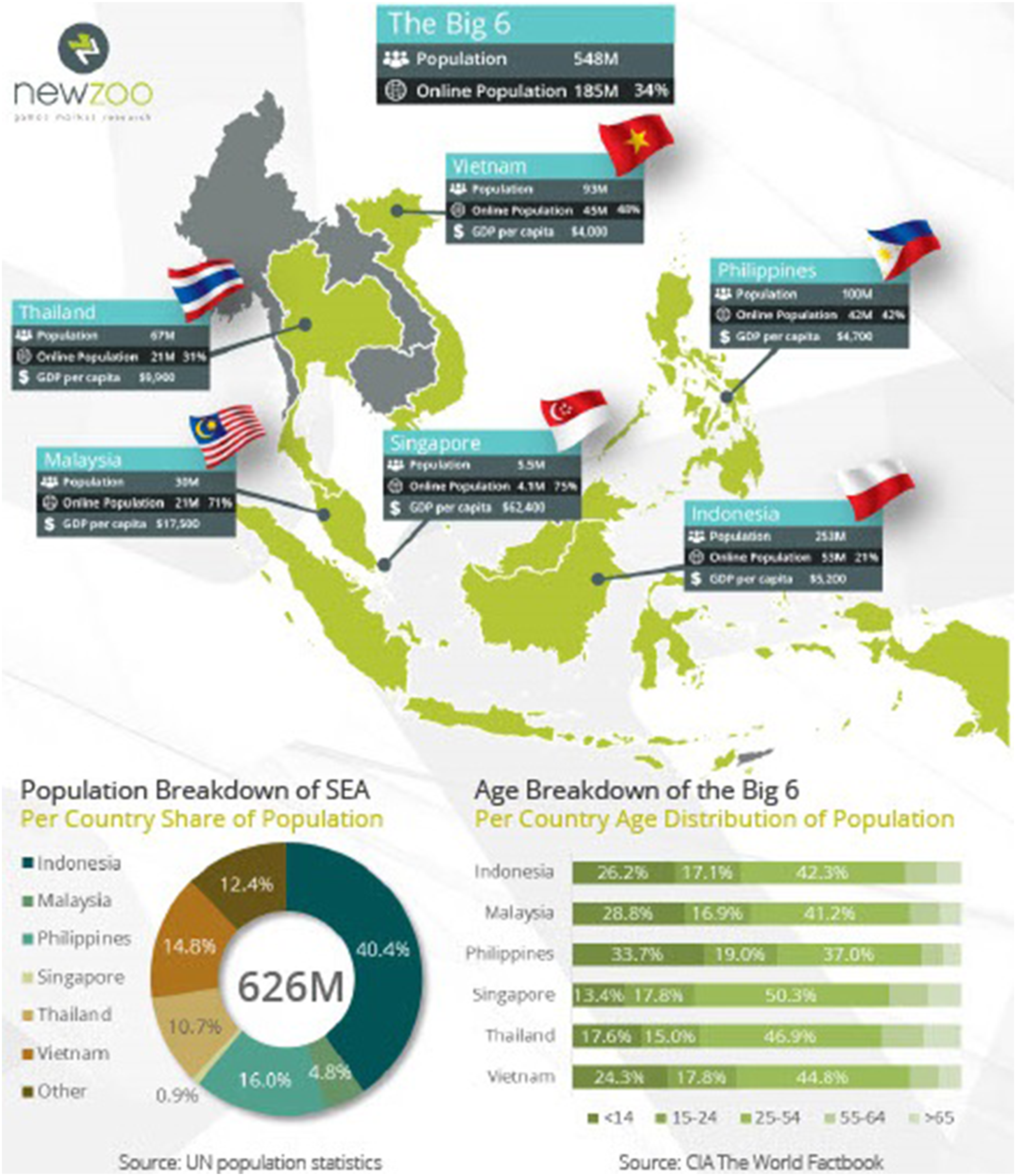
Technology: Data Collection and Player Measurement
Considering the importance of player data to Newzoo’s Southeast Asia reports, knowledge of how such data is collected and utilized in the context of the reports is imperative to understanding the discursive construction of the Southeast Asian games market from a game analytics perspective. Much can be learned from drawing an analogy between the notions of “players” and “audience” as media industry commodities. There is an abundance of studies on audience measurement in film/television studies as compared to the understudied topic of player measurement in game studies. In his investigation of the economic characteristics of media products to better understand media industry behaviors, Philip Napoli (2009) observes that media industries operate in what he describes as “dual product marketplace,” which means that “most sectors of the media industry simultaneously seek to manufacture and sell two completely different products to two completely different sets of consumers—they sell content to audiences; and they sell audiences to advertisers” (p. 163). In other words, many media firms operate in two different markets, namely “content market” and “audience market,” often simultaneously. Market-focused game analytics companies like Newzoo also operate within the “audience market,” but they differ from analytics provider for non-interactive visual media in a few important ways. Firstly, instead of “audience,” game analytics companies deal with “players,” whose interactions with the product are significantly different. Unlike viewers of non-interactive visual media such as films or television shows, players actively interact with games for the most part. Secondly, the business model differs substantively. Game analytics companies do not sell the attention of players to game publishers or advertisers (although some game publishers do sell players’ attention to advertisers); instead, they sell player data to game publishers.
Mass data collection from players in the contemporary game industry, as previously stated, is made possible by the advent of the internet and digital distribution. This method of collecting data over the internet is known as telemetry. In Game Analytics: Maximizing the Value of Player Data, Seif El-Nasr, Anders Drachen, and Alessandro Canossa (2013) define telemetry as “data obtained over a distance [that] is typically digital, but in principle any transmitted signal is telemetry” (p. 4). The bulk of the data collected through telemetry is derived from in-game player behavior, including the player’s interaction with the games and other players, as well as their purchasing behavior. Telemetry data is also present in Newzoo’s reports. For example, the “Zooming in on the Big 6” section in N-GMGC2017r includes lists of “Top 10 Mobile Games by Revenue” for Android and iOS in each of the nation during October 2016. While some of the population data utilized in Newzoo’s reports are telemetry data, such as the online population in the region, much of such data are non-telemetry census data, including the overall population, as well as their age and gender breakdown. Importantly, the usage of non-telemetry data by Newzoo as a market-focused game analytics company is meant to overcome the limited commercial appeal of telemetry-only analysis, given that game companies can easily obtain massive amounts of telemetry data from players through their own game servers. This means that telemetry-focused game analytics could be performed in-house instead of through third-party research firms, so non-telemetry data is a “value added” element of Newzoo reports.
To forecast future market revenues, which is the main selling point of its reports, Newzoo has to look beyond existing Southeast Asian players who can be tracked through telemetry data to the larger segment of the population who have yet to become players. I call them “players-yet-to-be,” that is, players who exist in the gap between the “population” and “players” categories in Newzoo’s market reports; one can calculate the number of players-yet-to-be by subtracting players from the total population. Importantly, players-yet-to-be can only be extrapolated from non-telemetry data, specifically census data. For example, the sources for “Population Breakdown of SEA” and “Age Breakdown of the Big 6” listed in the “Demographics” section of N2015r are “United Nations population statistics” and “CIA the World Factbook,” respectively. Census data are comprehensive but lacking in detail; as a result, people tend to be seen as categories. That said, it is necessary for Newzoo to utilize census data despite its shortcoming in the reports due to the speculative nature of players-yet-to-be. While potential players are often not the explicit focus of Newzoo’s reports, they are the undoubtedly the invisible pillars that underpin the discursive futurity of the Southeast Asian games market—consumers on whom the regional market’s predicted revenues growth are premised. In other words, while these players in potential have not yet come into existence, once they do, they have the potential to significantly contribute to the region’s gaming economy, or so the logic goes. Players, like television audience as defined by Napoli, are “highly perishable” products because their shelf life “is exceptionally short, lasting only for the duration of time that a media product is consumed” (2003, p.30). Hence, players conceived through game analytics need to be sold in the form of players-yet-to-be before they even come into existence. For this reason, players-yet-to-be are an imaginary construct who are produced for and only exists within market reports; they are the paradoxical futurity that game analytics companies are implicitly selling to game companies and cease to exist the moment they come into existence.
Analysis: Future Prediction Through Capitalist Accumulation
In Newzoo's reports, the expression of Southeast Asia’s future in terms of game revenues functions as a manifestation of the privileging of space over temporality. Such expression is a result of reading the heterogeneous temporalities experienced by Southeast Asians through the homogenizing lens of capitalism. For Harootunian (2012), the “memory of underdevelopment,” which arises from the unevenness produced by the law of capitalist accumulation, is actually “the history of untimeliness … and the noncontemporaneity that capitalism produces in various social formations, where people live not in the same present or past to our present, but in their own presents that are different from ours” (p. 19). However, we tend to view regions outside of Euro-America as underdeveloped because the capitalist present, widely perceived as the normative temporality, compels us to “classify societies that were backward as belonging to a separate past,” which Harootunian regards as capitalism’s failure to resolve its past (p. 20). Game analytics companies, including Newzoo, in their attempts to predict a future that can be safely secured, inevitably align their market analysis with the capitalist temporality in which all nations and regions can be neatly situated along one single axis of timeline. Such alignment allows them to avoid dealing with the messiness of noncontemporaneity that muddles the distinction between past, present, and future. In doing so, Newzoo also positions Southeast Asia as the “past” of nations with advanced game economies, which serve as the imagined “future” of the region, thus setting Southeast Asia on a temporal trajectory toward a pre-determined future.
Newzoo’s framing of Southeast Asia’s future through capitalist accumulation tends to omit certain cultural or racial factors that are sensitive but nevertheless important to the local markets. In Translating Time, Bliss Lim (2009) posits that homogeneous time, which operates to synchronize “people, information, and markets in a simultaneous present,” tends to creates conflicts for it “underwrites a linear, developmental notion of progress that gives rise to ethical problems with regard to cultural and racial difference” (p. 11–12). To render the heterogeneous temporalities experienced by the people of Southeast Asia legible to those from outside of the region, Newzoo filters the region through the logic of homogeneous time in its analysis, synchronizing the region into a simultaneous present with the global games market. But the prioritization of a capitalist present in Newzoo’s analysis also leads to the flattening of complicated factors like racial differences in order to solidify the monolithic category of national population, begetting further ethical problems, as Lim suggests.
Racial factors are especially important to understanding the market dynamics of a multi-racial country like Malaysia, for example. Peichi Chung (2017) notes that the publishers of online games in Malaysia, in which Malay is the dominant race, often prioritize players from the Chinese ethnic communities when choosing which title to publish: Although the Chinese population only occupies 30% of the country’s population, Chinese gamers have become the major source of income that shapes a publisher’s local style of marketing to promote games. According to an interview with a Malaysian online-game publisher, because most of the paying customers are Chinese gamers, publishers mostly offer online gaming environment in Chinese language. Despite the government’s effort to promote racial harmony under the policy of “One Malaysia,” this emphasis reveals a potential problem in the lack of development and publishing for local content that exist for all races in the country (p. 139–140)
Chung’s statement alludes to the complex and unique racial tension that Chinese ethnic communities experience in Malaysia. Arguing that the common understanding of racism as “a majority versus minority antagonism” is inapplicable in the Malaysian context, Fiona Lee (2019) points to the sustained socioeconomic inequalities between Malays and Chinese, which occurred as as a consequence of colonial rule and enabled the revival of the racial colonial tropes of “the lazy Malay and the entrepreneurial Chinese” in the postcolonial era (p. 224). For these reasons, Lee propounds that “in order to discern the workings of Han Chinese racism in the Malaysian context, racism must be analyzed in concert with capitalism and not as though they were distinct modes of hierarchy production that operated in isolation from one another” (p. 225). Despite the importance of racial components as part of Malaysia’s gaming economy, none of Newzoo’s analyses of Malaysia in any of the reports studied in this article address the issue explicitly. The absence of racial discourse within Newzoo’s analysis of the nation is most distinctly felt in the “Malaysia” page under N-GMGC2017r’s “Zooming in on the Big 6” section, in which the nation is highlighted as possessing “Highest Share of Chinese Game Titles in Top 10 (Mobile Games by Revenue).” However, the only census data included in the page is that of age and gender, making race the proverbial elephant in the room.
A ubiquitous device used by Newzoo to predict the revenue growth of the Southeast Asian games market is the formula of Compound Annual Growth Rate (CAGR), through which Newzoo is able to prophesize an ideal future in which the region’s game revenues will only ever increase. CAGR is a widely used business formula to calculate the annual growth rate when compounding is taken into account. Compounding refers to the ability of an asset to generate more earnings from the reinvestment of previous earnings. The formula of CAGR (Figure 2) is as follows: The formula of CAGR from Investopedia.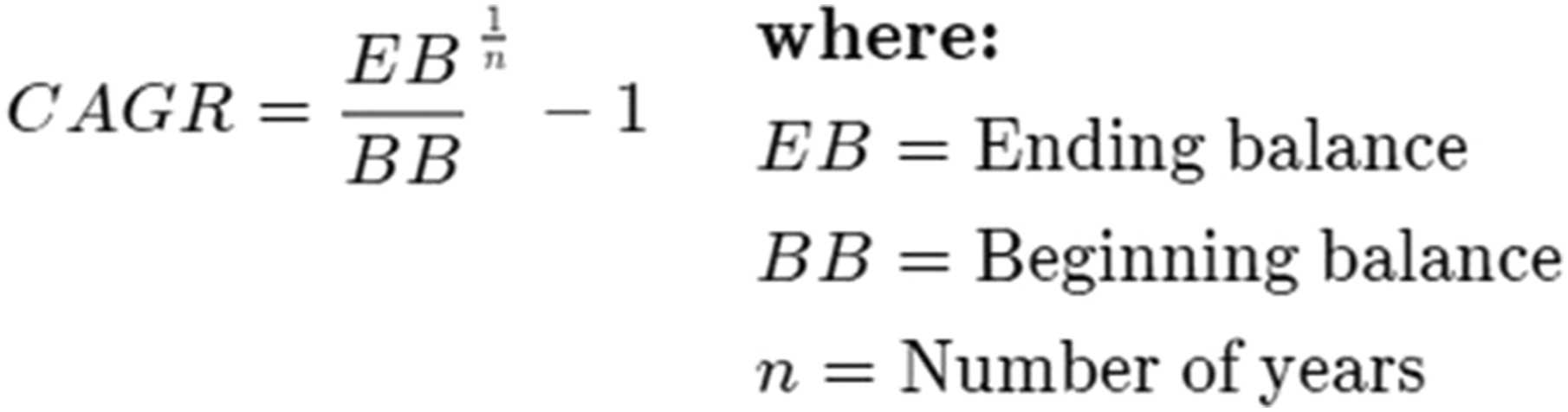
Investopedia, one of the largest educational websites devoted to investing and finances, defines CAGR as such: The compound annual growth rate isn’t a true return rate, but rather a representational figure. It is essentially a number that describes the rate at which an investment would have grown if it had grown the same rate every year and the profits were reinvested at the end of each year. In reality, this sort of performance is unlikely. However, CAGR can be used to smooth returns so that they may be more easily understood when compared to alternative investments (Murphy, 2019)
That is, CAGR assumes an ideal but improbable scenario in which “an asset, cash flow, or some other random variables grow at a constant rate of return over a sample period of time,” which aligns with the capitalist measurement of time via accumulation (Anson, Fabozzi, & Jones, 2011, p. 489). In N2015r, Newzoo predicts that the CAGR for Southeast Asia’s game revenues will increase by 28.8% over the period of 2013–2017, indicating that the game revenues for the region will almost triple within the 5-year period from $806 million to $2216 million. In N-GMGC2017r, Newzoo reaffirms the rapid growth they predicted of the regional market, stating that “the 2015-2019 CAGR for the Big 6 is 45.7%” and even highlights that the region’s figure “is well above the global average of 14.6%.” Such portrayals of Southeast Asia as a land of perpetual revenue growth no doubt appeals to many potential investors despite the limitations of this simplistic formula.
CAGR also enables Newzoo to spatialize the temporal progression of the Southeast Asian games market into measurable revenues through infographics. In the “Games Market” page of N2015r, the predicted yearly game revenues of the “Big 6” within the 5-year period of 2013–2017 are depicted as a bar chart (Figure 3). In the bar chart, the revenues made by each country annually are proportionately visualized as rectangular parts of a bar, which consists of seven differently colored rectangles that represent each of the “Big 6” and “the rest of SEA” stacked atop of each other. Each bar represents the total revenues made in the entire Southeast Asia region per year. As can be inferred from the successive increases in the heights of the chronologically arranged bars, the progress of time of the Southeast Asian games market is spatialized into the amount of revenues it aggregates per year. Such temporal representation of the regional market via bar chart bears close resemblance of the spatial representation of time via the circular-moving hands of analog clock—that time and, by extension, future is measurable—as per the logic of homogeneous time predicated on capitalist accumulation. A bar chart that shows the 2013–2017 game revenues and growth per country of the “Big 6.”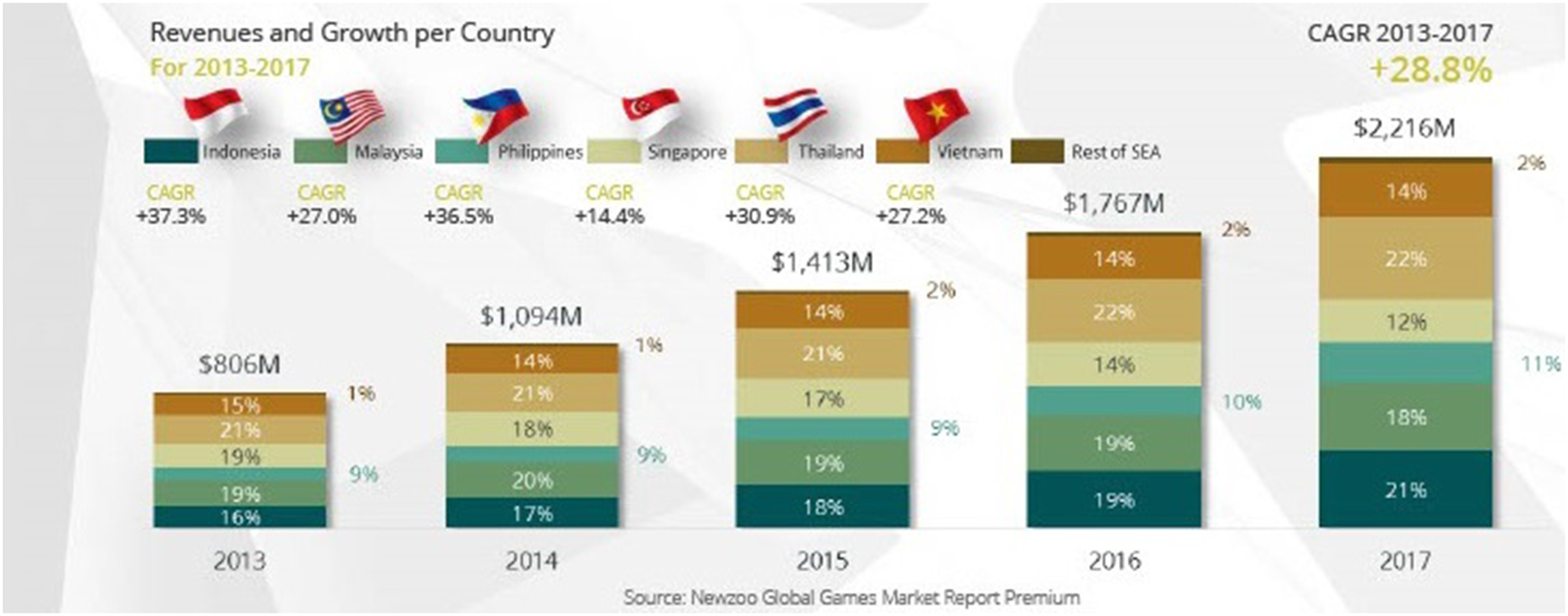
Mythology: Memory Loss and Deceptive Futurism
The status of Southeast Asia as “the world’s fastest growing games region” (N2015r and N-CGA2015r) or “the world’s fastest growing (mobile) games market” (N-GMGC2017r) is a myth that Newzoo’s reports actively work to sustain. As stated in the introduction, I use the term myth not to indicate falsehood as such; rather, I have sought to unpack the potency of this predictive rhetoric about the growth of Southeast Asian games market at a breakneck speed. In his examination of myths about cyberspace, Vincent Mosco (2004) similarly views myth as more than falsehood: “Enticing as it is for people influenced by science to want to assess stories as true (accurate) or false (myth), this is myopic and beside the point. Myths are not true or false, but living or dead” (p. 3). Rather, he describes myths as “stories that animate individuals and societies by providing paths to transcendence that lift people out of the banality of everyday life” (p. 3). Indeed, to understand the discursive construct of the Southeast Asian games market, it matters not whether the region’s status as “the world’s fastest growing games region” is true or false. Instead, we should pay attention to the prevalence of such myth in the discourses about the region, particularly the ways it has animated people’s reactions toward Southeast Asia in a gaming context; the myth is alive so long as it continues to sustain the collective imagination about the region.
While the myth of Southeast Asia as “the world’s fastest growing games market” may animate the public’s imagination about the region’s future, it is merely a placeholder that is not only devoid of meaning in and of itself, but also empties the historical meaning of the subject it replaces. According to Roland Barthes and Lavers (1991), “myth is constituted by the loss of the historical quality of things: in it, things lose the memory that they once were made” (p. 142). In Barthes’ terms, myth is a form of “depoliticized speech” that purifies its subject to provide its beholders a sense of “euphoric clarity”: In passing from history to nature, myth acts economically: it abolishes the complexity of human acts, it gives them the simplicity of essences, it does away with all dialectics, with any going back beyond what is immediately visible, it organizes a world which is without contradictions because it is without depth, a world wide open and wallowing in the evident, it establishes a blissful clarity: things appear to mean something by themselves (p. 143)
When Southeast Asia is dubbed “the world’s fastest growing games market,” its assimilation into the capitalist present depoliticizes the region in economic terms, much like the lack of discussions about race in Newzoo’s reports. The regional market’s newfound mythical sheen directs its beholders to look past its battered history as a region that has suffered immensely at the hands of Western colonizers toward its seemingly bright future within a regime of global capitalism led by its ex-colonizers, disregarding the irony and messy complexities therein. Essentially, such depoliticization of Southeast Asia renders both its past and its future irrelevant.
The assessment of a “fastest growing” regional games market, despite its deceptively forward-looking façade, is an exclusively presentist claim devoid of future, much like the promise of players-yet-to-be. The Southeast Asian games market is fastest growing according to its current rate of capital accumulation, specifically game revenues. But what will the regional games market become when it finally fulfills its promise as “the world’s fastest growing games market”? This question is never addressed in any Newzoo reports or articles, in speculative or definitive terms. In fact, answering this question may end up killing the myth because a downturn often follows the peak. In a Forbes article entitled “China is Too Mature for Rapid Economic Growth,” Bill Conerly (2019) suggests the reason for China’s steady decline in GDP since its double-digit growth preceding the 2008 financial crisis, a development akin to those of the “tiger” economies after the 1997 Asian financial crisis: “No fully developed country grows at a double-digit pace … Poor countries can make dramatic gains in catching up to the developed countries, but then it’s hard to make further gains.” Similarly, when the Southeast Asian games market reaches its maturity, it will also lose its mythical status as the “fastest growing.” Southeast Asia can only be “fastest growing” while it is still a “developing” country trying to “catch up” to the “advanced economies” within an all-consuming homogeneous capitalist present. In the mythical domain of “the world’s fastest growing games market,” discourses about Southeast Asia are grounded neither in the past nor the future, only the present.
The Passing of a Myth: Fastest No More?
While Newzoo has not made any Southeast Asian market reports available online for free since N-GMGC2017r, it has since published three publicly accessible condensed analytical articles about the regional market on its website, namely: • 2019 Newzoo “Navigating the World’s Fastest-Growing Games Market: Insights into Southeast Asia” (Fernandes, 2019a) • 2019 Newzoo-gamescom asia “Games Market Trends and Publishers to Watch in Southeast Asia: The World’s Fastest-Growing Mobile Games Market” (Fernandes, 2019b) • 2020 Newzoo-gamescom asia “Gaming in Southeast Asia: The Playing, Spending & Viewing Behavior of a Fast-Growing Games Market” (Weustink, 2020)
Interestingly, the framing of the Southeast Asian games market by Newzoo in these articles is subtly different from those in the earlier reports. The analysis contained in the two 2019 articles is similar: both articles reassert the status of the regional games market as the “fastest growing.” However, unlike earlier reports that outright declares Southeast Asia as “the world’s fastest growing games region” or “the world’s fastest growing (mobile) games market,” in which the word mobile is bracketed presumably to downplay the fact that the region is growing fastest in the mobile segment (only), the pair of 2019 articles instead emphasizes the dominance of the mobile segment within the regional market due to the swelling numbers of smartphone users in the region. Finally, the latest article published in 2020 simply addresses the region as “a fast-growing games market” in the title. The word “fastest” only appears in the article to state that the mobile is the fastest growing segment within the regional games market.
Does the subtle shift in Newzoo’s framing of Southeast Asia imply that the region, according to Newzoo’s metrics, is no longer “the world’s fastest growing games region” or even “the world’s fastest growing mobile games market”? Possibly. Has the growth of the regional games market finally plateaued? Unlikely. While it is certainly possible that the revenue growth in the regional games market has slowed down, more time is needed for a developing market to reach its maturity. Moreover, the 2020 article notes that the smartphone penetration rate within Southeast Asia is still on the rise, meaning that there are still more yet-to-be players to be converted within and beyond the “Big 6.” But does it matter that Southeast Asia is in fact still the fastest growing games market from a quantitative, data-driven perspective? Probably not. At the end of the day, the true value of “the world’s fastest growing games market,” despite its origin in game analytics as a title derived from hard numbers, lies not in its accuracy but rather its power to animate people’s imagination about the region as a myth.
There will surely come a time when the mantle of being “the world’s fastest growing games market” will be passed to another region. In fact, such passage might even be underway already. Nevertheless, this myth encapsulates the essence of Southeast Asia as a games market within the zeitgeist of the 2010s.
Footnotes
Declaration of Conflicting Interests
The author(s) declared no potential conflicts of interest with respect to the research, authorship, and/or publication of this article.
Funding
The author(s) received no financial support for the research, authorship, and/or publication of this article.
