



Abstract
This article examines Rievssat (2018), one of the six games developed during the 2018 Sami Game Jam, as a case study to demonstrate how digital games on Indigenous issues afford opportunities to embed Indigenous ways of knowing into the core of game design. In particular, by exploring Rievssat’s themes and game mechanics, this article identifies the way its procedural rhetoric models an understanding of and relationship to the game environment that reflects the dialogic connection with nature and animistic worldview unique to the Sámi people. This article thereby demonstrates the value of new media in recentering Indigenous systems of knowledge and cultural practices by engaging with and incorporating Indigenous epistemologies into the foundation of game design, revealing how Sámi digital games can offer insight into Sámi ways of knowing and experiencing the world to Indigenous and non-Indigenous players alike.
Keywords
My work for this article took place on the traditional, ancestral, and unceded territory of the the St’át’imc, also known as the Lillooet, and at the University of British Columbia’s Point Grey Campus, which is located on the traditional, ancestral, and unceded territory of the xʷməθkwəy'əm (Musqueam) people. This land has always been a place of learning for the Musqueam people, who for millennia have passed on their culture, history, and traditions from one generation to the next on this site. As a settler scholar and uninvited guest, it is my honour to work and live on these lands, while learning from the history of these places.
Introduction 1
The digital interactive narrative Rievssat (2018) begins with the short indie game’s avian player character, a riekko or willow grouse native to Northern Europe, taking flight (Figure 1). As the controls are released to the player, they navigate the bird’s flight path with the help of an Xbox controller, keyboard, or alt controller designed by the game creators that uses leap motion technology and an acceleration pedal (Figure 2). Immediately the riekko begins to navigate its home, a digital representation of the Sápmi, the Sámi people’s traditional and ancestral territories. Flying over the Samiland, collecting food, the player experiences the same environmental changes that confront the bird as the landscape transitions through the Sápmi’s eight seasons as well as through ever increasing human interference and settler colonization, presenting challenges to which the bird must adapt. The interactive narrative’s world thus slowly transforms from vast expanses of land largely uninhabited to some semblance of a rural cityscape, until the bird has the sense that it no longer belongs in its homeland.
2
Rievssat (2018), screenshot. Rievssat (2018), screenshot.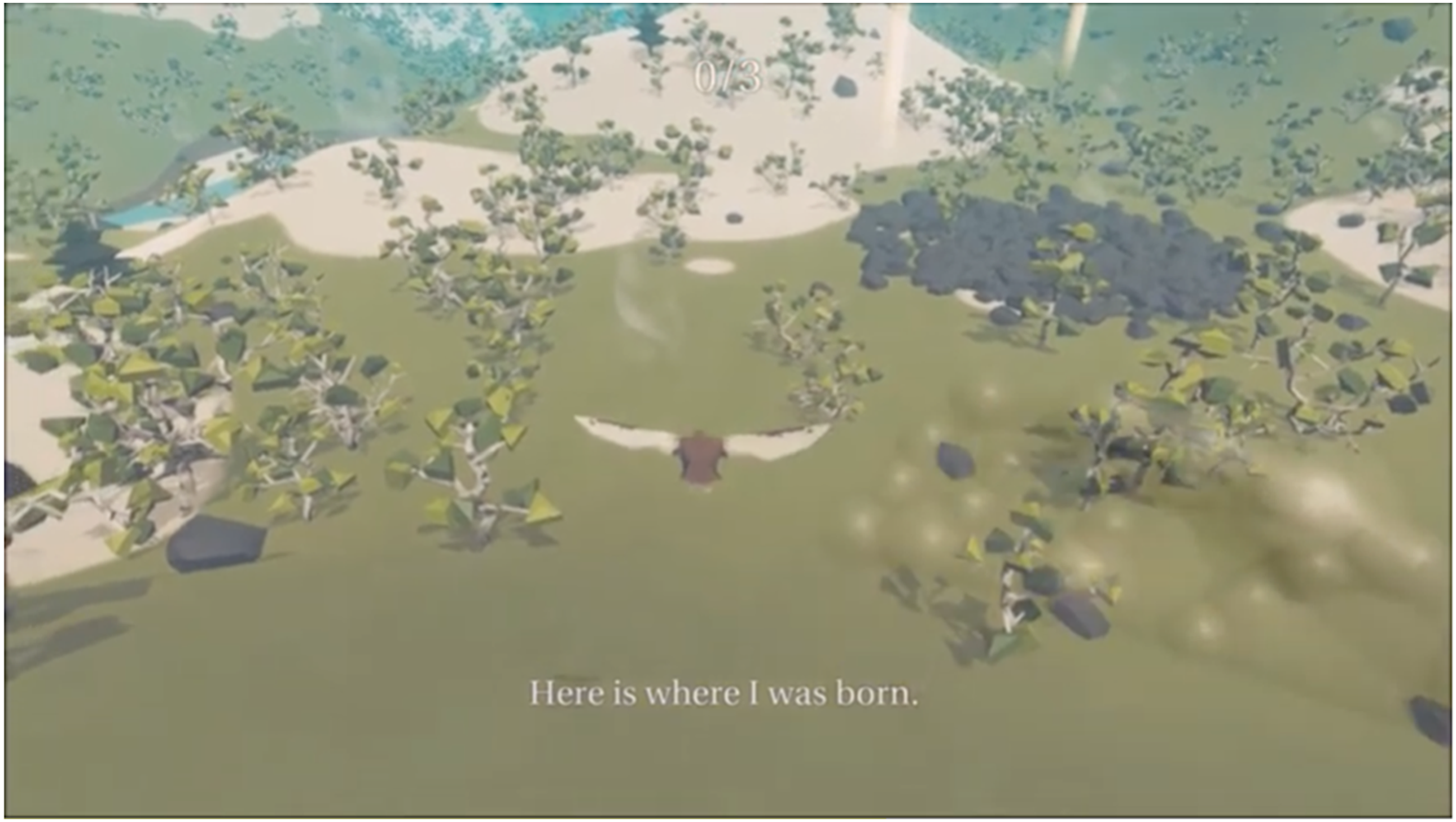
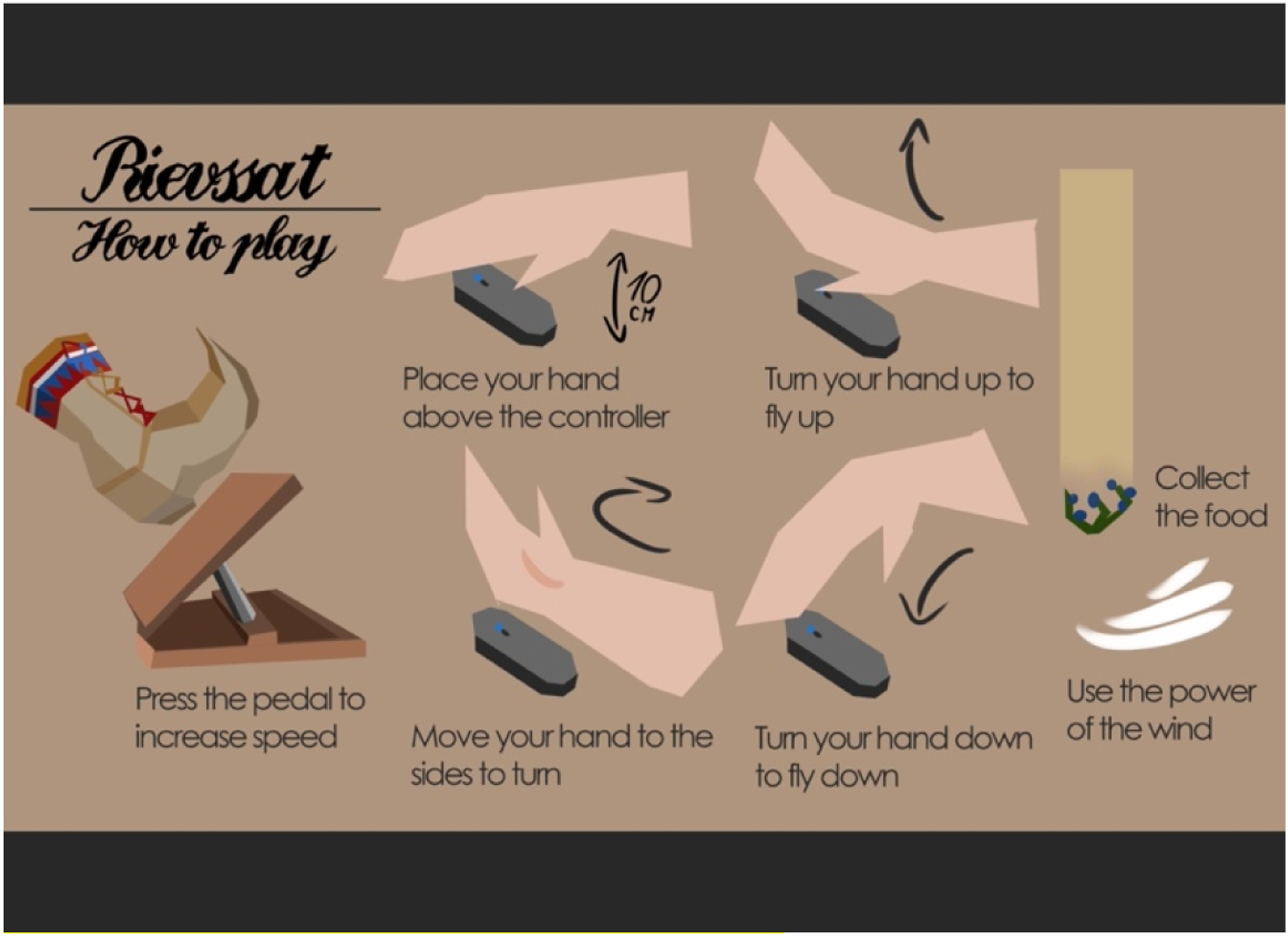
Developed by eight game designers and consultants during the 2018 Sami Game Jam, 3 Rievssat is one of six games created in Utsjoki, a small Sámi village next to the Norwegian border in Finland, between February 21st to February 25th, 2018. Here, the Sami Game Jam hosted a group of 44 jammers at the five-day game development event, in which experienced game designers and people from the Sámi community came together to create games on Sámi culture and traditions. Consisting of local Sámi participants and Finnish as well as international game students and professional developers, the Sami Game Jam provided an unprecedented “platform for indigenous game development and local game education and a platform to develop Sámi Pedagogy further” (Kultima and Laiti, 2019, p. 1). In particular, it drew attention to the important role digital games can play in examining Sámi issues.
From the first moment of Rievssat’s gameplay, the player begins their exploration of the traditional territories of the Sámi as the riekko, which is the Finnish name for the avian title character that is also featured in the game’s title in Northern Sami. The historic natural landscape of the Sápmi provides the initial setting for gameplay, while the accompanying narrative similarly foregrounds nature as primary to the game’s subject. Very quickly into the game, however, “nature” begins to transform as elements of “civilization”—the Samiland’s colonization—begin to occupy the landscape. Yet, the game does not frame the transition of these lands as particularly “unnatural”. Instead, the transformation of the region from the historical landscape of the Samiland is framed as unwanted interference, intrusions that “add dividing lines” and manifest in “build[ing] houses upon home” and the arrival of “tourists with big cameras” (Figure 3). As a consequence of these developments, however, the bird must change its flight pattern to increasingly avoid hunters’ traps, buildings (most notably churches), and road construction signs, while it continues to navigate its native territories. Rievssat (2018), screenshot.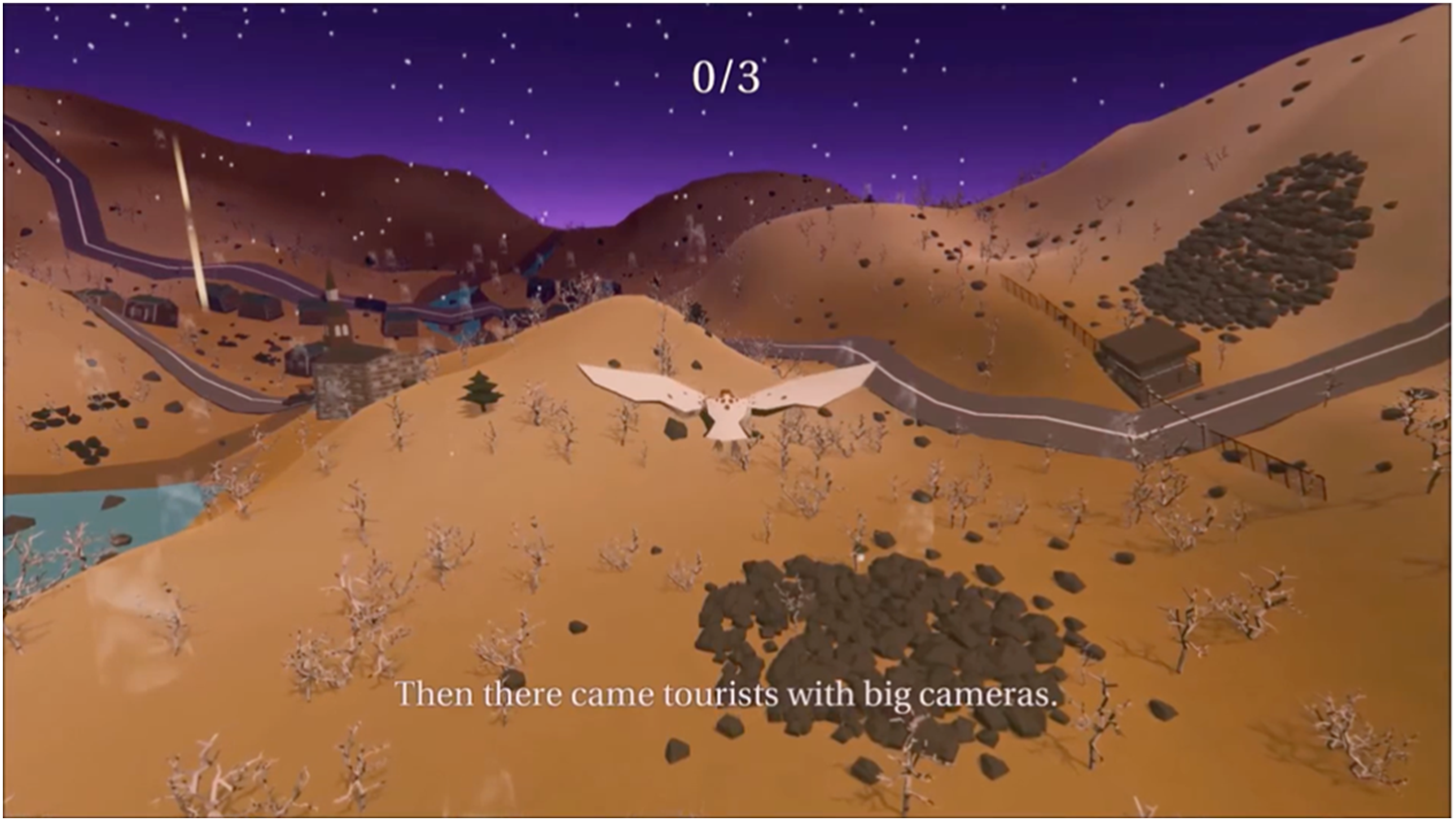
Rievssat thus draws attention to how the geography of the Sápmi has changed over the course of modern (Western) history as a result of its colonization, revealing how the riekko’s relationship to the natural landscape evolved alongside these developments. In reaction to the gradual development of the landscape, the riekko is forced to change its flight path and subsistence habits to account for the increasing colonization of its homeland. In this sense, the game literally maps out the process of colonization, which in turn provides the foundational conflict of gameplay. With the avian player character framed as a symbol for the Sámi people and their experience of settler colonialism, Rievssat’s interactive narrative emerges as an act of digital survivance, 4 a model for understanding the Sámi relationship with nature, and a testament to how and why incorporating narratives of adaptation is essential in discourses on Sámi colonization.
Researcher Positionality
As a woman of European descent living on the Northwest Coast of what is now called Canada, my scholarship in Indigenous Studies requires the acknowledgment of my privilege and position as a White settler in relationship to the First Nations on whose land I reside as an univited guest in Vancouver, British Columbia, where I live and work on the traditional, ancestorial, and unceded territories of xʷməθkwəy̓əm (Musqueam), Skwxwú7mesh (Squamish), and Səl̓ílwətaʔ/Selilwitulh (Tsleil-Waututh) Nations. Moreover, as a non-Indigenous person studying global Indigenous traditions and ways of knowing, it is even more important that I practice “relational accountability” (Wilson, 2008), acknowledging how my relationships inform my research and teaching by articulating my connection to the work I am doing and making my intentions and approach transparent.
My interest in Indigenous Studies arises from my relationship to the land upon which I grew up and the important Indigenous cultures that have existed here since time immemorial as well as the work of truth and reconciliation that has become increasingly essential in Canada. Researching and teaching in a European Studies department, I was surprised to see how scholars in my field struggled to find intersections between Indigenous Studies and European content beyond acknowledging the hegemonic culture of settle colonialism initiated and maintained by the many nations of Europe both historically and today. Yet, what is now considered Central, Eastern, and Northern Europe is the traditional territory of hundreds of thousands of Indigenous peoples. For example, contemporary Russia is home to more than 180 peoples, 40 of which are officially recognized as Indigenous (IWGA). Moreover, Kalaallit Nunaat (Greenland), the self-governing territory within the Danish Realm, is home to the Kalaallit (Greenlandic Inuit), which, according to 2018 estimates, comprises 89.6% of the population (International Work Group for Indigenous Affairs, n.d.).
Thus began my work exploring ways to integrate Indigenous voices and perspectives into my research and teaching in European Studies, learning as much as I could about the many Indigenous peoples that have lived in Central, Eastern, and Northern Europe since time immemorial. Incorporating the history and traditions, and contemporary experience of the Sámi, Chukchi, and Kalaallit into my work has led to a more complex and nuanced representation of European culture and politics, drawing attention to the systemic injustices faced by the Indigenous people living within the confines of the EU and beyond to undermine any uniform or monolingual sense of Europe’s nationally defined cultures. Moreover, this work has uncovered opportunities in my research and teaching for the exploration of settler colonialism from a global perspective, which in turn also informs how students understand and relate to the issues of settler colonialism and truth and reconciliation more locally.
Importantly, however, since my approach to Sámi culture and new media is from a global perspective and informed by work in North American Indigenous Studies, I am cautious of the potential for essentializing Sámi identity and experience and wary of flatting the complexity of this particular worldview as a consequence of my own geopolitical and settler subject position. So, while my work frames its intervention in the larger category of Indigenous new media and draws from Indigenous Studies broadly speaking, it is still very much invested in Sámi-defined Indigenous experience and does not seek to speak to or on behalf of other Indigenous communities. Yet, by framing play and games as significant transmitters of cultural knowledge, this case study illustrates how Indigenous digital games can foster opportunities for engaging and exploring important aspects of Indigenous identity and ways of knowing through Rievssat’s thematization of the Sámi’s dialogic and animistic understanding of nature. This article thereby demonstrates how Indigenous digital games more generally might be understood as important pedagogical tools for preserving and revitalizing Indigenous culture.
The Sámi People
With an estimated population of 50,000 to 100,000 people (IWGIA), the Sámi (also spelled Sami or Saami) traditional territories span four countries, Finland, Norway, Sweden, and Russia. However not all Sámi live in the Sápmi or Samiland, with, for example, more than 60% of the 9000 Finnish Sámi living outside of the tradition Sámi homeland (Valkonen & Valkonen, 2014, p. 27). Yet, while the Sámi are divided by the political borders of four nations, they continue to exist as one people, united by cultural and linguistic ties and a shared identity (Herrmann & Heinämäki, 2017, p. 5). Moreover, in the face of forceful governmental, cultural, and educational policies and structures imposed on the Sámi throughout the history of colonization until today, the Sámi continue to retain their own particular ways of being, knowing, and relating to other people and their environments (Valkonen et al., 2019, p. 8).
In addition to the Sámi languages, folklore, traditional knowledge, clothing, song (yoik), art (duodji), and forms of subsistence, one of the most distinctive features of Sámi culture is the Sámi’s close connection with nature (Valkonen & Valkonen, 2014, p. 27). This relationship has been described as “a combination of spirituality, philosophy and wisdom of life” (Valkonen & Valkonen, 2014, p. 27) and is an important element of Sámi identity both inside and outside of the traditional Sámi territories. In particular, this conception of reality places human beings in relationship to a world in which the land, animals, and people, as well as the spirits that govern them, collaborate (Helander-Renvall 2016, p. 71). This worldview is communicated through Sámi ways of living and Sámi storytelling traditions, which connect the Sámi to both ancestral and contemporary ways of living, passing on Sámi knowledge and history and forming the foundation of the Sámi epistemology (Kuokkanen, 2000, p. 419).
Popular understandings of this aspect of the Sámi worldview have resulted in the representation of the Sámi relationship with nature as the primary way of engaging Sámi experience in cultural production, and many of the digital games produced by the participants of the 2018 Sami Game Jam are a testament to this. However, media engagements with the Sámi relationship with nature are fraught, with the representation of this connection often superficial or fetishized. Consequently, popular culture problematically presents the Sámi relationship with nature as static and unchanging, creating the impression that it has existed in one particular form since time immemorial.
Moreover, the motivations behind the representation of the Sámi people and their culture have changed over the centuries (Fonneland, 2013, p. 194). And even while the perception that global Indigenous cultures have a special relationship with nature is widely accepted among Indigenous peoples themselves, it has also emerged as an important element of modern environmentalist discourse and international environmental activism (Valkonen & Valkonen, 2014, p. 25; Fonneland, 2013, p. 195). These factors have resulted in a layered mobilization of the Sámi-nature relationship in popular media that is not always in service to the Sámi people. Furthermore, these presentations of Sámi culture, which tend to describe an idealized version of Indigenous life, may in fact be a manifestation of destructive exotification (Fonneland, 2013, p. 195). For example, the assertion that all Indigenous peoples have a sustainable relationship with nature and their own special ecological wisdom has its roots in the Sámi worldview, but it has also, according to Anthropologist Kay Milton, mythologized and politicized popular understandings of Sámi culture (Valkonen & Valkonen, 2014, p. 25). Milton posits that within modern environmental and political discourse, the argument that Indigenous people have a close relationship with nature has been engaged to critique the “crooked” approach to the natural environment of industrial Western societies as much as it has provided an important point of connection in the identity politics of the global Indigenous community (Valkonen & Valkonen, 2014, p. 25).
So, while this recognition of the important role of nature in the lives of the Sámi is in some ways honoring one of the most significant markers of Sámi identity, many of these forms of engagement do not lend themselves well to the recognition of the Sámi’s contemporary relationship with nature, one that is still just as essential to Sámi identity politics but is also evolving to meet the needs and priorities of modern Sámi communities. Ultimately, even though representations of the Sámi-nature relationship are rooted in traditional understandings of the role of nature in Sámi society and culture, the idea that the modern Sámi connection to nature has remained unchanged despite the very palpable disruptions to the natural landscape of the Sámi territories does a disservice to the Sámi people, who are continually adapting to their surroundings through their dialogic relationship with nature, which itself is not defined by notions of a historical and untouched environment that is uncompromised by human presence. 5
Popular repesentations of the Sámi relationship with nature therefore reveal both embedded assumptions about the definition of that relationship as much as its problematic mobilization for various political agendas. Consequently, current popular, political, and environmental discourse suggesting that “authentic” Sámi ways of living need to be grounded in nature-based substances lifestyles (Helander-Renvall, 2010, p. 45), which are elements of Sámi, history, society, and culture that do not always map onto contemporary Sámi experience, need to be revisited. Moreover, the very idea of Sámi “authenticity” is itself oppressive, embodying a colonialist view of Sámi culture. The conception of Indigenous cultures’ special relationship to nature has thus not exclusively served the Indigenous people that are supposed defined it. And while it has its foundation in essential Sámi traditions, all too many popular engagements with the Sámi connection with nature problematically focus on linking the Sámi present to the Sámi past in such a way as to render the Sámi idealized others (Helander-Renvall, 2010, p. 45), and in environmental discourse, this dogma is unfortunately in need of no further justification (Valkonen & Valkonen, 2014, p. 25).
The norms concerning “Sámi authenticity” are thereby part and parcel of the hegemonic power relations between the Sámi and the governing bodies of the Sámi territories (Helander-Renvall, 2010, p. 45). Developed in dialog with non-Indigenous political agendas and touristic endeavors, the Sámi’s connection with nature is in need of reconsideration by way of contemporary representations of this relationship that contest static notions of Sámi lived experience. Turning to Indigenous new media that thematize the Sámi-nature relation, therefore, helps to recalibrate popular understandings of the Sámi’s real-existing relationship with their environment. Looking at Indigenous new media that embed Indigenous self-understanding, systems of knowledge, priorities, and perspectives at the core of their production helps to nuance mythologizing notions of Sámi identity. The work of Coppélie Cocq, for example, explores how “place” is constructed in Sámi digital environments to reveal placemaking itself as a narrative practice that emerges in relationship to contemporary Sámi identity discourses (Cocq, 2013, p. 1).
Similarly, Rievssat’s game design and gameplay push back on popular understandings of Sámi identity politics, revealing how the Sámi connection to nature is dialogic and evolving, while undermining the typical iconography of Sámi experience, namely through the culture of herding reindeer. Rievssat thus shows players a different relationship with nature than the one that has become increasing visible in popular media, including the Disney Frozen franchise. Here, the Sámi-nature relationship constructed through gameplay demonstrates how this connection to and understanding of nature is not one that is preoccupied with a mythologized past. Instead, gameplay illustrates how the Sámi people have and continue to adapt to their natural surroundings, even as the landscape itself becomes more and more disrupted by colonialization.
Furthermore, through the identity of the player character, a riekko, Rievssat presents its perspective on the Sámi relationship with nature through an animistic worldview that maintains important connections to Sámi epistemology. With the premise of the game itself grounded in the Sámi conception of animals as persons, Rievssat does not flatten understandings of nature–human relationships by discounting the consequences of colonialization on the non-human-persons of the Sápmi. Instead, Rievssat presents the Sámi’s relationship with nature as complex, participatory, and constantly evolving, perpetually redefined by the real existing circumstances of life both inside and outside of the Sámpi and impacting all the persons living in the Sámi traditional territories and beyond. Now, turning to the game mechanics and player experience of Rievssat, I illustrate how this game offers mediated access a Sámi worldview that not only reconnects Indigenous players to Sámi ways of knowing and experiencing nature but also illustrates to non-Indigenous players the unique perspective of the Sámi people and, importantly, on the Sámi game desigers’ own terms.
Rievssat’s Representation of the Sámi Relationship to Nature
Through the navigation of riekko player character and its thematization of the natural landscape of the Sápmi, Rievssat’s game design and gameplay evoke messages about the Sámi relationship to nature that draw direct parallels to elements of the Sámi worldview. Rievssat thereby models an engagement with Sámi epistemology at the very foundation of the game’s design. For example, Rievssat’s game progresses through Sámi-defined conceptions of time, and specifically, the changing of the Sápmi eight seasons. Sámi traditional knowledge was developed through repeated experiences of particular situations and this extended to conceptualizing the passing of time and the cycles of nature (Redding, n.d.). The Sámi year is thus divided into eight seasons, which are based up on the yearly cycles of the reindeer (Redding, n.d.).
Then, each of the game’s eight Sámi seasons appears with its own set of challenges, “as the bird’s natural habitat slowly fills up with humans and their society” (Laiti, 2021, p. 55). Game jam co-organizer Outi Laiti thus observes how Rievssat is thereby a parable for Sámi experience through the riekko’s attempt to grapple with the environmental effects caused by human actions (Laiti, 2021, p. 58). Here, the game itself embodies a continuation of the Sámi tradition of “performing animal roles … through the player’s identification with the bird” (Laiti, 2021, p. 58). In this sense, the willow grouse’s fight for survival therefore also symbolizes the plight of the Sámi: the bird feels estranged from its own land, as outsiders—the manifestation of colonial forces—gradually come to occupy more and more of the Sámi territory represented in gameplay (Laiti, 2021, p. 59).
As the game progresses, the player character must navigate Rievssat’s constantly evolving landscape (Figure 4). Trees are cut down as new buildings rise, taking up the bird’s natural habitat and applying new rules to its territories. The player is thus forced to make at first subtle but very quickly increasingly more dramatic changes to their flight pattern, while adapting their search for food as the Samiland becomes increasingly colonized. Moreover, play is accompanied by narrative exposition, the English translation of which runs along the bottom of the screen, describing the increasingly prescribed environment in which the riekko exists. The accompanying narrative thus further connects the loss of the bird’s natural habitat with the Sámi experience of colonial influences on their homeland (Horton, 2019, p. 71). These observations on the consequences of colonization on the geography of the Sámi traditional territories are important declarations on historical Sámi experience; yet they also provide essential opportunities for the digital witnessing of a contemporary understanding of the Sámi relationship with nature through a bird’s eye view of the Sápmi. Rievssat (2018), screenshot.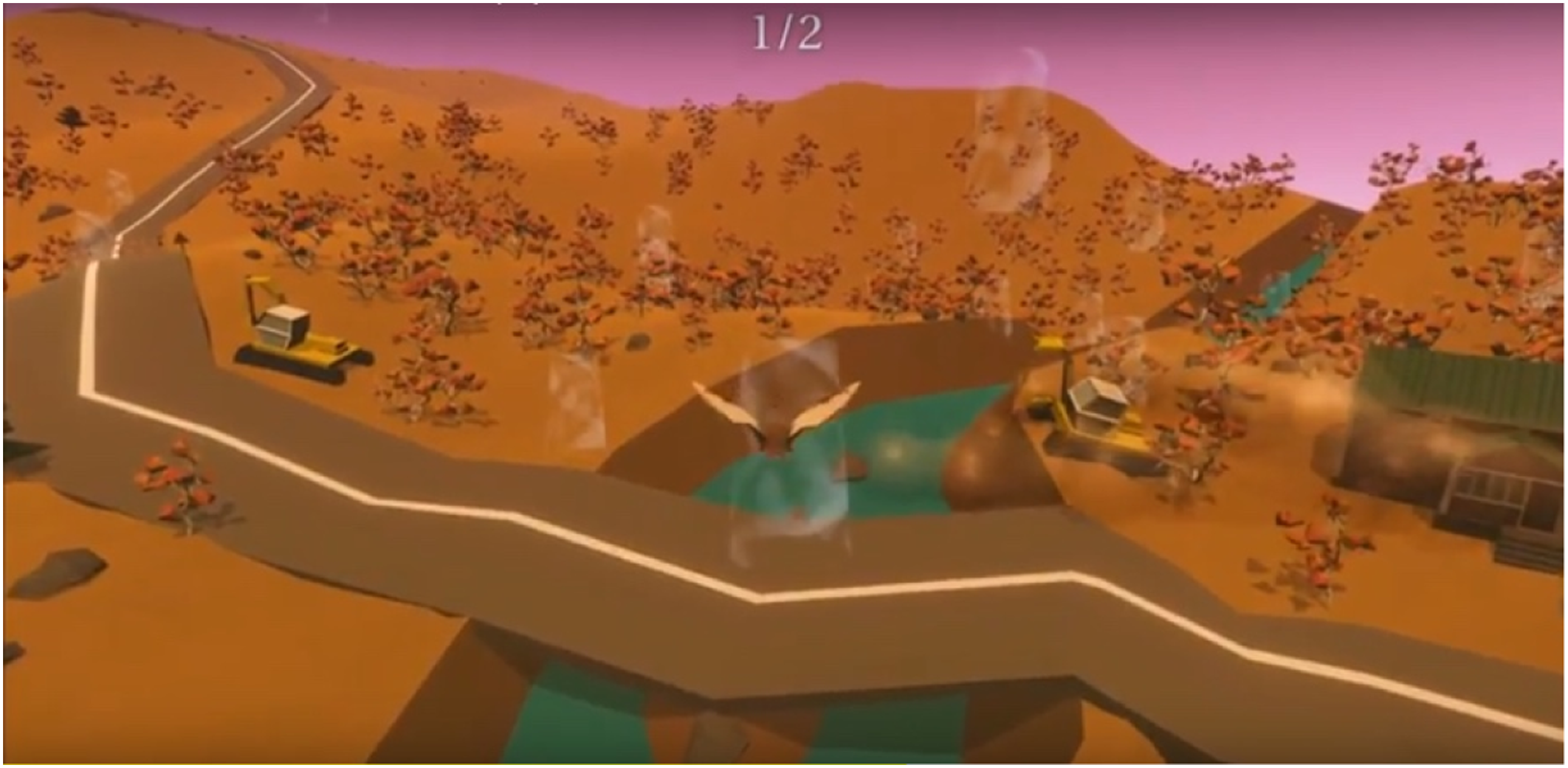
However, while the concept of “home” is intrinsically bound up with the evolving circumstances of the Samiland and even though the game articulates the bird’s sense that it “no longer feels at home in its homeland,” Rievssat concludes by asserting belonging despite the landscape’s transformation: “Here is where we were born. And here is where we will stay.” The game is thereby less of a statement on how settler encroachment on the Samiland resulted in its “unnatural” transformation, which would fall into a Western definition of nature that places it in opposition to civilization and is thereby invested in Western binary systems of knowledge; instead, Rievssat reveals the Sámi’s dialogic worldview, which emerges in relationship with the real existing circumstances of place and home to incorporate transformation and change into their understanding of nature. Rievssat thus demonstrates not how the Sámi remain out of place in the new circumstances of their colonization, but how they are agents within those spaces, adapting to the transformation of the Sápmi, while holding on to their traditions and worldview. In this sense, Rievssat simultaneously rejects the Western dichotomy of nature as something untouched by civilization as much as the notion that the Sámi relationship with nature is ancient and therefore out of sync with modern Sámi lifestyles. Here, the Sámi’s evolution with and alongside nature is thus characterized by the riekko’s relationship with its habit. The bird adapts and adjusts as nature itself changes. Then, with the bird’s flight guided by the player’s own movements, Rievssat ultimately combines the goal-oriented strategy of gameplay with an embodied experience of the Sámi people’s sense of alienation (Laiti, 2021, p. 59), thereby revealing the dialogic nature of the Sámi relationship with place.
This is not to say that Rievssat condones the colonization of the Samiland or seeks to frame this infringement of Western civilization of the Sámi territories as itself a “natural” phenomenon. The accompanying narrative unequivocally condemns the way in which the Sápmi has been altered by settler colonialism. Moreover, the colonial violence enacted on the Sámi people is unjustifiable as are the consequences of the oppression they faced and are still facing today. Both Indigenous communities and academic research have documented the dramatic consequences of colonialization on Sámi ways of living and the Sápmi. 6 However, even while demonstrating the harsh reality of colonialization on Sámi traditional ways of life, Rievssat empowers its player character and, in turn, the Sámi it represents, by illustrating how the reikko adapts and alters its habits and interaction with the natural landscape alongside its evolution. Rievssat thereby demonstrates how Sámi contemporary experience and adaptation is essential in discourses of Sámi colonialism.
Finally, the resistance to Sámi stereotypes is also an important feature of how Rievssat engages animals during gameplay. For example, the player character is bird instead of a reindeer, which, according to media representation, would be the more logical animal to represent “Sáminess.” However, while reindeer herding is an important part of Sámi culture and livelihood in many parts of the Sápmi and has, as a consequence of the tourist industry, in turn received a lot of attention in the media, the reindeer as the primary symbol of Sámi experience is fraught. Not only does it participate in the familiar tropes of the staged authenticity of Sámi culture, it also caters explicitly to a touristic gaze of the Sámi. 7 The willow grouse, however, is an animal that moves between all territories of the Samiland, flying over top of the coastal and Deatnu river regions as much as through the forested and mountainous regions. As an animal that therefore represents all parts of the Sápmi, it both undermines the touristic gaze represented by the fetishization of Sámi reindeer herding cultures, while also bridging the diverse experiences of the varied landscapes of the Sámi territories.
Yet, the mobilization of the riekko as symbol for Sámi experience also connects once again to a particular aspect of the Sámi worldview. The Sámi epistemology is animistic, which is a worldview that understands animals as persons as well. This ontology breaks down barriers between human beings and animals, culture and nature (Helander-Renvall, 2010, p. 44), and is a perspective common to many Indigenous peoples that opens up a space in which humans and non-humans interrelate to each other (Helander-Renvall, 2010, p. 44). According to the Sámi worldview, human beings are only one category of “person” among many, which includes animals and spirits as well (Helander-Renvall, 2010, p. 44). Thus, conceptions of nature and culture are constructed in reference to the ways animals also perceive their environment in which animals are also “autonomous agents” (Helander-Renvall, 2010, p. 45), whose experience is also an important site for understanding the impacts of colonialization.
Here, Rievssat’s thematization of the riekko’s experience of colonization is twofold: on the one hand, it pushes back on stereotypical symbols of Sámi experience, which all too often focus on reindeer herding as the Sámi’s most “authentic” relationship with nature. At the same time, however, it presents an animistic perspective on personhood, in which the riekko’s experience of the changing landscape of the Sámpi is as important as the other persons living in the traditional Sámi territories. It thereby reveals the intersubjective character of human and non-human relationships in the Sámi worldview and opens a space in which the riekko can tell its own story. 8
Conclusion
From the non-Indigenous perspective of someone enculturated in settler colonialism such as myself, it is difficult to ascertain how Indigenous peoples perceive their relationship with and to nature. While it is problematic to flatten global Indigenous perspectives to one particular understanding, learning to appreciate and understand Indigenous worldviews is nevertheless essential in processes of truth and reconciliation. Yet, finding ways to connect with Indigenous ways of knowing all too often puts the burden of education on Indigenous shoulders. New media produced in collaboration with members of Indigenous communities, however, affords individuals unique opportunities to experience Indigenous traditions and systems of knowledge without asking Indigenous communities to communicate Indigenous experience for the benefit and education of non-Indigenous curiosity. Moreover, digital games, in particular, have the potential to offer this knowledge as engaged, experiential, and participatory, which itself maintains important parallels to the interactive nature of traditional storytelling practices and other Indigenous systems of knowledge acquisition and dissemination. 9
With elements of the Sámi worldview embedded in the game mechanics, digital games such as Rievssat impart Indigenous perspectives by integrating a Sámi understanding of nature at its very foundation. Rievssat thus constructs a digital representation of Sámi mystic discourses and the Sámi dialogic and intersubjective relationship with nature. Rievssat thereby intervenes in contemporary discourses on Sámi experience, while demonstrating one way in which the Sámi community is mobilizing the affordances of new media to create awareness for Sámi issues to push back on popular misconceptions and stereotypes of Sámi identity.
Footnotes
Declaration of Conflicting Interests
The author(s) declared no potential conflicts of interest with respect to the research, authorship, and/or publication of this article.
Funding
The author(s) received no financial support for the research, authorship, and/or publication of this article.
