



Abstract
This article is a close reading of food and beverages in Bethesda’s acclaimed post-apocalyptic science fiction video game series, Fallout. Through a discussion of the visual design, narrative positioning, and in-game function of food and beverage consumption, this article demonstrates how Fallout uses food to critique the unchecked technological development, rampant consumerism, and environmental devastation of post-war American atomic culture. Specifically, pre-packaged, pre-apocalypse food is presented as a focal point for satire, while the irradiated meat harvested from the mutated creatures that populate this post-apocalyptic world is presented as abject and ambiguous. In this sense, food in the Fallout series, as in much science fiction media, can reinforce or challenge ideologies, beliefs, and cultural norms by evoking real-world anxieties.
Introduction
The representation and narrative role of food and beverage consumption in science fiction media can communicate messages, reinforce or challenge beliefs, and evoke anxieties about the relationship between culture, technology, the environment, and the body. As Laurel Forster (2004) has argued, “food appears as an important element in a surprising number of … science fiction films” because, like science fiction itself, food is a useful object of study for “investigat[ing] the relationship between social function and individual existence” (p. 251). As she elaborates, “food and science fiction provide a valuable means of understanding the link between the individual and controlling powers around her/him, often because of their ongoing concerns with the body and with technology” (p. 251). Like much science fiction film and television, many video games also incorporate the representation and consumption of food and drink, though their added element of interactivity means that the player is often tasked with having their character consume those substances, usually as a means to heal or boost their abilities. In this sense, the representation and consumption of food and drink in science fiction games can be rich with meaning, particularly as uncovered through an analysis of the process of acquiring those substances as well as the consequences for consuming them.
In Bethesda’s acclaimed Fallout video game series, set in a post-apocalyptic version of the United States, players can have their characters consume food to regain health. However, given the series’ setting in a deadly wasteland ravaged by nuclear fallout, most food is irradiated, thereby poisoning the player-character (hereafter PC) even as it heals them. The series offers two main types of food (or food-like) consumables: pre-packaged, commercial food items left behind from the pre-nuclear war period, and mutated food harvested in the hostile post-nuclear war wasteland. Many of the products from the former category have names that ironically reference the “atomic culture” of a retro-futuristic pre-war America. This article specifically analyzes the popular cereal “Sugar Bombs” and ubiquitous soda “Nuka-Cola” to explore the series’ critical satiric commentary on real-world atomic culture, commercial food production, unhealthy consumption, and unchecked consumerism. In addition, this article examines the abject meat players can harvest from the monstrously mutated creatures they combat in the wasteland as well as the way the games incorporate cannibalism through a series of darkly humorous “perks.”
Although there are other installments in the series, this article focuses exclusively on the main games developed and/or published by Bethesda: Fallout 3 (2008; hereafter F3), Fallout: New Vegas (2010; hereafter FNV), Fallout 4 (2015; hereafter F4), and Fallout 76 (2018; hereafter F76). In order to analyze the in-game representations and narrative framing of food in the Fallout series, as well as how eating and subsequent irradiation functions as a game mechanic, I use textual analysis methods established in film studies and adapted into game studies (Bizzocchi & Tanenbaum, 2011; Carr, 2019). This article builds upon Jean Retzinger’s (2008) research on food and the environment in post-apocalyptic films, especially in my discussion of the ways that the mutated and irradiated environment signals how the world has been radically altered by nuclear devastation. Jason Wallin’s (2019) work on biochemical modification in the Fallout series is also discussed in this article, as he analyzes the consumption of drugs in the series and the ways they affect the post-apocalyptic body. Finally, my reading of mutated meat is informed by the psychoanalytic concept of the abject, theorized by Julia Kristeva in her book Powers of Horror (1982) as that which is considered repulsive, disturbing, and threatening to bodily autonomy, health, and identity.
This article begins with a brief discussion of game studies scholarship on food, especially regarding the way food is visually rendered and how fans have recreated ludic food in the real world. This is followed by an analysis of the ways the Fallout series uses campy, nostalgic pre-packaged food products for critical, satirical commentary on atomic culture, capitalism, and consumerism. Next, I explore the harvesting and consumption of grotesque meat, including human flesh, comparing it to Kristeva’s consideration of food as polluting and abject. Overall, in its focus on food and beverage consumption, this article mirrors Laurel Forster’s (2004) work, in which she discusses “the metaphorical meaning of food as part of the political and cultural comment made by science fiction regarding both futuristic messages and reflections on contemporary society” (p. 253). Specifically, I argue that irradiated food represents the dangerous, contradictory, and precarious state of post-apocalyptic, science fictional America and the player who must navigate it, while also serving as a critical commentary on contemporary, real-world society.
Food and Video Games
While considerable work has been done on the topic of food consumption—especially its narrative functions and symbolism—in film, less attention has been paid to the role food plays in video games. The 2006 cooking simulator game Cooking Mama has been of particular interest to scholars who approach it from various perspectives. For example, Shira Chess (2017) has analyzed the ways the game makes players enact a highly gendered role as performers of affective labor connected to cultural assumptions and expectations about ideal motherhood. Interestingly, PETA developed its own parody version of Cooking Mama, called Mama Kills Animals (2008), in which the player must engage in the more gruesome aspects of food preparation, such as beheading a turkey, plucking its feathers, and disemboweling it. PETA’s game functions as a critique as well as a call to the developers to create a vegetarian version of Cooking Mama—and indeed, the latest installment of the series, Cooking Mama: Cookstar features an optional “vegetarian mode” (Plunkett, 2019). This preoccupation with ethical food preparation and consumption goes beyond cooking games and has spread into games that simply feature cooking as a mechanic as well. Michelle Westerlaken (2017), for example, has written about her entirely vegan playthrough of The Legend of Zelda: Breath of the Wild, an open-world fantasy game in which players can have their character cook and eat health-restoring food. Finally, in an important contribution to the topic of social commentary and ludic food consumption, Ian Bogost (2006) has written on the ways that Grand Theft Auto: San Andreas potentially encourages reflection on poverty and food access by forcing the player to have their character eat to maintain his stamina yet providing only fast food options. Healthier options cost more in the game, as they often do in real life, and the PC’s funds are limited. However, if the PC eats too many unhealthy foods like burgers and pizza, he will gain weight and lose stamina and so must either “diet” by starving himself or exercise to work off the weight he has gained. As Bogost (2006) argues, by incorporating the requirement to eat yet limiting the available options and presenting physical consequences for both eating and not eating, San Andreas “subtly exposes the fact that problems of obesity and malnutrition in poor communities can partly be attributed to the relative ease and affordability of fast food” (p. 176) and potentially “draws attention to the social reality of poverty and its related health effects” (p. 178). Although scholarship on this topic is limited, this concern with the way games incorporate cooking and eating speaks to the understanding that there is something important about the representation of food preparation and consumption in games, whether the focus is on who is doing the preparing/consuming or what kind of food is prepared/consumed.
There has also been little scholarly attention paid to ludic food itself—what it looks like and if it evokes certain symbolic or psychological associations, which relates more closely to my project here—though popular critics have written on how food is designed in video games. Again regarding Cooking Mama, food illustrator Everest Strayer-Wong has noted how, even if it is highly stylized, “food in video games gives her a sense of nostalgia for meals she’s never had” (qtd. In Thompson, 2019). Similarly, food artist Nelson Wu has observed that “food illustrations, often inspired by his time gaming, could convey emotions that ranged from nostalgia to understanding and familiarity” (qtd. In Thompson, 2019). Kat Thompson (2019) has pointed out that, with their improved graphical capabilities, video games have begun to feature highly realistic food. For example, the food in Final Fantasy XV is so realistic, elaborate, and delicious looking (Figure 1), that the game’s developer, Square Enix, has opened up a café in Tokyo that serves food from the game (Ashcraft, 2016; Plante, 2016). Fans of the game have attempted to recreate the recipes themselves, posting images of the dishes on Reddit and developing a community-driven cookbook (“That’s It!,” n.d.). Many fans have also recreated the highly realistic food from Monster Hunter: World to post on social media (Ashcraft, 2018; Ong, 2018). Similarly, several popular YouTube cooking channels have featured real-life recreations of video game food, such as Binging with Babish’s (2018) take on the bear stew from Red Dead Redemption 2. Holly Green (2015) has published a cookbook with recipes inspired by video game food as well as several online guides to the cooking mechanic in Fallout 4. As Chess (2017) has noted, “there is no satisfying consumption with the virtual food” since “food consumption, in video games, is entirely without the pleasures of tasting, chewing, and digesting” (p. 146). However, by designing aesthetically appealing food and even making players perform the ludic actions of food preparation, these games can make the player feel hungry and inspire them to make those same dishes in real life, thereby offering those pleasures in an indirect way. Highly realistic food from Final Fantasy VX. Note the stat boosts it offers if consumed. Screenshot used for the purposes of critique.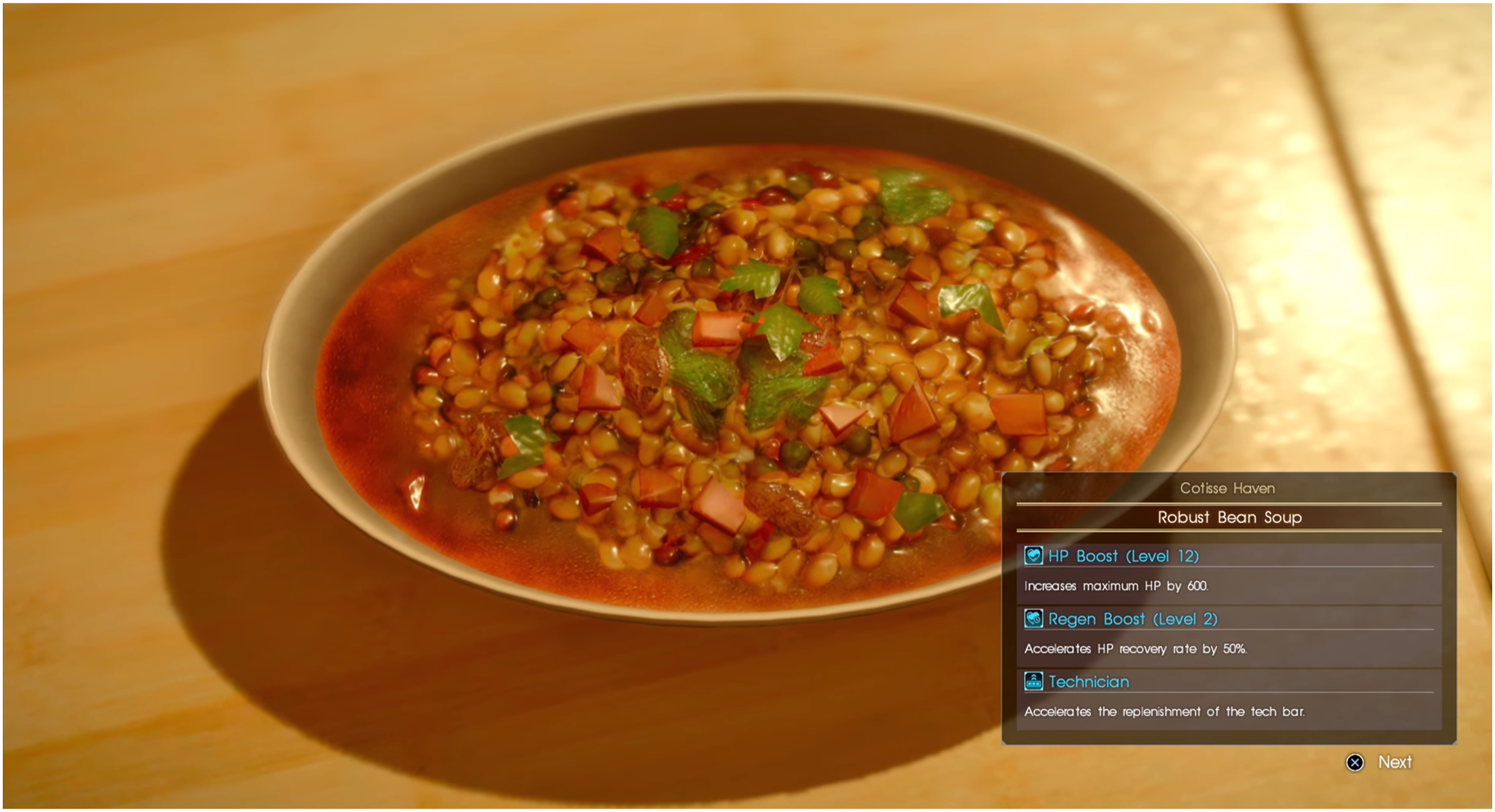
Additionally, beyond being a means to show off the developers’ attention to detail and 3D modeling skills, food in games usually serves a practical function by restoring health or boosting certain abilities. In this sense, the presentation of ludic food as an aesthetically pleasing and useful (though usually optional) in-game affordance sends the message that food is good for you. The Fallout series, on the other hand, approaches ludic food in a very different way. While food is still an important gameplay and narrative element, it is not necessarily aesthetically appealing and is even sometimes outright gruesome. In addition, rather than being a straightforward, useful affordance, the food in the Fallout series usually irradiates the PC, thereby poisoning them even as it offers health or ability boosts. Fallout’s food is inherently contradictory and humorously grotesque, encouraging an ambivalent rather than positive virtual gastronomical experience.
Food, Nostalgia, and Atomic Culture
The Fallout series presents an alternative historical timeline in which American post-war aesthetics lingered well into the 21st century, meaning that futuristic technologies such as advanced weapons, robots, and artificial intelligence proliferated alongside 1950s-era architecture, art, interior design, and music. In the year 2077, an apocalyptic nuclear war devastated the world and drove humanity into underground vaults. The player enacts the role of a vault dweller who emerges into a depopulated, devastated, and irradiated post-apocalyptic America. The series presents retro-futuristic technologies and aesthetics that parody and satirize post-war American culture by incorporating products, aesthetics, and advertising inspired by that time period but exaggerating them and presenting them as ridiculous. Anything that survived the nuclear devastation is considered a “pre-war” object in the series, with food and advertisements serving as particularly omnipresent reminder of the culture of this alternative, science fictional, pre-war America.
As Retzinger (2008) has noted in her work on food in post-apocalyptic science fiction films, “familiar foods serve as an anchor in an altered world (evoking both nostalgia and parody), whereas unfamiliar food may become one of the clearest measures of how far we have journeyed from the present” (p. 370). Although she is referring to film, this aptly describes food in the Fallout series as well. The role of nostalgia and parody is fulfilled by the pre-packaged pre-war food the player finds throughout the games in the series, especially cheekily named products like “Sugar Bombs,” “BlamCo Mac and Cheese,” and “Radioactive Gumdrops.” That the names of these products all reference bombs, explosions, and atomic power speaks to the pervasive influence of the pre-war era’s “atomic culture”—that is, a cultural obsession with atomic power which parodies that same obsession in real-world America during the atomic age (Zeman & Amundson, 2004)—and serves as an ironic reminder of humanity’s mistakes. Like most things in this post-nuclear apocalypse world, these pre-war products are all heavily irradiated (except the “Radioactive” Gumdrops which, humorously, have very low levels of radiation), thereby reinforcing the irony of their names. Sugar Bombs—a breakfast cereal shaped like mini nuclear warheads and containing 100% of the recommended daily amount of sugar—is a particularly omnipresent product throughout the series, with several promotional posters found scattered around the wasteland. These posters, advertising Sugar Bombs’ “Explosive Great Taste!” (Figure 2), mirror the style of the real product advertisements, movie posters, and propaganda that were popular in post-war America. A poster advertising Sugar Bombs in Fallout 3. Screenshot used for the purposes of critique.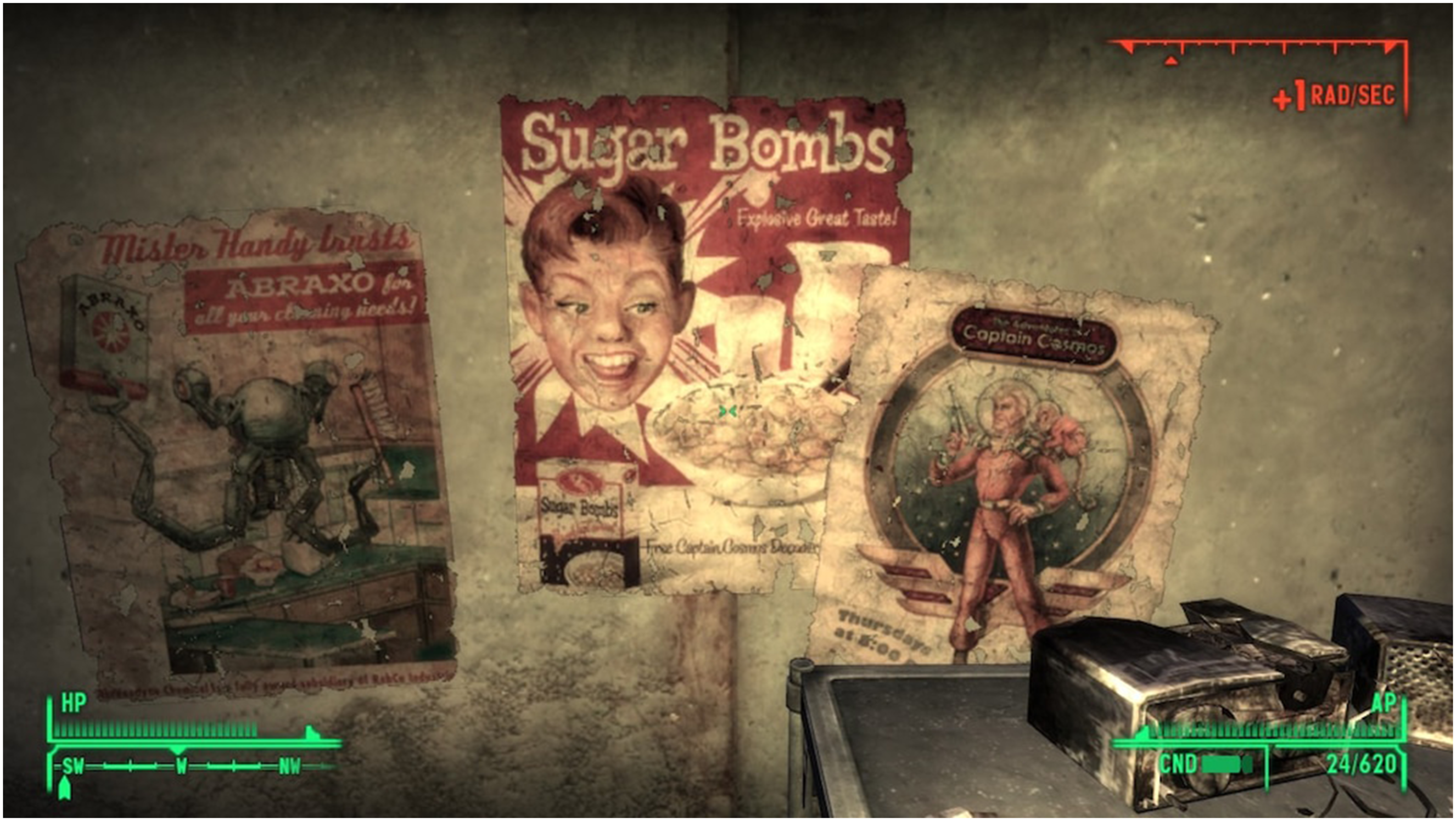
While Sugar Bombs are a well-known and widespread product, the most ubiquitous and centralized atomic culture consumable in the Fallout universe is Nuka-Cola (Figure 3). Besides being a clear parody of Coca-Cola in its name, logo design, and bottle shape, the name of the fictional creator of Nuka-Cola, Caleb Bradberton, is an amalgamation of the inventors of Coca-Cola (John Pemberton) and Pepsi-Cola (Caleb Bradham). In addition, a quest to get the formula for a new kind of Nuka-Cola in F3 is called “Just for the Taste of It” which was the slogan for Diet Coke when it was released in 1982. Nuka-Cola was the drink of choice for pre-war America and was so widely produced and consumed that countless unopened bottles remain centuries later in the post-war wasteland for the PC to find and drink.
1
Moreover, Nuka-Cola bottle caps have become the standard currency, highlighting the ways in which the series uses food products to subtly intertwine themes of toxic consumption (toxic in that it is both full of aspartame and highly irradiated), atomic culture, capitalism, and consumerism. In this sense, while the Fallout series is rife with symbolism and campy references to an idealized retro-futuristic alternative version of Cold War America, the series’ irradiated pre-war food functions as a particularly potent critical commentary. A Nuka-Cola enthusiast in Fallout 3. Note how the distinctive bottle shape and font for the logo is referencing Coca-Cola. Screenshot used for the purposes of critique.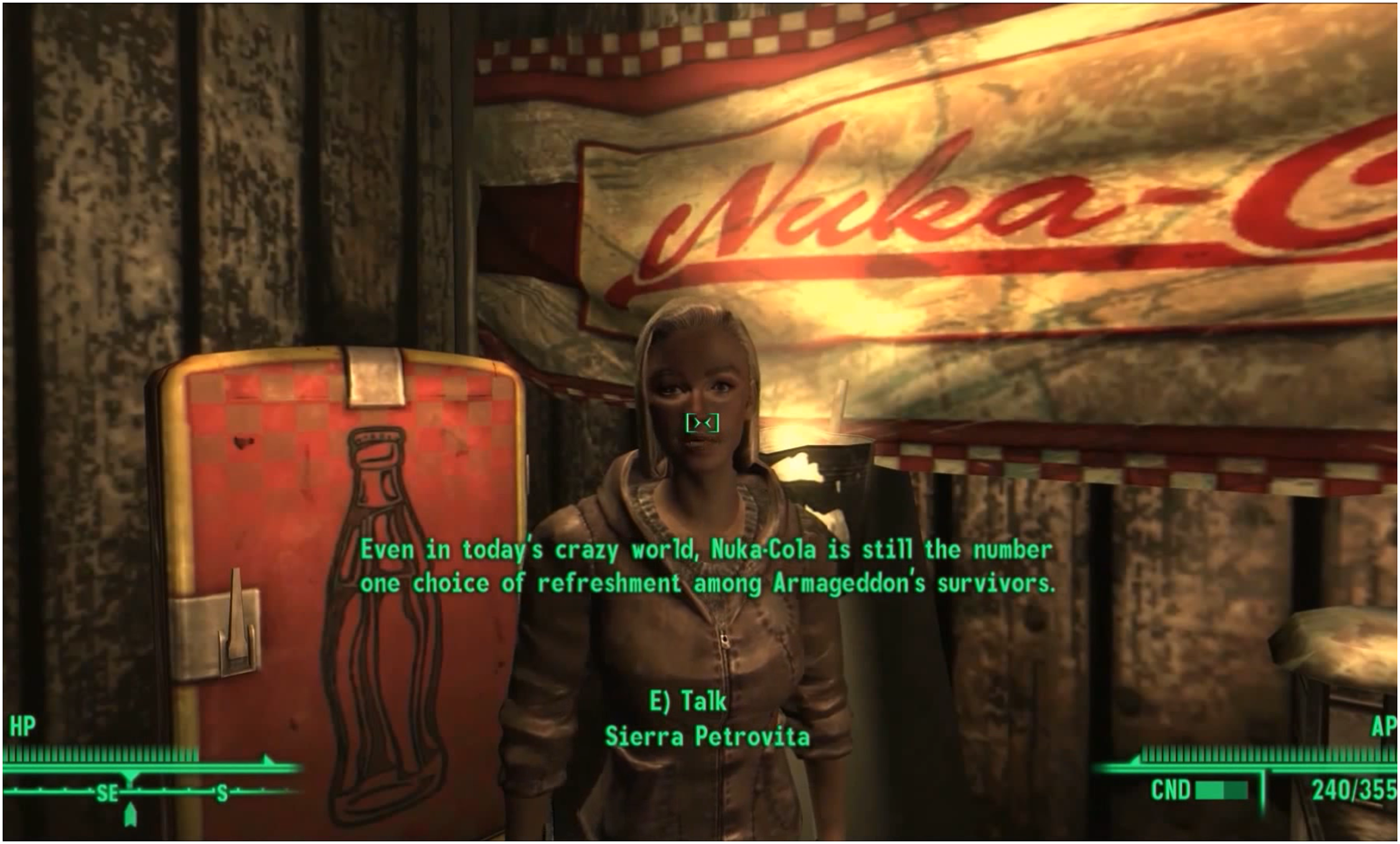
The series even features a Nuka-Cola Plant and a Nuka-Cola theme park, called Nuka-World, which are both overrun with mutated monsters and enemies for the player to fight. The Nuka-Cola Plant is occupied by an indigenous mutant variety of Mirelurk called “Nukalurk.” Nukalurks have unusual blue coloring and glowing skin due to their prolonged exposure to Nuka-Cola Quantum, an extra-irradiated version of Nuka-Cola that glows bright blue. Containing a mildly radioactive isotope, Quantum was originally designed as a pre-war secret weapon and developed with army sponsorship, though it was officially released for public sale on the same day the bombs dropped. Reports found in the Nuka-Cola Plant in F3 reveal that all the product testers of the first batch of Quantum died shortly after consumption. The company replaced the Strontium-85 isotope with Strontium-90 and it passed the Food and Drug Administration’s tests for safe public consumption, even though it made the drinker’s urine glow blue for a week. If mixed with Abraxo cleaner (a cleaning product found throughout the series) and turpentine, it makes a powerful “Nuka-grenade,” whereas mixing it with flour and vodka makes a delicious pastry called “Mississippi Quantum pie.” Like many things in the Fallout series, these food products are campy parodies, cautionary warnings, and critical satire.
Food Ambivalence and Adaptation
As previously discussed, food in the Fallout series is both useful and harmful: drinking Nuka-Cola, for example, will heal the PC for 10 hit points, which measure their health, and grant them one bottle cap, which they can add to their collection and use to purchase goods and services, but will also give them 3 rad. Quantum, unsurprisingly, gives 10 rad. A rad, which stands for “radiation absorbed dose,” is the unit of measurement for the PC’s level of irradiation. If that level gets too high in F3 and FNV, the PC’s abilities such as Endurance, Strength, and Agility start to decrease and at 1000 rad they die from “Fatal Radiation Poisoning.” In F4 and F76, radiation damage directly lowers the PC’s hit points at a rate of a 1% decrease for every 10 rad. In F76, the PC can even develop a mutation as a result of too much radiation exposure. In this sense, the positive healing benefits of the food and drinks consumed are balanced by the negative impact of radiation poisoning, fostering a necessarily ambivalent and cautious attitude toward consumption. This is important because, as Forster (2004) has noted, “the body in science fiction is a deliberately targeted zone, whether threatened from the interior or exterior. … What is visible regarding foodstuffs may conceal deliberate or unavoidable toxins and impurities hidden within” (p. 253). While this concern is common in science fiction, it is also highly realistic: from specific warnings about irradiated food after nuclear accidents like the 1986 Chernobyl disaster to generalized worries over pesticide levels in produce or steroid hormones in meat, the preoccupation with invisible and toxic contaminants in food is widespread.
This connection to real-world concerns is unsurprising since, as David Seed (1999) has argued, science fiction narratives of nuclear holocaust “perform a role of negative prophesy where dreaded outcomes are envisaged and therefore hopefully deferred, in such a way that the reader or viewer is induced to ponder on present signs of danger” (p. 9). Although Fallout is clearly incorporating these concerns in the same way much science fiction media do, a key difference is that Fallout tells players exactly how many hit points and how many rads they will receive from the food and beverages they consume, thereby removing the danger of the unknown and turning consumption from a risk into a calculable strategy. Making consumption into a gameplay strategy that involves adapting and augmenting the PC's body is perhaps unsurprising in a video game, a medium in which everything from ethical choices (Sicart, 2009) to romantic interactions (Enevold & MacCallum-Stewart, 2015) have been discussed in terms of “gamification” and optimization strategies. It also echoes real-world bodily optimization strategies, from strict fitness and diet regimes designed to increase muscular “gains” to supplements and chemical substances taken to promote weight loss. The numerical values assigned to food in the series—which indicate both their positive and negative impacts on the PC's body—similarly evoke the use of fitness tracking devices as well as calorie counting applications and programs all intended to collect biometric data, calculate and track food consumption, and generally monitor and manage the body. The player can also see statistical information for their character, such as their number of hit points, their level and number of experience points gained, how much damage and radiation resistance they have, and even the individual status of each of their main body parts. It can therefore be argued that video games like the Fallout series allow players to embody a fully quantified self, offering the experience of managing their character’s body to an extent not possible with their real-world human body (for more on this, see Lupton, 2016).
As part of this quantified optimization gameplay strategy, players can use a “food sanitizer” item to increase the amount of hit points restored by most consumables by 20%. However, the only way to resist radiation damage from consumables is to take a drug called “Rad-X” before eating or drinking. There is also an optional perk that players can acquire called “Lead Belly,” which halves the amount of rads received from eating and drinking in F3 and FNV, and can be upgraded to completely negate radiation from consumables in F4 and F76. The description for the Lead Belly perk in F4 and F76 reads: “Your digestive tract has adjusted to the weirdness of the Wasteland!” (Figure 4), thereby suggesting that the PC’s body has itself adapted, or mutated, in response to the dangerous food it consumes. This emphasis on bodily adaption in the face of the wasteland’s “weirdness” is important because, as Retzinger (2008) has observed: While the sheer physicality of the human (animal) body and what we already are provokes fear in horror films, science fiction explores fears about what we may become … Fear in science fiction, then, is often a fear that … we will become dehumanized not by becoming more animalistic, but by becoming more machine-like. (p. 379) The Lead Belly Perk from Fallout 4. Screenshot used for the purposes of critique.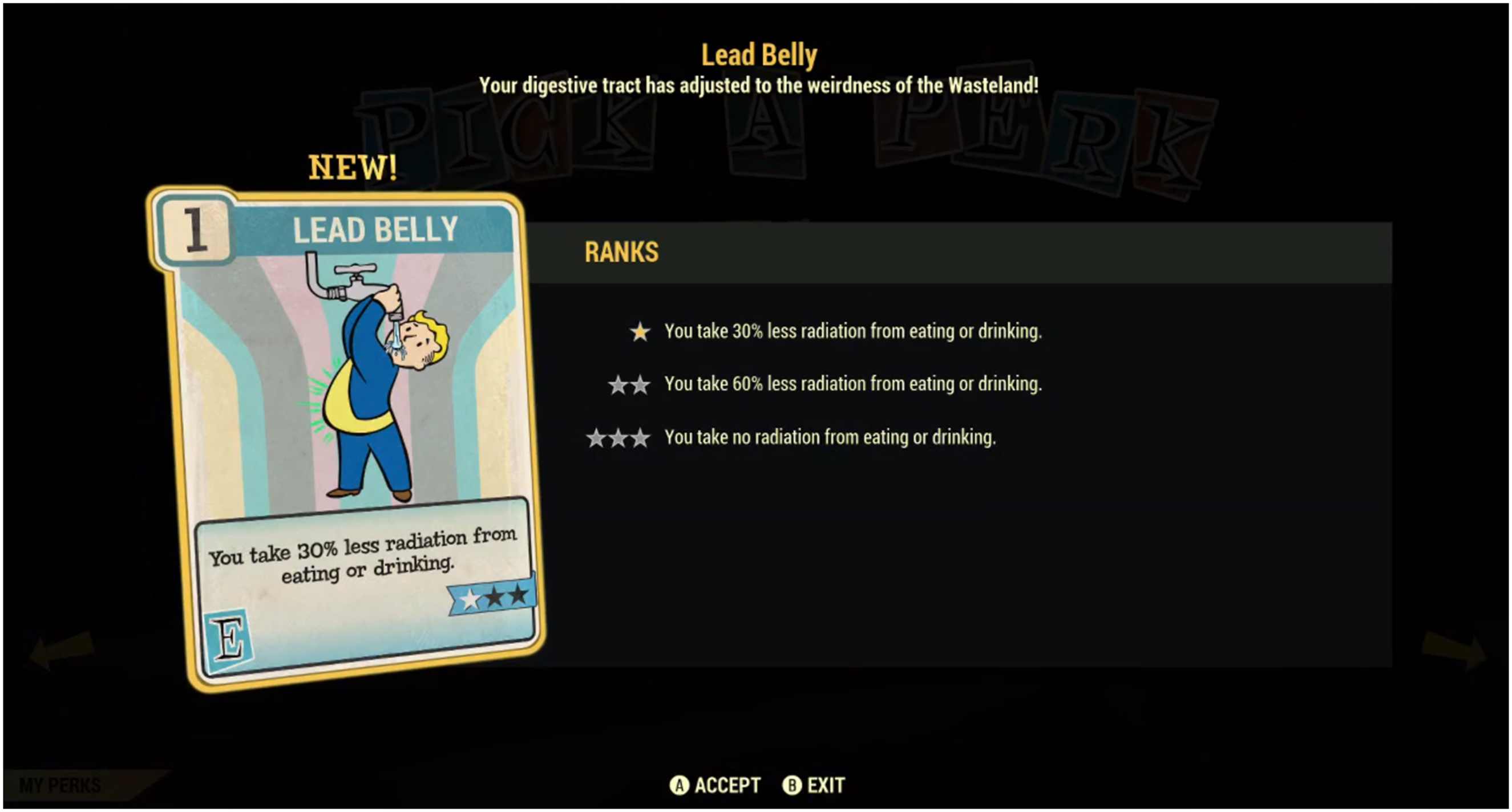
In this sense, even though it is an idiomatic expression, acquiring a Lead Belly in Fallout not only reveals how the human body will need to change in order to survive in an irradiated world but also suggests that this process of adaptation will render the human body more machine-like in that part of it will be made of metal.
The use of a food sanitizer device to increase health points gained and Rad-X to prevent radiation poisoning (as well as a drug called “RadAway” to remove radiation damage once it has been acquired) also points to the series’ incorporation of transhumanism, specifically in the ways that technology, in the form of gadgets and synthetic drugs, must be intertwined with nature, in the form of the human body and the food it consumes. While not the focus of my discussion here, it is important to note that these synthetic drugs (as well as the several kinds of alcoholic beverages available in the series) are also a form of consumable and so are another way in which the game allows players to navigate consumption and survival. As Wallin (2019) has noted, “Fallout’s consideration of post-apocalyptic drug-use constitutes a unique speculation on the idea of human survival through affective modification and biochemical manipulation” (p. 18). In other words, “the brutal world of Fallout posits human survival via becoming inhuman” (Wallin, 2019, p. 18–19). While Wallin focuses on biochemical modifiers such as the health-boosting “Stimpak” injections or the strength-boosting “Buffout” steroid pills, perks like Lead Belly, which permanently modify or enhance the PC’s physical capabilities, can also be considered as ways in which the series encourages bodily enhancement or augmentation. In any case, this perk coincides with Wallin’s (2019) argument that Fallout presents a “speculative idea that survival might require a radical rethinking of the body’s capacities for transformation against its radically changed ecological background” (p. 25). Survival in Fallout’s devastated wasteland requires a body that can adapt—“naturally,” as with the Lead Belly perk, or chemically, through the use of Rad-X and RadAway—in order to deal with nearly constant threats (in the form of monsters, enemies, and radiation) and safely or strategically consume what is effectively poisonous food.
This transhumanist intertwining of nature and technology/synthetics/biochemicals is unsurprising in a science fiction narrative. As Retzinger (2008) has argued, “food not only signifies the needs of the individual, biological body, and the grammar of a particular society and culture, but it also represents the interplay of nature and technology” (p. 371). This is also evidenced in the Fallout series since technological development—the atom bomb—has warped and contaminated nature so much that nearly everything is irradiated and many things are mutated as a result of the nuclear apocalypse and subsequent fallout. The mass-produced, processed, and pre-packaged foods from the pre-war era, such as Sugar Bombs and Nuka-Cola, harken back to a past culture that both worshiped and abused atomic power and cared more about profit than safety or quality control. Given the previously discussed ways in which these products were particularly toxic—Sugar Bombs’ high sugar content and Nuka-Cola Quantum’s dangerous radioactive ingredient—they function as critical commentary on the fictional (or alternative history) American culture that produced them but also on the real-world post-war American culture the games are parodying (for example, instead of a radioactive isotope in the soft drink, it was cocaine).
Retzinger (2008) has observed that “when characters eat familiar, contemporary foods in futuristic settings, food typically represents the world that has been lost” (p. 372). This is certainly the case when PCs consume Sugar Bombs and Nuka-Cola, see their advertisements around the wasteland, and listen to Galaxy News Radio in F3—which plays a selection of 1940s/1950s American pop music by artists such as Cole Porter, Billie Holiday, Bob Crosby, and The Ink Spots. Indeed, Retzinger (2008) has noted that “the chief mode of science fiction is not prophesy but nostalgia” (p. 372).
2
The nostalgia presented in the Fallout series does not necessarily evoke a longing for a real or imagined past, however. Rather, it functions as parody, satire, and critical commentary. This is a common way food is utilized in science fiction: While present-day, familiar food served up in an imaginary future can provide material expression for nostalgic longings for the past, it can also provide fodder for parody. Humor serves as one means of disrupting nostalgia for the past/present and the foods that signify them. (Retzinger, 2008, p. 374–5)
The pre-war food in the Fallout series serves this function through humor—especially with its obvious Coca-Cola parody—though it often pushes beyond the humorous into the horrific. With a pre-war culture so obsessed with atomic power that they would put a radioactive isotope in their soft drinks, it is perhaps no wonder that the future America that Fallout envisions is one of irradiated wastelands, warring factions, and mutated monsters.
Mutated and Abject Meat
As Wallin (2019) has argued, “the growing realization of our material imbrication with the environment is dramatized throughout Fallout’s registration of environmental radioactivity and post-nuclear radioactive weather patterns” (p. 24). While the environmental radioactivity certainly sends a clear message that the world has changed—and not for the better—I would argue that the most striking way in which the Fallout series communicates the true cost of humanity’s hubris and aggression is through its mutated beings. From two-headed cows called “Brahmin” 3 and giant “Radroaches” to hulking “Super Mutants” and withered “Ghouls,” the series is full of creatures and people who have undergone extreme physical transformations due to their prolonged exposure to radioactive fallout. While the crumbling cities, rusted vehicles, marauding clans of violent Raiders, and communities of survivors living in underground vaults all communicate the disturbing changes to human civilization, it is the environmental devastation—signaled through radioactive wastelands and physically mutated plants, animals, and people—that really demonstrates how deeply harmed the natural world has been.
While some mutated creatures and people are neutral or friendly, most of them are hostile and attack the PC on sight. When an animal is killed, the PC can often harvest its meat for consumption. Like the mutated animal it came from, this meat is generally presented as revolting and abject in its visual depiction and name. Although eating insect meat is only considered unusual or unpleasant in some cultures, the insects in Fallout are massive, mutated, and irradiated and have particularly unpleasant names. These include Bloatflies, giant mutant blowflies; Bloodbugs, giant mutant mosquitos; Stingwings, giant mutant Mecoptera; and Radroaches, giant mutant cockroaches (also humorously called “Great American Cockroaches”). The way these giant insects attack the player adds to their disturbing design: Bloatflies launch disease-carrying, pointed larvae from their abdomens as deadly projectiles and often explode when killed; Bloodbugs stab and drink their victims’ blood with their sharp proboscises and can spit the irradiated blood back at the target; Stingwings have venomous scorpion-like stings; and Radroaches have toxic saliva. Regardless of how mutated, irradiated, and poisonous these insect are, the PC can harvest and eat their meat (raw or cooked, depending on the game), along with other kinds of meat and eggs taken from giant rats, giant ants, huge “Radscorpions” with poisonous stings, Mirelurks (large mutated sea creatures like crabs, turtles, and lobsters), Yao Guai (giant, zombie-like, mutated black bears), and Deathclaws (massive, vicious, genetically engineered mutants created from chameleon DNA). In addition to this mutated meat, the PC can find and consume grotesque vegetation such as “brain fungus” and “mutfruit” (pronounced “mute-fruit,” short for “mutated fruit”).
As Kristeva (1982) has posited, food consumption (like all oral activity) destabilizes corporeal boundaries. In this sense, bringing an external object into one’s body is a reminder of its porousness and since “all food is liable to defile,” eating can disrupt the perceived wholeness and purity of the body (Kristeva, 1982, p. 6). As a substance that disrupts boundaries and potentially disturbs bodily autonomy and health, food can be considered abject. As Kristeva (1982) stated, “food loathing is perhaps the most elementary and most archaic form of abjection” (p. 2). However, because it is abject it is also ambiguous—inspiring horror and desire, repulsion and attraction, and fear and jouissance. Although it takes some theoretical and philosophical work to read all food as abject, the monstrous, mutated, irradiated meat in the Fallout series practically screams its own abjection. For example, “Bloatfly meat” is textually repulsive because the word “bloat” is associated with the unpleasant bodily after effects of eating troublesome food and because of the description of the creature itself: “One of the Wasteland’s most disgusting creatures, the Bloatfly shoots its maggots as projectiles, and often explodes upon death” (Bethesda Game Studios, 2008). Bloatfly meat is visually repulsive in that it is depicted as a raw, bloody, partial insect abdomen with spikes (Figure 5). Finally, it is also functionally abject in that it irradiates (i.e., poisons) the player even as it heals them, thereby exemplifying Kristeva’s (1982) discussion of food being abject when it “appears as a polluting object” (p. 76). This is just one example among many in the series, but it demonstrates that Fallout’s repulsive food is unlikely to be featured in video game-inspired cookbooks or YouTube cooking tutorials. Rather, it is aesthetically closer to PETA’s Cooking Mama parody, with its violent, bloody, and more visceral approach to “cooking.” Rather than portraying meat as a delicious substance to consume, Fallout presents it as grotesque, therefore suggesting a potential pro-vegetarian reading of the game’s food—a theme I will return to later. The in-game rendering of Bloatfly meat. Image taken from the Fallout wiki at https://fallout.fandom.com/wiki/Bloatfly_meat_(Fallout_4) and used for the purposes of critique.
Strange Meat, Karma, and Cannibalism
Although players know that mutated and irradiated food is poisonous, and they might perceive it as revolting, eating it strategically can help to ensure their PC’s survival. Players also have the option of delving even further into the abject by having their characters consume human flesh. This process may begin when the PC consumes “strange meat” in F3, which is found in various refrigerators throughout the game and has a similar design to the squirrel or iguana on a stick, but “looks and tastes strange” (Bethesda Game Studios, 2008). This meat is “widely suspected to be human flesh” (Bethesda Game Studios, 2008) and in FNV it causes a −1 penalty to the PC’s strength because, within the lore of that game, consuming human flesh without being a full cannibal causes debilitating “shakes” and can eventually lead to death. There is even a strange meat pie—a clear reference to Mrs. Lovett’s meat pies from the musical Sweeney Todd (1979). In F3 the player can also find a consumable that is unambiguously labeled as “human flesh,” though it is usually only harvested from the bodies of dead feral ghouls and unlike the strange meat, it cannot be bought or sold.
With the strange meat and human flesh consumable items, the series makes it clear that cannibalism is one way in which players can heal their characters. In fact, the games offer a perk that makes this process easier: the aptly named “Cannibal” perk, found in F3, FNV, F4, and F76, allows the PC to eat a corpse to regain health. However, they can only do so while in “sneak” mode, they lose “Karma” for the action, and if the act is witnessed, “it is considered a crime against nature” (Bethesda Game Studios, 2008) and spurs most onlookers to become hostile and attack the player. 4 Karma is the series’ morality system, awarding points for kind acts and removing points for acts that are considered evil. Losing Karma is not necessarily a bad thing, as players can gain certain perks when they become more evil. However, the fact that players do lose Karma for every corpse they consume reveals that cannibalism is considered a bad thing—even in this post-apocalyptic wasteland, there are standards. And yet, eating the strange meat or human flesh as a consumable item—rather than consuming it directly from a corpse—does not affect Karma at all. In this sense, the game separates substances that are considered “food” (including raw human flesh) from “not food” (raw human flesh eaten directly from a corpse). This arbitrary divide speaks to the arbitrary nature of our own culture’s food norms: why, for example, are some animals considered acceptable food and others are not?
Interestingly, this slippage is centralized in one of the perks available to Cannibal players in FNV: if they consume 25 corpses, they receive the Dine and Dash perk, 5 allowing them to harvest “human remains” from the corpses, rather than having to eat them directly. Eating human remains—a consumable with the same appearance as the human flesh consumable—does decrease Karma but does not anger onlookers and does not cause any irradiation, although the reason for this is left unexplained. Although the human remains consumable item is one of the few non-irradiated meats available in the game—and could therefore be understood as “clean” food—and is not considered a “crime against nature,” eating it is still an “evil” act. Oddly, human remains gathered from ghouls are also radiation-free with this perk, even though ghouls are supposedly highly irradiated mutant beings. Once again, the game is suggesting that harvesting remains from humans (and ghouls) directly cleanses it and makes it perfectly safe for consumption. The fact that harvesting meat from any other species of animal provides only irradiated meat means that cannibalism (with this perk) is one of the only ways to consume radiation-free meat. Given my point that it is the radiation that makes the food poisonous, and therefore polluting and abject, it is interesting to note that eating human flesh—one of the strongest taboos in most cultures since “the corpse represents fundamental pollution” (Kristeva, 1982, p. 109) and is therefore “the utmost of abjection” (p. 4)—provides uniquely non-polluting food.
Given the ubiquity of mutated humanoids in the Fallout universe, the question of which kinds of corpses count towards “cannibalism” is an interesting one and again reveals the arbitrary rules that surround food consumption in the game. In F3 and FNV, Cannibal players can only eat the corpses of humans and non-feral ghouls—that is, ghouls that have retained their sapience and not become vicious zombie-like beings—and when the ghoul is harvested with the Dine and Dash perk, players still receive the same kind of human remains as they would from a regular human corpse. In FNV the “Ghastly Scavenger” perk allows the player to eat super mutant or feral ghoul corpses as well. In F4, the Cannibal perk is expanded to allow feeding on human, super mutant, and ghoul corpses. This extends the category of what is considered “human” to a wide range of mutated humanoids, though the description of the perk in F4 refers to this as “mortal flesh” rather than human flesh. The PC can optionally gather non-playable companions in the series, and in F4 those companions nearly all react to the consumption of corpses—mostly very negatively, with comments like “ugh. I think I’m going to be sick”; “I’ve seen some nasty things in me [sic] day, but I think you just topped them all”; and “I’ve heard of coming up with improvised field rations, but that’s just disgusting” (Bethesda Game Studios, 2015). Some companions do not care if the PC eats corpses, and instead respond with amusing commentary like “well, that’s Commonwealth steak tartare for you” and “at least you had the politeness to wait till they’re dead” (Bethesda Game Studios, 2015). The most observant meta-commentary comes from the android companion X6-88 when he says, “I still can’t understand how doing that heals your wounds” (Bethesda Game Studios, 2015).
A lengthy animation occurs every time the PC cannibalizes a corpse, and it is particularly graphic in F4 and F76, with blood spurting out of the corpse as it is devoured. Although this is likely just a gratuitously grotesque aesthetic, the question of blood consumption is important for the consideration of abject food in Fallout. Throughout the series, players frequently find “blood pack” consumable items, and rather than having to give themselves a complicated blood transfusion in order to restore health, the PC simply seems to ingest the blood pack. In F4 and F76 players also occasionally come across “glowing blood packs” containing green fluid that offers radiation resistance instead of a health boost. These blood packs, unlike the regular red ones, are labeled “NOT FOOD” (Figure 6). Again, these blood packs are simply “consumed” by the PC, suggesting that they are, in fact, a kind of food. Consumption of these blood packs is not considered cannibalism; however, if the player chooses to help a clan of cannibals-turned-vampires in F3,
6
they receive the “Hematophage” perk, which allows them to regain 20 hit points by consuming blood packs, far more than they would normally receive. Given the name of this perk (the suffix “-phage” refers to something that eats or consumes), it is clear that the blood pack is considered food in the Fallout series, although why its consumption is not also considered cannibalism is left unexplained. The glowing blood pack from Fallout 4 and Fallout 76. Image taken from the Fallout wiki at https://fallout.fandom.com/wiki/Blood_pack and used for the purposes of critique.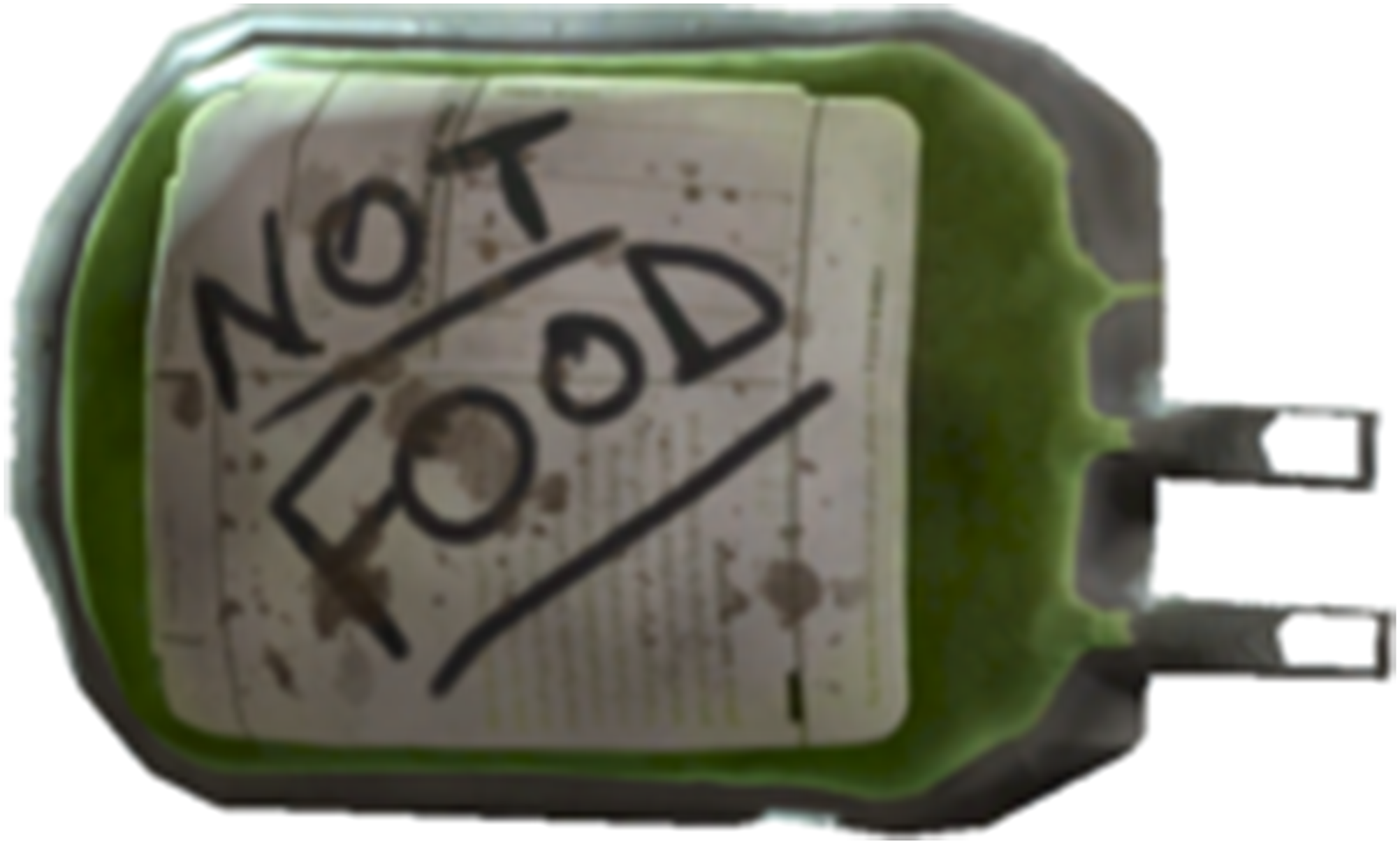
Conclusion
Whereas familiar foods like Nuka-Cola might evoke nostalgic longings or, conversely, function as critical commentary, as Retzinger (2008) has noted, “unfamiliar foods signal a world radically changed, with both nature and culture in jeopardy” (p. 378). Fighting and killing hostile humans, ghouls, super mutants, deadly giant insects, and other monstrous creatures then harvesting and eating their flesh while surrounded by familiar American landmarks from Washington D.C., Las Vegas, and Boston certainly signals to players that they are virtually occupying a world which has radically changed. Perhaps the most “normal” kinds of meat available in the Fallout universe are squirrel (which is consumed either as “squirrel-on-a-stick” or “crispy squirrel bits”), iguana (similarly consumed as “iguana bits” or “iguana-on-a-stick”), dog meat, and Brahmin steak (though it comes from two-headed cows). There is little animal husbandry in most of the Fallout series, meaning that meat is mostly scavenged, often after a life-or-death struggle. While eating food is optional in Fallout—except in “survival mode,” an optional difficulty mode in which PCs must regularly eat, drink, and sleep—players must heal their PCs in some way. If they do not use health-boosting chemical injections like Stimpaks, they must eat, drink, or sleep to recover lost hit points. Each time they consume unfamiliar, disturbing, and irradiated food, the player is reminded of the environmental devastation that surrounds them—both nature and culture in jeopardy.
Interestingly, relatively “normal” (though still irradiated) crops can be grown in F4 and F76, suggesting that perhaps post-apocalyptic human society is, or should be, vegetarian. Although it is unlikely this was the developers’ intention, it fits in nicely with the series’ overall critical commentary on human greed and the resulting environmental devastation. This is a common cautionary aspect to science fiction narratives, as “strange foods help emphasize the strangeness of the future and serve as a warning of what may be in store for us,” especially if we do not change our destructive behaviors (Retzinger, 2008, p. 377). While the series is more directly critiquing atomic culture, humanity’s greed and aggression, and our often warped relationship to technology, its presentation of food as irradiated, mutated, abject, and either obtained through bloody violence or produced in a controversial corporate setting can easily be read as a critique of contemporary food production, distribution, and consumption.
Overall, the Fallout series, like much science fiction media, incorporates its main themes in the consumable food items players encounter. This includes anxieties around human greed, unchecked technological development and consumerism, food as a polluting substance, and how the food we consume might change—contaminate and/or mutate—our bodies. Although the harvesting and consumption of food is not mandatory in the games, players cannot avoid exposure to food-related elements, such as the use of Nuka-Cola bottle caps as currency and the ubiquity of pre-war food products and advertising. While all consumers of science fiction media might experience visceral reactions to the food characters eat on-screen or on the page, video game players are presented with the opportunity to virtually enact that eating and define their character’s relationship to food. Will they choose to have their character murder monstrous creatures and eat their flesh, risking radiation poisoning? Or will they become cannibals and consume the flesh of corpses they find, risking becoming social pariahs? Will they mutate their bodies through perks like Lead Belly or choose to only heal themselves through Stimpak injections? Players must make a choice, since, as video game-inspired chef Holly Green has observed of the Fallout series, “a Vault Dweller cannot survive on Mirelurk Cakes alone” (qtd. In Wilbur, 2016). 7 In this sense, the Fallout series challenges players to define the nature of their survival in the hostile irradiated wasteland of post-apocalyptic America. Food in the series may therefore encourage critical reflection on contemporary American society and its relationship to food production and consumption.
Footnotes
Declaration of Conflicting Interests
The author(s) declared no potential conflicts of interest with respect to the research, authorship, and/or publication of this article.
Funding
The author(s) received no financial support for the research, authorship, and/or publication of this article.
