




Abstract
This article reports on a study with 11 bit studios and their game, This War of Mine. Rather than a formal analysis of the game, our objective was to situate the research in game production studies by documenting the design context (gamework) and designer perceptions about the game that inform morally complex gameplay. The research was conducted with four team members of 11 bit studios: a senior game designer, a writer, a senior writer (with stakes in marketing), and a quality assurance lead. We employed reflective interviewing techniques and visual methods to better understand how moral gameplay was designed. Our analysis illustrates the roles underlying narratives in the design process and balancing everyday work negotiations play in the design of moral gameplay, how a designer’s research informs the vision to create emotional realism in the game, and the importance of a player-centered iterative design process to produce morally engaging gameplay.
It is my second night out scavenging; I approach a deserted residence. I am short in resources. The people that I care for are hungry and we need food to get through the next day. As I enter, I notice an older couple sitting in the living room. I sneak inside quickly to scavenge whatever I can find. The couple hears me in their basement. The older guy asks what I am doing. His wife is sick, and they both look scared. As I continue to rummage, I think that he might become violent but he just stands there. He begs me to leave. I feel uncomfortable with my actions, but I need food for my people to survive. I stop searching through all the rooms and run toward the entrance. As I run past the elderly couple, I drop part of my loot. I feel ashamed by my actions. I wanted to play as a moral person, but the situation is harsh, am I bad? Days later I still wonder, do they feel safe in their home, are they still scared, and most importantly, are they still alive?
The above vignette demonstrates the moral nuances present within This War of Mine (TWoM), a single-player war survival game released in 2014 by Polish game company 11 bit studios. Unlike games which are played from a military perspective, such as Call of Duty (Infinity Ward, 2003) or America’s Army (U.S. Army, 2002), TWoM is played from the civilian perspective of war. The game takes place in a civil war setting where a player must keep a mixed group of playable characters called survivors alive by scavenging for resources to ensure their safety, as well as maintaining their physical and mental health. As the game progresses, resources become scarce. During scavenging sessions, the player encounters conflicting choices as illustrated in the vignette above. Ambiguous choices in the game creates a moral gameplay experience that reflects the disorientation and difficulties of being a civilian in wartime.
To achieve a realistic moral experience of war, the designers of TWoM incorporated certain game mechanics not often found together in conventional military war games. 1 First, the gameplay provides ambiguous moral choices. Altruism costs the player time and resources, but returning without resources can mean death to nonplayer characters and the loss of the game. Second, the game does not have an onboarding process. To parallel a civilian’s experience of war, the player must learn to survive without instructions. There are no guides coaching the player to learn as she plays. Third, there is no respawning. Once a playable character is dead, she cannot be brought back to life. By incorporating permanent death, the game simulates the precariousness of life in war and the psychological trauma that occurs to survivors of war. Finally, the gameplay includes nonplayable children and infants. 2 In most war games, children are absent in the design, while in war, children do exist and must be cared for. Omitting these aspects of war is one way in which conventional military war games selectively filter the reality of conflict (Pötzsch, 2015). The inclusion of these elements of innocent civilians, suffering, trauma, and children incorporates elements normally filtered out of military war games. The successful integration of these elements, as well as the critical acclaim 11 bit studios received, supports a deeper exploration of the moral gameplay in TWoM. 3 To better understand TWoM’s moral gameplay, the conditions under which the game was designed must be explored. We analyzed how designers at 11 bit studio reflected on the design process and on the many factors that informed their design choices. Our claim is that designing better moral gameplay goes beyond a consideration for ethical play (Zagal, 2009), or the actions defined by the game for the player (Fullerton, 2008; Sicart, 2009). We build on game ethics scholarship by asserting that designing better moral gameplay includes an exploration of the conditions under which games are produced (Bourdieu & Johnson, 1993; Julier, 2006), including business ethics (Zagal, 2009), the context of design (Sandovar, Braad, Streicher, & Söbke, 2016), the designer’s responsibility (Julier, 2006; Lawson, 2006; Sicart, 2009), and gamework culture (O’Donnell, 2014). A closer exploration of the social and technical context within which morally complex games are created can illustrate the dilemmas faced by designers (O’Donnell, 2014). Our aim is to highlight the importance of the designer context (gamework) and designers’ perspectives as a dimension not included in existing research on morally complex gameplay. Literature on ethics focuses on the artifact and business models not on the production of the game. In TWoM, this could include an understanding of the impact that traumatic events, such as war, have on a design team.
In this article, we set out to explore the design process and designer perceptions of morally complex gameplay in TWoM. To showcase the importance of such a production studies context, the structure of this article is divided into several sections. First, we present current discourses in games ethics and war game literatures, and position how this research is a step toward filling an empirical gap. Then, we define important considerations in the production studies field relevant to the study of moral game design by building on reflective design literatures (Julier, 2006), production literatures (Bourdieu & Johnson, 1993; Nieborg, 2011; O’Donnell, 2014), and ethical design practices (Sandovar et al., 2016; Sicart, 2009; Zagal, 2009). Lastly, after a short consideration of the methodological challenges and limitations of a focus group interview, we focus on the main results of our analysis.
Games Ethics and Morality
In this section, we signal the need to position a production studies perspective in the study of war games and ethical gameplay. Current research on morality and games is focused on the game’s content, the player as moral being, or organizational ethics. Sicart (2009) and Zagal (2009) provided the initial foundation for the consideration of ethics in games. Sandovar, Braad, Streicher, and Söbke (2016) built on Sicart and Zagal’s definitions to include the design context and designer’s perceptions. While Sicart and Zagal did advocate for designers’ responsibility and acknowledge networks of agents outside of game design play roles in game development, these were not explicitly stated in their variables.
For Sicart (2009), game ethics includes three variables: (a) ethical game design—the object and its components, (b) the ethical experience—ethical values projected into an experience from which agents can make a choice; and (c) the ethical player—the capacity of the player to play with moral reason. Similarly, Zagal (2009) included aspects of the cultural artifact and the frameworks that define the ethical experience. He did not define the ethical player per se but rather referred to the experience of ethical play: what it means to play fairly. Zagal (2009) also included one variable not discussed by Sicart, that of business ethics (what it means to develop a game ethically). These components are critical, as they highlight the multiplicity of factors that inform game ethics. In particular, Zagal’s (2009) business ethics aspect reflects on the importance of the organizational entity in the design of games.
Sandovar et al. (2016) reflected an information ethics perspective when they claimed that technologies carry the values and beliefs of those who design them (Flanagan & Nissenbaum, 2014). For this reason, they advocated that designers’ perspectives be included as variables in game ethics. Also proposed was the inclusion of the designer context—the context within which games are built. Although not explicitly outlined in their paper, their inclusion of contexts advocates for an integration of production culture—the culture of work in which games are produced (O’Donnell, 2014)—as part of the design process. In this article, we wish to include all the differing aspects of game ethics as part of the design of moral gameplay. To understand moral gameplay, all aspects of a game, including ethical game design, ethical experience, ethical gameplay, business ethics, designer context (gamework), and designer perceptions, must be understood. We focus specifically on the designer context and designers’ reflections in the design of war games that deal with morally complex gameplay.
Morality in War Games
Including the designers’ context and their lived experience could augment existing war game research. These discourses describe the relationship between war and the military. Most war games, for example, America’s Army (U.S. Army, 2002), Call of Duty (Infinity Ward, 2003), and so on, are played from the military perspective. As such, these texts critique the ideological and technical structures that exist between the U.S. military and the game industry. War games that diverge from using dominant representational strategies known in the war game discourse, such as Spec Ops: The Line (Yager Development, 2012) and TWoM, are positioned as critical alternatives to the military war game genre (Pötzsch, 2015). Currently, there are three prominent perspectives from which to examine the relationship between war and games.
The first set of literatures addresses meaningful play within a conflict simulation and wargames as a sociotechnical system of warfare (e.g., Crogan, 2011). This material perspective, which can be traced back to the Toronto School of Communication, studies the physical aspects of war games, such as computer simulation technology, and examines how the technology has developed historically in relation to the military industry. The second set of texts focuses on the economic and political relationships that exist between the game industry and the military industry (e.g., Dyer-Witheford & De Peuter, 2009). For example, Dyer-Witheford and De Peuter (2009) examined the imperial tendencies of the U.S. war game industry, including the role war games play in the global economy. The third set of literatures addresses the relationship between in-game representations and ideological warfare. These portray the main characters, their enemies, and the conflict within the game (e.g., Schulzke, 2013). From this semiotic perspective, moral games are analyzed through a textual reading. Although these war game literatures are theoretically sound cultural critiques, these texts do little to highlight the designer intention for these strategies. Thus, war game literatures do not include production aspects that could inform the final design. Finally, war games literature does not offer critical examinations of the moral and ethical components of war games. In the section that follows, we explore three main aspects of production: (a) production contexts, or the contexts under which texts are produced; (b) industry contexts, the various actors, networks, and relationships that inform game production; and (c) gamework context, which is game development work culture and respective practices. 4
Production Contexts
To understand how images and media texts inform society, the contexts in which these texts are made must be understood (Bourdieu & Johnson, 1993; Thompson, 1995). Moral games are produced by a diverse team that includes writers, designers, programmers, play testers, and external stakeholders. Both sociologists John Thompson and Pierre Bourdieu argued that focusing solely on the internal analysis of a text without consideration for the larger forces that created the text leads to inaccurate interpretations. For Thompson (1995), such an interpretation required an understanding of (a) the social and historical conditions in which texts are produced, (b) the way they are received by real people, and (c) and how people perceive what is familiar to them. This study addresses the specific social and historical conditions under which TWoM was produced.
For Bourdieu, the production of texts required two aspects, habitus and field. By habitus, he meant the attitudes that individuals absorb over time through their social world. Bourdieu argued that these attitudes are often aggregated and used unconsciously. As the habitus can reflect unconscious attitudes, and unconscious attitudes have been argued to be imbedded in design (Flanagan & Nissenbaum, 2014), design therefore suggests reflexivity by the designer (Sicart, 2009). Social working conditions and designers’ individual attitudes play a role in decisions about the kind of moral dilemmas that are included in gameplay (discussed later in this article). Not only is the designer a member of society, but she possesses knowledge which through her designs informs aesthetic and political aspects of our world (Julier, 2006). As cultural opinion makers, designers have a large role in shaping culture (Sicart, 2009).
Bourdieu’s reference to field, by which he meant the conditions under which an individual produces a text, is particularly important to digital games. These conditions inform and influence how attitudes are incorporated in texts. Solely studying the moral gameplay without including the social and historical forces that inform the design (context of design) and the perceptions of those who create the texts (designers’ perceptions) misses the cruciality of why moral gameplay contains those choices.
Industry context
To address moral gameplay, it is necessary to explore the complexity of the industry. The design of games is informed not only by the designer and the technology but also by the culture’s studio, and the variety of relationships the studio may have with the publisher, the marketers, and the platform. These three aspects in the industry are relevant to the study of game design in the following ways.
First, tension between creativity and profit often drives aspects of design and development in games (Nieborg, 2011). Like any product-based industry, having a skillset and an idea is not sufficient to be successful; capital is critical for production. Decisions about the design of a game may be driven by profit rather than by the game mechanics that best fit the vision of the game.
Second, as many in the industry know, game development is precarious in the sense that software development is more of a nonlinear process than a straightforward method. Even before the code is handed to the publisher, setbacks can occur in programming, or when integrating art and sound during play testing, or even during distribution (Dyer-Witheford & De Peuter, 2009). For example, a developer from Half-Life described the many difficulties they encountered while implementing specific events into the game that were designed to be fun until they adopted a more iterative design process (Birdwell, 1999). The lack of management structures and varied-sized teams across the different studios can affect deadlines and the design of the game (Dyer-Witheford & De Peuter, 2009).
Third, dependencies in the industry inform design indirectly through gamework organizational structures. Hierarchical structures based in networks of secrecy and professional recognition become barriers to entry and remaining in the industry. This dependency supports hierarchical work structures that leave little room for creative autonomy (Deuze, Martin, & Allen, 2007; O’Donnell, 2014) and instead produces debilitating periods of unreasonable work hours. These factors demonstrate that the game design process is not isolated to the designer and the game itself. Rather, the game design process exists within a larger context that requires exploration.
Gamework context
Until recently, gamework research centered on data derived from direct interviews with game developers outside of work settings, with scant exploration of the working conditions within companies (Kerr, 2013). Of the few reviews in the United States that have explored the day-to-day lives of game developers, most of the findings emphasized the console and its respective production network, or aspects of game developer culture, de-emphasizing data about the reflective experience of game developers. Reviews of game developers’ day-to-day lives are limited, as it is difficult for researchers to enter into the inner sanctum of a game studio, mainly due to game studios’ hesitancy to share company secrets and the need to protect their intellectual property (Kerr, 2013; O’Donnell, 2014).
One of the few reviews of gamework that teases out the lives of game developers was by O’Donnell (2014). In his ethnographic study, O’Donnell (2014) explored (a) the creative collaborative practice of developers; (b) the manner in which developers negotiate underlying social, technical, and conceptual systems; and (c) the challenges developers face in the production process. Through his research, O’Donnell discovered developer dilemmas: the tensions that exist between gamework and industry’s hierarchical structures. One dilemma refers to the negotiation between game professionals (and their tools) in the preproduction phase of a game. This negotiation plays a role in the design choices and the implemented gameplay and showcases the difficulties game developers face that inform games’ content. Such negotiations raise questions as to what extent these negotiations also inform moral game design.
Designing Moral Experiences
Having discussed the context of design, the next important issue is a reflection on ethical design. Sicart (2009) argued that ethical games ought to be designed for play, instead of being designed to create an ethical experience. His claim was that a game with an ethical system creates a richer play experience. For example, in Papers, Please (Pope, 2013), the play is primarily about shifting documents around in search for discrepancies, but the experience is enriched for the player through the impact her choices have on the lives of other characters in the game.
Sicart (2009) described two types of ethical game design: an open design where the values of the community and the player can be implemented and a closed design where the player cannot implement values beyond constraints. The design of TWoM could be considered closed, though player decisions exist that appear to drive the game’s main narrative. The game does create the two types of closed experiences outlined by Sicart (2009). As a subtracting experience, the game mechanics allow the players to draw their own conclusions. In TWoM, a player can delve into her thoughts and perceptions about a situation (i.e., what happened to the elderly couple). As a mirroring experience, TWoM also forces the player into ethical decisions, which yields uncomfortableness. For example, the decision to steal resources from the older couple leaves the player feeling uncomfortable and questioning herself, her identity.
Sicart (2009) stated that most players think strategically because the play is instrumental, not moral. So he suggested that to make moral play, games should be designed with a pause to force players to think differently, which he called Ludic Phronesis. This is not an immediate choice but is included in the sequence of play. If a design asks of the player to think differently, then it arouses the ethical agent within the player. He also suggested that for a player to pursue moral reasoning, the player must be presented with wicked problems. Giving players a good or evil meter does not help develop morality. By contrast, having players face ill-defined problems asks players to be responsible for their choices and supports their development as moral agents. The requirement to scavenge for resources in TWoM places the player in constant reflection about her actions and choices within a war experience. This is a perfect example of a wicked problem, because it offers imperfect information without clear outcomes. Lastly, he suggested designing technology such that players cannot save a particular state or start over from a certain point. This is exactly the mechanism employed in TWoM when the playable character cannot be respawned. If a player chooses to restart the game, the conditions are different each time. This means that the same gameplay can never be repeated. Sicart’s claim for a play-centric approach to the study of moral games is complementary to current design approaches that advocate something similar.
Game design scholars have expressed the importance for the player experience to be at the center of the design process (Fullerton, 2008; Salen & Zimmerman, 2004). As predicting player experience is difficult, placing the player at the heart of the design supports better outcomes for the design (Salen & Zimmerman, 2004). Often the iterative game design process is suggested as a tool for creating player experiences, involving the cyclical periods of conceptualizing, prototyping, and evaluating (Fullerton, 2008; Kors, 2015; Salen & Zimmerman, 2004). To understand this process and the perspectives that informed the design, this study turned to a qualitative approach to studying the game’s production.
Method
For this qualitative study, we drew from two approaches. To better understand perspectives on game production (Kerr, 2011), gamework (O’Donnell, 2014), and designers’ reflective experience (de Smale, 2016), we used a focus group format to interview four members of 11 bit studio. Focus groups are supportive of examining participants who “have all been involved in a particular concrete situation” (Eklund, 2015, p. 134). The focus group format engages all participants in discussing a shared experience. Sharing perspectives of a common experience supports exploration of novel ideas (Eklund, 2015; Kitzinger, 1995) and supports rich descriptions about social norms and shared values in a dynamic collaborative process. Although Eklund (2015, pp. 134–136) utilized the method to explore the experience of coordinated gameplay by players, the strength of a focus group to examine the same situation supports its use in game development settings.
As not all participant voices may be heard equally, we also employed visual methods, specifically drawing (Cross, 2011; Sandovar, in press). Visual methods support understanding of symbolic composition and visual components that inform the game design process, further contributing to our understanding of the development of TWoM.
Data Collection
To prepare, the authors participated in focus group training. The structure of the interview (Eklund, 2015, pp. 134–136) as well as an open-ended questionnaire were based on previous production studies (Guevara-Villalobos, 2011; O’Donnell, 2014; Sandovar, in press). The questionnaire addressed the designer’s vision of the game, the design process (including drawings), and moral choices during the design. The data were collected in a 2-hr semistructured interview with four members of the studio’s team (a senior game designer, a writer, a senior writer with stakes in marketing, and a quality assurance [QA] lead) on September 29, 2016, in Warsaw, Poland. Diverse studio roles provided differing perspectives about the development process.
Limitations
While the focus group was arranged to include a variety of team members to represent the different perspectives on the production process, their perspectives might not be representative for all members of 11 bit studios who worked on TWoM. As the interview was conducted roughly 2 years after the release of the original TWoM, narrative reflections may have been distorted over time. Another issue was that the interviews were conducted in English rather than in the participants’ native language, Polish. Although the language did not appear to hinder participants’ reflections, some nuances could have been lost in translation. Finally, this was a short study, not an ethnographic study conducted over a longer period of time, which would likely yield more in-depth perspectives about production culture.
Analysis
To identify, analyze, and report patterns within the data, a grounded theory informed approach was employed (Braun & Clarke, 2006; Kors, Ferri, van der Spek, Ketel, & Schouten, 2016). The objective was to generate detailed insights in relation to the development of TWoM. While the goal was not to develop a theoretical framework, grounded theory provided a clear structure to follow, including (a) in vivo coding, (b) open coding that led to core categories, (c) memo writing, and (d) selective coding, which related categories together to form three larger themes.
The recorded interview 5 was professionally transcribed and imported to a qualitative research software. First, each researcher coded the interview separately. To confirm the type of in vivo coding implemented, researchers met to discuss the in vivo codes. The first session yielded over 300 in vivo codes. After the first discussion, each researcher recoded the interview, employing active verbs that described the elements in the interview. Researchers met for a second time to discuss these open codes. This next phase yielded a combined 100 codes. Together the team discussed the codes and agreed how to relabel these codes in relationship to one another. The codes were reorganized into 25 codes and added to a spreadsheet. Over a series of meetings, these codes were recoded into categories, which also included the relationships codes had with one another. In the final coding session, these categories were further reduced to 10 main themes. After this, the authors collaboratively grouped the 10 themes in 2 parts: themes related to gamework and themes related to game design.
Results
As mentioned above, the final coding yielded two groupings: aspects related to gamework and elements of game design. Gamework includes underlying narratives within game development (habitus) and creativity and sustainability (the field). Game design includes vision (emotional realism) and gameplay is the language. These results reflect the elements that defined the design of TWoM and its moral gameplay.
Gamework
The first category of themes relates to the design culture at 11 bit studios. We included the hidden narratives that influenced the development as well as themes that reflected the balance between creativity and sustainability.
Hidden narratives
There were two underlying stories that occurred in the team’s work culture. The first reflects their cultural memory (the habitus, as referred to by Bourdieu & Johnson, 1993) and proximity to Eastern Europe, and how this proximity informs what they design. You need to keep in mind that it [the game] was from European perspective and mostly Western European. So for people from South America it was like European story in general. And we set it in this setting, not other, because it was easy for us to make a coherent one. Because we are from Eastern Europe so we know how to recreate buildings, the look, the feeling, the look of people—that kind of thing.(John, senior writer and marketing, September 29, 2016) And after a week of research I had to take a break because it was taking a toll on me. No matter what—I had some knowledge of history beforehand. No matter what I wanted to incorporate I was able to find something even more extreme that did happen actually. There were some scenes that were deemed by us too violent, too hard to witness even in the game, in a fictional setting to include them. (Dave, writer, September 29, 2016)
Creativity and sustainability
Similar to other production scholars, our research also found a tension between creativity and sustainability (Nieborg, 2011). As the game was not funded by an external party, TWoM had to sell well to break even. Though the intention for the game was to provide a serious perspective to the war game genre, ultimately their goal was to become financially sustainable. The designers described the tension: We don’t need to struggle every day to get salaries. Because on one hand you are the artist. On the other hand and probably represented by me in this group—the businessman. Because we need to make a living out of it. Otherwise it will be horribly tough. (John, September 29, 2016) Well, Polanski was a victim as well. And same goes to Schindler’s List by Spielberg or any other message that is about war. In the end you either make a living out of it or you need to do something different to make a living because we have wives and families.(John)
Game Design
The second category refers to aspects in game design, including (a) the vision the designers held throughout the development, (b) the unique language of gameplay to convey messages, (c) the value of iterations, and (d) the continuous negotiation between seriousness and entertainment.
Vision
The vision for the game was to provide an emotionally realistic experience of war from a civilian perspective. We termed this designed experience emotional realism. To create emotional realism, the designers of TWoM included conditions civilians face, such as famine, sickness, death, suffering, and boredom. The emotional experience conveyed closely resembles what cultural theorist Raymond Williams called structure of feeling (1977). For Williams, this structure captures a feeling or an emotion that is specific to a place, group, or period. Emotional realism for TWoM was expressed through their detailed research of civilian perspectives of war and their attempt to balance seriousness and entertainment. They reflected on other war experiences as central to their vision for the game: You know that there is fighting and you can believe that it is for the right cause and our guys, those who we support, are right. But it doesn’t change the fact that people are suffering there as long as the fighting is going on. In war games you have invariably the bad guys and the good guys and in This War of Mine there are us and there are many with guns. I learned about this term reading about massacres in Colombia. What the right wing militias and the left wing revolutionaries were doing. And people who lived in those villages that were visited in this side and the other side, they have a name for both sides. Men with guns. They didn’t care about what kind of ideology they professed.(Dave) But we wanted to have extensively researched background so when we built up the game we think up new events and scenes we can check them against our background to see if they fit. If something like that could happen in the game. And, the inspiration behind the events that transpire in the game are found in history. All those events are inspired by actual memories of the victims of armed conflict. And during the—after a week of researching because I wanted to root the story in actual stories in history so I can point when asked about some particular aspect of the game I can point to a time and place when something like that actually happened.(Dave) If we set the game as a recreation of particular conflict we would have to take sides. And even if we didn’t we would be accused of it. We would be accused of presenting historic events in some wrong way and so on. So, the game could have been attacked from the start as inaccurate. And secondly, we didn’t want it to talk about any particular conflict. (Dave)
Negotiating between entertainment and seriousness
Another code relating to emotional realism in TWoM is how the team negotiated between entertainment and seriousness. It was one of the very few proofs that games can be a serious media or a serious muse. Another muse. (John) Even when it was a very bare bones experience but what is obvious from the start is that it’s serious. When you play a survival game about a zombie apocalypse you are starting from the premise that this is a fantasy. This is something that cannot happen. That makes it a safe experience. And here we wanted to show something that can happen, that does happen right now and it can happen to you. And that changes both the emotional impact of the game and the requirements that it places on the developers because there is very little humor in the game. (Dave) A game that can be enjoyed, because people wouldn’t play This War of Mine if they didn’t take some kind of enjoyment from it, of overcoming obstacles, of seeing things through the end, of saving the people they were given the care of. (Dave)
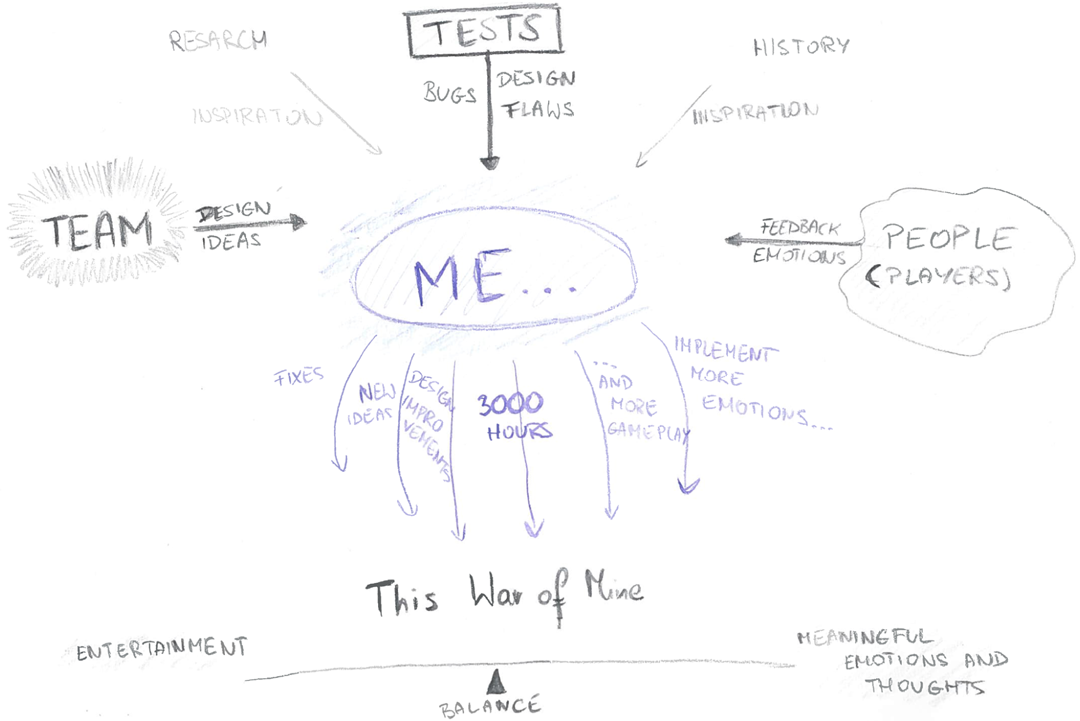
Drawing of quality assurance lead on his role in the development process of This War of Mine.
Gameplay is the language
The interactive nature of games provides players with the opportunity to actively engage with the message through gameplay. For the designers, this is seen as a unique language that might make games more convincing than movies and, possibly, more effective in spreading messages. My point was that games are capable of covering every story, be it controversial or whatever, as long as the gameplay is good. Because gameplay is the language. It needs to be engaging. Maybe not more successful than movies but maybe a little more convincing because they put you in the middle of the experience but they’re interactive. That’s why they can be effective when it comes to spreading the message. (John)
Such ambiguity creates a dissonance, which begs the player to reflect on her actions in the game. This strategy arouses what Sicart (2009) referred to as the ethical agent within the player. As in real life, there are no rewards or punishment for everyday actions. The game rather presents the question “What would you do?” in this situation, given the difficulties that a civilian might encounter in war: There are some situations in the game where you don’t have any good recourse. It’s just shit happens. You can just deal with it or sometimes die. (Dave) The endings depend on the amount of trauma they experience during our gameplay during the war. (Rick, designer, September 29, 2016)
Game Design Elements
Although the designers did use several techniques to increase what Galloway (2006) termed realisticness, their intention was to create an emotional experience. 6 The characters have been modeled on real people, the animations are motion captured, and in-game objects are based on their real-life counterparts.
However, this kind of realism was not the most important, and the designers stated that it was not their intention to have everything as realistic as possible in terms of visuals and simulation. What mattered for the team was to humanize the experience of war. Players’ resources were named our things instead of the typical inventory found in other war games. Also, the character’s health status was displayed with terms of affect (i.e., sad, depressed) instead of a numerical indication. The designers’ intentions were to move the player away from what Sicart (2009) called the strategic gameplay mode that instrumentalizes play: We need to think of people as people not as resources. The moment you start to treat them as resources you don’t really care because they could be a resource, gold, oil, coal—whatever. (Dave) If you look up The Little Ones in the game perspective, how they [children] fit into the equations, they really don’t. They shouldn’t be there. They are a burden. Not a big one. Not to the point of breaking the game because they can help a little bit but they really don’t belong here. Our city is actually in a war zone. (Dave) There were some scenes that were deemed by us too violent, too hard to witness even in the game, in a fictional setting to include the game. (Dave) If you start to kill children in a war game it stops to be an action game, right? It becomes a slaughterhouse. That’s not what you want to achieve. On the contrary, in our game you have children but they cannot be killed as well. Because we didn’t want to make it a gore game. (Rick) We wanted to create an emotional bond between the player and the characters in putting the players in an uncomfortable situation, […] pushing the player out of his comfort zone. (Dave) And the guy said that he played for nine days in game and one guy has starved to death, the second one was sick, and the third hanged himself. And he couldn’t handle the game anymore because it was his fault they died. He wanted to play the game. He will return to the game. But he can’t for now. It’s too much. He will come back in a couple of days. (John) There is no hand holding. And when you start the game you just have to survive and you have to figure it out when you start. You are dropped into the deep end and you just have to figure out what to do, what not to do. You learn not to fight if you can avoid if very quickly. You learn that wood is more important, especially in the beginning, than the weapons which is—we wanted in a way we wanted the player to feel helpless and lost initially. Because people who find themselves in this situation they get no tutorial, no cliff notes on war. (Dave)
Iterative design
How the player will respond to the gameplay experience is uncertain. The designers pointed to the importance of the iterative design process. In the sketch drawn by Dave (Figure 2), the writer, we see the clear cyclical nature of his work. He included smaller iterative cycles that refined each step before moving on to the next cycle. Also, he described that including gameplay (as part of the iterative design process) can be helpful in generating ideas.
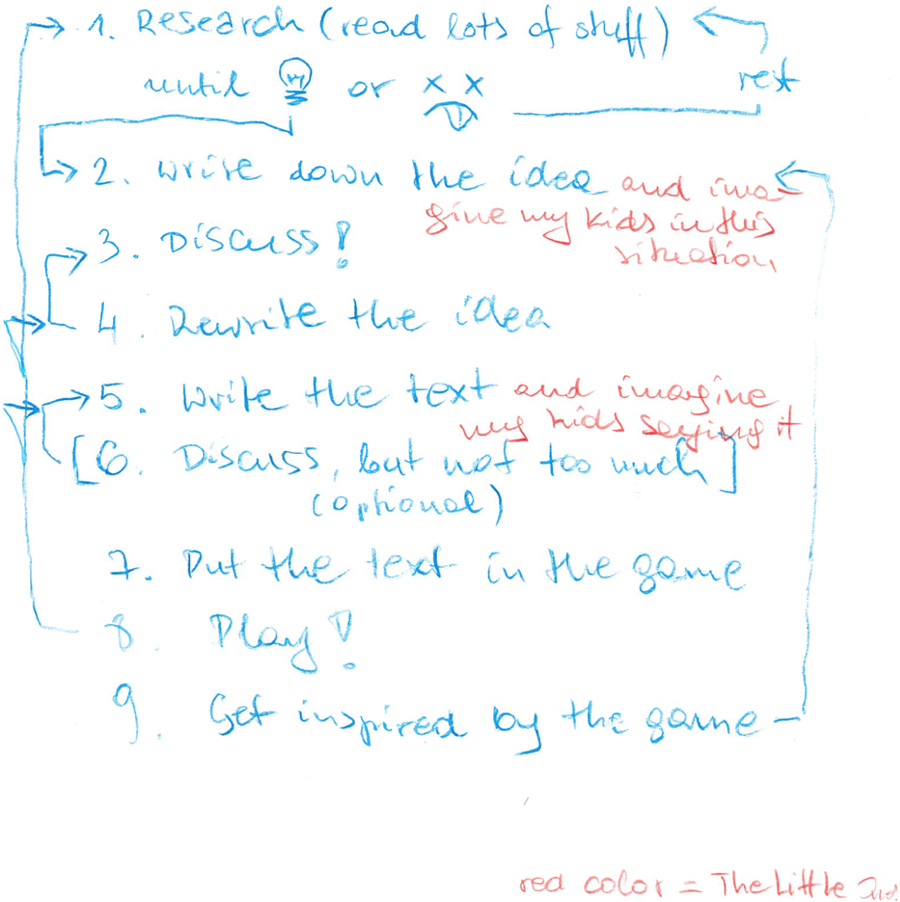
Sketch of writer (Dave) on his role in the development process of This War of Mine.
In explaining this iterative design process, the designers highlighted player testing as central to recreation of emotional experiences. For me it’s mostly, like I said, I’ve been in the middle of everything so it came from the whole team of designers, programmers, research, history, where we were searching for facts or testing people where they gave the feedback and emotions on everything. And giving a small adjustment to make as good bonds between entertainment and meaningful gameplay. (Tim, QA lead, September 29, 2016) The tests—people from the outside, at least for me it was a big deal because I remember that after some time you start to lose that emotional bulk with people. Especially when we added children. I didn’t feel they were children. But, when we took people to test they started to play differently, act differently, and make safer decisions to reassure that they will come back to their children to the shelter, et cetera. (John)
Discussion and Conclusion
Through a focus group study with 11 bit studios, we examined TWoM by including designer perceptions and the design context as aspects that inform the design of moral gameplay. A focus group format supported an understanding of the different development roles in the production process. The data yielded two thematic groupings: gamework narratives and game design. In what follows we discuss the application of these findings to moral game design.
Defining Moral Gamework Narratives
We defined gamework narratives as the underlying stories present throughout the design of TWoM. The first theme reflects the team’s habitus (Bourdieu & Johnson, 1993; Julier, 2006)—the manner in which the designers perceived their own lived reality—and how these perceptions motivated the vision for the game. The designers’ geographical location (Eastern Europe) informed the game’s visual aesthetic. The vision of the game, that of war, is deeply imbedded in Polish history (Sterczewski, 2016), particularly the Warsaw Uprising, which has been used as a central theme in other Polish games. Thus, the habitus illustrates that designers’ cultural heritage informed the game design (Sandovar, in press).
The second refers to Bourdieu’s concept of the field (conditions under which a text is produced). Specifically, the data reflect two of O’Donnell’s (2014) developers’ dilemmas. The first is the tension between creativity and profitability (Nieborg, 2011). Bourdieu and Johnson (1993) also referred to the struggle between art and money, and the manner in which this tension “structures the field of power” between the “symbolically dominant ‘pure art,’” and “economically dominant ‘commercial art’” (p. 250). Although the game is defined by designers as an art form, their responses also reflected the demands of the market. A closely related dilemma referred to the tension between entertainment and the capitalization of war. Although the team at 11 bit studios articulated the goal to design a game with a message against war, they also explicitly expressed the importance of creating a game for entertainment. They justified their work by naming war films, such as The Pianist (Polanski, 2002) and Schindler’s List (Spielberg, 1993). These critically acclaimed films are not only based on real stories and address the inhumanity of war but are also dramatized to captivate audiences and ultimately generate a profit.
A final gamework narrative included the hidden costs of designing a game with morally complex content, such as killing innocent civilians or sexual violence. We found that the designers were aware of their position of power in shaping the eventual moral gameplay experience, and expressed reflexive responsibility (Sandovar, in press; Sicart, 2009). The expression of this reflexive attitude was found in the team’s extensive research for the game. In part, the extensive research for the game was conducted to understand the experiences civilians face in war. Exploring conditions such as famine, illness, death, and boredom affected the designers. One respondent described the emotional toll of studying civilian experiences in wartime. Later in development, the cost of this responsibility manifested itself differently. Designers felt apathetic during gameplay, having lost the connection to the traumatic experience. The gameplay represents emotional realism absent in other war games; however, creating engaging moral gameplay also has hidden costs.
Designing Moral Experience Through Emotional Realism
To create moral gameplay, the team needed to balance emotional realism and entertainment. Although the setting for the game required the civilian experience of war, a game’s entertaining properties are of equal importance to create good gameplay. The designers reflected that games convey messages; as such, the game itself is the language. TWoM was designed to stimulate discomfort as did Spec Ops: The Line. Including other design elements, such as boredom and the lack of tutorial, are nuances that although designed intentionally by the designers, might not be noticed in a classical critical reading of the game as text. These elements are based on designers’ experiences with the research as well as their cultural history. This illustrates the importance of including designers’ perspectives in understanding moral gameplay.
The role of play testing was essential in the design of TWoM’s moral gameplay. Understanding player experiences through play testing is crucial to the development of a balanced play experience (Sicart, 2009). The play testing was central in the design of elements, such as the inclusion of children, unclear moral decisions, the lack of tutorial, and the use of boredom. The role of testers was acknowledged by Ash (2012). He conducted ethnographic research to understand how game designers make use of feedback sessions to test the positive or negative affective encounters they design for. The designers of TWoM also stressed the importance of continually testing with new players, because desensitization toward the emotionally engaging gameplay happens over time. An iterative design process means that gameplay is in constant negotiation. This could indicate that the moral value system is not fixed, but rather a combination of many factors influenced by many agents (Sicart, 2009).
From our findings, several suggestions can be proposed for the design of moral gameplay. First, a player-centric iterative design process refines the player experience. This is particularly relevant for gameplay containing moral content, since the design process tends to desensitize designers during development. From a critical perspective, the moral value system is a culmination of all these different iterations, where different player reactions informed gameplay. Another finding from our study was that the importance of conducting elaborate background research about a subject for a game (such as war) supports game-world coherence. At the same time, designers should be aware of the various underlying narratives of their work environment, as they could unconsciously influence the design.
Implications and Future Research
We advocate for the inclusion of production studies as a crucial component of understanding game design. The context of design and designers’ perceptions (symbolic capital) ought to be considered as intricate to the producers of the cultural work (Bourdieu, 1993). Further research could investigate this form of symbolic capital, and how it enacts within the field. Field research requires academics to work outside of their institutions in lieu of working side by side with studios (Nieborg, 2011; O’Donnell, 2014). We also advocate for the use of visual methods (i.e., drawings, photographs, sketches) as part of production studies. Designers notice and see the world visually, and in doing so express and work with their ideas in a graphical manner. Inclusion of these methods also supports a better understanding of the habitus, supports designers in self-reflection, and deepens an understanding of the field. In sum, this article has been a first step toward filling the empirical gap of including a production studies perspective on moral game design in war games.
Footnotes
Declaration of Conflicting Interests
The author(s) declared no potential conflicts of interest with respect to the research, authorship, and/or publication of this article.
Funding
The author(s) disclosed receipt of the following financial support for the research, authorship, and/or publication of this article: Part of this work is funded by the Netherlands Organization for Scientific Research (NWO), project numbers 314-99-106 and 022-005-017.