



Abstract
Therapeutic foster care agencies provide temporary placements and a range of services to at-risk youth to help ensure their safety, permanency, and wellbeing. The practitioners that plan such care operate under heavy caseloads, limited resources, and high stakes. There is significant interest in supporting these practitioners with various technological interventions, but their work and the context around it is still poorly understood. This study aims to better understand the current assessment and treatment planning work in therapeutic foster care. We used the abstraction hierarchy modeling approach to outline the purposes, values, constraints, processes, and tools that define the workplace ecology encountered by care coordinators and clinicians from therapeutic foster care programs at Hillside, a collaborating human service organization. The resulting abstraction hierarchy was closely examined to identify areas for interventions and design implications.
Introduction
The child welfare system, specifically foster care, is a dynamic and tightly constrained sociotechnical system with high stakes. Youth who exit foster care as adults without finding a permanent living situation experience a number of adverse outcomes at higher rates than those who were not in the system, including homelessness, incarceration, and substance abuse (Fowler, 2017; Shpiegel & Ocasio, 2015). Additionally, practitioners in foster care contend with heavy caseloads and limited resources due to austerity measures and the financialization of social services (Abramovitz & Zelnick, 2015). Given these challenges, there is increasing pressure to leverage technological solutions and evidence-based practices (Abdurahman, 2021). However, early attempts to apply machine learning risk assessment tools to child welfare screening have encountered substantial roadblocks (Chouldechova et al., 2018). These issues arise from a lack of understanding of the work domain by design teams and a failure to provide important contextual data as part of any decision-making aid.
This work addresses this significant gap by applying Work Domain Analysis (WDA), a phase in the Cognitive Work Analysis (CWA) toolbox, to child welfare settings. The primary output of WDA is the abstraction hierarchy (AH) model, which represents complex systems across five levels of abstraction connected by means-ends relationships (Vicente, 1999). Our abstraction hierarchy outlines the purposes, values, constraints, processes, and tools that define the workplace ecology encountered by care coordinators and clinicians from therapeutic foster care programs at Hillside, a collaborating human service organization. In this context, workplace ecology refers to the characteristics of the domain which constrain possible action, terminology which emerged from ecological psychology and Vicente and Rasmussen’s work (Vicente & Rasmussen, 1992).
Background
Foster Care - Domain Perspectives and Constraints
Social work scholarship and practice examine any given domain through three perspectives of scale: micro, mezzo, and macro (Glisson et al., 2012). This lens frames the foster care system by capturing federal and state policy priorities (macro), organizational priorities and constraints (mezzo), and individual and team decision-making factors (micro) that impact any particular youth in therapeutic foster care programs.
At the macro policy level, the foundational priorities of safety, permanency, and wellbeing were laid out in the 1997 Adoption and Safe Families Act (The Adoption and Safe Families Act, 1997). In practice, these priorities emphasize balancing the removal of a child from the home for safety reasons with an understanding of the trauma inflicted by that same removal. Other more recent legislation has expanded on this by allocating further funds toward preventive services Family First Prevention Services Act (2017), and it is federally mandated that youth in child welfare move toward the least restrictive level of care by increasing connections and permanency (e.g., from residential care to family foster care and from foster care to a permanent home) Adoption Assistance and Child Welfare Act (1980). However, while macro level policy has set priorities for the system, it has also instituted tight constraints and a number of processes on the operation of (mezzo level) organizations, including limited funding, paperwork, assessments, admission criteria, and numerous additional regulations, processes, and procedures. Increasingly austere government policies have forced child welfare organizations to adopt lean, financialized approaches to service delivery, a change that has culminated in frontline workers needing to operate with large caseloads, fewer resources, and greater organizational constraints (Abramovitz & Zelnick, 2015), all of which contribute to burnout and reduced services (Zelnick & Abramovitz, 2020). Child welfare legislation, research, and practice are increasingly required to use evidence-based practices to increase efficiency in service allocation and improve overall outcomes Family First Prevention Services Act (2017)).
At the micro level of child welfare, there are numerous challenges in the process of individual treatment planning and case management (Bosk, 2018; Wurst et al., 2022). These challenges largely motivate this study, as evidence-based practices and technological solutions need to be designed to facilitate optimal use of data and human-technology teaming. For example, one data-driven solution, the Alleghany Family Screening Tool, was designed to assist in the initial screening of tips to a child abuse hotline by providing a score that indicated the child’s risk of being removed from the home within two years of being screened in by a hotline worker (Chouldechova et al., 2018). However, the score presentation lacked contextual information relevant to practitioners’ decisions (Chouldechova et al., 2018). Additionally, the tool lacked proper training information, and practitioners had to game the system in order to better understand how particular factors impacted the risk score values (Kawakami et al., 2022).
These criticisms are not meant to imply that technological solutions are unnecessary, as practitioner-driven decision-making also has some limitations. Practitioners are often overloaded with information of uncertain accuracy from a variety of sources (Wurst et al., 2022), which can lead to a lack of adherence to assessment protocol. For example, a think-aloud study examining foster family matchmaking found that analytical guidelines were underused in decision-making and that practitioners instead relied on heuristics to offset time and resource constraints (Zeijlmans et al., 2019). Another study found that practitioners used a narrow range of evidence to make child protection decisions and were biased toward the information most available to them (Munro, 1999). While these strategies may introduce some amount of decision variance, they also represent practitioner expertise developed through extensive work in the field, and future interventions should aim to extend rather than replace that experience.
In a prior study, interviews with care coordinators and clinicians identified the connection between assessment, treatment and services, and outcomes as a core tenet of Hillside’s treatment planning process (Wurst et al., 2021). This concept, referred to as “The Golden Thread” at Hillside, hypothetically ties critical factors identified through assessment, interviews, and record review to treatment and services, and eventual outcomes. It represents the alignment of treatment and services based on identified needs and strengths of the youth and family to better support positive outcomes and impact. For example, the organization uses a number of tools to screen for Adverse Childhood Experiences (ACEs). If a need is identified through the use of the tools, the practitioner collaborates with the family and community-based providers to connect the youth to appropriate treatment such as mental health counseling to improve safety and wellbeing. While practitioners do plan treatment with this concept in mind, it has yet to be formally validated. There is a need to help practitioners at Hillside and other similar agencies to understand and examine factors that impact outcomes to inform their prioritization and effective use of assessments, treatments, and services.
Sorting through the vast amount of data that practitioners use to make decisions for treatment planning is one potential area in which technological solutions could enhance the capabilities of human decision-makers. More broadly, by understanding the strengths and shortcomings of both technological solutions and expert decision-making, as well as the ecology of the work domain in general, teaming and decision support can be better designed to improve overall outcomes and reduce workplace stressors. Toward that goal, this study uses Work Domain Analysis (WDA), one component of Cognitive Work Analysis, to qualitatively model the purposes, values, processes, and resources of the therapeutic foster care process.
Cognitive Work Analysis
Cognitive Work Analysis was first developed in the context of complex process control for mechanistic systems, particularly nuclear power plants (Vicente, 1999). The approach models the ecology of a given work domain through multiple phases of analysis, including a focus on the structure of the work domain, control tasks, operator strategies, work organization, and operator skills and competencies. One strength of this approach is that it describes the possibilities of action within a domain rather than offering descriptive or prescriptive views of current solutions.
WDA, in particular, focuses on developing an ecological model called an abstraction hierarchy (Vicente, 1999), which describes the work domain using multiple levels of abstraction. The first level is the functional purpose, which contains the purposes or reasons for the system to exist. Moving down the levels of the system, each subsequent level should answer “how” the previous level is supported. The second level, the abstract function level, contains values, balances, and constraints that determine how the functional purposes are achieved. Further down the model there is the general function level (representing processes or work functions that support the system objectives), the physical function level (representing more concrete functions that support the general functions), and finally the physical form level (representing the physical tools and resources that allow the physical functions to be conducted). These five levels of abstraction each should model the entirety of the work domain, moving across the levels simply shifts the level of abstraction through which we are viewing that system. Each entry in the model is connected to entries in the adjacent levels by means-ends links; moving down the links exhibits how that entry is being achieved and moving up exhibits towards what end it is working. Careful examination of the structure of an abstraction hierarchy can reveal meaningful insights into system dynamics, including contradictory objectives, process redundancies, hidden constraints, and design recommendations for process or tool improvement.
While CWA was traditionally used to study physical systems, there has been an increasing number of applications to intentional domains—those governed by human decision-making rather than physical laws (Austin et al., 2022; Read et al., 2015; Roscoe et al., 2019). We followed Naikar’s (2013) approach to WDA for intentional domains in our modeling work of therapeutic foster care at Hillside. Specifically, we developed an abstraction hierarchy of therapeutic foster care. A part-whole decomposition was not done as there are not meaningful subsystems within therapeutic foster care given a lack of formal hierarchy. While there are multiple actors who may function within this system, their roles are better explored by other phases of CWA. Our goal through this modeling work is to provide a more complete and systematic description of this work domain to guide future research, facilitate process improvement, and help identify opportunities to support future designs of technological solutions and supports.
Methods
System of Interest
The system or work domain of interest is Hillside’s therapeutic foster care, with an emphasis on their treatment planning work to support youths in their care. We are focusing on this aspect of the system as it involves significant decision-making, a large impact on youth outcomes, and substantial potential for support via process or tool improvement. This sort of partial, focused AH is described by Naikar’s approach and is generally used when a partial representation is functionally useful for the project at hand (Naikar, 2013). The therapeutic foster care programs aim to provide a safe family environment for youth who would benefit from more intensive therapeutic services than a standard foster care placement. Services include foster family care, case management, permanency planning, coordination of medical care, skill-building, and educational support (hillside.com).
Hillside is a human service organization that provides community-based services, education, and residential treatment. Their vision focuses on supporting youth and families in overcoming challenges to heal and thrive in their communities. Their work served over 9500 individuals in fiscal year 2021. The vast majority (96%) of Hillside’s funding comes from state and federal government reimbursements for services rendered. This reimbursement and licensure come attached to a wide range of regulation, including the Family First Prevention Services Act (2017) and the Fostering Connections to Success and Increasing Adoptions Act (Fostering Connections to Success and Increasing Adoptions Act (2008), as well as state- and local-level policies and regulations.
Data Sources
We developed this abstraction hierarchy of Hillside’s therapeutic foster care program using our understanding of the domain that stemmed from a range of data sources. A previous interview study conducted with five care coordinators and clinicians at Hillside provided many useful insights about the first 30 days of the therapeutic foster care treatment planning process (Wurst et al., 2022). This study utilized the Critical Decision Method (Klein et al., 1989) to review particularly challenging instances of treatment planning resulting in a better understanding of process, constraints, and the general workplace ecology. Hillside internal documentation was also reviewed to better understand the organization’s system and perspective. This set of documentation consisted of 16 assessment and workflow documents, two family handbooks, six service definition documents, and various training materials (L. Magguilli, personal communication, November 9, 2020). The assessment documents were specifically included in the physical form level of the model as resources used to support various physical functions.
We also reviewed external documentation and foster care literature outlining the values, priorities, processes, resources, and constraints of the child welfare field to leverage domain expertise in model development (Berger & Slack, 2020; Edwards & Wildeman, 2018; Roberts, 2022). Similarly, we reviewed a number of pieces of federal legislation (Fostering Connections to Success and Increasing Adoptions Act , 2008; Family First Prevention Services Act, 2017; “Public Health Law,” 2017) to identify how the purposes of safety, permanency, and wellbeing are being achieved and defined in child welfare.
Work Domain Modeling
The AH was developed iteratively through in-person and virtual discussions among team members of multiple disciplines, including human factors/cognitive engineering researchers, social work and child welfare researchers and practitioners, and a computational social scientist. Each iteration involved the use of domain-specific information from the data sources described above and each authors expertise. The initial model version was developed through a series of virtual collaborations between all authors using Miro, a digital whiteboard solution (miro, 2022). Based on reviewer feedback, the human factors researchers significantly revised the model during an in-person, whiteboard-based work session. Two of these three researchers have significant experience developing and analyzing models of this sort, and this work session focused on better fitting the model to AH conventions. The model was then transferred back to Miro and reviewed for face validity by the remaining authors, with only minor edits being made. Finally, examination of the completed model by the entire team generated new domain insights, system needs, and implications for technological interventions.
Results
The resulting abstraction hierarchy is illustrated in Figure 1. Our analysis focuses on the assessment and treatment planning work in therapeutic foster care at Hillside to better understand and support their service allocation, an area of significant interest to both Hillside internally and the larger child welfare work. Therefore, while all general functions are specified in Figure 1, we have chosen to only describe processes and capabilities, at the bottom two levels, that support the general functions of assessment and treatment planning, as well as care coordination which occurs in parallel and interacts with assessment and treatment planning. The remainder of the results section describes in more details the five levels of abstractions modeled. Abstraction hierarchy of therapeutic foster care. At the General Function level, bars below particular items indicate that they are not included in subsequent levels of the hierarchy.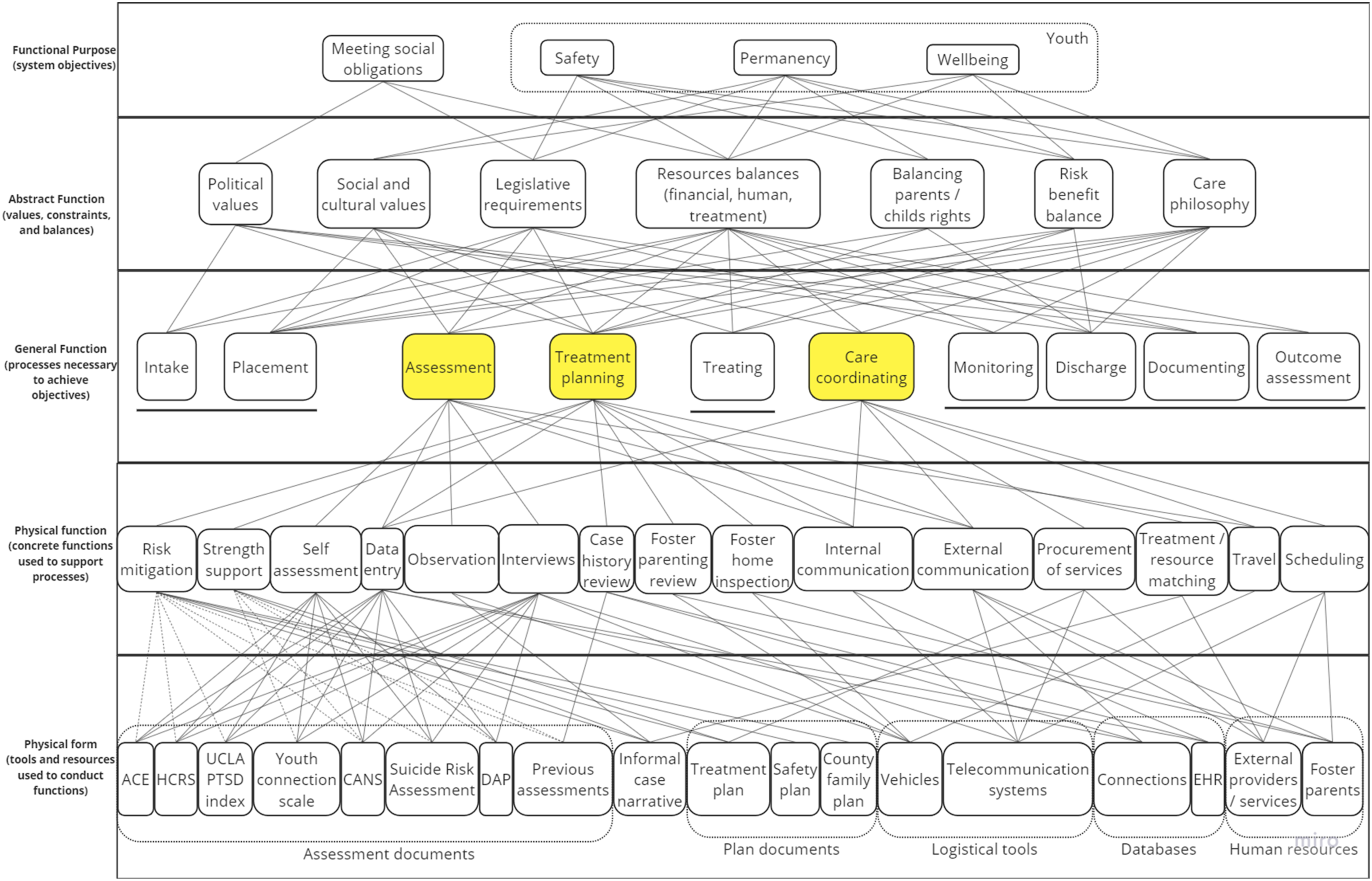
Functional Purpose
The functional purpose is the most abstract, high-level view of the work domain in question. This level contains the system objectives, that is, the reasons for which the system exists. In the case of therapeutic foster care, the primary objectives of the system are to provide care to youth while fulfilling its social obligations. More specifically, care is provided to ensure the safety, permanency, and wellbeing of youth in care (Wilson, 2014). These three objectives were formalized as high-level objectives for the child welfare system with the passing of the 1997 Adoption and Safe Families Act (The Adoption and Safe Families Act, 1997). The previous primary stated objectives of the system, preventing abuse and ensuring safety, were not fully adequate. A permanent home or sense of relational belonging and permanency are important to youth development (Salazar et al., 2011), and practice has therefore moved away from foster care as a long-term solution (Wilson, 2014). Wellbeing is defined by a number of primary outcomes, particularly academic performance, social and emotional competence, absence of psychological and behavioral problems, and physical health. The careful balancing and prioritization of these objectives drives much of the decision-making done during the treatment planning process.
One final objective was added, “meeting social obligations.” While many other abstraction hierarchies may involve a profit motive at the functional purpose level, Hillside’s therapeutic foster care program is a non-profit which operates on a social mandate to guide abused or neglected youth towards a functional adult life. While safety, permanency, and wellbeing are the focal outcomes for individual youth and families (as depicted by the dashed “Youth” box around these three objectives), the social obligations capture the impact of the therapeutic foster care system on society as a whole. This maintenance also requires legislation and allocation of government funds; as we will see in the following level, this leads to a number of constraints and priorities that impact how care must be conducted.
Abstract Function
The abstract function level outlines three sets of values, one primary constraint, and three balances that define how the objectives of the system above are met. Prior literature has identified the strong impact that differences in political values between nations have on their respective child welfare systems (Keddell, 2014). These values define what it is that a child welfare system should accomplish and how it should approach those aims. Social and cultural values act similarly at an individual level, as the lived experiences of agency practitioners, youth, and families define how safety, permanency, and wellbeing should be achieved and what successful care might look like. A number of studies have identified that differences in these values can lead to substantial racial bias in what data is gathered, how it is understood, and what decisions are finally made (Enosh & Bayer-Topilsky, 2015; Ray, 2019). Finally, various aspects of social work care philosophy define the values by which care is assessed; these include a belief in reducing the level of care when possible and trauma-informed approaches which advocate for more participatory care. Care philosophy also includes agency level values such as caring, inclusion, excellence, and cultural competency.
All care decisions are constrained by legislation which formalizes where practitioners might exercise discretion and what decisions are mandated. Some examples of this impact include the recent Family First bill which emphasized placement in kinship care Family First Prevention Services Act (2017) (and the need to document all care decisions made in New York state in the Connections database (Wurst et al., 2022). However, within the specifics of how treatment and care coordination are delivered, practitioners have reported having significant discretion within the law. Available resource balances are typically included at this level. In the case of therapeutic foster care, these balances would include the management of funding, available staff, and open spots for possible treatments that a youth might receive. These resource balances are supported by all general functions. Two other primary balances in the system include balancing the custody rights of parents with the best interests of youth and balancing possible treatment risks with benefits.
A number of the priorities and balances at this level, primarily legislative requirements, risk benefit balance, and care philosophy, result in a prioritization of the youth-focused objectives at the functional purpose level. While all three of these objectives are addressed in the treatment planning process, when they come into conflict they are prioritized in the order of safety, permanency, and finally, wellbeing. For example, when any youth is placed in foster care based on legislated standards for removal from the home, their permanency is not being met and their wellbeing may be impacted as a result. However, this decision to remove a child from the home is being made to ensure safety. This is balanced by care philosophy that encourages the lowest level of care that meets safety needs, for example, kinship care is preferred over foster care which is preferred over residential facilities. Similarly, when selecting initial treatment plan goals for youth in care, any immediate safety concerns are always the first to be addressed.
General Function
This level captures the functions required to support system objectives. For our analysis, these functions can generally be viewed as a pipeline through which youth typically travel through during their time in care. When a youth is admitted to the therapeutic foster care program at Hillside, they are matched and placed with a foster home while an intake function is required to enroll them in the electronic health record system. Alongside the intake and placement processes, practitioners begin to assess the youth and family in order to understand the youth’s strengths, needs, and historical factors. Based on that assessment, treatment must then be planned and executed. Treatment itself is accompanied by care coordinating, a function which involves aligning all internal and external practitioners involved with a case and ensuring that the youth is present at all needed appointments. During a youth’s care, progress is carefully monitored until some given conditions are met and a youth is discharged to their biological family, adopted, or otherwise leaves care. Finally, extensive documentation is required both internally and externally throughout a youth’s time in care, and final outcome assessments are completed at the time of discharge.
Physical Function
The processes presented at this level all support assessment, treatment planning, and care coordination. While some guidance is provided by best practices and evidence-informed assessment processes, different functions may be used to conduct the assessment process depending on a practitioner’s personal approach. These include observation of the youth and family, asking youth to complete assessment documents themselves, reviewing case history and prior assessments, and, most commonly, interviewing the youth or relevant adults. Our prior interview study identified that the specific functions used to plan treatment depend on a practitioner’s style (Wurst et al., 2022). However, these approaches include checking in with external providers, mitigating risks, and supporting existing youth strengths. Treatment planning also typically involves review of the foster parents and their home to understand their capacity for involvement in the youth’s care, which may lead to further education to expand that capacity. Any treatment planning process will also include communication with both internal and external team members, matching available resources with youth needs, and an extensive amount of data entry. A number of these same processes at the physical function level serve to support the care coordination process, particularly communication, data entry, procurement of services, scheduling, and travel. Completion of these processes typically impacts the assessment and treatment planning processes given heavy caseloads and time constraints, hence their inclusion into the current model.
Physical Form
The final level of this model includes the physical tools, documents, and resources used in this work domain. Given the focus on assessment and treatment planning, many of the tools included consist of assessment documents which are used to guide and document information from observations, interviews, or other physical functions. These include the Adverse Childhood Experience (ACE) Screen, Hillside Clinical Risk Screen (HCRS), University of California Los Angeles Post Traumatic Stress Disorder (UCLA PTSD) reaction index, Youth Connection Scale (YCS), Child and Adolescent Needs and Strengths (CANS) assessment, Suicide Risk Assessment, Developmental Asset Profile (DAP), and any previous assessments completed during prior involvements with the child welfare system. These assessments are completed upon intake to inform treatment, and may be repeated throughout care to track outcomes depending on the nature of the case. The abstraction hierarchy is meant to represent all possible means to support particular ends, and these assessment documents are completed with the intention of supporting the risk mitigation and strength support processes. However, practitioners have reported that they are rarely referenced after their initial completion during assessment. Instead, most practitioners rely heavily on their own informal case narrative or mental model of case dynamics to make treatment planning decisions. This underuse is captured in the model by dashed means-ends links.
Treatment and safety plan documents are used to formalize and communicate all treatment planning decisions. An external document authored by local county authorities, the county family plan, outlines the steps that biological parents must complete in order to regain custody of their child or accomplish an alternative permanency goal. Vehicles and telecommunications systems are crucial logistical tools for ensuring in-person and remote communication and presence of the youth and associated practitioners. Connections is an external database operated by the Office of Children and Family Services; Hillside is required to upload case data into this centralized location as well as their own internal electronic health records (EHR) system. Finally, while Hillside practitioners are considered the system users for the purpose of this model, external providers and foster parents can be considered to be “tools” or resources which are used in assessment and treatment planning. These external providers typically include counselors, health care providers, and education specialists who are crucial to delivering much of the care that Hillside includes in a treatment plan.
Discussion
This abstraction hierarchy was developed with the intent of developing a robust understanding of the workplace ecology of therapeutic foster care, including the system’s purposes, values, constraints, functions, tools, and resources. The resulting model yields many insights about the domain that have implications for system and technology design. Below we discuss these implications with respect to: Purpose Complexity, Value Driven Practices, Function Support, Tool Redundancy, and Design Implications.
Purpose Complexity
Beginning at the top of the abstraction hierarchy, the model provides insight into how the fundamental purposes of this system drive its functioning. Therapeutic foster care serves not only to ensure the safety, permanency, and wellbeing of youth, but also acts as a mechanism to protect societal stability and meet the societal obligations to youth in need of care.
By describing the purposes of therapeutic foster care as serving both the youth and the overall society, the abstraction hierarchy approach also illuminates issues of debate among those in the foster care, and more generally the social welfare, domain. Specifically, by tracing the historical development in this domain, we can observe that the functional purposes in this domain have been gradually expanded to provide more constraints and guidance of the foster care work.
Early approaches to child welfare emphasized the social need of the time to remove poverty from the public eye (Trattner, 1999). Without explicitly considering the purpose of care for youth, this approach led to poor outcomes for youth in the foster care system, including high fatality rates (Roberts, 2022). Perspectives shifted throughout the late 1800’s and early 1900’s, leading to greater prioritization in child safety, which—as our model demonstrates—can be enacted through legislations and resource allocation. However, increasing access to welfare programs was often racialized to the detriment of Black, Indigenous, and People of Color (BIPOC) communities (Eubanks, 2018). There is a potential role for the abstraction hierarchy to serve as a tool for identifying how and why biases and racism populate in this and similar social systems.
More recently, permanency and wellbeing became explicit objectives of foster care after child welfare experts realized the psychological harm associated with long-term out-of-home placements (Wilson, 2014). Over time, the system has better accounted for family rights, risk benefit balances, and began to develop care philosophies as a response to ensure the safety, permanency, and wellbeing of youth across the foster care system. We emphasize that the purposes of foster care system continue to evolve as new findings emerge from research in the social work and child welfare domains on the impact of various policies and interventions. Scholars and practitioners debate over various reform approaches, including the full abolition of the current foster care system over the argument that the current system fails to ensure safety, permanency, and wellbeing of youth (Roberts, 2022). The abstraction hierarchy may offer a unique approach to understanding critiques of the current system and the potential of new futures. Further analysis of the abstract function level could be used to identify where youth-focused priorities are not adequately supported. This analysis would include systematic coding of the requirements that legislation and resource constraints place on therapeutic foster care practice, as well as the impact that social values, care philosophy, and risk balances have on care within those constraints. Future forms of the foster care system could also be investigated using an abstraction hierarchy, allowing us to consider how we might change resource balances and recenter social/cultural values to better support youth outcomes.
Our abstraction hierarchy also revealed the challenge for practitioners to meet all three youth-focused purposes. As mentioned earlier, longer out-of-home placements help ensure safety but are detrimental to permanency and wellbeing; on the other hand, imposing guidelines on youth behavior in a treatment plan may impact their immediate wellbeing but be necessary to ensure safety. Practitioners have reported that these conflicts are typically resolved by considering the different abstract functions. In some instances, legislative requirements determine specific decisions, particularly as relate to safety and where a youth is placed. Legislative requirements also lead to a prioritization of the youth-focused functional purposes: safety is the premier focus, then followed by permanency and wellbeing in unison. However, when practitioners have discretion on treatment decisions, they often rely on social work care philosophies, including an emphasis on reducing the level of care and the trauma-informed care framework, which strives to involve youth in their own care and avoid retraumatization (Clark, 2015). A more concrete path to guide practitioners in practicing trauma-informed care and to support youth involvement in care may be necessary to better meet the youth-focused purposes of the system.
Value Driven Practices
Moving down the model, we encounter the values, balances, and constraints that determine how the purposes are met; examining these abstract functions in parallel can drive insight into where they can conflict and create undesirable practices. Meeting the legislative requirements for any given case can be a demanding task by itself, and satisfying this abstract function may come at the expense of other values at this level. When asked about common mistakes in the assessment and treatment planning functions, many practitioners reported that the heavy administrative load of data entry and form filling required to meet legislative requirements can lead to a sort of “check-box” behavior (Wurst et al., 2022). This can include duplicating paperwork for siblings and assigning irrelevant goals to youth cases simply to speed up the data entry process. This aligns with the findings from an earlier study on child welfare decision-making, which found that novice practitioners tend to follow a “proceduralist” approach defined by decision-making driven primarily by rules and regulations. More experienced practitioners instead take an “investigator” approach that involves much more focus on specific case details and complex problem solving (Newsome et al., 2015). In this case, heavy administrative loads may drive practitioners into more proceduralist mindsets in which they are focusing exclusively on filling out required documentation rather than the implication that those documents have for youth care. While it is unrealistic and misguided to imagine that legislative requirements might be entirely removed from the system, process or data management improvements could potentially lessen the administrative load created by legislative requirements and allow practitioners to focus more on other abstract functions.
Function Support
The assessment process is crucial to ensure that the care a youth receives will meet their needs, align with their social and cultural values, meet legislative requirements, and carefully balance risks and benefits associated with various options of care. Hillside standards and legislative requirements set the standards for the data entry aspect of assessment; certain forms must be filled. Evidence-informed assessment practices also provide some guidelines for how practitioners gather assessment information. However, prior interviews indicate that discretion may be exercised in the assessment process, including the possible tools/methods that practitioners might use to complete the assessment process. This can include observations, self-report in the case of older youth, interviews conducted with youth and family, and reviewing prior case history provided in the Connections database and other referral information. Unlike data entry requirements, these four physical functions are not formalized tasks that practitioners must complete.
While a number of approaches to assessment are possible, practitioners in our prior study report that interviews with youth and families are the primary source of assessment information. These assessment-guided interviews allow for the development of a personal relationship between practitioners and youth while completing assessment documents and building a case narrative, but there may be opportunities to better support these interviews and connect these interviews with other assessment support functions. For example, training on how best to conduct interviews while integrating all the different assessment tools merits further consideration, given that the child welfare system exhibits high rates of turnover (Gómez-García et al., 2020) leading to a relatively inexperienced workforce.
The model reveals other functions that might be enhanced to better support the assessment process. In particular, greater emphasis on case history review would allow for better accounting of youth’s previous trauma in assessment and further integration of care philosophy at the abstract function level. However, case history review is primarily achieved by accessing previous assessments through the Connections database, which practitioners have reported to be challenging to use under time pressure (Wurst et al., 2022). Alongside concerns regarding the agency EHR database, which are discussed below, this challenge presents a clear need for a data visualization tool that would better support the assessment and treatment planning functions.
The treatment planning process involves the identification of several areas of care, which primarily involve mitigating risks, such as a youth fleeing from their foster home, or supporting a youth’s current strengths, such as involvement in an extracurricular activity. These areas of care then need to be aligned to some appropriate resource, including internal staff like skillbuilders or external providers such as counselors. Practitioners currently rely largely on their informal case narrative, a sort of mental model of case dynamics, to make these decisions; this is a helpful resource as it can account for nuances which may be missed in the formal assessment documents. However, this introduces issues in decision transparency and consistency, both of which are noted issues in the domain (Keddell, 2014).
The means-ends relationships captured by abstraction hierarchy modeling could also offer unique insight into the “Golden Thread” concept emphasized at Hillside, that is, the need to tie case factors to treatments and evidence of outcomes associated with these treatments. The treatment planning and monitoring capabilities captured by the physical functions in our abstraction hierarchy can be better used to highlight questions for future quantitative analysis of agency data and offer visualizations of care coordination for training purposes. Similarly, our abstraction hierarchy also identifies the need for visualizations to support practitioners in drawing clear ties from a particular assessment variable to their risk mitigation intervention, which is then connected to the values and priorities such interventions are designed to uphold for the purposes served, thus verifying the “Golden Thread” of each case management. One primary reason for underuse of assessment documents may be the reported clunkiness of the agency EHR system in which the documentation is stored, which makes a strong argument for the potential of an improved case data visualization or decision support tool. Any sort of prescriptive algorithmic tool based on case data alone would likely miss the important nuance of the informal case narrative, but functionally organized presentation of assessment document data could likely amplify the expertise currently exhibited.
Tool Redundancy
As we considered the seven assessment documents that support the interview process and make up a significant portion of the data entry load, the question arose of whether or not these documents all worked together effectively to create a comprehensive understanding of the case. We reviewed the variables included in each of the assessment documents and found substantial overlap in the variables included in these documents, with 23% of variables being present in one or more document. In some cases, slightly different wordings in assessment items were determined to be capturing the same idea, such as “feel good about my future” from the CANS assessment and “optimism” from the DAP document. This redundancy is relatively unsurprising given that these assessments were all created independently from one another, and only the HCRS was created specifically by Hillside. The independent validation of each of these scales may hinder the ability to remove variables and reduce this redundancy, but greater integration of agency data management systems may allow variables to be entered into multiple assessments simultaneously, thereby reducing the administrative load.
Contributions
In addition to the specific findings discussed above, this work has two primary contributions to the literature; the first is domain specific, while the second is methodological and might be extended to other settings. This abstraction hierarchy offers a detailed, systems-focused model of therapeutic foster care, which has the potential to be further studied and utilized by practitioners and researchers. Our authors with domain expertise already identified several valuable insights from the model, but other social work researchers may be able to generate additional findings from the structure and content of this work. Practitioners may also review this model to better understand the complex network of purposes, values, constraints, processes, and resources within which their work functions.
While applying WDA to intentional domains is not a novel contribution, the use of WDA in social work is substantially underexplored. Our authors’ collaboration involved substantial translation of domain specific perspectives and language to allow therapeutic foster care to be represented in an abstraction hierarchy, and this translation opens the door to new collaborative possibilities. This AH contributes to this work by providing a methodological example of how the prototypical aspects of social work domains might be included in WDA, and this work could motivate others to look more closely at other social work domains, particularly the planning and delivery of various social services.
Design Implications
As previously discussed, development of a data visualization or decision support tool has substantial potential to improve the use of assessment documents in the functions that support treatment planning. Ecological Interface Design, or EID, is a potent approach to designing these sorts of tools, specifically with the abstraction hierarchy in mind (Rasmussen & Vicente, 1989). EID aims to use abstraction hierarchy models to design interfaces which support varying levels of cognition depending on the demands of a specific instance. In the instance of standard, prototypical scenarios, the resultant interface can present the system at a very abstract level, only displaying the current status of the system purposes. However, when novel scenarios demand more complex reasoning, the interface can then support practitioner reasoning across all levels of abstraction captured in the AH.
Specific to the therapeutic foster care domain, an ecological interface could allow for visualization of The Golden Thread across a variety of system perspectives. This hypothetical design could initially display high-level progress towards safety, permanency, and wellbeing for a given case, but then allow practitioners to view case data through the lenses of values and balances (abstract function level), case processes (general function level), functions to achieve those processes (physical function level), and the tools available to get this all done (physical form level). Each of these potential lenses would represent a whole view of the given case, simply at different levels of abstraction, and The Golden Thread could be actively visualized by representing the means-ends links between tools, processes, and objectives. For example, consider a case in which there are substantial concerns around a youth’s education. At the functional purpose level, a practitioner may be interested in how this education issue will affect overall wellbeing. At the abstract function level, care philosophy places a heavy emphasis on education, but the youth’s own social and cultural values could potentially contradict that emphasis. In order to meet these values and constraints, practitioners will need to assess the educational issue and plan treatment to address it; the processes of assessment and treatment planning then might be supported through a number of physical functions depending on their personal approach. Finally, the HCRS and DAP documents would physically represent these assessments, while the treatment plan document would outline the approach to care, and external providers might provide tutoring. Before a data visualization tool can be developed, the information requirements for each entry in the abstraction hierarchy must be fully determined to better understand what the tool would display. In the above example, this would include information like current status of youth wellbeing, summaries of care philosophy and youth values, progress through various processes, and variables from assessment documents.
There are many examples of how ecological interface designs can stem from a work domain model (Burns & Hajdukiewicz, 2004). For example, displays might show the acceptable range (thresholds) of an abstraction function (e.g., acceptable risk levels or the available financial resource) and provide direct links to available treatment planning options. Configural displays may be effective for summarizing values from the assessment documents found at the physical form level to allow practitioners to quickly identify which assessment areas may require further investigation. We believe that this approach to visualizing case data has real potential to increase use of assessment data in treatment planning, reduce decision variability, and potentially even mitigate racial bias by minimizing overreliance on heuristic approaches to decision-making (Keddell & Hyslop, 2019).
Limitations and Future Work
This study is primarily limited by its generalizability; foster care agencies have specific standard practices and child welfare varies significantly state by state. Hence our results are primarily significant in their application to Hillside specifically. In addition, heavy caseloads limited our direct access to practitioners, which may call the face validity of the model into question. However, given the expertise of our team and the inclusion of a Hillside representative amongst our authors, we are confident in the model and its implications. Our model was also limited by its focus on the assessment, treatment planning, and care coordination general functions. This focus was selected because of the potential for system improvement through these functions, but eventual incorporation of other functions into the model could offer new insight. Similarly, application of other phases of CWA could extend our understanding of the domain. For example, Control Task Analysis and Social Organization and Cooperation Analysis would be effective frameworks for studying the decision-making processes and teamwork dynamics, respectively.
A number of areas of future work were identified from this study, primarily in developing the information requirements associated with each entry of the abstraction hierarchy. This will allow for further investigation into complex purposes and values, as well as supporting the eventual design of a data visualization tool. Following construction of a tool to better support assessment and treatment planning processes, we will likely conduct in-situ usability studies to better understand how this new interface might affect the decision-making processes involved in treatment planning. All of this work will be conducted with the final goal of improving the therapeutic foster care system for all stakeholders, including youth, families, and practitioners.
We also note the positionality of the authors, given the subjective nature of qualitative modeling and its interpretations. We recognize that foster care system reform—including any recommendations for work redesign or the use of technological interventions—is only one approach to improving youth outcomes; there are more abolitionist perspectives of the child welfare system, as well as criticisms of technosolutionism in sociotechnical domains (Roberts, 2022). We hope that the contextual perspective provided by this research helps resolve some of the blind spots identified by these critiques and aim to incorporate some of these alternative perspectives in our future work.
Conclusion
This work set out to better understand and model the workplace ecology in which Hillside care coordinators, clinicians, and other practitioners make treatment decisions and plan care for youth in therapeutic foster care. Pulling from domain experience, Hillside documentation, existing literature, and legislative documentation, our team was able to develop an abstraction hierarchy that outlined that ecology across five abstraction levels. This approach resulted in domain insights including purpose complexity, value driven practices, function support, tool redundancy, and design implications. The value of the abstraction hierarchy model to this domain also further proves the applicability of WDA to intentional domains, especially those involving questions of social justice, as proposed by prior publications (Benda & Bisantz, 2020; Naikar, 2013). This study stands as a foundation on which future projects will be built, all with the consistent focus of helping youth in care.
Footnotes
Declaration of Conflicting Interests
The author(s) declared no potential conflicts of interest with respect to the research, authorship, and/or publication of this article.
Funding
The author(s) disclosed receipt of the following financial support for the research, authorship, and/or publication of this article: This work was supported by the National Science Foundation and Amazon (1939579).
