




Abstract

This article emerges from my engagement with two seminal texts: Dark Matters by Browne (2015) and Demonic Grounds by McKittrick (2006). Drawing on Browne’s (2015) examination of Blackness for Sale by visual artists, Mendi and Keith Obadike in 2001, which is a critique of the objectification of blackness, and on McKittrick’s (2006) depiction of the auction block as a site that marks the unfree body and the spaces outside of it, I turn to the underexplored intersection of collections, racism, and internet marketplace. Having served as a reviewer for Collections over the past 5 years, I reflect on how museum and archive scholarship has yet to adequately explore the commodification of black bodies, and blackness generally, in online collection spaces. The exponential growth of digital technologies has made the cyberspace a key site for understanding contemporary archives, arts, and collections. As such, in this article, I take us back to unresolved conversations around how black bodies continue to be commodified through internet commercial arts.
Browne (2015) critiques commercial sites such as eBay as complicit in the commodification of black bodies through the sale of slave memorabilia. Over the course of reflecting on and developing the idea of this paper, my visits to three online marketplaces—eBay, Etsy, and Uncle Davey’s Americana—revealed an active marketplace culture that traffics in slave-era relics—objects that risk retraumatizing Africans and people of African descent (Driscoll, 2017, 2020; Hillis et al., 2006; Kent, 2022) (see Figures 1–3).
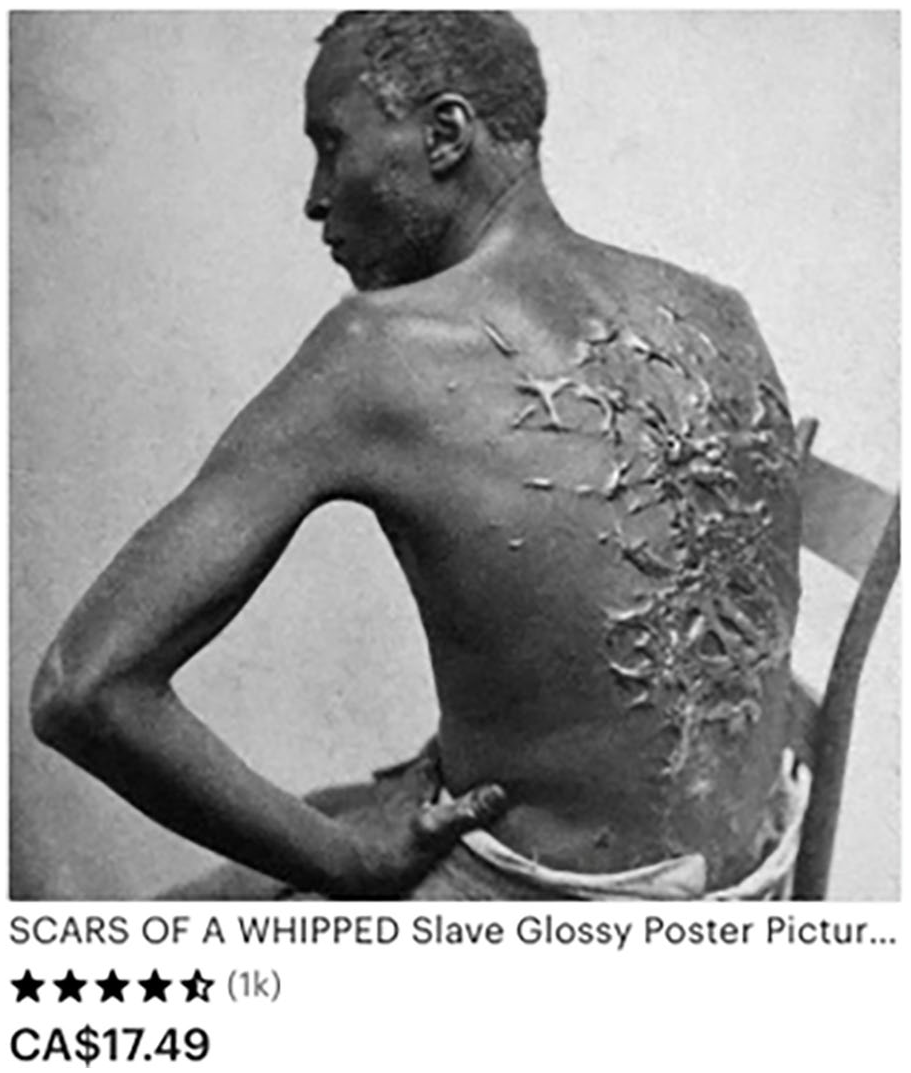
Screenshot from Etsy website.
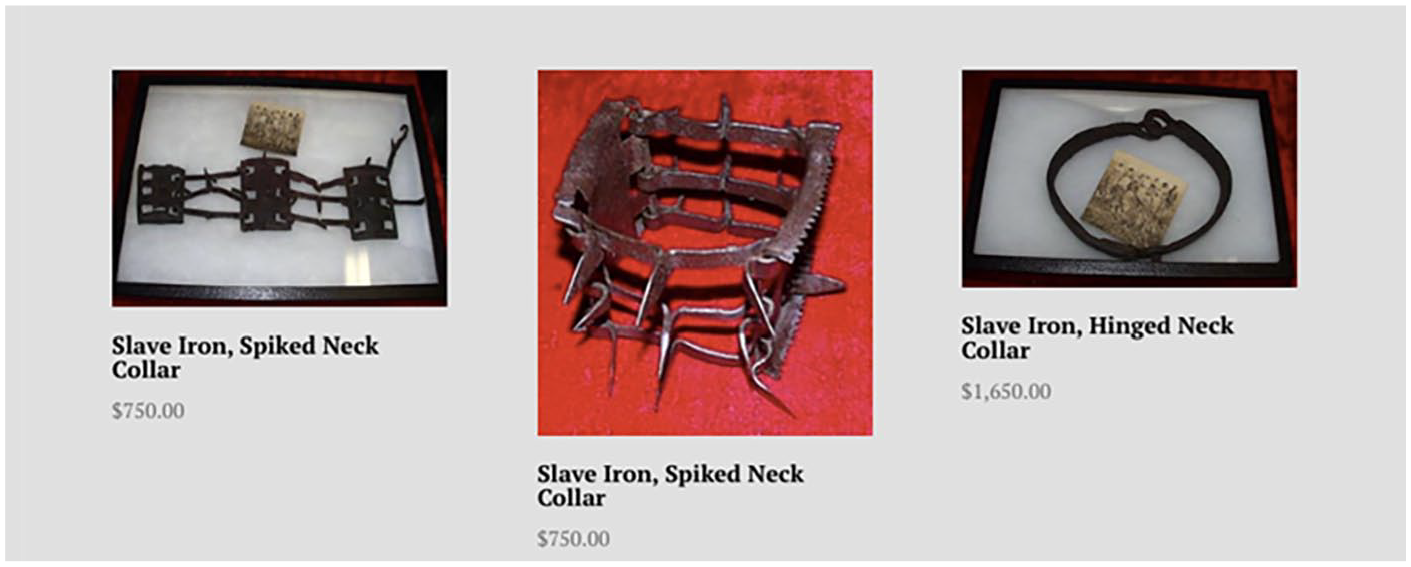
Screenshot from Uncle Davey’s Americana website.
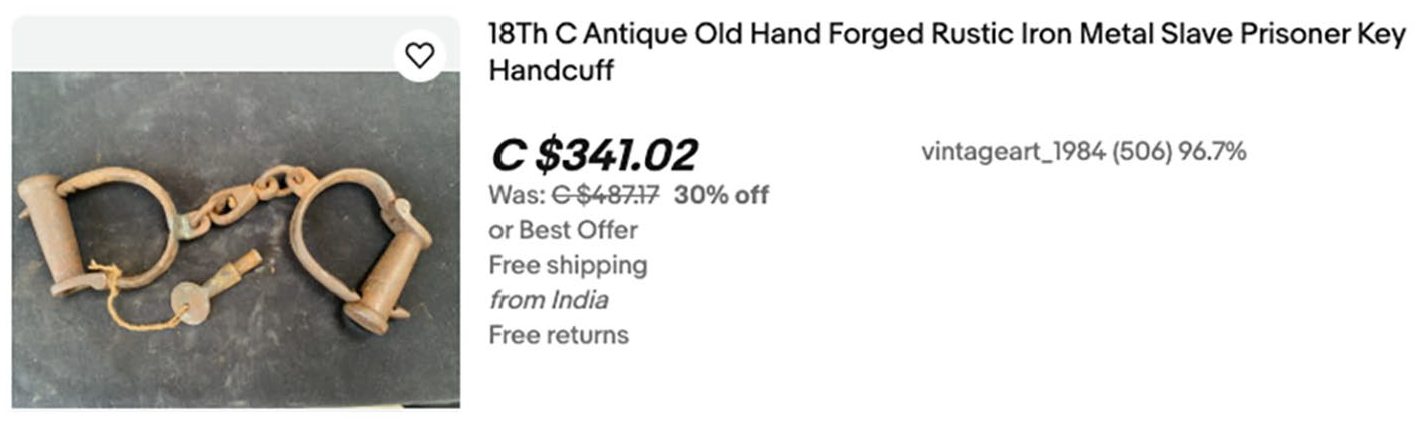
Screenshot from eBay website.
Research shows that consumers of these items, like other racist media and cultural productions, are mainly white, male, and middle-aged persons (Pilgrim, 2017; Turner, 1994). I hesitated to share these screenshots in this piece, fearing that I might reproduce the very harm I seek to critique. However, I believe it is crucial for readers to confront the extent of racial violence embedded in these transactions. Engaging with these sites gave me a visceral understanding of the slave auction block—what Browne and McKittrick describe as both a historical and ongoing apparatus of dehumanization, fetishization, and racial violence. Like the auction block, these online marketplaces represent sites that make possible the moment of sale, commodification, and objectification of black bodies (Browne, 2015; Kent, 2022). Through these platforms, the economies of bodies, racial inferiority, and justified enslavement are enacted, representing contemporary instantiations of the slave auction block (Browne, 2015; McKittrick, 2006). As shown in Figures 1 to 3, slave binding equipment such as neck collars and keys, and photographs of branded slaves are price-tagged, advertized, and marketed on internet sites without considering how black populations, whose ancestries were the victims of slavery, are impacted.
A traumatizing observation from the sites is the eerily unsettling terms such as “any condition,” “new,” “used,” and so on (see Figure 4) that are used to describe the items. These mundane descriptions not only obscure the violence these items represent but also make vivid the degree of objectification. Even more jarring is the notion that the items can be “shipped” across the U.S., Canada, and globally (see Figure 5)—visibilizing the image of the transatlantic slave shipment and signifying the ongoingness of slave trade. An important analogy to establish here is that internet browsers like Explorer, Navigator, and more recently, Chrome, Fire Fox, Safari are symbolic slave ships that transport buyers and sellers to online sites such as eBay, Etsy, and Uncle Davey’s Americana to trade in slave memorabilia, just like the slave ships that took European slave traders and colonizers to plunder Africa, and steal Africans as slaves (Browne, 2015, Driscoll, 2020). As such, I argue that the internet becomes the new Atlantic, or what Driscoll (2020) calls the “new electronic frontier” through which the ‘Explorer’ and ‘Navigator’ are able to implement slave (artefact) trading.
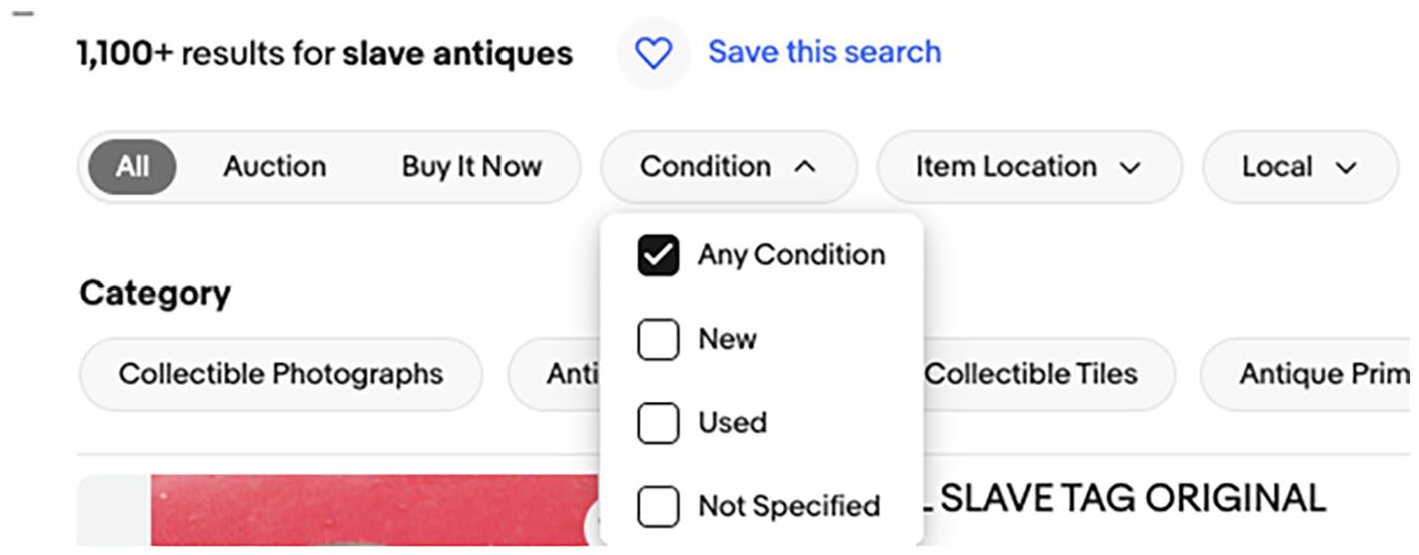
Screenshot from eBay.
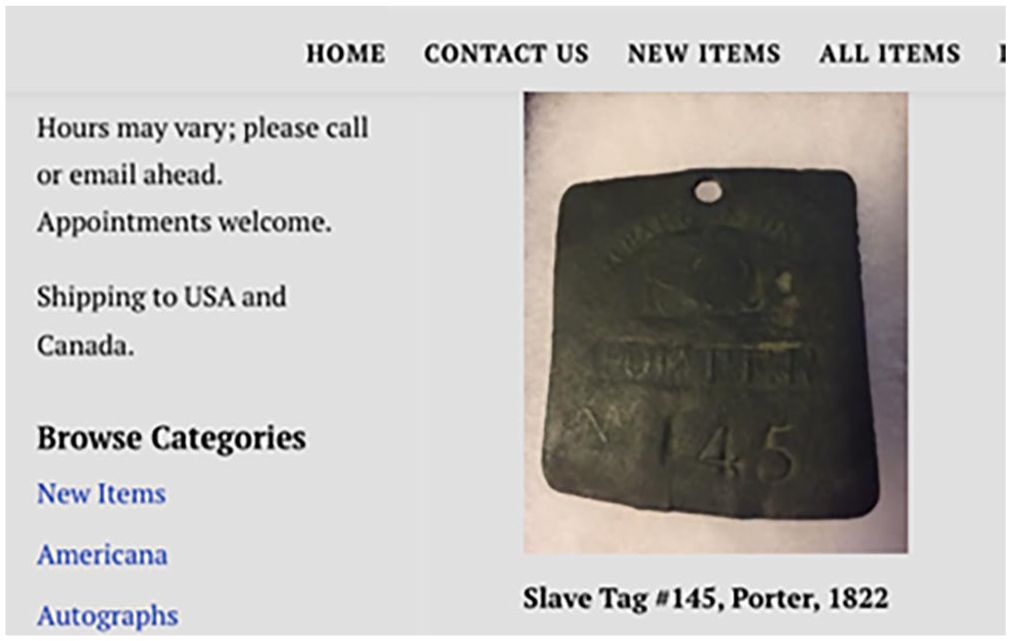
Screenshot from Uncle Davey’s Americana website.
This commodification reveals how black people continue to be portrayed in archive and collection cultures, reinforcing anti-black consumption and harmful practices (Hillis et al., 2006). hooks (1992) refers to this as “eating the Other,” which illustrates how the desire for the ‘Other’ is commodified for the purpose of gratifying white desire and consumption, where the ‘Other’ “becomes spice, seasoning that can liven up the dull dish that is mainstream white culture” because this ‘Other’ is seen as a “new delight, more intense, more satisfying” (p. 21).
As I observed, these sites tend to distort the history of the transatlantic slave trade by also advertising non-black and white bodies as “slaves,” thereby flattening distinct racial and historical traumas. In contrast to this harmful and racist revisionism, artists and educators, Mendi and Keith Obadike, black American couple of Igbo Nigerian origin, created a transgressive art piece titled Blackness for Sale, in which Keith Obadike put his blackness up for auction on eBay. Framed with marketing slogans that satirize those that are often used in actual slave artefact listings, the project disrupts the ongoing racial disposability through the online trade of racist collections and the commodification of blackness (Browne, 2015; Driscoll, 2017; Kent, 2022). Some of the slogans the artists used to market the so-called “benefits” and to signal the “warnings” of buying this blackness include: this heirloom has been in the possession of the seller for twenty-eight years; this blackness may be used for instilling fear; this blackness may be used for accessing some affirmative care action benefits (Limited time offer. May already be prohibited in some areas); the seller does not recommend this blackness to be used while demanding fairness; this blackness may be used by blacks as a spare (in case your original blackness is whupped off you); the seller does not recommend that this blackness be used by whites looking for a good time (Browne, 2015; Driscoll, 2017, 2020; Kent, 2022).
These descriptions represent the everyday ontological realities and resistance practice of black people. The artists also depict how the image of slave shipment and anti-black consumption is enacted through cyber marketplace. For example, they bring back the metaphor of shipping slaves across the United States and Canada (see Figure 6). They also indicate the price tag ($152.50) for the blackness that they put up for sale in contrast to the price ($10.00) offered by the first fictive bidder (see Figure 6). This suggests how black people have been reduced to what McKittrick (2014) calls “breathless numbers” (p. 17) or what she describes as mathematics black life, which reveals how black archival presence depicts the ways in which “blackness is cast inside the mathematics of unlivingness where black comes to be a bit” (p. 18).
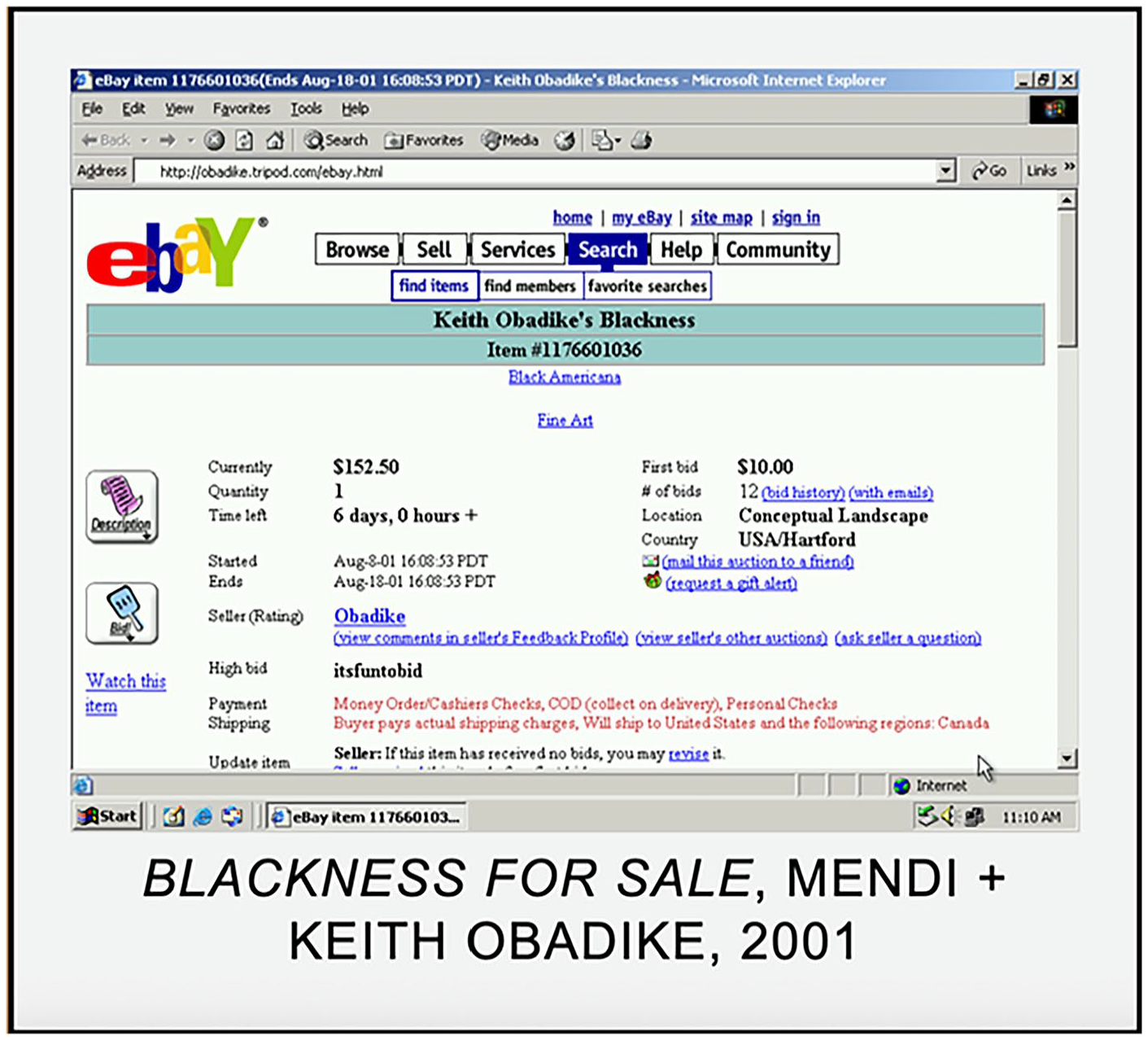
Screenshot from Net Art Anthology.
The Obadikes’ subversive black art auctioning is an intervention—a counterframing that challenges the normalization of slave memorabilia as kitsch collectibles. It exposes the discomforting ease with which racism is aestheticized and marketed, inviting public reflection on the violence of such commodification (Browne, 2015; Kent, 2022). Their project, which continues to generate conversations about the intersection of art collection, commerce, and race, also makes visible the disturbing reality that items once used and still being used to dehumanize black people—lynching photos, charred slave garments, severed body parts, mammy figurines—are being auctioned and collected (Browne, 2015; Driscoll, 2020; Hillis et al., 2006; Pilgrim, 2007). The intervention raises awareness of how collecting and consuming blackness in the form of vintage wares and photographic and branding artefacts reproduce and represent the ritualized practices and trauma of white supremacy, which justify colonial and slave practices (Browne, 2015). Often, black women’s bodies, and black women generally, are doubly objectified and sexualized in these online transactions, just as was done through the slave auction block (Browne, 2015; McKittrick, 2006), including through the mammy images that stereotype black women as female domestic slaves within white households and are saddled with roles as caregivers and wet nurses to white children (Driscoll, 2020; Pilgrim, 2000).
These artefacts are not just historical relics but souvenirs of white supremacy—symbols of domination passed down, collected, and preserved, which implies that those in possession of such collections own a part of someone, as a keepsake to remember their role as participants in acts of anti-black slavery that serve as a means of (re)constituting a slaver-trader community (Browne, 2015). The Obadikes’ Blackness for Sale disrupts this ritual of ownership and consumption. The auction was meant to last for 10 days, but after only 4 days, eBay flagged it as inappropriate and removed it (Kent, 2022). This confirms the power of anti-racist counterframing through arts. The project has sparked widespread dialogue about collections, race, and online commerce. In doing so, it has exposed how the digital marketplace has become a site of violence as well as resistance. Yet, the practice of anti-black consumption through cyber marketplace collections persists.
Conclusion
Cyber marketplace and collections are not neutral. As this article has shown, they could be haunted by the ghosts of slavery—where black suffering is reified. Yet, through counterframing acts like Blackness for Sale, artists and scholars can illuminate how racial violence is archived and circulated, and how it might be resisted. As museum scholars, artists, educators, critical race scholars, it behoves on us to not only witness but intervene and disrupt the cycles of cultural consumption that trade in black pain under the guise of aesthetics. The question, then, is not whether these racist collections belong in the marketplace, whether physical or digital, but whether the silence of scholarship permits them to stay.
Footnotes
Declaration of Conflicting Interests
The author declared no potential conflicts of interest with respect to the research, authorship, and/or publication of this article.
Funding
The author received no financial support for the research, authorship, and/or publication of this article.
