




Abstract
Collecting is a significant element in museum work, and is characterized by two main parameters, the manner of collecting—active or passive, and the sorting methods used for sorting the items prior to accepting them as part of the collection. The combination of these parameters influences the collection’s quality, as well as reflects the museum’s development, its status, the way it functions, etc. In addition, dealing with the manner of collecting and sorting items reflects the management and curatorship processes, the financing issue and the professional ties the museum maintains. This review presents the history of the collecting policy in a small urban museum in central Israel, in an effort to understand the meaning of the above mentioned parameters regarding the quality of the museum’s collection.
The Rishon Lezion Museum was established as part of the city’s 100th anniversary and as a follow-up to the establishment of the city’s archives. These institutions were established due to the city management’s wish to proudly present its local history. At first, the museum focused on the period of the city’s establishment as an agricultural village, ending with it becoming a local council. Later, the museum expanded its time and place definitions.
Over time, the museum had several managers and collection managers, all of whom learned museum work while performing their duties due to the lack of professional training at the time. This staff developed the collection and managed it. While the first manager had a centralized management approach and was involved in both the collection management and its curatorship, the following managers decentralized the different roles. However, the move from centralized to decentralized management did not change the collecting methods used.
According to the vision of the museum’s establishment, the need for development of theme-based exhibitions, and additional reasons, the museum used several methods in creating its collection. The main method was active collecting (from the community, organizations and institutions, according to the needs of specific exhibitions), in accordance with the museum’s goals and objectives. In addition, many items were received in a non-selective, cumulative and uncontrolled manner. As mentioned above, this collecting policy was determined by staff members, creating tension between controlled quality and uncontrolled non-quality collecting.
As the diagram (Figure 1) clearly shows, over time the collection developed in two parallel axes, matching the collecting and sorting methods acceptable worldwide. The museum staff’s intuitive collecting was controlled, which led to the creation of a quality collection. However, the staff also used a cumulative collecting method, with no sorting or selection, leading to the creation of a non-quality collection. The use of contradicting methods stemmed, among other things, from a lack of a clear collecting policy and an obligation to the local community expressed by the inability to refuse offered items. This duality in the development of the collection was ongoing over time, influencing the collection’s quality.
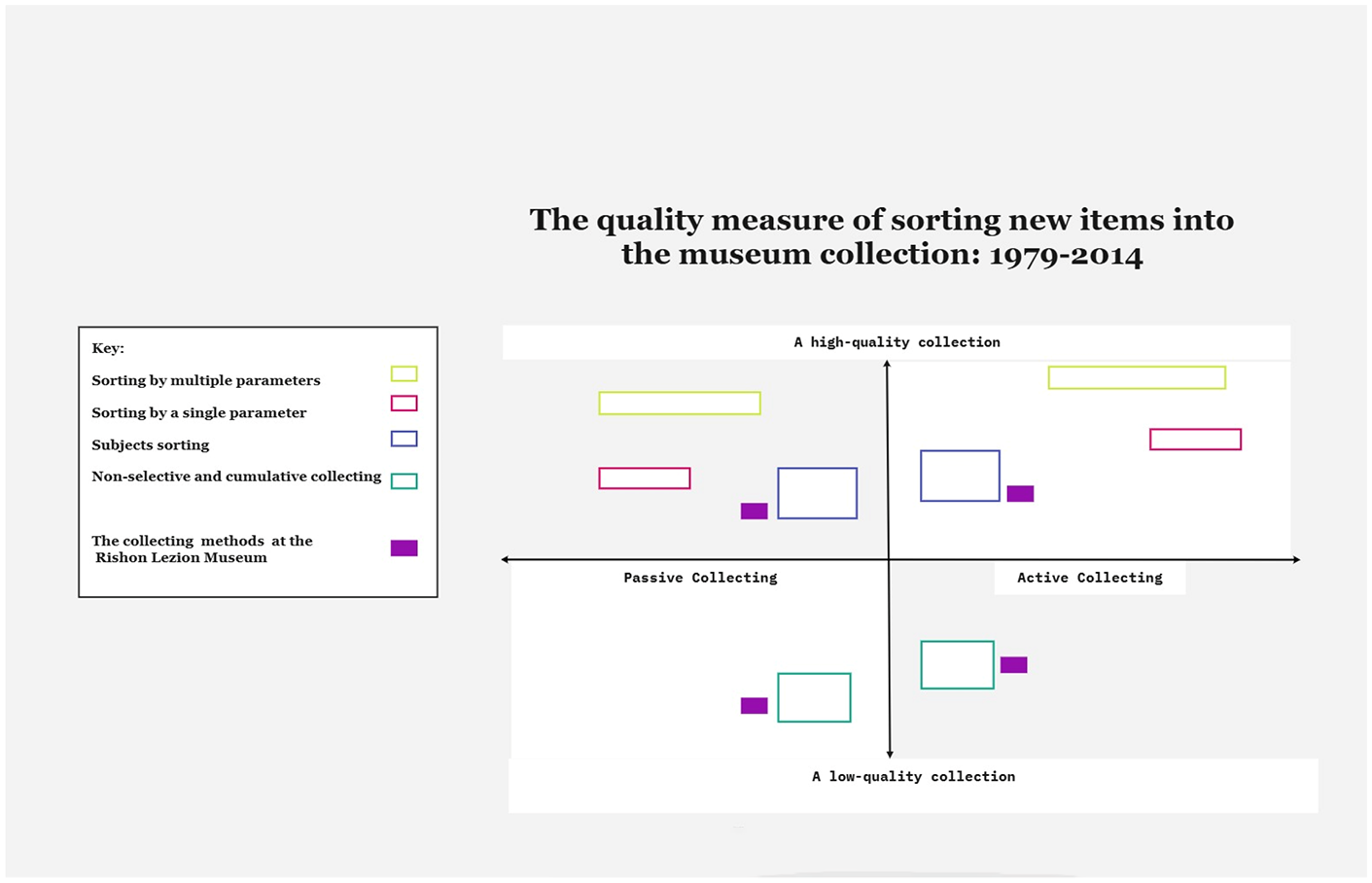
The quality level of sorting new items at the Rishon Lezion Museum, 1979–2014.
An additional element which influenced the quality of the collection at the Rishon Lezion Museum was the decision to sort the items prior to their acceptance according to the different methods (quantitative/qualitative, etc.), while the non-selective cumulative collecting was not followed by sorting of any kind, thus damaging the collection’s quality.
The collection development policy at the Rishon Lezion Museum remained static over decades, finally thwarting the development of a quality collection. It is also apparent that the move from centralized to decentralized management did not lead to professionalization in the collecting domain. In fact, the lack of collection policy and its correspondence with museum knowledge finally influenced the museum’s character and collection development. In light of this case study, taking into account the development of research and knowledge of collecting and sorting methods over the past decades, it is possible to determine that policy on the one hand and the implementation of collecting and sorting methods according to this policy on the other will improve the collection’s development and quality.
Footnotes
Declaration of Conflicting Interests
The author(s) declared no potential conflicts of interest with respect to the research, authorship, and/or publication of this article.
Funding
The author(s) received no financial support for the research, authorship, and/or publication of this article.
