




Abstract
Limited research has explored museum professionals’ perceptions of workplace hazards and risks, despite the presence of various health threats in museum work environments. This study aims to identify perceived chemical and biological hazards and contributing factors in Finnish museum workplaces. Utilizing data from two surveys and qualitative content analysis, it uncovers a range of perceived hazards, often linked to collection storage facilities, historical buildings, and museum collections. Mold, indoor air quality, and dust are central concerns. While recognizing chemical hazards in collections proves challenging, accident-related and ergonomic hazards receive broad recognition. Workplace hazards are perceived to be rooted in systemic and cultural factors, encompassing haphazard management, recurring themes of neglect, limited safety knowledge, and negative attitudes. Enhancing workplace safety in museums necessitates a comprehensive approach, including support and education for leaders and other professionals, improved work practices and storage facilities, and increased budgetary support.
Introduction
Scholars have long maintained an interest in the chemical and biological hazards linked to museum collections and work environments as well as in the health effects associated with them (Bastholm et al. 2022; Hawks and Makos 2000; Irvin, Cooper, and Hedges 1972; Marcotte et al. 2014; Sheldon and Johnston 1941). However, few have specifically addressed museum professionals’ perceptions of occupational hazards, even though understanding these perceptions is crucial for developing effective strategies to mitigate risks and ensure occupational safety. Slocum (2018) has studied awareness and policies regarding toxic materials in collections, while Shuang, Kamaruzzaman, and Zulkifli (2014) have delved into the perceptions of both visitors and staff regarding sick building syndrome. Additionally, there are studies concerning museum professionals’ experiences and perceptions of the COVID-19 pandemic and its influence on museums (Kieffer 2021; Pekonen 2022). Finally, conservators’ perspectives on conservation chemicals have been assessed in two recent studies (Gendron, Schrager, and Kingery-Schwartz 2022; Koss Schrager, Kingery-Schwartz, and Sobelman 2023).
This study aims to address the gap in the literature by investigating the perceptions of chemical and biological hazards among museum professionals in Finland. It seeks to identify the types of hazards considered significant and factors perceived to contribute to hazard development within museums. The survey data utilized and analyzed in the study was collected in 2022 as part of The Finnish Institute of Occupational Health’s (FIOH) Perceived and Measured Hazards in Finnish Museum Work Environments (MUHA) project.
In Finland, occupational hazards are commonly defined as potential sources of harm or danger in the workplace, while risks refer to the likelihood and severity of the harm that may occur (Riskien arviointi ja hallinta työpaikalla -työkirja 2021). In this study, hazard classification aligns with the widely adopted categorization of occupational hazard identification and risk assessment in Finland, covering chemical, biological, physical, accident-related, ergonomic, and psychosocial hazards (Riskien arviointi ja hallinta työpaikalla -työkirja 2021). In museums, chemical hazards, such as heavy metals, asbestos, and organic solvents, can arise from various sources, including collections, heritage buildings and sites, and the chemicals used in work tasks (Haberstich 1988; Hawks and Makos 2000; Kennedy and Kelloway 2021; Macken and Smith 2019). Biological hazards encompass various microorganisms, including mold fungi and viruses, such as COVID-19, which was prevalent in Finland during the surveys (Bastholm et al. 2022; Irvin, Cooper, and Hedges 1972; Oksanen et al. 2023).
Risk perception involves how individuals understand and interpret potential hazards and risks in various life aspects, shaped by beliefs, experiences, and cultural, institutional, and social influences (Bye and Lamvik 2007; Douglas and Wildavsky 1983; Hilhorst 1996; Möller 2012; Paek and Hove 2017). According to Slovic’s (1987) seminal work Perception of Risk, understanding lay people’s risk perceptions requires considering factors “dread risk” and “unknown risk.” The former includes feelings of lack of control, dread, catastrophic potential, and fatal consequences, while the latter involves hazards judged as unobservable, unknown, or new. Hazards rated higher on these factors, especially dread risk, are perceived as riskier (Slovic 1987). Moreover, groups often share common risk perceptions, influenced by their cultural affiliations, including the organizational culture at the workplace and the professional culture within the field (Bloor and Dawson 1994; Möller 2012). For instance, a recent study by Koss Schrager, Kingery-Schwartz, and Sobelman (2023) found that conservators’ perceptions of risks related to cyclododecane were influenced by their peers. In contrast, different groups within the same organization may have differing risk perceptions, with managers often more optimistic than employees (Hilhorst 1996; Tear et al. 2016).
While risk perceptions may not necessarily correlate with objective risks, and risk assessment is subjective, perceived risks can still be real (Möller 2012; Slovic 1987, 1999). Additionally, the perspectives of employees can offer valuable insights into risks and their underlying causes (Hilhorst 1996).
Materials and Methods
The MUHA project conducted two surveys in February 2022 to investigate chemical and biological hazard awareness as well as health and safety practices in Finnish museums. Given the lack of previous studies on occupational safety in museums in Finland, the project aimed to gain a comprehensive understanding of the situation in the field. Surveys were considered suitable approach for this purpose. 1
The author developed the surveys by drawing from international literature on museum hazards, Finnish legislation, occupational hygiene, and personal experience in museum work and hazards (Sinisalo 2018). Additionally, some questions from a background survey created by the author for participants of a museum safety training webinar organized by the Union of Museum and Cultural Heritage Professionals MAL on June 15, 2020, were incorporated. Furthermore, inspiration was drawn from the results of background surveys conducted and presented by Kerith Koss Schrager during the webinars of the C2C Care Course: Health and Safety in Collections Care hosted by the American Institute for Conservation from July 20th to August 24th, 2021.
Survey 1 was a census study, and it encompassed 75 main questions along with sub-questions. Meanwhile, Survey 2, which was anonymous, employed a self-selected sample approach, covering 141 main questions with sub-questions. The surveys were semi-structured, including closed-ended, open-ended and semi-open questions. Survey 2 also included opinion-based queries and allowed respondents to share information about their past workplace, in addition to their current one. Both surveys aimed to explore perceptions of hazards and risks in museum work, awareness, and experiences with workplace safety practices, collection management, documentation, mitigation measures, symptoms, and safety enhancement efforts. The surveys were conducted using the Webropol survey application. The study design assumed that gathered data reflects respondents’ understanding of reality. Ethical approval was obtained from the FIOH’s Ethical Committee, and participation was voluntary. The surveys underwent pilot testing with four respondents each in January 2022, leading to minor technical adjustments.
Survey 1 aimed to collect data from all professional museums across Finland, encompassing the 151 organizations listed in the Finnish Museum Statistics (Finnish Museums 2022: Facts and Figures 2023) and others with at least one permanent employee involved in museum-related work. Invitations were emailed to 237 2 organizations, reaching museum directors, managers, or individuals responsible for collections to respond on behalf of the museum. On the other hand, anonymous Survey 2 targeted individuals working, volunteering, or retired from professional and local museums, as well as related fields like private conservators. This diverse group included at least 2,700 employees in professional museums, alongside hundreds of employees and thousands of volunteers in local museums, and others connected to the museum sector (Finnish Museums 2022: Facts and Figures 2023; Paikallismuseotoiminta Suomessa vuonna 2021 2022). Invitations were distributed through various channels.
Survey 1 received 99 responses from 78 different museum organizations, while Survey 2 received 118 responses from anonymous participants. The response rate for Survey 1 was a minimum of 33%, 3 but it is not possible to ascertain the response rate for Survey 2 due to the unknown size of the population.
Respondents from Surveys 1 and 2 were asked partially different background questions; however, for certain background information, comparisons are possible. Although most respondents from both surveys were employed in cultural-historical museums or museums housing art and/or natural history collections alongside cultural-historical collections, and over half worked in museums owned by cities or municipalities, there were some demographic differences. Survey 1 respondents came from museums with smaller staff sizes compared to Survey 2 respondents. 4 Additionally, a larger proportion of them held leadership roles, with 30% being directors, 26% managers, and 44% representing other professional roles. However, it’s likely that in many museums, multiple individuals collaborated in responding to Survey 1, making it challenging to distinguish between management and employees based on the job title of the primary respondent. 5 In Survey 2, respondents could select multiple job tasks, with the most common being collection work (58%), exhibitions (39%), audience engagement (29%), and conservation (27%). Only 7% held management roles. Survey 1 respondents were not asked about their work tenure, but 40% of Survey 2 respondents had worked or volunteered at their current workplace for 0 to 5 years, 30% for 6 to 14 years, and 30% for 15 years or longer.
To explore respondents’ perspectives on the most significant hazards, health risks, and safety challenges within their current or previous workplaces, as well as within museums in general, responses to two open-ended questions from Survey 1 and five from Survey 2 were selected for qualitative content analysis. These seven questions represent just a fraction of the extensive MUHA surveys. Only those open-ended questions were included where hazards and risks were comprehensively addressed, rather than focusing on narrower topics such as hazards related to collections or facilities. In addition, quantitative questions were excluded from this paper.
Qualitative content analysis involves identifying categories or themes within written texts to summarize and highlight key content. It can be applied to various types of texts and may use theory-based or data-grounded approaches, or a combination of both. The coding process is integral to the analysis, following by the reorganization, summarization, and interpretation of coded categories. Both explicit (manifest) and implicit (latent) content are examined, including underlying themes. (Bengtsson 2016; Drisko and Maschi 2015)
In this study, the identification of occupational hazards was theory-based and deductive, but otherwise the author proceeded inductively based on the material. The author’s understanding of museum work, developed over almost 20 years working in Finnish museums, likely influenced the interpretations.
The unit of analysis in coding ranged from individual words to short phrases and longer texts, as well as latent content. However, it was mostly limited to relatively short expressions, as many open-ended responses consisted of only one or two words or lists of words. Often, the answers were so brief that fully grasping the intended meaning proved challenging, such as determining whether “mold” or “dust” was related to facilities, collections, or something else. Nonetheless, many respondents provided more comprehensive descriptions and explored the origins, contributing factors, and consequences of the hazards. The themes emerging from the data were not quantified, but attention was paid to their consistency or rarity. Because it was not possible to reliably distinguish between the responses of the management and the employees, the responses were analyzed collectively.
Finnish Museum Professionals’ Perceptions on Occupational Hazards and Their Causes, Contributors, and Consequences
Biological and Chemical Hazards and Their Immediate Causes
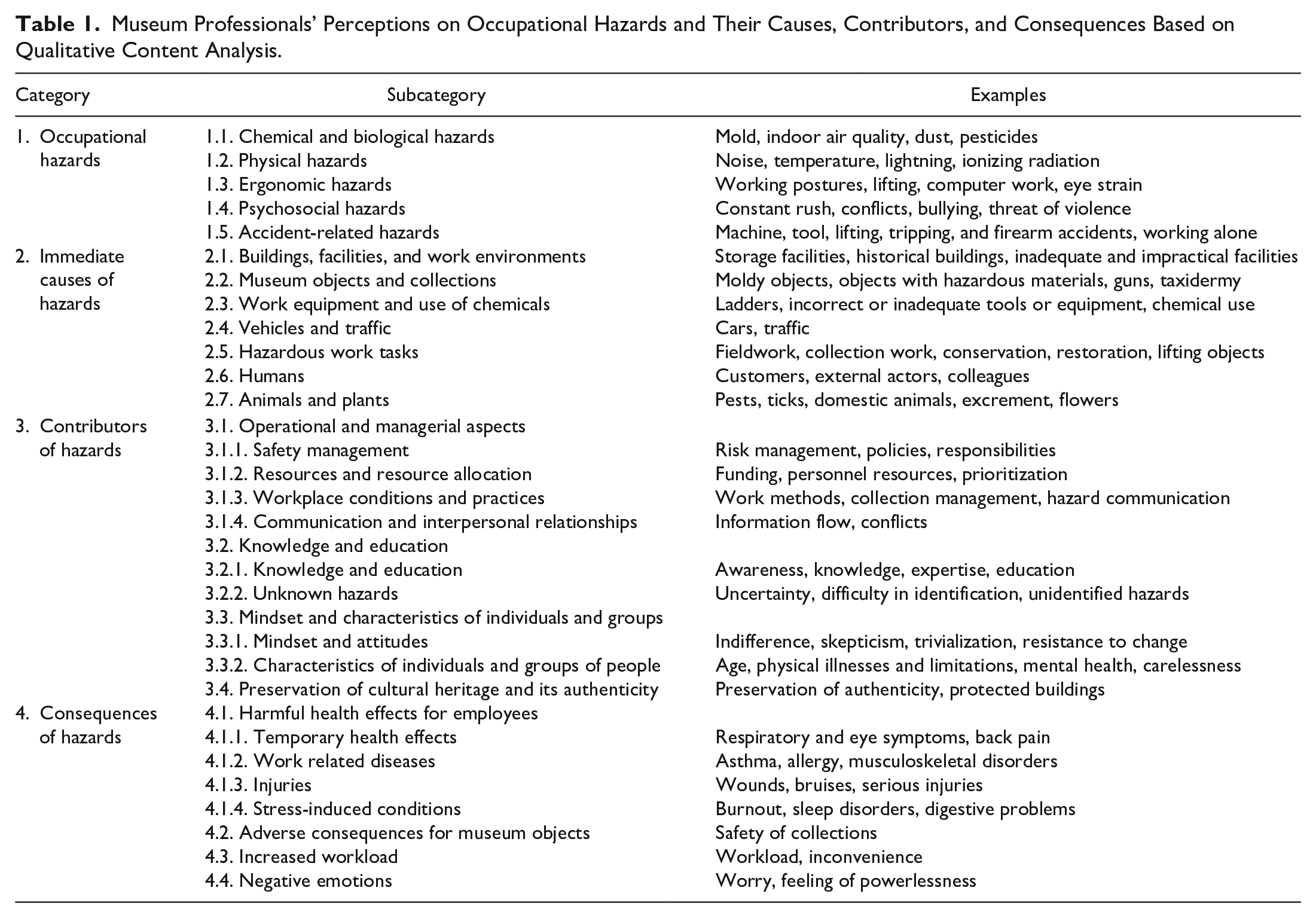
Museum professionals reported a multitude of chemical and biological hazards as well as a wide range of other stressors and hazards, including physical, ergonomic, psychosocial, and accident-related factors, which were perceived to originate from diverse sources (Table 1). Each of these sources had the potential to create a range of hazards. For instance, museum objects could house mold, contain harmful materials, necessitate awkward postures for workers, or pose risks due to their sharp edges.
Museum Professionals’ Perceptions on Occupational Hazards and Their Causes, Contributors, and Consequences Based on Qualitative Content Analysis.
Dust, mold, and indoor air quality challenges were perceived commonly and often associated with museum collections and facilities, like low-quality storage facilities and historical buildings. Some respondents explicitly connected poor indoor air quality to specific causes like mold, fine particulate matter, or emissions from building materials. However, many respondents did not explain their terms or distinguish between mold and indoor air quality issues, using these words interchangeably.
Some hazards were considered inherent (Hawks and Makos 2000), including materials like asbestos, creosote, heavy metals, and toxic pigments, as well as other “harmful materials in objects” 6 (S2Q4R15). Others were perceived as acquired hazards (Hawks and Makos 2000), such as dust and mold. Many of the respondents perceived that there was the possibility that “over time, objects may have been treated with all sorts of toxins” (S2Q4R81), including pesticides and other “harmful chemicals added to museum objects” (S2Q47R5).
Interestingly, many respondents seemed to prioritize other hazards over chemical and biological hazards, especially those present in museum collections. Some even downplayed their significance, emphasizing the importance of other hazards, especially accident-related ones, as illustrated by one respondent: “(The most significant health risks in museum work are) exactly the same occupational accidents as in any job (slipping, something falling/tipping over, threats from customers), as well as accidents that happen in traffic.” (S2Q4R14). This may indicate a lack of awareness regarding chemical and biological hazards in general as well as “museum specific” hazards, as suggested by another respondent: “(The biggest challenge is) expanding the concept of occupational safety to include issues addressed in this survey.” (S1Q82R98).
Respondents found it difficult to identify chemical hazards within museum collections, describing them as “invisible hazards” and “unidentified substances.” Similarly, in a study concerning toxic materials in museum collections, none of the participating museums knew precisely what toxic substances were present in their collections (Slocum 2018). Some Finnish museum professionals believed that these hazards did not exist in their work environments or that they posed an insignificant health risk. This observation does not align with Slovic’s (1987) concept of “unknown risk” but is consistent with the conclusions of Nenonen et al. (2021) and Antonucci et al. (2010) who have observed that employees tend to view hazards as less risky if they are either difficult to perceive through the senses or cause gradually developing occupational diseases. According to them, easily recognizable hazards primarily refer to sudden accidents, which is in line with the findings of this study.
Nenonen et al. (2021) and Antonucci et al. (2010) observe chemicals, gases, mold, and dust as challenging to perceive. However, mold/indoor air quality and dust did not go unnoticed by Finnish respondents who paid attention to “organic growth,” “old dust,” and stale indoor air. This heightened awareness may stem from the detrimental effects that mold and dust can have on collections, prompting museum professionals to give them special attention. Additionally, Finland has a history of extensive and long-standing concerns about indoor air quality and building moisture damage, sparking lively public discussions (Karvonen et al. 2021; Lampi et al. 2019; Tähtinen et al. 2020). The general population in Finland believes that both moisture damage and indoor air have broader health implications than research evidence alone can assess (Karvonen et al. 2021; Lampi et al. 2019). Furthermore, mold in museums has received some media coverage (Kaipainen 2013) and has appeared in the industry’s professional publications (Hakkarainen 2018).
Many respondents perceived animals or their excrement, bites, or stings as potential hazards, including various pests, insects, and both wild and domestic animals. These hazards were connected to poor-quality storage facilities, open-air museums, fieldwork, 7 and to tasks related to museum collections or animal care. They were associated with allergies, asthma, and disease transmission. Specific zoonotic diseases like epidemic nephropathy (“vole fever”) and tularemia (“rabbit fever”) were mentioned, along with disease-carrying animals such as bats, rodents, and ticks known for transmitting diseases like rabies, epidemic nephropathy, Lyme disease, and tick-borne encephalitis (Raulo et al. 2023).
Concerns about airborne disease transmission from humans, including COVID-19, were rare and mainly tied to customer service. The lack of concern towards COVID-19 is surprising, given its significant impact on Finnish museums, including facility closures, furloughs, salary suspensions, and financial losses (Koronapandemian vaikutuksia kulttuurialalla 2020–2021. Raportti kyselyn vastauksista 2021). However, the primary concern may not have been health but rather economic factors, as observed in a study concerning U.S. museum workers (Kieffer 2021). Additionally, museum professionals may have regarded the pandemic as a temporary issue, separate from the daily operations. These perceptions could have unconsciously led respondents to prioritize hazards that are considered more enduring and fundamental.
Finally, various chemical factors related to different work tasks and chemical use were mentioned. Concerns included wood dust from exhibition construction, conservation chemicals, cleaning agents, organic solvents, and paints.
Intangible Contributors of Hazards
Museum professionals often addressed intangible factors that contributed to the incubation of hazards and exacerbation of risks in the workplace (Table 1).
Operational and Managerial Aspects
Safety management practices encompass the methods employed to oversee occupational health and safety within an organization, including risk management, mandated by the Finnish Occupational Safety and Health Act (Työturvallisuuslaki 738/2002 2002). Concerns surfaced among museum professionals, particularly anonymous respondents, regarding the disorganized nature of safety management in their workplaces, including unclear responsibilities, the absence of established policies, and deficient risk management. Respondents observed that risks were often either not assessed or assessments were perceived to be lacking. Some expressed concerns about unidentified hazards, while a few believed that all hazards had been eradicated. These instances underscore potential shortcomings in risk management, which ideally should be an ongoing, continuous process, never truly completed (Anttonen and Pääkkönen 2010). Effective risk management can significantly enhance workplace safety, as exemplified in a study on construction accidents, where deficiencies in risk management played a paramount role among influencing factors (Haslam et al. 2005).
Another challenge pertained to limited resources. Respondents noted the struggle museums face due to constraints in finances, personnel, and time. This, in turn, often led to safety being deprioritized in favor of other tasks. Some studies have highlighted “role overload” in management, where handling multiple and sometimes conflicting responsibilities can hinder effective safety leadership, making safety work seem like an additional burden (Conchie, Moon, and Duncan 2013; Tappura, Nenonen, and Kivistö-Rahnasto 2017). Responses from museum professionals imply that role overload may affect not only management but employees as well.
Workplace conditions and practices represent another category of contributing factors. Challenges encompassed shortages of tools and personal protective equipment, as well as the use of improper work methods. Respondents reported shortcomings with hazard communication, such as the orientation of new employees, the absence or underutilization of guidelines, deficient hazard documentation, and inadequate use of warning signs.
Tomás-Hernandez (2021) has coined the term “storage debt,” defining it as the outcome of decisions that compromise documentation, conservation, or security standards in the management of museum collections stored away from public view. Storage debt is driven by resource scarcity, indifference, unclear responsibilities, and competing priorities. Neglecting it results in more profound issues. Storage debt is evident in the responses of Finnish museum professionals, highlighting issues like neglected building maintenance, insufficient collection management, and a lack of cleaning. These problems not only compromise the preservation of museum collections but also the health of employees. For instance, one respondent emphasized: ‘The level of cataloging for the museum’s object collection is subpar, and staff has no idea about everything that is in the collection. In storage, objects are sometimes packed in rather dubious boxes, and the labeling is deficient, one can never be certain about what they’ll encounter when opening a box’ (S1Q81R61).
Finally, communication and interpersonal relationships played a crucial role. Issues included interruptions in information flow within the museum and with the parent organization, an absence of safety discussions, and relationship problems with colleagues and superiors.
Knowledge and Education
A recurring theme was the widespread lack of knowledge and awareness, particularly concerning the identification of chemical hazards present in museum objects. This knowledge gap was not confined to individuals but was seen on a larger scale within workplaces and the broader Finnish museum sector. Factors contributing to this gap included inadequate cataloguing, the absence of risk assessment procedures, the lack of conservators on museum staff, the age of employees, and a broader issue of inadequate safety education in the field. As one respondent emphasized, “The greatest health risks are related to a lack of knowledge. At the beginning of my career, no one talked about the health risks associated with museum collections/objects. The field needs more education, especially for those already in the workforce” (S2Q4R13). It is likely that not all museum professionals are able to recognize their own lack of awareness, which may lead to exposure to chemical hazards.
Koss Schrager, Kingery-Schwartz, and Sobelman (2023) have pointed out that the conservator community lacks a well-established health and safety culture, due to the absence of consistent health and safety training in educational programs and workplaces. In Finland, this lack of awareness may, in part, be attributed to the professional culture. As far as the author knows, occupational safety has not been fully integrated into the training of museum professionals in Finland. However, since 2017, 8 organizations and individuals have initiated safety-related lectures, courses, and seminars, particularly addressing chemical and biological hazards.
Mindset and Characteristics of Individuals and Groups
Some respondents believed that workplace safety was compromised by the mindset of both management and employees. They mainly criticized the commitment and attitudes of museum management and higher-level management for their indifference, lack of awareness, trivialization, and skepticism regarding hazards. For instance, one response emphasized, “Management attitudes/ignorance and reluctance to incur additional costs.” (S2Q83R34).
Employee attitudes were viewed as hindering safety prioritization and reluctance to use personal protective equipment, with more profound impacts arising from management attitudes. Anonymous respondents, often not in managerial roles themselves, emphasized leadership commitment, expressing disappointment and distrust when hazard reports led to limited or no action. This echoes findings from other studies underlining trust issues and doubts about management’s safety dedication (Brown et al. 2006; Hambach et al. 2011). The concern is substantial, as employees’ perceptions of their managers’ commitment to safety has been found to be a significant indicator of safety compliance and accident rates (Subramaniam, Shamsudin, and Alshuaibi 2017; Tappura, Nenonen, and Kivistö-Rahnasto 2017).
The lack of understanding about hazards or the nature of museum work was considered a significant factor contributing to negative attitudes. One respondent noted, “The biggest challenge is to make the management understand the nature and needs of collection work. It’s difficult to make improvements if collection work is not understood or seen as important.” (S2Q162R18).
Additionally, specific individual and group characteristics, including physical disabilities, mental health issues, age, carelessness, and profession, were regarded as factors that could influence workplace safety. Volunteers were perceived as having a negative influence due to their age and limited hazard awareness, while conservators were viewed positively for their better understanding of hazardous materials compared to other professions.
Preservation of Cultural Heritage and its Authenticity
Preserving cultural heritage was perceived to have an impact on occupational safety. In protected buildings and other historical museum environments, it was not always possible to implement necessary measures without jeopardizing the authenticity of the site, as illustrated by this example: “The outdoor museum area poses its own challenges for occupational safety development because the area is intended to be maintained as authentically as possible.” (S1Q82R32).
Authenticity is seen important in heritage as it shapes a collective understanding of society and individual identity (Wood 2020). A perceived loss of authenticity can undermine personal identity and the cultural and social stability that communities rely on (Wood 2020). However, the commitment to preserving cultural heritage and its authenticity does not necessarily imply that museum professionals are unwilling to take significant measures when they perceive a threat to someone’s health. In a Finnish study, art museums found it more acceptable to deaccession artworks that posed risks to other objects or staff compared to any other reasons for deaccessioning (Robbins 2016).
Perceived Consequences
Hazards were perceived to have various consequences (Table 1), with a predominant focus on health-related impacts on workers. While a few respondents expressed concerns about the safety of museum objects, others cited the COVID-19 pandemic as increasing their workload and causing operational inconveniences. The emphasis on health may be attributed to the framing of survey questions. However, despite listing chemical substances like asbestos, lead, arsenic, and creosote, none of the respondents raised concerns about risks to pregnant employees or carcinogenicity (Frilander et al. 2022), indicating potential awareness gaps. Moreover, other consequences like workplace reputation, employee turnover, and legal implications remained unaddressed.
Some respondents, both employees and those in leading positions, alluded to experiencing negative emotions, such as a sense of powerlessness stemming from the perceived inability to improve challenging situations, as exemplified by one participant’s statement: “The facilities, meaning we’re forced to stay in poor conditions. Leaders higher up in the organization than the museum haven’t wanted to allocate funding to collection facilities and workspaces” (S1Q82R25). This sense of powerlessness resonates with the concept of “environmental suffering” as elucidated in a recent study centered on Finnish school principals dealing with indoor air quality issues (Finell and Walden 2024). Environmental suffering represents a form of social distress stemming from an individual’s placement within a polluted environment (Auyero and Swistun 2009; Finell and Walden 2024). The principals in the above-noted study experienced distress as they attempted to address the concerns of employees but lacked the operational and financial authority to make improvements (Finell and Walden 2024).
To foster managerial commitment to safety, it is essential for top management to acknowledge, support, and allocate resources to safety initiatives (Tappura, Nenonen, and Kivistö-Rahnasto 2017). Extending similar acknowledgment and support to employees is also a reasonable consideration, which would likely reduce feelings of powerlessness.
Conclusion
Based on the responses from two surveys, it can be concluded that Finnish museum professionals perceive their work environment as a complex terrain where a variety of hazards, including chemical and biological ones, are in play. Prominent concerns raised in the surveys revolve around mold/indoor air quality and dust, possibly influenced by the heightened concern of mold and poor indoor air quality within the Finnish population. Accident-related and ergonomic hazards are also regarded as central, potentially even more critical than chemical and biological hazards. While some museum professionals express concerns about the challenging identification of ‘invisible’ chemical hazards, especially in collections, others may be oblivious to such hazards. Failure to perceive certain hazards can lead to inadvertent exposures.
Museum professionals attribute chemical and biological hazards to various immediate causes, such as inadequate storage facilities, historical buildings, and collections. However, underlying systemic and cultural factors contribute to these hazards, including operational and managerial aspects, knowledge, mindsets, and cultural heritage preservation. Many of the contributing factors point to neglect: the absence of appropriate equipment, insufficient orientation and working instructions, and issues like inadequate housekeeping, dirty and deteriorating facilities, and “storage debt” (Tomás-Hernandez 2021). Addressing these factors is likely to reduce hazards and health risks in museum work environments.
Occupational hazards are perceived to have various health impacts on workers, affect museum objects, increase workload, and contribute negative emotions. Carcinogenicity and risks for pregnancy might be underrecognized.
All the factors mentioned above are interconnected, influencing each other and, in turn, the hazards. Their interconnectedness emphasizes the need for a comprehensive approach to enhance safety in museum workplaces. This approach involves addressing safety management deficiencies by providing support and education to both leaders and current/future professionals in the field. Addressing issues with historical buildings can be particularly challenging due to their importance for museums. However, enhancing low-quality storage facilities in non-historical buildings or relocating collections to better storage facilities could significantly boost safety. Additionally, since hazards in collections are often hard to identify, taking essential safety precautions when storing and handling any collections is crucial. This includes prioritizing proper facilities, maintaining high standards of housekeeping, using protective gloves rather than cotton gloves, and practicing good hand hygiene. Achieving these improvements may require additional resources or a reallocation of existing ones.
This study presents several limitations. A more comprehensive approach involving the analysis of all open-ended survey questions or the adoption of a mixed methods approach combining qualitative and quantitative data could have yielded more comprehensive findings. Additionally, due to the survey structure, it was challenging to reliably differentiate between management and employee perspectives, despite potential differences between them. However, despite these limitations, the findings provide a foundation for future exploration and action. Addressing the contributing factors and prioritizing the creation of safer museum work environments can help protect the professionals responsible for preserving cultural heritage.
Supplemental Material
sj-docx-1-cjx-10.1177_15501906241263476 – Supplemental material for Museum Professionals’ Perceptions of Chemical and Biological Hazards and Risks in Museum Work Environments in Finland
Supplemental material, sj-docx-1-cjx-10.1177_15501906241263476 for Museum Professionals’ Perceptions of Chemical and Biological Hazards and Risks in Museum Work Environments in Finland by Henna Sinisalo in Collections
Footnotes
Appendix
Questions subjected to content analysis and the number of responses:
Acknowledgements
I wish to thank my PhD supervisors, Evgeny Parshintsev, Rick Bonnie, and Suzie Thomas, for their guidance. The article was translated from Finnish and improved using ChatGPT 3.5.
Declaration of Conflicting Interests
The author declared no potential conflicts of interest with respect to the research, authorship, and/or publication of this article.
Funding
The author disclosed receipt of the following financial support for the research, authorship, and/or publication of this article: The MUHA project and this article were made possible with the support of the Finnish Work Environment Fund (project number 210044).

Notes
Author Biography
References
Supplementary Material
Please find the following supplemental material available below.
For Open Access articles published under a Creative Commons License, all supplemental material carries the same license as the article it is associated with.
For non-Open Access articles published, all supplemental material carries a non-exclusive license, and permission requests for re-use of supplemental material or any part of supplemental material shall be sent directly to the copyright owner as specified in the copyright notice associated with the article.
