




Abstract
Scholarly attention is increasingly focusing on museum catalogues: their histories, challenges and, as this paper explores, their potential. Many databases contain outdated information and offensive language, the legacy of colonial-era knowledge production and digitization processes that translated catalogue cards into database entries. Much has been written about the potential of catalogues to act as sites of contact and collaboration, as well as how institutions can and should mitigate harm stemming from discriminatory language within their catalogues. Yet as museum practitioners are acutely aware, the extensive work required to enact change throughout a database is rarely perceived as exciting enough to garner dedicated project funding. This paper uses the Museum of Archaeology and Anthropology and the Stores Move Project (2020–2024) as a case study to illustrate how museums can, and realistically must, integrate critical documentation work into larger projects in order to achieve these objectives. The authors first engage with MAA’s own history of collecting and cataloguing, before detailing how collections staff have incorporated documentation priorities (re-cataloguing, historicizing data, and addressing bias) into the larger Project. They conclude with the hope that by making this work more visible and demonstrating its value, such projects might attract dedicated funding in the future.
Keywords
Introduction
In contrast to ethics of collecting and display (Brodie, Doodle, and Watson 2000; Kuper 2023; Moser 2010; Shelton 2000; Thomas 1991; Were and King 2014), the lens of academic attention has turned more slowly to museum catalogues past and present as sites of knowledge production and mediation (Greene 2016; Parry 2007; Turner 2016a, 2020). While catalogues and their forebears were once the exclusive domain of museum staff, the movement of databases online has made them widely accessible, so that catalogue records are often the first point of interaction between an individual and the museum. Both the means of access (a museum-branded portal) and the medium (a digital interface) give the impression of institutional authorship and up-to-date information. However, as collections staff are only too aware, this is rarely the case. For all but the most recent accessions, most catalogue records were not born digital. Rather, original handwritten catalogue cards were transcribed to create digital records, often stripped of authorship and creation context in the process. The result is that object records regularly retain language and interpretation from when they were first registered, but without any visible indication that this is the case. This consolidates the impression of up-to-date knowledge and makes instances of outdated information and offensive language all the more jarring and, at times, toxic.
As Lord (2006, 2) acknowledges, museums have often been “characterized as Enlightenment institution[s] whose power to collect and display objects is a function of capitalism and imperialism.” And yet the museum’s capacity for self-reflexive critique means that, rather than perpetuating existing power structures, it is “able to resist and transgress systems that cast power relations and historical events as fixed and necessary” (Lord 2006, 2). In other words, the museum and the database in particular can become powerful sites for the re-contextualizing of knowledge production and the extension of access and inclusion. Many scholars have explored the museum catalogue as just such a site of contact and collaboration, with a focus on engagement with source communities and the potential for multi-authored records foregrounding indigenous knowledge (Boast, Bravo, and Srinivasan 2007; Boden 2022; Hogsden and Poulter 2012b; Newell 2012). Others have proposed various approaches to mitigate harm stemming from offensive and discriminatory language encountered within catalogues, while maintaining institutional transparency. These have largely focused on methods of contextualizing the records, rather than removing outdated language from the catalogue (Briscoe et al. 2022; Chilcott 2019; Wright 2019). What is less often discussed is how old data can reduce access to collections by rendering them less searchable. Outdated terminology, spelling and analysis can obscure objects sought by individuals who are not fluent in the history of the discipline. For such records, reassessment and updated descriptions are essential if catalogues are to fulfill their purpose as an effective finding aid.
While there is a general consensus as to the value of providing context, increasing opportunity for collaboration, and updating descriptions for museums to be more equitable, inclusive and accessible, in practice there are significant barriers to achieving these goals. They are all predicated on time, resources and a database that allows for the representation of multiple voices. For museums with catalogue records ranging from the low hundreds to the hundreds of thousands, this can represent years—potentially decades—worth of work for already overstretched collections staff. Without dedicated funding, this means a piecemeal approach to change as and when staff come across records as part of their daily work. Unfortunately, the behind-the-scenes work required to instigate consistent, thoughtful change throughout an entire database is rarely perceived as essential or exciting enough to garner dedicated project funding. Indeed, the value of catalogue work can sometimes be underappreciated even within institutions, which often feel the pressure to produce new engagements rather than update old data. Realistically, museum practitioners must harness the opportunities presented in other forms to instigate change. Undertaking this work can propel change within the museum itself and the results used to advocate for further investment.
This paper uses the Museum of Archaeology and Anthropology (MAA), University of Cambridge, United Kingdom and the Stores Move Project (2020–2024) as a case study to illustrate how museums can integrate critical and in-depth documentation work into larger projects and, in so doing, provide outcomes that can be used to demonstrate net benefits to future funders. As Turner (2016a) argues, “in order to work towards a postcolonial, equitable information infrastructure like a catalogue, a full acknowledgement of the social history of the development of the system itself is the first step” (pp. 103–104). We therefore begin with an overview of MAA and the collections it cares for, then turn to the history of its catalogue and cataloguers and how the link between the two was obscured by the process of digitization, before briefly detailing the development of the Museum’s database. Finally, we will explore how implementing a conscientious documentation program as part of the five-year project to move all off-site collections to a new store has provided the opportunity to actively historicize the catalogue, address bias and update descriptions, accelerating the development of the database and improving our own practice.
The Museum and Its Collections
The Museum of Archaeology and Anthropology was founded in 1883, the product of an arranged marriage between two distinct gifts to the University of Cambridge: the Cambridge Antiquarian Society’s local archaeological collections and the anthropological collections of Sir Arthur Hamilton-Gordon and Alfred Maudslay, mainly hailing from the Pacific region (Ebin and Swallow 1984; Elliott and Thomas 2011). Although archaeology and anthropology are now frequent bedfellows in university departments, at the time neither was an academic subject within the University. Indeed, MAA was foundational to the development of both disciplines in Cambridge (Rouse 1997; Smith 2009), which in turn meant that the Museum trained and benefitted from a network of archaeologists, anthropologists, civil servants and missionaries who worked across the British Isles, the British Empire and the rest of the world.
The archaeological collections at MAA have a Janus-like quality, functioning as both the local archaeology museum for Cambridgeshire and a museum of world archaeology. It was the destination for most local finds and excavation archives until the 1980s, after which the Cambridgeshire County Council became the repository for the county. The wider British and world archaeology collections were the result of active acquisition through purchase and exchange, excavations by Museum staff, and the Museum’s embedded relationship with the University’s archaeology department. This network was vividly illustrated by a world map hung in the office of Grahame Clark, Disney Professor of Archaeology (1952–1974), plotting sites excavated by Cambridge-trained prehistorians that unsurprisingly overlapped significantly, although not exclusively, with the British Empire (Smith 2009, 7). The resultant finds often made their way back to Cambridge and into the collection of MAA, where they were used to train the next generation of archaeologists. Acquisitions slowed in the later decades of the twentieth century, and new archaeology accessions are now primarily local finds, including gold and silver objects acquired through the Treasure process established by an Act of Parliament, 1 and carefully-vetted historic collections.
Unlike the archaeology collections, the anthropology collections were developed with a strong emphasis on non-European material culture. MAA’s first Curator, Anatole von Hügel, drew on his expansive network in Cambridge and beyond not only to bring together collections from diplomats, missionaries, and colonial administrators, but also to conduct exchanges with museums in Britain and overseas and fundraise for purchases from sale rooms. The extraordinary growth of these collections in the first decades of the Museum’s life made it a natural hub for the development of anthropology as a University discipline and an obvious repository for many of the collections formed by Cambridge-based anthropologists (Haddon 1923; Herle and Rouse 1998; Rouse 1997). As with the world archaeology collections, the anthropology collections grew with and through the British Empire (Elliott 2017; Elliott and Thomas 2011; Herle and Carreau 2012), and the establishment of the department of anthropology at Cambridge was expressed as being of direct benefit to the colonial enterprise (Smith 2009, 45). 2 Many of the collections formed by anthropologists and Cambridge-trained students found their way back to MAA along with a wealth of documentation, although insufficient staff and resources meant this data was rarely captured (or connected) in full. The focus of anthropology gradually shifted away from material culture after World War Two (Hutton 1944) resulting in fewer acquisitions. Since the 1980s, the collections have grown at a slow but steady pace, and largely showcase fieldwork by social anthropology students and MAA staff, as well as objects created as part of collaborative projects with source communities, and art commissions.
History of MAA’s Cataloguers and Catalogue
The relationship between MAA and the department 3 of archaeology and anthropology at Cambridge was not confined to the training of students and receipt of collections, although this has received the most scholarly attention (Clark 1989; Herle 2012; Rouse 1999; Smith 2009). For much of the twentieth century, MAA relied heavily upon individuals affiliated with the department to undertake the cataloguing essential to the functioning of the museum, often on a voluntary basis, in addition to its paid staff. As Turner (2016b, 164) notes, “routine cataloguing is an intellectual practice,” and in its undertaking these men and women shaped how MAA’s collections would be documented, understood and accessed for decades to come. Up until the late 1980s a direct link was maintained between the catalogue’s creators and its users by virtue of the original handwritten catalogue cards, usually dating to the year of accession. However, the Museum’s subsequent digitization program stripped catalogue records of their authorship, flattening the voices of dozens of individuals into a single institutional voice and collapsing the layering of additions into the appearance of a single event.
For much of its history MAA was under-resourced and understaffed, despite its affiliation with Cambridge University. Anatole von Hügel was the sole curator from 1884 until his retirement in 1921, 4 often with only a single assistant to help meet the demands of running the museum. At that time, and in common with other museums (Greene 2016; Thomas 2012), MAA’s data management capabilities were limited to accession registers, which only recorded basic information: identification number, brief description, place of origin, and collector/donor’s name. Judging by the handwriting in the accession books, von Hügel appears to have attempted the task of registering objects almost single-handedly for much of his almost forty years in post, in addition to his many other responsibilities. It is not surprising that something had to give, and that something often seems to have been cataloguing collections.
While it was clearly an unsustainable strategy for one or two people to document and manage a fast-growing collection using only an accession register, it wasn’t until von Hügel’s retirement that MAA changed strategies. In 1920 catalogue cards were introduced, and from that point on cards were made for every object (or group of objects) after their entry in the accession register. As with any methodological shift, this necessitated retrospective data capture; in this case, creating catalogue cards for the 28,000 objects (or group of objects) accessioned prior to 1919 using their accession register entries. 5 To this was added the considerable backlog of objects that had never been formally registered during the von Hügel years, including tens of thousands of objects acquired between 1910 and 1915 when the museum moved premises and during the First World War. The solution to tackling both the retrospective and future cataloguing of objects, apparently devised by the new Curator Louis Clarke and maintained for decades to come, was the creation of Honorary Keepers for specific collections (Roman, Melanesian, etc.). The holders of these voluntary positions were specialists in their fields, often linked to the department or University. It was “largely owing to the assistance of the Honorary Keepers [that many of the collections were] reorganised and catalogued” (Cunning 1981, 11).
From the late 1960s to the 1990s, MAA was able to slightly increase the number of paid staff and slowly shift away from Honorary Keepers. 6 This reflected the increasing professionalization of the Museum, but at the same time—perversely—meant less specialization, as the newly-created Curators for Archaeology and Anthropology had extremely broad remits (e.g., World Archaeology). In addition to the Director (previously titled “Curator”), the Curators were responsible for cataloguing new material, sometimes acquired through their own fieldwork; visiting researchers’ analysis was increasingly recorded too. Following in the footsteps of their predecessors, Honorary and otherwise, documentation continued to take the form of catalogue cards up until 1988, when the electronic database became the principal point of entry. By the 2000s the Director and the Curators were increasingly pulled away from daily collections and cataloguing work, in part by their teaching and supervising responsibilities for the department. This gap was filled by the establishment of Collections Managers for Archaeology and Anthropology 7 who are now responsible for cataloguing new accessions and updating of existing records, along with Collections Assistants and other project-based staff employed on temporary contracts. 8
Until MAA stopped creating catalogue cards in 1988, the variety of voices responsible for description and analysis—staff, Honorary Keepers, researchers—was visible upon the 6 inch by 4 inch cards in the guise of different handwriting (see Figure 1). 9 These miniature sites of knowledge production revealed changing place names, disagreements over authenticity, display history, and so on over the course of an object’s life at the Museum, as well as the inclusion of what is now considered offensive terminology and interpretation. This layered history would have been visually apparent to the user—primarily Museum staff and occasional visiting researchers—but that link was inadvertently broken by what was otherwise an essential step into the future: digitizing the database. The digitization program at MAA (1985–1995) was undertaken by temporary staff and volunteers working from catalogue cards and was exclusively a transcription process: objects were not consulted, no new information was added, terminology was not changed. The records therefore retained all their original information but were automatically tagged with their date of database entry, not creation date, giving the impression that a description written in 1939 was in fact authored fifty years later in 1989. Comments in different hands at different times were entered into a single field, often muddled and difficult to disentangle. By the time MAA’s database was publicly available online for the first time in 1998, the multiplicity of voices compiled over decades had been flattened into a monolithic and apparently up-to-date institutional voice.
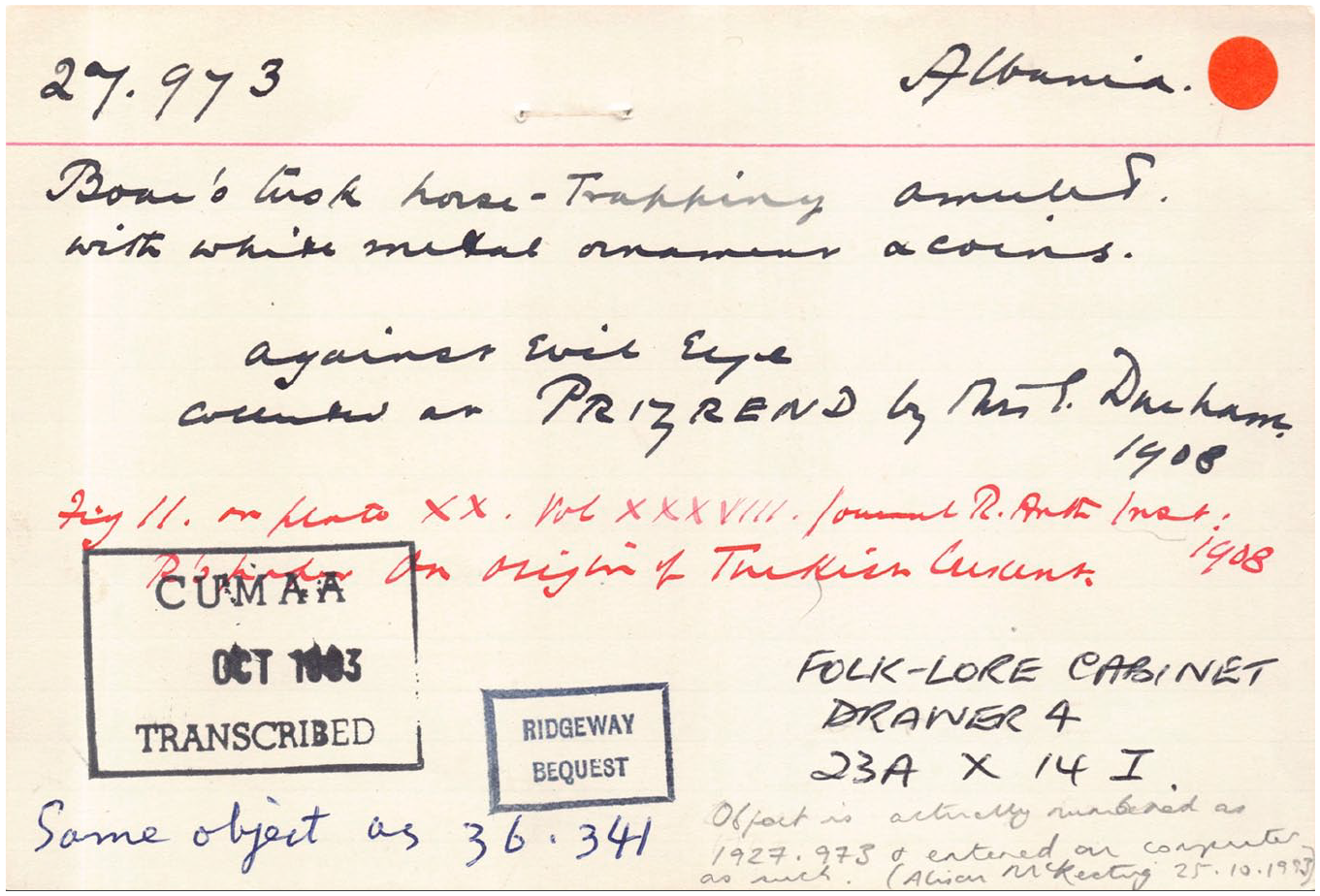
A catalogue card for an amulet for a horse (1927.973) showing a variety of different handwritten additions, some signed and dated.
Perhaps because of its early transition to a computer-based catalogue, MAA never adopted a pre-packaged collections management system such as Modes or Emu. The Museum uses a bespoke FileMaker Pro database, a descendant of the original FileMaker database introduced in 1995. In the years that followed, MAA staff experimented with how to expand the database 10 into a space that could accommodate multiple voices and act as a site of collaboration (Boast, Bravo, and Srinivasan 2007; Hogsden and Poulter 2012a; Salmond 2012), which ultimately led to the development of an events-based structure in 2016. 11 MAA continued to invest in methods of re-building connections between original documentation and the database and, in 2017, undertook a campaign of digitization of its accession registers, enabling pages from the register to be linked to their corresponding object records and consulted directly through Filemaker.
The database’s events-based structure provides the framework for achieving greater data transparency by allowing events to unfold in a visible thematic and chronological manner, tagged with an author and a date. Events divide into two categories: description and context, each with event-specific tags (see Figure 2). This gives staff the capacity to reinstate some of the context of data lost in the digitization process of the 1980s, make visible knowledge production in the form of multiple and dated descriptions, accommodate multiple voices and conflicting interpretations. Of course, creating a structure that allows for in-depth object biographies and multiple voices doesn’t populate that structure and MAA staff found themselves facing the task of cleaning the approximately 160,000 records, representing almost one million objects, created before the development of the latest version of the database. Enter the Stores Move Project.
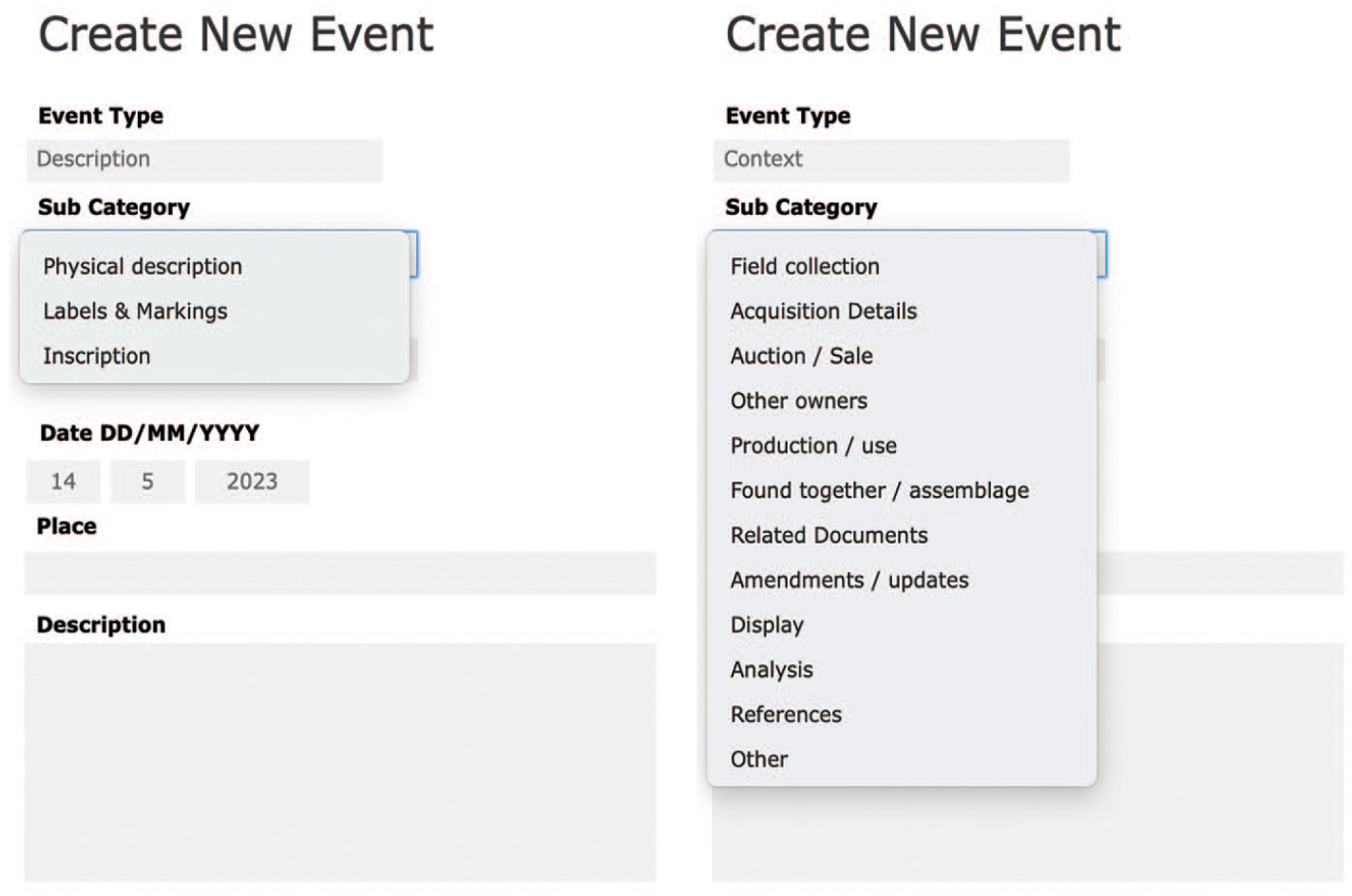
Events within MAA’s catalogue are divided into two categories, Description and Context, each with event-specific tags which are visible here in the drop-down menus for sub-category.
Case Study: The Stores Move Project
Since the 1970s over a third of the MAA collections—originally estimated at 300,000 objects, represented by about 60,000 catalogue entries—have been housed in part of a World War Two aircraft facility, a temporary structure not intended to survive the 1940s let alone the rest of the century. Located on the outskirts of Cambridge, in a building unsuited to regular staffing, the store has posed difficulties to access by staff, researchers and source communities for decades. In July 2019 the University of Cambridge generously provided £5.65m funding for a new off-site collections facility close to the city center. The Centre for Material Culture (CMC), which was handed over in October 2020, is an above-ground nuclear bunker that has been refitted to accommodate all off-site collections, as well as a large workroom and conservation area, freezer room and separate kitchen, to make it a fully-functioning workspace.
Although initially envisaged by the University as a “simple” move from one store to another, it was clear to MAA staff that the project could provide a once-in-a-generation opportunity to enact meaningful change to approximately a third of the collection’s catalogue records. Drawing on the precedent set by numerous museums currently undertaking similar projects 12 and positioning the increased visibility via the online portal as mitigating the potential harm/unfortunate optics of moving colonial-era collections into a concrete bunker, MAA staff advocated for documentation to be included as an integral element of the project. The University of Cambridge agreed and allocated £2.62m, funding the Stores Move Project (2020–2024) to document, condition check and photograph every object in the off-site store prior to packing and moving them to the CMC. The Project began in September 2020 and is due to end in December 2024. It consists of a dedicated team of 14 Collections Assistants, supported by the Collections Team Coordinator (Carreau), Collection Manager for Archaeology (Gunn) and Collections Manager for Anthropology. 13
The Stores Move Project was built upon hard maths and a hard deadline: the external store is due to be demolished in early 2025 to make way for a guided bus route. In order to meet the deadline of vacating all collections by December 2024, it was calculated that the Collections Assistants would have to process (unpack, assess, document, photograph, repack) one object every 15 minutes. It was therefore essential that Museum staff, including both authors, define the documentation priorities ahead of the Project’s commencement to distinguish “essential” work from “nice to have” and make any changes to the database necessary to facilitate them. This was undertaken through a process of timed-trials and consultation to determine what was achievable within the tight time frame. Naturally the best laid plans are always subject to adjustment upon implementation, and as the Project hit its stride some elements have been adjusted in response to different collections as well as on-the-ground realities. Throughout this process of refinement, however, MAA’s core documentation priorities established at the outset remained intact: re-catalogue the collections, historicize the database, and address bias.
Re-Cataloguing Collections
Prior to the Project’s commencement, the majority of MAA’s catalogue records had the same description that they were given when first accessioned although, as previously noted, this is not obvious from the database. These records were written by dozens of individuals over 140 years; as part of the Stores Move Project, a third of them will be re-written by a dozen individuals over the course of five years. This presented an unparalleled opportunity to standardize language and interpretation across approximately a third of the MAA’s collections to Spectrum-standard 14 and ICOM Object ID compliance. 15 It also allowed us to address a subtle but real barrier to access, particularly with historic collections like MAA’s: outdated terminology and interpretation. This is especially true for the archaeology collections, where the naming and understanding of artifacts has changed considerably over the past century but the database has not always kept up. Someone searching the online catalogue for Roman brooches, for instance, would miss more than 30 examples if they didn’t also search for “fibula.” The events-based structure of MAA’s catalogue does not allow for “find and replace” in its authored fields (i.e. context and description), meaning that each record must be individually updated. This constraint on quick, large-scale changes to data in the primary fields of MAA’s database does increase the potential for frustration—both from within and outside the museum—about the pace of change to some of the more egregious examples of outdated or offensive terminology within the catalogue. Yet, at its best, it also necessitates a more thoughtful and less reactionary approach to contextualization, hopefully demonstrated by the current Project.
In order to provide the necessary resources for the Collections Assistants to correctly identify and describe objects within each discrete collection, considerable groundwork was undertaken by the Collections Managers, Curators and Collections Team Coordinator to pull together object identification sheets, controlled terminology lists, published reports, and so on as well as to identify outdated terminology and confirm the correct replacements. When possible, collaboration with source communities and academics was sought ahead of collection processing, and indigenous terminologies and interpretations woven into the records. The benefit of working collection-by-collection is that Collections Assistants quickly get their “eye in” and in several instances recognized long-unidentified objects languishing in “problem” boxes. This was the case, for example, of the “Object of soft wood of unknown purpose” (Z 20245.1-2) re-identified as an African fire stick and hearth. In many cases the new description entails fleshing out the existing one, which are not incorrect so much as brief to the point of being indistinguishable from similar objects. Often objects are given entirely new descriptions. In every case, the aim is to produce a description that is accurate, up-to-date, incorporates appropriate terminology, and is findable. The result is the most consistent records the Museum has ever had.
Historicizing the Database
The challenges encountered by museum staff attempting to historicize databases have been widely discussed in the last decade (Briscoe et al. 2022; Chilcott 2019; Turner 2016a, 2020) and reflect accurately those faced by MAA. As discussed above, the previously multi-vocal layers present on MAA’s original catalogue cards were lost during MAA’s initial data migration when unrelated data (technical, historical, museological) were clumped together into a few, unauthored fields. A single field within the record for 1928.164 A, a Bronze Age grinding stone from Toszeg, Hungary, offers an example to the kind of untidiness discussed here: (Figure 3)
See photograph of object on card Number in top right hand corner of card 52 General note for Toszeg material; a total 330 artefacts from this excavation in Cambridge. Excavated by Tompa.Dr; Clarke.Louis.C.G. in 1927; Deposit: Stratum II –; Researcher: Petrological Identification By Forbes.Dr.C. on – 1 1984 – Sandstone. (bib) Schalk, Emily “Fundmaterial aus Toszeg in Naturhistorischen Museum in Wein” 17 August 1978. (In paper archive)
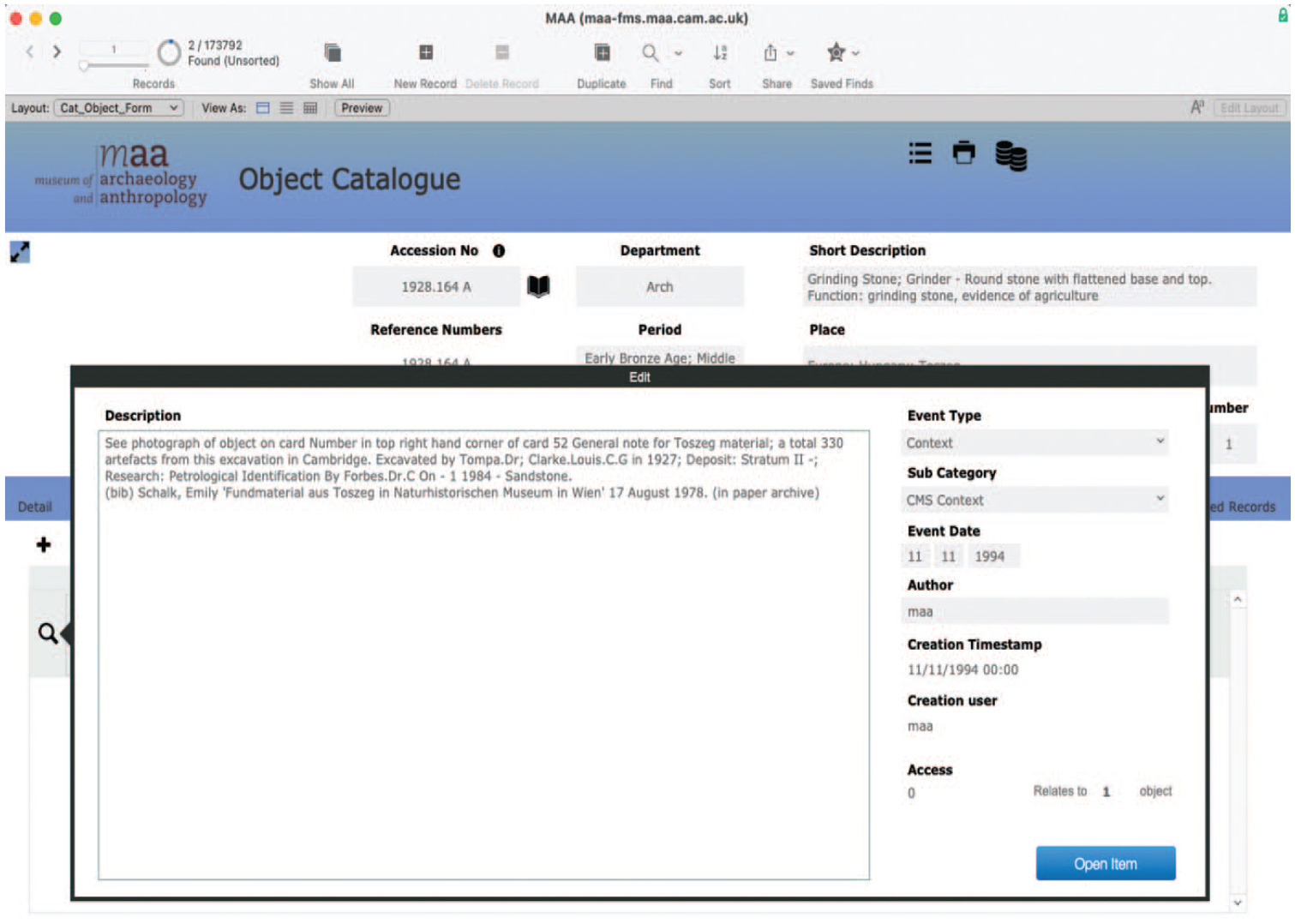
A typical example of multiple types of information previously recorded on the catalogue card for a Bronze Age grinding stone (1928.164 A) was transcribed into a single field on 11 November 1994.
In this all-too-typical example, the lack of articulation, authoring, and dating makes the data difficult to engage with, hinders searchability, and complicates efforts to establish meaningful connections between objects. The untidiness of the data is also visible online and can easily be misunderstood as lack of care, rather than what it often is: the result of successive technological developments that struggle to adapt or reflect rapidly transforming documentation systems and museum practices.
A large part of the Collections Assistants’ documentation routine is to address data accretion such as the example above by separating out individual events, naming and dating them appropriately, so what was once a jumbled mass becomes an ordered list amounting to an object biography. In the early days of the Project several of the Collections Assistants voiced their understandable discomfort with having their names associated with discriminatory or offensive historic data. This led to the authors working with the database developers to dissociate creation of an event from its authoring, so that new entries for old data can now be assigned authorship to past or contemporary individuals and dated accurately. If, as in many cases, authorship and dates cannot be established, then the information is authored as “MAA,” and the date is left blank. The database automatically sorts by date, creating a timeline of events and offering an overview of the object’s path within MAA and sometimes prior to its acquisition. 16
Museum staff have been utilizing the database’s capability to historicize data since the introduction of the events-based structure in 2016, but the implementation has always been curtailed by constraints on staffing and time. The work undertaken by the Stores Move Project has demonstrated on a large scale the potential of the database to honestly reflect MAA’s past, driving changes to provide a platform for more responsible and responsive engagement. It represents a tool for precisely the type of institutional self-critique that Foucault sees as essential to making meaningful social change (Lord 2006); it offers a way to acknowledge and contextualize past attitudes without erasure, while creating new interpretations that embrace plurality and greater equity, and in so doing challenge the idea of the museum as monolithic.
Addressing Bias
Widely understood as a negative feeling, discomfort is part and parcel of working in an institution such as MAA’s, where over two-third of the collections entered the Museum at the height of colonialism. Words encountered on historic object labels or acquisition notes are now considered offensive and jar with today’s ideas of inclusivity, equity and social justice. Yet to embrace discomfort is a productive and necessary vector for change: when harnessed in a supportive environment, discomfort increases accountability, transparency, and collaboration. 17 Within MAA’s catalogue, offensive terminology can take different shapes, from racist and/or patronizing language referring to the people who made or used an object or the naming of source communities and places, to misogynistic content and derogatory representations of disabilities or age. Although online and published resources offer valuable guidance to identify and address issues of language, 18 glossaries grow continuously to incorporate additional historical and contemporary terminologies. With the scope of the collections to be moved and a fast pace of work to maintain, the Store Move Project’s ability to identify and address problematic terminology is limited, but awareness of the regularity with which it has been encountered within the database has sparked renewed efforts for MAA to build in language assessments as part of day-to-day data management.
Bias also takes the shape of omissions. Women, craftsmen (as historically distinguished from artists), people with disabilities (when not described using derogatory terms), but also children, are scarcely visible in the records relating to the cultural objects they are or should be associated with. Much of the work of the Collections Assistants has been to re-humanize records and give minority groups a more prominent place by bringing information about makers and users back into the object descriptions themselves. The descriptions for 1931.134 (a group of twelve mats from Somalia) illustrates this change, having transformed from “12 circular coloured mats” to “12 circular mats made by women and used for sitting on. The mats are tied tightly together in a bundle but show purple, pink and natural woven material with loose fringe” (see Figure 4). Omission is also found in relation to sources of objects, where the collector or donor regularly appears as the “wife of” rather than be known by their name. This lack of visibility was noticed decades ago, when “female collector” or “female donor” were added to records to (presumably) rebalance the power dynamics behind the formation of the collections. In addition to being inconsistently implemented in the database, these notes are now widely and uncomfortably perceived as “othering” by MAA’s staff, who remove them 19 and shift their attention to the appropriate naming of the individual.
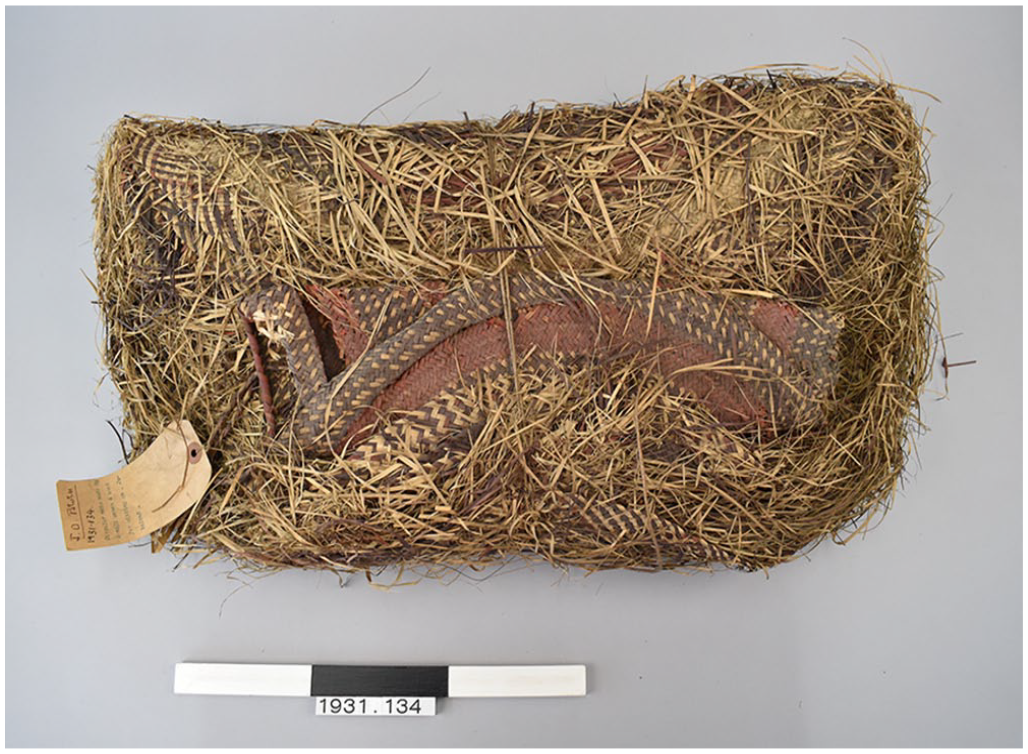
Twelve circular mats from Somalia, made by women and used for sitting on (1931.134). The mats are rolled in a single bundle and are currently too brittle to be disentangled.
One of the most impactful changes internally came with a very small edit to the data entry rules: if the indigenous name of an object was known, it should be the first element of a description, followed by a full stop, and shouldn’t be italicized. Indigenous names for artifacts appeared in historic documentation and were often included in objects descriptions on the database prior to the Project. They were, however, placed as an addendum to an object’s English-language name, either italicized or in brackets, thus creating a hierarchy of knowledge that was unbalanced, privileging data produced within the Museum, in line with its classification system and its (until the late 1990s largely Western and largely white) audiences. This shift has transformed the way staff approach objects. Gradually, the language is changing. Objects are called by their names: cascarón, jjembe, tamata. A name makes visible the link between source communities and objects, firmly anchoring it within a language and a space, offering an alternative to and sometimes superseding the language and the space of the Museum itself. When accurate and correctly transcribed, it can widen access from communities of origin. Undeniably, the risk of capturing and displaying incorrect data (outdated terminology, changes in orthography of a language, mistranscriptions) is high. Yet, the risk is worth taking for two reasons: debunking the myth of an all-knowing institution, where the database is presented as a repository for sanctioned and verified knowledge, and opening the door to corrections, connection with source communities, and the potential of collaborative documentation. 20
Conclusion
Three years into the Project, the Collections Assistants have edited 45,700 of the original 60,000 records under the remit of the Project, created 15,500 new records, uploaded 57,800 photographs and are on track for a successful completion; by the end of the Project in December 2024, we calculate that their work will equate to a total of forty-two person years. It likely goes without saying that a documentation project of this magnitude would never have been possible without the impetus of the Stores Move Project. And yet, is it too much to hope that a companion project to document the remaining two-thirds of MAA’s collection might no longer be unrealistic? There are already tangible benefits from the increased visibility of the collections now moved to the CMC. The call for proactive engagement with communities and increased programs of consultation and collaboration (Durand 2010; Peers and Brown 2003) is rarely discussed alongside the assessment of historical data and the re-documentation of the collections, but more inclusive and historically accurate documentation has already opened the door to productive engagement between the Museum and source communities.
Discussions between the Uganda National Museum in Kampala and MAA started in 2021, a year after the Stores Move Project began, mediated by the “Repositioning the Uganda Museum” project. 21 The subsequent re-documentation of the Uganda collections by the Collections Assistants demonstrably benefited from the collaboration, with dialogue between institutions contributing to making hundreds of records more accurately searchable and difficult histories visible. In turn, the increased visibility of the collections allowed the ‘Repositioning the Uganda Museum’ collaborators to identify objects of special cultural, historical, political, and religious significance, which took center stage during their visit to MAA in November 2022, and formed the basis of the Uganda National Museum’s request for objects to return to Uganda in early 2023. MAA has every reason to anticipate and encourage similar engagements with other collections.
While such positive outcomes could well prove valuable when advocating for future funding, the discomfort provoked by the wide and publicly visible gulf between the objects documented by the Project and the rest of the collection may also galvanize efforts to spur an equivalent on-site project. This would provide the opportunity to build on the experience gleaned from the current Project, and expand the potential outcomes. Without the tight deadline of the Stores Move Project, necessitated by the demolition of the store, a companion on-site project could allow more time for engaging source communities with the process. What this project has made more visible to us, working behind the scenes, is the importance of moving away from the cliché of individuals working with dusty ledgers: to reframe documentation work as a highly dynamic and responsive process that benefits from a wide network and a collaborative environment. On a par with research, thoughtful documentation can transform a collection, its staff, and maybe even an institution.
Footnotes
Declaration of Conflicting Interests
The author(s) declared no potential conflicts of interest with respect to the research, authorship, and/or publication of this article.
Funding
The author(s) received no financial support for the research, authorship, and/or publication of this article.
1.
The Treasure Act requires the discovery of gold and silver objects, groups of coins over 300 years old, or metal items of any age deemed of ‘national importance’ in England, Wales and Northern Ireland to be reported to the Coroner within 14 days. An inquest is then led to determine whether the object constitutes ‘treasure’ under the terms of the Act; if so, the object is offered for sale to local museums at a price set by an independent board, with the finder and landowner sharing the reward.
2.
3.
Over the years archaeology and anthropology have been a faculty and a department; the latter has been used here for consistency and ease.
4.
Although von Hügel officially retired in 1921, he left on annual leave on 24 June 1920 and on his return, was ‘granted a leave of absence for six months on account of ill health due to overwork in the Museum’ ( , 1). Dr Alfred Haddon was made deputy curator as a result, a position he held until the formal appointment of Louis Clarke on 20 June 1922.
5.
The task of transferring information from the accession register onto catalogue cards carried on for decades and was never fully completed.
6.
The last of whom is still an active presence at the museum.
7.
And, later, a Collections Manager for the Photographic Collections.
8.
It is in this context that the authors developed their passion for cataloguing and data management: Gunn has been Collections Manager for Archaeology since 2011 and Carreau worked on several research and collections projects, primarily with the anthropology collections, within MAA before becoming the Collections Team Coordinator of the Stores Move Project.
9.
MAA maintains a working document of handwriting samples from the earliest days of its foundation to the present day, in an attempt to reconnect handwriting to past and present members of staff.
10.
MAA’s current database is not a single catalogue, but over 20 different related tables including three separate collections (objects, photographs, archives) and most activities undertaken by the museum (loans, conservation, exhibition, research visits, box moves, etc.); of these, the three collections catalogues are publicly available (). For the purpose of this paper, ‘database’ and ‘catalogue’ refer to the object database.
11.
MAA works with external Filemaker developers to develop the database; originally Linear Blue and currently We Know Data.
12.
In particular, MAA is grateful to the British Museum, the Science Museum, the Pitt Rivers Museum, the Royal Museums Greenwich and the University Museum of Zoology.
13.
The project expanded in summer 2023, from nine to 14 Collections Assistants and with Gunn being seconded onto the project full time, to make up for the time lost to the Covid pandemic in 2020-2021. The Collections Manager for Anthropology (Rachel Hand) supported the project part-time until the processing of the anthropology collection was largely completed in spring 2023.
14.
16.
This new development is currently only visible in the internal database, but it is hoped that it can be introduced to the online catalogue soon.
17.
Following the introduction of ‘authoring’ to the database, we have noticed that staff dedicate more time to weighing the language they use when entering data, re-assigning authorship accurately when possible, or reaching out to MAA’s permanent collection team and experts outside the Museum when confronted with inappropriate language.
18.
See Antracoli et al. (2020); Briscoe et al. (2022), Chilcott (2019), Modest and Lelijveld (2018) and Clarissa Chew’s Cultural Heritage Terminology Network, (accessed December 5, 2023).
19.
This is illustrative of MAA’s concern to achieve a balance, within its database, between documentation of the collections and self-documentation. These notes, although ‘historic’, show the Museum’s attempt to engage with the demographics of the collections’ formation: they were only used to qualify acquisition sources, not makers and users of objects. As such, the knowledge of this attempt is important to retain institutionally, but retaining the notes in the objects’ records themselves is of little benefit to the object itself, or MAA’s stakeholders.
20.
MAA actively solicits corrections on its online database.
21.
The ‘Repositioning the Uganda Museum’ Project is led by Rose Mwanja Nkaale (Commissioner for Museums and Monuments and Director, Uganda National Museum), Nelson Adebo Abiti (Curator of Ethnography, Uganda National Museum), and Derek Peterson (Ali Mazrui Collegiate Professor of History and African Studies, University of Michigan). They visited MAA in November 2022. See https://lsa.umich.edu/history/news-events/all-news/facultynews/-repositioning-the-uganda-museum–project-to-repatriate-objects-.html and .