




Abstract
This article explores the significance of gender in understanding the formation of Indian collections in European museums, and how the activities of a single collector sheds light on the role of the individual and wider society. It focuses on Annie Marion Rivett-Carnac’s (1843–1935) contribution to multiple European museums over a period of over forty years. She amassed a personal collection of 6,000 to 8,000 items, brought together during her life in India alongside her husband. Her assemblage consisted of Indian body ornaments, jewellery, and items used in religious and daily practices, which she used to form networks with eminent figures in anthropology and ethnography in Europe, some outside of Britain’s traditional networks of British imperial collectors. While her husband has a prominent presence through his donations to museums, membership of learned societies and publications, little is known about her. Her contributions to museum collections in Britain, Germany and Sweden have largely gone unstudied, which this article seeks to address. It argues that Rivett-Carnac used her collections and the emergence of ethnography in Europe and British India as a way to position herself as a serious and respected scholar.
Keywords
Several museums in Europe hold collections from India assembled by Annie Marion Rivett-Carnac née Durand (1843–1935) during the British colonial occupation of the Indian subcontinent (1858–1947). Born in India and educated in Britain and Switzerland, she returned to India in the early 1860s to join her father, a military official, and in 1868 married John Henry Rivett-Carnac (1838–1923), who rose through the Indian Civil Service to occupy important positions in the governing of British India. 1 Rivett-Carnac’s collections are held in the V&A Museum and the British Museum in London, Ashmolean Museum in Oxford, Etnografiska Museet (Ethnology Museum) within the National Museum of World Culture in Sweden, and the Berlin based Ethnologisches Museum (Ethnological Museum) and Museum für Asiatische Kunst (Asian Art Museum). Rivett-Carnac and her husband both collected and described their gathered material as “the Rivett-Carnac collection.” However, John Henry Rivett-Carnac’s collections have received greater attention, partly due to his contributions to and membership of learned societies across Europe and India, and personal networks through his position as a colonial officer. Annie Marion Rivett-Carnac’s collections have received attention primarily in the context of the Indian collections held at the V&A Museum. 2 Her contributions as a field collector of Indian ethnographic material culture have largely been overlooked, which this article seeks to address. It will argue that she was not only a serious and respected scholar, who was personally acquainted with Indian culture and customs, but an able networker who responded astutely to the needs of varied European institutions (see Figure 1).
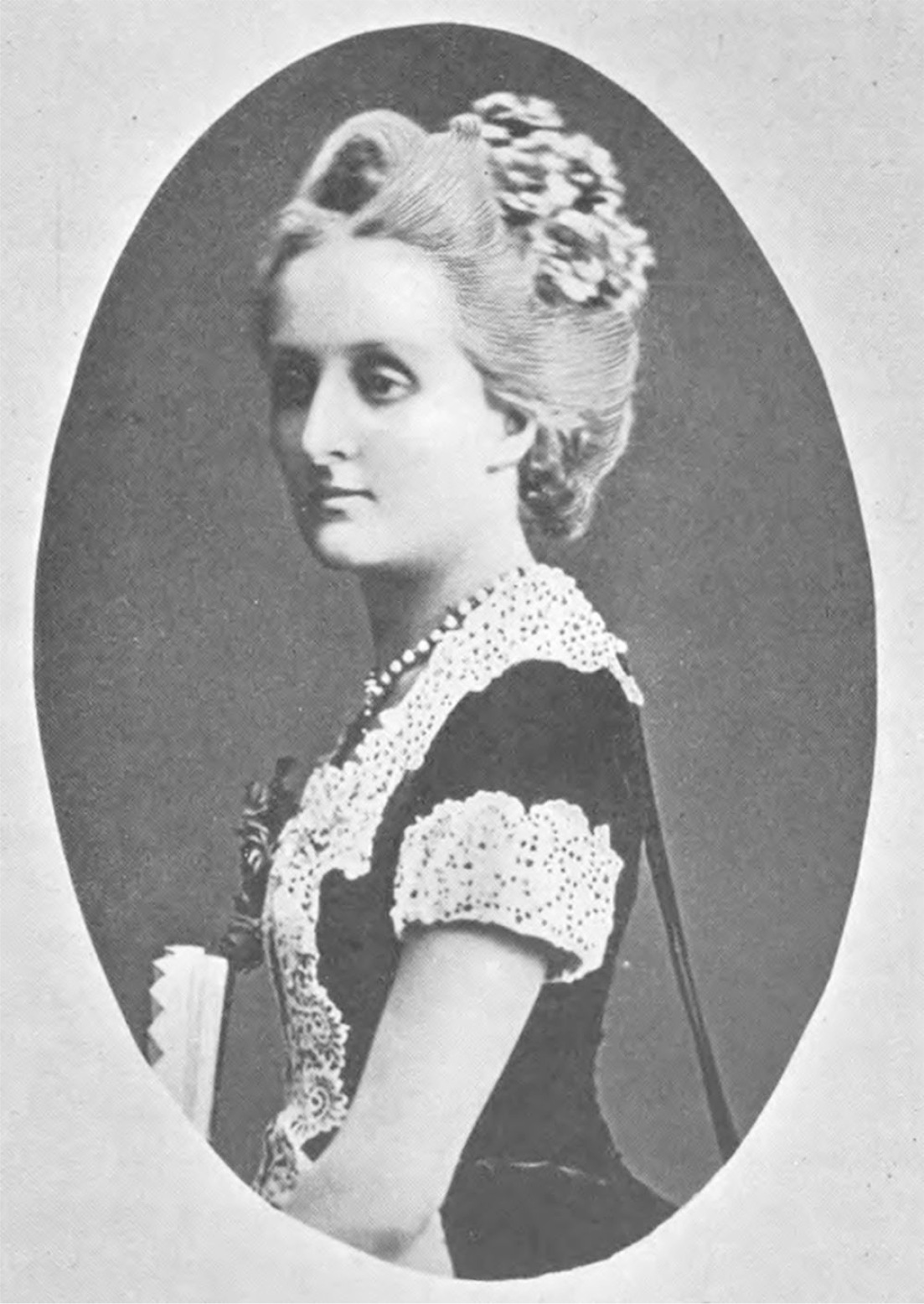
Annie Marion Rivett-Carnac c.1868. Courtesy of National Museum of World Culture, Sweden. Image in the public domain.
Research for this article is part of a wider study investigating the role and contribution of women collectors of South Asian objects and considering the intersections between gender, empire and material culture. 3 A significant proportion of Rivett-Carnac’s collection was received by the India Museum, then in South Kensington, in 1872 for the London International exhibition. 4 She is also one of the first fifty female contributors of South Asian material to the British Museum. Both of these points indicate that she was among the earlier cohort of women collectors in South Asia and current research indicates she was an exceptional collector. This case study is based on Rivett-Carnac’s published articles in the Journal of Indian Art & Industry, newspaper articles, family archives, and her collections themselves, which collectively provide insights into her approach to collecting. Over her lifetime she amassed a personal collection of between 6,000 and 8,000 items which attempted to provide an unique ethnographical survey of the people of India, mainly through their body ornaments. This included earrings, bangles, amulets, nose studs, finger rings, toe rings, anklets, brooches, beads, sandals, containers and vessels, and items used in religious ceremonies and daily practices. A selection of these was exhibited in nine UK and international exhibitions across Europe and their presence introduced a valuable alternative to the dominance of the India Museum (see Figure 2). 5 Its displays at these events focused primarily on items from urbanized and even courtly societies and Rivett-Carnac’s representation “of the Indian people” was a clear contrast. 6 Tracing her museum contributions from 1872 to 1913 and viewing them through the prism of her different roles within them provides a way to consider how she was perceiving the interests of these different institutions, scholars, and curators, and why she chose to give to each one.
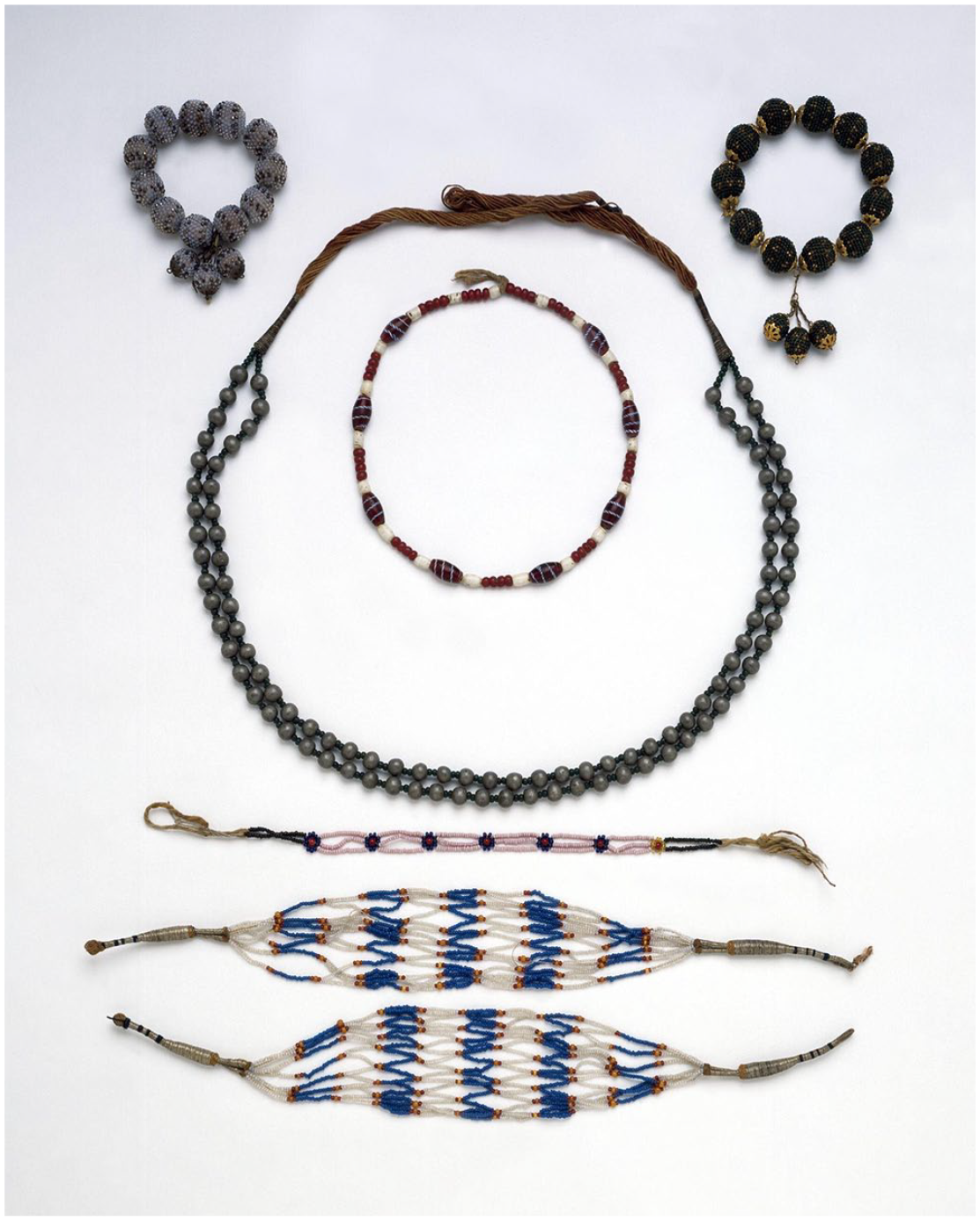
Armlets and necklaces displayed in the London International Exhibition 1872. © Victoria and Albert Museum, London [09229183(IS)].
The Field Collector 7
Rivett-Carnac used field collecting as a way to exert her agency as a woman, and her expansive knowledge base as a result of her collecting methods, positioned her as an authority in the nascent field of Indian ethnography. She specialized in “peasant jewellery,” known today as traditional jewellery of a people or place, and often provided written catalogues to accompany her collections when on public display or accepted by a museum. Her source knowledge came from a combination of personal observations, dialogue with local people, discussion among her familial and social networks with similar interests to understand Indian people, albeit expressed through different collecting practices, and through drawing upon published works from European and Indian scholars. Her practices and methodologies fit the characterization of an eccentric in Victorian upper class British Indian and British societies, however there is little evidence that she was regarded as such. 8 Rather, letters from family members and references to her collection in secondary sources show their authors seeking out her expertise. She frequently acquired items for her collections by shopping in bazaars, as outlined in her article in The Englishman’s Overland Mail for a British Indian audience, which was later reprinted in the UK-based Journal of Indian Art & Industry for a different readership. 9 The articles provide a glimpse into Rivett-Carnac’s experiences navigating Indian market life and what prompted her purchasing decisions. She noted these in her personal journal and also developed an extensive library on Indian subjects to aid her research. Her skills and reputation as a field collector led to her teaching other people in her network how to collect in India and develop catalogues to show the scientific value of their assemblage. 10 Rivett-Carnac’s ability to articulate the significance of her collections is what made them valuable for exhibition purposes. Triggered by British nostalgia in the face of industrialization, there was a significant movement toward techniques from the past and this was highlighted at the London International Exhibition 1872 where a significant selection of Rivett-Carnac’s collection was displayed and then went on tour to another five international exhibitions. Handmade jewellery was considered superior to machine made in Britain at this time, and wearing it was considered a visual signifier of wealth. 11 The items also provided a window onto the people of India, inspiration for European artisan craftsmanship, and a way of promoting the metals and laborious skilled techniques of the Indian subcontinent to stimulate trade opportunities for the British empire. Rivett-Carnac was able to provide a glimpse into the “authentic” India and its people through her field collecting and catalogues, providing an alternative view of urbanized and courtly Indian traditions.
The Ethnographer
Through Rivett-Carnac’s collecting practices, she built up an ethnographic understanding of local culture and customs and demonstrated her understanding of caste and local identity distinctions. Recognition amongst notable authorities on Indian art and manufacture such as Sir George Birdwood, coupled with exposure to European audiences through international exhibitions, made her a visible and knowledgeable collector on the world stage. In 1874 to 1875 she was commissioned by Andreas Fedor Jagor, a German ethnologist, naturalist and explorer, to collect on behalf of the German Königliche Museen (Royal Museums, Berlin). This augmented the five thousand plus items he acquired in India to support the development of the Berlin museum’s ethnographic collections. 12 In correspondence with officials at the Königliche Museen she provided a detailed catalogue of the items she had bought for the museum as part of one of her commissions. 13 Stretching to twenty-eight pages and made up of 123 items categorized as ornaments, clay toys, metal ornaments, fabrics and dyes, she contextualized them and their significance, noting in particular where they were acquired, their Indian name, associated local religious customs, caste, gender, and age specificities, and where on the body to wear items or how to use them. 14
In c.1869 she collected brooches in the Himalayan foothills, and this collection is distinctly different from the rest of her assemblage. While the majority of Rivett-Carnac’s collection was acquired in British controlled territories such as the North West Provinces (modern day Uttar Pradesh) and developed and exhibited to show the jewellery and body ornamentation of Indian people, these Himalayan brooches were collected to illustrate their resemblance to European finds and forms (see Figures 3 and 4). In her 1914 article about the brooches she outlined regional differences between the plains of India and the northern mountainous region, demonstrating her understanding and awareness of local practices and their significance, and was able to undertake a comparative study within her wider collection. 15 Her ability to travel across India, often accompanying her husband on official duties, provided her with opportunities to witness varying customs, learn about them from local people and use this as the basis for forming her collection. The subsequent categorizing of the collection and associated peoples enabled her to strategically position herself at the forefront of emerging contemporary scientific thought in India. 16
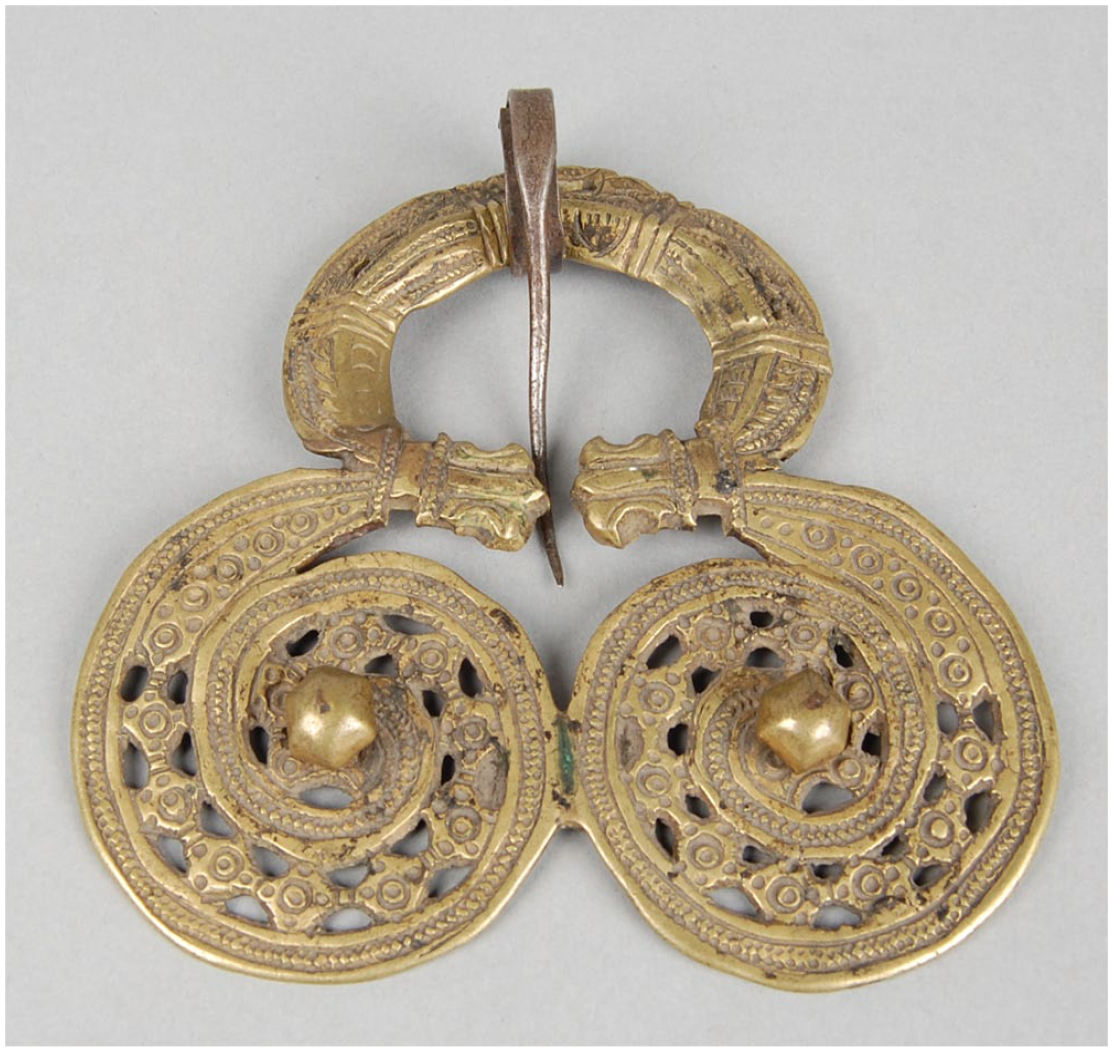
Brass brooch collected in the Himalayan foothills. © Trustees of the British Museum [1913,1222.2].
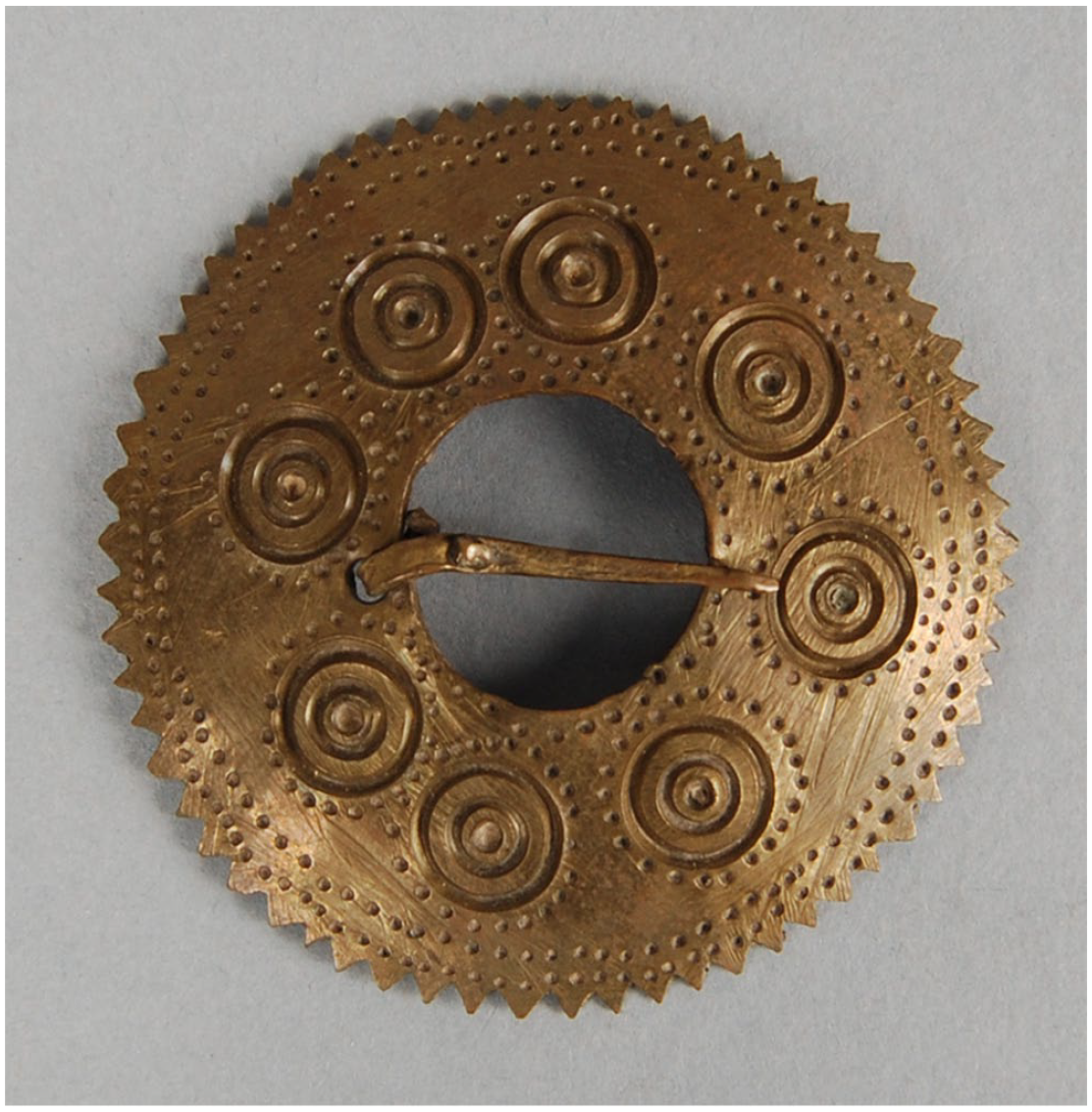
Brooch bought in the Mussoorie Bazaar in the Himalayan foothills. Rivett-Carnac compared and contrasted the details on it against Indian Hindu, Danish and British beliefs and traditions. © Trustees of the British Museum [1913,1222.4].
Rivett-Carnac’s gender enabled her to specialize in types of collections that were understudied by others. Bangles, anklets, earrings, and other items in her assemblage, had received little attention until she applied the classificatory science underpinning ethnography to position herself as an expert on Indian jewellery and body ornaments as worn by the masses. She was well known amongst her contemporaries for her collections and associated knowledge, and had strong well-formed networks with others in powerful positions in British India across political, cultural, and social spectrums. 17 The Journal of Indian Art & Industry (1884–1917) was a vital publication to disseminate the arts of India and Rivett-Carnac was one of only two women to contribute to it. 18 In a male dominated collecting landscape, Rivett-Carnac identified a gap in the colonial power’s knowledge base and sought to carve out a niche for herself. She positioned herself as a specialist on a subject matter that was of great significance to the understanding of India and its people, but one that was receiving little attention from male collectors or scholars.
The Scholarly Networker
Rivett-Carnac used her collections and collecting practices to push the traditionally accepted boundaries for British women in India at the time. 19 She navigated social constraints by building up a network of scholars and curators in Europe through whom she could gain visibility and legitimacy as an expert on her subject matter. The 1872 London International Exhibition specialized in jewellery, providing Rivett-Carnac with an opportunity to showcase her collection and then secure a home for some of the items at the South Kensington Museum, today’s V&A Museum. 20 This initial exhibition was a catalyst for the successful international tours her collections embarked upon around Europe, however it also provided her with a legitimacy to be a subject specialist on Indian ethnography and material culture. Rivett-Carnac and her husband nurtured their relationships with various scholarly figures in European anthropology and ethnography circles, particularly in Germany and Sweden, countries outside of the traditional networks of British imperial collectors. As mentioned, above, during 1874 to 1875 Rivett-Carnac was engaged by German ethnologist Andreas Fedor Jagor while he was in India to collect on behalf of the Berlin based Königliche Museen’s developing ethnographic collections. 21 The collections were received by Adolf Bastian, a key figure in anthropology and ethnography, who, along with other German scholars, encouraged Rivett-Carnac to further her inquiry into the Himalayan brooches she collected. This resulted in her article on the subject being published in the German Journal of Social and Cultural Anthropology (1886). Shortly after the interaction with Jagor came the Rivett-Carnacs’ joint donation to Vanadis, a Swedish expedition in India, led by ethnographer Hjalmar Stople in 1885. 22 They gifted fifty-fives items comprising vessels, religious artifacts, and jewellery, toward a wider assemblage of over 2900 items Stople collected, many of them purchased or gifted to him during his time in India (see Figure 5). 23 Correspondence between Stople and Rivett-Carnac’s husband reveals the role she played from the shadows. It was at her bidding that her husband extended an invitation to Stople to stay with them a few days, where he would have seen their collection, met with her and discussed the various items the couple donated and he took back to Sweden with him. No documentary evidence survives about their conversations but the Rivett-Carnacs most likely would have provided explanatory information about the items they were putting forward, and she would have been key in selecting the body ornaments and jewellery held in the Swedish museum today. While her collections, insights and writing were devoured with gratitude at the Königliche Museen, they fell out of favor at the South Kensington Museum as curators travelled to India themselves to collect. 24 This could be a result of Britain’s historical relationship with India and the flow of goods over a long period of time, whereas countries like Germany and Sweden were trying to establish their ethnographic collections without a foothold in the Indian subcontinent. Rivett-Carnac was not able to access the learned societies which her husband was a member of, so she developed ways to circumvent the barriers she was facing by using her collections to position herself across Europe as an authority of Indian ethnography, an emerging field at the time. Commissions from, and donations to, museums outside of Britain provided her with opportunities to engage with scholarly men, which in turn could provide her collecting practices and assemblages with validation and credentials for her personal advancement. 25
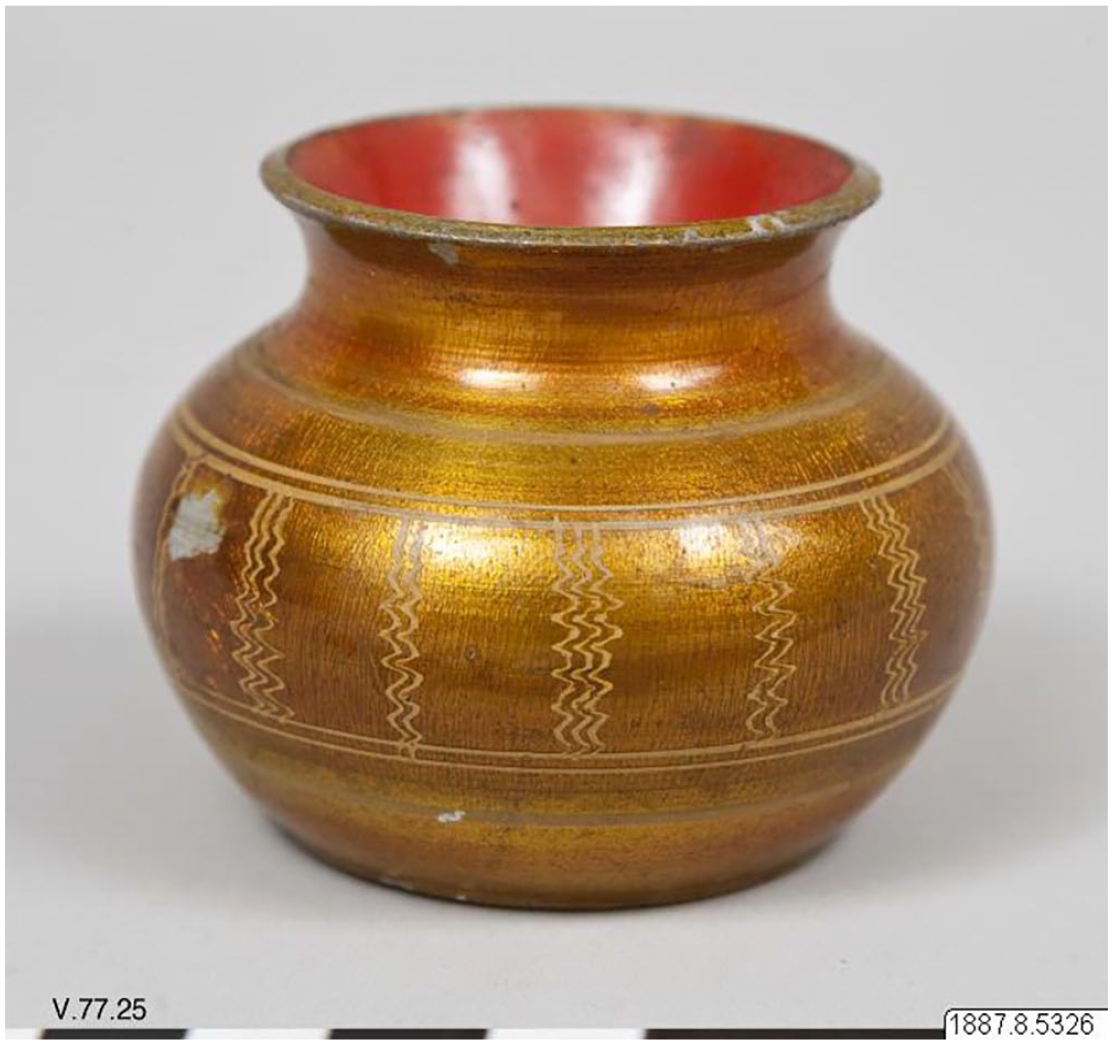
Lota (vessel) gifted to the Swedish expedition, 1885. © National Museum of World Culture, Sweden, (CC BY 2.5) [1887.8.5326].
Rivett-Carnac adapted to meet the requests of scholars and curators, providing her with opportunities to build on her specialism and further engage and interact in intellectual circles. As well as her contributions to museums in Germany and Sweden, in Britain, Rivett-Carnac monitored the world of museums and responded to organizational interests. The formation of the Indian Institute in Oxford and its museum was accompanied by many collecting missions and requests for material. 26 Prior to 1902, Rivett-Carnac responded to this and donated nine ancient bead necklaces to the museum, as well as dispersing her bead collection to other collectors and as yet unidentified museums. 27 In 1910, inspired by British Museum curator Charles Hercules Read’s article about Anglo-Saxon brooches and his view that brooches were a significant and valuable class of antiquity, she responded by donating her remaining brooch collection to the museum and publishing an article about them in the Journal of Indian Art & Industry (1914). 28 This final article, which she also sent to the German Society of Anthropology, illustrates how she utilized her male social, scholarly and intellectual networks to provide her with credibility and standing.
Gender and the Collector
Rivett-Carnac’s vast collection provides insights into the way an individual utilized material culture to negotiate gender and empire. The scale and scope of her collection dominated UK and European public displays of Indian jewellery for over thirty-five years between 1872 and 1908. She was an exceptional collector who used field collecting and ethnography as a way of pursuing scholarly interests which were otherwise inaccessible to her because of her gender. She compiled an arsenal of knowledge about the items she collected, which she judiciously disseminated to provide European exhibitions, museums and people, with her ideas of the “authentic” India.
Footnotes
Acknowledgements
I would like to thank my supervisors Sarah Longair and Kate Hill at the University of Lincoln, and Sushma Jansari at the British Museum, for their feedback on earlier versions of this article.
Declaration of Conflicting Interests
The author declared no potential conflicts of interest with respect to the research, authorship, and/or publication of this article.
Funding
The author(s) disclosed receipt of the following financial support for the research, authorship, and/or publication of this article: Research for this article was made possible by a Collaborative Doctoral Partnership funding award from the UK Arts & Humantities Research Council (Grant ID-AH/V004735/1).
1.
Society notices indicate that Annie Marion Durand was in London In June 1861. In July 1864 her father’s second wife, Emily Augusta Durand, gave birth to Ethel Durand in Simla, India. It is most likely that Annie Marion accompanied Emily Augusta so was also in India by 1864.
2.
See Henry Cole, Catalogue of the Objects of Indian Art Exhibited in the South Kensington Museum (London: Eyre & Spottiswoode, 1874), 162. Nick Barnard, Indian Jewellery (London: V&A Publishing, 2008), 10, 94–96. Charlotte Gere and Judy Rudoe, Jewellery in the Age of Queen Victoria: A Mirror to the World (London: British Museum Press,  ), 295–7.
3.
South Asia is defined as modern day Afghanistan, Bangladesh, Bhutan, India, Maldives, Nepal, Pakistan and Sri Lanka.
4.
For discussions about the rise and fall of the India Museum see Ray Desmond, The India Museum, 1801-1879 (London: H.M. Stationery Office, 1982); Arthur MacGregor, Company Curiosities: Nature, Culture and the East India Company, 1600-1874 (London: Reaktion Books, 2018) and Arthur MacGregor, The India Museum Revisited (London: UCL Press, ).
5.
London International Exhibition, 1872; Vienna World’s Fair, 1873; Objects of Indian Art exhibition at the South Kensington Museum, 1874 (for which she also provided a written catalogue that informed parts of Henry Cole’s overall exhibition catalogue); Paris Universal Exhibition, 1878; Amsterdam International Colonial and Export Exhibition, 1883; Antwerp World Fair, 1885; Colonial and Indian Exhibition, London, . Imperial Institute, London. 1894; Muhammadan Art and Life in Turkey, Persia, Egypt, Morocco, and India, Whitechapel Gallery, London, 1908.
6.
MacGregor, The India Museum Revisited, 181–2. See also Kajal Meghani, Splendours of the Subcontinent: A Prince’s Tour of India, 1875-6 (London: Royal Collection Trust, ), to see the types of urbanised and courtly items displayed at the 1878 Paris Universal Exhibition, along with Rivett-Carnac’s traditional Indian jewellery.
7.
The definition of a field collector employed here is outlined as ‘a person who obtains an artefact, or series of artefacts, directly from the person who manufactured it or else from the person owning and using it for its original intention and probably within its country of origin. The field collector also obtains first-hand information’, Alison Petch, “Collecting Immortality: The Field Collectors Who Contributed to the Pitt Rivers Museum, Oxford,” Journal of Museum Ethnography, 16 (): 127–39.
8.
Marianne Camus, “Can One Be a Woman and an Eccentric?,” in In and Out: Eccentricity in Britain, ed. Sophie Aymes-Stokes and Laurent Mellet (Newcastle upon Tyne: Cambridge Scholars Publishing, 2012), 151–64, available at: https://proxy.library.lincoln.ac.uk/login?url= https://search.ebscohost.com/login.aspx?direct=true&db=nlebk&AN=523774&site=ehost-live.
9.
See Mrs J. H. Rivett-Carnac, “An Afternoon Ramble in an Indian Bazaar.” Englishman’s Overland Mail, June 16, 1883 and Mrs J. H. Rivett-Carnac, “An Afternoon Ramble in an Indian Bazaar,” Journal of Indian Art & Industry, 1, no. 3 (): 6–8.
10.
11.
Gere and Rudoe, Jewellery in the Age of Queen Victoria, 295–6.
12.
Claudine Bautze-Picron, “From Bodhgayā to Berlin,” in Precious Treasures from the Diamond Throne: Finds from the Site of the Buddha’s Enlightenment, ed. Sam Van Schaik, Daniela De Simone, Gergely Hidas, and Michael Willis, vol. 228 (London: British Museum Press, ), 120–8. Also detailed in an earlier version of the article by the author.
13.
These items have since been separated between the Ethnologisches Museum and the Museum für Asiatische Kunst.
14.
15.
16.
17.
In Rivett-Carnac, Many Memories, her husband refers to some of their social networks including Lahore museum curator John Lockwood Kipling; European aristocrats, and other members of the Indian Civil Service. English journalist Mary Frances Billington in her publication Women in India () dedicated a chapter to jewellery and ornaments and similarly referenced Rivett-Carnac’s collection as a ‘marvellous’ example of ‘peasant jewellery’. Rivett-Carnac’s British diplomat brother posted to the USA displayed items given by her and her husband in his official residence in Washington D.C., to showcase Indian culture and wares. Colonel Hendley, an amateur authority on Indian art and frequent contributor to the Journal of Indian Art & Industry also acknowledged ‘borrowing’ from Rivett-Carnac’s scholarship.
18.
Of the 90 contributors, she ranked joint fifth in terms of the number of contributions she provided, four in total.
19.
Much has been written about this and some examples of female collectors and women in India generally include: Joanna Goldsworthy, “Fanny Parkes (1794–1875) Female Collecting and Curiosity in India and Britain,” in The East India Company at Home, 1757-1857, ed. Margot Finn and Kate Smith (London: UCL Press, 2018), 131–52, available at: https://discovery.ucl.ac.uk/id/eprint/10043118/1/The-East-India-Company-at-Home.pdf; Margaret MacMillan, Women of the Raj: The Mothers, Wives and Daughters of the British Empire in India (London: Thames & Hudson, 2018), https://ebookcentral-proquest-com.proxy.library.lincoln.ac.uk/lib/ulinc/detail.action?docID=5878021; Nupur Chaudhuri and Margaret Strobel, eds., Western Women and Imperialism: Complicity and Resistance (Bloomington, IN: Indiana University Press, 1992), https://hdl.handle.net/2027/heb.04617; Elizabeth Buettner, Empire Families: Britons and Late Imperial India (Oxford: Oxford University Press, 2004), https://ebookcentral-proquest-com.proxy.library.lincoln.ac.uk/lib/ulinc/detail.action?docID=422530 and Indrani Sen, Gendered Transactions: The White Woman in Colonial India, c. 1820–1930 (Manchester: Manchester University Press, 2017), .
20.
A selection of Rivett-Carnac’s collection can be viewed on the V&A’s database: https://collections.vam.ac.uk/search/?q=09229(IS)&page=1&page_size=50 (accessed November 17, 2023).
21.
Claudine, “From Bodhgayā to Berlin.”
23.
24.
Robert Skelton, “The Indian Collections: 1798 to 1978,” The Burlington Magazine, 120, no. 902 (1978): 296–305 and Tim Barringer, “The South Kensington Museum and the Colonial Project,” in Colonialism and the Object. Empire, Material Culture and the Museum, ed. Tim Barringer and Tom Flynn (Abingdon and New York, NY: Routledge, ), 11–27.
25.
The couple left India in 1894 and settled in Switzerland c.1900. They had a close relationship with Heinrich Angst, the first Director of the Swiss National Museum, Zurich (1892-1903) and British Consul General in Zurich, 1896-1916, where conversations about material culture continued, peppered in their correspondence held in Zurich National Library, Nachl H/Angst/71/11 and Nachl/H/Angst/71/12.
26.
27.
Mrs J. H. Rivett-Carnac, “Ancient Beads,” Journal of Indian Art & Industry, 9 (1902): 5–12. Note this collection at the Ashmolean Museum is incorrectly attributed to Rivett-Carnac’s husband in Naman P. Ahuja, Art and Archaeology of Ancient India. Earliest Times to the Sixth Century (Oxford: Ashmolean Museum, ), 272–3 and confirmed by the museum documentation records that it was given by her.
28.
Rivett-Carnac, “Notes on a Collection.”