




Abstract
Marginalia have been created by many varied readers across the centuries, transforming texts into personal artifacts and offering valuable insights into many varied socio-cultural contexts and communities. However, the tendency to record marginalia only where it pertains to bibliographical data has often privileged some voices over others, skewing the historical narrative available to researchers using archive and special collections catalogs. This article explores the importance of recording marginalia (both its presence and its function) in catalog entries in order to allow traditionally marginalized voices to be heard. It provides a brief overview of projects using marginalia to tell unheard stories of marginalized figures challenging authority before questioning the reluctance of catalogers to include detailed descriptions of marginalia, concluding by offering some recommendations as to how marginalia could be cataloged to better represent the myriad of voices as yet unheard.
Introduction
To mark a book in ink or pencil is a mode of active response; it is the reader’s way of processing what they have read, creating a dialog with the author and the text, and leaving behind a trail of their thoughts and reactions to the same. Even more passive marks, such as doodles, pen trials, and snippets of daydreams offer insights into the manner in which a reader engages with the text in front of them, revealing boredom and distractedness as much as equivalent marks reveal keen interest and considered thought. This process of marking texts (for some cathartic, for others critical, and for others still reflective) has been, and continues to be, practiced by readers of all ages, genders, classes, and races, transcending sociocultural divides. From medieval monks glossing complex liturgical texts to today’s “Tiktokers” cramming novels with annotated post-it notes, the act of writing in the margins of texts has appealed to many diverse readers over the centuries and shows no sign of dying out.
Marginalia are thus deeply personal markings of great value to interdisciplinary research, providing glimpses into the ways in which readers understand texts and relate them to themselves and their socio-cultural contexts. They offer tantalizing traces of what mattered to a reader, and clues as to the historical spaces in which they were reading and marking their texts. In short, the presence of marginalia transforms a text into a personal artifact, a deeply individualistic record of a reader’s mindset at a particular time. Given the obvious value of studying marginalia, an area now firmly established in the fields of history, literature, anthropology, and linguistics, it is surprising to see how few catalog entries include mentions of the presence of marginalia in their descriptions, or merely note the existence of the marginalia without describing their functions relative to the text. Yet marginalia offer an arena for challenges to authority to be acted, for those hushed by prejudices to speak out, and for historical actors otherwise unknown to leave their mark in the world. They are important, diverse spaces through which thousands of lost voices speak, and so it is vital that this is reflected in catalog entries if we are to truly portray the diverse voices contained within libraries and archives.
In this article, I seek to address the importance of including descriptions of marginalia in archival and special collections catalogs. In particular, I will focus on the ways in which doing so can introduce traditionally marginalized voices into catalogs, offering recommendations as to how to more consistently catalog marginalia. This article concludes that it is imperative for catalogs to include detailed descriptions of marginalia so that the voices of traditionally marginalized individuals may be heard in the historical record. Afterall, to consider the margins of a page, rather than merely its main text, is in and of itself an act of decentring.
Defining Marginalia
It is oft claimed that the term marginalia (sing. marginalium) first appeared in print in 1819, when one “G.J.” wrote in Blackwood’s Edinburgh Magazine that ‘the following is transcribed from the blank leaf of a copy of Sir T. Brown’s Works in folio, and is a fair specimen of these Marginalia’. 1 However, the term was used almost two hundred earlier to refer to printed marginal notes that provided additional context to the main text, featuring in the title of a 1640 work printed by Leonard Lichfield, Historia Britannica hoc est, De Rebus Gestis Britanniæ seu Angliæ. . .Marginalia & Index rerum copiosus. 2 Today, as then, marginalia is used to describe any form of markings (both visual and textual, printed and handwritten) made on a text that are usually—but not always—located in the margins of the said text.
The practice of writing in books long predated the first printed use of the term. However, it was more common for markings prior to this to be described as apostille, deriving from apostiller in Middle French meaning to add notes, and the Latin postilla meaning note. For example, in a letter from Nicholas Wotton (1497–1567) to William Petre (1505–1572) dated 29 May 1546, Wotton described marginalia on a political treatise, writing:
Any yn the margent was written an apostille of this effecte, “these very selfe wordes are expressedde yn tharticle of the comprehension” of the Kinge of England made yn the laste treatye betwixte us and “France.”
3
As scholars seek to represent marginalia digitally, and in the wake of Genette’s (1997) Paratexts: Thresholds of Interpretation, preference has begun to be shown for the more computer-based terminology of “paratextual material” over marginalia, with this somewhat broader term more neatly encompassing the full range of marginal notation—both visual and textual—apparent in historical and contemporary texts. 4 Tatiania Nikolaeva Nikolova-Houston has, in her doctoral thesis, taken this computer-linguistics approach further, going as far as to consider marginalia within hypertext theory, arguing that a text and its marginalia are an interconnected system of related elements that enable the reader to move from one element to another with ease, just as hyperlinks allow users to navigate websites. 5 Whether termed apostille, marginalia, or paratextual data, however, the core of what is being described remains the same: notations of either a visual or textual nature made on an existing text.
The Function of Marginalia
Marginalia has, in recent decades, been brought to the fore by scholars seeking to use marginal notes as important entryways into the thoughts and experiences of a variety of historical actors. Some prefer to see marginalia as a set of practices, rather than a collection of markings. Michael de Certeau has described reading and making marginal notes as a practice akin to poaching, for instance, whilst Roger Chartier has described the same as a process of appropriation. 6 Anthony Grafton, Lisa Jardine, Heidi Brayman Hackel, and Fred Schurink meanwhile have all considered marginalia and reading as integrally entwined processes, with active readers approaching texts with the idea to gain something from them. 7 However, Joshua Calhoun has warned against interpreting readers as goal-oriented, suggesting that new approaches should be adopted when considering how readers used books, such as considering object traces like the rust marks left on pages closed around pairs of glasses that indicate the moment reading stopped and interpretation began. 8 Calhoun also suggests that marginalia may be entirely divorced from the process of reading, warning that it could serve other purposes than to merely respond to a given text. In this way, Calhoun is indebted to the scholarship of the likes of William Sherman, Bradin Cormack, and Carla Mazzio who focussed on material features of the book and signs of use that moved beyond marginal notes on the text, including amongst other things pen-trials, doodles, writing practice, arithmetic, and family histories. 9
More recently, analyses of the function of marginalia have moved beyond ideas of reading practices, with scholars preferring to consider the creation of marginalia as distinct processes, with their own theoretical underpinnings. Steven Zwicker, for example, has given marginalia more autonomy by describing it not as an off-shoot of the process of reading, but rather as a process of writing. From summarizing through interpreting to transcribing, Zwicker notes that the production of marginalia is a considered process that is more akin to the act of writing than it is reading.
10
One of the most pertinent strands of thought that has emerged from this scholarship is the notion of marginalia as an agent of change, both within the material text, and in scholarship more broadly. Michael Camille, for instance, noted in his 1992 work Image on the Edge that:
once the manuscript page becomes a matrix of visual signs and is no longer one of flowing linear speech, the stage is set not only for supplementation and annotation but also for disagreement and juxtaposition—what the scholastics called disuptatio.
11
With agency comes the power to change and thus margins have come to increasingly be seen as arenas for challenging authority.
Finding the Marginal in Marginalia
Great strides have been made in recent years to identify and study the marginalia of renowned individuals, with important works such as William H. Sherman’s John Dee: The Politics of Reading and Writing in the English Renaissance, and projects such as “Melville’s Marginalia Online,” “Adam Smith 300—Marginalia Project,” “Samuel Beckett: Digital Manuscript Project,” and “Mill Marginalia Online” to name just a few providing nuanced studies of the reading and writing practices of influential people. These projects offer invaluable insights into the people behind the famed and/or literary personas, providing glimpses into their thoughts and feelings, and sometimes showing the genealogy of the writings that secured their fame. However, in choosing to focus on the marginalia of already renowned individuals, such studies neglect to explore marginalia’s full value as a source for understanding the lives and worlds of traditionally marginalized figures, centring their analysis on the lives of individuals who are usually white, Western, heterosexual, wealthy, and/or male.
Gender
Some important projects have, in response, used marginalia as a means of reinstating the voices of those traditionally silenced in the historical record. Though it is not within the scope of this article to provide a comprehensive list of each of these, it is useful to gloss a select few that demonstrate the various ways in which marginalia is being used to amplify traditionally hushed voices. A number of these concern gender, using marginalia as a means of discovering women’s voices in particular.
Recent projects have focussed on the role marginalia played in contesting patriarchal authority. Catherine Sutherland, for instance, identified a collection of books owned by Mary Astell (1666–1731), regarded by some as the first English feminist, at Magdalene College, Cambridge that contain a wealth of marginalia by Astell herself which reveal her engagement with natural philosophy, her political and religious leanings, her understanding of the sciences, and her fluency in French. 12 Katherine Acheson and Georgianna Ziegler have, meanwhile, noted that Anne Clifford (1590–1676) used marginalia as a means of creating a “genealogical space in which to build fortresses of entitlement and moats and buttresses of inheritance,” with her marginalia being deeply personal and asynchronic representations of the ways in which she related texts to her own battles with patriarchal authority. 13 As a woman fighting gender-normative legal processes, Clifford used marginalia as a space in which to enact the power struggle brought about by her gender. Meanwhile, Rosalind Lewin Smith has argued that marginalia between Elizabeth I and her subject Anne Poyntz allowed the two to establish a dialogue which enabled the then princess to enact political motives whilst facing restrictions under the house arrest imposed on her by her sister, Mary I. Kathleen Lubey 14 has further shown that Hester Piozzi used her marginalia on copies of The Spectator to enact a feminist approach to history, arguing that the presentation of heterosexuality and polite English culture was a harmful narrative for women as it reinforced their social and legal inequalities, drawing upon her own experiences of courtship and marriage to argue against the socio-normative images presented in the periodical. 15
The use of marginalia to challenge socio-cultural norms and subvert traditionally gendered hierarchies of power has also been explored in relation to contemporary examples of marginalia. Notably, Amy Castro Baker et al. have used marginalia on surveys to consider the experiences of non-binary, gender fluid, gender queer, and transgender youths in comparison to those of their cisgender peers, and argue that marginalia are used by gender non-conforming youths as a means of giving themselves a voice where they are otherwise miscategorized or eliminated from sampling. 16 For non-cis-male individuals, therefore, marginalia has provided a crucial space in which to contest gender authority, giving women, gender fluid, non-binary, and transgender individuals opportunities to leave their own mark in the historical record and contest patriarchal systems of authority.
Age
Children have also traditionally been marginalized in the historical record, despite producing—and continuing to produce—a cornucopia of marginalia. Jackson (2002) has considered the marginalia of children in her seminal classic Marginalia: Readers Writing in Books. 17 In particular, Jackson discusses a late eighteenth-century copy of Evenings at Home, annotated by two young female owners, the first one Hannah Andrews who wrote her name across the flyleaves and opening pages, and the second one Lucy Weldron or Meldron who copied the earlier owner’s name, before practicing her own and later proudly declaring that “I am much improved in my writing since I wrote that ugly Hannah Andrews.” 18 Here, we see two female children attempting to access the world of readers, being proud of their eventually neat annotations that would enable the graduation from pen trials in the endleaves to annotations in the margins, from childhood to adulthood.
Children too could use marginalia as a means of contesting the power of adults. Seth Lerer argues that in producing marginalia, children adopt “a subjectivity long understood as restricted to literate adults,” reinstating their voices into narratives of textual consumption. 19 Once again, ideas of subverting authority are brought to the fore by Lerer who concludes that margins are contested spaces of literary authority: between controlling institutions and those that playfully subvert them, between the canon and the autonomy of the reader, and between the adult and the child. 20 This challenge to authority is also studied in the context of a late eighteenth-century French children’s book owned by Isabella Broome (b.1791). 21 In this book, one of fifty-five volumes gifted to Isabella between the ages of four and twelve, a child (likely Isabella’s younger sister Mary) has doodled in red crayon, prompting Isabella to write: “C’est Mon Livre ce n’est pas le tien mon ami.” 22 Here, Isabella contests the authority of her younger sister whilst simultaneously affirming the assertion made earlier that marginalia transforms texts into personal artifacts: the young Isabella saw her sister’s marginalia as a claim of ownership of the book, and used her marginalia as a means of reasserting her own authority. Though the marginalia of children is infrequently commented upon in catalog entries, it is a vitally important insight into children’s learning experiences, as well as the use of marginalia to contest authority.
Race
Marginalia can also play an important role in decentralizing scholarship, providing avenues into historical spaces beyond well-studied European and American locales. Yinzong Wei, for instance, has studied the marginalia of famed Chinese scholar and calligrapher 何焯 (He Zhou, 1661–1722) to analyze the pivotal role marginalia played in producing a “communication circuit” (as coined by Robert Darnton in 1982) in which texts could circulate, situating marginalia as a central “node” within this circuit and revealing that marginalia encapsulates the shift in late Imperial Chinese scholarship from philosophy to philology. 23
Susana Molins Lliteras has similarly considered the marginalia found in the manuscripts of the Fondo Kati Library, Timbuktu. Focussing on what these marginalia reveal about the historian of Western Sudan Maḥmūd Ka‘ti (d.1593) and the Tārīkh al-fattāsh chronicle, Lliteras argues that the marginalia ascribed to Ka’Ti serves three functions: establishing a chronology of his life, affirming his scholarly credentials, and curating his image as a historian. These, she argues, proved vital in his family’s compilation of the chronicle, turning the margins into a space for curating the historical craft, creating a family identity, and transmitting scholarly practices. 24 In a similar way, Christopher D. Bahl has argued that seventeenth-century South Asian scribes used paratextual elements such as marginalia and colophons to advertise their academic skills and carve a space for themselves in learned society. 25 Just as Ka’Ti used marginalia to define himself as a historian, so too were the scribes in Bahl’s studying using marginalia as a means of claiming authority and asserting their place within the scholarly world. Bahl was not the first to note the use of paratextual elements by pre-modern scribes. Cynthia Northcutt Malone argued in 2015, for instance, that medieval scribes used paratextual elements to aid a variety of reading practices. 26 However, Bahl was the first to situate these paratextual practices within the context of identity formation.
Further exploring marginalia as a means of building a sense of community, Shenila Khoja-Moolji has explored the ways in which cookbooks written by three Shia Ismaili Muslim women were transformed into records of the recreation of communities who faced multiple displacements during the twentieth century via their marginalia. 27 Likewise, Alfa Mamadou Diallo Lélouma and Bernard Salvaing have argued that marginalia in nineteenth-century West African Arabic manuscripts enabled scribes to build a sense of community, demonstrating that marginal remarks such as “I wrote it for myself and for he who needs it among the Muslims, and for our Shaykh” bound together societies of scholars as well as socio-religious communities. 28 Itself an act of decentring, marginalia thus offers a crucial means of decentring the historical narrative, introducing marginalized voices into anglophone scholarship that has oft neglected non-Western histories.
Class
Marginalia is also a useful tool with which to analyze issues of class, providing a key “history from below” insight into the lives, reading habits, and thoughts of non-elite readers, though the exclusivity of education throughout much of history prohibits marginalia from being as effective in illuminating these marginalized voices as it is others. 29 That said, non-elite readers did leave their marks on the texts they read.
Yuri Cowan, for example, has shown that the marginalia on Norwegian broadside ballads provides a crucial record of the daily lives of lower sort individuals in the early modern period. 30 Cowan demonstrates that marginalia on such ballads preserve information about the local histories described, the authorship of the ballad, and their socio-cultural and historical contexts, making them appealing to antiquarian collectors inspired by the nationalist efforts to accumulate folkebøker. Similarly, Angela McShane has highlighted the loss of such marginal insights caused by collectors trimming, cutting, and pasting broadside ballads into neat and uniform bound volumes, arguing that this process has obscured the very insights that Cowan hails as significant. 31 Exploring the readerly interactions of lower-class individuals, Patrick Buckridge has similarly demonstrated that the marginalia in Australian metropolitan and provincial newspapers provides a vital means of gauging the reactions of such readers to national politics. Buckridge also suggests that the margins of these newspapers provided a forum for expressing anxieties over class and gender, and the ways in which working class individuals strove to better educate themselves. 32
Recent scholarly work has thus revealed the multifarious ways in which marginalia illuminates the lives of those confined to the shadows of history, allowing the stories of those hushed voices to be brought to the fore and celebrated as a means of diversifying traditional narratives.
The Value of Marginalia in Catalog Entries
Current State of Catalog Entries
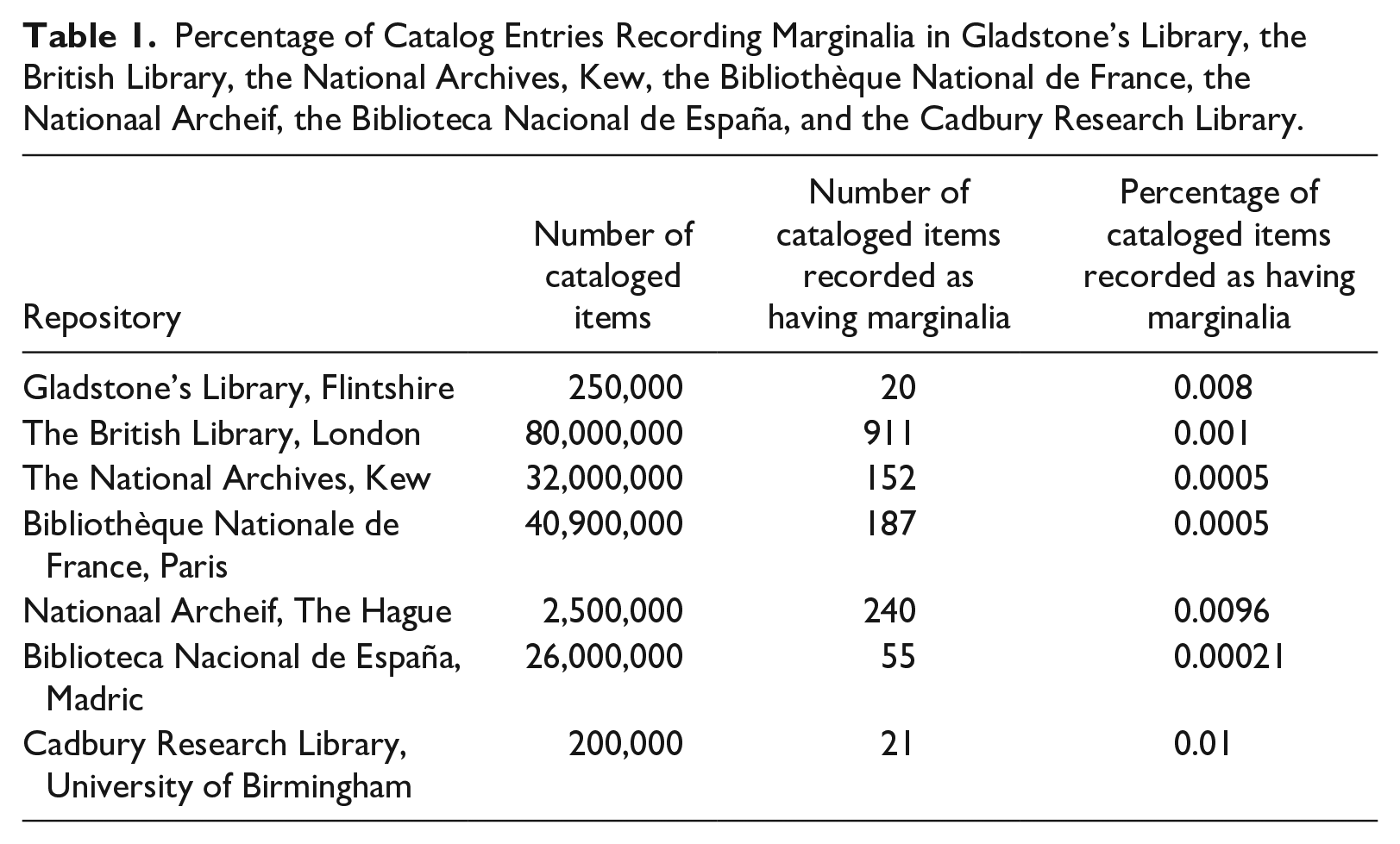
Despite many studies, of which the above are just a small sample, demonstrating the value of studying marginalia as a means of accessing marginalized voices, archival, library, and special collections catalogs have, in many cases, failed to keep pace with scholarly trends, neglecting to include detailed information about marginalia in their catalog entries [See Table 1]. At the time of writing, the Gladstone’s Library website, for example, states that they hold between 6,000 and 10,000 books owned by Gladstone that contain marginalia. 33 Yet, a search of their catalog for “marginalia” in the notes field brings up just four results, and a search for “annotations” only a further sixteen. Out of a catalog of more than 250,000 items, this equates to records of marginalia in just 0.008 percent of the items described, a figure that should, at the very least, be between 2.4 percent and 4 percent. Likewise, the British Library holds over eighty million items in its collections, yet just 911 records record the presence (or otherwise) of marginalia, equating to 0.001 percent. Similarly, the National Archives at Kew’s catalog allows users to search more than thirty-two million records held by over 2,500 archives. Of these records, just 152, or 0.0005 percent, mention marginalia. The same is true of other major European repositories. The Bibliothèque Nationale de France contains 187 records detailing notes marginal out of a collection of around 40.9 million items (0.0005 percent), for example, whilst a search for kanttekeningen in the catalog of the Dutch Nationaal Archeif returns 240 records out of a collection of 2.5 million (0.0096 percent). The Biblioteca Nacional de España likewise holds 26,000,000 items, of which only 55 (0.00021 percent) are cataloged as containing marginalia whilst the University of Birmingham’s Cadbury Research Library list just 21 of their 200,000 special collections items as featuring marginalia (0.01 percent).
Percentage of Catalog Entries Recording Marginalia in Gladstone’s Library, the British Library, the National Archives, Kew, the Bibliothèque National de France, the Nationaal Archeif, the Biblioteca Nacional de España, and the Cadbury Research Library.
Where marginalia is recorded, entries are often brief, describing the hand (if known) and date of the marginalia but rarely much beyond this. In the catalog entry for Or 11996, for example, the British Library note that:
. . .Marginalia in various hands occurs throughout the manuscript, in both Kurmanji Kurdish and Persian. . .
34
Likewise, the entry for TS 11/296/1017/2 by the National Archives, Kew reads: “Bail reminder in Smith and Norton v. Mrs Lee, with marginalia. . . .”
35
Though useful in identifying the presence of marginalia, neither of these entries offer any sense of who might have written this marginalia and when, and neither do they comment on the function of the marginalia. By contrast, the Magdalene College Library Catalog includes detailed comments on the marginalia found within a copy of Traité de physique by Jacques Rohault that was owned by the aforementioned Mary Astell. The entry reads:
. . .Volume 1: Ms inscription on title page: “nolo virtute relicta invidiam pacare” (“I do not want to subdue envy by abandoning virtue”). Ms notes on lower endpaper and further notes in pencil on upper and lower pastedowns. All in the hand of Mary Astell. . .
36
This is a significant improvement on the earlier examples. Whilst more granularity with the regards the function of the “notes” would be useful, the entry at least comments on the hand and the broad function of the marginalia, even providing transcriptions and locating the marginalia on the page.
Reluctance to Include Marginalia
Creating detailed descriptions of archive and special collections materials is a costly venture, both in terms of time and money, and this creates a significant barrier to libraries and archives producing entries that are in line with—and that can therefore best support—current scholarly trends. However, there are a number of more conceptual issues that have also created reticence to the idea of recording marginalia, the most prominent of these being the notion of value.
There remains a strong divide between those who relish marking their books and those who are appalled at the thought of anything but a pristine copy. This has long been the case, as William Sherman has noted. 37 Indeed, with modern libraries now needing to lend collections to thousands, if not millions, of users, readers are actively dissuaded from putting pen to paper, ensuring pristine copies are maintained for readers for many years to come. This attitude to library books perpetuates notions of pristine texts as inherently more valuable than marked ones, an attitude that marginalia scholarship has striven to overturn yet one that holds a powerful sway. Even in 2018, Cambridge’s Whipple Library held an exhibition of books that had been “subjected to notes, annotations, or other such inscriptions” [emphasis my own]. 38 As such, the more positive outlook on marginalia has been a recent and slowly adopted outlook that has further inhibited the recording of marginalia in catalog entries, with catalogers only beginning to consider the worth of marginalia.
Value of marginalia also presents problems when that value is placed on specific historical actors. Though some have moved swiftly to record marginalia in catalog entries, many catalog entries include details of marginalia only where it pertains to standard bibliographical data, such as the author, date, or provenance. Bristol Archives, for example, record in the description of 11168/73/a, a c.1883 pamphlet on the history of the West Indies slave trade by Mr Hilbert and Henry Bright, that the item features “marginalia and [is] interleaved with numerous supplementary notes in Henry Bright’s handwriting.” 39 Similarly, Gloucestershire Archives note in their description of D1799/E243, a series of eighteenth-century letters sent primarily between William Blathwayt, Thomas Hurnall, and Charles Watkins, that “characteristic marginalia by Wm. Blathwayt” is featured throughout. 40 Lambeth Palace Library, in addition, catalogs their copies of Edmund Gibson’s Tracts on Convocation by making reference to the “marginalia in his hand.” 41 This approach has served, in many cases including those cited above, to amplify already dominant voices, particularly those of famed, white, Western men, as noted earlier. Resultantly, the privileging of such voices has led to a disparity in the representation of male and female contributors to cataloged items. The Bibliothèque Nationale de France lists 1,152,322 male record creators in data.bnf.fr compared to 462,762 female creators, a disparity of 42.7 percent that highlights male contributions over female ones. Whilst the nature and survival of special collections means that items created by men dominate, this level of disparity does not accurately reflect the presence of women in the historical record, a disparity that could be minimized if more catalog entries recorded female contributions as demonstrated in women’s marginalia. Similarly, the National Archives currently lists 47,591 men as record creators, compared to just 5,610 women, a disparity of 78.67 percent. By privileging those who created manuscripts, rather than all who later contributed to them, the gaze is disproportionately male. The National Archives also list 167 contributors without a gender. In many cases, this is due to an ambiguity in the creator’s identity. However, it will be important for catalogs to incorporate voices across the gender spectrum moving forwards in order to redress not only the balance between male and female record creators, but also gender queer, transgender, and non-binary ones.
It is admittedly difficult to identify with any certainty marginalized figures who have left behind fewer examples of their writing than their more famous counterparts. Identifying anonymous marginalia is often only possible, and even then not with total surety, by comparing the sample to other examples of the same hand. This relies on such examples existing, skewing the bias towards wealthy, white, Western, men whose books and papers have had a higher chance of survival. This inherent bias thus privileges those whose voices are already raised within the historical narrative, with marginalia having value only when it pertains to those privileged few. Indeed, Wheaton College notes in their blog post about marginalia in their special collections that some texts:
become artifacts in their own right through the identities of their once-owners. Signed or notated by famous authors or historical figures, these extra-textual additions come to define the character and value of the work.
42
This approach serves only to further marginalize the myriad of historical figures who have marked texts just as readily as their notorious counterparts, yet whose voices are judged as less valuable for the prestige of the library or archival collection.
However, knowing the name of an individual is not always necessary—it is the function of their marginalia, the socio-cultural groups they give voice to, and their subversion of authority that counts most. We do not always need to know the author of the marginalia to see it’s worth and thus all marginalia is worthwhile of being recorded, whether we can confirm the hand it is in or not.
Further compounding the theoretical issues that have often proved inimical to including marginalia—and especially the marginalia of marginalized groups—in catalog entries is the lack of systematic framework for marginalia descriptions. There is, for instance, no space for marginalia in traditional bibliographical structures, and, even with the development of TEI-XML attributes—a text-based coding metalanguage commonly used to aid the production of digitized texts—to support cataloging efforts, there is no marginalia attribute or tag. This means that descriptions of marginalia are often subsumed into descriptions of the manuscript content. There are two possible tags that may be used: the first is <note>, designed to encompass all additional comments found in a text, though this works to the exclusion of non-textual marginalia, and the second is <add>, designed to describe any additional letters, words, or phrases, though again to the exclusion of non-textual marginalia. These tags can be very useful to scholars seeking to digitally represent manuscript pages, but less so when being used to construct catalog entries.
How, then, do we capture all voices contained within the copious marginalia that proliferate in archives and libraries? How can we ensure that those traditionally championed by history do not continue to dominate the historical record? How can catalogers allow researchers to locate the marginal in marginalia efficiently, facilitating the telling of new historical narratives that can decenter those that currently prevail?
Recommendations
It is my recommendation that marginalia be recorded as its own field, with hands being identified wherever possible and catalogers recording not only the presence of the marginalia but also its function(s) within the text. H.J. Jackson suggested in 2002 that the universal field of “ms. Notes” could be used to distinguish marginalia in catalog entries. However, this implies that what is being recorded is merely textual, occluding visual markers such as manicules, diagrams, doodles, and punctuation marks. Indeed, this term has not, for instance, manifested as a TEI-XML attribute, nor has it become a common feature in catalog entries using other methods such as relational databases. The RBMS Controlled Vocabularies list does offer similar suggestions in its “marginalia” category, suggesting that catalogers split descriptions of marginalia into “markings” and “annotations.” However, with the exception of the inclusion of manicules and underlining as subcategories of “markings,” both of these categories follow Jackson’s lead and neglect visual marginalia such as doodles, diagrams, sketches, and symbols. Although details of these visual marginalia could be added in a comments field, this unspecific workaround inhibits the user’s ability to filter by items containing marginalia, or effectively search catalogs for those same items. In this sense, then, details of marginalia become hidden in plain sight, and the voices they contain remain hushed. Similarly, Heidi Brayman Hackel has suggested a threefold division of marginalia: marks of active reading, marks of ownership, and marks of recording but here too is preference given to textual, rather than visual, marginalia. Brayman Hackel discusses other forms of marginalia that do not fit this tripartite division—marginal images, geometric figures, fragments of verse, calculations, and fragments of verse amongst others—but offers no suggestion of how to reconcile these with her three-way division.
One solution to the prizing of textual over visual marginalia may be to use the term “paratext” instead. However, this category is perhaps too broad given that many paratextual elements today, such as award badges, taglines, and publisher logos offer little insight into readerly engagement. But if “ms. Notes” is too narrow, and “paratext” too broad, what is the Goldilocks solution? I propose that the category of “marginalia” is adequate despite its simplicity, encapsulating both textual and visual elements whilst simultaneously conveying a sense of place and action. In TEI-XML, <marginalia> could easily fall under the broader <msDesc> attribute, whilst relational databases could unproblematically introduce “marginalia” as an open text field. In creating such an attribute/field wherein the existence and function of marginal notes and images can be fully described, marginalia can be separated from the broader category of “manuscript description,” giving marginalia a sense of authority whilst simultaneously providing a space where voices (and particularly marginalized voices) and be heard.
It is imperative, however, in a world of linked open data that descriptions are consistent across collections to enhance searchability and shareability. This article thus additionally recommends that a detailed, granular controlled vocabulary that fully encompasses the diversity of marginalia, both textual and visual, should be developed. The establishment of such a controlled vocabulary, more detailed than that currently in existence, would allow for richer descriptions of not only the presence of marginalia, but also their function relative to the text, and thus the ways in which readers were using marginal spaces to record their own voices. This will be of great benefit to scholars seeking to address reading practices, as well as those interested in uncovering marginal voices. Only in providing clear and detailed access to marginal spaces can we uncover the marginalized voices they contain.
Conclusion
Annotated texts are personal artifacts, unique microhistories of individual readers, and are therefore idiosyncratic in a way that “unblemished” copies of the same printed work are not. They do not fit into the neat bibliographical categories that have long since shaped archival catalogs, and they pose problems for catalogers in terms of description. Yet it is this problematic, idiosyncratic nature that gives marginalia its value, making it imperative for archival catalogs to accurately and thoroughly describe the use of marginalia in their collections, as much as any other catalog field.
Marginalia are testaments to the power of reading. Far from being a simple process of a reader absorbing information from a text, they reveal how readers created active dialogues with written texts, contesting authority, and creating shared identities. Marginalia are thus an integral part of a text’s history as much as they are vital socio-cultural records, providing material evidence for lives that have otherwise gone unrecorded. In recording marginalia in catalog entries, archivists can thus play a crucial role in elevating the voices marginalized figure that have often gone unheard. Marginalia is not to be marginalized, but rather celebrated as an important means of accessing uncataloged stories and elevating unheard voices.
Footnotes
Declaration of Conflicting Interests
The author declared no potential conflicts of interest with respect to the research, authorship, and/or publication of this article.
Funding
The author received no financial support for the research, authorship, and/or publication of this article.
1.
“G.J.,” Blackwood’s Edinburgh Magazine, November 1819, 197. https://www.google.co.uk/books/edition/Blackwood_s_Edinburgh_Magazine/__IFSctxDqcC?hl=en&gbpv=1&dq=fair%20specimen&pg=PA197&printsec=frontcover
2.
3.
“Wotton to Petre.1,” The National Archives, Kew, SP 1/219, fol.124.
4.
5.
6.
Michel de Certeau, The Practice of Everyday Life (Oakland, CA: University of California Press, 2011), 174; Roger Chartier, Forms and Meanings: Texts, Performances, and Audiences from Codex to Computer, trans. Lydia G. Cochrane, Milad Doueihi, and David D. Hall (Philadelphia, PA: University of Pennsylvania Press,  ), 89.
7.
Anthony Grafton and Lisa Jardine, ““Studied for Action”: How Gabriel Harvey Read His Livy,” Past & Present, 129, no. 1 (1990): 30–78; Heidi Brayman Hackel, Reading Material on Early Modern England: Print, Gender, and Literacy (Cambridge: Cambridge University Press, 2005); Fred Schurink, ““Like a Hand in the Margine of a Booke”: William Blount’s Marginalia and the Politics of Sidney’s Arcadia,” The Review of English Studies, 59, no. 238 (): 1–24.
8.
9.
William H. Sherman, Used Books: Marking Readers in Renaissance England (Philadelphia, PA: University of Pennsylvania Press, 2008); Bradin Cormack and Carla Mazzio, Book Use, Book Theory: 1500-1700 (Chicago, IL: University of Chicago Press, ).
10.
12.
Catherine Sutherland, “Books Owned by Mary Astell in the Old Library of Magdalene College Cambridge,” The Library, 24, 3 (forthcoming, September 2023) 267–301; Tom Almeroth-Williams, “Ahead of Her Time: Magdalene College Cambridge Has Discovered a Treasure Trove of Women’s Intellectual History,” Last Modified March 8, 2021, available at: .
13.
Katherine Acheson, “Introduction: Marginalia, Reading, and Writing,” in Early Modern Marginalia, ed. Acheson (New York, NY: Routledge, 2021), 1–12, at p. 6; Katherine Acheson, “The Occupation of the Margins: Writing, Space, and Early Modern Women,” in Early Modern English Marginalia, ed. Acheson, 70–90; Georgianna Ziegler, “Anne Clifford Reads John Selden,” in Early Modern English Marginalia, ed. Acheson, 134–54.
14.
Rosalind Lewin Smith, “Paratextual Marginalia, Early Modern Women, and Collaboration,” in Gender, Authorship, and Early Modern Women’s Collaboration, ed. Patricia Pender (London: Palgrave Macmillan, 2017), 175–200. See also, Rosalind Lewin Smith, “Narrow Confines: Marginalia, Devotional Books and the Prison in Early Modern Women’s Writing,” Women’s Writing, 26, no. 1 (): 35–52.
15.
16.
17.
Heather Joanna Jackson, Marginalia: Readers Writing in Books (London: Yale University Press, 2002), 19.
18.
Jackson, Marginalia, 21.
19.
20.
Lerer, “Devotion and Defacement,” 128.
21.
22.
‘This is my book. It is not yours my friend.’
23.
24.
25.
26.
27.
28.
29.
Nikolova-Houston, Margins and Marginality, 33, 131.
30.
31.
32.
33.
Katie Ruffley, “The Reader Behind the Book - A Look at Marginalia,” Gladstone’s Library, Last Modified January 18, 2018, available at: .
35.
37.
39.
40.
41.
“Tracts on Convocation by Edmund Gibson,” Lambeth Palace Library, MS 4400-4405, available at: https://archives.lambethpalacelibrary.org.uk/CalmView/Record.aspx?src=CalmView.Catalog&id=MSS%2f4400-4433%2f4400-4405&pos=50.
42.
Wheaton College, “Marginalia in the Archives,” From the Vault: Voices from Buswell Library Archives & Special Collections, Last Modified August 1, 2022, available at: .