




Abstract
The special approaches to cataloging architectural drawings that were developed in the analog era of printed catalogs have persisted for over half a century. But the growth of digital technology in more recent years has created new challenges and opportunities for custodians of architectural drawings that have yet to be fully explored. This article examines traditional approaches to cataloging architectural drawings in the United Kingdom, including the highly influential system developed at the Royal Institute of British Architects in the 1970s, alongside recent literature and examples of modern finding aids to reveal the impact that digital technology has had on the practice of archival description, together with the possibilities that new technology offers for presentation and access to online descriptions. By highlighting the key developments in digital cataloging and relating them to the medium of architectural drawings, this article will enable custodians of architectural collections to ensure that their catalogs are fit for purpose in the digital age.
Keywords
Introduction
Architectural drawings have acquired a special status owing to their unique characteristics, which have influenced the way they are cataloged and described. An architectural drawing can be defined as a “sketch, diagram, plan, or schematic used to design, construct, and document buildings and other structures.” 1 They are primarily a visual, rather than textual, medium, and consequently have often been considered by repositories as prized, standalone objects, more akin to works of art than archival records. 2 Yet in spite of their artistic qualities, architectural drawings are first and foremost conduits of information—whether in the form of a design concept, a constructional detail, or the communication of an idea through the medium of the presentation drawing (Figure 1). Studying architectural drawings also requires special knowledge and skills. As well as an understanding of the drawing’s purpose and where it fits in the design process, researchers must be familiar with the conventions of orthographic projection, scale, symbols and legends, and the use of color to denote different building materials and phases of construction. In physical terms, architectural drawings are often large documents, and they exist in a wide variety of formats—from pencil, ink and washes on paper to blueprints, diazotypes, photostats, and xeroxes. 3 Today, manuscript architectural drawings are made rarely, as architects use computer aided design (CAD) software to produce visual representations of buildings. 4 All of these characteristics set architectural drawings apart from typical archival records, with consequences for how they are arranged, stored, and described. 5
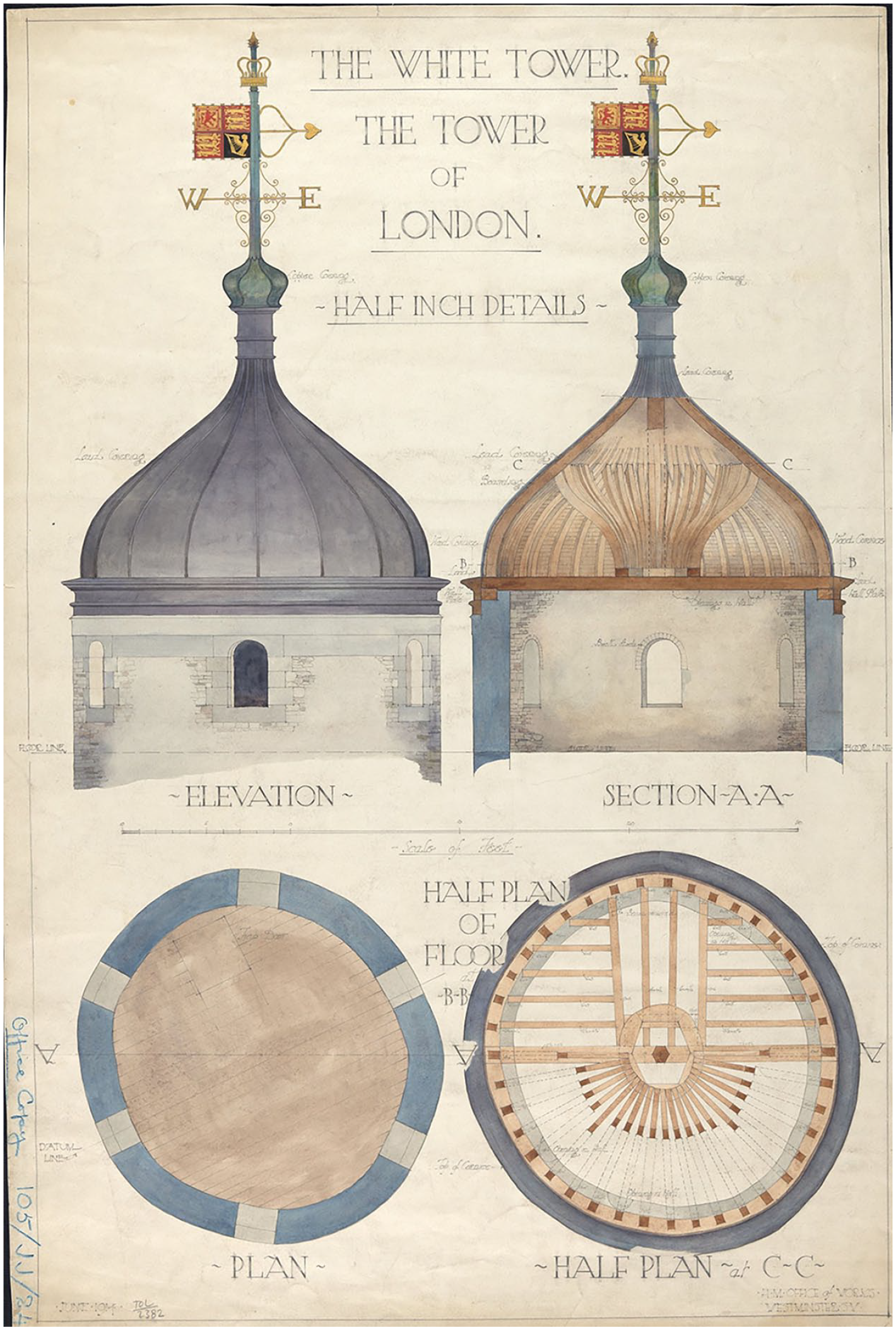
Survey of the White Tower, H.M. Office of Works, 1914. HRP EH/TOL/2382. © Historic Royal Palaces.
One of the earliest publications to touch on the topic of cataloging architectural drawings was Ehrenberg’s (1982) Archives and Manuscripts: Maps and Architectural Drawings. Published as part of the Society of American Archivists’ Basic Manual Series as a general reference work, it offered practical guidelines for archivists, but was not restricted to the activity of cataloging. 6 Ehrenberg’s manual did, however, set out the principle of multilevel description for architectural drawings, which is one of the key concepts that differentiates archival description from cataloging as practiced in libraries and museums. 7 Porter and Thornes’ (1994) Guide to the Description of Architectural Drawings is the most comprehensive work on the subject. In the Guide, Porter and Thornes laid out the theoretical foundations and conceptual framework of a cataloging standard for architectural drawings which recognized the importance of information networks. By articulating a set of principles and defining the types of information that should be recorded when describing architectural drawings, the authors hoped to pave the way for a common framework for cataloging architectural drawings. 8 In the International Council for Archives’ Guide to the Archival Care of Architectural Records (2000), Maygene Daniels describes a variety of different approaches to the description of architectural records, while acknowledging the role of descriptive standards. 9 Like Daniels, Susan Hamburger advocates consistency in the description of architectural records by adhering to descriptive standards and the use of controlled terminologies, while calling on catalogers to consider both the intrinsic and extrinsic attributes of architectural drawings. 10 A more recent article by Fleischer (2016), which describes a cataloging project at Stan Hywet Hall and Gardens, sheds light on the different approaches taken to cataloging a collection of architectural drawings by a team consisting of both curators and archivists. 11
Something that the existing literature has not addressed to any great extent, however, is the role of digital technology and its impact on the theory and practice of cataloging as they relate to architectural drawings. Angela Giral’s description of the AVIADOR project—an initiative to create a cataloging system for architectural drawings that could be integrated with the Avery Architectural and Fine Art Library’s bibliographic systems, and linked to graphic data held on videodiscs—outlines an early attempt to incorporate the medium of architectural drawings into a digital cataloging system. 12 Porter and Thornes considered the role of computers in relation to architectural drawings cataloging in more conceptual terms, but their development of a common framework to underpin computerized database systems is now outdated and has been superseded by the growth of international standards for archival description. 13 And although Daniels recognizes the impact of technology on the practice of description, highlighting the roles of databases, networks, and online finding aids, she offers few practical solutions to the challenges of cataloging in the digital age. 14 Indeed, in a more recent article Daniels appears to play down the impact of technology, arguing that “the underlying principles and goals of archival arrangement and description will remain unchanged—even as they continue to be adapted to the new information environment.” 15 Where the implications of technology for professionals working with architectural drawings have been addressed more fully is in the preservation of CAD and other design records, rather than arrangement and description. 16 The full impact of digital technology on the cataloging of architectural drawings, however, remains to be explored.
This article seeks to provide answers to some of the questions posed by technology by considering the main challenges of cataloging architectural drawings in the digital era—namely the growth of computer networks, and the changing requirements and expectations of users. By examining traditional approaches to cataloging architectural drawings in the United Kingdom and reviewing recent literature and examples of modern finding aids, this study will reveal the challenges that digital technology has created for catalogers of architectural drawings, together with the opportunities that technology presents in terms of access to online descriptions. Highlighting the key developments in digital cataloging and relating them to the medium of architectural drawings in this way will enable custodians of architectural collections to ensure that their catalogs are fit for purpose in the digital age.
Cataloging Architectural Drawings in the Pre-Digital Era: The RIBA Method
The cataloging of architectural drawings in the twentieth century was characterized by the development of a set of special conventions in response to the unique attributes of the medium. In the United Kingdom, the practice of cataloging architectural drawings was pioneered by the curators of the Drawings Collection at the Royal Institute of British Architects (RIBA). Between 1969 and 1984, the RIBA published a complete catalog of its collection in a series of nineteen printed volumes. 17 At the heart of the RIBA’s approach to cataloging was the foregrounding of the visual properties of architectural drawings and an emphasis on attribution. According to Jill Lever, general editor of the RIBA Drawings Catalog, “tracing origin or provenance is a small part of the task of cataloguing architectural drawings. More important is to establish an attribution, date and location.” 18 The most detailed description of the RIBA’s approach to cataloging is provided by Eleanor Gawne, a former curator at the RIBA. 19 Gawne describes the complete process of cataloging at the RIBA, from appraisal through to arrangement and description, using case studies to demonstrate how the process is applied in practice, and the various data elements that might be recorded for any given drawing. Finally, Gawne briefly describes the relationship between the RIBA’s approach and a range of international standards, terminologies, and authority controls. Thanks to its broad scope, the originality of its method, and its high standard of scholarship, the RIBA catalog set a benchmark for the cataloging of architectural drawings, and its approach to cataloging continues to be influential and highly respected.
In spite of its many positive attributes, the RIBA method is not without drawbacks. Its emphasis on the visual and physical qualities of drawings—evident in the inclusion of “aspect” as a distinct data element, as well as descriptions of watermarks, inscriptions, and signatures—means that less attention is given in the catalog to the archival provenance of each drawing. Consequently, the catalog’s entries often lack context, in the sense of connections to associated material and custodial histories. 20 The RIBA’s approach is also methodologically problematic. As Gawne explains, the RIBA cataloging approach conforms to the UKMARC AMC standard. 21 But this bibliographic standard is not designed to facilitate complex, multi-level descriptions in which the relationships between records are clearly articulated. 22 Therefore, the RIBA’s use of bibliographic systems results in a relatively flat structure of arrangement that enforces the separation of architectural drawings from associated records, such as job files, correspondence, photographs, and financial records. 23 Questions can also be asked about the catalog’s usefulness to researchers as a finding aid. As a product of the print era, the original RIBA catalog was built around the static presentation of information with entries arranged alphabetically by architect, and included few subject access points other than a general index, and no graphical means of discovery. Finally, while the detailed scholarship behind the RIBA’s catalog is admirable, it is more akin to a catalog raisonné than an archival finding aid.
The issues identified with the RIBA method of cataloging have been compounded by the technological developments of the early twenty-first century. The growth of network technology has made standardization an increasingly important aspect of cataloging. At the same time, new methods for accessing historical collections via the Internet have forced custodians of collections to reconsider the ways in which finding aids and digital objects are presented to researchers. Addressing these points, the rest of this article explores the challenges and opportunities that digital technology provides for catalogers of architectural drawings.
The Challenge of Standardization
The growth of technology—and in particular the introduction of computerized database systems and the Internet—has had significant consequences for catalogers of all types of collections. Computers have been used to create finding aids in libraries and archives since at least the 1970s. The earliest systems were used primarily to generate indexes and basic inventories that could be printed out and used as hand lists. 24 The development of relational database systems meant that catalogers could manipulate the information stored in catalogs in more complex ways, and better reflect the intellectual structures of collections in their descriptions. Today, collections management systems enable custodians both to describe and manage their collections, and are in widespread use by repositories around the world. Alongside the development of database software, the invention of the Internet triggered an “archival revolution,” allowing the publication of finding aids via the World Wide Web and spawning efforts to create a “universe of documentation” built on networks of repositories and information. 25 In many ways, the creation of formal networks of archival description has reified the open sharing of data envisaged by the pioneers of web technology. 26 The Internet has become an essential tool for the widespread dissemination and linking of catalogs.
The development of database and network technologies has heightened the need for consistency and interoperability in cataloging. Efforts to achieve consistency in describing collections have led to the development of numerous standards for the description of archive, library, and museum collections. Despite this, architectural drawings have typically been treated as unique and cataloged using separate systems from other types of collections, and little thought has been given to the ways in which traditional architectural drawings catalogs might be brought into line with more widely used descriptive standards. While the importance of standards and the benefits of compliance have been acknowledged, the cataloging of architectural drawings has been characterized largely by the development of special rules and, in the case of the RIBA, shoehorned into inappropriate or bespoke digital systems. Gawne acknowledges that “cataloguing description and naming standards for drawings are the same as those for traditional archives, and should be based on internationally recognised standards.” 27 The Architectural Drawings Advisory Group’s attempts to develop a systematic approach to cataloging architectural drawings in the mid-1980s represented an effort to address key conceptual issues in the cataloging of architectural drawings in much the same way that a typical standard operates. 28 But even as recently as 2009, Maygene Daniels characterized traditional standards as costly and restrictive, and argued that they are likely to be superseded by Internet search engines which offer full text search capabilities. 29 Nevertheless, in the age of the semantic web, the creation of structured data is in fact more important than ever, and the international archiving community continues to develop standards for describing collections and linking catalog data. 30
The suggestion that architectural drawings require special treatment is belied by the fact that existing standards are perfectly suitable for describing a range of media. The format agnosticism of the major descriptive standards means that in theory they can be used to describe any type of collection, including architectural drawings. For example, the International Standard for Archival Description (ISAD(G)) defines four multilevel description rules and twenty-six data elements that can be applied to any type of collection, regardless of format. 31 Certain standards make explicit reference to architectural drawings. The widely used Rules for Archival Description, for instance, includes a chapter dedicated to the description of architectural and technical drawings. 32 As well as setting out general rules of description, the chapter includes guides to relevant data elements, and suggests how these can be used to accommodate data specific to architectural drawings, such as “scale.” Similarly, the Manual of Archival Description includes a section devoted to describing architectural plans. 33 Data structure standards also make allowances for the description of architectural drawings. Encoded Archival Description, a standard for structuring archival descriptions using extensible markup language (XML), allows ‘scale’ to be recorded as an attribute of the ‘materialspec’ element. Additionally, thesauri such as the Getty Research Institute’s Art and Architecture Thesaurus and Thesaurus of Geographical Names have obvious relevance for the description of architectural drawings. 34 While Daniels considers the development of an international standard for the description of architectural records within the format of ISAD(G) as “likely,” there is a danger that an overabundance of standards will result in confusion instead of cooperation. 35 The suggestion that architectural drawings catalogs require separate standards, therefore, is both undesirable and untrue.
Using descriptive standards to catalog architectural drawings is an essential step toward ensuring that finding aids can be shared, distributed, integrated, and understood in the digital age. Complying with existing standards enables descriptions of architectural drawings to be shared and integrated in union catalogs, which rely on consistent and predictably structured data. In purely practical terms, adhering to standards also means that architectural drawings can be described and managed using commercially available collections management systems. Bespoke systems can be costly and difficult to develop, and catalogers are likely to encounter problems when ingesting or transferring data between such systems, not to mention the difficulties for researchers caused by the lack of consistency between catalogs based on local systems. On the contrary, adherence to recognized standards, together with the use of controlled vocabularies, gives architectural drawings catalogers the best chance of making their descriptions interoperable and therefore shareable, reusable and comprehensible for users in the twenty-first century.
Opportunities for Improving Access
Digital technology has brought about changes in the way that information about objects is captured. Yet an equally important part of the cataloging process is to consider how descriptions are presented to users. Most repositories have some form of online presence, and an increasing number provide access to their collections through web-based catalogs and finding aids, as well as through social media channels. At the same time, archival networks have brought together disparate collections in the form of union catalogs, providing researchers with integrated access to materials held by different repositories. The overarching effect of these developments is that the distance—both physical and intellectual—between the users and the custodians of historic records, has increased in the digital era, as the availability of finding aids has accompanied a loss of human interaction between researchers and archivists. 36 Digital technology has therefore fundamentally altered the dynamic between the custodian and the user.
As a result of the expansion of remote access to archives, the significance of the online finding aid as a tool for research has increased. The need for custodians of collections to understand user behavior and requirements has consequently become paramount. Little information about users of architectural drawings catalogs exists, but it is possible to draw some conclusions from studies of general archival finding aid users. Studies of users’ interactions with digital catalogs demonstrate that researchers have difficulty using online finding aids, and that both the design and the content of finding aids affects the ability of researchers to use them efficiently. 37 There is also clear evidence that user expectations and requirements have evolved in the digital age. For instance, studies show that researchers expect to be able to access descriptions online, while many—especially inexperienced users—also expect to find digital copies of material via online finding aids. 38 It is common among the newest generation of users to assume that everything is available online, and conversely that if something is not online then it does not exist. 39 Users also want access to items to be as direct as possible—a particular challenge to archivists trained in the art of hierarchical description, which is complicated by the fact that navigating complex, multi-level descriptions presents a stumbling block for many researchers. 40 Terminology is another issue—many users struggle to comprehend archival jargon, with terms such as “fonds” causing considerable confusion among non-specialists. 41 The findings of user studies suggest there is much for catalogers to think about when creating digital finding aids.
For catalogers of architectural drawings, there are two main challenges that stand out. The first is the issue of direct access to items. There is compelling evidence that users of online finding aids prefer direct access to descriptions of individual items, rather than overarching descriptions of whole collections. 42 Existing guidelines present conflicting views about the level to which architectural records should be described. Traditionally, drawings have been cataloged at the level of the individual item. 43 At the RIBA, this approach is taken for all drawings created before 1840, items created after 1840 that are considered important, and in cases where the cataloger has “rare or exclusive” knowledge. 44 On the other hand, Lowell and Nelb argue that “an item-level descriptive model is appropriate for managing holdings of unique single items, but is poor archival practice for large design collections.” Instead, they suggest, description should be done at the series or sub-series (or “project”) level. 45 However, when taking into consideration the expectations of researchers in the digital age, it is clear that item-level cataloging of architectural drawings is the ideal.
Admittedly, the item-level approach to cataloging places high demands on repositories in terms of resources, staff time, and expertise. Digitizing entire collections is not a realistic objective for most repositories. There is a danger, too, that item-level descriptions of entire collections might be overwhelming for researchers, and may in fact hinder retrieval of records. 46 However, user studies suggest that the provision of descriptions of individual items, as opposed to collection-level descriptions, is most likely to help custodians to meet their users’ expectations. And as an extra benefit, item-level description can help repositories to plan for the care of their collections and reduce unnecessary handling of items when undertaken strategically alongside collection storage projects. 47 While cataloging individual items might require reducing the amount of detail provided in descriptions, it is increasingly easier—and beneficial for users—for repositories to provide digital surrogates of items through their catalogs, which can at least go some way to mitigating the exclusion of textual information. 48
The second major challenge for catalogers of architectural drawings is the issue of terminology. Typically users find the use of archival jargon to be an obstacle to their research. 49 For catalogers of architectural drawings there is an added layer of complexity in the need to think about the use of technical terms from the field of architecture, which are not easily understood by non-specialists. Thesauri and controlled vocabularies can be helpful tools, assisting catalogers to select appropriate and consistent terms to use in descriptions, and facilitating the use of finding aids by researchers by introducing structured and controlled subject access points. The Getty’s Art and Architecture Thesaurus (AAT)—a structured vocabulary containing nearly half a million terms arranged into a framework of facets and hierarchies—is the most obvious source for controlled terms relating to architectural records (Figure 2). 50 Equally, standard terms should be applied to geographic locations, as well as personal and corporate names. Standards such as ISAAR-CPF facilitate consistency in the format of authority records, including those for architectural firms and individual architects. 51 Another solution that might be considered more appropriate where unusual or subject-specific terms are used is to incorporate a glossary into the finding aid. A good example is provided by Mackintosh Architecture: Context, Making and Meaning, which features a glossary of subject-specific vocabulary consisting of both textual definitions and illustrations, designed to help users understand unfamiliar terms such as “skewputt” and “Aberdeen Bond.” 52 Whatever the remedy, it is important for catalogers in the digital age to think carefully about terminology when describing architectural collections.
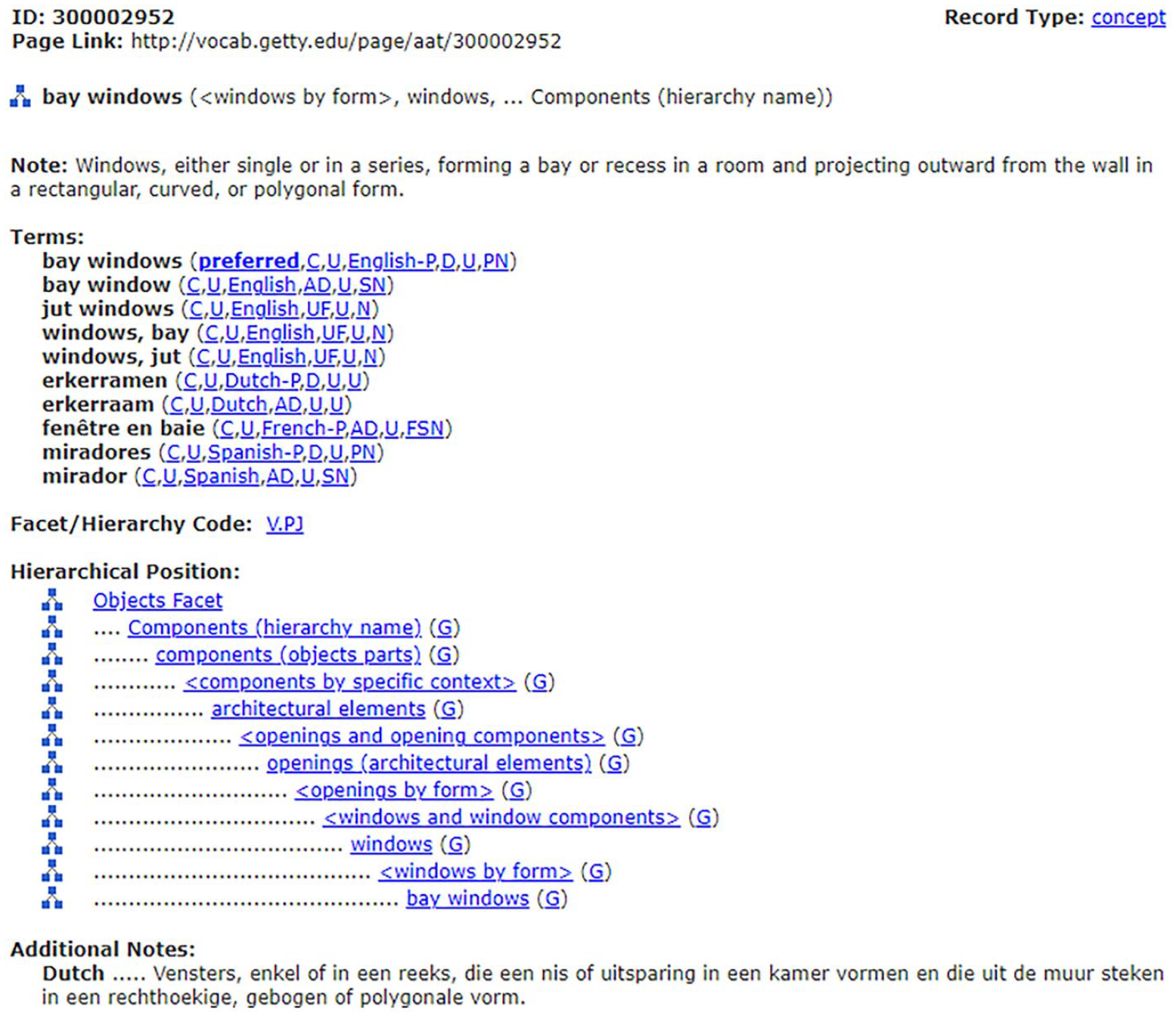
Contains information from the J. Paul Getty Trust, Getty Research Institute, the Art & Architecture Thesaurus, which is made available under the ODC Attribution License.
While researchers face challenges in using online finding aids, technology also offers new possibilities for navigation, presentation, and interaction with catalogs. Advanced and faceted search techniques enable users to conduct sophisticated and highly targeted searches of repositories’ holdings, while digital technology also facilitates new ways of browsing. 53 Graphical interfaces allow users to seek material according to visual criteria, and geographical information can be used to create new methods of accessing records through location data. 54 Meanwhile, social tagging, blogging, comment boxes, annotation, bookmarking, and other “Web 2.0” features have been used to drive user engagement through the creation of “participatory” finding aids. 55 Compared with the printed catalogs of the analog era, modern finding aids present catalogers and users with much more sophisticated opportunities for engagement with collections, and the ability to conduct deeper research into collections via the medium of the catalog.
Participation is a valuable tool both for catalogers and users of architectural drawings. Modern web technology provides repositories with the chance to create participatory finding aids that incorporate social and interactive components to encourage user engagement. Such features have been shown to drive greater participation, foster a sense of community among remote users, and to encourage greater use of collections. 56 Users of Sir John Soane’s Museum’s online catalog, for example, can construct personal collections of online content for future reference using the “My Collection” feature. 57 User-contributed geotagging perhaps represents the best opportunity for custodians of architectural drawings to capitalize on the participatory web. The Georeferencer tool developed by Klokan Technologies GmbH and the University of Portsmouth has proven particularly successful. More than 530,000 maps have been tagged and made available through Old Maps Online, while at the British Library volunteers have tagged nearly 73,000 maps using the Georeferencer, providing accurate location data and enabling data visualization, as well as new ways for users to discover and interact with digitized maps. 58 As a close relation to the cartographic medium, it is not difficult to imagine how architectural drawings might benefit from similar geotagging initiatives. Thanks to their graphic qualities, digitized drawings are also prime material for inclusion in blogs and for sharing via social media channels, where they can be quickly and easily exposed to a wide audience, with the potential to generate high levels of click-through traffic to online descriptions and finding aids. 59 The adoption of social and participatory features in catalogs and descriptions therefore heralds a wealth of opportunities for fresh engagement with collections of architectural drawings.
Digital technology has not only changed the content of finding aids but the ways in which they are delivered as well. The design of online finding aids has a significant bearing on the ability of users to interact successfully with them. Digital technology has made the ability to conduct complex searches possible for most users of online finding aids. However, despite the ubiquity of search functions in online finding aids, browsing remains an important method of entry into descriptions of collections. In the digital age, information visualization can be an effective tool for facilitating discovery. 60 For architectural drawings catalogers this point is particularly relevant because as a visual medium, architectural drawings are especially well suited to discovery through graphical means. Moreover, such graphical tools for discovery eliminate the barriers to access created by unfamiliar terminology, which might be an obstacle for non-specialist researchers. Using digitized material and linked geographical data, catalogers can create “generous,” graphical interfaces for architectural drawings collections including image grids and map-based viewers. Mackintosh Architecture’s map-based search feature provides a good example of the type of visual and intuitive discovery tool that is enabled by modern technology (Figure 3). 61 In this interactive feature, pins show the locations of projects completed by the architect, Charles Rennie Mackintosh, and provide direct links to records within the catalog. Such features have many advantages over traditional search tools. As well as providing access to collections, map-based interfaces visualize data for users, and help to overcome problems connected with language and toponymy. 62
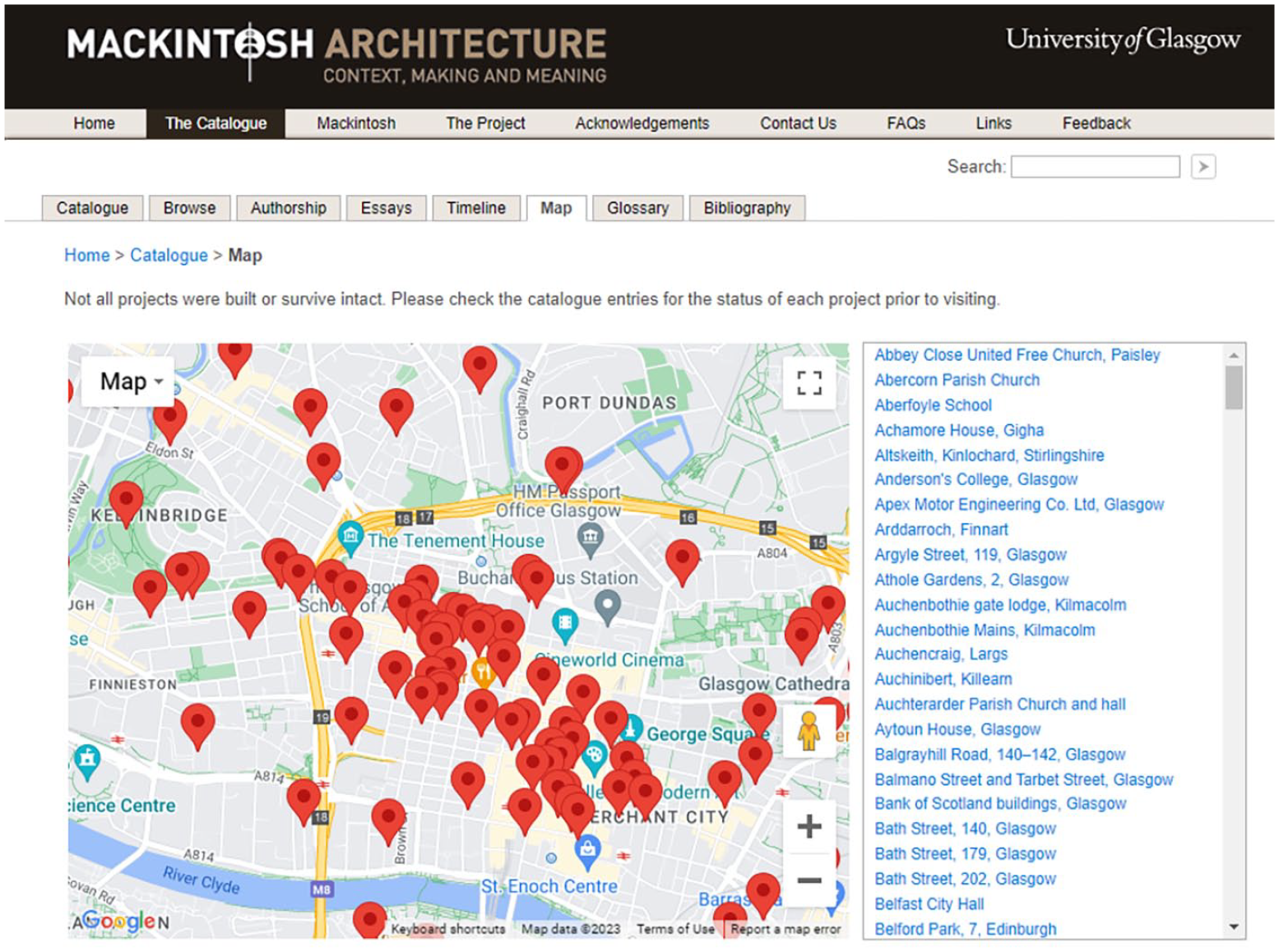
© Mackintosh Architecture, University of Glasgow, 2014.
Digital technology has had a profound impact on the dynamic between the user and the archive. As Mitchell Whitelaw writes, in the digital age “interfaces matter more than ever, because many users, in many collections, will never encounter the physical object (if there is one); increasingly, our only experience of a collection will be digital.” 63 In order to create helpful finding aids, custodians of architectural drawings must first understand their users. Existing studies of general archive users offer some guidance, suggesting that it is particularly important for catalogers of architectural drawings to consider the level of access they can provide to records, and to use clear and intelligible language in their catalogs. Technology also provides new opportunities. Interaction with collections of drawings may be encouraged through the development of participatory features, including geo-tagging tools. Furthermore, custodians can facilitate engagement with their collections through the implementation of graphical interfaces. Catalogers of architectural drawings are in a prime position to capitalize on the new opportunities technology offers to make finding aids appealing and helpful to users in the digital era.
Conclusion
Digital technology presents both challenges and opportunities for catalogers who work with architectural drawings. The approaches to cataloging that were developed in the era of printed catalogs, including the pioneering and highly influential method used by the RIBA, must be reassessed in light of recent developments in technology. In this article it has been argued that descriptions of architectural drawings must first conform to standards so that they can be shared and understood by users and applications. Widespread adherence to standards would lay the foundation for the creation of a single reference tool or union finding aid for architectural drawings, similar perhaps to the Old Maps Online portal, which provides access to historical maps held by a number of different institutions via a predominantly graphical interface. Such a tool would be of great help to researchers, eliminating as it would the need to know where a particular architectural archive might be found, while offering researchers the ability to make new discoveries and connections through data visualization.
Considering the needs of users is more important than ever. To this end, direct access to drawings should be enabled wherever possible, while care should be exercised around the use of terminology, and thesauri and glossaries should be employed to aid understanding. Exploiting the tools of the modern Web, participation and interaction should be encouraged, and the visual nature of architectural drawings exploited wherever possible. Graphical interfaces, enabled by technology, provide a new opportunities for discovering collections which are particularly well suited to providing access to collections of architectural drawings. Following these guidelines will allow custodians of architectural drawings not only to ensure that their catalogs are fit for purpose, but to exploit the opportunities that technology offers for cataloging in the digital age.
Footnotes
Acknowledgements
The research for this article was undertaken as part of Historic Royal Palaces’ research assignment scheme. I would like to extend sincere thanks to Melanie Bailey-Melouney, Ed Bottoms, Eleanor Gawne, Susan Palmer, and Dr Marianne Wilson for reading and commenting on an earlier draft. This article is dedicated to the late Jill Lever (1935–2017), an authority on the subject of architectural drawings who taught me how to catalog, and much else besides.
Declaration of Conflicting Interests
The author declared no potential conflicts of interest with respect to the research, authorship, and/or publication of this article.
Funding
The author received no financial support for the research, authorship, and/or publication of this article.
1.
2.
3.
For an overview of the development and characteristics of photoreproductions, see Eléonore Kissel and Erin Vigneau, Architectural Photoreproductions: A Manual for Identification and Care (New Castle, DE: Oak Knoll Press, 1999).
4.
In modern practices and schools of architecture it is not uncommon for film, sound, 3d models and game software to be used in the design process (Edward Bottoms, email message to author, April 3, 2023).
5.
Perhaps as a result of their special characteristics, architectural drawings cataloguing does not feature specifically in the syllabuses of any of the qualifications accredited by the Archives and Records Association (UK & Ireland).
6.
Ralph E. Ehrenberg, Archives and Manuscripts: Maps and Architectural Drawings, SAA Basic Manual Series (Chicago, IL: Society of American Archivists, 1982).
7.
Ehrenberg, Archives, 23.
8.
Vicki Porter and Robin Thornes, A Guide to the Description of Architectural Drawings (New York, NY: G.K. Hall [for] the Getty Art History Information Program, 1994), available at:  .
.
9.
10.
Susan Hamburger, Architectural Records: Arrangement, Description and Preservation (Carlisle, PA: Mid-Atlantic Regional Archives Conference, 2004), 18–9.
11.
S. Victor Fleischer, “Managing Architectural Records in the House that Rubber Built: a Case Study in Multi-Disciplinary Collaboration in Museum Archives,” Journal of Archival Organization, 13, no. 1–2 (2016): 47–61.
12.
Angela Giral, “At the Confluence of Three Traditions: Architectural Drawings at the Avery Library,” Library Trends, 37, no. 2 (Fall 1988): 232–42.
13.
Porter and Thornes, Guide.
14.
Daniels, “Description of Architectural Records,” 87.
15.
Maygene Daniels, “Arrangement and Description of Architectural Records: Time-Honoured Principles and New Technologies,” Comma: International Journal on Archives, 2009, no. 1 (2009): 104.
16.
17.
Jill Lever et al., Catalogue of the Drawings Collection of the Royal Institute of British Architects (Farnborough: Gregg International Publishers Ltd., 1969–84).
18.
Jill Lever, “Cataloguing the RIBA Drawing Collection,” Architectural Design, 5/6 (1978): 395.
19.
Eleanor Gawne, “Cataloguing Architectural Drawings,” Journal of the Society of Archivists, 24, no. 2 (2003): 175–87.
20.
In the RIBA’s catalogue, ‘provenance’ means the ownership of a drawing over time. By contrast, the archival definition of ‘provenance’ relates to ‘the administrative origin of a record or of an archival collection and is concerned with determining how the individual or organisation accumulated, organised and used its records’ (Caroline Williams, Managing Archives. Foundations, Principles and Practice (Oxford: Chandos Publishing, 2006), 13).
21.
Gawne, “Cataloguing Architectural Drawings,” 184.
22.
Kent M. Haworth, “Archival Description: Content and Context in Search of Structure,” Journal of Internet Cataloging, 4, no. 3–4 (2001): 20–21.
23.
Gawne, “Cataloguing Architectural Drawings,” note 1.
24.
Michael Roper, “Computer Applications Committee: a Consultation Document,” Journal of the Society of Archivists, 5, no. 1 (April 1974): 103.
25.
26.
For the background to the creation of a national archival network in the UK, see National Council on Archives, Archives On-line: The Establishment of a United Kingdom Archival Network (1998).
27.
Gawne, “Cataloguing Architectural Drawings,” 184.
28.
Porter and Thornes, Guide, xvii.
29.
Daniels, “Arrangement and Description,” 104.
30.
Lois Hamill, Archival Arrangement and Description: Analog to Digital (Lanham, MD: Rowman and Littlefield, 2017), 402. For an introduction to the concepts behind the latest development in international cataloguing standards, see Gretchen Gueguen, Vitor Manoel Marques da Fonseca, Daniel V. Pitti, and Claire Sibille-de Grimoüard, “Toward an International Conceptual Model for Archival Description: A Preliminary Report from the International Council on Archives’ Experts Group on Archival Description,” The American Archivist, 76, no. 2 (Fall/Winter 2013): 567–84.
31.
32.
33.
Margaret Procter and Michael Cook, Manual of Archival Description, 3rd ed. [MAD3] (London and New York, NY: Routledge, 2016), 332–42.
34.
35.
36.
Richard J. Cox, Lisa Alderfer, Brigitta Arden, Therese Barry, Abby Bence, Siri Berdahl, Brian Bleich, et al., “Machines in the Archives: Technology and the Coming Transformation of Archival Reference,” First Monday, 12, no. 11 (November 2007), available at: ; Dennis Meissner, “First Things First: Re-Engineering Finding Aids for Implementation of EAD,” The American Archivist, 60 (Fall 1997): 375; Christopher Prom, “User Interactions with Electronic Finding Aids in a Controlled Setting,” The American Archivist, 67 (Fall/Winter 2004): 265.
37.
Joyce Chapman, “Observing Users: an Empirical Analysis of User Interaction with Online Finding Aids,” Journal of Archival Organization, 8, no. 1 (2010): 4–30; Morgan Daniels and Elizabeth Yakel, “Seek and You May Find: Successful Search in Online Finding Aid Systems,” The American Archivist, 73 (Fall/Winter 2010): 535–68; Wendy Duff and Penka Stoyanova, “Transforming the Crazy Quilt: Archival Displays from a Users’ Point of View,” Archivaria, 45 (1998): 44–79; Prom, “User Interactions,” 234–68; J. Gordon Daines III and Cory L. Nimer, “Re-Imagining Archival Display: Creating User-Friendly Finding Aids,” Journal of Archival Organization, 9, no. 1 (2011): 4–31; Elizabeth Yakel, “Encoded Archival Description: Are Finding Aids Boundary Spanners or Barriers for Users?,” Journal of Archival Organization, 2, no. 1–2 (): 64.
38.
Prom, “User Interactions,” 247; Chapman, “Observing Users,” 12.
39.
Fleckner, “The Last Revolution,” 12.
40.
Prom, “User Interactions,” 247; Chapman, “Observing Users,” 20; Daines and Nimer, “Re-Imagining Archival Display,” 8; Daniels and Yakel, “Successful search,” 540.
41.
Duff and Stoyanova, “Transforming the Crazy Quilt,” 52. See also Chapman, “Observing Users,” 17, and Daines and Nimer, “Re-Imagining Archival Display,” 10.
42.
Cory Nimer and J. Gordon Daines III, “What Do You Mean It Doesn’t Make Sense? Redesigning Finding Aids from the User’s Perspective,” Journal of Archival Organization, 6, no. 4 (2008): 227.
43.
Daniels, “Description of Architectural Records,” 83.
44.
Gawne, “Cataloguing Architectural Drawings,” 180–1.
45.
Waverly Lowell and Tawny Ryan Nelb, Architectural Records: Managing Design and Construction Records (Chicago, IL: Society of American Archivists, 2006), 98 & 100.
46.
Fleischer, “Managing Architectural Records,” 52.
47.
Lois Olcott Price, Line, Shade and Shadow: The Fabrication and Preservation of Architectural Drawings (New Castle, DE: Oak Knoll Press, 2010), 247.
48.
Daniels, “Description of Architectural Records,” 83. The importance of access to digital images of architectural drawings, and their ability to serve as a form of descriptive data, was one of the foundations of the AVIADOR project, described in Giral, “At the Confluence,” 232–42.
49.
Daines and Nimer, “Re-Imagining Archival Display,” 10. This observation applies to both descriptive text and field headings.
50.
Baca and Harpring, “The Getty Vocabulary Program,” 184.
51.
Gawne, “Cataloguing Architectural Drawings,” 184.
52.
53.
54.
Robert B. Allen, “Using Information Visualization to Support Access to Archival Records,” Journal of Archival Organization, 3, no. 1 (): 38. For an example of a project which used geolocation data to facilitate access to an archival collection of photographs, see Deborah Boyer, Robert Cheetham, and Mary L. Johnson, “Using GIS to Manage Philadelphia’s Archival Photographs,” The American Archivist, 74 (Fall/Winter 2011): 652–63.
55.
Mary Samouelian, “Embracing Web 2.0: Archives and the Newest Generation of Web Applications,” The American Archivist, 72 (Spring/Summer 2009): 68.
56.
Samouelian, “Embracing Web 2.0,” 69. See also Michelle Light and Tom Hyry, “Colophons and Annotations: New Directions for the Finding Aid,” The American Archivist, 65 (Fall/Winter 2002): 216–30.
58.
“Old Maps Online,” Klokan Technologies GmbH, 2022, available at: https://www.oldmapsonline.org; “Georeferencer,” British Library, available at: (accessed March 20, 2023).
59.
Felicia Williamson, Scott Vieira, and James Williamson, “Marketing Finding Aids on Social Media: What Worked and What Didn’t Work,” The American Archivist, 78, no. 2 (Fall/Winter 2015): 504.
60.
61.
Imrie et al., “Mackintosh Architecture.”
62.
Christopher Fleet, Kimberly C. Kowal, and Petr Přidal, “Georeferencer: Crowdsourced Georeferencing for Map Library Collections,” D-Lib Magazine, 18, no. 11/12 (November/December 2012), available at: ; Agata Maggio, Josef Kuffer, and Maurizio Lazzari, “Advances and Trends in Bibliographic Research: Examples of New Technological Applications for the Cataloguing of the Georeferenced Library Heritage,” Journal of Librarianship and Information Science, 49, no. 3 (2017): 300.
63.
Whitelaw, “Towards Generous Interfaces,” 124.