




Abstract
This article focuses on the preservation of the tangible material culture of the Shona traditional music legacy. It reports on how the author collected and deposited the Shona tangible materials used during both sacred and secular contexts. For this research, an applied action research methodology was employed together with ethnography. Ethnographic fieldwork was conducted in Hwedza, Chikomba, Bhuhera, and Gweru, and the applied action approach informed the preservation of tangible materials. The findings indicated that the paradigm shift in religious belief, rural-to-urban migration, and modern technology are threatening the sustenance of the Shona traditional materials and that there is a need to protect them before they disappear. As a mitigative measure, the author collected some musical instruments and traditional objects and deposited them in a local departmental music archive at a university in Zimbabwe. It is therefore recommended that more collections be done to safeguard the vulnerable music heritage of the Shona.
Introduction
Every African culture is believed to be what it is because of, among other things its material culture. The production of our activities is used to solve society’s social, political, religious, and economic problems. Prown defines material culture as:
. . . artifacts of beliefs, values, ideas, attitudes, and assumptions, of a particular community or society at a given time. The term material culture is also frequently used to refer to artifacts themselves, and the body of material available for such study. (Prown 1982, 2)
In the case of us the Shona people of Zimbabwe, our material culture embraces traditional objects, musical instruments, props, costumes, and many more. The Shona are a spiritual people who believe in ancestry. We occasionally organize ceremonies that are meant to appease the ancestors. Apart from using the materials mentioned above for domestic use, we also use them to contextualize these ceremonies. We have been with these materials as far back as the pre-colonial period. The materials have been efficacious in enabling them to lead a meaningful life as a culture. However, this material culture has of late experienced some changes due to several factors which are; modern technology, rural-to-urban migration, and the advent of the church. These changes have impacted the sustainability of the materials.
This article presents a report on what transpired during the collection and deposition of some of the tangible materials used during traditional ceremonies like kurova guva by the Shona people of Zimbabwe. The content is an extract of the findings of my Ph.D. studies on the preservation of Shona legacy of mbira carried out in 2012. The article will discuss my experiences in the field and participants’ perceptions of the need to preserve the Shona cultural legacy of music. The article then touches on the collection process indicating the forms that were used and the type of materials collected. A discussion on how some ethical issues were considered is also discussed in this paper. Ethical issues are paramount when research involves humans. A brief outline of how the tangible materials were deposited and cataloged is presented and lastly the challenges faced in the whole process. The words archive and museum are going to be used interchangeably in this article. While a museum is taken to refer to a building where materials of sentimental and historical value are stored for reference and preservation, an archive is “. . . a means of accessing the artifacts, thoughts, and outputs of past researchers . . .” (Hill and Davidson 2012, 154). They are both repositories of historical and cultural sources although they are some slight variations in the mandates on what is to be collected, how materials are arranged and described, and how the institution relates to its users (Lourens 2020)
Methodology
The data collection for the study that generated the content of the article was informed by two methodologies which are ethnography and applied action. An ethnographic field study was conducted from 2011 to 2012 in Hwedza, Chikomba, Bhuhera, and Gweru, and the applied action approach informed the preservation of tangible materials. Face-to-face interviews were administered to twenty owners of the different materials collected. Where necessary some still photos were taken as a way of collection, especially for those materials which could not be collected. A field notebook was also used to record any important information concerning the collection of the materials.
The study was also informed by applied action theory founded by Kurt Lewin in 1946 which stresses the practical application of theoretical knowledge in solving social problems. The theory is believed to have been developed at the same time as the pedagogue’s action, creation, and development of schools. Emphasis is on experience and a cyclic system in which planning followed by implementation, followed by evaluation, and back to planning again becomes the common phenomenon (Avorgbedor 1992). This theory assisted the study in informing the methodology approaches employed. The same author suggests that the theory calls for action research based on previous barriers and sources which can serve us in finding an answer. The theory of applied action research informed the practical methodological approaches enshrined in this study.
In this article, for ethical issues, I will not use the real names of the participants consulted. Instead, I will refer to the as P1, P2, to P20. (P1 means Participant 1 which is the first one I worked with). Even the name of the institution is anonymized, but the names of locations for the participants are real. Below is a brief biographic information of the participants who were consulted during the field study.
P1 is a man aged 58. He is a mbira maker and also a mbira player. He has migrated from the rural areas of Zvimba in the Midlands Province of Zimbabwe and is now living in the city of Gweru in the same province. P2 is a male peasant farmer who is seventy-nine years old and resides in Hwedza Mashonaland East Province in Zimbabwe. He is a former police officer who used to hunt. That is how he got the horns of a kudu, P3 is an eighty year old woman also from Hwedza. P4 is a male, fifty-eight years of age, and is a mbira maker and player who relocated to Harare from Rusape. P5 is a female aged forty-eight years old and works for the National Museum in Harare. P6 is a sixty-eight-year old male who makes and sells traditional drums in Mavingo. P7 is a seventy-year-old man from Chikomba. He is a mbira player. P8 is a seventy-five-year-old male mbira player also from Chikomba area. P9 is a seventy-eight-year-old woman who is a culture bearer residing in Hwedza. P10 is an eighty-two-year-old culture bearer from Bhuhera. P11 is a forty-two-year-old curator who works for Gweru Military Museum. P12 is a seventy-eight-year-old mbira player from Hwedza. P13 is a fifty-nine-year-old male mbira maker from Bulawayo. P14 is an eigty-eight-year-old female culture bearer from Hwedza. P15 is thirty-five-year-old mbira player form Hwedza. He plays with P12. P16 is a sixty-nine-year-old mbira male player from Chikomba. He is related to P8. P17 is a seventy-eight-year-old pastor of the Apostolic church from Hwedza. P18 is a female who is thirty-six years old and works for the National Archive of Zimbabwe. P19 is a female culture bearer who is eighty-two years old. The last participant is a male culture bearer who is eighty-eight years old from Hwedza.
Traditional Ways of Preserving Tangible Cultural Materials
Before the introduction of modern ways of preserving tangible materials, we the Shona had our traditional methods of preserving heritage. Basing on the school of thought that maintains that for a people’s culture to survive, there must be the longevity of certain core materials. In other words, there must be ways of making these materials last longer so that they retain their utility value and remain relevant as part of heritage. One method was through the constant use of materials during rituals and other events. For instance, performing mbira dzaVadzimu, together with hosho and ngoma during kurova gura ceremony and other sacred ceremonies is a way of preserving the instruments and their music by continuously performing them each time such ceremonies are conducted. The ceremonies help in sustaining the instrument and its music. In this case, the ceremony or ritual becomes a “living archive” of the pieces performed on mbira dzaVadzimu, the mbira itself and other instruments that accompany mbira dzaVadzimu and even traditional objects used during the ceremony.
The other traditional method that the Shona used is inheritance. The heritage is handed over from grandparents to grandchildren as part of their inheritance. For instance, a grandchild can inherit his grandfather’s mbira. When he dies, he will further hand the instrument to his grandchild and so on. During fieldwork, I collected a mbira that was inherited by grandchildren, for example, those that were collected from P1 of Gweru.
The Shona people were also careful about the storage system as a way of preservation. P3 and P7 concurred that storing materials in the cooking room (imba yekubukira) was used as a way of preserving materials. The materials were hung up on the roof exposed to smoke from the fire. The soot formed by the smoke then formed a layer on the material thereby acting as a traditional fumigation system. I have seen materials like mbira, walking sticks, and moon-shaped axe handles that have turned brown because of soot. For the Shona this is a preservation process.
As Shona people, we have very clever ways of protecting some of the materials. We use taboos as a deterrent measure to avoid people from tempering with certain important materials. Taboos are traditional customs that prohibit a certain practice in society. For example, it was taboo for a woman to touch mbira especially when she is menstruating. Also, certain names made attached fear to certain material for example mbira dzavadzimu denotes not only evidence of antiquity but respect and fear.
The other approach was the use of proverbs which Matiure (2022, 137) listed in a table in his chapter on ethical issues revisited. Proverbs like Chawawana batisa mudzimu haupe kaviri—(What you have got keep it firmly the ancestors do give twice.) This proverb and many more presented in the table referred to made the Shona people look after their materials jealously.
My experiences as a Shona by origin and mbira player by inheritance together with sentiments by other participants especially P5 and P11 have indicated that the traditional methods of preserving cultural legacies discussed above and many more are slowly declining and being substituted by modern methods. In the absence of these traditional methods of preserving tangible materials, there is every reason to resort to modern approaches which are through documentation and the use of archives and museums. Most of the materials that were collected are those that are no longer needed by their owners who have joined the church or those that have no one to use after the owner is no more. I feel depositing the tangible materials after taking them from context is a better way of preserving them, especially those which are no longer in use. However, I am cognizant that the process compromises the indigenousness of the materials and also leads to the institutionalization of the same which in itself disentangles the bond between owners of the materials and the materials collected. However, a lack of resources and financial support made it difficult to expedite the project.
Collection of Tangible Materials
During the fieldwork, I consulted cultural bearers on what they think about the likelihood of some of the materials disappearing and what can be done. One of the participants suggested indicated that there are certain traditional objects and musical instruments that are slowly dying because they are no longer in use, He suggested that “. . . there is a need to establish some museums where we would keep samples of such instruments so that our children may be able to learn and know where we came from” (Interview, 25 January 2012). The participant’s suggestion is in line with Bradsher (1988) who maintains that “Archives today constitute an informational and cultural resource and a storehouse of knowledge, and are the key elements in perpetuating and improving . . . national heritages, cultures and societies” (p. 31). The decline of the sacred use of Shona cultural materials implies the loss of the Shona identity and dignity. It also means that the future generations of the Shona will lose their heritage and this ultimately will result in the disintegration of the social system that characterizes the hegemony of the Shona people. To preserve the Shona material culture associated with music, I found it necessary to archive the tangible material culture that is used during kurova guva ceremonies.
As a Shona (Zezuru to be precise) by origin, I grew up in the rural areas of Chivhu where I got engaged in mbira playing at an age of 12. I attended several sacred and secular ceremonies where music was performed. I also interacted with several elders as I grew up and got to know some of the important aspects of our musical heritage and how they were slowly declining in number and value. As a scholar of ethnomusicology, I then got interested in carrying getting more information about the main instrument of the Shona, which is mbira. I studied the relationship between mbira music and spirit possession at the Masters’s level. I established that mbira is highly efficacious in evoking ancestral spirits in spirit mediums during all-night ceremonies (mapira- singular bira) (Jones 2008). At Ph.D., I then studied how to archive tangible heritages and carried an applied action research in which I collected the materials presented in this article.
I operated as an emic researcher and this made it possible to convince the participants to surrender their materials to me. Also, a few of the participants are my relatives, some of my fellow mbira players and makers, and the rest were connected to my relatives and friends who were accessed through Snowball sampling technique.
The process of establishing an archive of materials that are part of the cultural legacy of Shona music in the context of kurova guva will not only assist in preserving them but will also go a long way in creating a source of valuable knowledge for future scholarly studies.
Collection of material is a practical expedition that is informed by archive theory which is emphasized by Abraham (1991, 54) when he says, “Practice is the engine that drives archival theory.” According to this theory, the primary thing to do in the field is to search for the materials relevant to one’s collection. After searching for the tangible materials relevant to mbira dzaVadzimu mentioned above, I did not just collect materials but also recorded information concerning the source of the material, the material itself, the place where it was collected, and any other necessary information.
Most of the materials were collected from Hwedza district, Gweru urban, and a few from Harare. The collection of materials was done in line with the expectations of ethical considerations. Agawu (2003) defines ethics as “a branch of philosophy which studies the nature and criteria of right and wrong action, obligation, values and the good life, and related principles” (p. 199). In addition, Jackson (1987) emphasizes ethics by saying, “Ethics . . . have to do with the moral implication of the role you play while you’re doing fieldwork and with the moral consequences of your decisions and actions after you’re done with the fieldwork” (p. 259).
What Jackson says is in line with the current ethnographic paradigm which requires field workers to exercise sound ethics when collecting data or materials from the field. It is important to note that some of the culture bearers today are enlightened on the issue of modern ethics. They can indicate instances where ethical considerations were not properly administered. For instance, when I visited Cosmas Zambuko, a great traditional mbira player, I asked him if I could video record him playing mbira pieces. In response, he narrates how he was cheated by a certain researcher when he says, Imi vafana munongoda kutitepa kuti mugonoita mari nenziyo dzedu isu tisina chatinowana. Gore rapera mumwe mufana akauya akatirekodha pano akabva aenda zvachose kana kumbodzoka kuzonditenda, which translates to You, young people, you just want to record our music so that you make money without giving us anything. Last year, a similar young man came and recorded me here and never returned to say thank you” (Interview, 17 August 2012). Zambuko’s sentiments are a clear testimony that some of the traditional participants are aware of the need for ethical consideration as well as ownership rights. The form had five sections that had some information concerning addressed intellectual and administrative control of the materials legal issues.
To get permission to collect data from participants, I used a release form in which participants indicated their willingness to be interviewed and to surrender their material. The form had five sections that addressed intellectual and administrative control of the materials’ legal issues. The form was designed to instill confidence and trust in the owners of the materials in me. On the top, it had the name of the curator and that of the owner of the materials. It also had a disclosure statement outlining the reason why that materials are acquired.
Section One had something to do with ownership, that is information concerning the individual who owns the object to be collected. The statements involved statements that indicate that; the depositor is the legal owner of the material. This was to acknowledge the participant in this case the depositor, as the legitimate sole owner of the materials, that the depositor confirms that he/she is free to willingly and voluntarily lend the material to the Archive (This statement was meant to exonerate me the curator from appearing as if I forced the depositor to surrender their material), the depositor grants the Archive the right to use the material, any materials deposited in the museum or archive should conform to issues of accession, the materials must be accessed by scholars and any interested parties (This statement was meant to make the depositor aware of accession). Two questions may be asked, do the materials have a better life in the archive, and can they be used? Yes, the materials are safe since they will be catalogued and displayed in safe places. Both the owner and visitor will be allowed to play them as a way of continuity. Of course, this will be done under the control of the archivist. In addition, owners still active in the use of the materials will be invited occasionally during events organized by the archivists to showcase and demonstrate to community members and scholars since the archive is in an institution far from the community. Also, the materials deposited on long-term loans remain the property of the depositor who can withdraw them at any time. This statement demonstrated the freedom, liberty, and democracy in the decision by the depositor that the system endows, the deposit agreement shall be binding on any successors in title to the ownership of the materials. This meant that the depositor is free to nominate someone who can take over as the legitimate owner at any time they may wish to do so and that the depositor has the right to notify the Archive of any changes in ownership or contact details.
The second section had to do with the conservation and preservation system. It included the following statement; the material will be stored in the environment monitored by the archive and the archive will take appropriate measures for preservation.
The third section had to do with the cataloging system. It included the following two statements; The material will be listed as part of the Archive cataloging system, the material will be allocated an accession number for identification and retrieval, and the fourth section covered aspects of accession. That involves how the materials will be made available and their safety, the material will be available for any interested bona fide individuals, the material will be accessible to the public, and the material will not be removed from the archive without the written consent of the depositor.
The last section described what happens when a depositor opts to withdraw their material. The withdrawal statement indicated that; the depositor is free to withdraw their material from the archive at any time.
At the end of the form, there is space for the signature of the curator which is me, and the depositor which is the person donating or selling the material and the date it was donated. In museums and archiving, signatures are important as they are evidence of binding. In the case of those participants who could not write, I asked them to tick. Dates are also very important because they indicated when the agreement was done. This is important for future records. That is, visitors will have an idea of how long that material has been in the museum. The forms were in duplicate and each participant was given a copy and I retained one for filing.
I encouraged the participants to read the terms of the depositor form and then sign (Titon 2011). All the participants showed a willingness to participate in the study by signing the forms. However, I made them understand that I will not use the materials or information for any personal gains and that any intention to use the material or information for any purpose other than for educational use will be done in consultation with the owner.
Apart from the release forms, the collection of archival materials makes use of other documentation systems that vary from one archiving system to another. During the collection process, I was guided by various interrogatives like “who, what, where, when, and by whom” for each item collected (Seeger 1986, 269). I also recorded information about the owner of the material and the material on a collection inventory form (Table 1). The form had my name and that of the owner on top followed by five sections which are presented in the Table 1 below:
Information on the Release Form.
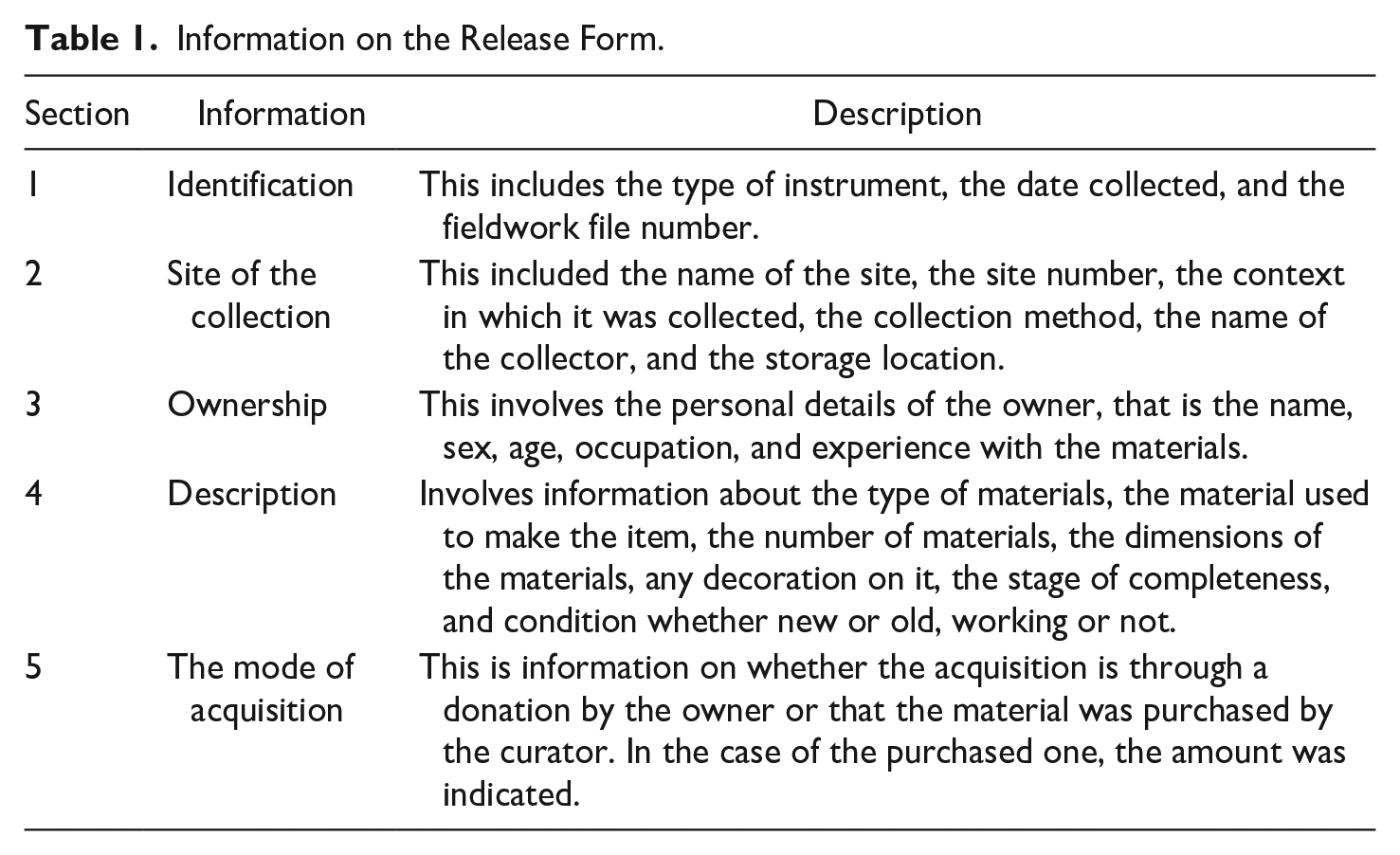
Data concerning recorded on the collection inventory form make it possible for whoever accesses the documents to know who owns the material, what was collected, where it was collected, how it was collected, in what condition, its dimensions, state, and how it was acquired.
Ethical Issues
As a fieldworker, I made sure that I employed reflexivity concerning issues of ethics. I borrowed ideas from Finlay (1998) who reminds us that reflexivity, refers to the self-assessment exercised during the fieldwork of one’s own beliefs, judgments, and practices and includes consideration of how one’s presence in the field influences the research itself. I asked depositors to sign an ethical clearance form as part of their consent. The form needed the incumbent to write their name and fill in details to indicate that they voluntarily accept to donate/sell their materials to me for preservation. They indicate the day. Month and year. They also indicate that they are free to withdraw or repatriate their material any time they wish and that the materials may not be used for any gainful means but only for academic purposes. They then sign at the bottom of the form and I also sign.
Deposition and Cataloging
After collecting seventy materials in the form of musical instruments, traditional objects, and props, I had to take them to our institution where I had established a departmental music museum to display them. I then stored fifty in the store room and catalogued about twenty. The following are some of the musical instruments collected and deposited in the museum. Each material is accompanied by a name tag with its name, accession number, a brief history of the instrument, its description, and information about its owner. The accession number comprised the first three letters of the name of the material, followed by the entry number and year. For example, the first mbira’s accession number would be MBI/01/12, the first drum, ngoma would be NGO/01/12, and so on. Below are some of the materials deposited into the museum with their accession numbers and a brief description.
Mbira dzaVadzimu (Accession Number MBI/07/12)
This mbira was donated to the archive by P12 who currently resides in Gweru. According to P12, the mbira was constructed in 1963 and was given to him by his uncle who lives in Gokwe. The mbira was played during several sacred mapira ceremonies like kurova guva to evoke spirits in spirit mediums. It has twenty-two keys and is tuned in mahororo.
Mbira dzaVadzimu (Accession Number MBI/04/12)
This mbira dzaVadzimu was collected from P8 who lives at Sadza Growth, south of Hwedza, on the 10th of August 2012. The instrument was estimated to be over forty years old. The owner confirmed that he bought it around 1973 from an old man in Chigondo area in Hwedza. The mbira has twenty-two keys and is tuned in nyamaropa. The man has been playing this mbira during various gatherings
Mbira dzaVadzimu (Vembe) (Accession Number MBI/09/12)
This hybrid of mbira dzaVadzimu called vembe was constructed by P4 in 2011. It has 23 keys and is tuned in C. It is slightly different from dzaVadzimu in that the tuning system and arrangement of the keys are altered by shifting the tonal order for mbira to the key on the fourth position from the left of the top manual.
Traditional drums (ngoma) (Accession number NGO/04/12)
The traditional drum (ngoma) plays a pivotal role in both sacred and secular ceremonies in Shona society. The traditional drum is believed by the Shona to symbolize the voice of the ancestors. The ability of ngoma to produce a sound loud enough to be heard from a distance enables it to draw the attention of both the living and the dead. The embodiment of the skin of the drum may not be taken for granted as observed by Nzewi when he says:
Such skin carries spiritual energy because of the presence of dry, fresh blood in the skin . . . In the African philosophy of life, the drum, although simple in appearance, is deeply evocative in action, inspiring creativity as well as producing a profoundly beneficial effect on humans, human society, and other living things . . . There is a symbolic connection between the drum as a sonic force and blood as a life force. (Nzewi 2007, 58)
Nzewi’s sentiments clearly show that there is a strong bond between the traditional drum and members of society. What Nzewi is saying is also true for the Shona who treat the sound of the drum as a signal of life and social hegemony. The traditional drum is played to accompany mbira music by articulating the timeline of the song. The drum also adds the intensity of the performance of mbira during kurova guva and also during dandaro performances.
I managed to collect and deposit a small old drum of chidzimba type that was donated by P10 from Buhera, south of Hwedza. The drum has been played in both secular and sacred functions for a long time. The owner cannot remember when he made it but confirmed that he made the body from mutiti tree and the membrane from the skin of a cow called Manzuma. The value enshrined by the drum will be engraved on the card that is attached to the drum when displayed in the archive. The visitor may read the information and in addition, the curator may explain further.
Hand shakers (hosho) (Accession number HOS/01/11)
These traditional hand shakers are made from gourds (mapudzi). Mapudzi is a special type of pumpkin grown by the Shona peasant farmers of Zimbabwe. Inside each hosho are some small seeds (hota) that hit against the walls of the shaker to produce a rattling sound. The hand shakers were bought from Gweru Musika in November 2011. The vendor, P6, who sold them to me, indicated that they were made in Gokwe by her son in 2010.
Traditional resonator (deze) (Accession number DEZ/ 0/12)
The resonator was collected from P11 of Chikomba, south of Hwedza, on the 10th of August 2012. He made it in 1998 from pumpkin and has used it to amplify his mbira in both sacred and secular ceremonies. The resonator broke several times during performances because gourd resonators are fragile.
Modern resonator (deze) (Accession number DEZ/02/12)
This is a modern resonator that was bought from P13 in Harare in 2011. The resonator is made from fiberglass. The idea of making fiberglass resonators was introduced by Andrew Tracey at Kwanongoma College of Music in Bulawayo. Although it is made of a material that is different from that of a gourd, it still serves the same purpose of increasing the volume of the sound of the mbira. The attachment of buzzers on both the resonator and mbira is a Shona practice that is meant to create a buzzing sound which is believed to be associated with the ancestral spirits.
Traditional horn (hwamanda) (Accession number HWA/01/12)
This traditional horn was collected from P2 of Farm Number 55 Zviyambe, in Hwedza District. The horn is used to accompany mbira music during kurova guva performances. It is made from the horn of an antelope. Currently, the horn is used to accompany songs in churches services as shown below:
Leg rattles (Magagada) (Accession number MAG/ 01/12)
These leg rattles (magagada) were bought from Gweru market, adjacent to the long-distance bus terminus called Kudzanai. A lot of people from the rural areas surrounding Gweru City which include Gokwe, Shurugwi, Zaka, Lower Gweru, and Chiwundura bring their different artifacts and instruments and sell them at Gweru Musika. The rattles are made from wild fruits collected from the forest. Leg rattles are used by dancers to resonate their dancing steps. They also assist in articulating the rhythm of the music when the dancer stamps on the ground. They produce a rattling sound similar to hand shakers.
Traditional Objects
I also collected traditional objects which are used during traditional ceremonies together with musical instruments. These materials which embrace wooden plates (ndiro) and traditional containers (tswanda) winnowing trays (rusero) automatically become ritual objects during traditional ceremonies like kurova guva. As soon as the ceremony is over, some of the objects retain their common domestic role in the home. Below are some of the objects collected and deposited in the museum.
Traditional Container (tswanda) (Accession Number TSW/01/12)
A traditional Shona container (tswanda) is yet another object that is made out of the same materials as the winnowing tray. However, its shape is different in that it has a cup shape. It is used to collect grain from the granary. It is also used to carry farm produce from the fields. The smallest can carry 2 kg of contents and the largest can carry about 20 kg. The large ones are called matengu (singular dengu). The traditional container is used to carry grain when preparing traditional brews for the traditional ceremony like kurova guva. It was collected from P14.
Traditional Clay Pot (chirongo) CHI/01/12
This object is made with clay. It was collected from Hwedza from P14. The special type of clay is molded into a pot which will then be roasted in a traditional furnace to make it strong. Clay pots are in different shapes and sizes. The clay pot is used to fetch water. It is also used as a container for a sweet traditional brew (mahewu) and also for sour milk (hodzeko). It is used to contain traditional brew that is consumed during a traditional ceremony. It is the one that is used to contain and carry traditional brew. It is also used as the ritual pot (dziva) which marks the end of the ceremony.
Traditional Cup (mukombe) MUK/01/12
This object was deposited by P14 made by emptying the contents of a calabash and then drying it. They are of different sizes and have handles different from that of a cup. Mukombe is used to draw water or traditional brew from the main container, (chirongo). Used to draw beer from the clay pot (chirongo) during the traditional beer parties. The traditional cup is also used by traditional healers and spirit mediums during healing ceremonies.
Snuff Container(chinu) CHI/01/12
This object deposited by P7 is made in the same way as the traditional cup. However, the snuff box is smaller than the mukombe. Some makers embryoid it with bids with different colors. A snuff container is used by those who sniff snuff to contain snuff. It is used as a container from which they collect and fills smaller snuff. Chinu is also used by spirit mediums to store snuff in large quantities. It is also used by women as an oil container which they present to the family of the husband as a symbol of power.
Dancing Props
Walking Stick (tsvimbo) TSV/01/12
It is used as a walking stick by old people. Tsvimbo is used as a dancing prop by spirit mediums during mbira performances. It is also used as a symbol for inheritance during nhaka and zita rituals. It was surrendered by P15 from Hwedza.
Machete (bakatwa) BAK/01/12
The machete collected from P12 from Chikomba is usually part of the weapons carried by a hunter during a hunting expedition. During kurova guva a machete is used as a dancing prop. A machete is also a symbol of bravery.
Moon-Shaped Axe (gano) GAN/01/12
The moon-shaped axe donated by P15 from Hwedza is a hunting weapon used by hunters. During kurova guva the moon-shaped axe is used as a dancing prop. Spirit mediums believe that when they dance swinging the moon-shaped axe. It is a symbol of fighting against evil spirits (ngozi). Below is a table 2 summarizing the collected materials and those who surrendered them:
Summary of Material Collected.
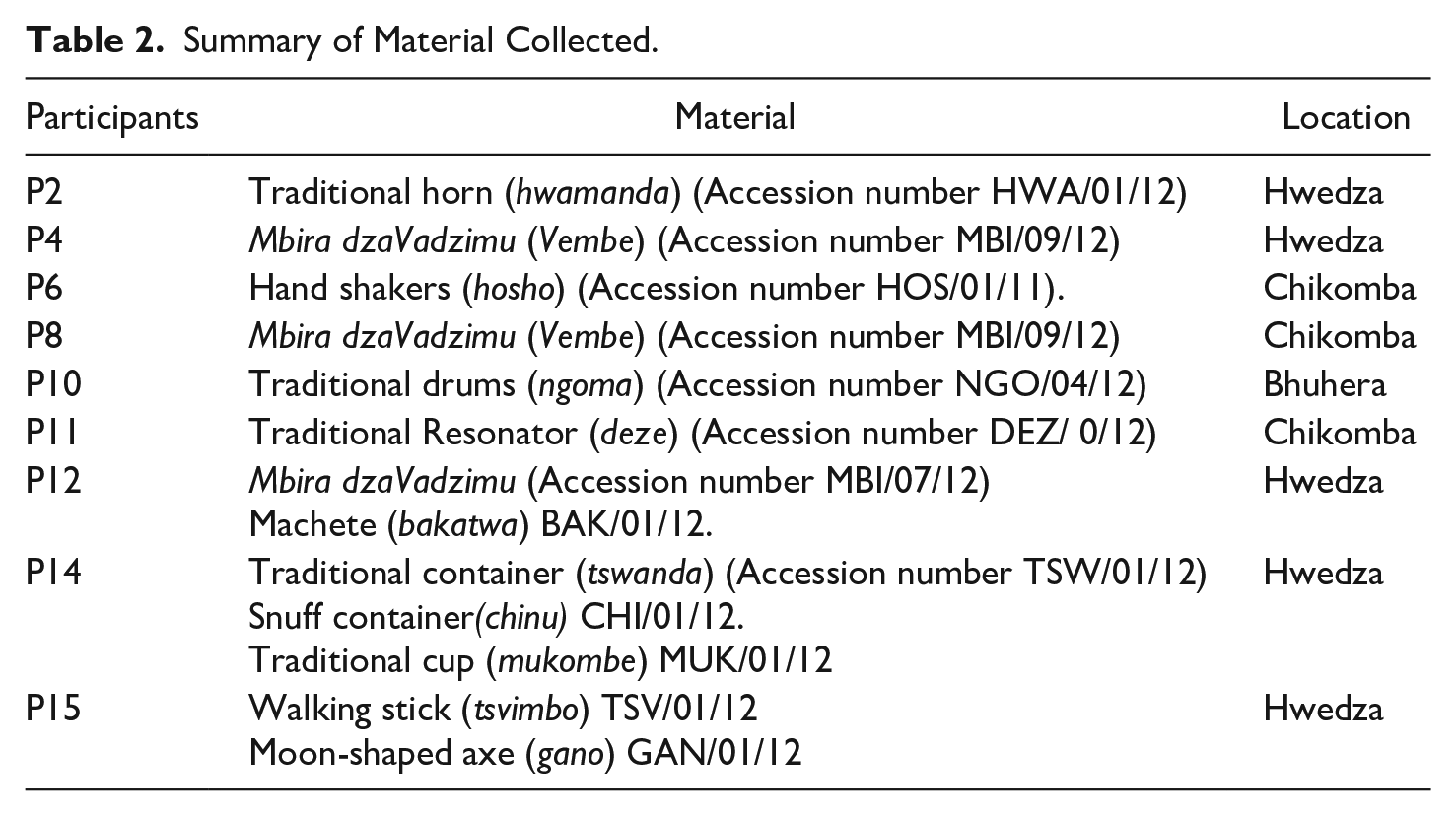
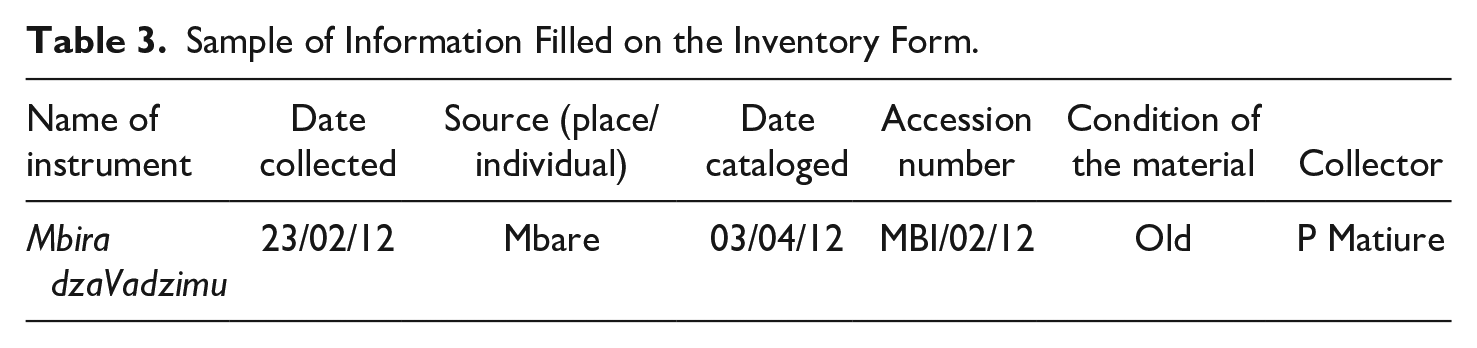
The various collection forms filled during collection in the field are then compiled into inventory forms kept in the museum with information on the type of material as shown in Table 3 below:
Sample of Information Filled on the Inventory Form.
The photograph (Figure 1) below shows part a display of the materials indicated above:
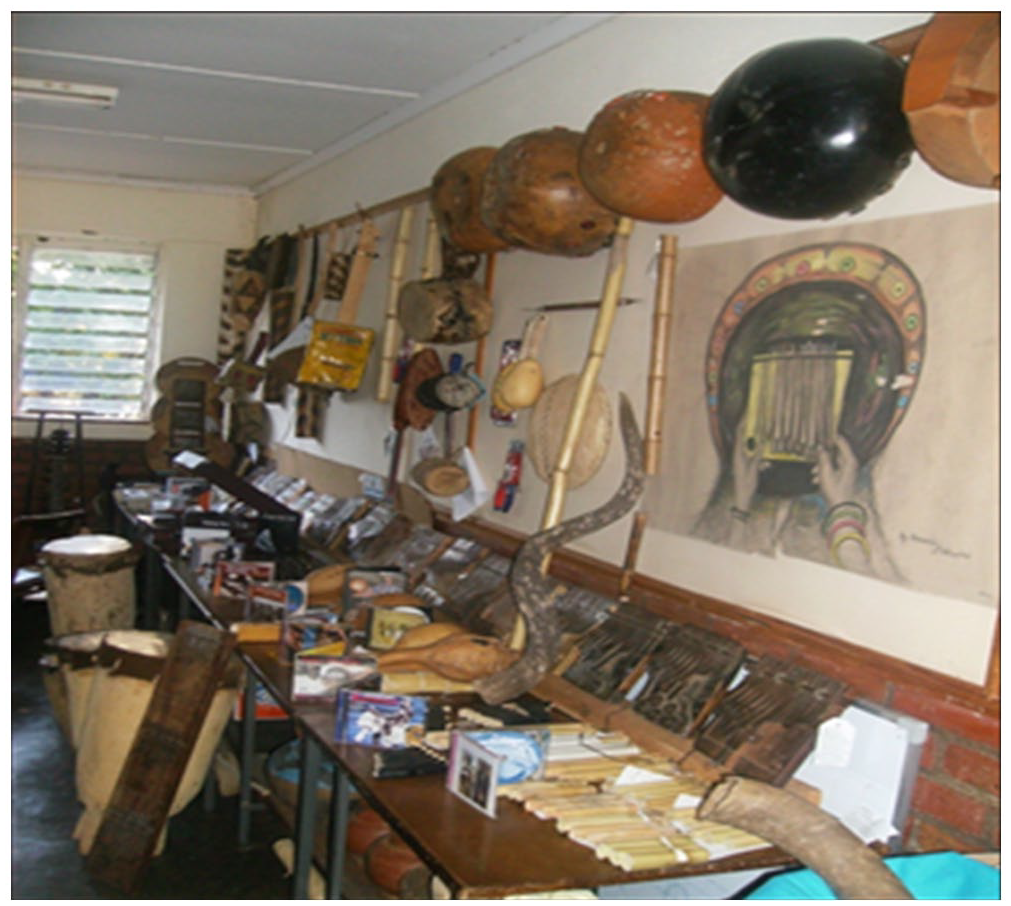
Materials displayed in the archive. (Photography by P Matiure 2012)
Challenges
Archivists are faced with several challenges during the collection and deposition of materials. The challenges emanated from role conflict caused by the multifunctional nature of the profession as well as the overlapping of roles. The archivist finds him or herself faced with conflicting interests. I also had similar challenges when I engaged in all the roles mentioned above. Sometimes I failed to define my position and found myself shifting roles at certain stages of my study. Sometimes I found myself over-emphasizing certain areas at the expense of others. However, from another angle, multiple roles created an opportunity for me to experience the various roles of an archivist.
The other challenge that I encountered was a lack of financial support. Although both University A, where I was registered, and University B, where I am employed assisted this study financially, the money was not enough to buy all the materials that I needed to undertake this project.
The other challenge was that the museum room that I managed to secure was small. It was also used as an office for me and another staff member. Because of the limited space, materials are crowded in the archive. The limited space made the display and arrangement of materials difficult. I hope the University will be able to provide a bigger room for the archive and treat it as part of the university library facilities. The biggest challenge was that I was always overwhelmed with archive work. Collecting, cataloging, and displaying materials at the same time and compiling information about the instruments demanded a lot of time which I did not have.
Conclusion
The collection of materials for an archive is a difficult yet fascinating activity. It calls for hard work and discipline on the part of the collector and depositor. It also calls for thorough documentation as well as organizational skills in terms of cataloging. Some forms have to be filled in as part of record keeping and cataloging.
The Music Museum was established to preserve tangible materials that are part of the cultural legacies of the Shona used during kurova guva ceremony. Particular emphasis was placed on traditional instruments and traditional materials that are usually used during kurova guva ritual and mbira pieces.
Tangible materials were collected by paying particular attention to ethical considerations. Letters of consent were signed by participants before they were interviewed and before they agreed to be photographed or sell their material. They also signed forms to show that they were willing to deposit their material in the archive. Materials were classified according to type and use. Some Accession numbers were allocated to these instruments for easy access. Apart from these materials, mbira pieces, and traditional songs, some photographs and films were also deposited in the archive. Danielson (2001, 4) posits that “sound recordings of voices of the past have opened up new imaginative and emotional vistas for numerous individuals and communities.” As an extension of this idea, the archive established includes recordings of both visual and audio images. Every material deposited was accompanied by a card with an accession number and some important information concerning the history of the materials and their function in the Shona community. It is therefore recommended that more collections of other tangible and intangible materials be done to safeguard the vulnerable music heritage of the Shona. Past collections are carried out by non-local curators and researchers and the material is stored outside Zimbabwe and it is difficult for the Shona people to access them.
As a mitigative measure, I recommend that these materials that belong to other traditional cultures be repatriated not only to local museums but also to the original families who own them. Such a move is likely to revive the life of traditional tangible materials that are likely to disappear and this will enable the materials to be accessed by the progenies of the owners. I also suggest that heritage preserved is heritage sustained. As such, there is a need for governments and non-governmental organizations to assist in decentralizing the archiving system so that there are more initiatives that support living archives in local communities. The current archives that are located in institutions and towns are out of reach by community members.
Footnotes
Declaration of Conflicting Interests
The author declared no potential conflicts of interest with respect to the research, authorship, and/or publication of this article.
Funding
The author received no financial support for the research, authorship, and/or publication of this article.
