




Abstract
This paper explores the Grace Mary Crowfoot collection of textile objects and letters found in the Textile Research Centre (TRC) in Leiden. Crowfoot, a textile archeologist worked mainly between North Africa and the Middle East, although her interests were far more expansive. Her collection in the TRC has largely gone unstudied. Including a variety of textile samples and related artifacts, along with letters between Crowfoot and her mentee Robert Charleston, the collection seems disparate, however I argue that we may garner much information from such a collection The paper questions how small, diverse collections can be useful for academic research. How can a small collection like the Crowfoot collection be used and how can it contribute to our understanding of the individual and wider society? This paper explores the opportunities and scope in analyzing smaller collections themselves as historical records.
Keywords
On the shelves of the Textile Research Centre (TRC) in Leiden, among the many hundreds of boxes, is a miscellaneous collection of items which belonged to the renowned textile history Grace Mary Crowfoot (1879–1957). Very little had been studied of Crowfoot’s life and artifact collections. Only short biographical pieces by family and friends existed online and almost nothing in print. The disparate nature of the collection at the TRC may have been the reason it had been so little studied; large collections of a certain type of object or collections from a particular place naturally allow for easier analysis. The Crowfoot collection consists of weaving equipment, wool samples, textile samples, and pieces made by Crowfoot herself, along with a small bunch of letters between Crowfoot and Captain Robert J. Charleston (1916–1994). No one item stood out as warranting a full study, however I found myself questioning how such a collection could be used and what information and impressions it might provide historians and others. How does a small collection of miscellaneous items advance our knowledge of a time, place, person, or culture?
A collection can take many forms. Objects, books, letters, and images all make up some of the most famous collections in museums and historical institutions. Much of the time, the focus of research is on the objects themselves. As items of historical interest, they tell us about the producer or culture that created the artifact. Research of collectors themselves is a relatively new field. Major collectors such as Hans Sloane, Sarah Sophia Banks, and Helene Kröller-Müller have been studied extensively but many others eluded research until recently. 1 Often, only in extraordinary cases such as Howard Carter and Lord Carnarvon’s discovery of the tomb of Pharaoh Tutankhamun are the general public even aware of the collector and discoverer. Even in cases such as this, it is only the big names, the superstars of the archeology field that get acknowledged. As Christina Riggs points out in her work on the “collective effort at the tomb of Tutankhamun,” many other unnamed and usually local excavators were involved in this success. 2 They went unnamed and their achievements unrecorded.
In many cases collectors similarly go unnoticed. Their donations to museums are simply a footnote, if included at all. Even more difficult is finding the women who were involved in developing museum collections and extracting their own work from that of their male counterparts, whether that be their husbands, brothers, or instructors. That is why, when I became aware of the textile collection gathered by Grace Mary Crowfoot, along with a collection of letters between her and a Robert Charleston at the Textile Research Centre in Leiden, I was intrigued. This collection was in Grace Crowfoot’s (known as Molly) name and is a visual display of her interests and expertise. Furthermore, the fact that the collection was in a research institution in Leiden, open to all, meant that I was able to engage with the objects and letters in a way that may not have so easy been should they have been within the vaults of a larger museum.
This collection, both the textile artifacts and the letters, provide a glimpse into Molly Crowfoot’s passion for textile archeology and anthropology and the effort made on her part to gather and disseminate information on the history of textiles. 3 The collection was a rare chance to glance into the mind of another academic and enthusiast and try to understand the person behind the objects they had gathered. The choices made in what to keep may communicate something about the motivations of the collector. Moreover, the letters provide some very interesting insights into life for both academics and wider British society during the period. Many of the letters were written during World War II and make mention of the difficulties of life at this time, while also illustrating the difficulties of producing academic work in wartime.
This paper will ask a number of questions relating to the Grace M. Crowfoot collection in the TRC, Leiden. Firstly, what does the collection tell us about Crowfoot herself? Secondly, how can a small collection like this be used and how can it contribute to our understanding of life in the British Empire for academics and archeologists during this period? And finally, what does this collection tell us about women working in this arena? How did they make collections and what was their agency in the process? The Crowfoot collection, I argue, can provide much more information than one might assume at first glance—about Grace Crowfoot, women in archeology, and the processes and psychology of collecting.
The Life and Letters of Grace Crowfoot
Grace Mary Hood was born in 1877 in Lincolnshire, England, to Sinclair Frankland Hood and his wife Grace. The younger Grace, or Molly as she was known, came from landed gentry with a history of interest in Egypt and archeology. 4 Her connections brought her into contact with scholars such as William Flinders Petrie and opportunities in the field of archeology. Her family history of archeological collecting, her interactions with eminent academics, and access to archeological fieldwork no doubt stimulated Crowfoot’s interests. As a young woman she initially took some archeological research in Europe but eventually decided in 1908 to study midwifery.
In 1909, Molly married John Winter Crowfoot, Assistant Director of Education in Sudan. They were to have four daughters together. The two moved to Cairo and then to Sudan. While her husband was busy with wartime intelligence work around the Red Sea, Molly was left to her own devices in Khartoum. She immersed herself in studying spinning and weaving techniques as a way to involve herself in the local community. 5 Her weaving skills developed during this time and she became an authority on the weaving of cloth on primitive looms. Initially she wrote about the botany of the region but soon began publishing on textiles in the journal Ancient Egypt, writing “Models of Egyptian Looms” in 1921 and “A Tablet Woven Band” in 1924. 6
Her connections with Flinders Petrie afforded her access to the Egyptian archeological scene and she was asked to use her knowledge of Sudanese weaving to compare methods of spinning and weaving discovered in an Eleventh Dynasty tomb. 7 Crowfoot was to find that the methods had scarcely changed. This Egyptological connection would last through her life, with her later being asked to study a tunic found in the tomb of Tutankhamun. 8
Molly Crowfoot’s research into textiles continued after the couple’s 1926 relocation to Palestine. John Crowfoot had been offered the Directorship of the British School of Archaeology in Jerusalem and would go on to undertake numerous large excavations in the region, including at Samaria-Sebaste (1931–1933, 1935) and Jerusalem Ophel (1927). During the excavations Molly Crowfoot took charge of managing the camp and the living arrangements. She also worked on the archeological finds and published articles included in the three volumes focusing on the Samaria-Sebaste excavations. 9 The Objects from Samaria included articles written by Crowfoot on pottery, lamps, glass, and other subjects, highlighting the variety of her academic interests and important position in the excavation and documentation processes. 10
Upon returning to England in the mid-1930s Molly and John took up residence in the family home known as The Old House, in Geldeston. Both Molly and John Crowfoot were active in their academic fields of interest during World War II. The letters at the TRC between Molly Crowfoot and Robert Charleston cover this the period until 1950.
Robert Charleston was born in 1916. He served in India and Ceylon during World War II and the letters between him and Crowfoot show that he already had a deep interest in textiles. Upon return to Britain, Charleston studied at Oxford and later took a job at the Victoria and Albert Museum. His interests were wide ranging and he became an expert on glass and produced around 100 articles on the subject. He would go on to become Keeper of Ceramics and Glass at the V&A between 1963 and 1979. The book World Ceramics, an illustrated history was published in 1968 with Charleston as editor. Charleston died on December 4, 1994. His obituary in the Guardian describes him as “A quiet, but not a remote scholar, Charleston was respected for his authority, conscientiousness, sincerity and common-sense and ever prepared to share his knowledge and enthusiasm. In those who enjoyed his friendship—and there were many—he inspired deep affection.” This summation of character can be seen throughout the communication between himself and Grace Crowfoot.
Within the letters between the two scholars one can uncover some interesting illustrations of academic life during this period with mentions of the Blitz found in earlier writing. Crowfoot writes that “all is very quiet round here at the moment, a cessation of the daylight raids of a few weeks ago. Some bombs fell in Bungay but marvellously only one of them exploded.” 11 Charleston, writing from India and Ceylon, also discusses life during the war in his letters, noting that he had been in hospital in India five times since he had last written and that he will try to visit the Stein Collection on his war leave that autumn. 12
A comment made on the paper submitted by Robert Charleston to Bankfield Museum was that there was not enough paper to print it. Rationing and the Paper Salvage program meant that paper had to be saved as much as possible for the war effort. 13 In writing about the reason the Bankfield Museum had refused his paper, Crowfoot wrote that Mr. Hodge “has doubts about the allocation of paper for it etc. but will let me know the result ‘in due course.’” 14
In fact, much of the paper used in the letters between Crowfoot and Charleston are pages pulled from notebooks with frayed edges. The authors of the letters squeeze in lines of dialog, turning the page, and writing in the margin where needed. Crowfoot, especially, who was writing from home, writes on scraps of paper and squeezes in extra lines around the page rather than starting a new one.
This is all indicative of wartime and additional to the details on textiles found in the letters, these clues relating to scholarly work are of interest to those wishing to understand academic life during the wartime period.
Molly continued to write on a range of topics related to textiles, with her interests including local finds and those much further afield, such as Scandinavian and Indian textiles. The depths of her knowledge are evident in her being asked to examine such major finds as the textiles in the tomb of Tutankhamun and the Dead Sea Scrolls.
Molly Crowfoot died in 1957 and was buried with her husband in Geldeston. Her papers and photographs are held in the Sudan Archive at Durham University Library, the Palestinian Exploration Fund archives, London, and the TRC in Leiden.
Crowfoot was a pioneer in the study of primitive weaving techniques and textile archeology. In a biography of Molly, her daughter Elizabeth notes that “Archaeological study in the textile field has developed widely since her death,” and that “the rise, during her last years, of a generation of seriously trained women textile archaeologists was a great joy.” 15 Her research into textiles remains important to this day while object collections include those in the British Museum and the TRC collection. There is also a collection of papers in the Palestinian Heritage Centre, Jerusalem. These collections are important for the archeological, anthropological, and historiographical contributions and deserve further study, a project on which I hope to embark.
Contents of the Collection
The artifacts collected by Crowfoot and donated to the TRC, Leiden, are varied and may at first glance seem somewhat insignificant. However, for textile enthusiasts this small collection of weaving materials constitutes important evidence of styles and tools used in traditional weaving practices in (among other places) Sudan, Egypt, and the Middle East. Furthermore, the collection demonstrates the tremendous effort on Molly Crowfoot’s part in documenting these practices. Crowfoot was clearly passionate about the history of weaving practices and her collection demonstrates an interest that goes beyond the finished products but to understand technique and development. Indeed, her letters to Robert Charleston are filled with discussions on the style of weave and the tools used.
The collection contains an assortment of objects relating to weaving, including spindles, shuttles, whorls, weaving cards, wool samples, cloth samples, and trial pieces.
The majority of the objects originated in Sudan, Syria, and Palestine but there are also pieces from as far afield as Peru. Another significant portion of the collection is made up of tiny linen textile fragments from the West Bank region. These archeological pieces are dated around 100 AD and come from the Qumran caves, the site of the discovery of the Dead Sea Scrolls. Crowfoot was invited to examine the linen wrappers for the scrolls and wrote preliminary and full accounts of these pieces of cloth in 1951 and 1955, respectively. 16 That Crowfoot was asked to study the linens demonstrates her position at the forefront of textile archeology and the acknowledgement of this fact among her peers. Each of the Qumran textile pieces found in the TRC are small fragments originally found in Cave 1. These textiles are made of flax, with a variety of weaving qualities from coarse to fine. 17 The 1951 account describes her examination of the textile wrappers for the Dead Sea Scrolls but the pieces within this collection were not the wraps themselves but pieces of linen possibly used to pack around the wrapped scrolls, padding the area inside the jars and holding the scrolls in place. These small pieces of fabric are torn fragments possibly from clothing. 18 Dr. Gillian Vogelsang Eastwood, director of the Textile Research Centre, notes that there are “various hems present, all of which are rolled and stitched using both overcast stitching and simple hem stitching.” 19 Light blue linen thread is visible in the stitching of the hems. A comment by Vogelsang Eastwood mentions that one piece may be a button from the neck opening of a tunic. 20 The pieces were evidently viewed as so small as to have been insignificant to the larger find and so left in the possession of Crowfoot.
Another interesting part of the collection is the weaving equipment. Coming from Sudan and across the Middle East, these tools demonstrate the universality and differences in weaving practices. Crowfoot and Charleston’s discussion of textiles and weaving in their correspondences highlight this fact as they discuss similarities between practices around the world.
The TRC collection contains many examples of spindles and whorls from North Africa and the Middle East. Spindles have been found across the world and date back to at least the Neolithic period. The bulk of the spindles in the Crowfoot collection come from Sudan and the Mediterranean. In 1931 Crowfoot wrote an account of “Methods of Hand Spinning in Egypt and the Sudan.” 21 This paper compares the spinning techniques of ancient Egypt with that of modern Egypt and Sudan. By means of a series of photographs of women using traditional weaving equipment and techniques and comparing them to wall paintings and statues from ancient Egyptian tombs, Crowfoot points to similarities and differences in the weaving techniques (Figures 1 and 2).
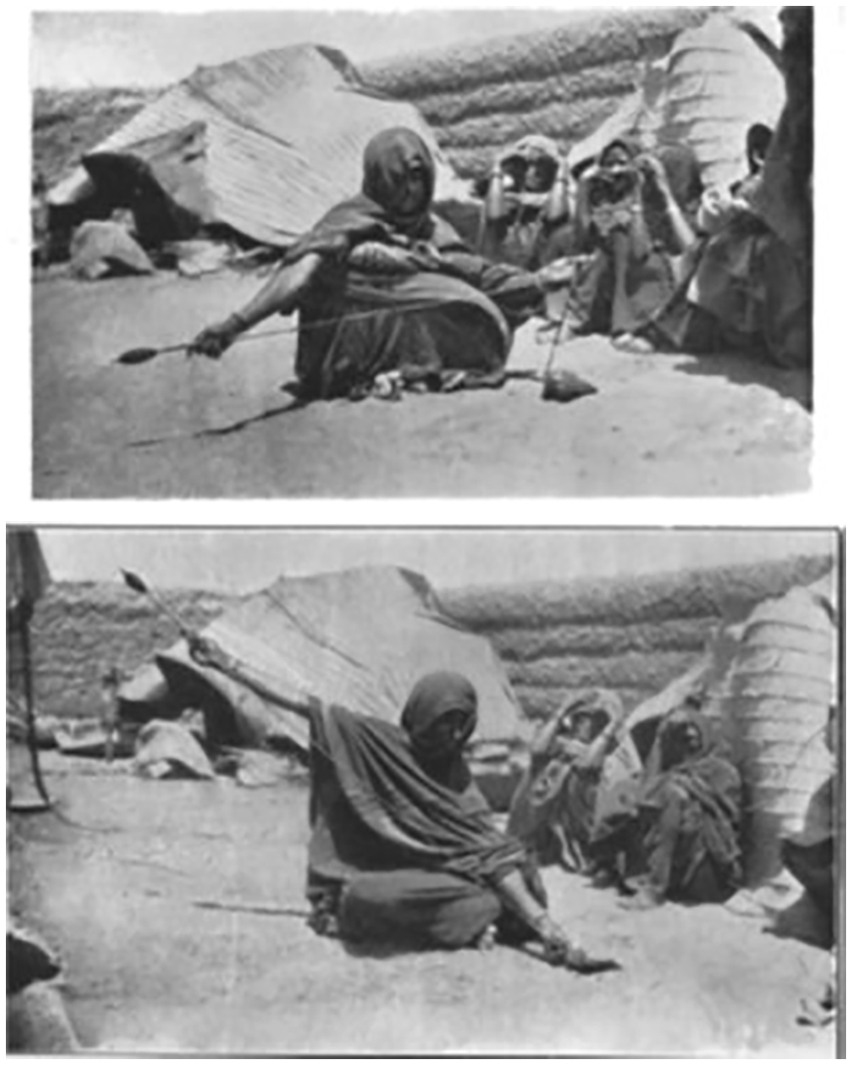
Source. Grace M. Crowfoot, “Methods of hand spinning in Egypt and the Sudan,” in County Borough of Halifax, Bankfield Museum Notes 2, no. 12 (1931), plates 4 and 5.
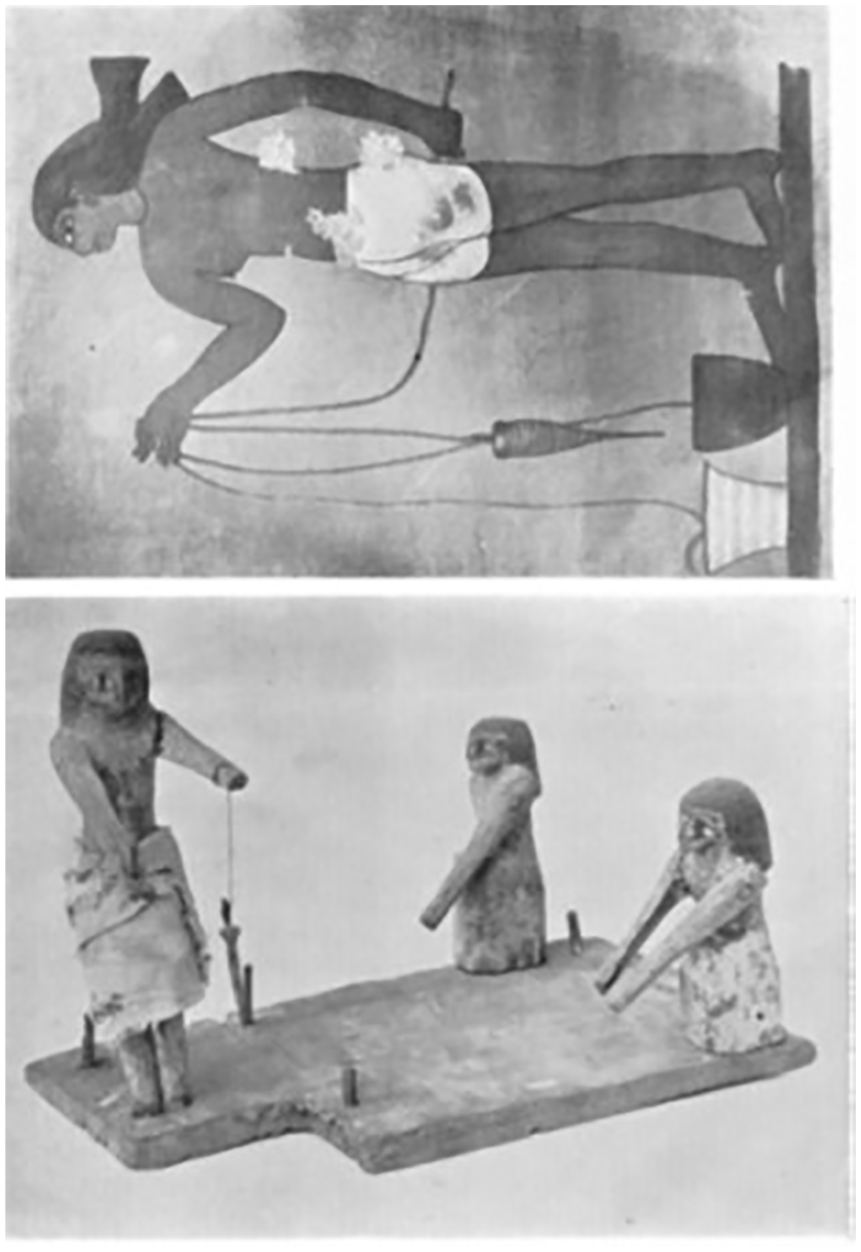
Source. Grace M. Crowfoot, “Methods of hand spinning in Egypt and the Sudan,” in County Borough of Halifax, Bankfield Museum Notes 2, no. 12 (1931), plates 16 and 17.
The spindles in the TRC collection are all dated from the 1920s and it can be assumed that some of these were studied for the 1931 publication. Crowfoot’s paper includes photographs of spindles for comparison and although it cannot be definitively answered whether these are the same items from the Leiden collection, some items are almost identical (see Figures 3 and 4) In her conclusion Crowfoot writes that “the method of spinning cotton in the Sudan yet shows strong points of resemblance to the flax spinning of Ancient Egypt, stronger even than those shown by the wool spinning of the Egyptian fellahin,” pointing to a spinning technique in Sudan which she analyzed as close to that of ancient Egypt. 22 The spindles in the Crowfoot collection, then, are important examples not only of equipment in Sudan but also can provide an indication of how spinning was performed in ancient Egypt.
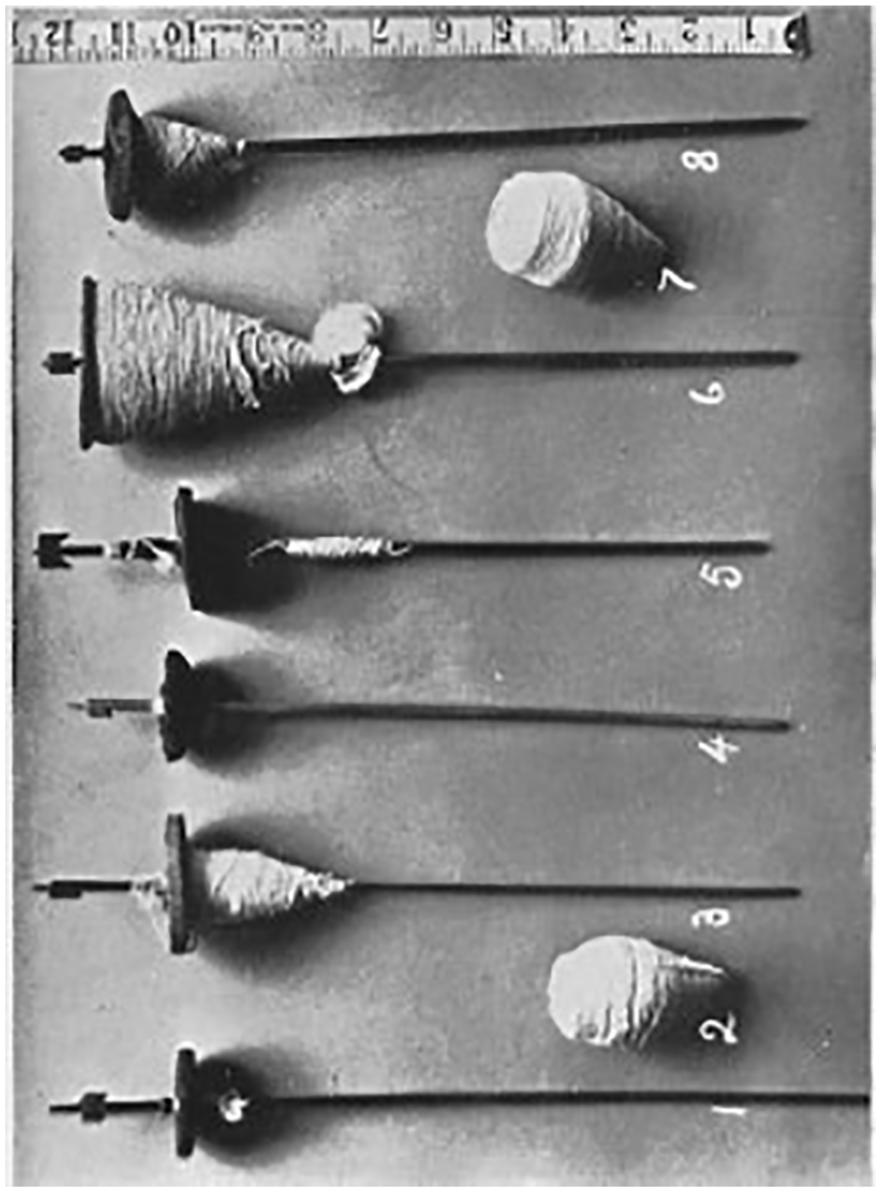
Source. Grace M. Crowfoot, “Methods of hand spinning in Egypt and the Sudan,” in County Borough of Halifax, Bankfield Museum Notes 2, no. 12 (1931).
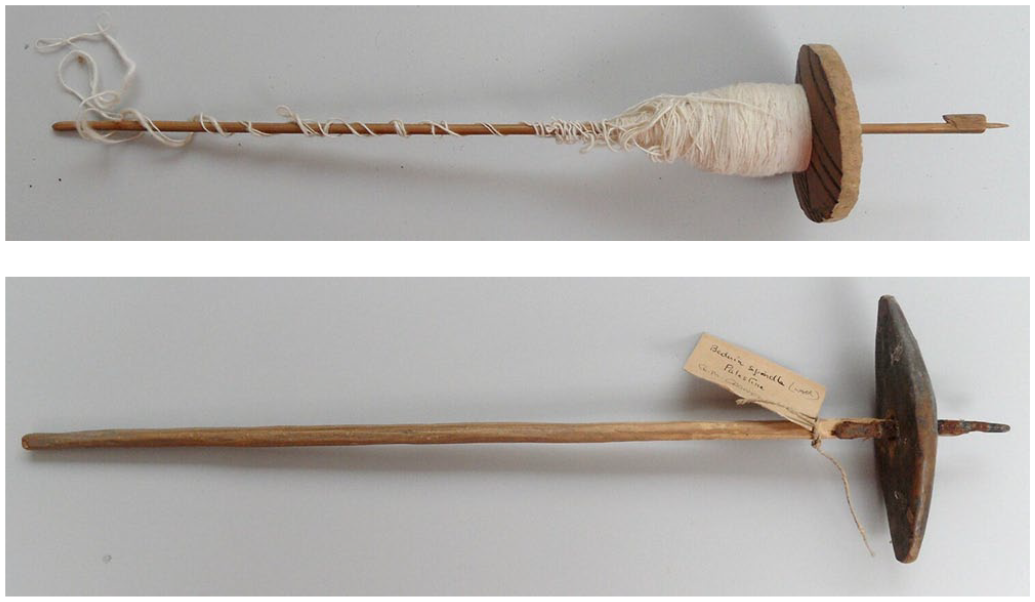
Samples of spinning equipment in the Grace Crowfoot Collection, Textile Research Centre, Leiden.
The many samples of embroidery and weaving found in the collection include pieces from Sudan, Nigeria, Peru, and Syria. There are a number of “trial pieces” and examples of woven thread which were “spun for Crowfoot’s ancient Egyptian reconstruction project.” 23 The trial pieces, many created by Crowfoot herself, include examples of the weaving found in ancient Egyptian tombs, one from the Tutankhamun find and another with a label describing it as a “replica of part of the Girdle of Rameses by G M Crowfoot.” 24 Another sample of Viking-style hand weaving is labeled as having been sent to a George W. Taylor, 25 evidently as a means of visually describing the traditional techniques. 26 This process of recreating samples of archeological textiles has become a common tool for archeologists, being seen as part of the experimental archeology movement which became popular in the 1960s and 1970s. 27 However, Crowfoot was part of a group of pioneer archeologists using this approach in textiles. 28
In one of her letters to Robert Charleston, she mentions creating one of these samples in the Egyptian style, stating that she was:
Trying to reproduce Senmud in braid—the first known pattern piece from Egypt, of the time of Queen Hatshepsut, but haven’t yet succeeded in getting a photo of it, and the published reproductions are not clear and don’t give back and front—it is only a little geometric pattern but quite nice.
29
Crowfoot’s collection is helpful not only as a means for examining weaving processes but also in understanding the scope of interest of the person who collected them. Her trial pieces provide evidence of Crowfoot’s achievements in using traditional weaving methods and the hands-on process in which she conducted her research.
The Qumran Cave fragments are a surprising find in the TRC, Leiden, and present an interesting example of previously overlooked material culture which may now have the chance to be properly studied. The small fragments of cloth found with the Dead Sea Scrolls were given to Crowfoot to study, along with larger pieces of cloth. 30 The fragments were left with her after her report had been written, presumably being of little worth in comparison to the immense biblical treasures that were found in the series of caves. The abandonment of the cloth fragments with Crowfoot and their later donation to the TRC is an indication of disinterest in textiles while other pieces of material culture are prized. The recent scandal in the Museum of the Bible, Washington DC, in which purported fragments of the Dead Sea Scrolls were proven to be fakes shows how valued even tiny pieces of the scrolls are while these textiles have gone largely unstudied. 31 These fragments were donated to the TRC by Elisabeth Crowfoot, Molly’s daughter who was friend and teacher of TRC Director Gillian Vogelsang Eastwood. They were packed into a small cigarette box. 32
The textile fragments at the TRC were not included in Crowfoot’s paper on the textiles found in the caves, possibly being seen as too small to have been of any interest at the time. However, in 2019 a project by the Network for the Study of Dispersed Qumran Cave Artefacts and Archival Sources (DOQCAAS) at King’s College London was set up to uncover artifacts from the caves which may have been overlooked or unrecorded. 33 The Network states, in its announcement of their discovery of the TRC textiles that “It is planned that the Qumran Cave 1Q textiles that can now be located will be studied and published together in a future volume dealing with the archaeology of Qumran Cave 1Q.” 34 The Covid-19 pandemic has slowed the pace of this project. 35
The cloth fragment’s belonging to the Crowfoot collection at the TRC had not originally been included in the papers published on the Qumran textiles, however scientific developments may now help to further uncover the background of these pieces and their part in the story of the Dead Sea Scrolls.
The correspondence found in Crowfoot collection in the TRC is in the form of letters between Molly Crowfoot and Robert Charleston. The letters were given to Dr. Vogelsang Eastwood by Charleston and are especially interesting in that they include letters and replies from both parties, covering a period of approximately ten years. The correspondences, between two friends and academics, provide an interesting glimpse into the lives of Crowfoot and Charleston in Britain and the Empire during World War II and its immediate aftermath. The letters offer insights into two people who were deeply immersed in textile studies, and academia more generally. They are personal correspondences discussing professional and academic interests, with Crowfoot serving as a mentor for Charleston, pushing him to work on papers and maintain his interest in textiles.
The letters date between the early 1940s and 1950 when Molly was in her mid-sixties to seventies. By this time she was a widely published author on textiles and traditional crafts, as well as having produced a number of books and papers on botany in North Africa and Palestine. Although publication records show that Crowfoot was still publishing during this time, her earlier letters show her concern with ensuring the successful publication of Charleston’s work. Robert Charleston was in his mid-twenties at the beginning of their correspondence. At this time he was a British Army Private stationed in India and later Ceylon (modern-day Sri Lanka). His letters describe visits to museums and historical sites in the region and his interest in textiles and other artistic production. He returned to England, presumably after the war, and the letters written during the second half of the 1940s mention his studies at Oxford and eventual employment at the Victoria and Albert Museum. 36
Throughout the 1940s Crowfoot’s publications focused on Palestinian textiles along with publishing her work on the Tunic of Tutankhamun. In her later letters she was researching Viking and Saxon textiles, although papers on these were not published until after culmination of the letters between her and Charleston. 37 The two correspondents discussed textiles back and forward through their letters and both seem to be genuinely pleased to have a contact who was as fascinated by the subject as themselves.
At all times Crowfoot is very encouraging of Charleston, mentoring him not only on textiles but, as the letters show, putting him forward to publications in the hope of having his work published. Her encouragement reveals her deep interest in textile study and her drive to encourage other’s interest. Again, Robert Charleston was in his mid-twenties when the collection of letters begins. In 1946, at the age of thirty, he writes to Molly Crowfoot to let her know that he has applied to attend Oxford to study for a B.Litt in which his thesis will cover Economic History or, more specifically, “textiles in the Roman Empire.” 38 Charleston is reaching out to Crowfoot in friendship and as a mentor. He asks her if she knows anyone at the college who might be interested in being his Supervisor. 39 These letters are an illustration of a developing mentorship and friendship during the period. Furthermore, it is interesting that it is the woman who is in the senior position. They are useful not only in gaining an insight into the characters of the two authors but also in understanding the processes of academia during the 1940s and the connections and networks necessary to achieve success.
Building a Career and Collection
The Crowfoot collection is evidence of the decisions made in museum exhibits and how choices can preference certain material culture objects over others. During the 1980s, the textile collection was given over to Dr Gillian Vogelsang Eastwood (TRC), herself a textile archeologist and former student of Elizabeth’s, by the family who felt it would be best looked after by the TRC. The more ornamental pieces such as hats, shoes, and baskets had been given to the British Museum in 1981. Understandably, objects which are more esthetically pleasing or exotic end up on exhibition to the public. While many of the objects Crowfoot collected are of importance to the history and development of weaving and textile manufacture along with textile archeology, they do not have the “wow factor” that many museums want and need to keep up footfall. 40 This is where smaller institutions such as the Textile Research Centre, Leiden, play an important role in the preservation and cataloging of objects of historical and scientific value. The disparate nature of the objects in the collection means that they may have been separated and placed in storage in different parts of a museum, which would have made it extremely difficult to follow and analyze Crowfoot as a collector. The TRC provides an instance in which many different objects were kept together under the collector’s name rather than place of origin or material. This has allowed a fuller picture of the life and work of Grace Crowfoot.
By the time of the last letter between Molly Crowfoot and Robert Charleston (1950) women were making headway in the academic arena, although equality was far off and has arguably still not been reached. While things did change, for much of Crowfoot’s career, she was an exception to the norm. During the first half of the twentieth century women continued to play supporting roles in public life and this was no different within the academic and archeological fields. Many of the women who took part in excavations in North Africa and the Middle East did so because of family connections or as wives to their archeologist husbands. These women often helped raise funds, took charge of the camp, keeping it in good order, and recorded finds. 41
Single women and academics did have some opportunity to take part in these digs but were most often working under a male superior. There are numerous examples of women who worked under the tutelage of William Flinders Petrie, 42 for example, and later under James Lesley Starkey in Palestine. 43 The women present at archeological sites made important contributions to archeology, yet their work is often overlooked and the recognition went to their male counterparts. However, unlike many of the local workers at excavation sites in the Middle East and North Africa, these women’s stories can and are being excavated from the archives and more and more research is being done to highlight their achievements.
Grace Crowfoot fits into both categories and also transcends them. Her position as wife of John Crowfoot gave her the opportunity to travel to regions of the world difficult for a single woman to access, while her achievements in the field of textile archeology allowed her to take part in excavations where her expertise was valuable.
By choosing to study a discipline traditionally related to the work of women, Crowfoot may have given herself an opportunity not normally available to those of her sex. Textile archeology provided a niche in which Crowfoot could develop expertise without too much competition from other male archeologists. Similarly, Crowfoot was able to access spaces reserved only for women and to learn how to weave and create textiles in the traditional methods of North Africa and the Middle East.
While most people who worked on excavation sites sought out objects made from ceramics, metals, and stone, the textile fragments found on these sites often went under-studied. Having trained herself in the study of ancient textiles, Crowfoot became an important authority on ancient fabric and weaving techniques. Indeed, her 1941 paper on the Tunic of Tutankhamun notes that although there was lots of publicity and publications focusing on the treasures of the Pharaoh’s tomb, “publications did not give details of all the objects found, some of which of necessity were described only cursorily or set aside altogether for future study. This was the case with the textiles.” 44 Although Carter is noted as stating that “the material from this tomb will be of extreme importance to the history of textile art, and it needs very careful study,” 45 little work was done on the textiles in the tomb until Crowfoot wrote her paper focusing on the Tunic. 46
In focusing on textiles Grace Crowfoot made herself a valuable member of the academic community and one who was called on in instances such as the study of the Tutankhamun shroud and the Dead Sea Scrolls. Her position as a Grande Dame of textile archeology led to her educating others. Robert Charleston was among those who benefitted from Crowfoot’s expertise. In May 1948 she wrote to Charleston to lament not having seen him on her recent visit to the Victoria and Albert Museum. Charleston had been appointed to the staff of the textile department and Crowfoot congratulates him noting that “I feel now as if I had a friend at court!” 47 This comment alludes to her own lack of formal training and position outside of formal academia. Although by this stage she is a well renowned expert, Crowfoot may not have seen herself as part of the official academic sphere. The letter goes on to discuss mutual interests in “Saxon things” and Crowfoot asks Charleston if he has “any views about it,” pointing to the development of relationship of equals, at least between herself and Charleston. In a later letter (1950) Crowfoot is again modest in her position as expert of textiles. She writes in the opening of her letter, “Just imagine! I have been asked to give six lectures on Ancient Textiles under the Munro foundation at Edinburgh University next year, 1951.” 48 Crowfoot goes on to ask that if Charleston has any spare time she would be glad of his advice in designing the course. Clearly being modest, Crowfoot’s letter is also an indication of her view of herself as not an academic in an institutional sense. While it is apparent that she is respected as a textile expert, she is surprised to be asked to teach formally at a university. By the time of this letter she is aged seventy-three and has been studying in the field of textile archeology for over thirty years. The role of gender in Crowfoot’s letters is manifest in her surprise to be asked to lecture. Assumptions about entitlements, which relate in part to gendered social perceptions, are manifest, as the letters reveal in Charleston a confidence in himself. For example, when Charleston is applying for his studies at Oxford, he writes that he is “acting on the assumption that the verdict will be favourable.” Similarly, his expectancy that his writing will be published and that he will make new discoveries, demonstrates his confidence. 49 These statements are illustrative of both his gender position and his youth. Conversely, Crowfoot’s surprise at being asked to lecture indicates that she is still not openly confident in her position as top expert in her field. The letters provide an interesting example of the gender constructs and hierarchies at play in the academic arena.
Conclusion
Aside from the obvious interest for textile historians, the Grace Crowfoot collection is a valuable record of one woman’s passion, academic interest, and success. The letters between Crowfoot and Robert Charleston are a valuable insight into academic work during the period, along with being an illustration of a developing mentorship and friendship. Although the collection can be considered small, the variety of objects and the geographical scope of their origin are illustrative of Crowfoot’s interests and her efforts to present commonalities in textile and weaving traditions from around the world. The weaving and spinning tools found in the collection helped Crowfoot understand the processes used in ancient times, as shown in her publications on ancient Egyptian tomb textiles. These artifacts clearly have value to academic research and their preservation in the TRC collection is valuable for researchers studying the history and archeology of textile manufacture. The Dead Sea Scroll fragments are another example of the continuing significance of the collection.
Finally, the Crowfoot collection is useful to analyze as an example of a woman working in the academic and archeological fields during the 1940s. While Grace Crowfoot’s life and experiences may have been an exception to the average woman’s during this period, she was not exempt from the restrictions placed on women. Crowfoot traveled where her husband went and the scope of her research is evidence of this. Her focus on Sudan and Palestine was due to her circumstances and while she was able to develop a prominent academic career through this situation, it must be recognized that access came initially through her husband’s career. That being said, the letters between Crowfoot and Charleston display enormous agency on the part of Molly, whose interests by the 1940s had progressed far beyond Sudan and Palestine. Furthermore, her publications and the discussion of her activities in the academic world demonstrate her recognition and acclaim as one of the foremost experts on textile archeology. Crowfoot’s work continues to be important to the field with contemporary archeologists referencing her research on the ancient Egyptian weaving, Qumran caves, and the Tunic of Tutankhamun. 50 The continuous and common reference to her work demonstrates the influence she had on the field of archeology.
The Grace Crowfoot collection allows for analysis from many different angles and is useful in gaining insight not only in textile archeology but also into the life of one of the forerunners in this emerging academic field. The various components of the collection have significance for those working in a number of areas and the importance of the Textile Research Centre, Leiden, in preserving the collection must be acknowledged. The collection being intact, rather than being divided among different departments in a museum, means that it can be analyzed as a representation of the collectors’ interests along with the individual objects being of cultural and historical value. The collection has been a starting point for my own research as I am sure it will be for others.
Footnotes
Declaration of Conflicting Interests
The author declared no potential conflicts of interest with respect to the research, authorship, and/or publication of this article.
Funding
The author received no financial support for the research, authorship, and/or publication of this article.
1.
James Delbourgo, Collecting the World: The Life and Curiosity of Hans Sloane (London: Penguin Books,  ); Alison Walker, From Books to Bezoars: Sir Hans Sloane and his Collections (London: British Library Publishing, 2012); Arlene Carol Leis, Sarah Sophia Banks: Femininity, Sociability and the Practice of Collecting in Late Georgian England (York: University of York, 2013); Catherine Eagleton, “Collecting America: Sarah Sophia Banks and the ‘Continental Dollar’ of 1776,” The Numismatic Chronicle, 174 (2014): 293–301; Eva Rovers, De eeuwigheid verzameld: Helene Kröller-Müller (1869–1939) (Amsterdam, Netherlands: Prometheus, 2019).
2.
3.
Textile archaeology is the study of archaeological textiles to understand what was used in textile production, along with investigating the social context of production and the people behind the production of textiles. Artex, “Textile Archaeology,” Artex, Hellenic Center for Research and Conservation of Archaeological Textiles, available at: (accessed February 18, 2022).
4.
5.
Ibid.
6.
Grace M. Crowfoot and H. Ling Roth, “Models of Egyptian Looms,” Ancient Egypt, 4 (1921): 97–101; Grace M. Crowfoot, “A Tablet Woven Band,” Ancient Egypt, 4 (): 98–100.
7.
8.
9.
This volume was published after Molly Crowfoot’s death and included a one[?]-page note on the Grace Mary Crowfoot Memorial Fund, which raised money in her name to have the book published.
10.
11.
Bungay is a town about five miles from Geldeston, where the Crowfoots lived. Grace Mary Crowfoot, AJ31, 1943?, Crowfoot Collection, Textile Research Centre, Leiden.
12.
Large collection of objects and manuscripts discovered by Marc Aurel Stein, some of which is in the British Library and the Victoria and Albert Museum. These included textile artefacts.
13.
14.
Grace Mary Crowfoot, AJ22, 1944, Crowfoot Collection, Textile Research Centre, Leiden.
15.
Some notable textile historians include Margrethe Hald, Agnes Geijer, Audrey Henshall, and her daughter Elizabeth Crowfoot.
16.
17.
18.
Ibid.
19.
Ibid.
20.
TRC, “Cloth Fragment,” Textile Research Centre, TRC, Leiden, 10 October 2021, available at: https://trc-leiden.nl/collection/?trc=&zoek=Crowfoot&cat=&subcat=&g=&s=100&f=0&&id=36197
21.
Crowfoot, Methods of Hand Spinning in Egypt and the Sudan.
22.
Ibid., 43.
23.
“Skein,” TRC 2016.0273a, Crowfoot Collection, Textile Research Centre, Leiden; “Skein,” TRC 2016.0273i, Crowfoot Collection, Textile Research Centre, Leiden.
24.
“Trial Piece,” TRC 2016.0196, Crowfoot Collection, Textile Research Centre, Leiden, available at: https://trc-leiden.nl/collection/?trc=&zoek=Crowfoot&cat=&subcat=&g=&s=100&f=0&&id=21226
25.
Possibly the famous botanist and eventual head of Kew gardens (1956–1971), Sir George Taylor. Crowfoot had written a number of books on botany and her drawings were given to Kew Gardens after her death.
26.
“Trial Sample,” TRC 2016.0136, Crowfoot Collection, Textile Research Centre, Leiden, available at: https://trc-leiden.nl/collection/?trc=&zoek=Crowfoot&cat=&subcat=&g=&s=100&f=0&&id=21167
27.
28.
Ibid.
29.
“Cloth (replica), Loom,” TRC 2014.0783, Crowfoot Collection, Textile Research Centre, Leiden, available at: https://trc-leiden.nl/collection/?trc=&zoek=Crowfoot&cat=&subcat=&g=&s=100&f=0&id=9582
30.
31.
32.
“Cigarette Box,” TRC 2019.2410, Crowfoot Collection, Textile Research Centre, Leiden, available at: https://trc-leiden.nl/collection/?trc=&zoek=Crowfoot&cat=&subcat=&g=&s=100&f=0&id=36178
33.
34.
36.
37.
38.
Robert J. Charleston, AJ11, 1945, Crowfoot Collection, Textile Research Centre, Leiden.
39.
“Do you happen to know anyone in the University who would be likely to be interested in the Supervision of a person with as sordid an academic past as I have (double Third) on the strength of my proposed line of study?”; Robert J. Charleston, AJ11, 1945, Crowfoot Collection, Textile Research Centre, Leiden.
40.
Museums as institutions must choose what to exhibit and what to store. These choices are made by individuals, the institution as a whole, and in some cases the nation. The reasoning behind such choices are varied and include the desire to prove an evolutionary pattern and to demonstrate hierarchies of mankind. Even without these motivations, some cultures are favoured over others for their histories and artifacts. These cultures tend to be seen more in museum exhibits. Along with being educational institutions, museums are businesses and the more well-known and striking objects tend to be given the best space. Footfall is important and these objects attract visitors. Alex Barker, “Exhibiting Archaeology: Archaeology and Museums,” Annual Review of Anthropology, 39 (): 293–308; Henrietta Lidchi, “The Poetics and Politics of Exhibiting Other Cultures,” in Representation: Cultural Representation and Signifying Practices, ed. Stuart Hall (London: SAGE, 2003).
41.
42.
Ibid.
43.
44.
Crowfoot and Davies, “The Tunic of Tut’ankhamūn,” 113.
45.
46.
47.
Grace Mary Crowfoot, AJ5, 1948, Crowfoot Collection, Textile Research Centre, Leiden.
48.
Grace Mary Crowfoot, AJ2, 1950, Crowfoot Collection, Textile Research Centre, Leiden.
49.
Charleston writes that he thinks that “on the whole that there are a lot of discoveries just round the corner, and I hope to make one or two of them when I go (if I go) to New Delhi to look at the Stein Collection.” Grace Mary Crowfoot, AJ14, 1950, Crowfoot Collection, Textile Research Centre, Leiden.
50.
Orit Shamir and Naama Sukenik, “Qumran Textiles and the Garments of Qumran’s Inhabitants,” Dead Sea Discoveries, 18, no. 2 (2011): 206–25; Nancy Arthur Hoskins, “Woven Patterns on Tutankhamun Textiles,” Journal of the American Research Center in Egypt, 47 (2011): 199–215.