




Abstract
This paper examines the intersection of environmental sound recording, sound collection, and archiving by drawing on Land-based approaches, Indigenous epistemologies, and methodologies. In particular, this paper considers some of the implications for immersive sound-based fieldwork informed by site-specific listening methods, embodied learning and forms of reflexivity that are rooted in Indigenous concepts of relationality (kinship). Specifically, this paper revolves around an initial field research trip from our project Sonic Coordinates: Decolonizing through Land-based music composition (supported by the New Frontiers Research Fund) which took place in the region of Timiskaming (Northern Ontario, Canada) during the fall of 2019. Consequently, our paper examines what was learned through this process, and how critical listening and recording/collection of environmental sounds can be used to inform Indigenous sound/music composition and aural forms of storying. This paper ultimately explores the ephemeral concepts of sound materiality and how aural archiving and documentation (through digitizing and digital platforms) is used to preserve and engage historical memory, cultural knowledge and shifts toward the development of sonic art and communication that is informed by site-specific research practice.
Keywords
Introduction: Storying the Land Through Environmental Sound Recording and Archiving
“What remains of poetry if the voice is removed? Yet the always previous territory of sound is there. The geography of sound waves ghost or spiritize or abstract, the soundless written text.” (Glancy 2008, 279)
The Land is resonant and animated with deep, rich waves of memory, knowledge, and history that continually weaves the poesis of past, present, and future. The Land, our oldest storyteller and philosopher, is embedded with diverse languages, texts, soliloquies, melodies, and songs that for the listener offers new insights and strategies on reflective listening that is critical for engaging in the work of sonic archiving and composition. By listening, reflecting, and responding to the Land we learn to engage in forms of aural weaving that are reminiscent of Indigenous Storywork (Archibald 2008) and ways of cultivating a deeper sense of kinship and relationality. Archibald explains how Indigenous stories and storytelling should include principles of storywork to ensure that stories are used effectively, stating that “stories can ‘take on their own life’ and ‘become the teacher’ if these principles are used” (Archibald 2008, ix). She expands on this point by outlining seven storywork principles—“respect, responsibility, reciprocity, reverence, holism, interrelatedness, and synergy” (Archibald 2008, ix)—taught to her by Elders, and how these have supported her research and methodology. Undoubtedly, such principles may vary from nation to nation, reflecting different teachings (knowledge bundles) and practices. To this extent we acknowledge the interconnected aspects of these principles, and similarly we see these characteristics as critical points that underscores our sound-based fieldwork and research. Our work also builds on nuanced discussions about research and how practices of “re-searching” can offer critical understandings about our work that echoes the words of Indigenous scholars Absolon and Dion (2017) who state: “we use re-search purposefully to indicate our shared commitment to the production of knowledge that is both Indigenous and decolonizing. We hyphenate the word to re-search and in doing so promote an act of looking again at how we search and as we ‘re-search, we re-write and we re-story ourselves’ by centering our epistemologies, principles, and methodologies in our search and gathering journey” (pp. 82–83, emphasis added).
This paper examines the intersections of Land-based research, environmental sound recording, and sonic archiving as a form of storying the land, and is structured around a collection of reflections that are authored by members of the research team. The selected reflections are like strands that help weave our collective story and experience pertaining to observations of the research that was conducted during our initial fieldtrip that was taken in September of 2019 in the area of Timiskaming, which spans across northeastern Ontario and northwestern Québec. In particular, the focal point of our first trip involved visiting Mount Cheminis which sits at that Ontario-Québec border.
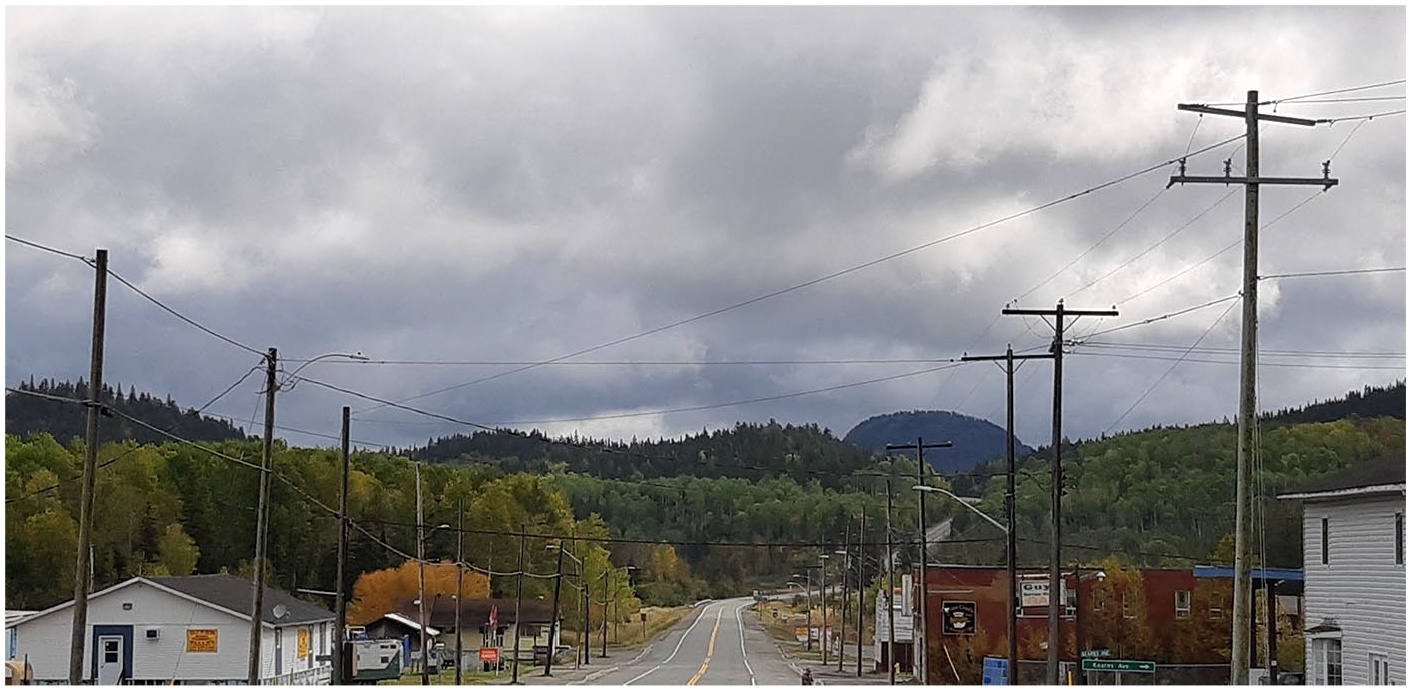
Image of Mount Cheminis (background) protruding from the earth like a bowl. View of picture taken from Virginiatown, Ontario. Image provided by the authors.
This work is part of a larger research project, funded by the New Frontiers Research Fund, entitled Sonic Coordinates: Decolonizing through Land-based music composition that is centered around sonic archiving and its use in storying Land (i.e., we engage in field research that involves recording sounds from the Land and surrounding environment). We investigate immersive approaches to sonic/sound-based research, looking at how these works can deepen one’s aural (listening) experience and relationship with land and environment. Specifically, this research involves gathering and archiving different environmental sounds through field recordings that informs new approaches to Land-based music sampling, composition, and soundscaping while providing a way to story the Land through forms of sonic engagement. By engaging the research through reflexive discourse, we engage new insights on ways to understand our environment through land-based sound methodologies, which involves gathering, recording, and archiving environmental sounds as a process of storying the land. To facilitate our approach, we draw on modes of reflexivity to determine what was learned from the initial sound-based research trip at Timiskaming and discern new pathways toward a critical listening experience.
A Journey Toward Understanding Sonic Relationships With the Land: A Reflexive Practice
As a research team we come from different backgrounds and experiences, which has offered a broader scope of perspectives and knowledge to this project: for instance, the project co-principal investigators are from different Indigenous ancestral backgrounds: Spy is Algonquin-Anishnaabe and Jean is Inuk. Spy and Jean first met in 2012 while working on Indigenous initiatives and education at a university in southwestern Ontario. Ceci, who grew up in Mexico City has been reconnecting with her family’s Indigenous ancestral roots, joined the team in 2019 as a research associate and has been helping with field research and documentation. In the context of this project we recognize that the multiplicity of identities and perspectives is helpful in terms of strengthening the research as this brings multiple lenses that helps to facilitate the overall research and analysis. Our research praxis weaves reflective vignettes that captures our aural/oral understandings of Land-based research and how these methods helped us to understand and interpret knowledge(s) within an Indigenous epistemology and framework.
listening to sound recordings captured at Mount Cheminis, Kapkigiwan, Lake Timiskaming (September 2019)
Mount Cheminis
As soon as the recording starts, I have a physical reaction. My heartbeat speeds up and I have the sensation in my gut of excitement, apprehension even. I hear footsteps, someone moving then the thunderbirds coming, closer and closer, wind and water, then moving off, becoming softer as they go. Until they are a memory.
It brings me back to the mountain. The warmth of the sun when we were near the top, the coolness of the trail in the shade of the trees, the light rain that fell while we were on the mountain, rain and sun mixed together. Standing in front of the big boulders that surround the base of the mountain, fallen long ago, sensing the ancestors among them.
We walk upwards, noticing the shapes in the stones under our feet, like petroglyphs. Are those the homes of the little people there in the hole in the gnarled tree stump half hidden between the stones?
We did a pipe ceremony near the top of the mountain, smoke from the pipe spiraling upward towards the heavens. Prayers offered and a sense of quiet and peace flows around us. Feeling connected to the old ones who were here long before us. The wind rustles the leaves, soft and gentle, then faster before becoming quiet again but always present there on the face of the mountain.
We leave the ribbons of colour fluttering in the wind there, an offering to the ancestors, to creation, carrying our gratitude for this day, for this life.
Back at the base of the mountain our big, brilliant yellow jeep waits to take us to the next sacred site. The jeep that represents the happiness this trip brings us, the sense of being in relationship with each other, and with our mother, Aki, the earth.
Water at Kapkigiwan Park
Thousands of gallons of water pouring over the falls never ending. How long has this water flowed over the stones at this place? We stand and listen to the roar of the water, geese loud as they fly overhead. A forest damp and dark, mysterious. I am present to how tiny we are in the vastness of time and space, how fleeting a human life in the timelessness of this place. Footsteps make no imprint on the stones; we will pass without making an impression here. Have the ancestors stood on this little rocky beach in awe of the beauty and peace here? We are listening to the land, capturing wind, birds, water, footsteps with a powerful recorder, keeping the sounds of the land, taking them home to listen and remember. Will the land remember us when we are gone?
Lake Timiskaming
The water sounds different here. A big rocky beach, stones tumbled onto the shore, the waves blown in by the wind grinding the stones against each other. The surf covers all other sound, and I am alone with the sky, water, wind, and earth.
Then into the cedar forest. Sudden quiet, no wind, surrounded by trees standing in place, ready to resume dancing once we leave. We whisper, awed by the sense of the sacred. I step outside onto a bank above the lake and lie in the grass. With a whisper of wings, an eagle flies directly over me, disappears across the water, and I feel blessed by this place. I find myself months later transported back there to linger in the quiet and peace of a sacred grove. A plaque there tells us that people from all over the world have made pilgrimages to this grove to experience this.
listening to sound recordings captured at Mount Cheminis and Highway 11 (September 2019)
Although I’m originally from the Timiskaming area, and still visit regularly, I found myself engaging with the sounds of the Land and environment with both a sense of familiarity but also a level of heightened awareness. I can quickly recognize the cackling calls of ravens, the wind whistling through the poplar trees, the shape of sounds echoing off the Trans-Canada highway bouncing across bodies of water, and contrasting reverberations emerging from various industrial activities (logging, mining, etc.), ultimately serving as a continuous soundtrack for this unique part of the north.
As I listen to the sound recordings that were captured during our visit to Mount Cheminis in the fall of 2019, I feel like I am being transported back to the space and moment. There is something about the recorded sounds that evokes a living memory from that visit which is joyful: I recall the vibrant colours that were present that day and how pronounced the hues of green, yellow, brown, and grey that were throughout the landscape. I also recall the different scents, such as damp earth and spicy fragrances (like black pepper and sage) that lifted up from the soil as we walked along the path to reach our destined recording location(s). Although I am familiar with this place, and its landscape and terrain, Cheminis never ceases to lose its magic every time I come to visit. When I reflect on the archival recordings and materials from our trip, I recognize many things that were learned: for instance, a lot was learned from the more pragmatic preparatory/planning work such as learning to leave room to navigate the unexpected when conducting sound work, and determining what are the most suitable compact pieces of equipment (handheld devices, microphones, cables, etc.) to bring, especially when hauling gear into the bush, up a hill, or hiking up a mount. There are many things to learn when engaging in land-based sound and archival work, and what is learned is how the “process” itself is an equally critical facet of the research praxis.
I realize my experience of this trip was somewhat different for me this time, which I believe was partly due to the fact that I spent most of the trip from “behind the microphone,” and as a result the sonic experience was heightened by the studio headphones I wore that then fed into a portable multi-channel recording device while being simultaneously plugged into 3-4 microphones pointing in all directions. Also, while I am scholar/researcher, I am also a composer/musician and librettist, and quite often I draw inspiration from environmental sounds, themes and topics. Unlike the experience of simply “sit-and-listen-and-note-what-you-observe,” I realize my experience was greatly amplified by a type of “surround sound” reality. I recall hearing the slightest rustling as if a large being were moving, a pebble slipping could sound like the weight of a boulder, the wind blowing through trees could feel oceanic with percussive tones punctuating through the constant droning sounds of the forest. It felt like Mount Cheminis – an inselberg formation – was a moving rock, a living being, existing in an animate state. Here the concept of “macro” appears to exist within a microcosmic sphere, and it feels much like I am listening to an entire universe through a tiny vessel. This place seems to bring all things into perspective, and is a place where the Land “speaks.”
When I think about the ways that the Land speaks or sings, I recognize a form of musicality that underscores it. I am reminded of
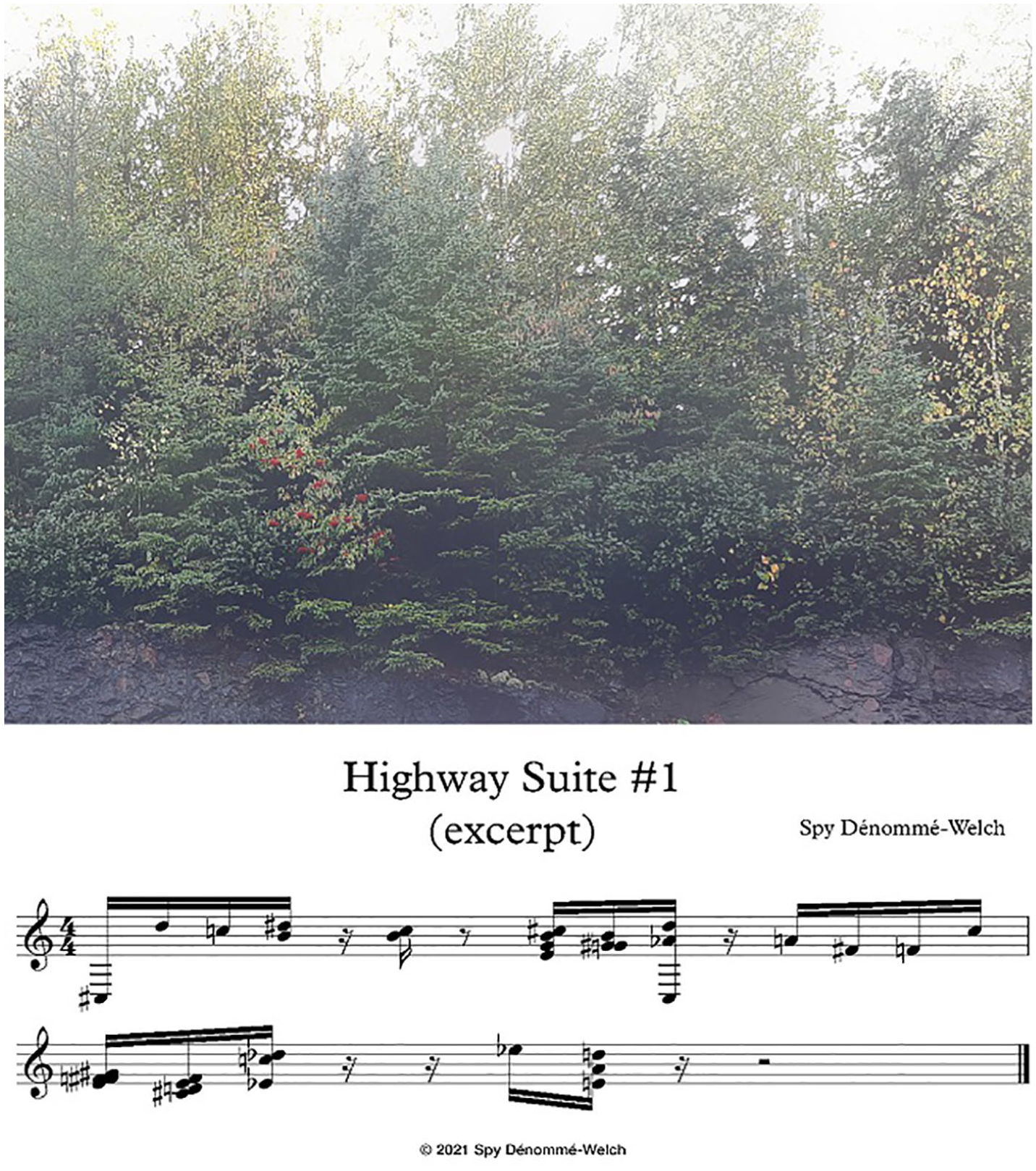
Image of blasted rock along Highway 11 near Kenogami, Ontario, with sample of musical phrasing from “Highway Suite,”
I was born in the northern area of Mexico City. All my life I have been in close contact with Mexica (Aztec) and Mayan Indigenous practices to be in relation with our ancestors. I learned from family members, community elders and teachers some healing practices and ceremonial protocols to honor the land.
Mount Cheminis
My heart races when I listen to the sound materials we collected during the trip. I have a profound connection and gratitude to the location and to the nature elements that make the Timiskaming Region unique. I was born with a neurological condition called synesthesia that helps me understand the world through sound, color, vibration and temperature. The American Heritage Medical Dictionary describes this as a “condition in which one type of stimulation evokes the sensation of another, we when the hearing of a sound produces the visualization of a color” (The American Heritage® Medical Dictionary, 2007). What I can recall from the location, the trees, the sound of the wind, the vibration of the leaves and the serenity of the land is a feeling of warm temperature and sparkles of different colors. What I mostly saw were yellow, red, orange and blue colors. Like little fireworks in front of me. When the sound is steady and constant, the sparkles turn to light waves of color, like curved lines in the sky. It was a whole-body experience to walk through the mountain with my colleagues and to discover areas full of sound and sensation. The mountain sings, we just need to listen, record and preserve the sound to use it in different ways such as composition, teaching and storytelling for generations to come.
Drawings (What I Saw Through Sound)
I often document what I see and feel to be able to remember the sensory elements of a place, a musical piece, a theater production, different food flavors, or smells. I usually draw with water markers or watercolor on white cardstock paper because the vibrancy of the colors remains the same over time. Natural landscapes and sounds usually have more colorful elements that look like waves or sudden sparkles of color. The colors I saw more in this experience were yellow, blue, red and light pink. These colors are common for me in places surrounded by water (rivers, rain, or waterfall) and I also experienced warm temperatures that I describe as a wave of heat, especially in Mount Cheminis.
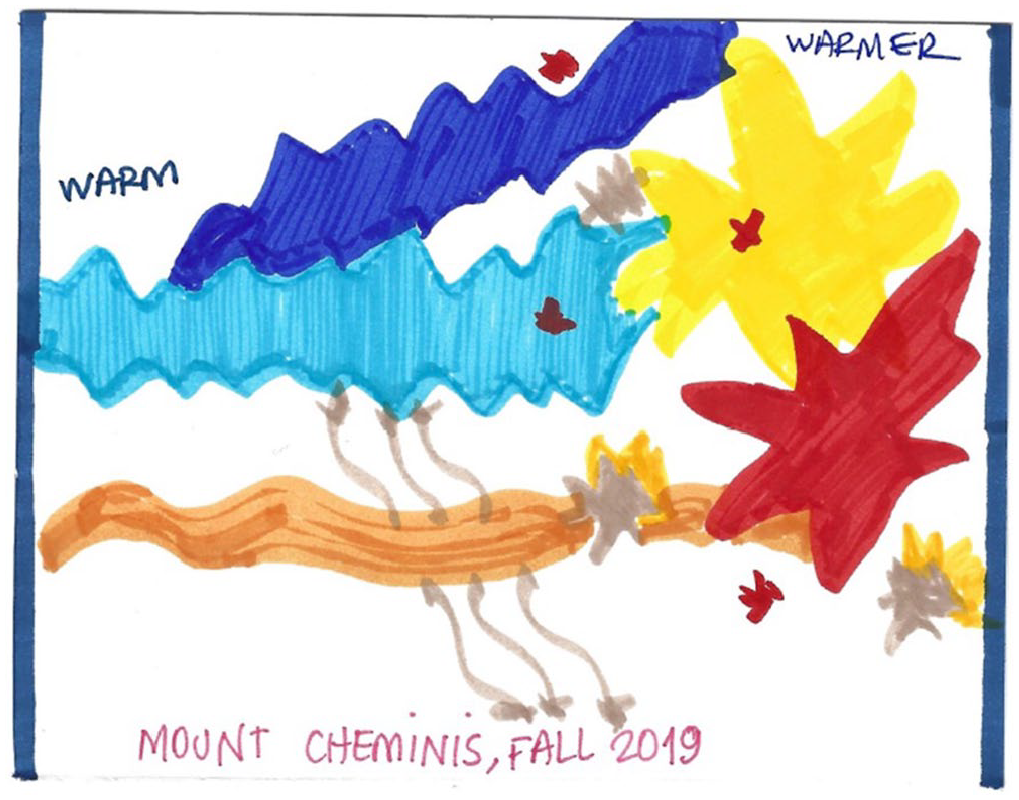
Ceci’s visualizations of sound from Mount Cheminis (September 2019). Image provided by Garcia Vega.
Kapkigiwan Park
Large bodies of water are my favourite; I feel cold wind down my spine every time I am close to a waterfall or a river. The volume of water being carried in this place is incredible. I noted harmonious sounds and a beat that suggested rhythm and balance between the water and the different types of trees living in the area. The sounds of the wind combined with the water as a backdrop produced lilac and yellow tones. I saw them like waves rather than sparkles. This usually happens when the sound is consistent and when the volume is high. This place reminded me of the outskirts of my hometown in Mexico City, where large bodies of water can be found and enjoyed.
The variety of trees and birds in this area was different than Mount Cheminis, the trees did not have many leaves because it was the fall and we could observe the structure and color of the branches. I clearly remember the smell of the ground and the saltiness in the air. Very soothing, very majestic.
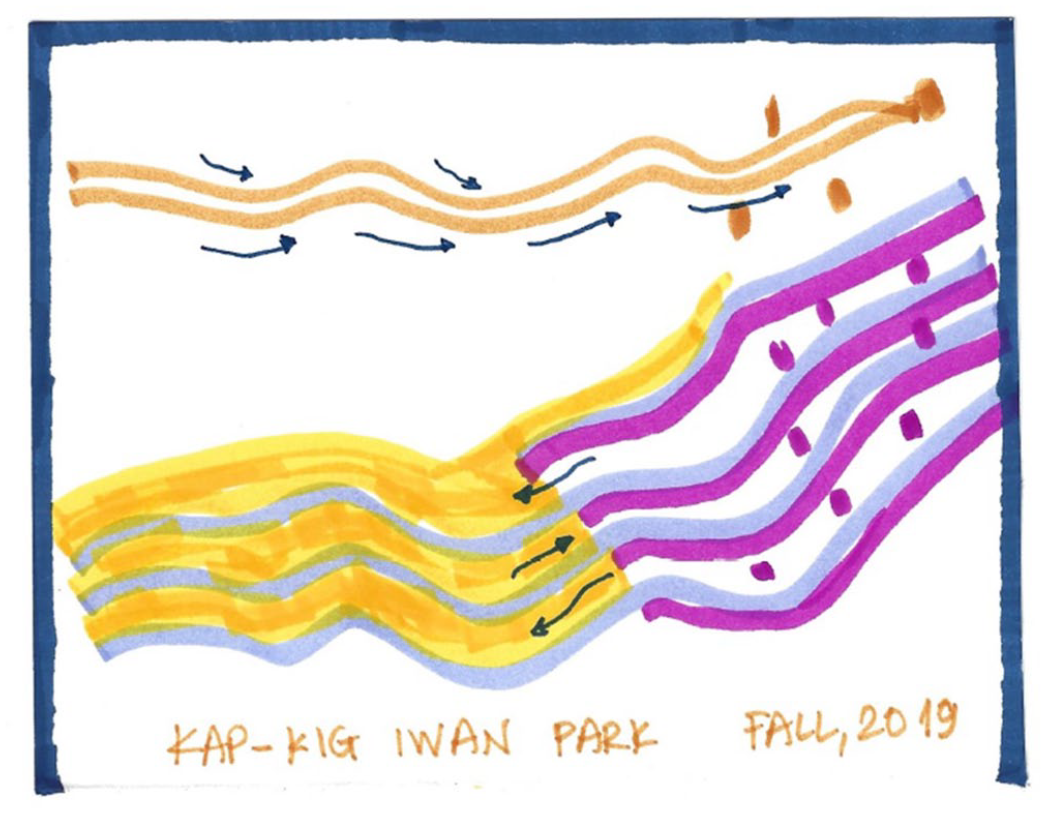
Ceci’s visualizations of sound from Kapkigiwan (September 2019). Image provided by Garcia Vega.
Excerpt From Ceci’s Field Notes
What can I do to share the information I learned from the land? The region we visited was special, I want to go back and see it all again with friends and students. My senses were activated in these locations. The city sounds don’t usually feel harmonious and very pleasant. Seeing and feeling nature is something that needs to be preserved and shared. If sounds are this soothing, what can we do to share them with people that don’t live here? Our journey to record them left in me a clear sense of honour and opportunity to communicate what nature taught us and to include more experiences in my life to be close to nature. The more present we are, the more we learn from the land.
Conclusion
Our experience of engaging research using immersive approaches to Land/sound
Footnotes
Declaration of Conflicting Interests
The author(s) declared no potential conflicts of interest with respect to the research, authorship, and/or publication of this article.
Funding
The author(s) disclosed receipt of the following financial support for the research, authorship, and/or publication of this article: We acknowledge the support of the Government of Canada’s New Frontiers in Research Fund (NFRF), [NFRFE-2018-1068].
