




Abstract
Over the past decade, a multitude of digital platforms engaging with Indigenous collections of ancestral belongings have been developed for the public in an effort to reconsider and reconceptualize notions of access and Indigenous ownership in virtual space. An initiative in partnership with the Onsite Gallery, the Virtual Platform for Indigenous Art (VPIA) is a newly developed resource that originates from Dr. Gerald McMaster’s Entangled Gaze Project at the Wapatah Centre for Indigenous Visual Knowledge, OCAD University in Toronto, Canada. VPIA is a strategic digital platform that brings together a specific dataset of Indigenous artworks and cultural belongings that portray European and Asian newcomers to Turtle Island, drawn from global museum collections. The platform’s innovative approach to collections is grounded in a dual record format, where visitors are invited to create a Community-Member profile and contribute knowledge and information to artwork pages that consist of a permanent institutional record and an evolving community-generated VPIA record. The VPIA is intended to bridge communities and institutions to facilitate digital contributions of novel ideas about the Turtle Island contact zone and the implications of the colonial period, from early contact through to the twentieth century.
Keywords
Introduction
Over the past decade, a multitude of digital platforms engaging with Indigenous collections of ancestral belongings have been developed for the public in an effort to reconsider and reconceptualize notions of access and Indigenous ownership in virtual space. 1 An initiative in partnership with the Onsite Gallery, the Virtual Platform for Indigenous Art (VPIA) is a newly developed resource that originates from Dr. Gerald McMaster’s Entangled Gaze Project at the Wapatah Centre for Indigenous Visual Knowledge, OCAD University in Toronto, Canada. 2 VPIA is a strategic digital platform that brings together a specific dataset of Indigenous artworks and cultural belongings that portray European and Asian newcomers to Turtle Island, drawn from global museum collections. The platform’s innovative approach to collections is grounded in a dual record format, where visitors are invited to create a Community-Member profile and contribute knowledge and information to artwork pages that consist of a permanent institutional record and an evolving community-generated VPIA record. The VPIA is intended to bridge communities and institutions to facilitate digital contributions of novel ideas about the Turtle Island contact zone and the implications of the colonial period, from early contact through to the twentieth century.
The VPIA distinguishes itself from many digital strategies for collection platforms through its positioning of historical artworks and belongings as ongoing sites of cultural entanglement. The platform strategy showcases both the social interactions that develop around Indigenous artworks, and how these relationships impact meaning and context. Using an iterative, Wiki-style framework, the platform establishes ways in which users can chart the transformation of object knowledge from fixed institutional records to a living document layered in textual and graphic contributions by Indigenous and non-Indigenous artists, researchers, and Knowledge Keepers. As additional relationships, cultural contexts, and dialogues develop around each object or belonging, the underlying complexity of the enculturated artwork can emerge. This approach to mobilizing collections allows for the articulation of artworks as sites of social and cultural exchange and is a vital case study for the Indigenization of museum collections.
To develop the VPIA, ten protocols were established via consultation and collaboration, which were refined and reified over the course of development into four foundational principles. This Indigenous-led methodology resulted in specific targets and partnerships. Throughout the course of development, the VPIA team navigated issues like the organization of knowledge from an Indigenous-led perspective, and how it could transcode to a digital collections environment. Terminology, categorization, and organization taken up by the institutional museum system often lack specificity and accurate content. Thus, a challenge of the VPIA has been to create a framework that is open and contingent upon community participation. From iterative ideation and conceptualization to the user experience (UX), visual design and development of the VPIA, this paper addresses the protocols that were initially established, and how the subsequent guiding principles aided in the creation of an open-source platform for user-generated content that situates Indigenous frameworks and perspectives as equal to or greater than institutional knowledge.
Context: Entangled Gaze and the Haida Gwaii Knowledge Exchange
An integral part of VPIA’s development was The Entangled Gaze: A Knowledge-Exchange Workshop that took place over two days in February 2019 at the Haida Gwaii Museum at
Postcolonial theory has informed a great deal of research on the analysis of representations of non-Western and non-European peoples, yet for the most part it has ignored Indigenous Knowledge Systems and ways of seeing. 3 This knowledge-exchange workshop set-out to shift the conversation away from Western representations by reframing and prioritizing Indigenous community perspectives and how they can inform the design of a digital platform.
Cross-generational representatives from communities in four cultural regions of Canada and the United States attended the event, including the Northwest Coast, the Plains, the Woodlands, and the Arctic. 4 Representatives were selected based on their knowledge of and expertise in artistic production that exhibits aspects of the Entangled Gaze. Dialogues about artworks produced at the intersection of colonial forces and diverse cultures also helped mobilize the Wapatah Centre’s larger research agenda of theorizing the Reverse Gaze as it deconstructs dominant institutional hierarchies of knowledge (Figure 1).
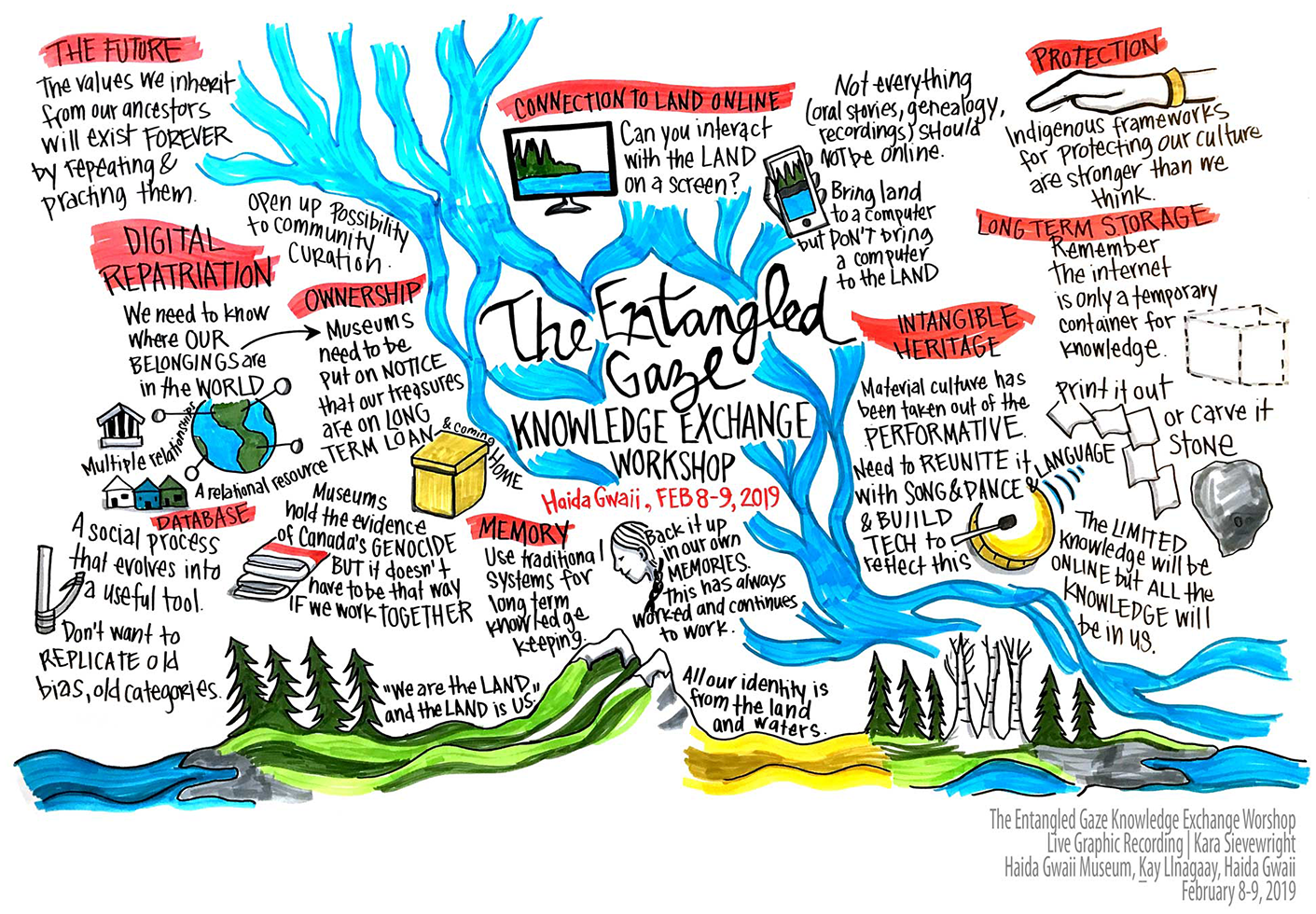
“Knowledge Exchange Map.” Created by visual artist and facilitator Kara Sievewright during the live graphic recording of the Haida Gwaii workshop. February 8–9, 2019.
The workshop played a significant role in generating protocols for the development of the VPIA. During the two days, a collaborative space for Indigenous scholars, students, artists, and Elders, along with established Indigenous and non-Indigenous museum professionals and researchers from Canada, the United States, and Europe was created. Together, they exchanged perspectives about digital protocols for storing and sharing Indigenous art created in cultural contact zones. Outcomes included key conceptual and user experience requirements for the VPIA, as well as Indigenous-led strategies for the development of respectful use policies and sustainable expansion. Together, the workshop participants and visual facilitators cultivated an Indigenous-led strategy for research accessibility and digital database development.
The following ten protocols represent the synthesis of outcomes across participants’ cultural perspectives and approaches to engagement with and representation of Indigenous Knowledge and culture online:
Cultural Integrity
Cultural integrity is key to the creation of an Indigenous database and is understood as the wholeness of community and culture. Culture resides in complicated and entangled networks of place, practices, objects, language, people, and values. To exclude any of these elements is to undermine the coherency and integrity of the whole.
Recognition of Place
The land has sustained our cultures through time, and we, in turn, are required to protect it. In doing so, we take care of ourselves. An Indigenous-centric database must re-connect objects and the knowledge that surrounds them with their homeland.
Knowledge Parity
Indigenous Knowledge Keepers and researchers have authority and parity to academic scholarship. In building a digital database, knowledge parity requires expression at multiple levels. The narratives, language, and explanations of Indigenous artwork can no longer privilege Western discourse.
Language
Language creates meaning and structures communication. The language of museums and collections often secures the absence of Indigenous peoples. An Indigenous database must decolonize the terminology and categories that continue to govern museums, archives, and collections, and engage in a process of Indigenization.
Accessibility
An Indigenous-driven database may remedy imbalances in accessibility by enabling communities to locate and connect with their cultural heritage, which has been displaced and distributed around the world. It can assist them in building a more complete understanding of their culture’s historic and present-day accomplishments.
Cultural Heritage
Cultural heritage is defined through objects that have an ongoing historical, traditional, or cultural importance to Indigenous groups. As a framework, it implies specific conventions to concepts of ownership, protection, and permission. An object of cultural heritage is owned as a collective resource and requires consensus to determine how that object is (or is not) represented, identified, spoken about, and used.
Promoting Indigenous Futures
The narratives and languages of Indigenous collections are often anchored in colonial history. An Indigenous database must reunite objects with people, song, and dance, and facilitate the use of technologies and terminologies that support this endeavor. Its design must be human-centered, using digital supports to enrich how people interact with their communities and culture. It must undo historical biases, inaccuracies, and mistakes, to lay the groundwork for new possibilities and countless iterations of possible Indigenous futures.
Longevity and Sustainability
The values and knowledge of Indigenous cultures are inherited from their ancestors through storytelling and practice. To sustainably maintain cultural objects and knowledge for future generations, we must consider how the digital world can grow alongside Traditional Knowledge holding systems, without undermining their foundations (Figure 2).
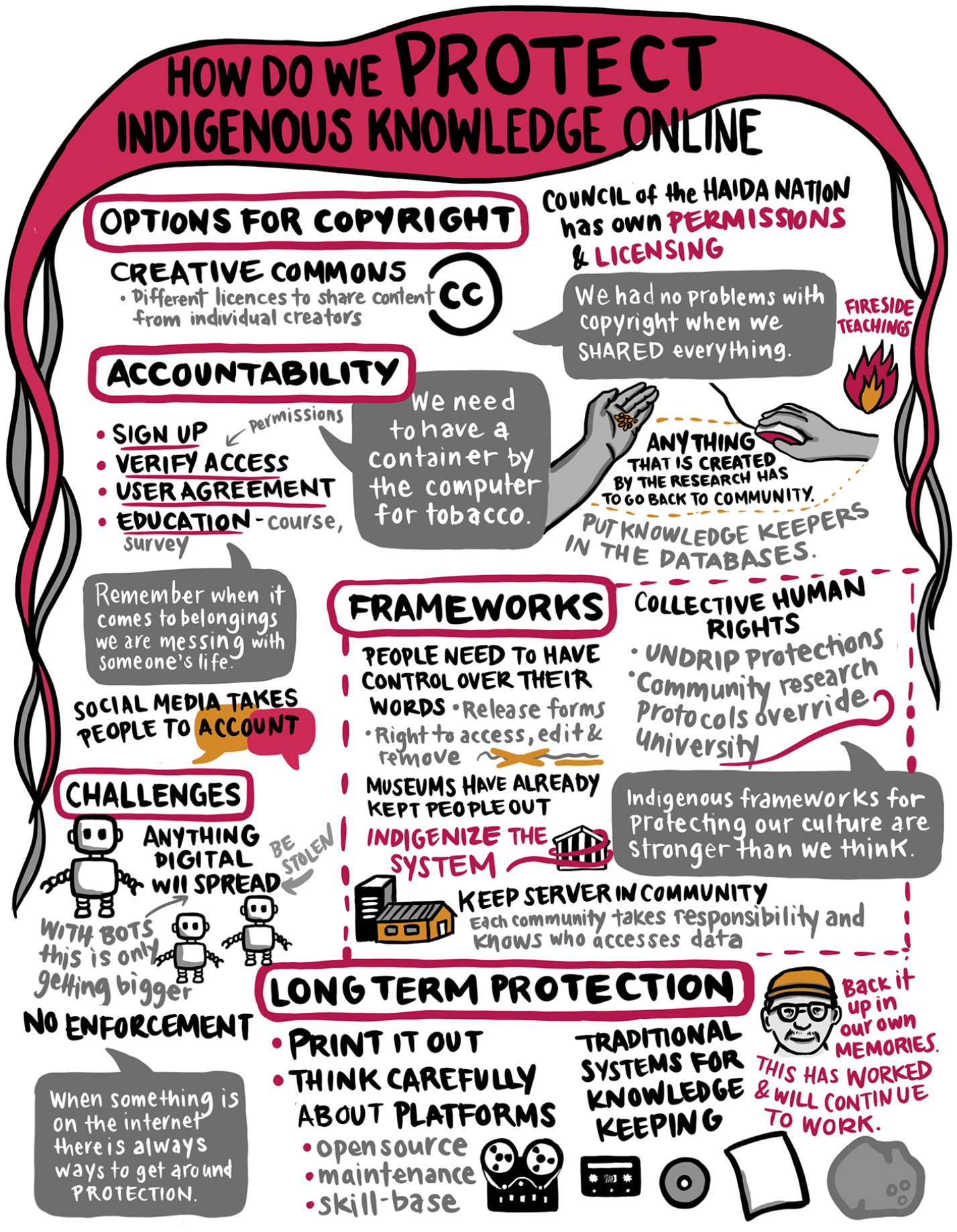
“How Do We Protect Indigenous Knowledge Online.” Created by visual artist and facilitator Kara Sievewright during the live graphic recording of the Haida Gwaii workshop. February 8–9, 2019.
Digital Repatriation
The repatriation of cultural heritage to Indigenous communities—whether in physical or digital form—is of utmost importance to cultural thrivance. Facilitating access to cultural objects strengthens connectivity and supports collective remembering. Repatriation reaffirms the power and authority of the communities to remember and perform who they are.
Collectivity and Community
An Indigenous database must be conceived as a collaborative process. Databases are relational tools, building and strengthening connections between objects, communities, and people. By acting as a bridge between museums and Indigenous communities, possibilities for collective and reciprocal knowledge making occur through the interpretation and contextualization of a living document.
By fostering critical discourse on the theme of reversing the gaze, the workshop enabled a focused discussion on how Indigenous artists practiced the art of looking throughout history. 5 Jisgang Nika Collison, the executive director and curator of the Haida Gwaii Museum, observes: “We’re waking up after decades of silence; we’re decolonizing our minds. Central to this process is the Haida language. Our language is who we are; through it we are turning back the tide of cultural unlearning and creating a Haida future rich with history, language and a worldview for our children and their children.” 6 Taking inspiration from this insight and the importance of engaging with Indigenous knowledge holders and researchers, language is essential to Indigenous Visual Knowledge (Figure 3).
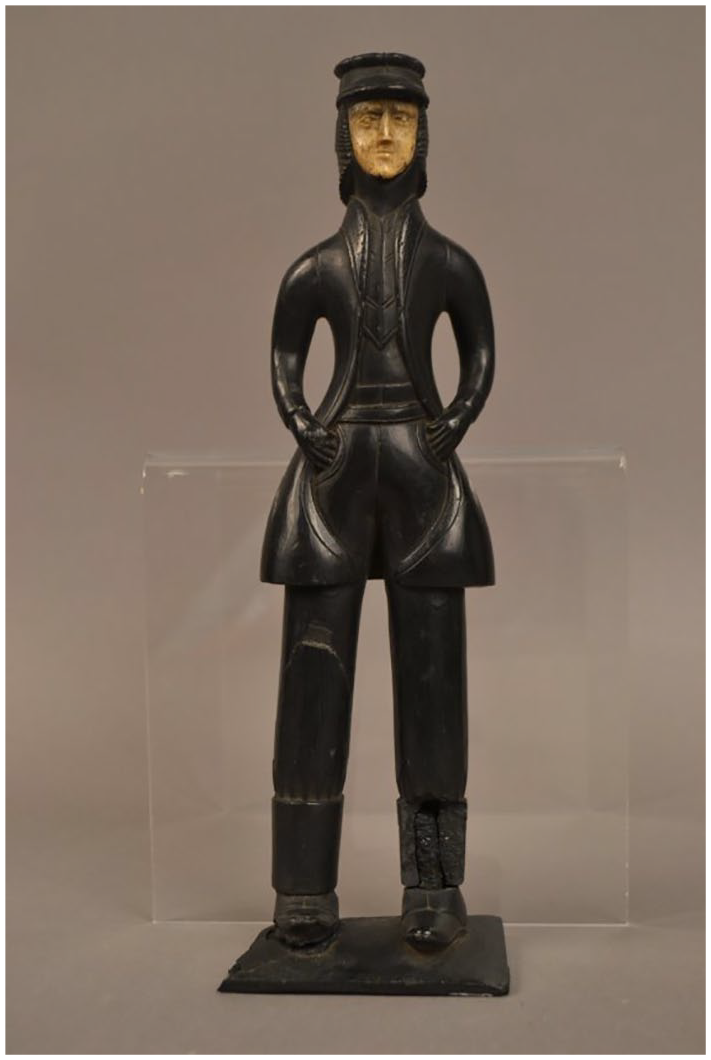
Once Known Haida Artist, Figurine of a White Sea Captain, Argillite and Whalebone, INE XX 1, ©Boston Children’s Museum.
Using the ten protocols as a guide, platform development ensued by focusing on two strategic themes: Engaging Indigenous Knowledge and Mobilizing Knowledge and Partnerships for Reconciliation. The Wapatah Centre promoted Indigenous knowledge mobilization through a series of outreach events titled the Indigenizing the (Art) Museum Series. 7 Drawing from these events a set of key principles intended to guide the design and development of the VPIA were established.
VPIA Principles: Land, Language, Community, Engagement
During the process of development and UX design a series of Four Principles were created to guide VPIA Community-Members as they engaged with the platform and built new networks of Indigenous Knowledge through user-generated content contributions. The future growth and accountability of the VPIA are directly informed by these principles and they embody the project’s commitment to reciprocal relationships and knowledge.
Land
Encouraging and practicing an embodied connection to the Land by reflecting on its role in an Indigenous-led digital space.
Language
Committing to an ongoing revision of and discussion on the vernacular surrounding Indigenous artwork.
Community
Facilitating meaningful engagement as part of the VPIA community through contributions to the platform.
Engagement
Prioritizing and maintaining a respect for Indigenous Knowledge and the ways in which it is interacted with and shared.
Outcomes: VPIA as an Indigenous-led Open-Source Digital Strategy for Accessing Traditional Knowledge
The development of the VPIA was an experimental strategy in the Indigenization of digital design. The first step in approaching the challenge of creating an Indigenous-led digital collections platform was to develop a comprehensive sense of the protocols and values that guide Indigenous relationships to material collections and culture online.
The VPIA sought to accomplish three primary goals:
(1) Determine the needs of users regarding respectful access, use, and contribution to Indigenous art through the VPIA record as a living and growing document.
(2) Build a network of reciprocal partnerships with researchers, institutions, and communities involved in the field of digital Indigenous artwork collections.
(3) Develop a prototype platform through rigorous user experience and design testing, in partnership with key leaders including Jennifer Wemigwans, Bonnie Devine, Jason Baerg, and Kade Twist.
From a technical perspective, the VPIA was developed as a custom, open-source software solution. The various development levels consisted of NodeJS and ExpressJS for the back-end, while the database was organized using MySQL. Caminte was implemented, which allowed for switching between regular SQL databases and NoSQL ones. React was used for the front-end needs of the platform.
The platform was developmentally split up into several large components, consisting of a Wiki Engine, User Management Solution, Search Function, and a Media Upload function. The Wiki Engine is built on code that supports basic Wikipedia-style functions. The VPIA initially deployed Matterwiki, which is a functional wiki engine allowing for revision, content creation, editing, and search functionality. The novel Wiki Engine supports select functions, including: (1) Creating user-specific content, such as text and multimedia; (2) Users are allowed to edit most content found in a specific VPIA artwork record; (3) This revision function provides access to each record’s unique editing history. VPIA users are treated as Community-Members and can view altered Wiki-record content, return to an earlier form of the record, and make their own additions based on their experience and knowledge. Wiki functionality is further supported through WYSIWYG content editor software. The benefit of WYSIWYG was found to be that a community-member could input content without having to mark up the content manually using code. While Matterwiki was used as the preliminary baseline for development, the editor that was bundled with it was removed. TinyMCE was deployed in the VPIA framework for image support and formatting.
Each subsequent iteration of the VPIA’s functionality and user experience originated by questioning how the foundational protocols and guiding principles could be met. For example, the solution of using a Wiki-style framework was devised to reinforce knowledge parity between academic and non-academic users. The wiki core of the platform allows for the prioritization of Indigenous voices through opportunities to alter institutional content, aligning artworks with the language and descriptors of their source communities.
This approach allows VPIA to distinguish itself from other platforms from a development perspective: the platform is focused on the needs of the communities that will use it. Thus, Community-Members can create living archival documents that reflect the lived-experience and Traditional Knowledge of contributors. As opposed to institutional records that reflect the interests of the museum, VPIA records can offer a space where knowledge and stories are rendered visible and authoritative. VPIA holds the possibility to become a powerful tool of digital repatriation, while allowing museum institutions to encounter vital information and step toward the decolonization and Indigenization of their holdings.
Conclusion
The major success of this project lies in the team’s creation of an entirely new approach to a Wiki-framework to develop an alternative to the museum record in the form of a living document. Wapatah Centre was able to build a strong model for how digital technology can be driven by Indigenous knowledge, language, and protocols. As a case study in the application of Indigenous research methodology and protocols to digital design, the platform has few equivalents in terms of reach and measurable impact.
VPIA development brought together a significant network of Indigenous and institutional collaborators to shape and troubleshoot the platform for the purpose of ensuring future sustainability. Consistently, the issue faced by online collections management programs is access to viable funding options that secure the database and provide adequate hosting services for user-base growth. 8 Beyond the technical considerations, however, are the questions about what museums can do to decolonize and Indigenize their collections. 9 With more and more digital projects emerging, museums must consider the lack of accessibility surrounding their Indigenous collections and how digital platforms like the VPIA can support the growth of their archival records through the integration of Indigenous Visual Knowledge.
Footnotes
Declaration of Conflicting Interests
The author(s) declared no potential conflicts of interest with respect to the research, authorship, and/or publication of this article.
Funding
The author(s) received no financial support for the research, authorship, and/or publication of this article.
1.
Some recent databases include: The Great Lakes Research Alliance for the Study of Aboriginal Arts & Cultures (GRASAC), available at: https://grasac.org; The Reciprocal Research Network (RRN), available at: https://rrncommunity.org; Iningat Ilagiit, available at: https://iningatilagiit.ca; and the Plains Ledger Art Project, available at: 
2.
See ab-Original: Journal of Indigenous Studies and First Nations and First Peoples’ Cultures, Special Issue: The Entangled Gaze, 2, no. 2 (2018).
3.
Bernard Smith, European Vision and the South Pacific (New Haven: Yale University Press, 1985); Tzvetan Todorov, The Conquest of America: The Question of the Other (Norman: University of Oklahoma Press, 1999); Glen Sean Coulthard, Red Skin White Masks: Rejecting the Colonial Politics of Recognition (Minneapolis: University of Minneapolis Press, 2014).
4.
Participants: Gaahlaay Lonnie Young, Skil Hiilans Allan Davidson, GwaaGanad Diane Brown, Captain Gold, Kii’iljuus Barbara J. Wilson, Guujaww Edenshaw, Nika Collison, Cherie Wilson, Sean Young, Vince Collison, Geoff Horner, Gwaai Edenshaw, Jaalen Edenshaw, Gerald McMaster, Eric Tootoosis, Stephen Augustine, Roger J. Lewis, Krista Ulujuk Zwadski, Lucy Bell, Greg Hill, Jonathan Lainey, Peter Jemison, Christian White, Adrienne Huard, Martha Black, Alan Elder, Nathalie Macfarlane, Kathryn Bunn-Marcuse, Natalja Chestopalova, Brendan Griebel, Dana Moraes, Kara Sievewright, Walker Brown.
5.
Sam Pack, “Reversing the Gaze: The ‘Whiteman’ as Other,” International Journal of Business and Social Science, 1, no. 3 (2010): 295–301.
7.
See Indigenizing the (Art) Museum: Gerald McMaster in Conversation With Jill Ahlberg Yohe, 1 April 2021, available at: https://youtu.be/YOzaHPXjxu8; Indigenizing the (Art) Museum: Gerald McMaster in Conversation With Annika Johnson, 15 April 2021, available at: https://youtu.be/yonG5bbb4ds; Indigenizing the (Art) Museum: Gerald McMaster in Conversation With Greg Hill, 22 April 2021, available at: https://youtu.be/r2PwW2qKWfM; Indigenizing the (Art) Museum: Gerald McMaster in Conversation With Jaimie Isaac and Jocelyn Piirainen, 29 April 2021, available at: https://youtu.be/v-v5g3hOm2M; Indigenizing the (Art) Museum: Gerald McMaster in Conversation With Patricia Marroquin Norby, 6 May 2021, available at: https://youtu.be/xlb7PN4O8w8; Indigenizing the (Art) Museum: Gerald McMaster in Conversation With Kathleen Ash-Milby, 13 May 2021, available at: https://youtu.be/cR1BK3fBYJI; Indigenizing the (Art) Museum: Gerald McMaster in Conversation With John G. Hampton, 26 May 2021, available at: https://youtu.be/zPl5Y6Tobqg; Indigenizing the (Art) Museum: Gerald McMaster in Conversation With Tarah Hogue, 10 June 2021, available at: https://youtu.be/PmyYJtulp-o; Indigenizing the (Art) Museum: Gerald McMaster In Conversation With Rhéanne Chartrand, Event Forthcoming, available at:
8.
Jennifer Wemigwans, Protecting and Promoting Indigenous Knowledge Online (Regina: University of Regina Press, 2018).
9.
Karen Aird and Gretchen Fox, Indigenous Living Heritage in Canada (Ottawa: Canadian Commission for UNESCO’s IdeaLab, 2020).