




Abstract
In May 2020, Arizona State University’s history department offered its first remote, digital internship to graduate students. Students completed a 180-hour internship between May and August 2020. The internship involved weekly meetings, curation, collecting, journaling, and marketing. Over the summer, the interns worked to identify a silence in the archive and address it by creating a collection plan targeting the perceived silence. The interns drew on their own networks to build the collection, created a collection plan, conducted oral history interviews, wrote a blog post, and completed a final portfolio.
Keywords
As COVID-19 spread, shelter-in-place restrictions dissolved the structures of home, school, work, foodways, and socialization. Worldwide, societies ushered in a “new normal.” In March 2020, A Journal of the Plague Year: An Archive of COVID-19 (JOTPY) began documenting pandemic experiences: gutted grocery stores, black-market PPE, closed schools, empty streets, and silent playgrounds. Utter disruption brought with it a once-in-a-lifetime opportunity: the chance to solicit and curate crowdsourced stories and house them in a pandemic archive. By April, JOTPY amassed over 3,000 stories with no sign of slowing down. These stories required processing: content analysis and curation for public and academic audiences. The project needed a larger curatorial team, and in response, Arizona State University’s history department offered the first of three planned graduate student internships working directly with the archive.
Normally, the word “archive,” conjures the image of a brick and mortar building with stacks of semi-organized contents, filing cabinets, and finding aids. In JOTPY, the contents are organized using similar principles and metadata, but all of its items are digital. While interns had no set physical location to report to, JOTPY inhabits an extensive digital space that includes the archive’s website hosted by Omeka and its digital workspace operated on Slack. An archive can be enhanced or hindered by its organization, and graduate students proved crucial to managing its contents.
Of all the changes that occurred in 2020, one positive shift was the value and recognition of remote labor. For students, this led to an inevitable rise in what Jade Ryerson and Katherine Crawford-Lackey termed, “Quar-interning.” 1 Arizona State University’s COVID-19 Archive naturally lent itself to this role: a flexible internship opportunity, completed on the student’s time and schedule. Successful interns completed 180+ hours of service. Their workload included weekly meetings, curating stories in the archive by adding metadata and following best practices in public history, collecting stories about pandemic experiences, identifying and addressing archival silences, data cleaning, categorizing stories, adding tagging and geolocation information, conducting oral histories, and writing three reflection pieces based on primary sources submitted to the archive.
Curation
Curation forms the backbone of a rapid response archive and frames the digital repository in real-time. 2 Data curation connects items to a larger global context comprised of libraries, publishers, scholars, and the public. 3 Its information channels users through the archive. 4 JOTPY uses the Dublin Core Metadata Element Set, which includes fifteen “core” elements to describe items. The same basic metadata is applied to every pandemic story. 5
Each entry includes a title, description (the story), date, and the contributor. Dublin Core offers controlled vocabulary, and in addition, curators add folksonomy terms. A controlled vocabulary is an organized list of words and phrases used to index content. Controlled vocabulary indicates an initial relationship between an item and thousands of other stories in the same category. After gaining a sense of the story, curators add additional, more specific words to describe submissions. Additional terms provide more paths into the archive and identify precise connections. For example, a political cartoon depicts Peru’s national government ending the prohibition against children going outside on May 18, 2020. The image shows two panels. On the left, it reads: “First day children can go outside,” (Shows a father chasing his son). On the right: “First day of exercise,” (the father is collapsed in his chair sleeping). 6 Its controlled vocabulary phrases include “home and family life,” “art and design,” and “national government.” The curator’s tags added: son, father, meme, Twitter, hijo, padre, exercise, and tired (Figure 1).
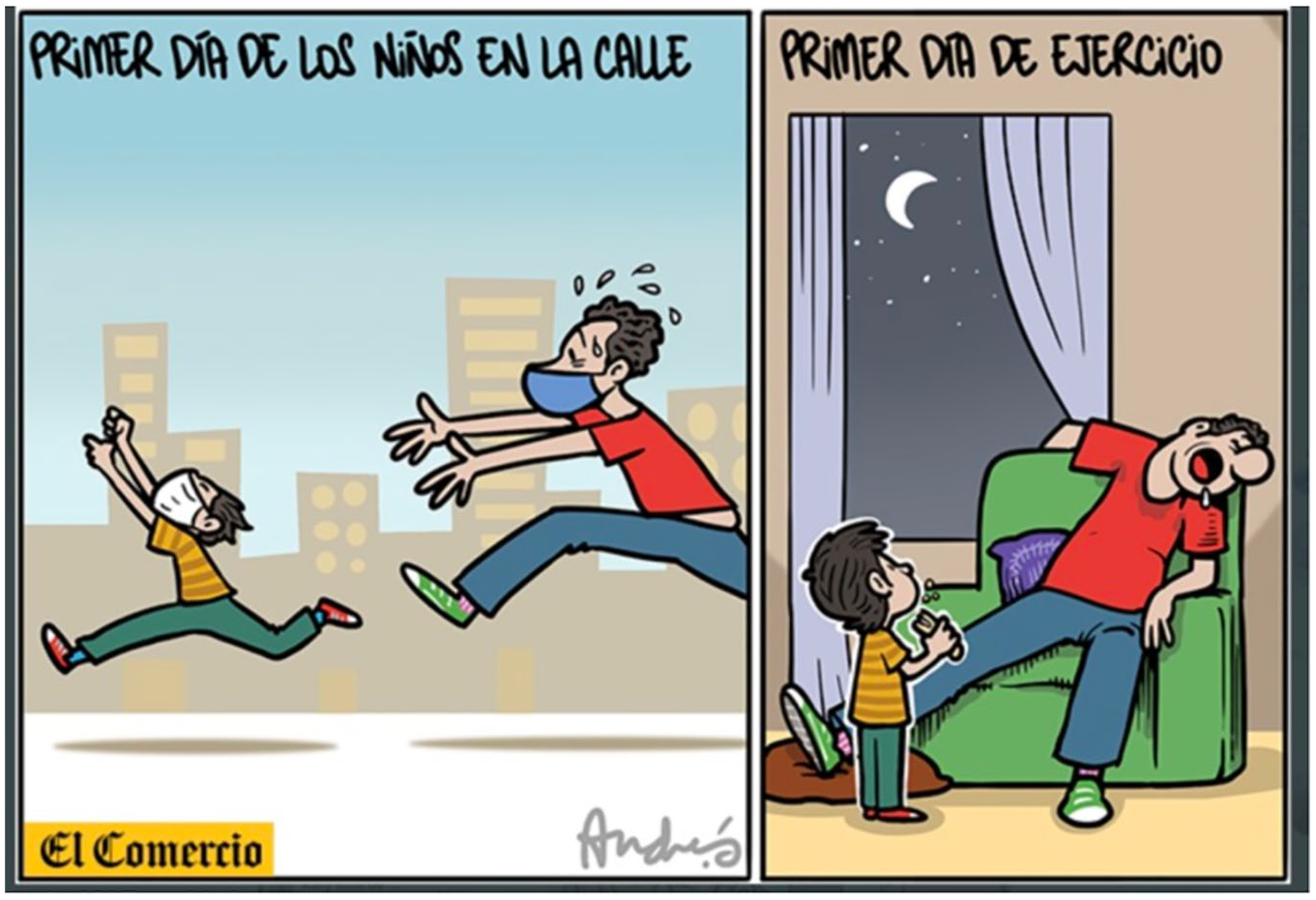
Political cartoon by Andrés Edery.
The submission form allows contributors to add their own “tags,” or metadata. User-driven tags counter the traditional top-down taxonomy and allow for socially built metadata. 7 When uploading a story, participants are encouraged to tag it with keywords. These terms are saved as “contributor tags,” a folksonomy, (a portmanteau of ‘folk’ and ‘taxonomy), 8 forged from public input. Users create their own language of categorization; each term becomes its own field- an access point that breaks out from the traditional schema. Every COVID story, therefore, is contextualized by the contributor and the curatorial team.
Collecting
After spending a few weeks working in the archive, the interns established a collection plan to solicit stories related to specific topics like lost graduations or canceled sports seasons. The team reviewed collection plans from various institutions: the New Bedford Whaling Museum, the Smithsonian, and others. 9 After assessing the genre, they wrote a collection mission statement. In other words, what was the purpose of this collection, what does it do well, and why does it matter? Furthermore, how does this collection bolster and serve the mission of the COVID-19 archive at large? Next, they developed a plan for soliciting and collecting stories.
To capture digital and print audiences, the interns wrote and advertised the collection for a target audience. Next, they composed a social media call for submissions and a more traditional newspaper press release. These exercises drew on the interns’ ability to conceptualize, communicate, and market a collection. As the internship progressed, they searched and aggregated submissions into collections. Toward the end, they wrote a blog post centered on the prompt: what does this collection tell us about the pandemic? Finally, they combined these materials with their journal and their 5 to 10 favorite items into a digital portfolio. The portfolio was built and hosted within the archive and highlights the work and skills they acquired.
Silences
Archives are not neutral spaces. They are a corpus of items that have been collected, organized, prioritized, and cataloged by human actors. 10 They influence how stories are remembered. Simon Fowler writes, “Sources and archives are neither neutral nor natural. . .this. . .is the reason for so many silences.” 11 Rapid response archives are no exception. A rapid response archive operates on the premise that contributors and curators collect around a historical moment, an episode deemed important enough to stop what we were doing and document instead. Yet, even with our best efforts and a team comprised of students, faculty, and curators around the world, JOTPY inherently creates silences. Silences reflect sources that either were not created in the first place, or not preserved. 12
The curatorial team can address some of these issues in real-time. Interns process track, and organize content and are trained to think critically about what JOTPY does well and what it might be missing. Technology increases inclusion. For example, oral histories help capture the ways people discuss and process their lived experiences like delivering a newborn during a pandemic. Moreover, memories reflect an individual’s political, moral, and existential views of the present. 13 Recording these experiences captures subtle dynamics within a public health crisis.
Visual records dominate the archive, but interns and students can reflect on and submit items related to changing soundscapes, smells, physical spaces, and tactile experiences. For example, intern Shanna Gagnon wrote “. . .there is an odd tension of noise inside my home and silence the second I step outside. I find myself needing a quiet space when I’m in my house. Yet the second I walk outside, it’s way too quiet . . . I start to feel uncomfortably lonely and in need of human connection.” 14 Beyond the sources collected, the interns also identified an archival silence and created a collection targeting that absence. Their labor amplified distinct perspectives.
The summer interns zeroed in on several collection ideas: healthcare, incarceration, LGBTQ+, COVID brides, rural voices, the San Francisco Bay Area, children, the performing arts, foodways, and social justice (Figures 2 and 3). These collections reflected their individual strengths, areas where they might pull together their networks to fill information gaps. In the fall cohort, curators managed those collections and added motherhood, law enforcement, New Mexico narratives, and mental health.
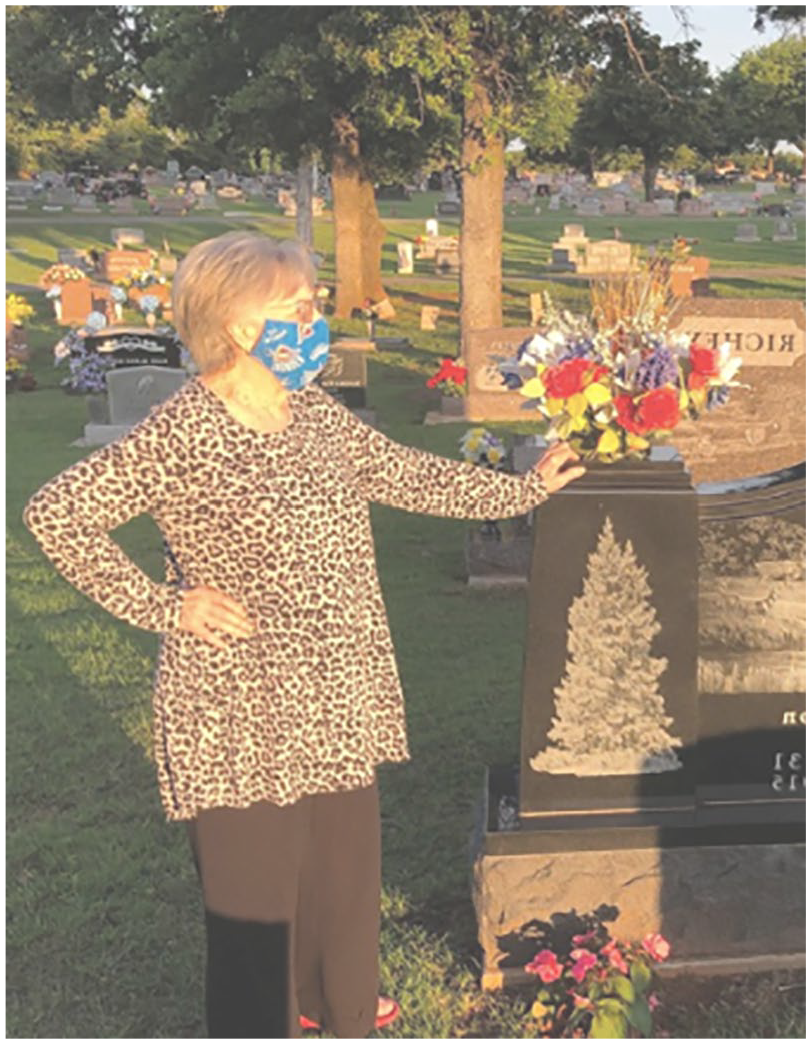
A grandmother visits her husband’s grave for the first time since COVID shelter-in-place restrictions began in Blanchard, Oklahoma.
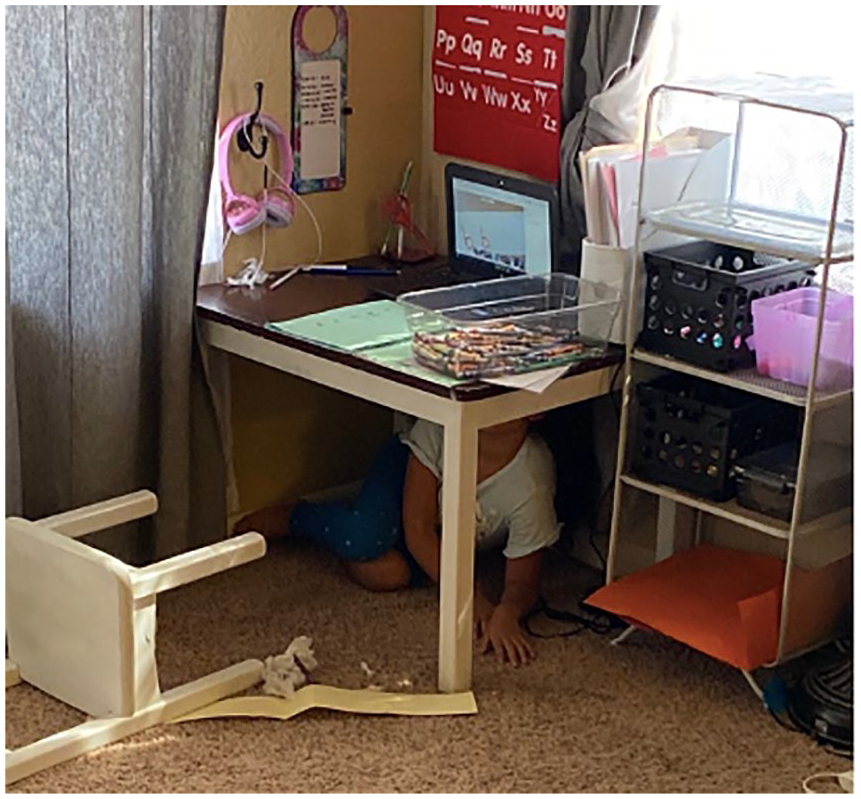
Image shows a kindergartener hiding under her desk during first class Zoom meeting.
How to Run a Digital Internship: Communication Is Key
The ability to communicate and receive feedback is critical. Interns met weekly as a group, attended larger project-wide town hall meetings, and navigated between the Omeka website, Canvas, and Slack. Intern Shanna Gagnon noted, “Our team’s ability to directly communicate with each other, to offer constructive feedback, to step in to help others when needed, and to adapt to ever-constant changes characteristic of working in a rapid response live archive, was simply incredible.” 15 Slack facilitated effective communication. It allowed the team to divide up work into different channels and promoted file sharing, threaded conversations, direct messages, and audio/video calls.
What Interns Gain
The internship goes beyond traditional academic learning by introducing students to practical, desirable workforces skills. The interns learned to work remotely and asynchronously as a team using Slack. They learned how to use new software to create stable files. For example, they navigated to the Wayback Machine to capture websites and save them for future use. 16 To save ephemeral social media posts, they used screen capture or recording software to create screenshots or MP4 files. And, when processing oral history audio files, interns generated AI transcriptions with Otter.ai.
Some participants seized the opportunity to emerge as leaders within the group. Whether distinguished by critical thinking, attention to detail, consistency, or experience, almost everyone had a moment where they became the expert and taught the group about a topic or issue. Intern Lawson Miller wrote, “. . .the internship has given me practical experience in being a leader among my peers, communicating effectively through press releases and social media, and developing standardized practices.” 17 After working on the project for several months, Miller trained new interns on how to curate and reviewed their work for quality and consistency.
Finally, and perhaps most importantly, the internship built community. Sometimes online coursework can feel contrived. In the internship, collaboration is necessary. Working in teams made the workload a social experience. Intern Alexis Walker reflected, “Before the internship, I shied away from group projects as a necessary evil to be avoided at all costs however the internship showed me just how fun working with others could be and to value a great team.” 18 Echoing this sense of collaboration, intern Chris Twing added, “By the end of our fifteen-week internship we had become even more than a team, we had become a family. I believe this was partially due to a shared crisis. . .For many of us, our weekly Zoom. . .was nearly the only face-to-face contact, though virtual, we had with anyone.” 19 As weeks of lockdown dragged on, the curatorial team’s weekly meetings felt like a hybrid of work and socialization.
Directing the internship taught me to value the distinct perspectives everyone brought to the team. No two were exactly the same, but they all added something the project needed. The interns committed themselves to an extensive internship experience and broke down digital barriers. They walked away with an unexpected comradery uniting a geographically and demographically disparate team. Furthermore, the JOTPY internship created a sense of purpose, spurred by the sense of doing work that matters and work that will matter for future generations. We each became part of the archive, and it left a legacy with us. Years from now we will look back on the historical shift created by the COVID-19 pandemic and remember the dedication and care that went into curating pandemic stories.
Footnotes
Declaration of Conflicting Interests
The author declared no potential conflicts of interest with respect to the research, authorship, and/or publication of this article.
Funding
The author received no financial support for the research, authorship, and/or publication of this article.
