




Abstract
As museum and library doors shuttered in response to COVID-19, digital portals opened new possibilities for centering collections as an antidote to social isolation. A joint effort between the University of Kansas’s (KU) Spencer Museum of Art and KU Libraries demonstrates how the constraints of physical distancing as a preventive health measure prompted the creation of a “hands-off,” yet interactive series of programs about preventive conservation strategies to apply to collections at home. The goal was to sustain a sense of community with Friends of the Museum and Friends of the Libraries by triangulating among institutional collections, examples from staff members’ homes, and the invitation for Friends to share their collections. As the series evolved with the pandemic, the role and messaging of collections care shifted as an act of community care. This article will discuss the process, challenges, and impact of this collaboration.
Keywords
If a museum’s purpose is predicated on the alchemy of bringing people and objects together in intimate physical proximity, sustaining engagement with communities around collections during the closures wrought by COVID-19 might seem to present an identity crisis. For the Spencer Museum of Art (SMA) at the University of Kansas (KU), prior investment in digital engagement positioned us to build community around collections in new ways. Shortly after we pivoted to remote working and began leveraging existing content and digital adaptations of canceled programs, a staff-wide call for digital engagement ideas generated a range of creative proposals. A cross-departmental “Spencer Art At Home” team formed and began meeting weekly to evaluate each proposal. The team worked with the proposer to develop approved ideas and work through logistics, promotion, and partner engagement.
Collaborative Conservation
Among SMA’s partnership priorities is a four-year conservation initiative with KU Libraries—funded by the Andrew W. Mellon Foundation. Through a jointly appointed conservator, this initiative aims to bridge existing resources, forge stronger relationships between KU Libraries and SMA, and provide more collaborative stewardship of campus collections that support teaching and research. KU Libraries maintains several campus locations which house more than 4.4 million print volumes and 58,934 linear feet of archival materials. The SMA’s 45,000+ works of art represent more than sixty cultures across six continents and 5,000 years of human history.
Physical distancing as a preventive public health measure presented an unlikely framework for a new series of virtual programs about applying preventive conservation principles from collections care at KU to collections at home. The preliminary proposal assumed that “spring cleaning” might take on new meaning and turn up objects of personal significance as sources of comfort. It envisioned an opportunity to “roll up your sleeves with KU experts for a “hands-off” workshop about preventive conservation. . .drawing connections between institutional collections and similar materials [at home].”
The SMA’s strong desire to make programming and resources widely accessible complicated the need to sustain a sense of community with and among our 450+ members and to test new ideas and technologies with some measure of control. With enthusiastic support from KU Libraries to include their 370+ Friends, we (the authors) along with colleagues in collections, advancement, and communications found consensus around piloting a program with both Friends groups, inviting them into the experiment and an iterative design process.
The Logic of a Logic Model
The SMA’s practice of using a logic model, 1 an outcomes-based planning tool built around if-then relationships, enabled us to quickly distill and develop ideas in the urgency of the moment (Figure 1). By identifying the audience within the situation, we could articulate the “need” for a “distinctive member benefit that speaks to the moment with sensitivity, sustains community through crisis, and maintains the ethos of SMA and KU Libraries.” This helped us see the forest for the trees, or the curiosity for the cabinets, to arrive at our “solution.” “A Curiosity of Cabinets: Collections Care at Home” would be a series of live programs that center collections as a “constant” and triangulates institutions, presenters, and participants (Figure 2). It aspired to demonstrate the power of preventive conservation and to empower Friends of SMA and KU Libraries to enact those practices at home, cultivating a culture that values collections care.
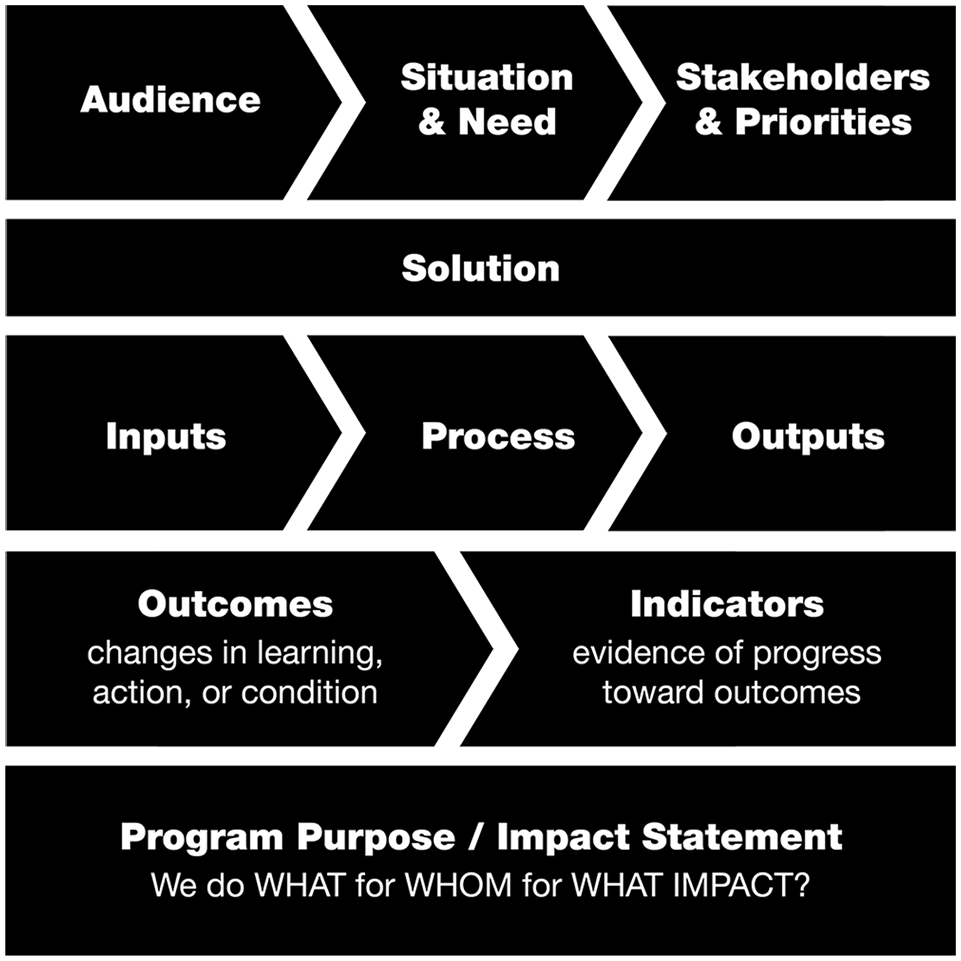
Anatomy of a logic model, adapted from the Shaping Outcomes initiative of the Institute of Museum and Library Services. Courtesy of the author (August 2020).
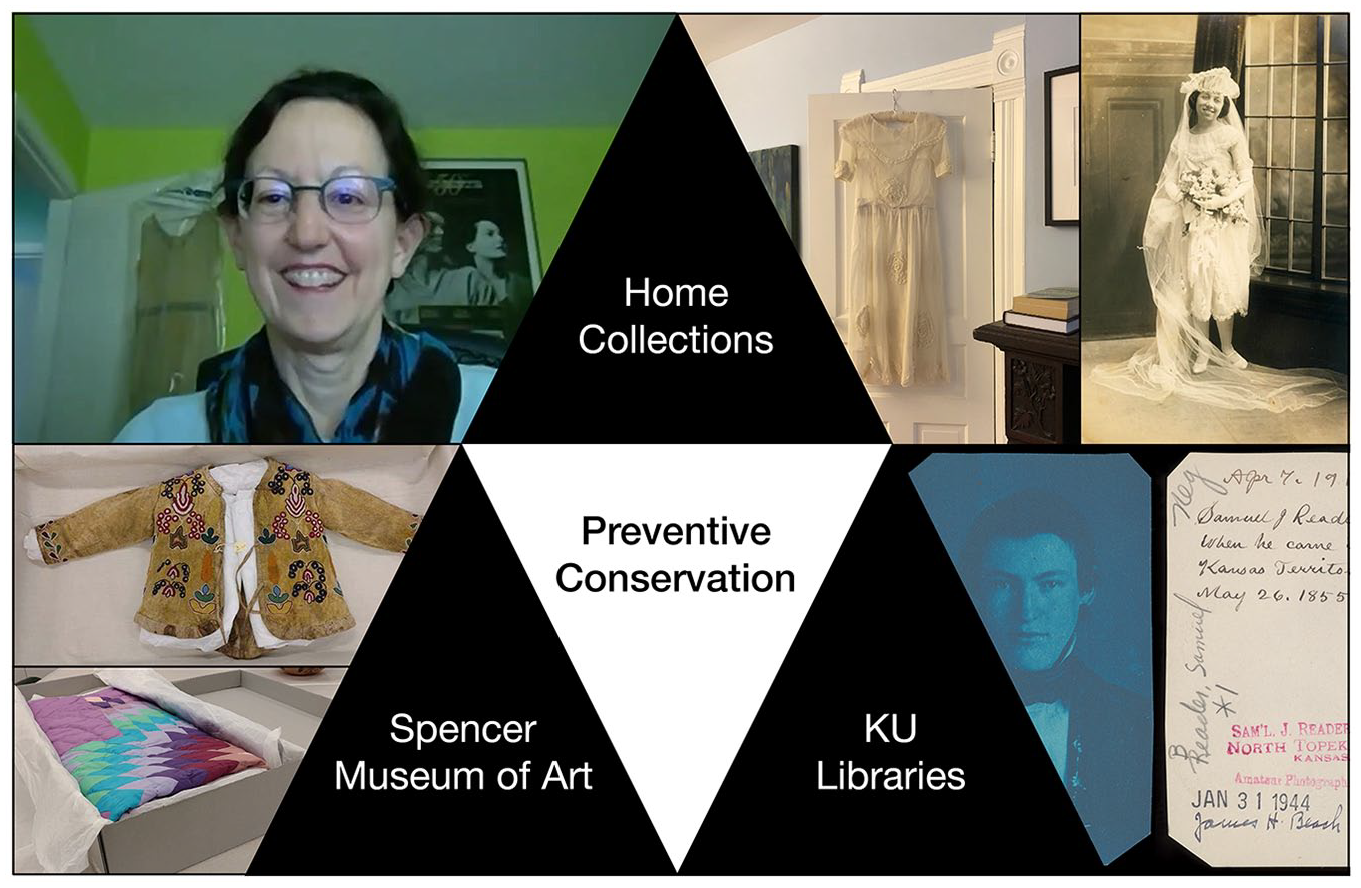
“A Curiosity of Cabinets: Collections Care at Home” triangulated among collections from the Spencer Museum of Art, KU Libraries, and presenter and participant homes, and around preventive conservation principles. Courtesy of Spencer Museum of Art and KU Libraries (August 2020).
Impacts are the enduring changes resulting from combined outcomes, but they are often temporally distant from the program and depend on a confluence of conditions beyond its control. We discuss below, from the authors’ respective expertise in conservation and public practice, how data, observations, and feedback suggest a trajectory toward impact, as well as the capacity—and limitations—for this program as a reciprocal act of community care.
Content Creation
We set an aggressive timeline of three, thirty-minute sessions in one month using Zoom. Each session featured two experts and a host and focused on specific materials: art on paper and photographs, textiles, and books and archival materials. We prioritized practical concepts in preventive care, making the distinction between “interventive” actions, such as repairs—often best left to a trained conservator—versus preventive actions. The Ten Agents of Deterioration, a list of the primary threats to cultural heritage objects, is foundational in guiding risk-management strategies used by collection care professionals. 2 We discussed a few key Agents in each session, addressing the risk level and mitigation practices for those materials. Participants received a resource handout with session takeaways, a list of online retailers for recommended supplies, and a bibliography for continued learning.
We personalized each session with examples from our homes, presented alongside institutional examples. One presenter shared a framed photograph mailed to her by her sister to inspect for “condition issues” which had a sonogram hidden in the back announcing her sister’s pregnancy (Figure 3). This, in combination with a cyanotype of Samuel J. Reader (1855) from KU’s Kenneth Spencer Research Library, set up a discussion about proper storage enclosures. The location of another presenter’s artwork hanging in a windowless hallway and SMA’s impression of “The Great Wave off Kanagawa” (circa 1829–1833) by Katsushika Hokusai demonstrated the importance of mitigating light exposure.
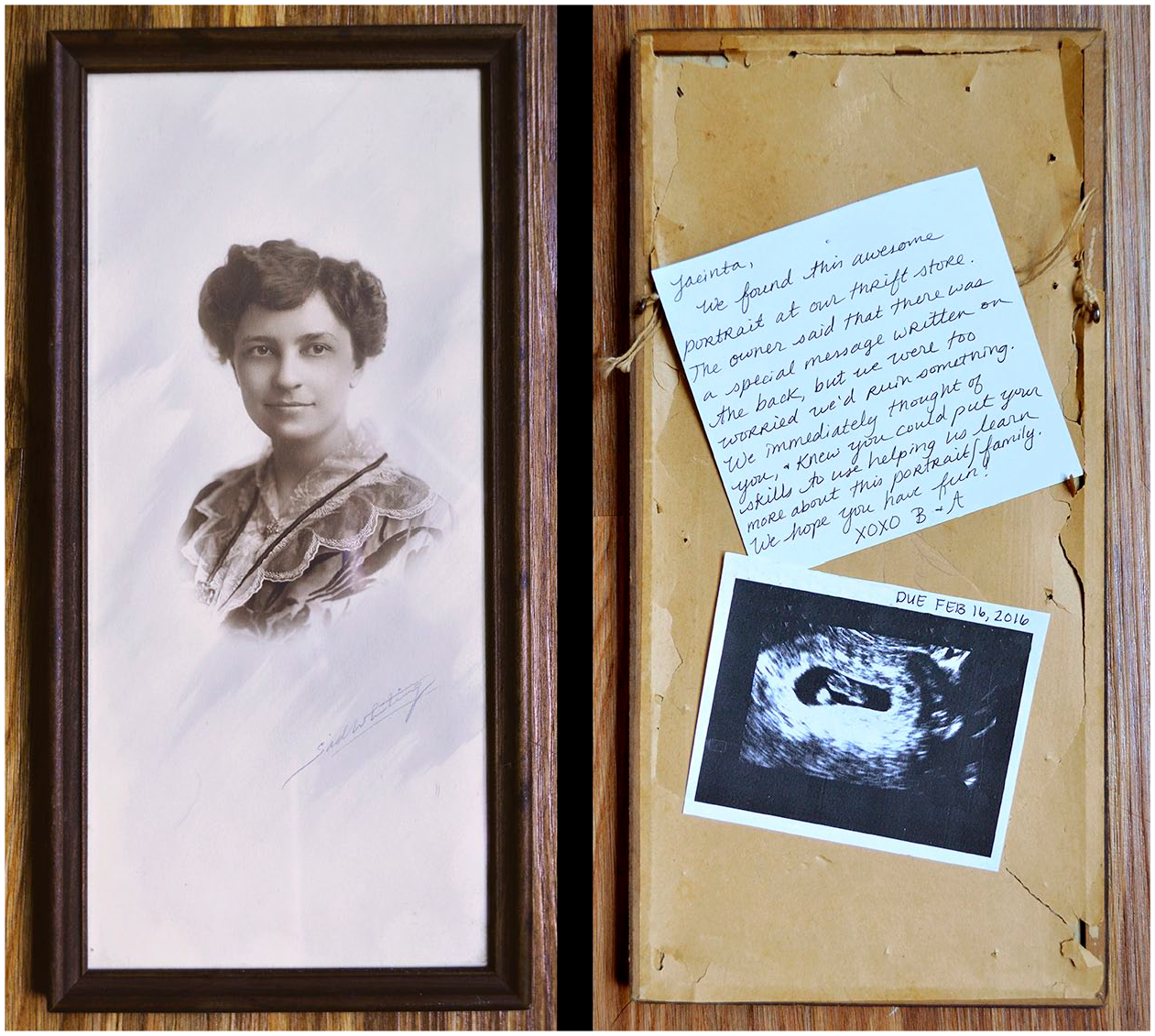
One presenter, a conservator, shared how her sister used a framed photograph as a decoy to announce her pregnancy, hiding the sonogram in the back of the frame and asking her sister to inspect it for condition issues. Courtesy of the author (August 2020).
In the textiles session, another presenter shared her great-grandmother’s wedding dress that was recently passed down to her. Images of KU Libraries and SMA textile storage illustrated best practices that can be scaled to a home environment. We demonstrated how a padded hanger can be made at home using a few basic materials and how certain textiles like quilts or antique clothing may be folded in a box and supported with tissue “snakes.” In the session about the care of bound materials, presenters showed off their childhood “diaries across the decades” and scrapbook examples from KU Libraries to help illustrate informational versus artifactual value.
While we initially envisioned informal conversations, lighting and computer camera quality made sharing nuanced details about storage and housing strategies difficult. We opted instead to use slides but began with all participants on-screen to mimic “arriving” to a physical space. The chat was monitored by the host and questions were posed throughout to maintain a conversational approach. We provided closed captioning and shared technical jargon in advance to ensure accurate captions.
As we became more Zoom-proficient, we enhanced the interactive experience. Inspired by a Preservation Week webinar from the University of Illinois at Urbana-Champaign, 3 the host introduced each presenter using childhood photographs that featured the materials of that session and concluded with a “guess who” game at the end. We used Zoom’s polling function to learn what kinds of textiles and paper materials people owned to emphasize certain points throughout the presentations and another to gauge interest in future programming topics (Figure 4). Our uncertainty surrounding audience participation and comfort with the platform was assuaged by the enthusiasm for sharing, active chat, and question and answer sessions, so we extended the other two sessions to sixty minutes. The extra time allowed for more content, but the goal was to give participants more time to share objects, shape the conversation, and build community.
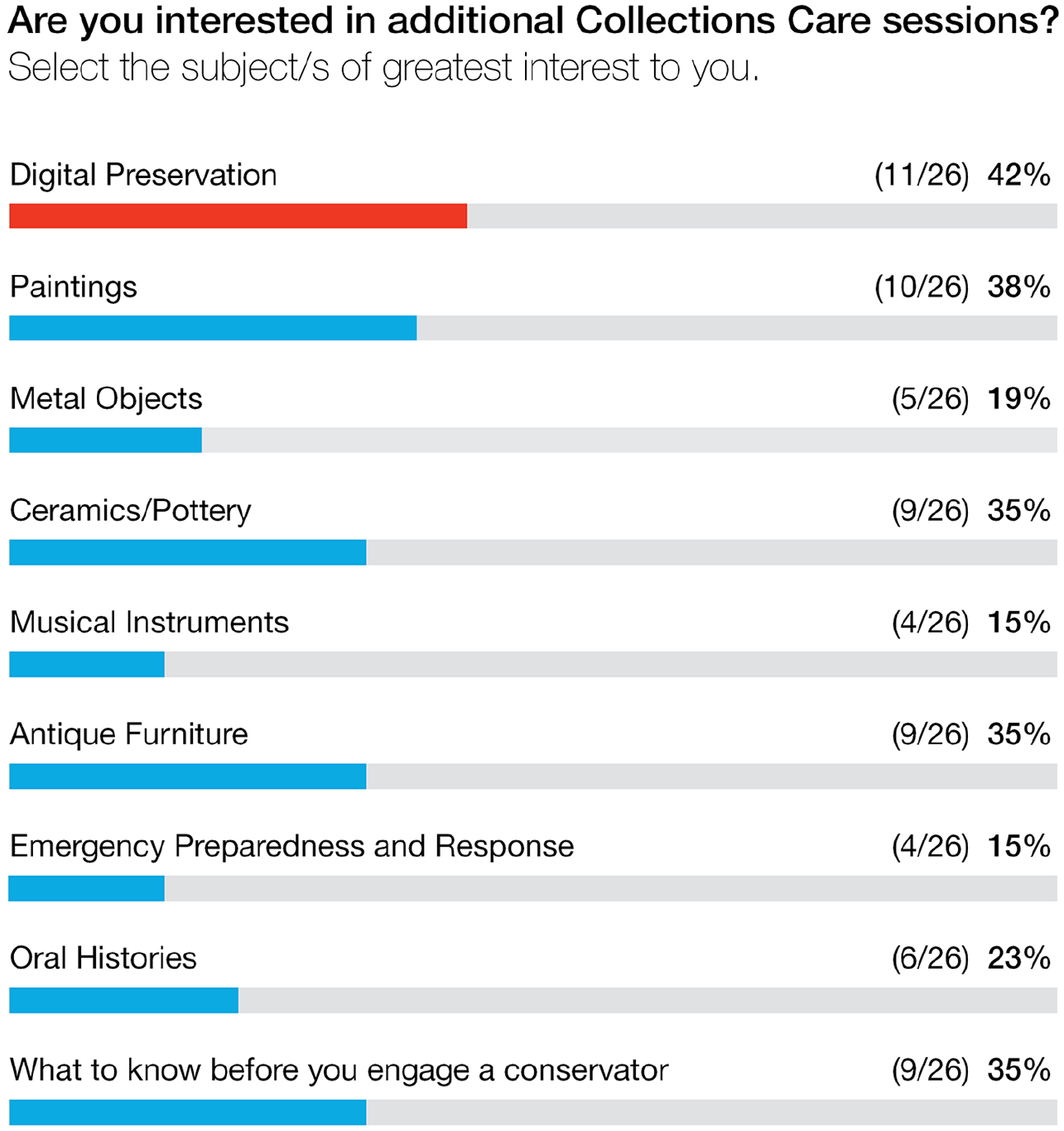
Poll from the third session to gauge interest in and priorities for future session topics. Courtesy of the author (August 2020).
A Personal Learning Process
The circumstances of this project brought together perspectives from conservation, programming, and development staff. We scheduled two rehearsals before each session to test flow and technology, and to vet the content for a general but highly invested audience. This allowed for feedback about areas that needed emphasis, repetition of key concepts, clarification of jargon, and increased interactivity. The key principles of andragogy, or “the art and science of teaching adults,” combined with museum education theories 4 and new research on virtual visits for older adults helped us transform complex conditions into a supportive learning environment.
Recognizing learners as self-directed and autonomous, and teachers as facilitators, adult educator Malcolm Knowles’s foundational assumptions of andragogy propose that adults (1) need to know why they need to learn something, (2) need to learn experientially, (3) approach learning as problem-solving, and (4) learn best when the topic is of immediate value. 5 These principles undergirded a personal learning process 6 in which participants gained an understanding of why preventive conservation matters. Sharing collections stirred their deep wells of experience and the instruction and resources motivated direct action to care for them. By modeling the personal process ourselves, we facilitated an improvisational sharing of and dialogue about participants’ stories and collections quandaries. 7 From that process flowed participants’ Civil War–era letters penned in iron gall ink, heirloom quilts, Navajo rugs, a flapper-era dress, a family tree, and rare books, revealing the kinds of collections that matter to our members.
The screen is both a barrier for those without access to or difficulty with technology and a portal to overcome physical barriers to our resources. With little research available on Interactive Virtual Learning (IVL) for older museum audiences, the Cleveland Museum of Art’s 2018–2019 study 8 on the subject helped us prioritize a warm and conversational style that encouraged participation; a blend of rich content, demonstrations, and open-ended discussion; and testing of and support for technology. Mixing up and moving between dialogue and slides added dimension and helped combat the dehumanizing effect of the screen.
The Limitations of Care
Delivering programming over the course of a month in “pandemic time” seemed at once like a flash and an eternity. In Kansas, where COVID-19 cases were only just emerging, the pandemic remained largely abstract for many in our area. However, the outcry over George Floyd’s death under the knee of a police officer that erupted on the eve of our third program, and the culture of white supremacy, systemic racism, and police brutality that were thrown into high relief that weekend were both global and local. What did it mean to deliver this program the following morning? How could we meaningfully respond and engage, personally and professionally? We considered availability and relevance of alternate campus collection examples or canceling the program before deciding to proceed as planned.
Our institutions prepared a statement reaffirming the responsibility of SMA and KU Libraries to address systemic racism and expressing solidarity with Black Lives Matter. As white women speaking to a largely white audience, we grappled with the legacies of colonialism and systems of oppression right in front of us, and in which we are entrenched and complicit. We understood that statements and action plans were just the beginning of a long and difficult road toward real equity. While asserting that “we care for collections, and we care for one another,” we questioned what that care really meant and to whom. We held, if unassuredly, to our conviction that collections can be a “constant” in times of distress and a testament to our shared humanity; that museums and libraries can mutually exist as places of respite and arenas for community dialogue and advocacy. 9 But how can that equilibrium be achieved in institutions born of exploitation and violence, now under retrenchment? In the context of collections with complicated histories, how can we reconcile our aspirations for care with our limitations for care? While “essential workers” continue to care for our basic needs through this pandemic, we as museum and library professionals echo our case as essential to society, but to do so, we must call out: what is our “essential work?”
Impact and Recalibration
As the pilot series drew to a close, we paused to reflect and to recalibrate our responsibilities and programs in response to our communities’ needs. This work is ongoing.
For “A Curiosity of Cabinets,” registration data, observations, and feedback tied back to our logic model. By requiring registration per KU’s Zoom policy, we observed a pattern of repeat participants and an average of 47 people at each session. Many attended all three, including philanthropic donors, community members, artists, current and retired faculty and administrators, and docents, as well as some Friends who were not regular attendees of in-person events. The series produced a community of learners, and, as a form of rapid prototyping, it enabled us to test new ideas, refine them quickly, and incorporate them into the next session.
10
The risks were low and the opportunities for cultivating a culture that values collections care were high as reflected in feedback from attendees:
Thank you for another wonderful Curiosity of Cabinets program! I appreciated the chance to show you my flapper dress. My grandmother would've worn it in the 1920s, as a teenager. . .The dress was in one of two closets that survived when my apartment in Omaha was burned down. . .Today's session inspired me to take better care of her things. Or use some of them, as she did, though I don't think I could pull off the flapper dress! It was lovely to spend an hour with all of you and learn about preserving personal treasures just as the world is changing so dramatically.
A sense of community care amongst the organizers developed as well. Instead of packing our bags (for one presenter, a trip to visit family, for another, her wedding and honeymoon), we found ourselves unpacking our own collections and seeking connections to loved ones through them. Sharing with one another became a morale-boosting exercise, suggesting that nurturing relationships among staff and our Friends groups through this program advanced both the concept of collections care across the University and the outreach goals of the Mellon Initiative.
As we work to evolve “A Curiosity of Cabinets” and redefine the scope of our “essential work,” we strive to bring the two into better alignment by broadening the program’s reach and pool of experts, and thus its capacity for care.
Footnotes
Acknowledgements
The authors wish to thank SMA and KU Libraries’ colleagues: Saralyn Reece Hardy, Kevin Smith, Whitney Baker, Sofía Galarza Liu, Angela Watts, Alexis Fekete-Shukla, Brittany Nanney, Celka Straughn, Christy McWard, Leah Hallstrom, Elizabeth Kanost, and Ryan Waggoner, for their critical contributions and spirit of generosity, and the Andrew W. Mellon Foundation for enabling this collaboration.
Declaration of Conflicting Interests
The author(s) declared no potential conflicts of interest with respect to the research, authorship, and/or publication of this article.
Funding
The author(s) disclosed receipt of the following financial support for the research, authorship, and/or publication of this article: The research and programming presented in this article is made possible through a generous grant from the Andrew W. Mellon Foundation.
1.
Institute of Museum and Library Services. “IMLS Shaping Outcomes and Logic Model.” n.d., available at:  (accessed 15 August 2020).
2.
Stefan W. Michalski, “An Overall Framework for Preventive Conservation and Remedial Conservation.” ICOM Committee for Conservation, 9th Triennial Meeting, Dresden, German Democratic Republic, 26–31 August (1990): 589–591.
3.
Jennifer Hain Teper, “Preserving Your Family Heirlooms.” University of Illinois at Urbana-Champaign. Webinar, 2020, available at: (accessed 30 April 2020).
4.
Kimberly H. McCray, “Gallery Educators as Adult Learners: The Active Application of Adult Learning Theory,” Journal of Museum Education, 41, no. 1 (2016): 10–21. .
5.
Innovative Learning Services, “Andragogy (Malcolm Knowles),” 2020, available at: (Accessed 15 August 2020).
6.
Kimberly H. McCray, “Gallery Educators as Adult Learners,” 15–6.
7.
8.
Dale Hilton, Arielle Levine, and Janet Zanetis, “Don’t Lose the Connection: Virtual Visits for Older Adults”, Journal of Museum Education, 44, no. 3 (2019): 253–63. .
9.
Yesomi Umolu, “On the Limits of Care and Knowledge: 15 Points Museums Must Understand to Dismantle Structural Injustice,” Artnet, 2020, available at: (accessed 25 June 2020).
10.
Charlie Miller, and Emily Tarquin. “Center for the Future of Museums Blog: 5 Steps for Rapid Prototyping,” American Alliance of Museums, 2012, available at: (accessed 19 June 2012).