




Abstract
COVID-19 is a paradigm-shattering development which will have far-ranging effects, many still unforeseen and unanticipated. Community collecting initiatives provide insight and local-level perspectives to momentous events. Examined with other institutions’ holdings, these collecting initiatives illustrate larger trends and allow for a comparative look at reflections and reactions toward historic happenings like the ongoing pandemic. When the virus first spread, rapid-response collection was at the foremost thoughts of many California State University (CSU) archivists. Thankfully, the CSU’s 23 campuses have a robust community of archival practice, called the CSU Archives and Archivists Roundtable (CSUAAR). CSU archivists engaged each other promptly by conversing, collaborating, supporting, and sharing. We will discuss the community of practice at the CSU, highlight how the CSUAAR facilitated projects and developed some shared approaches to collecting efforts, and illustrate three different rapid-response collecting projects developed at the university level (CSU Bakersfield, CSU Northridge, and CSU San Marcos).
Keywords
Introduction
When COVID-19 infections exploded across the Northwestern and Northeastern U.S. in March 2020, it was obvious that the pandemic’s impacts would be far-ranging and paradigm-shifting. California State University (CSU) campuses began closing shortly thereafter; by the end of the month all twenty-three campuses had transferred to a virtual model of instruction and student support.
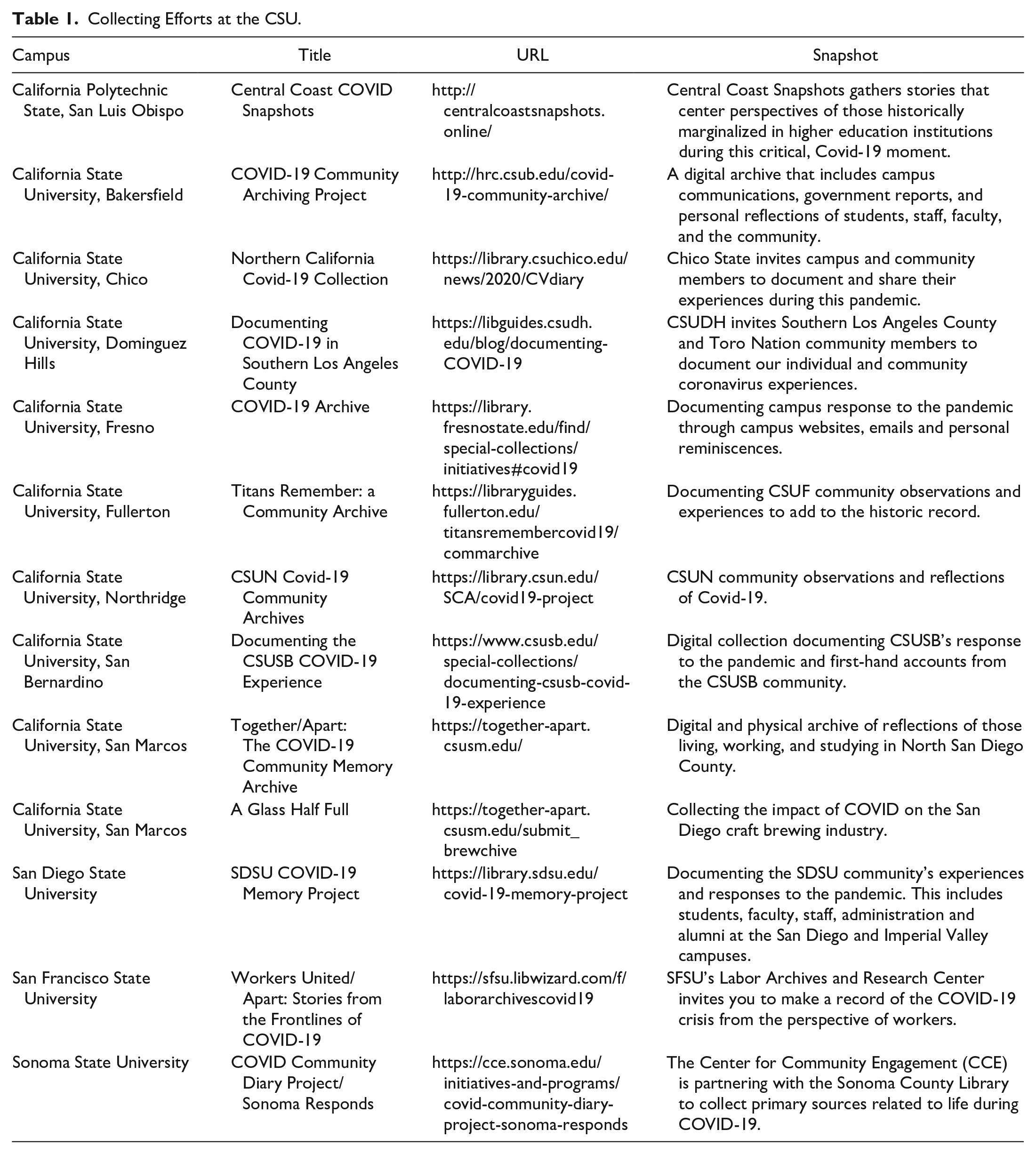
Those first weeks post-closure were breathless and blurred as we adapted to our new reality. Still, as archivists, we understood that these momentous times must be documented and preserved. Thirteen CSU libraries and archives instituted COVID-related collecting projects within weeks. These “rapid-response” 1 collecting initiatives, while differing in implementation across CSU campuses, were guided and influenced by conversations through the CSU Archives and Archivists’ Roundtable.
Shared Approaches
The CSU Archives and Archivists’ Roundtable (CSUAAR) is a community of practice 2 of archivists and librarians from the 23 CSU campus libraries. Normally, the group meets once a month via Zoom. Discussion topics are generated by the group to share information, make announcements, and muddle through issues in a social learning environment. 3 With the move to remote work, the established online network became a vital space to discuss documenting the COVID-19 experience on our campuses and in our communities. Many members were not familiar with rapid-response collecting, so the CSUAAR became a place to share and learn together. Due to the dynamic and urgent nature of the pandemic, members began meeting more frequently, twice a month. Discussions during this time ranged from capturing social media, campus news and emails, websites and ties to existing pandemic collections–AIDS/HIV and 1918 Spanish flu. Members also shared how they designed their projects, conducted outreach, connected with faculty to incorporate projects into classes, and linked to existing oral history programs. A Google doc was created for members to contribute their own efforts and document other rapid-response projects happening around the nation. Additionally, between meetings the CSU libraries Slack channel and CSU Special Collections listserv became places for asynchronous sharing (Figure 1).
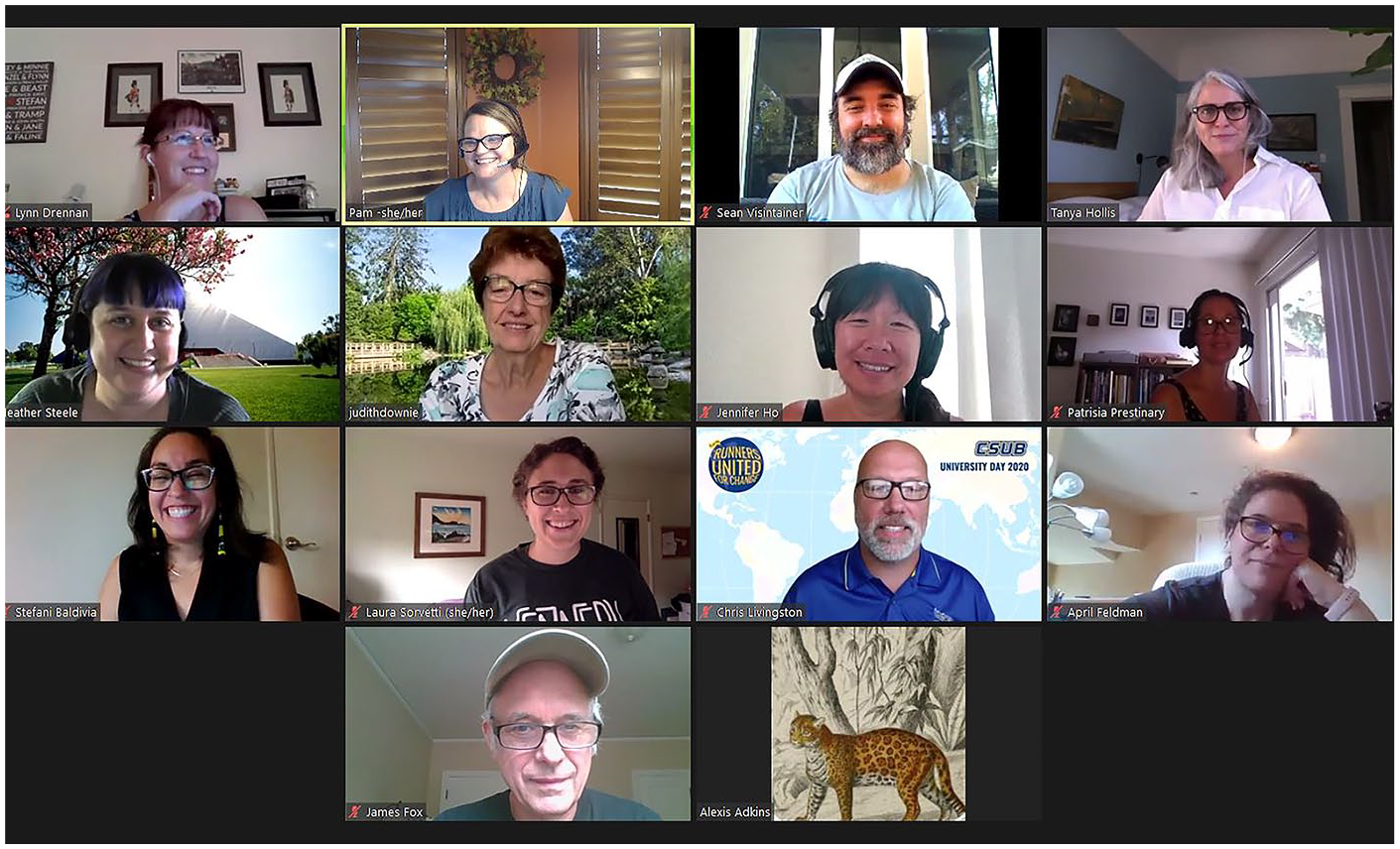
Members of the CSUAAR meet on August 18th, 2020.
The social learning environment of the CSUAAR assisted archivists with resolving many COVID collecting-related issues, providing tangible benefits. Since the CSU rapid-response collecting efforts are designed to collect community responses to an ongoing pandemic, there was never any doubt that health information would be collected, and there was concern by archivists about how to notify contributors that their health information may be made public, and how to design donation language in a way that addressed this. CSU archivists designed and shared a simple statement that was inserted into the terms and conditions of some collecting projects to notify contributors and indemnify institutions: “Please note that health information is private. By submitting, the Contributor agrees to make any health information disclosed in the contribution public.” Another concern raised in discussion centered around the role of Institutional Review Boards (IRB) 4 in the oversight of collecting projects. Although IRB oversight can differ by institution, activities related to “oral history, journalism, biography, literary criticism, legal research, and historical scholarship” are generally exempt from IRB oversight (Electronic Code of Federal Regulations 2018). San Diego State University adopted language to this effect and shared that language with other members of the CSUAAR, which was embraced in other collecting initiatives. In other instances, entire terms and conditions were shared, which assisted the CSUs with the analysis, discussion, and design of their own community participation terms.
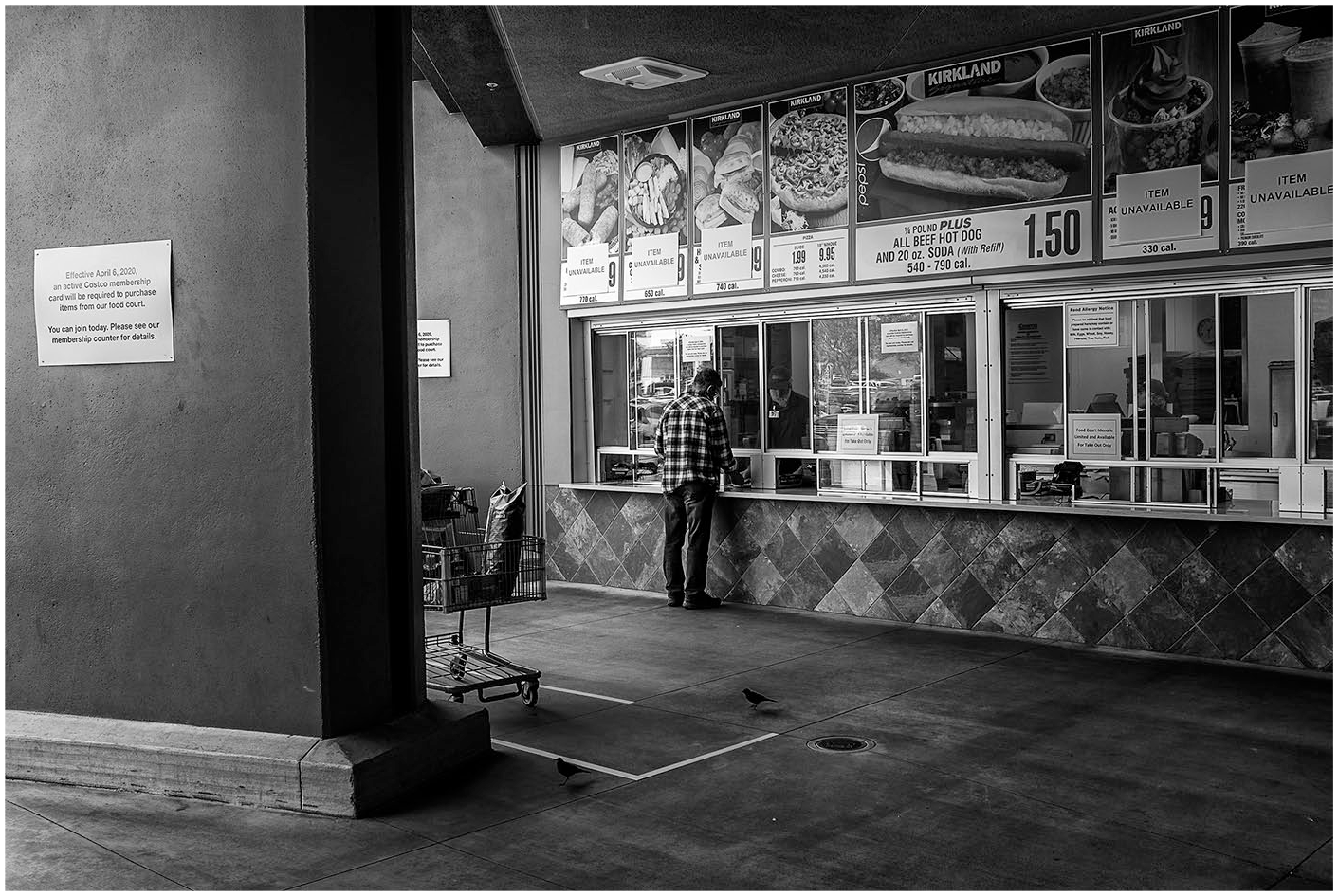
Lone individual ordering at a food court with most items unavailable. Photograph by James D. Phenicie, courtesy of Together/Apart: The COVID-19 Community Memory Archive at the California State University, San Marcos University Library, Special Collections Department.
Divergent Implementations
California is a vast state, and the CSU system is the largest four-year public university in the U.S.A, educating 482,000 students and employing 53,000 people during 2020 (California State University 2020, 3). By necessity, the collecting initiatives undertaken by the thirteen campuses across the state would look different as determined by the needs of each campus and the missions of their libraries. Three rapid-response collecting efforts are documented in more detail below.
CSU Bakersfield
The Historical Research Center (HRC; http://hrc.csub.edu/aboutus/) at CSU Bakersfield (CSUB) serves as the repository for university and regional archives, and is deeply embedded into the History Department’s public history emphasis, where we teach courses in archives and special collections and oral history methodology. When the quarantine began, the oral history methodology course was in progress. After the transition to online instruction, we noticed some students were having difficulty with the new reality. To focus their anxiety, students could, for extra-credit, record a video diary lasting between five and thirty minutes utilizing a simple question prompt: How has the COVID-19 crisis impacted your life as a CSUB student? Sixteen out of thirty students participated.
The video diaries were a springboard for CSUB’s COVID-19 archive. Because of the quarantine, all materials are collected in digital format. This collection includes video diaries, city and county council meeting minutes, WHO situation reports, CDC reports and statistics, local newspaper accounts, campus communications and training modules, and photographs. As of this publication, we have collected 7.3 gigabytes of digital information.
Another component of this project is community participation. To facilitate this, we created a webpage (http://hrc.csub.edu/covid-19-community-archive/) where CSUB students, staff, faculty, or community members can submit written or video recorded reflections of the pandemic. Unfortunately, there has been limited participation. The primary concern is getting the off-campus community to participate. To mitigate the lack of participation, social media messages are regularly posted.
Another challenge has been arrangement and description of material as it is collected. While our intentions were to have the content available as we collected it, we found there are delays in preparing the material for access. All digital files are made ADA compliant and redundancies are created. After this work is complete the materials are uploaded to the public space for access.
While it is too early to assess the long-term impact of this project, the material that has been collected to date represents a variety of aspects and perspectives about the pandemic. Looking forward, we plan to make our workflows more efficient. To assist in processing materials, we will utilize students that are enrolled in the public history practicum next academic year. This provides a service-learning component with the purpose of “enhance[ing] students’ academic and civic learning” that enables them to explore civic responsibility (Lim and Bloomquist 2014/2015, 196). Lastly, to boost student participation, we have reached out to the history department and they have agreed to offer students extra-credit to share their stories.
CSU Northridge
Shortly after we began telecommuting in mid-March, CSU Northridge (CSUN) Special Collections & Archives began discussing a community-based COVID-19 project. We were anxious to document these events as they occurred, to collect in the now. The immediacy of COVID led us from our first conversation to our first submission in approximately three weeks.
First, we defined our scope. Several institutions are collecting COVID stories in our area so we decided to focus on our campus community, particularly students—but also faculty, staff, and alumni. Our goal is to collect personal stories and impressions, including diaries/journal entries, short video or audio clips, 2-dimensional art, and other forms of personal expression with the hope of engaging our community and documenting its response to COVID-19 and its concomitant safer-at-home orders.
Next, we addressed logistical and legal challenges associated with collecting predominately digital material on short notice; creating web content; a digital submission form and accompanying legal statements—and obtaining approval for these statements from library administration. After this work was completed all components were turned over to our web development team.
Our greatest challenge has been soliciting submission and obtaining buy-in from the community. While we want to grow the collection as much as possible, we also want to be mindful that we are asking our community to share personal trauma. Several professors adjusted assignments late in the Spring semester to address COVID-19 and informed students of our effort. The majority of our submissions have come in this way. Expectations are that this will persist as we continue to reach out to teaching faculty. We are also collaborating with members of the Freshman Orientation faculty to accept submissions of student community service learning projects, likely oral histories, in the Fall. To date, CSUN’s teaching faculty continue to be the project’s greatest advocates.
During initial planning, decisions regarding curation and delivery were postponed. This was based on several factors, chief among them the overall uncertainty of the crisis. Another factor was our emerging work-from-home reality, creating significant shifts in projects and workflows, as well as logistical difficulties in virtual project planning and implementation across library units on such short notice. Though we currently have no specific workflow for curation and delivery, we have agreed in principle that the creation of a digital collection is the most appropriate delivery method for our current users.
The crisis has no end date and therefore neither does our project. Further, recovery plans, repopulation of campus, and other adjustments to the evolution of whatever the new normal might be will also be of interest, “as a disaster appears to have different impacts when viewed soon after as opposed to years, decades, or centuries later” (Rettig 2019, 10).
CSU San Marcos
At CSU San Marcos (CSUSM), our rapid-response collecting effort, Together/Apart: The COVID-19 Community Memory Archive, was envisioned as a “community-based participatory archive,” where community members “shape the archival record with documentation of their personal experiences and relationships” (Roeschley and Kim 2019, 28). Our project team’s first decisions defined Together/Apart’s community. We decided to scale the project up and out, starting with our immediate campus community. By the end of April we widened our collecting call to those that live, work, or study in North San Diego County.
Next, we considered questions around what to collect. This was determined by the anticipated end results of the project: Together/Apart would be a research archive, a seed for future exhibitions, and a community engagement project, providing means for our community to reflect and commemorate. Together/Apart would be a predominately digital archive, though we would accept physical donations as well. We should not neglect the value of materials, formats, or content (Rettig 2019, 12). We would collect testimonials, written and visual, but also items of artifactual value for future exhibition purposes. To engender community engagement, reflection, and a space for future commemoration, we would collect ephemera, artwork, and other non-archival materials with community meaning (Sheffield 2017, 360).
The digital portal for participation was built by the Library, keeping sensitive health information in-house and out of the hands of “Big Tech.” There are multiple pathways for collaborators to contribute. Options for participation include uploading digital files, submitting testimonials via a guided questionnaire, and donations of physical items. While the infrastructure was created, the project team also designed terms and conditions, website language, and outreach initiatives.
For Together/Apart, closing the project’s collecting phase will be decided by factors beyond our project team’s control; there is no end date in sight. We are adapting an impact timeline suggested by Rettig (2019, 11) for disaster collecting: impact and response, reflection, reconstruction. We are still in the “impact and response” phase and have to date collaborated with 73 community members who have submitted 293 items. Once our campus reopens, we’ll start a “reflection” collecting phase in earnest, where we will seek oral histories from our community. This phase will also see the creation and publication of a finding aid for the research collection and a companion digital archive. Documenting the reconstruction phase post-COVID will likely go on for years, as new information, artifacts, and opportunities for oral history and community reflection surface (Schwartz et al. 2018, 106).
Conclusion
At the time of writing, the pandemic courses through the U.S. Barring a few exceptions, CSU instruction and support services will be virtual through spring of 2021, perhaps longer. The road to recovery and normalcy will be winding. Additionally, the murder of George Floyd has brought forth another societal paradigm shift, as Americans grapple again with issues of race, policing, and structural racism. Still reeling from the pandemic, the archivists of the CSUAAR are now also engaged in conversation and sharing about how to collect and preserve this second major moment of 2020. It has, frankly, been a lot to take on. And yet, the discussion has never centered on whether or not to collect, but rather questions of how, and when, and what. For clarifying these questions, the robust community of practice that is the CSUAAR has been invaluable, and for our colleagues across the CSU, we are abidingly grateful.
Collecting Efforts at the CSU.
Footnotes
Declaration of Conflicting Interests
The author(s) declared no potential conflicts of interest with respect to the research, authorship, and/or publication of this article.
Funding
The author(s) received no financial support for the research, authorship, and/or publication of this article.
