




Abstract
Applications supporting various multimedia data in wireless multimedia sensor networks (WMSNs) have specific QoS requirements on bandwidth, delay, and/or packet loss. Perception of applications' QoS requirements and detection of link states are indispensable for the design of QoS-aware routing mechanism. Software defined networking (SDN) is suitable for the purpose since it provides visibility of network resources and programmable interfaces. OpenFlow is the most recognized realization of SDN. We propose a QoS-aware routing mechanism for OpenFlow-enabled WMSNs. The mechanism consists of a framework and routing algorithms on SDN controller. The framework includes two functions: detection of link states among OpenFlow-enabled nodes and determination of flow's QoS requirements. The routing algorithms are achieved in two steps. First, the SDN controller seeks the feasible paths that satisfy QoS requirements of a flow. If there is no path which satisfies the required QoS, the path will be decided by the proposed algorithms depending on flow types: delay-sensitive, bandwidth-sensitive, and best-effort traffic. We conducted experiments on a SDN testbed to evaluate our mechanism and compared the results with conventional routing protocols. The results show that proposed routing mechanism increases the throughput by 43% for video data and reduces the delay by more than 30% for audio data.
1. Introduction
Recent advances in cost-efficient hardware technology have set new stage for the deployment of wireless sensor networks (WSNs) with powerful sensor nodes in reasonable cost. The paradigm is changing from scalar services (temperature, humidity, etc.) to real-time multimedia applications (video, audio, imaging, etc.). Examples of such wireless multimedia sensor network (WMSN) [1] applications include target tracking, environmental video/imaging surveillance, telemedicine, video vehicle detection, and battlefield intelligence [2–5].
Real-time multimedia applications usually require QoS assurances on bandwidth or delay but are tolerant to packet loss, unlike reliability requirement of scalar sensor data. High bandwidth and low delay requirements are major challenges for WMSNs and efficient QoS routing mechanisms are urgently needed to realize envisioned multimedia applications. Many QoS routing mechanisms and protocols [1] are proposed on optimizing network resource utilization, avoiding traffic congestion, and balancing network traffic. Most of them focus on calculating the optimal path with best network conditions without considering QoS requirements of applications. An application may consist of various types of flows, such as video, voice, text, and sensing data. Path decision could be made for each flow according to its QoS requirements and network conditions, which is conducive to network resource orchestration and QoS guarantee.
Software defined networking (SDN) [6] paradigm seems to be promising to present better network resource management, traffic control, and application classification in order to design an efficient QoS-aware routing mechanism. SDN separates the network into data plane and control plane and introduces centralized controllers to abstract control functions for the network. Programmable APIs in SDN controllers (Floodlight, OpenDaylight, Ryu, etc.) [7] are especially suitable to realize QoS-aware routing. As the most recognized realization of SDN, OpenFlow [8] has many in-built functions such as traffic statistics collection, access control, and network configuration. Some explorations on fusion of SDN and WSN have been carried out, such as Flow Sensor [9], Sensor OpenFlow [10], and Software Defined Wireless Network (SDWN) [11]. There are still many issues that need to be addressed, such as sensor network topology discovery, efficient self-organized routing mechanism, and network resource management.
In this paper, we propose a routing mechanism for WMSNs based on SDN technology. In the network architecture, OpenFlow-enabled nodes (OFNs) act as cluster headers, maintain connections with neighbor OFNs, and forward packets on behalf of sensor nodes. The mechanism consists of QoS-aware routing framework and algorithms. The framework is constructed at the application layer of SDN controller with five components cooperated to achieve the proposed mechanism.
The rest of this paper is organized as follows. In Section 2, we discuss related studies on QoS routing in WSNs as well as the exploration of SDN in WSNs. In Section 3, we propose a QoS-aware routing mechanism with algorithms in detail. In Section 4, we evaluate the performance of our mechanism with experimental results. Finally, we summarize our experimental results and point out the future research directions in Section 5.
2. Related Works
QoS routing mechanisms in WSNs employ QoS metric-based path decisions. For multimedia data transmission, bandwidth, delay, packet loss, and energy efficiency are usually taken as the major concern in QoS metrics. Collaborative QoS Routing (CQR) [12] was proposed to achieve efficient bandwidth utilization for real-time flows. Based on Reliable Energy Efficient routing Protocol (REEP) [13], Multimedia REEP (MREEP) [14] was designed as constraint-based routing for real-time and non-real-time traffic. Extended from SPEED [15], Power Adaptive SPEED (PASPEED) protocol [16] achieves energy efficiency by satisfying application-specific delay with minimum transmission cost. PASPEED selects the most energy efficient node among possible next-hop nodes to provide the demanded delivery speed. For nodes with multiple network interfaces, if network capability cannot fulfill on-going flow's QoS requirements, the node can use other interfaces to transmit data for better QoS assurances [17].
Many QoS routing mechanisms have been presented for cluster-based WSNs. Cluster-Based Real-Time Protocol (CBRP-L) [18] combined LEACH [19] and CBRP [20], which discards high delay links and running LEACH to form clusters. The complexity of CBRP-L on uneven grid-based clustering and header selection algorithms result in excessive power consumption. Cluster-based ASARC [21] actuated multimedia sensors to maximize event information and minimize the level of redundancy. Some mechanisms focused on suppression of message flooding and data aggregation to reserve network resource. GRMR [22] proposed a data centric routing mechanism including efficient regional multicast tree construction and data aggregation at the border node to offer QoS assurances.
Some explorations have been conducted in the area of extending SDN to WSNs. Sensor OpenFlow [10] proposed a Software-Defined WSN architecture and tried to address some key challenges, such as flow creation, in-networking processing, and backward and peer compatibility. A novel SDN-based WSN architecture was introduced in [23], where master node acts as the SDN controller and center nodes are OFNs. Center nodes request master node for the route of the first received packet of a flow. Then the master node calculates the route based on network topology and network conditions. SDWN [11] was presented as an extension of WSN, including the main idea, on-going researches, and open issues. OpenRoads [24] envisions a world where users can move freely among SDWNs.
Although above literatures have better performance in some specific scenarios than compared mechanisms, they are still suffering from some shortcomings. Conventional QoS routing mechanisms mostly attempt to select the path with best network conditions without considering the flow's QoS requirements. For cluster-based QoS routing mechanisms, the election of cluster header and clustering process are energy consuming. SDN-enabled routing mechanisms currently are still the initial step and far from completion. This paper focuses on the satisfaction of flow's QoS requirements, in order to guarantee the QoS of data delivery in resource-constrained OpenFlow-enabled WMSNs.
3. QoS-Aware Routing in OpenFlow-Enabled WMSNs
In WSNs, data is transmitted through multihop nodes to destination commonly. Some of the intermediate nodes are powerful enough to endow with important roles, such as clustering and data aggregation. In this paper, we assume that some intermediate nodes are OpenFlow-enabled nodes (OFNs). Each OFN maintains a control interface and several flow tables as defined in OpenFlow protocol [8]. Control interface is responsible for OpenFlow message exchange with SDN controller. Flow tables store flow-oriented forwarding rules issued by controller. Controller is the core network component, which maintains a centralized control plane to manage all OFNs of the network. We present a QoS-aware routing mechanism for OpenFlow-enabled WMSNs, including routing framework and flow-based QoS-aware routing algorithms. This mechanism focuses on link selection among OFNs to provide optimal QoS guarantee and network resource utilization.
3.1. Network Structure and Topology Discovery
As illustrated in Figure 1, the multihop sensor network consists of sensor nodes, a sink node at the bottom right corner, OFNs acting as cluster headers, and a SDN controller. Sensor nodes are only aware of the route to its cluster header (OFN). The controller maintains an overlay network among OFNs through multihop connections. All sensor nodes are clustered to their nearest OFN in hop count. Each OFN is elected as a cluster header automatically and maintains connections with adjacent OFNs. All traffic in a cluster is converged to OFNs before being injected to the network. OFNs forward the traffic according to their flow table rules or ask the controller for action. This architecture simplifies access control, network management, and data aggregation.
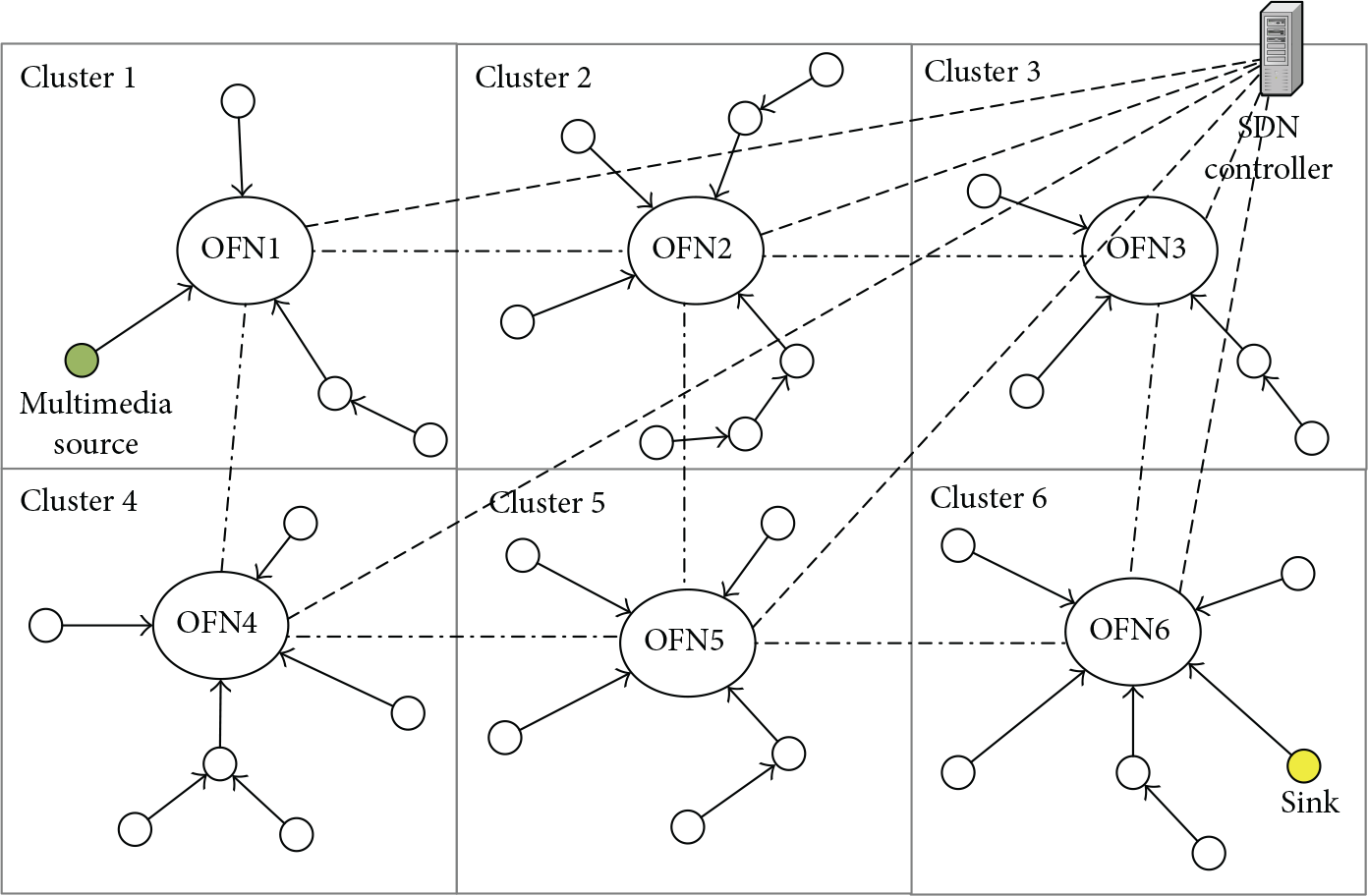
OpenFlow-enabled WMSN structure.
To build the overlay network composed of OFNs, topology discovery should be performed firstly. Link Layer Discovery Protocol (LLDP) [25] is the inherent network topology discovery protocol in OpenFlow, which is a Layer 2 protocol to advertise and receive information from its adjacent OFNs. LLDP was designed for single-hop link discovery between OFNs. It is hard to directly apply LLDP to WSNs since most of the sensor nodes are not OpenFlow-enabled due to resource constraints. For hybrid OpenFlow networks, Broadcast Domain Discovery Protocol (BDDP) [25] was derived from LLDP and had been programmed in some open source controllers, such as Floodlight and OpenDayLight. BDDP has same packet format with LLDP, but destination MAC address is changed from multicast address to broadcast address (ff:ff:ff:ff:ff:ff). Therefore, BDDP messages can be penetrated through OpenFlow indirect links.
The problem is that ad hoc feature of WSN may result in BDDP message diffusing to the whole WSN, which leads to traffic overhead and energy inefficiency. Therefore, it is infeasible to apply BDDP directly for topology discovery in WSNs. To avoid flooding of BDDP messages, we propose gradual topology discovery mechanism. This mechanism limits the relay hops of BDDP messages by managing the Time-to-Live (TTL) field.
In initial phase, controller sends a BDDP message (TTL value = 1) encapsulated in Packet-Out message to all OFNs in the network. After decapsulating the received Packet-Out message, OFNs advertise the BDDP message to their neighbor nodes. The neighbor nodes could be OFNs or conventional sensor nodes. If the neighbor is an OFN, it encapsulates this BDDP message in Packet-In message and sends it to controller. If not, it will notice that the TTL value is 1 and discard the message. After that, the controller gathers all the one-hop links among OFNs. Subsequently, the controller injects a new BDDP message with increased TTL value to the network to find the collection of routes with multihop links among OFNs. This process is completed until all OFNs have at least one route with other OFNs. Not only the shortest route but also multiple routes could be collected between each two OFNs. Finally, the route collection can be used to draw a network graph which includes all the OFNs. Optimal routes with best QoS conditions among OFNs are selected as the edges in the graph. Controller adjusts the graph dynamically according to link events. For example, edges among OFNs can be changed when a link goes down or a new link comes up.
3.2. Routing Framework
SDN architecture [26] consists of three layers: forwarding layer, control layer, and application layer, as shown in Figure 2. The forwarding layer is made up of physical OFNs, which performs data forwarding according to the rules in flow tables. Control layer is responsible for the implementation of routing decision, topology discovery, traffic classification, and network configuration.

SDN architecture for QoS-aware routing mechanism.
The proposed framework, as illustrated in Figure 2, consists of five components: link state detection, flow classification, flow management, QoS-aware routing, and per-flow routing policy. Those components work together based on the information collected from the control layer, such as topology and flow statistics. Link state detection is responsible for detecting up-to-date link states among OFNs, including delay and bandwidth, using traffic monitoring tool sFlow [27] or NetFlow [28]. Flow classification classifies online traffic [29] based on analyzing the flow statistics information using data mining technique, such as K-medoids algorithm [30]. Flow management maintains flows' QoS requirements. QoS-aware routing is in charge of path determination depending on link states and flow's QoS requirements. Finally, routing decision is issued to control layer by per-flow routing policy and distributed to OFNs located on the delivery path.
The routing modeling can be explained as follows. An OpenFlow-enabled WSN can be modeled as a network graph

The utilization rate of a link can be calculated by (2). Here,

The available bandwidth of each path can be computed by

Our mechanism attempts to avoid traffic congestion when new flow is added to the link. Cost of a link is calculated according to link capacity

The optimal path is the one with minimum bandwidth cost presented by sum function of each link cost:

3.3. Flow-Based QoS-Aware Routing Algorithms
The routing algorithms are committed to find the most feasible path for specific QoS requirements. A feasible path is the one that can provide sufficient resource to satisfy all QoS requirements of the flow. For conventional multiconstrained QoS routing algorithms, if there is no path satisfying QoS constraints, the flow would be simply dropped. However, in many scenarios of WMSNs, such as emergence scene monitoring, it is helpful to receive real-time multimedia data as much as possible regardless of packet loss rate. Therefore, in the case of the fact that feasible path cannot be found, the proposed algorithms give the flow an optimal path which provides best effort on QoS satisfaction.
The algorithm is divided into two steps. The first step is to find feasible paths which can assure flow's QoS requirements, while the second step is to find a best-effort path when feasible path does not exist. If feasible paths exist, one of the paths will be selected to transmit the flow. In the situation of multimedia data transmission, it could be difficult to find a feasible path in resource-constraint sensor networks. If feasible path does not exist, it means that flow's QoS requirements cannot be guaranteed during data transmission. Then, the routing algorithm is differentiated depending on flow types: bandwidth-sensitive traffic, delay-sensitive traffic, and best-effort traffic. This algorithm is to supply QoS assurances to the flow as much as possible. The detailed procedure is explained in Figure 3.
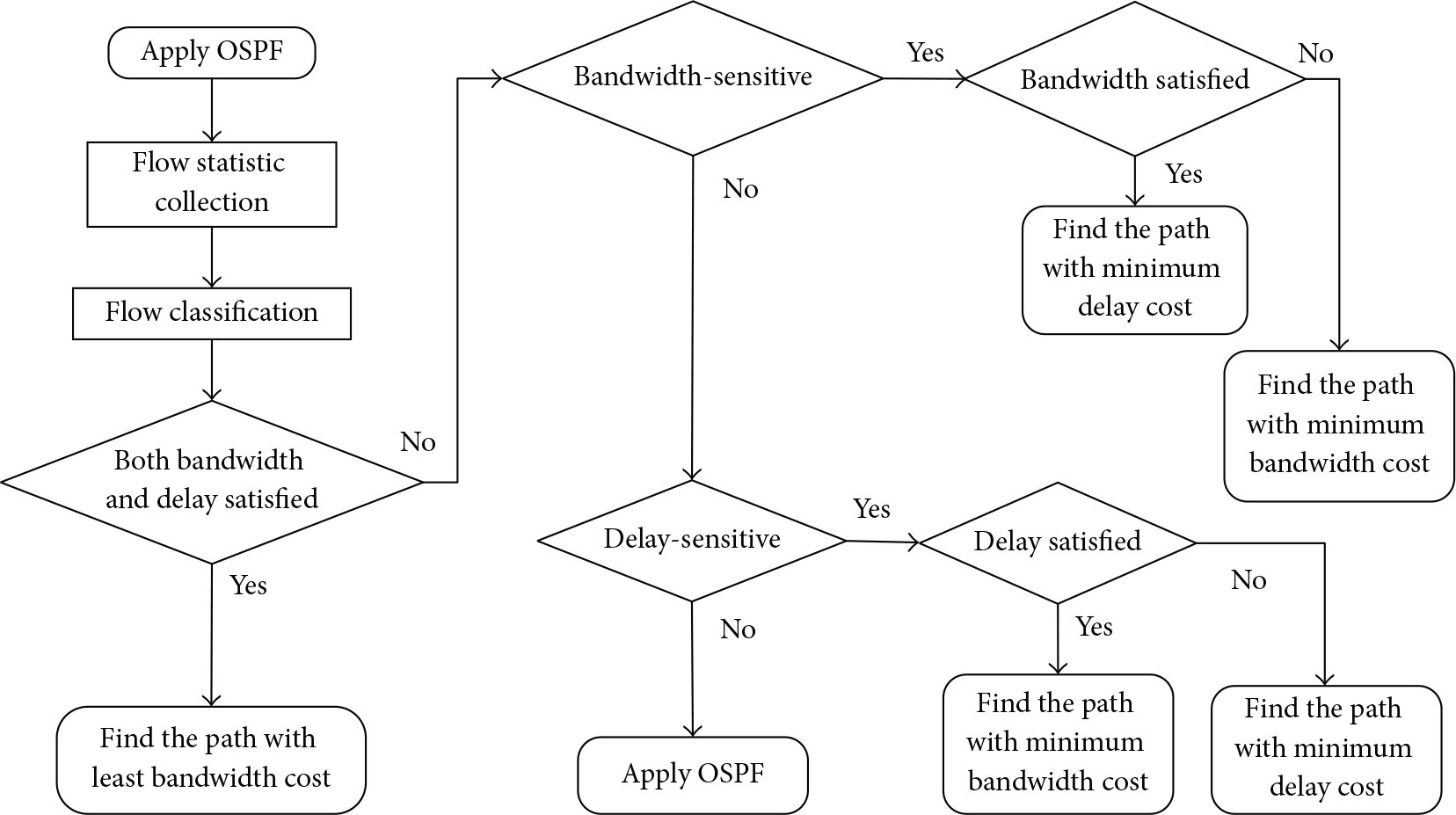
QoS-aware routing algorithm.
Initially, when a packet is received by an OFN, the OFN first checks its flow table entries. If no flow table entry is matched, this packet will be sent to the controller using Packet-Out message. After receiving the Packet-Out message, the controller first applies an OSPF [32] path to the packet and following packets that are affiliated with the same flow. Simultaneously, the controller starts QoS-aware routing mechanism by collecting statistics information of the flow for a short period. Applying the flow classification mechanism, controller can classify the flow to a specific type, such as real-time video/audio/imaging, common data retrieval, or scalar sensor data. QoS requirements of each flow type are predefined to the controller following ITU standard definition [29]. Then, controller builds a table for the flow with six tuple pieces of information {flow ID, {src, dst}, flow type, required bandwidth, required delay, and flag} as shown in Table 1. Flow ID is used to represent the flow from same application with same QoS requirements. {src, dst} pair denotes the connection from source to destination. Flow type is obtained after flow classification as the basis to specify the QoS requirements. Flow's QoS requirements are the predefined values for each flow type. Flag is set to identify whether the flow is bandwidth-sensitive, delay-sensitive, or best-effort traffic. Best-effort traffic is the flows that prefer higher bandwidth and delay tolerant, such as data backup from source to data storage (like FTP).
Flow classification.

To find an optimal QoS path, the two steps of the routing algorithm are elaborated as follows.
Step 1 (finding a feasible path satisfying QoS requirements of the flow).
Feasible paths should satisfy flow's bandwidth and delay constraints. Result of (5) gives the bandwidth cost of each path for each flow. Pseudocode is shown as Algorithm 1. The path that can satisfy flow's bandwidth and delay and has the lowest cost is selected as the optimal path.
If there is no feasible path found, the routing algorithm will go to Step 2 to find a best-effort path on QoS satisfaction.
given a session pair
Loop
for ( if ( if ( end Loop
Step 2 (finding an optimal path when no feasible path exists).
Due to the instability and the resource restriction of WSNs, more attentions should be paid to the case that no path satisfies the flow's QoS requirements. In this case, the algorithm is divided into three cases depending on the categories of the flow: bandwidth sensitive, delay sensitive, and best effort, in order to supply QoS assurances to the flow as much as possible.
Case 1 (routing algorithm for bandwidth-sensitive flows).
Bandwidth satisfaction is more meaningful than delay for many applications. For instance, bandwidth guarantee for multimedia data retrieval from accident site could provide smooth and high definition video/images. For bandwidth-sensitive flows, priority of bandwidth is much higher than latency. If there are paths satisfying bandwidth requirement while dissatisfying delay requirement, the path with lowest delay cost is selected as the optimal path. Delay cost is defined as hop counts of the path by (6). In this situation, among bandwidth satisfied paths, the one that has smallest hop count is selected. If there is no path that can satisfy bandwidth requirement, the path with largest available bandwidth will be selected. Consider

Algorithm 2 illustrates the path selection process for bandwidth-sensitive flows when no feasible path is found.
given a session pair
Loop
for ( if ( if ( else if ( if ( end Loop
Case 2 (routing algorithm for delay-sensitive flows).
For delay-sensitive flows, delay has more impact on data transmission performance than bandwidth. Therefore, if there are paths satisfying delay requirement but dissatisfying bandwidth requirement, the path with lowest bandwidth cost will be selected as the optimal path. If there is no path satisfying the delay requirement, the path with lowest delay will be selected. The routing process is shown in Algorithm 3.
given a session pair
Loop
For ( if ( if ( else if ( if ( end Loop
Case 3 (routing algorithm for best-effort flows).
Best-effort flows are nondetrimental traffic that is not sensitive to QoS metrics. Typical applications would be peer-to-peer file sharing, historical data retrieval, and data backup. Best-effort flows usually have lowest priority, so that network resource should be allocated to other QoS sensitive applications preferentially. The residual network resource can be used for data transmission of best-effort applications. If new applications with higher priority are injected to the network, best-effort flows should be confined to release enough resource for QoS assurance of the new applications.
4. Experiments and Performance Evaluation
There are some SDN/OpenFlow simulators, such as Mininet [33] and EstiNet [34]. And there are some well-known simulators for routing protocols, such as NS2 [35] and OPNET [36]. The problem is that SDN/OpenFlow simulators do not support the implementation of new routing mechanisms, while well-known routing simulators usually are not compatible with OpenFlow protocol. Therefore, we built a physical network testbed using virtual machines (VMs) and Open vSwitch software [37] installed at OFNs. Three typical flow types (video, audio, and file sharing) were selected to evaluate the performance of proposed QoS-aware routing mechanism. The comparison was conducted with traditional routing algorithms, OSPF and RIP.
4.1. Experiment Environment
As shown in Figure 4, the overlay network testbed was made up of OFNs, source, sink, and controller. OFNs were built using Open vSwitch software (version 2.0.2). Ubuntu servers (14.0.4.4 LTS) deployed with VLC server, VLC client, and Ryu controller (Release 1.0) [38] in VMs using Virtualbox (version 5.0.10) act as the source, sink, and controller, respectively. The software Quagga [39] was used to build Linux Routers for the implementation of routing protocols RIP and OSPF with the same network topology. Delay and bandwidth of each link were set by Linux command tc.

Testbed for OpenFlow-enabled WMSN.
4.2. Methodology
When a sensor node (source in Figure 4) starts a new flow to sink, OFN1 will receive the first packet of the flow. Without previously installed rules for the incoming flow, OFN1 forwards the first packet to the controller. If the controller cannot determine the flow type, it applies an OSPF path to the flow and observes the flow statistics information. After the success of flow classification, the controller assigns a new path to the flow according to the proposed routing algorithms.
We tested the performance of RIP, OSPF, and proposed QoS-aware routing mechanism for real-time video (bandwidth-sensitive and delay-sensitive), audio (delay-sensitive), and file sharing (best-effort traffic). Real-time video flow was emulated by 3 Mbps streaming traffic from source to sink using VLC player. Real-time audio flow was emulated by 100 Kbps UDP traffic using iperf, where only delay was evaluated since the available bandwidth of any link can satisfy the bandwidth requirement. File sharing was emulated by TCP traffic with buffer length 2 Mbps, window size 56 Kbytes, and max segment size 512 bytes. The link states are indicated in Figure 3 with bandwidth, delay, bandwidth cost, and delay cost.
In the experiments, all traffic went through path (source, OFN1, OFN4, OFN5, and sink) for RIP, which has the smallest hop counts. QoS metrics of the path is as follows: 1.8, 160, 73, 7. Path (source, OFN1, OFN4, OFN2, OFN3, OFN5, and sink) with QoS metrics (10, 245, 10, 14) was selected as the default path of OSPF, which has the highest bandwidth. Paths for different flows were different for QoS-aware routing mechanism depending on the comparison between flow's QoS requirements and network conditions. Take 3 Mbps real-time video streaming as an example; path (source, OFN1, OFN2, OFN3, OFN5, and sink) was determined as the route with QoS metrics (5, 115, 16, 9), which has higher bandwidth than RIP path and lower delay than OSPF path.
4.3. Tests and Evaluation Results
In the experiments, for bandwidth-sensitive and delay-sensitive video data transmission, both throughput and delay were evaluated. For delay-sensitive audio data transmission, only delay was evaluated. For best-effort file sharing, only bandwidth was compared since bandwidth is dominative to overall transmission speed.
4.3.1. Real-Time Video Data Transmission
Video streaming server was put on source and client was on sink. Video data transmission through RIP, OSPF, and QoS-aware routing paths was tested, as shown in Figures 5, 6, and 7. Bandwidth of RIP path is 1.8 Mbps. To transmit 3 Mbps streaming, 41% packet loss rate results in low video quality (Figure 5). Bandwidth of OSPF path is adequate for the streaming but delay is around 248 ms which is longer than requirement (150 ms). Thereby in Figure 6, the frames of both sides reveal apparent time difference, which may result in low quality of experience for interactive applications. Streaming through QoS-aware routing path is displayed in Figure 7, where both frames are nearly the same with no packet loss and small one-way delay (115 ms).

Video quality through RIP path.
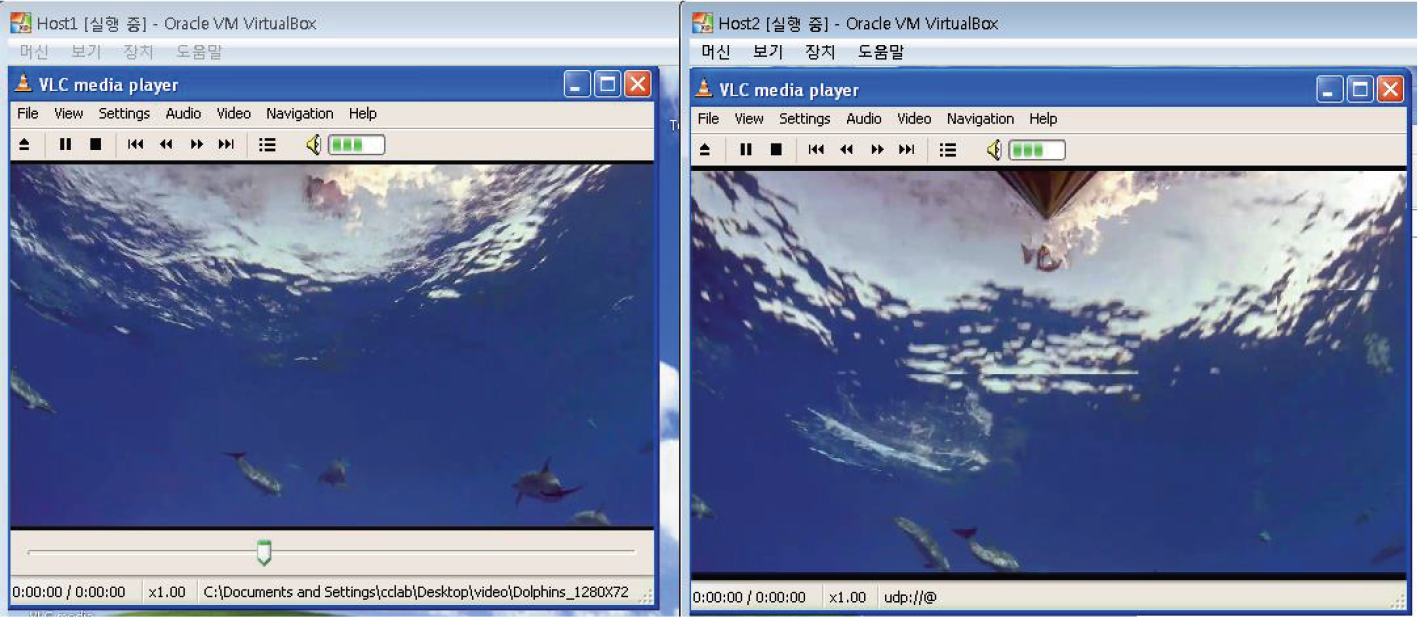
Video quality through OSPF path.
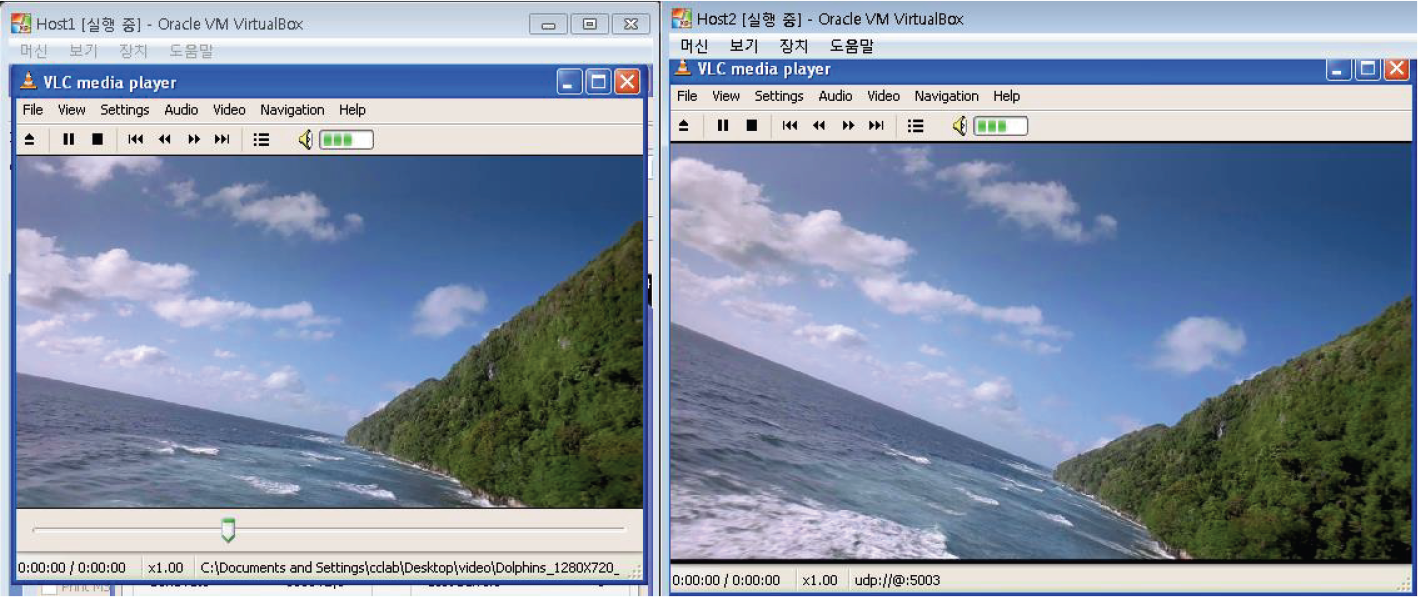
Video quality through QoS-aware path.
We also tested the throughput variation when the path switched from RIP path to QoS-aware routing path. The throughput is significantly increased from around 1.73 Mbps to 3 Mbps, and jitter is reduced from around 6 ms to 1 ms (Figure 8). Consequently, quality of video data transmission through QoS-aware routing path is much better than RIP path and OSPF path.

Path switching from RIP path to QoS-aware path.
4.3.2. Real-Time Audio Data Transmission
Generally, packet size of audio data is small and data rate is much lower than video. Transmission of audio data requires little bandwidth but is sensitive to delay. Therefore, we emulate audio streaming by 100 Kbps UDP traffic with packet size of 300 bytes. Test results in Figure 9 indicate that the average delay is 165 ms for RIP path, 249 ms for OSPF path, and 63 ms for QoS-aware routing path, respectively. According to the definition in Table 1, only the QoS-aware path can satisfy the delay requirement (100 ms).

Delay test for audio data transmission.
4.3.3. File Sharing Data Transmission
File sharing applications have lower priority than other applications. It desires higher bandwidth for fast data transmission. Therefore, the path with highest available bandwidth is usually assigned to those applications. In our scenario, bandwidth of RIP path is 1.8 Mbps, while OSPF path is 10 Mbps. Without regard to other flows, QoS-aware routing path is the same path with OSPF. Test result indicates that when path switching from RIP path to QoS-aware routing path, throughput increases 5.5 times from 1.73 Mbps to 9.64 Mbps as shown in Figure 10. Within 60 seconds, the transmitted data size is 12.4 Mbytes through RIP path, while it is 68.8 Mbytes through QoS-aware routing path.

Performance improvement from RIP path to QoS-aware path.
4.3.4. Summary
Performance evaluation was conducted with implementations of OSPF, RIP, and proposed QoS-aware routing mechanism in a SDN testbed. Experiment results show that QoS-aware routing mechanism increased the throughput by 43% compared to RIP for video data transmission and reduced the delay by 30% and 54% compared to RIP and OSPF for audio data transmission, respectively. QoS-aware routing algorithm has advantages in QoS satisfaction for different types of flows. The advantages are derived from adopting SDN technology, which allows us to decide per-flow routing policy to mostly satisfy the QoS requirements.
5. Conclusion
In today's wireless sensor networks, more and more complex applications are deployed and QoS-sensitive multimedia data is growing in the network. The SDN technology allows us to find the optimal path that can provide per-flow QoS assurance as much as possible. In this paper, we proposed a QoS-aware routing mechanism for OpenFlow-enabled WMSNs, which includes a QoS routing framework and algorithms. The framework, located at the application layer of SDN architecture, is composed of five components: link state detection, flow classification, flow management, QoS-aware routing algorithms, and per-flow routing policy. The routing algorithms seek feasible paths that can satisfy flow's QoS requirements, if they exist. Otherwise, the routing algorithm decides optimal path depending on the flow types: delay-sensitive, bandwidth-sensitive, and best-effort traffic.
We built a SDN overlay network testbed made up of OFNs using Open vSwitch and SDN controller using Ryu controller. A series of experiments were conducted to compare the routing performances for multimedia data transmission. The result shows that the proposed routing algorithm has overall advantage in QoS satisfaction for different types of flows.
This mechanism can be widely applied to WMSN applications, such as telemedicine, intervehicle communications, and environmental monitoring. In the future, we will further investigate introducing other QoS parameters into QoS metrics, such as packet loss, reliability, and node power level. We will also take sensor node mobility into consideration on routing decision.
Footnotes
Competing Interests
The authors declare that there is no conflict of interests regarding the publication of this paper.
Acknowledgments
This work was supported by ICT R&D program of MSIP/IITP, Republic of Korea (no. B0126-16-1078, Creation of PEP based on automatic protocol behavior analysis and Resource management for hyper connected for IoT Services).