




Abstract
Wireless sensor networks (WSNs) have become an important part of our lives as they can be used in vast application areas from disaster relief to health care. As a consequence, the life span and the energy consumption of a WSN have become a challenging research area. According to the existing studies, instead of using direct transmission or multihop routing, clustering can significantly reduce the energy consumption of sensor nodes and can prolong the lifetime of a WSN. In this paper, we propose a low energy fixed clustering algorithm (LEFCA) for WSNs. With LEFCA, the clusters are constructed during the set-up phase. A sensor node which becomes a member of a cluster stays in the same cluster throughout the life span of the network. LEFCA not only improves the lifetime of the network but also decreases the energy dissipation significantly.
1. Introduction
Wireless sensor networks (WSNs) consist of a large number of sensor nodes distributed over a geographical area with predefined positions or random deployment. By sensing the environmental events within their respective ranges sensor nodes collect data of interest and communicate the data through the nodes until the data finally arrives at the base stations (BSs) for final processing. WSNs are used in a vast array of applications which may require fixed monitoring and detection of specific events such as environmental applications, military applications, patient monitoring, disaster relief, smart home, and smart city systems.
A typical wireless sensor node is composed of a sensory unit, a communication unit, a power unit, and a processing unit. The sensory unit has a data acquisition component and ADC. The communication unit has a radio transceiver. The power unit is supported by a battery source and the processing unit performs signal processing tasks. Typically, a WSN node can only be equipped with a limited power source. The node remains active as long as the battery is not dead and hence power saving is usually a crucial criterion in this domain of applications. Energy consumption can occur in sensing, data processing, and communications components. The sensing and data processing components operate at low sequential and consume less than 1 mW of energy. The communication component on the other hand is considered as the most energy consuming activity, as a result it has a significant impact on the network lifetime. Therefore, energy-efficient communication and routing protocols can help an increased network lifetime for WSNs.
Routing protocols for WSNs can be classified into direct communication, multihop routing, and clustering methods.
Each sensor node collects and transmits the data directly to the BS in direct transmission. If the BS is far away from the sensor nodes, the batteries of the nodes will be drained quickly. Thus, direct transmission is not appropriate for WSNs which are deployed over large areas. In multihop routing, several multihop paths are used to satisfy the network connectivity. Each sensor node may deliver its sensed data or forward data collected by other nodes. Nodes closer to the BS consume their energy rapidly as they have more data to process coming from the downstream nodes. Due to the heavy load on the relaying nodes, multihop routing may not be suitable for dense WSNs. In clustering, nodes are arranged into clusters that communicate through a cluster head (CH). The CHs gather data from their associated members, aggregate the data, and transmit them to the BS. By this way, the average transmission distance of the nodes to the BS decreases. The sensed data is received by the BS within just two hops. Thus, clustering provides significant energy savings in WSNs.
Providing energy-efficiency [1–3], increasing lifetime and contributing to green networking solutions [4, 5] for WSNs have become a key research area. To extend the network lifetime, various energy-efficient wireless sensor network protocols and algorithms have been proposed in the literature. Network data processing [6], data fusion [7], and network coding [8] are some of the measures taken to reduce the amount of data processed, sensed, or transmitted. Minimization of energy spent in processing, sensing, and transmission of data allows sensor nodes to save energy. Such energy savings help to extend the lifetime of WSN applications.
Following the above objective, in this paper, we propose low energy fixed clustering algorithm (LEFCA) which uses fixed clustering and threshold based CH selection mechanisms together. With intelligent CH determination, the initial CHs and as a consequence the clusters are formed with the initialization of the algorithm. Under LEFCA, clusters stay fixed for the entire network lifetime and the number of CH changes is minimized by threshold based CH selection. A new CH is not selected until the current CH's energy level falls below a predefined value. By this way, significant gains in energy consumption are observed which also leads to increased lifetime.
The rest of the paper is organized as follows: Section 2 gives a brief information about some of the novel cluster based routing protocols used for WSNs. Section 3 describes our proposed LEFCA protocol in detail. In Section 4, the simulation environment is explained, and the performance of LEFCA is measured and compared with most successful cluster based protocols. The paper ends with the concluding remarks presented in Section 5.
2. Cluster Based Routing Protocols for WSNs
Cluster based routing is the most common way routing for WSNs as clustering results in significant energy savings and lifetime enhancements. This section describes and compares some of the well-known cluster based routing protocols in the literature.
LEACH [9–11] is a simple and efficient round based adaptive routing protocol. Sensor nodes form clusters without any help from an external agent or a node in the network. LEACH divides the time into frames called a round. Every round consists of two phases. In the set-up phase the CHs are elected and clusters are formed. In the steady-state phase, collected data is transmitted to the BS.
The CHs are elected based on a probability function. Each sensor node selects itself to become a CH with a certain probability function. This probability function is designed in such a way that within a specific number of rounds each sensor node becomes a CH only once and the energy consumption is fairly distributed over the entire network. After the election of the CHs, each CH announces its identity to the other nodes and the remaining nodes join the nearest CH to form the clusters. The communication inside a cluster is organized by the TDMA schedule generated by the CH. The CHs send the collected data to the BS and one round is completed. The same process is repeated for every round. To prevent the interference of the transmissions for different clusters, different CDMA codes are used. CHs randomly choose a unique code from a list of spreading codes. The CHs filter incoming signals using this spreading code. Consequently, the radio signals of the neighboring clusters are filtered out hence interference of the transmission of the nodes is minimized.
As CHs are chosen randomly inefficient cluster formation is highly probable with LEACH. Cluster topologies and CHs change at every round with the cost of extra overhead and energy dissipation. Thus, numerous LEACH variants have been proposed in the literature. Many of these LEACH variants aim to change the CH selection process to obtain energy-efficiency. CH selection is managed adaptively according to the energy reserve of local active nodes in [12]. Time based CH selection for LEACH (TB-LEACH) [13] modifies the CH election process to form uniform cluster pieces. In advanced LEACH (ALEACH) [14] the most energy-efficient nodes are selected as CHs. Stable Cluster Head Election (SCHE) [15] calculates the optimal probability value for the sensor nodes to become a CH. Leader Election with Load Balancing Energy (LELE) [16] compares the remaining energy and distance of a node with its neighbors to determine it as a CH. Optimal CH selection algorithm which does not need to know the location information of the nodes is developed in [17].
The number of clusters formed in each round of LEACH can change due to the probabilistic CH selection process. Some rounds can even result with no CH selection and no data collection. To solve the variability of the number of CHs, Two-Step Cluster Head Selection (TSCHS) [18] uses two stages: temporary CH election stage and optimal CH election stage realized by using the current energy and distances to the BS of the temporary CHs to select CHs.
Another approach to solve the variance in the cluster numbers is to fix the number of clusters [10, 19, 20]. With LEACH Fixed Clustering (LEACH-F) [10], once the clusters are formed, there is no need to initiate the set-up phase repeatedly for the subsequent rounds. The clusters are created once and fixed by using a centralized cluster formation algorithm. The CH role is rotated between the nodes belonging to a cluster. During the set-up phase, each node sends information about its location and energy level to the BS. Then the BS computes the average node energy based on this information. The nodes which have energy below this average value cannot become CHs for the current round. The top “k” nodes with the highest energy levels are determined to become CHs for the next round. When the optimal CHs and associated clusters are found, the BS sends a message back to all the nodes in the network. This message contains the CH ID for each node. If ID of a node matches this CH ID, the CH role is taken by that node. The CH selection is realized in order according to the CH ID list. The first node listed in the cluster undertakes the CH role for the first round; the second node listed in that cluster list becomes CH for the second round. Thus, the nodes are aware of when they are CHs and when they are not. The steady-state phase of LEACH-F is the same as that in LEACH. LEACH-IMP [19] uses constant CHs instead of rotation of CHs as in LEACH. Proposed protocol works generally in two phases. In the first phase, the nodes are homogenized according to divided grids. In the second phase, for each divided region, one CH is selected according to its optimal position in the cluster. This algorithm uses position information; thus it can consume additional energy to overcome this determination. However, the homogeneous distribution provides more energy savings than LEACH. Reference [20] also presents dynamic round time based fixed LEACH (LEACH-F) in which round time is designated based on the current energy levels of the nodes. The results demonstrate that dynamic round time based LEACH-F provides improvement over energy and network lifetime enhancement when compared with LEACH.
Modified LEACH (ModLEACH) [21] includes an efficient CH replacement scheme and dual transmitting power levels. Multipower levels are used to reduce the packet drop ratio, collisions, and interference from other signals. When a node becomes a CH, the routing protocol in ModLEACH informs it to use high power amplification and when a node becomes a regular cluster member, the mode of that node becomes low level power amplification mode. Threshold based CH changing mechanism is used in ModLEACH to provide more efficient CH replacement. If the energy of the existing CH is higher than the threshold it continues to act as a CH if not a new CH for that cluster is elected and the cluster is formed again. ModLEACH outperforms LEACH in terms of network lifetime and CH formation.
While many homogeneous LEACH variants have been developed as described above, there are also heterogeneous cluster based WSN routing protocols. Stable Election Protocol (SEP) [22] is a successful protocol for WSNs and contains advanced nodes which are fitted with extra energy resources. SEP uses a weighted election probability based approach to determine CHs according to the residual energy of each node. In SEP, m corresponds to fraction of the advanced nodes which are fitted with a times more energy than the normal nodes. As a consequence, the total initial energy of the WSN is increased by
DEEC [23] is another heterogeneous and distributed clustering protocol where the CHs are selected by a probability based on the ratio between residual energy of each node and the average energy of the network. The nodes which have high residual energy are more probable to become CHs. The epoch denoted by
3. Low Energy Fixed Clustering Algorithm (LEFCA)
Our proposed LEFCA algorithm uses the clustering approach mentioned in the previous sections by partitioning the nodes into clusters. However, in our approach clusters remain fixed throughout the entire lifespan of the WSN. In this manner, significant energy savings can be achieved. For each cluster, a CH is responsible for collecting and delivering the sensed data to the BS.
The operation of LEFCA starts with intelligent CH determination mechanism performed by the BS. When the CHs are determined, the set-up phase of LEFCA in which the clusters are formed can start. In the steady-state phase of LEFCA, data transmission starts. Finally, in CH decision phase, the CH changing mechanism is realized if needed. The following subsections describe the operation of the LEFCA algorithm.
3.1. Set-Up Phase
After the deployment of the sensors, the LEFCA algorithm initiates with the set-up phase. The steps of the set-up phase are illustrated in Figure 1. Some of the deployed sensor nodes are selected as CHs via the BS. A CH node is responsible for setting up the cluster by broadcasting its identity so that neighbor nodes join its cluster. When the members of a cluster are determined, the CH sets up and announces the TDMA schedule for the member nodes which denotes the corresponding time frames of data transmission for the cluster members. This phase starts with intelligent CH selection mechanism.

The set-up phase for LEFCA algorithm.
3.1.1. CH Selection Phase
Instead of selecting the CHs randomly, the intelligent CH determination mechanism is developed for LEFCA. Random selection of CH nodes provides each node to have equal chance to become a CH at the beginning of each round. This mechanism reduces network costs because there is no need to use transmission of position information to the BS. On the other hand, it may lead to some critical problems. CHs may be distributed unevenly throughout the network. Remote nodes can be selected as CHs resulting in significant energy dissipation and a shorter lifetime.
To annihilate these deficiencies, the intelligent CH selection mechanism is developed for LEFCA. In intelligent CH selection mechanism, the BS broadcasts a position information request message to the WSN. When sensor nodes receive this message, each sensor node sends its position information to the BS. The transmission of the position information causes energy consumption by the nodes; however it is realized only once as the clusters are fixed. After the transmission of the position information, the BS selects the CHs located at the center of each cluster. The number of clusters is determined according to the optimum cluster number for a WSN.
3.1.2. Cluster Formation Phase
Each node which has elected itself as a CH needs to notify the remaining nodes about the selection and later form the clusters for LEFCA algorithm. Once the nodes in LEFCA are elected to be CHs by BS, they will notify all other nodes in the network that they have been elected for this role. To do this, each CH node broadcasts an advertisement message (ADV) shown in ADV Message Structure of LEFCA of Section 3.1.2, using a nonpersistent carrier sense multiple access (CSMA) MAC protocol [24]. In nonpersistent carrier sense multiple access (CSMA) MAC protocol, a node does not listen to the channel all the time while it is busy. After sensing a busy channel, the node waits a randomly selected interval of time before sensing again. When the timer runs out, the node again senses the channel. The node resets the timer if it is still busy; otherwise the node transmits the packet. The advertisement message contains the ID of the CH and a header that recognizes this message as an announcement message. To ensure that all nodes receive the advertisement message, these messages are broadcasted into the whole network by the CHs. Each non-CH node decides to which cluster it belongs by selecting the CH that needs the minimum communication energy, based on the received signal strength of the advertisement message from each CH. Symmetric propagation channels for pure signal strength are assumed as the pure signal strength attenuation of a message sent from a transmitter to a receiver will be the same as the attenuation of a message from the receiver to the transmitter. The traversing of the same path for both cases by electromagnetic wave provides symmetric propagation. This symmetric propagation provides nodes for hearing the CH advertisement with the largest signal strength; thus if they select the largest signal it means that minimum amount of transmitted energy is needed for communication.

After the members choose their clusters, these members must inform their associated CHs about their selection. Each node in a cluster sends a join-request message (Join-REQ) to the selected CH using again a nonpersistent CSMA MAC protocol. This message contains the ID of the member node, the ID of the associated CH, and a header. The structure of this message is given in Join-REQ Message Structure of LEFCA of Section 3.1.2. Note that the length of these messages is fixed, and contrary to LEACH and LEACH based protocols, the transmission of these messages is realized only once in LEFCA because it uses fixed predefined clustering approach throughout all rounds instead of changing clusters for each round.
Join-REQ Message Structure of LEFCA

In LEFCA, once the clusters are formed, the CHs broadcast a TDMA schedule within its own cluster which includes allocated time slots (TSs) for each cluster member to transmit data. Also in each cluster, one extra TS is assigned for existing CH to transmit collected data from members to the BS. The length of the frame is determined according to the number of nodes
Time Slot Assignment for Cluster Members in LEFCA Cluster

The TDMA schedule allocates specific time intervals for each of the cluster members to transmit their collected data to their CHs in LEFCA. TDMA schedule not only prevents the collisions among data messages but also enables the radio components of each regular node to put to sleep mode at all times except during their transmit time, thus providing energy savings.
After the reception of the TDMA schedule by the cluster member nodes, the set-up phase is completed and data transmission with steady-state phase is ready to start. Figure 2 shows an example of randomly deployed sensor nodes in a WSN and Figure 3 shows an example illustration of the clusters formed after the LEFCA set-up phase.

The randomly deployed sensor nodes in a WSN.

The cluster formation and CHs after the set-up phase.
3.2. Steady-State Phase
The main objective of the steady-state phase is to transmit the collected data to the base station through the CHs and to determine whether a CH change needs to be made. Figure 4 shows a typical round for the LEFCA algorithm with its two subphases: data transmission and CH change decision.

The LEFCA round. Data transfers and changing of CHs if needed occur during the steady-state phase.
3.2.1. Data Transmission Phase
This phase is divided into slots allocated for each of the cluster members, where the member nodes transmit their data to the CH. The duration for each slot is fixed; thus the time to transmit data hinges on the number of member nodes in the cluster. When the data collection from the cluster members is complete, the CH transmits collected data to the base station.
Transmission in one cluster can affect communication in a nearby cluster. To reduce intercluster interference, each cluster in LEFCA communicates by the help of these unique spreading codes. Within a cluster, every node uses a common transmitting code so that there is no intercluster collision in transmitter-based code assignment mechanism. If two nodes in a cluster are not transmitting simultaneously, there will be also no intracluster collision. From the predefined list, the CHs obtain these codes according to their advertisement order and they use these codes within their clusters. When transmitted data from associated members are reached to the CH, CH filters all received energy using this spreading code. Combining DS-SS with a TDMA schedule in LEFCA decreases intercluster interference while eliminating intracluster interference.
Note that CH transmits the collected data from its associated members using a fixed spreading code and a CSMA structure. CH listens to the channel to hear if anyone else is sending data to the BS using the BS spreading code, if not CH transmits the data to the BS using the BS spreading code. Otherwise, CH waits to send the data to the BS.
3.2.2. CH Change Decision Phase
The LEFCA algorithm uses fixed clusters; thus a sensor node which becomes a member of a cluster during the set-up phase stays as a member of the same cluster for the entire lifetime of the sensor network. However, the CHs may change at the beginning of a new LEFCA round.
When data transmission phase of a round is complete, the CH needs to decide whether it will continue to act as a CH for the next round or choose a new CH. This decision is made based on the CH's remaining energy. If the CH's remaining energy is above a predefined threshold value (ThV), it continues to act as the CH for the next round and notifies the cluster members by specifying its CH ID. If on the other hand the CH's remaining energy is below the ThV, the current CH selects a new cluster head which will become the new CH in the next round and notifies the cluster members by specifying the new CH's ID. If a new CH needs to be elected the current CH chooses the new one randomly among the alive members of its cluster. Figure 5 illustrates the CH change mechanism in LEFCA while keeping the clusters fixed.

CH changes in LEFCA.
Determination of (ThV) is an important step for LEFCA because the ThV has a significant impact on the network lifetime. If the ThV is very small, the CH might die during a round resulting in network disconnectivity. If the ThV is large, the algorithm might select a new CH for every round resulting in larger network and set-up costs. ThV is selected to be equal to initial energy of a node, the CHs will change, at every round, and LEFCA will behave like the LEACH protocol.
To reduce the networking and clustering costs seen with traditional LEACH, the ThV should be determined in such a way that the CH should be alive at the end of the round to keep network connectivity. Equation (1) can be used to determine the minimum ThV which assures certain network connectivity. The energy dissipated in the CH node during a single frame is


Outside BS situation.
The value of
For example, assume that the farthest node to the BS has the coordinates of 
To determine the ThV, it is assumed that only one cluster is formed and the
For experiments in LEFCA,
When these values are placed into (1),

According to result in (5), if remaining energy of any CH node in the system is greater than 0.0052 it can survive certainly for a round. Thus, to provide connectivity between any CH with BS, the ThV should be chosen greater than this value; thus it is determined as 0.05 J. Table 1 shows the ThVs for various networks with different number of nodes, BS locations.
Determination of ThV.

Note that, in a typical round, a CH node will consume significantly more energy than the regular nodes and the basic motivation behind LEFCA algorithm is to abuse the CH node by keeping it as a CH as much as possible while trying to keep the regular nodes' energy at a maximum. This type of CH changing mechanism provides substantial energy savings, as new cluster topologies are not formed for every round. There is no need to use advertisement, join request, and TDMA schedule messages for each round as the clusters are fixed.
4. Simulation and Performance Analysis of LEFCA
In order to measure the performance of LEFCA, an extensive set of simulations are conducted in an area of 100 × 100 meters with 100 randomly deployed sensors. The base station is located outside the sensor field at coordinates (150,50). Each simulation is repeated 100 times with different sensor deployments and unless otherwise stated the average performance measures are presented.
A simple model for the radio hardware energy consumption is used to run the simulations. The transmitting nodes dissipate energy to run the radio electronics and the power amplifier. The receiving nodes consume energy to run the radio electronics. Depending on the distance between a transmitter and a receiver, cross-over distance
Thus, to transmit l-bit message through a distance d the radio expends


The transceiver energy
Simulation environment parameters.
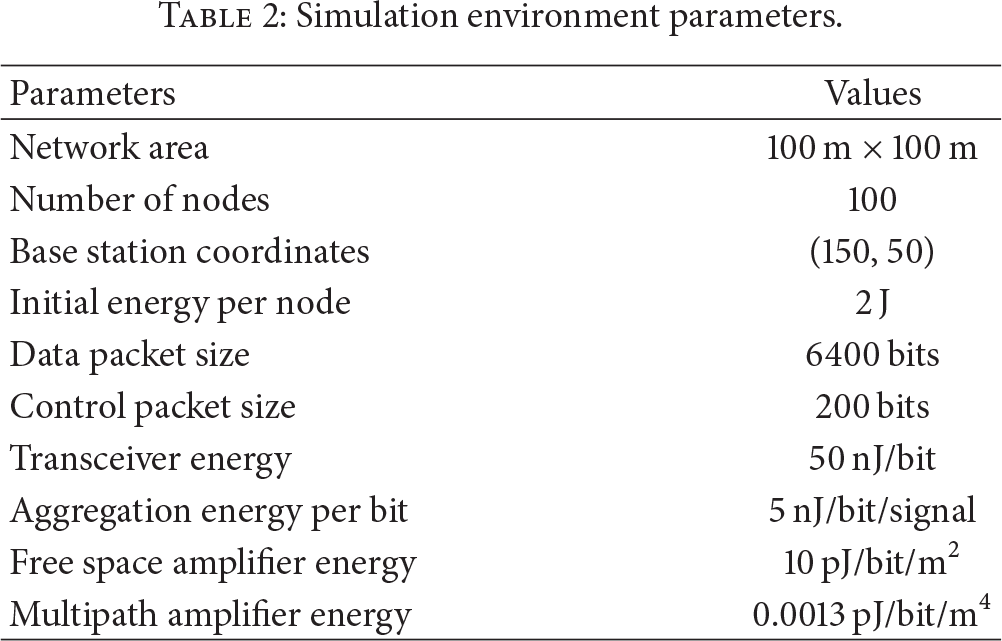
In the simulations, the impact of the random and intelligent CH selection mechanisms and the ThV on the performance of LEFCA is observed. The energy map of the network is studied for a sample topology to understand how the CH abusement effects the energy distribution in the network. To compare LEFCA's performance with other important algorithms, LEACH and its two successful variants (LEACH-F and ModLEACH) are chosen. In addition to LEACH variants, LEFCA is compared with two novel heterogenous algorithms SEP and DEEC. The comparisons are made in terms of residual energy, number of alive nodes, and network lifetime.
4.1. Cluster Topologies with Intelligent CH Selection
Since the clusters will remain fixed throughout the entire WSN lifetime, the initial cluster topologies are very important. Figures 7, 8, 9, and 10 show the cluster topologies based on intelligent CH selection mechanism of LEFCA for 5, 6, 9, and 10 clusters, respectively. Depending on the desired number of clusters LEFCA selects the sensor nodes which are closest to the center of each cluster as the CHs. For example, if the desired number of clusters is 6, the network is divided into 6 pieces and the nodes at the center (or closest to the center) of each piece become the CHs. The remaining nodes join to a CH which is nearest to their positions and the cluster topologies are formed.

WSN for 5 clusters.

WSN for 6 clusters.
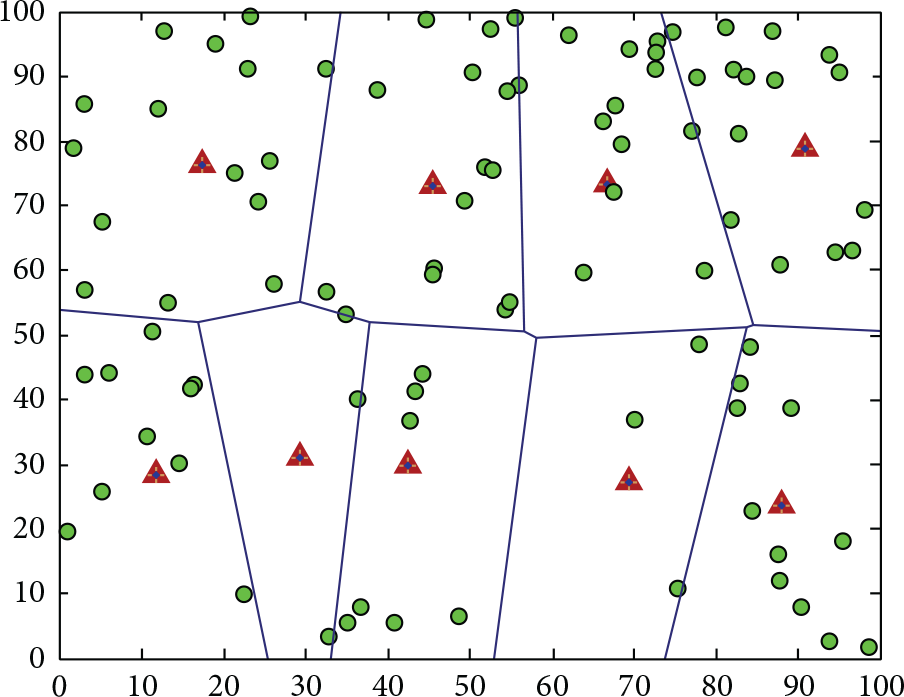
WSN for 9 clusters.

WSN for 10 clusters.
4.2. Comparison of Random and Intelligent CH Selection Mechanisms of LEFCA
In this part, LEFCA is analyzed for its lifetime when CHs are selected based on the intelligent CH selection mechanism or randomly. For each value of the number of clusters, the average and 95% confidence interval values of lifetime are obtained for 100 iterations of a sensor network with 100 nodes.
As can be seen from Figure 11, the average lifetime of the WSN increases significantly with the intelligent CH selection. The difference increases as the number of clusters increases. For example, for a network with 10 clusters, the lifetime gain is approximately 800 rounds. Thus, intelligent CH selection outperforms traditional random CH selection method for lifetime and energy-efficiency.

Comparison lifetime performance of random and intelligent CH selection of LEFCA in terms of number of clusters.
4.3. Impact of ThV in Network Lifetime
Figure 12 compares the performance of LEACH and LEFCA for different ThVs by illustrating the number of dead nodes versus round number. From this figure, it can be observed that as the ThV increases the network lifetime decreases. A lower ThV also results in an earlier first node death as LEFCA abuses the CHs before selecting a new CH. However, the lifetime gain for any ThV is very significant.

Number of dead nodes according to the different ThVs.
Note that the lifetime of LEACH for the same network is approximately 3200 rounds and a significant improvement for network lifetime is achieved with LEFCA.
4.4. Energy Map of the Network
The energy consumption for the individual nodes under LEFCA and LEACH protocols is analyzed through simulation studies in order to understand the energy dissipation of the entire network. The average lifetime of the LEACH protocol is approximately 3500 rounds for a network consisting of 100 nodes which is obtained from simulations as shown in Table 3.
Network lifetime comparison.
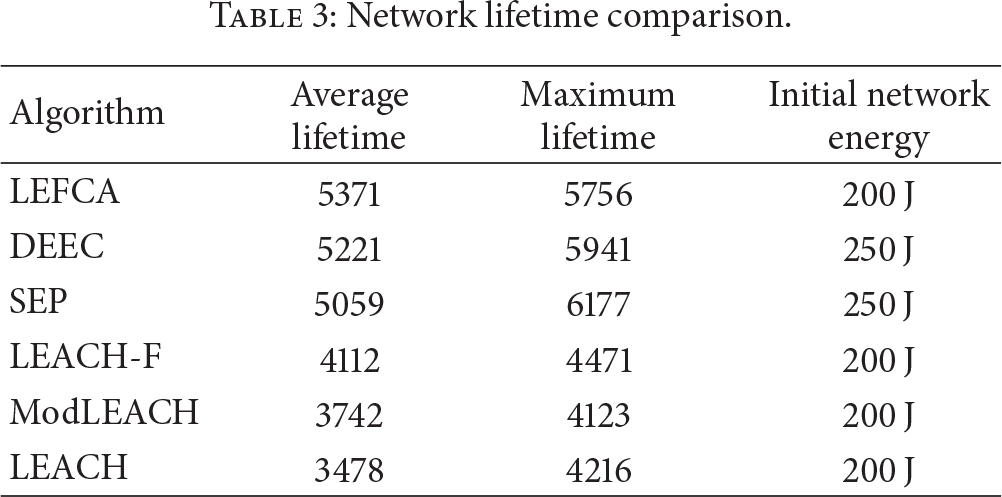
Figure 13 shows the energy map of the LEACH protocol at round number 3500. At this round, approximately half of the nodes are dead and very few nodes closer to the BS have a very small amount of remaining energy in the order of

Energy map of LEACH at round 3500.

Energy map of LEFCA at round 3500.
Figure 15 shows the energy map of LEFCA at round 4600. While the network is completely dead for the LEACH protocol at this round, LEFCA can still gather data from WSN. Contrary to LEACH protocol at round 3500, the alive nodes are distributed across the entire network, giving a possibility to reach even the furthest clusters. By design, the LEACH protocol forms clusters for every round which brings excessive network costs, overhead, and energy consumption. With LEACH, the nodes which are farthest to the BS die first and hence equal load and energy distribution cannot be obtained once there are dead nodes in the network. Collecting information from remote clusters of the WSN becomes increasingly impossible as the network grows old. On the other hand, LEFCA tries to maintain full network connectivity when compared with LEACH. LEFCA abuses the energy of the CHs until their residual energy falls down the ThV. When a new CH change is needed, the CH is randomly chosen from the members of the same cluster. The CH change mechanism of LEFCA also decreases the number of CH changes in WSN. With less number of CH changes, the additional network traffic and overhead are reduced and energy-efficiency can be maintained. Because of these reasons, LEFCA not only improves the network lifetime but also makes it possible to collect data from the entire network topology at all times.

Energy map of LEFCA at round 4600.
4.5. Residual Energy
The energy consumption rate in a WSN can vary significantly with the employed routing algorithm and directly impacts the lifetime of the WSN. Figure 16 compares the total residual energy of LEFCA with LEACH, LEACH-F, ModLEACH, DEEC, and SEP. While LEFCA, LEACH, LEACH-F, and ModLEACH use homogeneous networks where all the nodes are identical with the same initial energy, SEP and DEEC use heterogeneous networks where some of the nodes have more initial energy compared to the rest of the nodes. Thus, the total initial energy of the WSN with SEP and DEEC is 250 J while for the other algorithms it is 200 J.

Round number versus residual energy.
It is observed that the energy consumption rate of LEFCA is the lowest among all compared algorithms. The fixed clustering approach complemented with full utilization of the CHs results in fewer number of CH changes and provides a conservative energy consumption for LEFCA. For example, after 2000 rounds LEACH holds 15% of its initial total energy, while LEFCA holds approximately 50% of its initial total energy. When the entire energy of the network is spent under LEACH, LEFCA still maintains 20% of its total initial energy. Although SEP and DEEC start with 25% more initial energy, LEFCA's conservative energy consumption yields in a better residual energy after round 800 for DEEC and round 1950 for SEP. Thus, LEFCA is an energy-efficient algorithm.
4.6. Number of Alive Nodes
Clustering is a fundamental way for extending the lifetime of a WSN. In Figure 17, various cluster based routing algorithms are compared based on the number of alive nodes. The lifetimes are measured when all the algorithms start with an initial number of 100 alive nodes.

Round number versus number of alive nodes.
When compared with LEACH, a 57% improvement in the network lifetime can be observed under LEFCA. While LEACH lasts for 3237 rounds, LEFCA lasts for 5659 rounds. Not only does LEFCA have a longer lifetime than LEACH and its variants (LEACH-F and ModLEACH) but also a comparison with SEP and DEEC (both have 25% more initial network energy) yields a longer lifetime for LEFCA. Node deaths start earlier under LEFCA, but the rate of node deaths is much lower than all the algorithms compared. While trying to transmit the collected information through abused CHs, infrequent CH changes keep remaining nodes' energy levels as high as possible under LEFCA and node deaths are distributed almost evenly for the network lifetime. For LEACH based protocols and SEP, following the first node death, the remaining node deaths occur quickly. As a consequence, a longer lifetime is achieved under LEFCA.
4.7. Network Lifetime
For each algorithm, the simulations are repeated 100 times for different topologies and the maximum and average observed lifetimes are presented in Table 3 as well as the initial network energies. LEFCA's conservative energy consumption ratio increases the lifetime of a WSN significantly. LEFCA outperforms LEACH and its variants. When LEFCA is compared with novel routing algorithms such as SEP and DEEC, extended lifetimes are also observed although LEFCA starts with lower initial energy.
5. Conclusions and Future Work
In this paper, a fixed clustering based routing protocol (LEFCA) for WSNs is proposed. In the past decade, the exponential growth of the ICT led to research for green networking to provide energy-efficient solutions at all layers of the Internet protocol stack. For WSNs, an energy-efficient routing protocol can increase the lifetime of the network. LEFCA achieves this objective through fixed number of clusters and reduced number of CH changes. For the LEACH algorithm and most of its variants, the clusters and CHs change at every round resulting in an excessive amount of energy consumption. On the other hand, LEFCA keeps the same cluster topology formed at the start of the network for the entire lifetime and minimizes CH changes with a threshold based CH change mechanism. By this way, LEFCA spends the network energy in a conservative manner and increases the network lifetime. When the performance of LEFCA is compared with traditional and novel routing algorithms, significant gains are observed in terms of energy usage and lifetime.
Due to the distance factor, the clusters that are farthest from the base station tend to consume more energy under LEFCA. The first nodes that die in the network are usually the members of far clusters. Further improvement in the performance of LEFCA can be obtained by placing relay nodes and transmitting the collected data through the relay nodes in a multihop communication method. By this way, the lifetime of far nodes can be extended.
Under LEFCA, the initial CHs are selected in an intelligent way to form the clusters. However, the subsequent CH changes are made randomly. Instead of picking up a random cluster member to become the next CH, the nearest member or the member with the maximum remaining energy can be chosen. This approach also has a further potential improvement for the performance of LEFCA.
Footnotes
Competing Interests
The authors declare that they have no competing interests.